Abstract—Mechanical properties at elevated temperatures of as-cast and extruded AA6063 aluminum alloy reinforced with SiCparticles (SiCp) were studied. Hot extrusion was carried out
with reduction in area of 25% on the as cast composites which were prepared by the vortex method. Tensile tests carried out at room temperature showed that for the as-cast composites, the addition of SiCp up to 10% by weight improves the strength but
reduces ductility . Further addition of SiCp reduces both the
strength and the ductility of the composites. At 150 and 300 oC the matrix alloy exhibits higher strength than the composites, but the extruded composites have better strength than as-cast composites. Time rupture creep tests carried out at 300 oC showed that the composites exhibits higher creep resistance as compared to the matrix alloy except at relatively low stresses where the matrix has a better creep resistance.
Index Terms—Mechanical Properties, Creep, Metal Matrix Composites, Extrusion.
I. INTRODUCTION
Aluminum alloys reinforced with particulates are more attractive than traditional aluminum alloys for applications requiring higher stiffness and strength [1,2]. Reinforcement by particles or short fibers of SiC has proved to be especially advantageous since it offers composite materials having virtually isotropic properties at low cost. Recently, there has been a growing interest in using metal matrix composites for high temperature applications, especially under creep conditions, in aircraft and automobile engines technologies.
Although many studies have been devoted to the characterization of the room-temperature mechanical behaviour of aluminum metal matrix composites, only limited high temperature data are available [3-7]. The influence of addition of ceramic particles to aluminum alloys on the elevated temperature strength is difficult to predict. For example, Nieh et al. have studied the tensile properties of composites reinforced with SiC particles over a range of temperatures from room temperature up to 400 oC [6]. They showed that the composites exhibits better mechanical strength up to 150 oC as compared to the unreinforced alloy, but at higher temperatures the mechanical properties of the composites is almost the same as the material without SiC particles addition. Luster et al. [4] showed that there is no beneficial strengthening at elevated temperatures of Al2O3
Manuscript received February 11, 2009.
Tarek. A. Khalifa is a Professor at Mechanical Engineering Department, Shoubra Faculty of Engineering, Benha University, Cairo, Egypt. (Phone: 002-010-1343329; fax:002-02-22023336; e-mail: tkhalifa50@ yahoo.com). Tamer. S. Mahmoud is an Assistant Professor at Mechanical Engineering Department, Shoubra Faculty of Engineering, Benha University, Cairo, Egypt. (Phone: 002-018-3657294; fax: 002-02-22023336; e-mail: tsamir@ Benha-univ.edu.eg).
reinforced 6061Al composites, but the strength was actually reduced in comparison with the unreinforced alloy. Several studies [8-11] have shown that particle reinforcement improves the creep resistance of aluminum alloys. In the range 150 to 250 oC, the creep behaviour of particle reinforced aluminum alloys is dependent on the matrix strength and matrix strengthening mechanisms. In matrices with strong and stable microstructures; precipitation strengthened or solution strengthened, only modest creep strengthening from the addition of reinforcement is observed. In weak matrices such as pure aluminum, the presence of reinforcing particles alters the matrix dislocation structure during creep, resulting in significant matrix strengthening.
Stir casting route is the most promising one for synthesizing discontinuous reinforcement dispersed aluminum alloy matrix composites because of its relative simplicity and easy adaptability with all shape casting processes [12]. The composites produced by stir casting have many defects such as particles clustering and high porosity content, which have a deleterious effect on the mechanical properties [13-14]. These defects can be altered by mechanical working of the composites such as extrusion or rolling [15]. Mechanical working of monolithic alloy, usually carried out above the recrystallization temperature, not only deforms the alloy into the desired shapes and sizes but also refines the microstructure and reduces the porosity content, which in turn improves the mechanical properties. However, this is not completely true in the case of composite materials due to incompatible deformation characteristics of the matrix and the ceramic reinforcement particles. This incompatibility leads to changes in the optimum processing conditions.
The objective of the present work is to study the effect of extrusion on elevated temperatures tensile and creep behaviour of aluminum metal matrix composites produced by the vortex method .
II. EXPERIMENTAL PROCEDURES
The aluminum alloy used as the matrix was 6063 having the composition given in Table 1. The composites were prepared by the vortex method. SiC ceramic particles (SiCp) having a size range of 30 to 150 μm and an average size of 60 μm were used for reinforcement. The matrix was reinforced with 5, 10, and 15 % wt of SiCp.
The vortex method involved melting the matrix by heating it to a temperature of 710 oC in an electric resistance furnace. After the aluminum was melted, it was degassed with dry nitrogen gas to minimize the oxidation of the molten metals. A simple steel stirrer attached to a variable speed motor was used to stir the melt. The stirring speed was 750 rpm and the stirring time was about 10-15 minutes. Before introducing the ceramic particles to the melt, they were properly preheated to a temperature of 300 oC for 2 hours. After the
Elevated Temperature Mechanical Properties of
Al Alloy AA6063/SiC
p
MMCs
stirring process was completed, the crucible was taken from the furnace and the composite was poured into a metallic mold. After the as-cast composites were prepared, they were cut and machined into round bars having a diameter of 17 mm for extrusion. Extrusion was carried out on the as-cast composites with a reduction ratio of 25% in area. The billet was heated to a temperature of 500 oC for half an hour before the composite was extruded. Both as-cast and extruded composites were solution heat treated at 530+3 oC for three hours and then quenched in cold water. After cooling, specimens were cut and artificially aged at 175+1 oC to determine the peak hardness level attainable during age hardening and the time required for achieving such a hardness level. Vickers hardness test measurements were carried out using a load of 10 kg.
Table 1. Chemical composition of AA6063 matrix alloy Si Fe Cu Mg Ti Al 0.38 0.15 0.007 0.46 0.11 Balance Tensile and creep tests were carried out to determine the effect of adding SiCp with different weight percentages and the effect of deformation on the mechanical properties of AA6063 after heat treatment. Tensile tests were done at room temperature, 150, and 300 oC. Tensile specimens were prepared from the as-cast and the extruded composites. Tensile specimens having a diameter of 3 mm and a gauge length of 16 mm were machined longitudinally from the extruded billets. Tests were done using an Avery-Dennison universal testing machine with a load capacity of 100 KN and a gripping device for threaded-end specimen according to ASTM standard A 370-74 G 25. For each condition, three specimens were tested. After each test, the ultimate tensile strength (σUTS), the 0.2% offset yield strength (σYS), and the ductility δ% (measured by % elongation) were calculated.
[image:2.595.52.288.627.710.2]Conventional high temperature creep rupture tests were carried out at 300 oC, in which a single tensile load is applied in a continuous fashion throughout each test until rupture occurs. The temperature was measured with three thermocouples at the top, middle and bottom of the specimens and the difference between the three thermocouples readings were not allowed to exceed + 3 oC. The strain was measured using an extensometer having a range +2 mm. Three different stress levels were used in the creep tests which are 10, 20, and 40 MPa. The rupture time was recorded and the rupture ductility was calculated. Fig. 1 shows the dimensions of the creep specimen used in the present investigation.
Fig.1. The Creep specimen
The microstructure of each tested condition was examined in both longitudinal and transverse directions of extrusion using optical microscopy. The actual volume fraction of particles was determined using quantitative metallographic techniques. Particle agglomeration was measured using line
intercept method. The porosity of the composites was measured using the typical Archimedes (water displacement) method. Scanning electron microscopy (SEM) was used to study the fracture surfaces after tensile and creep tests.
III. RESULTS AND DISCUSSION
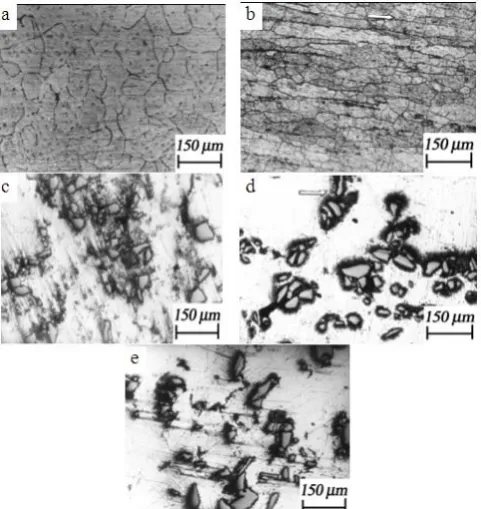
Examination of microstructure showed that the matrix grain size of the as-cast AA6063 was in the range of 120 to 170 μm with an average value of 145 μm, while, the grain size of the extruded alloy ranged from 50 to 100 μm with average value of 75 μm this is clearly noticed in Fig. 2a,b. The most apparent difference in metallographic features between the as-cast and extruded composites is that SiCparticles, are present as banded clusters in the as-cast composites, and become more uniformly distributed in the extruded composites in both longitudinal and transverse directions as shown in Fig. 2 (c, d and e).
Fig.2. Effect of extrusion on the microstructure of composites and matrix alloy (a) as-cast matrix (b) extruded matrix (c) as-cast 15%wt SiCp composite (d) extruded 15%wt SiCp composite – longitudinal direction (the arrow indicates the extrusion direction) (e) extruded 15%wt SiCp composite – transverse direction.
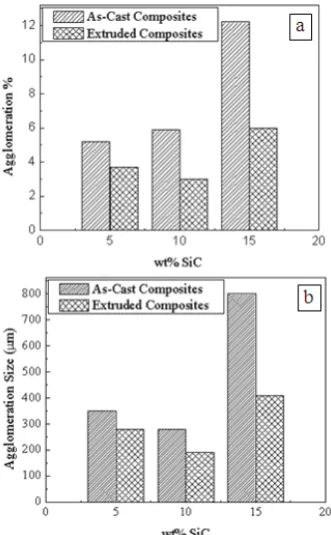
Particle agglomeration was measured as volume fraction using line intercept method. Fig. 3 shows the volume fraction of agglomeration and agglomeration size versus the weight % of SiCp for the as-cast and extruded composites. For the as-cast composites the agglomeration volume fraction increased with increasing weight % of SiCp as shown in Fig. 3a. Also, Fig. 3b shows that the extruded composites have reduced agglomeration size when compared to the as-cast composites. This may be due to the shear flow of the aluminum matrix and grain splitting phenomena, which is found to be more extensive in the composites as compared with the unreinforced matrix [9].
show that with increasing the weight percentage of SiCp, the porosity of the composites increases. This may be due to the increase of stirring time required to disperse the SiCp which increases the air bubbles entering the slurry [12]. The extruded composites exhibit a lower porosity content as compared with the as-cast samples, this is due to the compressive strains involved in the extrusion process.
[image:3.595.86.252.147.415.2]Fig.3. Effect of extrusion on (a) the agglomeration % and (b) the agglomeration size for composites with different weight percentages of SiCp.
Fig.4. A plot showing the variation of voids % for both extruded and as-cast composites with various weight percentages of SiCp.
Figure 5 shows the age hardening curves for the as-cast and extruded composites. It was found that in all conditions, the addition of SiCp to the matrix reduces the time required to reach the peak hardness as compared to the matrix alloy (3-6 hours for composites and 8-9 hours for matrix alloy). Also, increasing the weight % of SiCp reduces the time required to reach the peak hardness. Both as-cast and extruded composites showed the same aging behaviour. It was found that addition of SiCp to the matrix alloy increased the hardness and this increase was maintained during the
different stages of artificial aging. The highest hardness value of 69 VHN was observed for the as-cast composites having 15% wt SiCp. The accelerated aging behaviour observed in the present investigation may be a result of an increased dislocation density in the vicinity of SiCp, which is due to a large difference in the coefficient of thermal expansion between SiCp and the matrix. The higher dislocation density can both aid the diffusion of solute atoms and serve as nucleation sites, thereby leading to a more rapid precipitation process [16-17].
Fig.5. Aging curves for composites (as-cast and extruded). Figure 6 shows the tensile properties of the matrix alloy and the composites (as-cast and extruded) at ambient, 150 and 300 oC. The room temperature tensile test results show that for the as-cast composites there is a slight increase in tensile strength with increasing the wt % of SiCp up to a value of about 10%. Further increase in wt % of SiCp resulted in a decrease in tensile strength. A similar trend is observed for the extruded composites. This may be due to the high porosity content, and clustering of particles in the composites. The 0.2 % offset yield strength of the as-cast composites showed a more pronounced increase with increasing weight percent of SiCp up to a value of 10% which is again followed by a noticeable decrease with further increase of the weight percent of SiCp to a value of 15 %. The values of the 0.2 % offset yield strength of the extruded composites followed a similar trend showing a less pronounced increase with addition of SiCp. The extruded composites were generally stronger than the as-cast composites.
The tensile tests carried out at 150 oC showed that, for the as-cast conditions, increasing the wt % of SiCp reduced both the tensile strength and 0.2 % offset yield strength as compared to the unreinforced alloy. For extruded conditions the ultimate tensile strength (UTS) increased with addition of SiCp up to 10 wt %. Further increase in wt % of SiCp is accompanied by a decrease in strength. The values of the 0.2 % offset yield strength followed a similar trend but with the peak value occurring at 5% wt of SiCp. The tensile tests carried out at 300 oC indicated that the addition of SiC
p to the matrix decreases both the tensile strength and the 0.2 % offset yield strength. Generally, extrusion raised the strength. Increasing the weight % of SiCp causes a slight reduction in the tensile strength of the extruded conditions. A similar trend was observed for values of the 0.2 % offset yield strength. The reduction in strength of the composites may be due to that at 300 oC the primary MgSi
[image:3.595.307.537.182.344.2] [image:3.595.82.256.466.612.2]more rapidly due to the presence of SiCp and this results in a more rapid decrease in the matrix strength which is the dominant factor in the strength of the composites at this temperature.
Fig.6. Variation of tensile properties with volume fraction of SiCp at different temperatures (a) tensile strength; σUTS (b) 0.2 % offset yield strength; σYS (c) elongation ; δ%.
At room temperature increasing the wt % of SiCp reduces the ductility (measured as elongation %) of the composites as compared with the unreinforced alloy and the ductility of the extruded composites were higher than that of the as-cast composites. Extrusion, generally, raised the ductility of the matrix material at both room temperature and elevated temperature. These improvements achieved by extrusion may be due to reduction in matrix grain size, reduction of the porosity content, and the more uniform distribution of SiCp. For testing at elevated temperatures increasing the wt % of SiCp did not show a consistent effect on ductility and the effect of extrusion on ductility of the composites did not follow any clear trend.
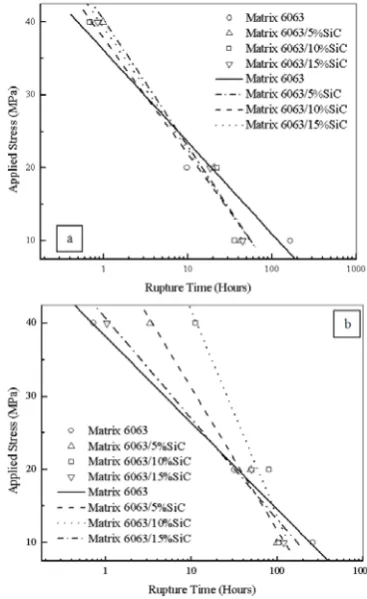
Fig. 7 shows the rupture lifetimes of the matrix and composites obtained from creep tests. It is noticed that in
[image:4.595.332.516.263.563.2]the as-cast conditions, the composites exhibits longer creep rupture time except at low stresses (10 MPa) where the matrix has longer creep life times. A similar trend was also observed for the extruded composites. No consistent effect on creep life time was observed with varying the weight percent of the reinforcing particles. An example of the time-strain creep curves is shown in Fig. 8 for the as-cast composites at a stress level of 10 MPa. Table 2 lists the values of the minimum creep rates for both the as-cast and extruded composites. The results revealed that in the as-cast conditions, the matrix has higher values of minimum creep rates as compared to the composites except at 20 MPa where the 5% wt SiCp composite has the maximum value. Also in the extruded conditions the matrix exhibits higher values of minimum creep rate as compared to the composites except at 40 MPa where the 10 % wt SiCp composite has the maximum value .
Fig.7. Creep rupture life times of (a) as cast and (b) extruded composites at 300 oC. Specimens were tested at three applied
stresses 10, 20 and 40 MPa.
[image:4.595.318.530.600.766.2]Table 2. Minimum creep rate of the composites (%/hr). Stress (MPa) Conditio
n
Weight%
SiCp 10 20 40
0 0.1520 0.0830 8.000
5 0.0070 0.2860 1.7800
10 0.0012 0.0333 4.6000
As-Cast
15 0.0026 0.1330 1.6000
0 0.0330 0.3810 3.2000
5 0.0010 0.1550 2.6000
10 0.0025 0.1350 5.0000
Extruded
15 0.0019 0.2960 3.5000
Power law exponents have been established using minimum creep rates for both as-cast and extruded composites, using the following relation:-
n Kσ
ε = (1) Where
ε
is the minimum creep rate, σ is the applied stress, Kis a material constant, and n is the power law exponent which is also a material constant. Table 3 summarizes the values of the power law exponent (n) and the constant K for the matrix and both as-cast and extruded composites. The calculated values of n show that, the composites have higher values of n
[image:5.595.306.549.236.413.2]as compared to the unreinforced alloys. This behavior is in agreement with previous work [8-11]. In the as-cast composites, increasing the weight percentage of the SiCp added to the matrix alloy increases n to reach its maximum value of 5.9 at 10 %wt SiCp . Any further increase in the SiCp weight percentage reduces the power law exponent. The power law exponent of the extruded composites has an approximately constant value range 5.4 and 5.6. Extrusion increases the values of the power law exponent except for the10% wt SiCp composites where the as-cast composite has a slightly higher value of the exponent n as compared to the extruded composites.
Table 3. Values of the power law exponent (n) and constant K
for the investigated composites. As-cast composites composites Extruded Weight
% SiCp n k n k
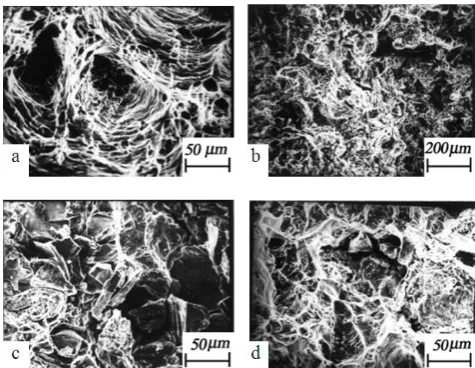
0 2.85 8.88×10⁻⁵ 3.3 1.74×10⁻⁵ 5 4.87 3.67×10⁻⁸ 5.6 3.08×10⁻⁹ 10 5.9 1.02×10⁻⁹ 5.4 8.76×10⁻⁹ 15 4.63 7.70×10⁻⁸ 5.4 1.10×10⁻⁸ The general feature associated with the fracture of the particle reinforced composite material can be summarized in terms of macroscopically brittle behaviour of the specimens, which fractured without any evidence of necking. Examination of the fracture surfaces of the failed tensile specimens at room temperature revealed the mechanism of the failure in the composites. Fig. 9a shows the fracture of the unreinforced as-cast specimen. It shows an even distribution of dimples, indicative of ductile failure. In composites the ductile dimples were still present, but now contain reinforced particles and the size of dimples was dependant on the size of
SiCp. It was noted that extrusion increases the interface strength between the particles and the matrix and decreases the porosity content. This is reflected by the smaller area % of sites indicative of particle decohesion in the fracture surface of the extruded composites. Particle pull-out was sometimes observed as shown in Fig. 9b. The pull-out particles were coated with aluminum matrix.
The fracture surfaces of the high temperature tensile specimens are quite different when compared to the room temperature fracture. As shown in Fig. 9c, an intergranular fracture mechanism has occurred in the matrix alloy although the fracture surface still contains dimples. The fracture surfaces of the composites show that decohesion along the interface between the SiCp and the matrix is still an integral fracture mechanism at high temperature, see Fig. 9d.
Fig.9. SEM micrographs of the tensile fracture surfaces of AA6063/SiCp composites; (a) room temperature as cast unreinforced; (b) room temperature extruded 10% SiCp; (c) At 300 °C, extruded unreinforced and (d) At 300 °C, extruded 10% SiCp.
Fig.10. SEM micrographs of the creep fracture surfaces of AA6063/SiCp at 300 oC; (a) Extruded unreinforced at 10 MPa; (b) Extruded 10% SiCp at 20 MPa; (c) As cast 10% SiCp at 20 MPa and (d) As cast 5% SiCp at 40 MPa.
[image:5.595.307.545.485.669.2]fracture surface as shown in Fig. 10a The fracture surfaces of the composites show that fracture occurs by void nucleation and growth around the grain boundaries of the matrix, while the reinforcing particles along the boundaries delaminate. The final fracture occurs by the link up of the voids at decohered particles leading to a dimpled fracture surface as shown in Fig. 10b. In addition to intergranular separation the fracture surfaces of the as-cast composites show extensive particles clustering as shown in Fig. 10c, this particles clustering is less observed on the fracture surfaces of the extruded composites. The final failure for reinforced alloys at high stresses is mostly intergranular in nature as shown in Fig. 10d with little evidence of reinforcement particle fracture. Some decohesion is apparent at the particles/matrix interface close to the final fracture surface.
IV. CONCLUSIONS
1. Extrusion with 25% reduction in area % reduces the porosity content of the as-cast composites and causes redistribution of SiCp clusters, resulting in a more uniform distribution of the SiCp.
2. Composites exhibit a significant acceleration in kinetics of precipitation in compare with the unreinforced matrix alloy. This acceleration is attributed to a decrease in the incubation time required to achieve the peak hardness.
3. The addition of SiCp to AA6063 improves the strength (but reduces ductility) of the alloy at room temperature, up to 10 wt%, then the strength decreases with further increase in SiCp content. At elevated temperature the results indicated that the addition of the SiCp decrease the tensile strength as compared to the matrix alloy. Extruded composites showed a similar trend but with relatively higher values of strength.
4. The as-cast and extruded composites exhibit higher creep resistance as compared to the unreinforced alloy except at relatively low stresses below 10 MPa where the matrix shows a better creep resistance. 5. The as-cast and extruded matrix alloy has a power
law exponent (n) close to 3, while the as-cast composites have (n) ranging between 4 and 6 which is higher than that of the matrix alloy. Power law exponent of the extruded composites is approximately constant and was in range 5.4 to 5.6, which is generally higher than that of the as-cast composites.
6. The matrix material generally exhibits a higher value of minimum creep rate as compared to the composites for both as cast and extruded conditions.
REFERENCES
[1] T. S. Mahmoud, F. H.Mahmoud, H. Zakaria, T. A. Khalifa, "Effect of squeezing on porosity and wear behaviour of partially remelted A319/20 vol.-% SiCp MMCs", Proc. IMechE, Part C: J. Mechanical
Engineering Science, 2008, 222(C3), pp. 295-303.
[2] L. H Qian., Z. G Wang., H. Toda and T. Kobayashi, "Effect of reinforcement volume fraction on the thermo-mechanical fatigue behavior of SiCW/6061Al composites", Mat. Sci. Eng. A, 2003, vol.
357, 1-2, pp. 240-247.
[3] T. G. Nieh, D. R. Lesuer and C. K. Syn, "Tensile and fatigue properties of a 25 vol.% SiC particulate reinforced 6090 Al composite at 300 oC",
Scrip. Metall., 1995, vol. 32, No. 5, pp. 707-712.
[4] J. W. Luster, M. Thumann and R. Baumann, "Mechanical properties of aluminum alloy 6061-Al2O3 composites", Mat. Sci. Tech., 1993, vol. 9,
pp. 853-862.
[5] J. Singh, S.K. Goel, and V.N.S. Mathur, "Elevated temperature tensile properties of squeezed-cast Al-Al2O3-MgO particulate MMCs up to
573 K", J. Mat. Sci., 1991, vol. 26, pp. 2750-2758.
[6] T. G. Nieh, C.M. McNally, J. Wadsworth, D. L. Yaney and P. S. Gilman, "Mechanical properties of a SiC reinforced aluminum composite prepared by mechanical alloying, in "Dispersion strengthened aluminum alloys", Edit by Y .W. Kim and W. M. Griffith, The Minerals, Metal and Materials Society, 1988, pp. 681-692. [7] J. Oñoro, M.D. Salvador, L.E.G. Cambronero, "High-temperature
mechanical properties of aluminium alloys reinforced with boron carbide particles", Materials Science and Engineering: A, Vol.499, 1-2, 2009, pp. 421-426.
[8] J. Čadek, M. Pahutova and V. Šustek, "Creep behaviour of a 2124 Al alloy reinforced by 20 Vol. % silicon carbide particulates", Mat. Sci. Eng., 1998, vol. A246, pp. 252-264.
[9] P. E. Krajewski, J. E. Allison and J. W. Jones, "The effect of SiC particle reinforcement on the Creep behaviour of 2080 aluminum alloy", Metall. Trans. A, 1993, vol. 28, 3, pp. 611-620.
[10] T. G. Nieh, "Creep rupture of silicon carbide reinforced aluminum composites", Metal. Trans., 1984, vol. 15A, pp. 139-146.
[11] V. C. Nardone and J. R. Strife. "Analysis of creep behaviour of SiC carbide whisker reinforced 2124 AA (T4)", Metall. Trans., 1987, vol. 19A, pp. 109-114.
[12] S. Ray, "Review: Synthesis of cast metal matrix particulate composites", J. Mat. Sci., 1993, vol. 28, pp 5397-5413.
[13] P. K. Ghosh and S.Ray, "Influence of process parameters on the porosity content in Al(Mg)-Al2O3 cast particulate composite produced
by vortex method", AFS Trans., 1980, vol. 88, pp. 775-782. [14] B.C. Pai, R.M.Pillai, and K.G. Satyanarayana "Stir cast aluminum
alloy matrix composites", In Proceedings of Advances in Metal Matrix Composites, Edit by M. A. Taha and N. A. El-Mahallawy, 1993, pp. 117.
[15] R. Rahmani Fard, F. Akhlaghi, "Effect of extrusion temperature on the microstructure and porosity of A356-SiCp composites", Journal of
Materials Processing Technology, vol. 187-188, 12, 2007, pp. 433-436. [16] G.M. Janowski and B.J. Pletka. "The effect of particle size and volume fraction on the aging behaviour of liquid-phase sintered SiC/Aluminum composite", Metal. Trans. A, 1995, vol. 26A, pp. 3027-3035. [17] Y. Song and T.N. Barker, "Accelerated Aging Process in Ceramic