Recall Error Analysis for Coreference Resolution
Sebastian Martschat and Michael Strube Heidelberg Institute for Theoretical Studies gGmbH Schloss-Wolfsbrunnenweg 35, 69118 Heidelberg, Germany
(sebastian.martschat|michael.strube)@h-its.org
Abstract
We present a novel method for coreference resolution error analysis which we apply to perform a recall error analysis of four state-of-the-art English coreference reso-lution systems. Our analysis highlights differences between the systems and iden-tifies that the majority of recall errors for nouns and names are shared by all sys-tems. We characterize this set of com-mon challenging errors in terms of a broad range of lexical and semantic properties.
1 Introduction
Coreference resolution is the task of determining which mentions in a text refer to the same entity. State-of-the-art approaches include both learning-based (Fernandes et al., 2012; Bj¨orkelund and Farkas, 2012; Durrett and Klein, 2013) and de-terministic models (Lee et al., 2013; Martschat, 2013). These approaches achieve state-of-the-art performance mainly relying on morphosyntactic and lexical factors. However, consider the follow-ing example.
In order to improving the added value of oil products, the second phase project of the Qinghai Petroleum Bureau’s Ge’ermu oil refineryhas been put into production. This will further improve the factory’soil products structure.
Due to the lack of any string overlap, most state-of-the-art systems will miss the link between
the factory and the Qinghai Petroleum Bureau’s Ge’ermu oil refinery. The information thatfactory
is a hypernym ofrefinery, however, may be useful to resolve such links.
The aim of this paper is to quantify and char-acterize such recall errors made by state-of-the-art coreference resolution systems. By doing so,
we provide a solid foundation for work on em-ploying knowledge sources for improving recall for coreference resolution (Ponzetto and Strube, 2006; Rahman and Ng, 2011; Ratinov and Roth, 2012; Bansal and Klein, 2012, inter alia). In par-ticular, we make the following contributions:
We present a novel framework for coreference resolution error analysis. This yields a formal foundation for previous work on link-based error analysis (Uryupina, 2008; Martschat, 2013) and complements work on transformation-based error analysis (Kummerfeld and Klein, 2013).
We apply the method proposed in this paper to perform a recall error analysis of four state-of-the-art systems, encompassing deterministic and learning-based approaches. In particular, we iden-tify and characterize a set of challenging errors common to all systems, and discuss strengths and weaknesses of each system regarding specific er-ror types. We also present a brief precision erer-ror analysis.
A toolkit which implements the framework pro-posed in this paper is available for download.1
2 A Link-Based Analysis Framework
In this section we discuss challenges in corefer-ence resolution error analysis and devise an error analysis framework to overcome these challenges.
2.1 Motivation
Suppose a document contains the entity BARACK OBAMA, which is referenced by four mentions in the following order: Obama,he, the president
andhis. A typical output of a current system not equipped with world knowledge will consist of two entities:{Obama,he}and{the president,his}
Obviously, the system made a recall error. But, due to the complex nature of the coreference reso-lution task, it is not clear how to represent the
re-1http://smartschat.de/software
(a)
m1 Obama
m2 he
m3 the president
m4 his
(b)
m1
m2
m3
the president m4
n1 n2
n3
(c)
m1
m2
m3
the president m4
(d)
m1
m2
m3
the president m4
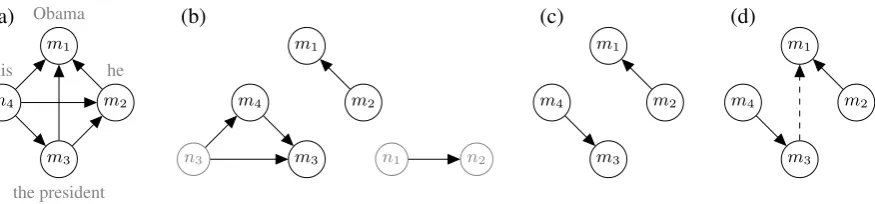
Figure 1: (a) a reference entityr, represented as a complete one-directional graph, (b) a setS of three system entities, (c) the partitionrS, (d) a spanning tree forr.
call error: is it missing the link betweenthe pres-identandObama? Can the error be attributed to deficiencies in pronoun resolution?
Linguistically motivated error representations would facilitate both understanding of current challenges and make system development faster and easier. The aim of this section is to devise such representations.
2.2 Formalizing Coreference Resolution To start with, we give a formal description of the coreference resolution task following the termi-nology used for the ACE (Mitchell et al., 2004) and OntoNotes (Weischedel et al., 2013) projects. Amentionis a linguistic realization of a reference to an entity. Two mentionscoreferif they refer to the same entity. Hence, coreference is reflexive, symmetric and transitive, and therefore an equiva-lence relation. The task of coreference resolution is to predict equivalence classes of mentions in a document according to the coreference relation.
In order to extract errors, we need to compare the reference equivalence classes, given by the annotation, with the system equivalence classes
obtained from system output. The key question now is how we represent these equivalence classes of mentions. Adapting common terminology, we also refer to the equivalence classes as entities.
2.3 Representing Entities
The most straightforward entity representation ig-nores any structure and models an entity as a set of mentions. This representation was utilized for error analysis by Kummerfeld and Klein (2013), who extract errors by transforming reference into system entities. In this set-based representation, we can only extract whether two mentions corefer at all. More fine-grained information, for example about antecedent information, is not accessible.
We therefore propose to employ astructured en-tity representation, which explicitly models links established by the coreference relation between mentions. This leads to a link-based error repre-sentation which formalizes the methods presented in Uryupina (2008) and Martschat (2013).
We employ for representation a complete one-directional graph. That is, we represent an en-tity e over mentions {m1, . . . , mn} as a graph
e = (N, A), where N = {m1, . . . , mn} and A = {(mk, mj)|k > j}. The indices respect the mention ordering. Mentions earlier in the text have a lower index. An example graph for an en-tity over four mentions m1, . . . , m4 (such as the
BARACKOBAMAentity) is depicted in Figure 1a. In this graph, we express all coreference relations between all pairs of mentions.2
Using this representation, we can represent a set of entities as a set of graphs. In particular, given a document we consider the set ofreference entities
R given by the annotation, and the set of system entitiesS, given by the system output. In order to extract errors, we compare the graphs in R with the graphs inS.
In the following, we discuss how to compute re-call errors for a reference entityr ∈Rwith respect to the system entitiesS. For computing precision errors, we just switch the roles ofRandS.
2.4 Comparing Reference and System Entities
As we represent entities as sets of links between mentions, errors can be quantified as differences in the links. For example, if an edge (representing a link) from some reference entityr ∈Ris missing
[image:2.595.84.522.63.165.2]in all system entities inS, this is a recall error. In order to formalize this, we employ the notion of apartitionof an entity. Letr ∈Rbe some ref-erence entity, and letSbe a set of system entities. The partition of r by S, written rS, is obtained by taking all edges inr that also appear inS. rS consists of all connected components ofr(we will refer to these assubentities) that are also inS. All edges inrthat are not inrS are candidates for re-call errors, as these were not in any entity inS.
Figure 1b shows a setSof three system entities: two consist of two mentions, one of three men-tions. In our running example, this corresponds to the system output{Obama,he}and{the pres-ident, his} plus some spurious mentions, which are colored gray. The graphrS for our example is shown in Figure 1c. The two edges correspond to the correctly recognized links (he,Obama) and (his, the president). All edges in r (Figure 1a) missing from this graph are candidates for errors.
2.5 Spanning Trees
However, taking all edges inrmissing inrSas er-rors leads to unintuitive results. In the BARACK OBAMA example, this would lead to four errors being extracted: (the president, Obama), (his,
Obama), (the president, he) and (his, he). But, in order to correctly predict the BARACKOBAMA entity, a coreference resolution system only needs to predict three correct links, i.e. it has to provide a
spanning treeof the entity’s graph representation. Therefore, to extract errors, we compute a span-ning treeTrofr, and take all edges inTr that do not appear inrSas errors. Figure 1d shows an ex-ample spanning tree for the running exex-ample en-tityr. The dashed edge, which corresponds to the link (the president,Obama), does not appear inrS and is therefore extracted as an error.
The strategies for computing a spanning tree may differ for recall and precision errors. Hence, our extraction algorithm is parametrized by two procedures STrec(e, P) and STprec(e, P) which,
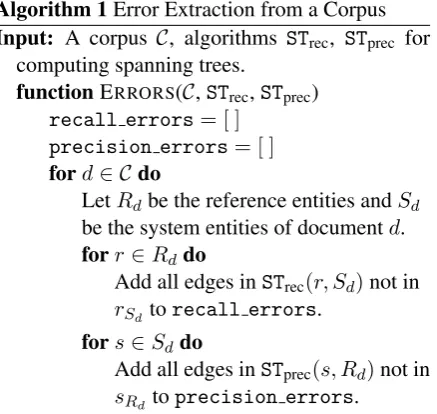
given an entity e and a set of entities P, output a spanning treeTe ofe. The whole algorithm for error extraction is summarized in Algorithm 1.
3 Spanning Tree Algorithms
In the last section we presented a framework for link-based error analysis, which extracts errors by comparing entity spanning trees to entity parti-tions. Therefore we can accommodate different
Algorithm 1Error Extraction from a Corpus Input: A corpus C, algorithms STrec, STprec for
computing spanning trees.
functionERRORS(C,STrec,STprec)
recall errors= [ ]
precision errors= [ ]
ford∈ C do
LetRdbe the reference entities andSd be the system entities of documentd. forr∈Rddo
Add all edges inSTrec(r, Sd)not in rSdtorecall errors.
fors∈Sddo
Add all edges inSTprec(s, Rd)not in sRdtoprecision errors.
Output: recall errors,precision errors
notions of errors by varying the algorithm for com-puting spanning trees. We now present some span-ning tree algorithms for extracting recall and pre-cision errors.
3.1 Recall Errors
We first observe that for error extraction, the struc-ture of the spanning trees of the subentities appear-ing inrSdoes not play a role. Edges present inrS are not candidates for errors, since they appear in both the reference entityr and the system output S. Therefore, it does not matter which edges from the subentities are in the spanning tree.
Hence, to build the spanning tree, we first choose arbitrary spanning trees for the subentities in the partition. We choose the remaining edges according to the spanning tree algorithm.
Having settled on this, we only have to decide which edges to choose that connect the trees rep-resenting the subentities. There are many possible choices for this. For example, the graph in Fig-ure 1c has four candidate edges which connect the trees for the subentities.
We can reduce the number of candidate edges by only considering the first mention (with respect to textual order) in a subentity as the source of an edge to be added. This makes sense since all other mentions in that subentity were correctly re-solved to be coreferent with some preceding men-tion. We still have to decide on the target of the edge. In Figure 1c, we have two choices for edges:
(m3, m1) and (m3, m2). We now present two
Choosing Edges by Distance. The most straight-forward way to decide on an edge is to take the edge with smallest mention distance between source and target. This is the approach taken by Martschat (2013).
Choosing Edges by Accessibility. However, the distance-based approach may lead to unintuitive results. Let us consider again the BARACK OBAMA example from Figure 1. When choosing edges by distance, we would extract the error (the president, he). However, such links with a non-pronominal anaphor and a non-pronominal antecedent are difficult to process and considered unreliable (Ng and Cardie, 2002; Bengtson and Roth, 2008). On the other hand, the missed link (the president,
Obama) constitutes a well-defined hyponymy re-lation which can be found in knowledge bases and is easily interpretable by humans.
Uryupina (Uryupina, 2007; Uryupina, 2008) presents a recall error analysis where she takes the “intuitively easiest” missing link to analyze (Uryupina, 2007, p. 196). How can we formal-ize such an intuition? We will employ a no-tion grounded in accessibility theory (Ariel, 1988). Names and nouns refer to less accessible entities than pronouns do. For such anaphors, we prefer descriptive (name/nominal) antecedents. Inspired by Ariel’s degrees of accessibility, we choose a target for a given anaphormias follows:
• Ifmiis a pronoun, choose the closest preced-ing mention.
• If mi is not a pronoun, choose the closest preceding proper name. If no such mention exists, choose the closest preceding common noun. If no such mention exists, choose the closest preceding mention.
Applied to the example from Figure 1, this algo-rithm extracts the error (the president,Obama).3
3.2 Precision Errors
Virtually all approaches to coreference resolu-tion obtain entities by outputting pairs of anaphor and antecedent, subject to the constraint that one anaphor has at most one antecedent.
We use this information to build spanning trees for system entities: these spanning trees con-sist of exactly the edges which correspond to anaphor/antecedent pairs in the system output.
3A similar procedure was used by Ng and Cardie (2002) to extract meaningful antecedents when training a corefer-ence resolution system.
4 Data and Systems
We now discuss data and coreference resolution systems which we will employ for our analysis. 4.1 Data
We analyze the errors of the systems on the En-glish development data of the CoNLL’12 shared task on multilingual coreference resolution (Prad-han et al., 2012). This corpus contains 343 docu-ments, spanning seven genres: bible texts, broad-cast conversation, broadbroad-cast news, magazine texts, news wire, telephone conversations and web logs. 4.2 Systems
State-of-the-art approaches to coreference resolu-tion encompass various paradigms, ranging from deterministic pairwise systems to learning-based structured prediction models. Hence, we want to conduct our analysis on a representative sample of the state of the art, which should be publicly avail-able. Therefore, we decided on two deterministic and two learning-based systems:
• StanfordSieve4 (Lee et al., 2013) was the
winning system of the CoNLL’11 shared task. It employs a multi-sieve approach by making more confident decisions first.
• Multigraph5 (Martschat, 2013) is a
deter-ministic pairwise system which is based on Martschat et al. (2012), the second-ranking system in the English track of the CoNLL’12 shared task. It uses a subset of features as hard constraints and chooses an antecedent for a mention by summing up the remaining boolean features.
• IMSCoref6 (Bj¨orkelund and Farkas, 2012)
ranked second overall in the CoNLL’12 shared task (third for English). It stacks mul-tiple decoders and relies on a combination of standard pairwise and lexicalized features.
• BerkeleyCoref7(Durrett and Klein, 2013) is
a state-of-the-art system that uses mainly lex-icalized features and a latent antecedent rank-ing architecture. It outperforms Stanford-Sieve and IMSCoref on the CoNLL’11 data.
4Part of Stanford CoreNLP, available athttp://nlp.
stanford.edu/software/corenlp.shtml. We use version 3.4.
5http://smartschat.de/software 6http://www.ims.uni-stuttgart.de/
forschung/ressourcen/werkzeuge/IMSCoref. en.html. We use theCoNLL 2012 system.
7http://nlp.cs.berkeley.edu/
System MUC B3 CEAF
e Average Fernandes et al. 69.46 57.83 54.43 60.57 Martschat 66.22 55.47 51.90 57.86 StanfordSieve 64.96 54.49 51.24 56.90 Multigraph 69.13 58.61 56.06 61.28 IMSCoref 67.15 55.19 50.94 57.76 BerkeleyCoref 70.27 59.29 56.11 61.89
Table 1: Comparison of the systems with Fernan-des et al. (2012) and with Martschat (2013) on CoNLL’12 English development data.
For Multigraph, we modified the system described in Martschat (2013) slightly to allow for the in-corporation of distance (similar to Cai and Strube (2010)). Inspired by Lappin and Leass (1994), we add salience weights for subjects and objects to the model to improve third-person pronoun reso-lution. We also extended the feature set by a sub-string feature. Furthermore, motivated by Chen and Ng (2012), we added a lexicalized feature for non-pronominal mentions that were coreferent in at least 50% of the cases in the training data.
StanfordSieve was run with its standard CoNLL shared task settings. The learning-based sys-tems were trained on the CoNLL’12 training data. We trained IMSCoref with its standard settings, and trained BerkeleyCoref with the final feature set from Durrett and Klein (2013) for twenty it-erations. We evaluate the systems on English CoNLL’12 development data and compare it with the winning system of the CoNLL’12 shared task (Fernandes et al., 2012) and with Martschat (2013) in Table 1, using the reference implementation v7 of the CoNLL scorer (Pradhan et al., 2014).
BerkeleyCoref performs best according to all metrics, followed by Multigraph. StanfordSieve is the worst performing system: the gap to Berke-leyCoref is five points in average score.
4.3 Discussion
Although we analyze recent systems on a recently published coreference data set, we believe that the results of our analysis will have implications for coreference in general. The data set is the largest and most genre-diverse coreference corpus so far. The systems we investigate represent major di-rections in coreference resolution model research, and make use of large and diverse feature sets pro-posed in the literature (Ng, 2010).
5 A Comparative Analysis
The coreference resolution systems presented in the previous section are a representative sample of the state of the art. Therefore, by analyzing the errors they make, we can learn about remaining challenges in coreference resolution and analyze the qualitative differences between the systems. The results of such an analysis will deepen our understanding of coreference resolution and will suggest promising directions for further research.
5.1 Experimental Settings
Previous studies identified the presence of recall errors as a main bottleneck for improving per-formance (Raghunathan et al., 2010; Durrett and Klein, 2013; Kummerfeld and Klein, 2013). This is also evidenced by the CoNLL shared tasks on coreference resolution (Pradhan et al., 2011; Prad-han et al., 2012), where most competitive systems had higher precision than recall. This indicates that an analysis of recall errors helps to understand and improve the state of the art. Hence, we focus on analyzing recall errors, and complement this by a brief analysis of precision errors.
We analyze errors of the four systems presented in the previous section on the CoNLL’12 English development data. To extract recall errors we em-ploy the spanning tree algorithm which chooses edges by accessibility. We obtain precision errors from the pairwise output of the systems.
5.2 A Recall Error Analysis of StanfordSieve Since StanfordSieve is currently the most-widely used coreference resolution system, it serves as a good starting point for our analysis. Remember that we represent each error as a pair of anaphor and antecedent. For an initial analysis, we cate-gorize each error by mention type, distinguishing between proper name, common noun, pronoun, demonstrative pronoun and verb.8
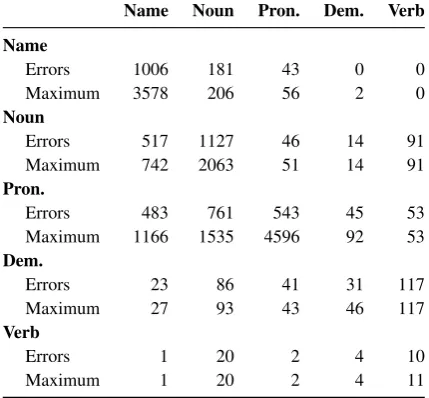
StanfordSieve makes 5245 recall errors. To put this number into context, we compare it with the maximum number of recall errors a system can make. This count is obtained by extracting recall errors from the output of a system that puts each mention in its own entity, which yields 14609 er-rors. In Table 2 we present a detailed analysis. For each pair of mention type of anaphor and
Name Noun Pron. Dem. Verb Name
Errors 1006 181 43 0 0
Maximum 3578 206 56 2 0
Noun
Errors 517 1127 46 14 91
Maximum 742 2063 51 14 91
Pron.
Errors 483 761 543 45 53
Maximum 1166 1535 4596 92 53
Dem.
Errors 23 86 41 31 117
Maximum 27 93 43 46 117
Verb
Errors 1 20 2 4 10
Maximum 1 20 2 4 11
Table 2: Number of StanfordSieve’s recall er-rors according to mention type, compared to the maximum possible number of errors. Rows are anaphors, columns antecedents.
tecedent, the table displays the number of recall errors and of maximum errors possible.
StanfordSieve gets almost none of the links in-volving verbal or demonstrative mentions correct. This is due to the system not attempting to handle event coreference, and performing very poorly for demonstratives. On the other hand, recall for pro-noun resolution is quite good, at least when con-sidering non-verbal antecedents. While Stanford-Sieve makes 1885 recall errors when the anaphor is a pronoun, it successfully resolves most of such links present in the corpus. Finally, let us consider the links involving only proper names and com-mon nouns. In total, these amount to 6589 links in the corpus (around 45% of all links). Stanford-Sieve misses 2831 of these links. Pairs of proper names seem to be easier to resolve than pairs of common nouns. Links between a common noun and a proper name are less frequent, but much more difficult: most of the links are missing.
5.3 Analysis of the Other Systems
In the previous section we identified various char-acteristics of the errors made by StanfordSieve: only (comparatively) few errors are made for pro-noun resolution and name coreference, while other types of nominal anaphora and coreference of demonstrative/verbal mentions pose a challenge for the system. Do the other systems in our study also have these characteristics? In order to answer
Proportion
System Total Anaphor Pron. Name/Noun
StanfordSieve 5245 36% 54%
Multigraph 4630 32% 56%
IMSCoref 5220 32% 58%
BerkeleyCoref 4635 32% 56%
Table 3: Recall error numbers for all systems.
this question, we repeated the analysis for the three other systems described in Section 4. We summa-rize the results in Table 3. We only report num-bers for pronoun resolution and name/noun coref-erence, as all systems do not resolve verbal men-tions and perform poorly for demonstratives.
StanfordSieve makes the most recall errors, closely followed by IMSCoref. Multigraph and BerkeleyCoref make around 600 errors less. While the total number of errors differs between the systems, the distributions are similar. In par-ticular, around 55% of recall errors made involve only proper names and common nouns. The num-ber is a bit higher for IMSCoref. We conclude that, despite variations in performance, both de-terministic and learning-based state-of-the-art sys-tems have similar weaknesses regarding recall.
The results displayed in Table 3 suggest vari-ous opportunities for future research. In this pa-per, we will focus on analyzing name/noun recall errors, as these constitute a large fraction of all re-call errors. Future work should address the pro-noun resolution errors and a characterization of the verbal/demonstrative errors.
5.4 Analysis of the Name/Noun Recall Errors We now turn towards a fine-grained analysis of the name/noun recall errors.
Table 4 displays the number of such recall errors made by each system, according to the mention types of anaphor and antecedent. We are interested in errors common to all systems, and in qualitative differences of errors between the systems.
5.4.1 Common Errors
[image:6.595.74.289.67.266.2]Number of Recall Errors (Anaphor-Antecedent)
Description Name-Name Noun-Name Name-Noun Noun-Noun
StanfordSieve 1006 517 181 1127
Multigraph 753 501 189 1152
IMSCoref 1082 500 188 1264
BerkeleyCoref 910 456 171 1072
Common errors 475 371 147 835
Correct boundaries idenfified 257 273 108 563
[image:7.595.123.475.83.190.2]excl. IMSCoref 156 222 97 475
Table 4: Name/Noun recall errors for all systems.
Common All
Type % Type %
ORG 25% PERSON 26%
PERSON 19% GPE 26%
GPE 16% ORG 20%
DATE 14% NONE 14%
NONE 9% DATE 6%
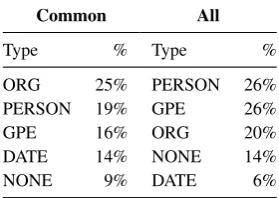
Table 5: Distribution of top five named entity types of common name-name recall errors and all possible name-name recall errors.
Furthermore, in order to assess the impact of mention detection, the table shows the number of common errors where boundaries for both men-tions were identified correctly by some system. We can see that boundary identification is a diffi-cult problem, especially for proper name pairs: for 48% of such errors, no system found the correct boundaries of both mentions participating in the error. The number of errors where correct bound-aries could be found drops significantly after cluding IMSCoref. This is due to the mention ex-traction strategy of IMSCoref: the other systems in our study discard the shorter mention when two mentions have the same head, IMSCoref keeps both mentions. Hence, the system is able to cor-rectly identify some mentions even in the presence of parsing or preprocessing errors. However, as a result, IMSCoref has to process many spurious mentions, which makes learning more difficult.
We conclude that mention detection still consti-tutes a challenge. We now proceed to a detailed analysis of errors common to all systems. In pass-ing we will discuss difficulties in mention detec-tion with regard to specific error types.
Errors between Pairs of Proper Names. The systems share 475 recall errors between pairs of proper names. In Table 5, we compare the distri-bution of gold named entity types of these errors with the distribution of gold named entity types of all possible errors (obtained via a singleton sys-tem). We see that especially difficult classes of links are pairs with type ORG or DATE.
Let us now consider lexical features of the er-rors.9 In 154 errors, the strings match completely,
but the correct resolution was mostly prevented by annotation inconsistencies (e.g. China instead of
China’s) or propagated parsing and NER errors, which lead to deficiencies in mention extraction.
For 217 errors, at least one token appears in both mention strings, as in the “Cole” and the “USS Cole”. This shows the insufficiency of the features which hint to alias relations, may it be heuristics or learned lexical similarities (for 109 of the 217 er-rors, both mention boundaries were identified cor-rectly by at least one system). Disambiguation with respect to knowledge bases could provide a principled way to identify name variations.
We classified the remaining 104 errors manu-ally, see Table 6. For a couple of categories such as identifying acronyms, spelling variations and aliases, disambiguation could also help. Many er-rors happen for date mentions, which suggests the use of temporal tagging features.
Errors for Noun-Name Pairs. We now inves-tigate the errors where the anaphor is a common noun and the antecedent is a proper name. 371 er-rors are common to all systems. The high fraction of common errors shows that this is an especially challenging category. We again start by investigat-ing how the distribution of the named entity type
[image:7.595.111.251.238.337.2]Description Occ. Example
Acronyms 20 National Ice Hockey Leagueand NHL
Alias 24 Floridaandthe Sunshine State Annotation 2 Annotation errors (pronoun as
name)
Context 2 Paula Coccozandjuror number ten Date 29 1989andlast year’s
Metonymy 12 South AfriaandPretoria Roles 8 Al Goreandthe Vice President Spelling 7 HsiachuotzuandHsiachuotsu
Table 6: Classification of common name-name re-call errors without common tokens.
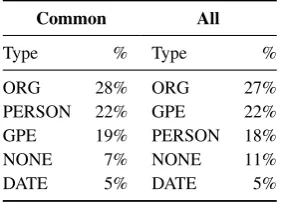
Common All
Type % Type %
ORG 28% ORG 27%
PERSON 22% GPE 22%
GPE 19% PERSON 18%
NONE 7% NONE 11%
[image:8.595.75.289.64.202.2]DATE 5% DATE 5%
Table 7: Distribution of top five named entity types of common noun-name recall errors and all possible noun-name recall errors.
of the antecedent differs when we compare com-mon errors to all possible errors. The results are shown in Table 7. Links with a proper name an-tecedent of type PERSON are especially difficult. They constitute 22% of the common errors, but only 18% of all possible errors.
Most mentions are in a hyponymy relation, like
the prime ministerandMr. Papandreou. This con-firms that harnessing such relations could improve coreference resolution (Rahman and Ng, 2011; Uryupina et al., 2011). For 65 of the errors (18%) there is lexical overlap: the head of the anaphor is contained in the proper name antecedent, as inthe entire parkandthe Ocean Park.
When categorizing all common errors accord-ing to the head of the anaphor, we observe 204 dif-ferent heads. 142 heads appear only once, but the top ten heads make up 88 of the 371 errors. The most frequent heads arecompany(15),group(12),
government, country and nation (each 9). This suggests that even with few reliable hyponymy re-lations recall could be significantly improved.
We observe similar trends when the anaphor is a proper name and the antecedent is a noun.
Reference System
System Stanford MG IMS Berkeley
Stanford - 51 47 61
MG 17 - 42 60
IMS 26 54 - 54
Berkeley 12 42 25
-Table 8: Comparison of noun-name recall errors. Entries are errors made by the system in the row, while the participating mentions are coreferent ac-cording to the the system in the column.
Errors between Pairs of Common Nouns. 835 errors between pairs of common nouns are shared by all systems. For 174 of these, the anaphor is an indefinite noun phase, which makes resolution a lot harder, since most coreference resolution sys-tems classify these as non-anaphoric and therefore do not attempt resolution.
For further analysis, we split all 835 errors in two categories, distinguishing whether the head matches between the mentions or not. In 341 cases the heads match. For many of these cases, parsing errors propagate and prevent the systems from rec-ognizing the correct mention boundaries.
In order to get a better understanding of the er-rors for nouns with different heads, we randomly extracted 50 of the 494 pairs and investigated the relation that holds between the heads. In 23 cases, the heads were related via hyponymy. In 10 cases they were synonyms. The remaining 17 cases involve many different phenomena, for example meronymy. This confirms findings from previous research (Vieira and Poesio, 2000).
Hence, looking up lexical relations, especially hyponymy, might be helpful to solve these cases. 5.4.2 Differences between the Systems
In order to analyze differences between the sys-tems, we compare the recall errors they make. The information how recall errors differ between systems will enable us to understand individual strengths and weaknesses.
Exemplarily, we will have a look at the differ-ences in the errors when the anaphor is a common noun and the antecedent is a proper name. By sys-tem design and by the total error numbers (Table 4) we expect the learning-based systems to have a slight advantage over the deterministic systems.
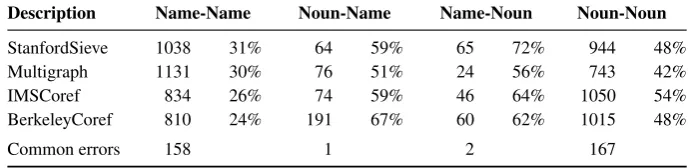
[image:8.595.111.252.256.357.2]Number and Proportion of Precision Errors (Anaphor-Antecedent)
Description Name-Name Noun-Name Name-Noun Noun-Noun
StanfordSieve 1038 31% 64 59% 65 72% 944 48%
Multigraph 1131 30% 76 51% 24 56% 743 42%
IMSCoref 834 26% 74 59% 46 64% 1050 54%
BerkeleyCoref 810 24% 191 67% 60 62% 1015 48%
[image:9.595.125.470.83.167.2]Common errors 158 1 2 167
Table 9: Name/Noun precision errors for all systems. The percentages are the proportion of precision errors with respect to all decision of the system in that category.
the system in the row, while the participating men-tions are coreferent according to the the system in the column. The numbers confirm our hypothesis, but also show that the deterministic systems are able to recover a few links missed by the learning-based systems.
For example, BerkeleyCoref recovers 60 links that could not be found by Multigraph, including 34 links without any common token, such asthe airlineandPan Am. Multigraph recovers only 42 links not found by BerkeleyCoref, 21 without any common token. Qualitatively, StanfordSieve and Multigraph are able to resolve a few links thanks to their engineered substring match, such as the judgeandDallas District Judge Jack Hampton.
We also conducted similar investigations for common noun and proper name pairs. For com-mon nouns, the trends are similar: the learning-based systems have an advantage over the deter-ministic systems. However, only few relations be-tween nouns with different heads are learned – compared to StanfordSieve, BerkeleyCoref recov-ers only 11 such pairs, such as the man and an expert in the law. Recall of the deterministic sys-tems is further hampered by their strict checks for modifier agreement, which they employ to keep precision high. Both systems miss for example the link from the anaphorthe Milosevic regimetothe regime, since the nominal modifier of the anaphor does not appear in the antecedent.
For proper names, Multigraph employs so-phisticated alias heuristics which help to resolve matches such asMarshall Ye Ting’sandhis grand-father Ye Ting. This explains the corresponding low number in Table 4. The lexicalized features of Multigraph, IMSCoref and BerkeleyCoref help to learn aliases when there is no string match, es-pecially for the bible part of the corpus (resolving links such asJesusandthe Son of Man).
5.5 Precision Errors
In the above analysis we identified common name/noun recall errors and discussed strengths and weaknesses of each system. Let us comple-ment this analysis by a brief discussion of corre-sponding precision errors.
Table 9 gives an overview. It displays the num-ber of precision errors for each category, and the proportion of these errors compared to all deci-sions in that category. We can see some general trends from this table: first, more decisions lead to a higher proportion of errors. This shows the dif-ficulty of balancing recall and precision. Second, proper name coreference seems much easier than common noun coreference. Coreference involving different mention types is a lot harder – the sys-tems only attempt few decisions, most of them are wrong. This confirms findings from our recall er-ror analysis. Third, the fraction of common erer-rors is very low, which indicates that precisions errors stem from various sources, which are handled dif-ferently by each system.
6 Related Work
We now discuss related work in coreference res-olution error analysis and in the related field of coreference resolution evaluation metrics.
Kummerfeld and Klein (2013) devise a method to extract errors from transformations of reference to system entities. They apply this method to a variety of systems and aggregate errors over these systems. By aggregating, they are not able to ana-lyze differences. They furthermore focus on de-scribing many different error classes, instead of closely investigating particular phenomena.
Evaluation Metrics. We extract recall and pre-cision errors. How does our error analysis frame-work relate to coreference resolution evaluation metrics, which quantify recall and precision er-rors? We first observe a fundamental difference: evaluation metrics deal with scoring coreference chains, they provide no means of extracting recall or precision errors. Therefore our analysis com-plements insights obtained via evaluation metrics. We follow Chen and Ng (2013) and distinguish betweenlinguistically agnostic metrics, which do not employ linguistic information during scoring, andlinguistically informed metrics, which employ linguistic information similar as we do when com-puting spanning trees.
We limit the discussion of linguistically ag-nostic metrics to the three most popular evalua-tion metrics whose average constitutes the official score in the CoNLL shared tasks on coreference resolution: MUC (Vilain et al., 1995), B3 (Bagga
and Baldwin, 1998) and CEAFe(Luo, 2005).10
Our framework bears most similarities to the MUC metric, as both are based on the same link-based entity representation. In particular, when we divide the number of errors extracted from an en-tity by the size of a spanning tree for that enen-tity, we obtain a score linearly related11to the MUC score
for that entity (recall for reference entities, preci-sion for system entities). B3 and CEAFe are not
founded on a link-based structure. B3 computes
recall by computing the relative overlap of refer-ence and system entity for each referrefer-ence mention, and then normalizes by the number of mentions. CEAFecomputes an optimal entity alignment with respect to the relative overlap, and then normalizes by the number of entities. As the metrics are not link-based, they do not provide means to extract link-based errors. We leave determining whether the framework of these metrics exhibits a useful notion of errors to future work.
10These are linguistically agnostic since they do not differ between different mention or entity types when evaluating.
11via the transformationx7→1−x
Recent work considered devising evaluation metrics which take linguistic information into account. Chen and Ng (2013) inject linguis-tic knowledge into existing evaluation metrics by weighting links in an entity representation graph. Tuggener (2014) devises scoring algorithms tai-lored for particular applications by redefining the notion of a correct link. While both of these works focus on scoring, they weight or explicitly define links in the reference and system entities, thereby they in principle allow error extraction. However, the authors do not attempt this and it is not clear whether the errors extracted that way are useful for analysis and system development.
7 Conclusions
We presented a novel link-based framework for coreference resolution error analysis, which ex-tends and complements previous work. We ap-plied the framework to analyze recall errors of four state-of-the-art systems on a large English bench-mark dataset. Concentrating on errors involving only proper names and common nouns, we identi-fied a core set of challenging errors common to all systems in our study.
We characterized the common errors among a broad range of properties. In particular, our anal-ysis highlights and quantifies the usefulness of world knowledge. Furthermore, by comparing the recall errors made by each system, we identified individual strengths and weaknesses. A brief pre-cision error analysis highlighted the hardness of resolving noun-name and noun-noun links.
The presented method and findings help to iden-tify challenges in coreference resolution and to in-vestigate ways to overcome these challenges.
Acknowledgments
This work has been funded by the Klaus Tschira Foundation, Heidelberg, Germany. The first au-thor has been supported by a HITS Ph.D. scholar-ship.
References
Mira Ariel. 1988. Referring and accessibility.Journal of Linguistics, 24(1):65–87.
Mohit Bansal and Dan Klein. 2012. Coreference se-mantics from web features. In Proceedings of the 50th Annual Meeting of the Association for Compu-tational Linguistics (Volume 1: Long Papers),Jeju Island, Korea, 8–14 July 2012, pages 389–398.
Eric Bengtson and Dan Roth. 2008. Understanding the value of features for coreference resolution. In
Proceedings of the 2008 Conference on Empirical Methods in Natural Language Processing,Waikiki, Honolulu, Hawaii, 25–27 October 2008, pages 294– 303.
Anders Bj¨orkelund and Rich´ard Farkas. 2012. Data-driven multilingual coreference resolution using re-solver stacking. InProceedings of the Shared Task of the 16th Conference on Computational Natural Language Learning,Jeju Island, Korea, 12–14 July 2012, pages 49–55.
Jie Cai and Michael Strube. 2010. End-to-end coref-erence resolution via hypergraph partitioning. In
Proceedings of the 23rd International Conference on Computational Linguistics, Beijing, China, 23– 27 August 2010, pages 143–151.
Chen Chen and Vincent Ng. 2012. Combining the best of two worlds: A hybrid approach to multilin-gual coreference resolution. InProceedings of the Shared Task of the 16th Conference on Computa-tional Natural Language Learning,Jeju Island, Ko-rea, 12–14 July 2012, pages 56–63.
Chen Chen and Vincent Ng. 2013. Linguistically aware coreference evaluation metrics. In Proceed-ings of the 6th International Joint Conference on Natural Language Processing, Nagoya, Japan, 14– 18 October 2013, pages 1366–1374.
Greg Durrett and Dan Klein. 2013. Easy victories and uphill battles in coreference resolution. In Pro-ceedings of the 2013 Conference on Empirical Meth-ods in Natural Language Processing,Seattle, Wash., 18–21 October 2013, pages 1971–1982.
Eraldo Fernandes, C´ıcero dos Santos, and Ruy Milidi´u. 2012. Latent structure perceptron with feature in-duction for unrestricted coreference resolution. In
Proceedings of the Shared Task of the 16th Confer-ence on Computational Natural Language Learning,
Jeju Island, Korea, 12–14 July 2012, pages 41–48.
Jonathan K. Kummerfeld and Dan Klein. 2013. Error-driven analysis of challenges in coreference reso-lution. InProceedings of the 2013 Conference on Empirical Methods in Natural Language Process-ing,Seattle, Wash., 18–21 October 2013, pages 265– 277.
Shalom Lappin and Herbert J. Leass. 1994. An algo-rithm for pronominal anaphora resolution. Compu-tational Linguistics, 20(4):535–561.
Heeyoung Lee, Angel Chang, Yves Peirsman, Nathanael Chambers, Mihai Surdeanu, and Dan Ju-rafsky. 2013. Deterministic coreference resolu-tion based on entity-centric, precision-ranked rules.
Computational Linguistics, 39(4):885–916.
Xiaoqiang Luo. 2005. On coreference resolution performance metrics. In Proceedings of the Hu-man Language Technology Conference and the 2005 Conference on Empirical Methods in Natural Lan-guage Processing, Vancouver, B.C., Canada, 6–8 October 2005, pages 25–32.
Sebastian Martschat, Jie Cai, Samuel Broscheit, ´Eva M´ujdricza-Maydt, and Michael Strube. 2012. A multigraph model for coreference resolution. In
Proceedings of the Shared Task of the 16th Confer-ence on Computational Natural Language Learning,
Jeju Island, Korea, 12–14 July 2012, pages 100–106.
Sebastian Martschat. 2013. Multigraph clustering for unsupervised coreference resolution. In51st Annual Meeting of the Association for Computational Lin-guistics: Proceedings of the Student Research Work-shop,Sofia, Bulgaria, 5–7 August 2013, pages 81– 88.
Alexis Mitchell, Stephanie Strassel, Shudong Huang, and Ramez Zakhary. 2004. ACE 2004 multilingual training corpus. LDC2005T09, Philadelphia, Penn.: Linguistic Data Consortium.
Vincent Ng and Claire Cardie. 2002. Improving ma-chine learning approaches to coreference resolution. InProceedings of the 40th Annual Meeting of the As-sociation for Computational Linguistics, Philadel-phia, Penn., 7–12 July 2002, pages 104–111.
Vincent Ng. 2010. Supervised noun phrase corefer-ence research: The first fifteen years. In Proceed-ings of the 48th Annual Meeting of the Associa-tion for ComputaAssocia-tional Linguistics, Uppsala, Swe-den, 11–16 July 2010, pages 1396–1411.
Simone Paolo Ponzetto and Michael Strube. 2006. Exploiting semantic role labeling, WordNet and Wikipedia for coreference resolution. In Proceed-ings of the Human Language Technology Confer-ence of the North American Chapter of the Associa-tion for ComputaAssocia-tional Linguistics,New York, N.Y., 4–9 June 2006, pages 192–199.
Sameer Pradhan, Lance Ramshaw, Mitchell Marcus, Martha Palmer, Ralph Weischedel, and Nianwen Xue. 2011. CoNLL-2011 Shared Task: Modeling unrestricted coreference in OntoNotes. In Proceed-ings of the Shared Task of the 15th Conference on Computational Natural Language Learning, Port-land, Oreg., 23–24 June 2011, pages 1–27.
of the Shared Task of the 16th Conference on Com-putational Natural Language Learning,Jeju Island, Korea, 12–14 July 2012, pages 1–40.
Sameer Pradhan, Xiaoqiang Luo, Marta Recasens, Ed-uard Hovy, Vincent Ng, and Michael Strube. 2014. Scoring coreference partitions of predicted men-tions: A reference implementation. In Proceed-ings of the 52nd Annual Meeting of the Association for Computational Linguistics (Volume 2: Short Pa-pers),Baltimore, Md., 22–27 June 2014, pages 30– 35.
Karthik Raghunathan, Heeyoung Lee, Sudarshan Ran-garajan, Nathanael Chambers, Mihai Surdeanu, Dan Jurafsky, and Christopher Manning. 2010. A multi-pass sieve for coreference resolution. In Proceed-ings of the 2010 Conference on Empirical Methods in Natural Language Processing,Cambridge, Mass., 9–11 October 2010, pages 492–501.
Altaf Rahman and Vincent Ng. 2011. Coreference res-olution with world knowledge. In Proceedings of the 49th Annual Meeting of the Association for Com-putational Linguistics (Volume 1: Long Papers),
Portland, Oreg., 19–24 June 2011, pages 814–824. Lev Ratinov and Dan Roth. 2012. Learning-based
multi-sieve co-reference resolution with knowledge. InProceedings of the 2012 Conference on Empirical Methods in Natural Language Processing and Nat-ural Language Learning,Jeju Island, Korea, 12–14 July 2012, pages 1234–1244.
Don Tuggener. 2014. Coreference resolution evalua-tion for higher level applicaevalua-tions. InProceedings of the 14th Conference of the European Chapter of the Association for Computational Linguistics, Gothen-burg, Sweden, 26–30 April 2014, pages 231–235. Olga Uryupina, Massimo Poesio, Claudio Giuliano,
and Kateryna Tymoshenko. 2011. Disambigua-tion and filtering methods in using web knowledge for coreference resolution. In Proceedings of the 24th International Florida Artificial Intelligence Re-search Society Conference,Palm Beach, USA, 18– 20 May 2011, pages 317–322.
Olga Uryupina. 2007. Knowledge acquisition for coreference resolution. Ph.D. thesis, Saarland Uni-versity, Saarbr¨ucken, Germany.
Olga Uryupina. 2008. Error analysis for learning-based coreference resolution. In Proceedings of the 6th International Conference on Language Re-sources and Evaluation, Marrakech, Morocco, 26 May – 1 June 2008, pages 1914–1919.
Renata Vieira and Massimo Poesio. 2000. An
empirically-based system for processing definite de-scriptions. Computational Linguistics, 26(4):539– 593.
Marc Vilain, John Burger, John Aberdeen, Dennis Con-nolly, and Lynette Hirschman. 1995. A model-theoretic coreference scoring scheme. In Proceed-ings of the 6th Message Understanding Conference
(MUC-6), pages 45–52, San Mateo, Cal. Morgan Kaufmann.