Abstract—Lean is a culture of real and continuous optimization. It is efficiency at its best. Lean as a concept of continuous optimization in the midst of limited resources must be practiced continuously as a long term organizational norm. Imbibing this practice could be carried out even at the expense of short-term financial goals. In making Lean practice a culture in an organization, the five key aspects of “Satisfying the customer” “Ensuring real value in the value Stream” “A well prepared, effective and efficient Human Resource” “An In built Just-In-Time system for all activities including deliveries and inventory management” and “A hallmark of total quality in process and product” must all be built on the foundation of continuous improvement. This conceptual paper takes a close look at building a culture of Lean with the five key concepts of Customer, Value Stream, Human Resource, Just-In-Time and Total Quality as a base.
Keywords—Lean, Continuous Improvement, Culture, Human Resource.
I. INTRODUCTION
Lean production is an integrated management system that emphasizes to a great extent the elimination of waste and the continuous improvement of operations for the optimization of the benefits derived from its immediate use of scarce resources. Lean production is a complete system that welds the activities of everyone from top management to line workers, to suppliers, into a tightly integrated whole that can respond almost instantly to marketing demand from consumers [1]. From the above definitions, lean can be seen to be an all inclusive system. It is inclusive because it is a closed circle of people, materials, processes and product with constant feedback mechanism. According to Womack et al. 1990, lean is a complete system. Complete with the customer in mind, people creating value at the appropriate quantity and quality just in time for the customer‟s use through a value driven process that is none compromising to waste. In the cause of the research on the human aspects of lean, three companies which include two in the UK and one in Turkey which has so far been visited has shown that Lean is a complete optimization culture of people, process and quality as illustrated in figure 1.
The people include the customers for whom the business exist, the suppliers and vendors who supplies the materials
I. K. Dibia is a Researcher with the Regional Centre for Manufacturing Industries (RCMI), Department of Mechanical & Design Engineering, University of Portsmouth, PO1 3DJ Portsmouth, United Kingdom (e-mail: [email protected]).
S. Onuh, PhD., MIET FHEA(UK) CEng is a Senior Lecturer at the Regional Centre for Manufacturing Industries (RCMI), Department of Mechanical & Design Engineering, University of Portsmouth, PO1 3DJ Portsmouth, UK (e-mail: [email protected]).
and parts for the production and also meet other intermediary needs in full or part for the business, and also the Human Resource that activates and make the whole system work. The Process is the unit activities in stages that takes the input through the system and converts the input into final output to meet the consumers‟ need at the quality specified by the consumers. Quality is the Hallmark of an efficient and effective Lean System which is complete and inclusive.
[image:1.595.370.472.271.346.2]
Figure 1: Lean 'A Complete Optimization Culture of People, Process and Quality'. Source: Dibia (2010)
II. LEAN „THE CUSTOMER‟CULTURE
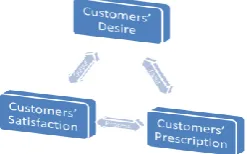
For Lean, it is all about the Customer. Customer first, Customers‟ desire „in‟, Customers‟ prescription „processed‟, Customers‟ satisfaction „out‟. That is the culture; the products are made with the customers always as the sole factor for the business. The customers are consumers‟, the users and the market. They create the market for the product and they are the market for the product. The Customer Culture is all about Satisfying the customer by knowing what they desire and meeting that need as illustrated in figure 2.
Figure 2: Lean 'The Customer' Culture. Source: Dibia (2010)
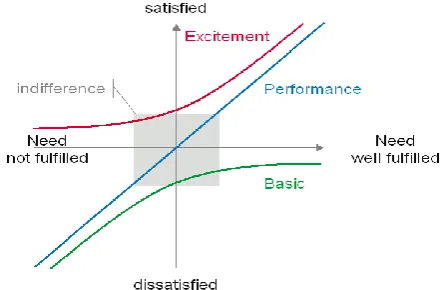
A lot has been said about satisfying customers‟ needs from notable journals [2,3,4,5] but Kano, Seraku, Takahashi, and Tsuji (1984) did develop a model called „Kano‟s model of customer requirements‟ which is today constantly used to categorize the attributes of the product or service based on how well they are able to satisfy customer requirements [6,7,8,9,10,11,12]
.
Lean Culturerization: A Long Term Philosophy for Full Optimization of
the Human Resource
[image:1.595.359.483.546.623.2]Figure 3: Kano model. Source wikipedia (2010)
The popular Kano customer requirement categories are;
Must be of Basic quality element: Customers believes the ingredient or quality must be there for them to be satisfied as illustrated in the satisfied top quadrant in figure 3.
Attractive quality element: If it is there it is an added satisfaction which could lead to excitement but if it is not there the customer will not be dissatisfied and will still accept the product or service as illustrated in figure 3.
One-dimensional quality element: customer satisfaction is proportional to the level of fulfilment. The higher the level of fulfilment, the higher customer satisfaction, and vice versa [12].
Indifferent quality element: Does not affect customer‟s satisfaction whether this quality is provided or not.
Reverse quality element: This element dissatisfies customers when present but when absent, customers are satisfied.
III. VALUE STREAM
The value stream is a collection of all actions and resources that are required to get a service or a product out, through the main flows, starting with the input or raw material and ending with the customer [13]. The actions include those that are value added as well as non-value-added, it also considers the flow of both information and materials within the overall supply chain. The Value Stream which must be of true value to customer and the organisation should be truly efficient and effective as the main aim of the value stream is to identified any form of waste and also trace the source or origin of the waste by mapping out the route which will be used to see exactly what is happening and where it is happening so as to eliminate any identified waste within the stream. It provides a visible means of identifying areas for continuous improvement seen within the stream as represented in its pictorial map called the value stream map. The key element of the value stream map is its use for the identification of a process and its flow and the value added in the process along each stage on the flow path.
Conceptually, the value stream map is a lean tool that has been effectively used in evaluating non-value added
activities. It is a tool that helps in visualizing a system by the representation of information, process, material and human resource flow. It also creates a common language about a process, by which decisions can be made to eliminate the non value adding activities [14]. Several different Value Stream tools has been conceptualised, they include Production variety funnel [15], Supply chain response matrix [16], Quality filter mapping [17], Decision point analysis [16], Physical structure mapping [17], The Big picture mapping [13], Demand amplification mapping [18] and Maintenance value stream map [14].
While it is true that most of the researchers have developed various tools to optimize various operations in the supply chain, it is also true that most of these tools fall short in linking and actually visualizing the nature of the material and information flow together with the real interactive productive activities of the human resource which is the main driving force of the lean system and the actual determinant factor of the of the real value created within the value stream. Looking at the value stream as the real big picture of the true productive system powered by the human resource, the system should be seen as a big picture of team players with inter-related processes and not as individual processes.
IV. THE HUMAN RESOURCE
From research and the initial conceptualization of the term „lean thinking‟ first by Taichi Ohno in 1988 and later by Womack and Jones in 1996, Lean thinking included processes that are flexible, reduce waste, optimize the process, improve process control and finally utilizes the human resource but it is a well known fact that lean thinking as it is practiced today does not seem to appreciate in a realistic and practical terms the importance of the human resource [19, 20]. This is today very visible from the acknowledgment from Toyota which is the internationally tested, proven and accepted symbol and example for Lean when its president Akio Toyoda concluded that one of the major strategic faults in the present day Toyota System that led to the massive recalls of over 8.5 million vehicles as at February 2010 due to faulty accelerator pedals and breaking systems in some of their flagship models is that “Toyota pursued growth over the speed at which they were able to develop their people and the organization and Toyota should be sincerely mindful of that”. Lean is truly more about the people because Lean is a way of life in an organization, it is a culture and there is no culturization without the people because the people must imbibe it and live it by practicing it continuously. If there is development in technology in any system or organization, the people should be developed to meet up with the technological development at the same pace and speed. If there is growth in any form or sphere within the organization the growth should be at the same speed at which the organization is able to develop its people. That is why the people are the fundamental resource of any organization. They are the philosophy, the real foundation, the real resource on which every organization is built. That is the reason why they are not just referred to as people but as the invaluable „Human Resource‟.
which can be firmly regarded as a people that plays a major role in organization especially when it comes to the practice of lean are the suppliers or vendors. For this group, the organization may have some element of control but not total control as more often than not they are a different entity from the organization that they serve with their supplies. They can be referred to as external human resource, adjunct human resource or better still symleanitic human resource as their people quality, performance, efficiency and effectiveness do rub-off on the organization they supply in the Lean system. The final and main group of these very important people aspect of any organization are the staffs of the organization better known as the human resources of the organization as they belong to the organization and the organization has great control over their activities and actions just as their activities and actions are determinant factors on the performance of the organization. They are the invaluable human resources of the organization as their abilities, skills, performance, development and growth are a major deciding factor of the success, sustenance and future of any organization. Therefore, how this human resource is utilized will go a long way in determining continuous success and existence of its organization.
Organizations should endeavour to always have and recruit staffs that are well trained, intelligent, very skilled and well suited for the job. This is very important because lean draws on the knowledge, skills and metal power of all employees in any organization to be able to achieve and sustain success. Organizations should always ensure that their staffs are of the highest quality and only the best fit for each job is always employed to meet the needs of the organization and therefore ultimately meet the need of the customers. In utilizing these staffs as invaluable resources which they are, the objective of optimization in utilization should always be a factor of consideration by the organization.
In today‟s lean organization it a form of best practice for the human resource to work in highly effective, efficient and functional teams. The teams are generally made up of multi-skilled members who can interchange task and can easily fit in when they are short of hands within the team due to any unforeseen circumstances. Each team task and responsibility should be very clear as the various nature of each team task and allocation of responsibilities can generate many dependencies that require orchestrated but aligned actions to converge them all towards the master plan [21] which is getting out the end product or service that perfectly satisfies the customer with little or no form of waste from its conception to its delivery at the final interface with the customer. The team attitude in lean is a culture of collective responsibility in ensuring excellent performance in a continuous improving system. Teams also offer management a formal mechanism to use in tapping their workers‟ skills and knowledge when trying to solve a production problem or to improve processes through kaizen events [22].
In utilizing the human resource both as individuals and as team players, a culture of continuously initiating various forms and degree of improvement should be imbibe in them while they should be given the power to take decisions and act decisively within their processes when need be as they are regarded as process engineers in the Lean system. The human resource should be very involved in all activities in
the organization as full active participant and not just as mere controlled participant who just do as told and nothing more or less. The Human Resource must be truly prepared and equal to the task of efficiently creating and bringing value to the customer with good skills, personal know how and excellent team work. This should be encouraged by well structured and result oriented compensation and motivational processes and procedures. There should also be well laid out and organised training and development programmes to continuously improve the available human resource in any organization. This should be a culture in any organization that hopes to achieve success in their Lean practice and also sustain that success.
Lean culturerization calls for a new and consistent type of people relationship within the business and activity flow of any organization. A new kind of relationship for guaranteed satisfaction between the organization and its customers, a new kind of relationship between the organization and its people, its invaluable human resource and between the organization and its suppliers. A trusting relationship characterized by symleanitic mutual assistance to ensure customer satisfaction, just in time deliveries of products and services, continuous organizational and business success and an un ending cycle of continuous improvement within the system.
V. JUST-IN-TIME
Just-In-Time is a manufacturing philosophy which seeks to eliminate waste associated with all source of resources in use which includes; time, labour, and space (office, work floor, work stations and storage). Just-In-Time seek to produce and deliver finished goods just in time to be sold, sub-assemblies just in time to be assembled in to into the main system as a finished product, and purchase materials just in time to be transformed into fabricated parts [23]. The concept in simple terms means „produce only what is needed, when it is needed and in the quantity that is needed‟. The Just-In-Time philosophy emphasizes the performance of activities based on immediate need or demand, in manufacturing; it simply involves the production of goods based on demand [24]. In an ideal Just-In-Time practice there is no room for producing for anticipated demand, work-in-process are almost totally eliminated as only goods that are immediately needed are produced. Just-In-Time attempts to manufacture products from start to finish [25] and to be able to efficiently and effectively do this according to the philosophy, Drury (1990) suggest that;
The factory floor layout should be rearranged from the batch production style to a production layout using flow lines.
This flow lines should be U-shaped as it allows workers access to more than one machine, and it creates an in-built space to be able to help other workers if any trouble occurs in the system.
Minimum levels of inventories are maintained as any problem with production, will cause delay in delivery.
Jobs must be done right the first time as there are no room for defects as this in itself is a waste of time and material.
A Just-In-Time culture is a must for any lean system and it must transcend its production management, suppliers‟ management and inventory management to eliminate waste in terms of space for storage and useful capital held in form of material and unnecessary delays. Everything of these aspects of production must be well coordinated with good information flow which must be synchronized with the work flow for efficient performance and optimum utilization of available resources to produce the right quality and quantity of product or service needed at the right time and at the right point.
In the practice of Just-In-Time, the act of synchronization which could also be simply defined as matching output with customer demand is very important as it helps in minimizing inventory levels with the aid of one of the Just-In-Time techniques called Kanban. Kanban in manufacturing is a simple method of notifying preceding work centres that material is required downstream [26].
As part of the Just-In-Time culturization in Lean, it is very important that all components of the processes employed to produce a good or service should be visible to those participating in the process as this allows the human resources which are the process participants the opportunity to
Know exactly what is expected from them,
See exactly what they are doing and how it affects the entire process,
Learn more from what they have seen,
Easily inspect and continuously improve the processes within the system due to its visibility. Customers are also part of the people involved in the process as they per take in the outcome of the process and give feedback which tends to define the value and quality of the service in lean practice. If the process is also visible to the customers, they may define the value and quality of the service by what they see in the process [26].
VI. TOTAL QUALITY MANAGEMENT SYSTEM
The importance of quality management system as a practice in the culture of lean cannot be over emphasized. Quality Management is defined as an integrated approach to achieving and sustaining high quality output, focusing on the maintenance and continuous improvement of processes and defects prevention at all levels and in all functions of the organization, in order to meet or exceed customer expectations [27]. A functional quality management system provides accurate and timely feedback about the manufacturing process, permitting shop floor personnel to detect, diagnose, and remedy process problems as they occur [28]
. The sustenance of Lean as an efficient and effective system has an embedded prerequisite of quality. Quality in
Lean philosophy is in the process. It is constant, continuous and total. It attempts to ensure „zero defects‟ which eliminates the deadly waste of rework and defects. Crosby (1992) in his integrated notion of quality stated that “Quality means getting everyone to do what they have agreed to do and doing it right the first time is the skeletal structure of an organization, finance is the nourishment, and relationships are the soul”[29]. This is the hallmark of „Lean‟. Simply put „Doing it right the first time‟ eliminates waste and so sustains the real organization (skeletal structure). Finance surely nourishes the system while according to Crosby, “relationships are the soul of the organization”, and such relationship includes the relationship with the staff, relationship with the suppliers and most importantly relationship with the customer. This all important relationship with the customer can only be sustained with continuously improved products and services that meet the need of the customers and also satisfy him.
A good quality system must be well organized, must meet customer‟s expectations as much as possible, reduce waste and involve people (staff, vendors and customers). Deming (1982) broadened the definition of “customer” pointing out that each person or step in a production line or business process is to be treated as a “customer” whether internally or externally [30, 31]. It is unity of purpose, the purpose being to ensure quality. This unity of purpose results in a pull system of “the next process is the customer” meaning the preceding process must always do what the subsequent says just in time [31]
. Otherwise Just-In-Time which is the regulatory aspect of Lean will not work. Coordinating this pull system is the Human Resource which must have a culture of quality and must be effectively manage it to ensure its sustenance.
VII. METHODOLOGY
VIII. FUTURE WORK
A full Ideographic approach will be included in the research and this will entail playing the role of an internal observer by working within the system to fully understand the dynamics of the human aspects in the practice of lean within one of the companies. It will also provide information for the soft system construct that will be used as part of my methodology. Records and results on the influence of the human resource aspects on the success and sustenance of Lean will also be sourced from existing literatures.
IX. CONCLUSION
To be able to build a culture of lean in any system it is important to appreciate the magnitude of what is to be done because it is not a one off practice or a switch button that goes on once it is triggered on. The knowhow for the implementation is also very important but most importantly is the Leadership and management long term commitment which must be seen to precede every activity during its implementation. This long term commitment on Lean which is a culture of excellence, quality and continuous improvement must be seen and sheared by both the suppliers and the internal human resource who are the people galvanizing and making the lean system functional. This culture of excellence and quality will then flow to the customer who must be continuously satisfied just in time from the value created in the value stream of satisfaction which is the path way and hallmark of Lean.
REFERENCES
[1] Womack, J., Jones, D. and Roos, D. (1990). The Machine that Changed the World. Harper Collins, New York, NY.
[2] Askin, R.G. and Dawson, D.W. (2000). Maximizing customer satisfaction by optimal specification of engineering characteristics. IIE Transactions 32 (1), 9-20.
[3] Curtis, C.C. and Ellis, L.W. (1998). Satisfy customers while speeding R&D and staying profitable. Research Technology Management 41 (5), 23-27.
[4] Pogacnik, M. and Kopac, J. (2000). Technology and reducing the product development times. Strojniski Vestnik-Journal of Mechanical
Engineering 46 (2), 103-109.
[5] Yang, Y.N., Parsaei, H.R., Leep, H.R., Chuengsatiansup, K. (2000). Evaluating robotic safety using quality function deployment.
International Journal of Manufacturing Technology and Management 1 (2/3), 241-256.
[6] Kano, N., Seraku, K., Takahashi, F., and Tsuji, S. (1984). Attractive quality and must-be quality. The Journal of the Japanese Society for Quality Control, 14(2), 39-48.
[7] King, B. (1995). Designing products and services that customer wants. Productivity Press.
[8] CQM (1993). A special issue on Kano‟s methods for understanding customer-define quality, The Center for Quality of Management Journal, 2.
[9] Clausing, D. (1994). Total quality development – A step by step guide to world-class concurrent engineering. New York: ASME Press. [10] Cohen, L. (1995). Quality function deployment: How to make QFD work
for you. MA: Addison-Wesley.
[11] FREP (2005). Forest and Range Practice Act Resource Evaluation Program. Quality Assurance Framework. Background Paper July 18, 2005.
[12] Lee, Y-C., Sheu, L-C., Tsou, Y-G. (2008). Quality function deployment implementation based on fuzzy Kano model: An application in PLM system. Computer and Industrial Engineering Vol. 55; page 48-63. [13] Rother, M. and Shook, J. (1999). Learning to See: Value Stream Mapping
to Add Value and Eliminate Muda. The Lean Enterprise Institute, Inc., Brookline, MA.
[14] Kannan, S., Li, Y., Ahmed, N. and El-Akkad, Z. (2009). Developing a Maintenance Value Stream Map. The University of Tannessee, Knoxville, TN 37996-2210 en.scientificcommons.org/42607502 – USA. [15] New, C. (1974). “The production funnel: a new tool for operation
analysis”. Management Decision, Vol. 12 No. 3, Page 167-178. [16] Hines, P., Rich, N. and Jones, D.T. (1997). Lean logistics. International
Journal of Physical Distribution Logistics. Vol. 27(3/4); Page 153-173. [17] Hines, P. and Rich, N. (1997). The seven value stream mapping tools.
International Journal of Operation and Production Management Vol. 17(1); Page 46-64.
[18] Hines, P. and Taylor, D. (2000). Going lean. Cardiff, UK: Lean Enterprise Research Centre Cardiff Business School.
[19] Ohno, T. (1988). The Toyota Production System: Beyond Large-Scale Production. Productivity Press, Portland.
[20] Womack, J. and Jones, D. (1996). Lean Thinking: Banishing Waste and Create Wealth in Your Corporation. New York: Free Press.
[21] Entin, E.E. and Serfaty, D. (1999). Adaptive team coordination. Human Factors 41, 321-325.
[22] Cook, C.R. and Graser, J.C. (2001). Military Airframe Acquisition Costs; the Effects of Lean Manufacturing. RAND Monograph Report MR-1325-AF.
[23] Schonberger, R.J. (1982). Japanese Manufacturing Techniques: Nine Hidden Lessons in Simplicity. Free Press, New York.
[24] Drury, C. (1990). Counting the Cost of AMT Investment. Journal of Accountancy, April, Page 134-138.
[25] Younies, H., Barhem, B and Ed Hsu, C. (2007). A review of the Adoption of Just-In-Time method and its effect on efficiency. The Public Administration & Financial Management, an Interactive Journal (PAMIJ) 12, 2 2007.
[26] Duclos, L.K., Sih, S.M. and Lummus, R.R. (1995). JIT in service: a review of current practices and future directions for research.
International Journal of Service Industry Management Vol. 6, No.5 pages 36-52.
[27] Flynn, B.B., Schroeder, R.G. and Sakakibara, S. (1994). A framework for quality management research and an associated measurement instrument. Journal of Operations Management, Vol. 9, page 339-366.
[28] Nakamura, M., Sakakibara, S. and Schroeder, R. (1998). Adoption of Just-in-Time Manufacturing Methods at U.S. and Japanese Owned Plants: Some Empirical Evidence. Journal of IEEE Transactions on engineering management, Vol. 45, No. 3 page 230-240.
[29] Crosby, P.B. (1992). Completeness: Quality for the 21st Century. Dutton,
N.Y., 17, 118-121, 234.
[30] Deming, W.E. (1982). Quality, Productivity and Competitive Position. MIT Press, Cambridge, MA: MIT Center for Advanced Engineering Study.
[31] ICOMIA, (2008). International Council of Marine Industry Associations on “Lean thinking and the Environment”. www.icomia.org.
DEFINITION OF TERMS