4016
Saliency Learning: Teaching the Model Where to Pay Attention
Reza Ghaeini, Xiaoli Z. Fern, Hamed Shahbazi, Prasad Tadepalli School of Electrical Engineering and Computer Science, Oregon State University
1148 Kelley Engineering Center, Corvallis, OR 97331-5501, USA
{ghaeinim, xfern, shahbazh, tadepall}@eecs.oregonstate.edu
Abstract
Deep learning has emerged as a compelling solution to many NLP tasks with remarkable performances. However, due to their opac-ity, such models are hard to interpret and trust. Recent work on explaining deep models has introduced approaches to provide insights to-ward the model’s behaviour and predictions, which are helpful for assessing the reliabil-ity of the model’s predictions. However, such methods do not improve the model’s reliabil-ity. In this paper, we aim to teach the model to make the right prediction for the right reason by providing explanation training and ensur-ing the alignment of the model’s explanation with the ground truth explanation. Our exper-imental results on multiple tasks and datasets demonstrate the effectiveness of the proposed method, which produces more reliable predic-tions while delivering better results compared to traditionally trained models.
1 Introduction
It is unfortunate that our data is often plagued by meaningless or even harmful statistical biases. When we train a model on such data, it is possible that the classifier focuses on irrelevant biases to achieve high performance on the biased data. Re-cent studies demonstrate that deep learning mod-els noticeably suffer from this issue (Agrawal et al., 2016; Wadhwa et al., 2018; Gururangan et al.,2018). Due to the black-box nature of deep models and the high dimensionality of their inher-ent represinher-entations, it is difficult to interpret and trust their behaviour and predictions. Recent work on explanation and interpretation has introduced a few approaches (Simonyan et al.,2013;Ribeiro et al.,2016;Lei et al.,2016;Li et al.,2016,2017; Ghaeini et al.,2018b;Ribeiro et al.,2018) for ex-planation. Such methods provide insights toward the model’s behaviour, which is helpful for detect-ing biases in our models. However, they do not
correct them. Here, we investigate how to incor-porate explanations into the learning process to en-sure that our model not only makes correct predic-tions but also makes them for the right reason.
Specifically, we propose to train a deep model using both ground truth labels and additional an-notations suggesting the desired explanation. The learning is achieved via a novel method called
saliency learning, which regulates the model’s be-haviour using saliency to ensure that the most crit-ical factors impacting the model’s prediction are aligned with the desired explanation.
saliency-trained model to perturbations introduced on part of the data that contributes to the explana-tion.
2 Saliency-based Explanation Learning
Our goal is to teach the model where to pay atten-tion in order to avoid focusing on meaningless sta-tistical biases in the data. In this work, we focus on positive explanations. In other words, we expect the explanation to highlight information that con-tributes positively towards the label. For example, if a piece of text contains the mention of a particu-lar event, then the explanation will highlight parts of the text indicating the event, not non-existence of some other events. This choice is because posi-tive evidence is more natural for human to specify. Formally, each training example is a tuple
(X, y, Z), where X = [X1, X2, . . . , Xn] is the
input text (lengthn), y is the ground-truth label, andZ ∈ {0,1}nis the ground-truth explanation as
a binary mask indicating whether each word con-tributes positive evidence toward the labely.
Recent studies have shown that the model’s predictions can be explained by examining the saliency of the inputs (Simonyan et al., 2013; Hechtlinger, 2016; Ross et al., 2017; Li et al., 2016) as well as other internal elements of the model (Ghaeini et al., 2018b). Given an exam-ple, for which the model makes a prediction, the saliency of a particular element is computed as the derivative of the model’s prediction with respect to that element. Saliency provides clues as to where the model is drawing strong evidence to support its prediction. As such, if we constrain the saliency to be aligned with the desired explanation during learning, our model will be coerced to pay atten-tion to the right evidence.
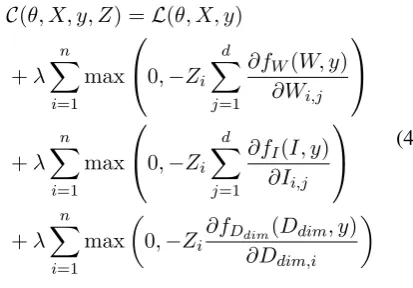
In computing saliency, we are dealing with high-dimensional data. For example, each word is represented by an embedding ofddimensions. To aggregate the contribution of all dimensions, we consider sum of the gradients of all dimen-sions as the overall vector/embedding contribu-tion. For thei-th word, ifZ[i] = 1, then its vector should have a positive gradient/contribution, oth-erwise the model would be penalized. To accom-plish this, we incorporate a saliency regularization term to the model cost function using hinge loss. Equation 1 describes our cost function evaluated
on a single example(X, y, Z).
C(θ, X, y, Z) =L(θ, X, y)
+λ
n
X
i=1
max
0,−Zi d
X
j=1
∂fθ(X, y)
∂Xi,j
(1)
whereLis a traditional model cost function (e.g. cross-entropy),λis a hyper parameter,f specifies the model with parameterθ, and ∂X∂f
i,j represents
the saliency of thej-th dimension of wordXi. The
new term in theCpenalizes negative gradient for the marked words inZ(contributory words).
Since C is differentiable respect toθ, it can be optimized using existing gradient-based optimiza-tion methods. It is important to note that while Equation1only regularizes the saliency of the in-put layer, the same principle can be applied to the intermediate layers of the model (Ghaeini et al., 2018b) by considering the intermediate layer as the input for the later layers.
Note that if Z = 0 then C = L. So, in case of lacking proper annotations for a specific sample or sequence, we can simply use0as its annotation. This property enables our method to be easily used in semi-supervised or active learning settings. 3 Tasks and Datasets
To teach the model where to pay attention, we need ground-truth explanation annotation Z, which is difficult to come by. As a proof of con-cept, we modify two well known real tasks (Event Extraction and Cloze-Style Question Answering) to simulate approximate annotations for explana-tion. Details of the main tasks and datasets could be found in section B of the Appendix. We de-scribe the modified tasks as follows:
1)Event Extraction: Given a sentence, the goal is to determine whether the sentence contains an event. Note that event extraction benchmarks con-tain the annotation of event triggers, which we use to build the annotation Z. In particular, the Z
value of every word is annotated to be zero un-less it belongs to an event trigger. For this task, we consider two well known event extraction datasets, namely ACE 2005 and Rich ERE 2015.
Sentence Conv-W3 Conv-W5
Max-Pooling
Dim & Seq Max-Pooling
Sentence Conv-W3 Conv-W5
Max-Pooling
Dim & Seq Max-Pooling
Query Conv-W3 Conv-W5
Max-Pooling Max-Pooling
[image:3.595.74.293.62.167.2](a) (b)
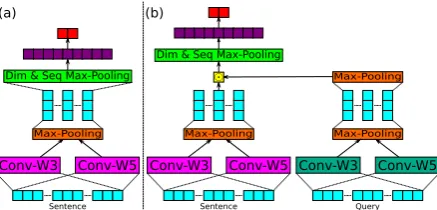
Figure 1: A high-level view of the models used for event extraction (a) and question answering (b).
replacement. For this task, we use two well known cloze-style question answering datasets: Children Book Test Named Entity (CBT-NE) and Common Noun (CBT-CN) (Hill et al.,2015).
Here, we only consider the simple binary tasks as a first attempt to examine the effectiveness of our method. However, our method is not restricted to binary tasks. In multi-class problems, each class can be treated as the positive class of the binary classification. In such a setting, each class would have its own explanation and annotationZ.
Note that for both tasks if an example is neg-ative, its explanation annotation will be all zero. In other words, for negative examples we have
C=L. 4 Model
We use simple CNN based models to avoid com-plexity. Figure1illustrates the models used in this paper. Both models have a similar structure. The main difference is that QA has two inputs (sen-tence and query). We first describe the event ex-traction model followed by the QA model.
Figure1 (a) shows the event extraction model. Given a sentenceW = [w1, . . . , wn]wherewi ∈
Rd, we first pass the embeddings to two CNNs
with feature size ofdand window size of3and5. Next we apply max-pooling to both CNN outputs. It will give us the representationI ∈Rn×d, which
we refer to as the intermediate representation. Then, we apply sequence-wise and dimension-wise max-poolings toI to captureDseq ∈Rdand Ddim ∈ Rn respectively. Ddim will be referred
as decision representation. Finally we pass the concatenation ofDseq andDdimto a feed-forward
layer for prediction.
Figure 1(b) depicts the QA model. The main difference is having query as an extra input. To process the query, we use a similar structure to the main model. After CNNs and max-pooling we end
Dataset S.a P.b R.c F1 Acc.d ACE No 66.0 77.5 71.3 74.4
Yes 70.1 76.1 73.0 76.9
ERE No 85.0 86.6 85.8 83.1 Yes 85.8 87.3 86.6 84.0
CBT-NE No 55.6 76.3 64.3 75.5 Yes 57.2 74.5 64.7 76.5
CBT-CN No 47.4 39.0 42.8 77.3 Yes 48.3 38.9 43.1 77.7
[image:3.595.310.523.62.217.2]aSaliency Learning. bPrecision. cRecall. dAccuracy
Table 1: Performance of trained models on multiple datasets using traditional method and saliency learning.
up withQ∈Rm×dwheremis the length of query.
To obtain a sequence independent vector, we apply another max-pooling toQresulting in a query rep-resentationq ∈Rd. We follow a similar approach
to in event extraction for the given sentence. The only difference is that we apply a dot product be-tween theintermediate representationsand query representation (Ii =Iiq).
As mentioned previously, we can apply saliency regularization to different levels of the model. In this paper, we apply saliency regularization on the following three levels: 1) Word embeddings (W). 2) Intermediate representation (I). 3) Decision representation (Ddim). Note that the
aforemen-tioned levels share the same annotation for train-ing. For training details please refer to Section C of the Appendix.
5 Experiments and Analysis
5.1 Performance
Dataset S. W.a I.b D.c ACE No 61.60 66.05 63.27
Yes 99.26 77.92 65.49
ERE No 51.62 56.71 44.37 Yes 99.77 77.45 51.78
CBT-NE No 52.32 65.38 68.81 Yes 98.17 98.34 95.56
CBT-CN No 47.78 53.68 45.15 Yes 99.13 98.94 97.06
[image:4.595.85.277.61.226.2]aWord Level Saliency Accuracy. bIntermediate Level Saliency Accuracy. cDecision Level Saliency Accuracy.
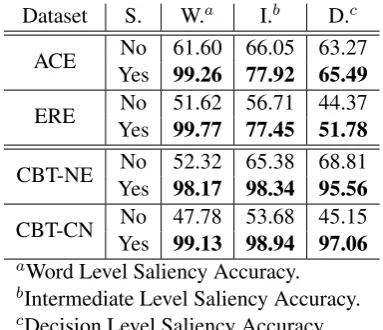
Table 2: Saliency accuracy of different layer of our models trained on ACE, ERE, CBT-NE, CBT-CN.
models without saliency learning, we conducted the one-sided McNemar’s test. The obtained p-values are0.03,0.03, 0.0001, and 0.04 for ACE, ERE, CBT-NE, and CBT-CN respectively, indicat-ing that the performance gain by saliency learnindicat-ing is statistically significant.
5.2 Saliency Accuracy
In this section, we examine how well does the saliency of the trained model aligns with the an-notation. To this end, we define a metric called
saliency accuracy (sacc), which measures what
percentage of all positive positions of annotation
Z indeed obtain a positive gradient. Formally,
sacc = 100 P
iδ(ZiGi>0)
P
iZi whereGi is the gradient
of elementiandδis the indicator function. Table 2 shows the saliency accuracy at differ-ent layers of the trained model with and with-out saliency learning. According to Table2, our method achieves a much higher saliency accuracy for all datasets indicating that the learning was in-deed effective in aligning the model saliency with the annotation. In other words, important words will have positive contributions in the saliency-trained model, and as such, it learns to focus on the right part(s) of the data. This claim can also be verified by visualizing the saliency, which is pro-vided in the next section.
5.3 Saliency Visualization
Here, we visualize the saliency of three positive samples from the ACE dataset for both the tradi-tionally trained (Baseline Model) and the saliency-trained model (saliency-saliency-trained Model). Table 3 shows the top 6 salient words (words with
high-est saliency/gradient) of three positive samples along with their contributory words (annotation
Z), the baseline model prediction (PB), and the
saliency-trained model prediction (PS). Darker
red color indicates more salient words. Accord-ing to Table 3, both models correctly predict 1 and the saliency-trained model successfully pays attention to the expected meaningful words while the baseline model pays attention to mostly irrele-vant ones. More analyses are provided in section D of the Appendix.
5.4 Verification
Up to this point, we show that using saliency learn-ing yields noticeably better precision, F1 measure, accuracy, and saliency accuracy. Here, we aim to verify our claim that saliency learning coerces the model to pay more attention to the critical parts. The annotation Z describes the influential words toward the positive labels. Our hypothesis is that
removing such words would cause more impact on the saliency-trained modelssince by training, they should be more sensitive to these words. We mea-sure the impact as the percentage change of the model’s true positive rate. This measure is cho-sen because negative examples do not have any annotated contributory words, and hence we are particularly interested in how removing contribu-tory words of positive examples would impact the model’s true positive rate (TPR).
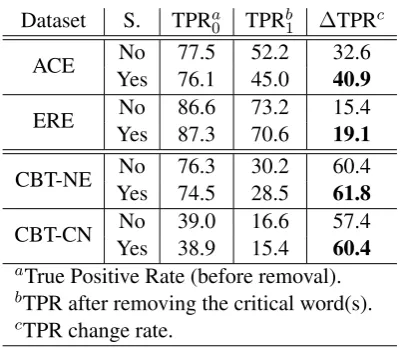
Table 4 shows the outcome of the aforemen-tioned experiment, where the last column lists the TPR reduction rates. From the table, we see a con-sistently higher rate of TPR reduction for saliency-trained models compared to traditionally saliency-trained models, suggesting that the saliency-trained mod-els are more sensitive to the perturbation of the contributory word(s) and confirming our hypoth-esis.
It is worth noting that we observe less substan-tial change to the true positive rate for the event task. This is likely due to the fact that we are using trigger words as simulated explanations. While trigger words are clearly related to events, there are often other words in the sentence relating to events but not annotated as trigger words.
6 Conclusion
id Baseline Model Saliency-trained Model Z PB PS
1 The judge at Hassan’s The judge at Hassan ’s extradition 1 1 extradition hearing said extradition hearing said hearing
that he found the French that he found the French said handwriting report very handwriting report very
problematic, very confusing, problematic, very confusing, and with suspect conclusions. and with suspect conclusions.
2 Solana said the EU would help Solana said the EU would help attack 1 1 in the humanitarian crisis in the humanitarian crisis
expected to follow an expected to follow an attack on Iraq. attack on Iraq .
[image:5.595.81.519.60.258.2]3 The trial will start on The trial will start on trial 1 1 March 13 , the court said . March 13 , the court said.
Table 3: Top 6 salient words visualization of data samples from ACE for the baseline and the saliency-trained models.
Dataset S. TPRa0 TPRb1 ∆TPRc ACE No 77.5 52.2 32.6
Yes 76.1 45.0 40.9
ERE No 86.6 73.2 15.4 Yes 87.3 70.6 19.1
CBT-NE No 76.3 30.2 60.4 Yes 74.5 28.5 61.8
CBT-CN No 39.0 16.6 57.4 Yes 38.9 15.4 60.4
aTrue Positive Rate (before removal). bTPR after removing the critical word(s). cTPR change rate.
Table 4: True positive rate and true positive rate change of the trained models before and after removing the contributory word(s).
of our method on multiple tasks and datasets us-ing simulated explanations. The results show that saliency learning enables us to obtain better pre-cision, F1 measure and accuracy on these tasks and datasets. Further, it produces models whose saliency is more properly aligned with the desired explanation. In other words, saliency learning
gives us more reliable predictions while delivering better performance than traditionally trained mod-els. Finally, our verification experiments illustrate that the saliency-trained models show higher sen-sitivity to the removal of contributory words in a positive example. For future work, we will extend our study to examine saliency learning on NLP tasks in an active learning setting where real ex-planations are requested and provided by a human.
Acknowledgments
This material is based upon work supported by the Defense Advanced Research Projects Agency (DARPA) under Contract N66001-17-2-4030.
References
Aishwarya Agrawal, Dhruv Batra, and Devi Parikh. 2016. Analyzing the behavior of visual question answering models. In Proceedings of the 2016 Conference on Empirical Methods in Natural Lan-guage Processing, EMNLP 2016, Austin, Texas,
USA, November 1-4, 2016, pages 1955–1960.
Yubo Chen, Liheng Xu, Kang Liu, Daojian Zeng, and Jun Zhao. 2015. Event extraction via dy-namic multi-pooling convolutional neural networks.
In Proceedings of the 53rd Annual Meeting of the
Association for Computational Linguistics and the 7th International Joint Conference on Natural Lan-guage Processing of the Asian Federation of Natural Language Processing, ACL 2015, July 26-31, 2015,
Beijing, China, Volume 1: Long Papers, pages 167–
176.
Yiming Cui, Zhipeng Chen, Si Wei, Shijin Wang, Ting Liu, and Guoping Hu. 2017. Attention-over-attention neural networks for reading comprehen-sion. InProceedings of the 55th Annual Meeting of the Association for Computational Linguistics, ACL 2017, Vancouver, Canada, July 30 - August 4,
Vol-ume 1: Long Papers, pages 593–602.
Bhuwan Dhingra, Hanxiao Liu, Zhilin Yang, William W. Cohen, and Ruslan Salakhutdinov. 2017. Gated-attention readers for text compre-hension. Proceedings of the 55th Annual Meeting of the Association for Computational Linguistics, ACL 2017, Vancouver, Canada, July 30 - August 4,
[image:5.595.81.283.307.481.2]Reza Ghaeini, Xiaoli Z. Fern, Liang Huang, and Prasad Tadepalli. 2016. Event nugget detection with forward-backward recurrent neural networks. Pro-ceedings of the 54th Annual Meeting of the Associ-ation for ComputAssoci-ational Linguistics, ACL 2016, Au-gust 7-12, 2016, Berlin, Germany, Volume 2: Short
Papers.
Reza Ghaeini, Xiaoli Z. Fern, Hamed Shahbazi, and Prasad Tadepalli. 2018a. Dependent gated reading for cloze-style question answering. InProceedings of the 27th International Conference on Computa-tional Linguistics, COLING 2018, Santa Fe, New
Mexico, USA, August 20-26, 2018, pages 3330–
3345.
Reza Ghaeini, Xiaoli Z. Fern, and Prasad Tadepalli. 2018b. Interpreting recurrent and attention-based neural models: a case study on natural language in-ference. InProceedings of the 2018 Conference on Empirical Methods in Natural Language Process-ing, Brussels, Belgium, October 31 - November 4, 2018, pages 4952–4957.
Suchin Gururangan, Swabha Swayamdipta, Omer Levy, Roy Schwartz, Samuel R. Bowman, and Noah A. Smith. 2018. Annotation artifacts in nat-ural language inference data. InProceedings of the 2018 Conference of the North American Chapter of the Association for Computational Linguistics: Hu-man Language Technologies, NAACL-HLT, New Or-leans, Louisiana, USA, June 1-6, 2018, Volume 2
(Short Papers), pages 107–112.
Yotam Hechtlinger. 2016. Interpretation of predic-tion models using the input gradient. CoRR, abs/1611.07634.
Felix Hill, Antoine Bordes, Sumit Chopra, and Jason Weston. 2015. The goldilocks principle: Reading children’s books with explicit memory representa-tions. CoRR, abs/1511.02301.
Rudolf Kadlec, Martin Schmid, Ondrej Bajgar, and Jan Kleindienst. 2016. Text understanding with the at-tention sum reader network. In Proceedings of the 54th Annual Meeting of the Association for Compu-tational Linguistics, ACL 2016, August 7-12, 2016,
Berlin, Germany, Volume 1: Long Papers.
Tao Lei, Regina Barzilay, and Tommi S. Jaakkola. 2016. Rationalizing neural predictions. In Pro-ceedings of the 2016 Conference on Empirical Meth-ods in Natural Language Processing, EMNLP 2016,
Austin, Texas, USA, November 1-4, 2016, pages
107–117.
Jiwei Li, Xinlei Chen, Eduard H. Hovy, and Dan Ju-rafsky. 2016. Visualizing and understanding neu-ral models in NLP. In NAACL HLT 2016, The 2016 Conference of the North American Chapter of the Association for Computational Linguistics: Hu-man Language Technologies, San Diego California,
USA, June 12-17, 2016, pages 681–691.
Jiwei Li, Will Monroe, and Dan Jurafsky. 2017. Un-derstanding neural networks through representation erasure. CoRR, abs/1612.08220.
John Walker Orr, Prasad Tadepalli, and Xiaoli Z. Fern. 2018. Event detection with neural networks: A rig-orous empirical evaluation. InProceedings of the 2018 Conference on Empirical Methods in Natural Language Processing, Brussels, Belgium, October
31 - November 4, 2018, pages 999–1004.
Jeffrey Pennington, Richard Socher, and Christo-pher D. Manning. 2014. Glove: Global vectors for word representation. Empirical Methods in Natural
Language Processing (EMNLP), pages 1532–1543.
Marco T´ulio Ribeiro, Sameer Singh, and Carlos Guestrin. 2016. ”why should I trust you?”: Explain-ing the predictions of any classifier. In Proceed-ings of the 22nd ACM SIGKDD International Con-ference on Knowledge Discovery and Data Mining,
San Francisco, CA, USA, August 13-17, 2016, pages
1135–1144.
Marco T´ulio Ribeiro, Sameer Singh, and Carlos Guestrin. 2018. Anchors: High-precision model-agnostic explanations. InProceedings of the Thirty-Second AAAI Conference on Artificial Intelligence, (AAAI-18), the 30th innovative Applications of Arti-ficial Intelligence (IAAI-18), and the 8th AAAI Sym-posium on Educational Advances in Artificial Intel-ligence (EAAI-18), New Orleans, Louisiana, USA,
February 2-7, 2018, pages 1527–1535.
Andrew Slavin Ross, Michael C. Hughes, and Finale Doshi-Velez. 2017. Right for the right reasons: Training differentiable models by constraining their explanations. In Proceedings of the Twenty-Sixth International Joint Conference on Artificial Intelli-gence, IJCAI 2017, Melbourne, Australia, August
19-25, 2017, pages 2662–2670.
Karen Simonyan, Andrea Vedaldi, and Andrew Zisser-man. 2013. Deep inside convolutional networks: Vi-sualising image classification models and saliency maps.CoRR, abs/1312.6034.
Adam Trischler, Zheng Ye, Xingdi Yuan, Philip Bach-man, Alessandro Sordoni, and Kaheer Suleman. 2016. Natural language comprehension with the epireader. InProceedings of the 2016 Conference on Empirical Methods in Natural Language Process-ing, EMNLP 2016, Austin, Texas, USA, November
1-4, 2016, pages 128–137.
A Background: Saliency
The concept of saliency was first introduced in vi-sion for visualizing the spatial support on an image for particular object class (Simonyan et al.,2013). Considering a deep model prediction as a differ-entiable model f parameterized by θ with input
X ∈ Rn×d. Such a model could be described
us-ing the Taylor series as follow:
f(x) =f(a)+f0(a)(x−a)+f 00
(a) 2! (x−a)
2+. . .
(2) By approximating that a deep model is a linear function, we could use the first order Taylor ex-pansion.
f(x)≈f0(a)x+b (3) According to Equation 3, the first derivative of the model’s prediction respect to its input (f0(a)
or ∂f∂x|x=a) describes the model’s behaviour near
the input. To make it more clear, bigger deriva-tive/gradient indicates more impact and contribu-tion toward the model’s prediccontribu-tion. Consequently, the large-magnitude derivative values determine elements of input that would greatly affect f(x)
if changed.
B Task and Dataset
Here, we first describe the main and real Event Extraction and Close-Style Question Answering tasks (before our modification). Next, we pro-vide data statistics of the modified version of ACE, ERE, CBT-NE, and CBT-CN datasets in Table5.
• Event Extraction: Given a set of ontolo-gized event types (e.g. Movement, Trans-action, Conflict, etc.), the goal of event ex-traction is to identify the mentions of differ-ent evdiffer-ents along with their types from natural texts (Chen et al.,2015;Ghaeini et al.,2016; Orr et al.,2018).
• Cloze-Style Question Answering: Docu-ments in CBT consist of 20 contiguous sen-tences from the body of a popular children book and queries are formed by replacing a token from the 21st sentence with a blank. Given a document, a query, and a set of can-didates, the goal is to find the correct replace-ment for blank in the query among the given
Dataset
Sample Count
Train Test
P.a N.b P. N.
ACE 3.2K 15K 293 421
ERE 3.1K 4K 2.7K 1.91K CBT-NE 359K 1.82M 8.8K 41.1K CBT-CN 256K 2.16M 5.5K 44.4K
[image:7.595.313.520.62.187.2]aPositive Sample Count b Negative Sample Count
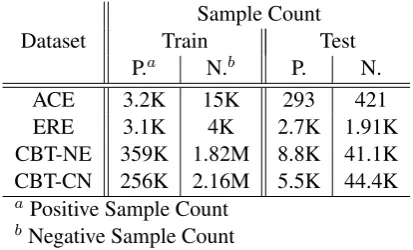
Table 5: Dataset statistics of the modified tasks and datasets.
candidates. To avoid having too many neg-ative examples in our modified datasets, we only consider sentences that contain at least one candidate. To be more clear, each sample from the CBT dataset is split to at most 20 samples – each sentence of the main sample as long as it contains one of the candidates (Trischler et al., 2016; Kadlec et al., 2016; Cui et al.,2017;Dhingra et al.,2017;Ghaeini et al.,2018a).
C Training
All hyper-parameters are tuned based on the de-velopment set. We use pre-trained300−DGlove
840B vectors (Pennington et al., 2014) to ini-tialize our word embedding vectors. All hidden states and feature sizes are300dimensions (d = 300). The weights are learned by minimizing the cost function on the training data via Adam op-timizer. The initial learning rate is 0.0001 and
λ = 0.5,0.7,0.4,and0.35 for ACE, ERE, CBT-NE, and CBT-CN respectively. To avoid overfit-ting, we use dropout with a rate of0.5for regular-ization, which is applied to all feedforward con-nections. During training, the word embeddings are updated to learn effective representations for each task and dataset. We use a fairly small batch size of 32 to provide more exploration power to the model. Finally, Equation 4 indicates the the cost function that is used for the training where
W,I, andDdim are theword embeddings,
representa-Sentence
Conv-W3 Conv-W5 Max-Pooling
Dim & Seq Max-Pooling
Sentence
Conv-W3 Conv-W5 Max-Pooling
Dim & Seq Max-Pooling
Query
Conv-W3 Conv-W5 Max-Pooling Max-Pooling
[image:8.595.79.286.282.426.2](a) (b)
Figure 2: A high-level view of the models used for event extraction(a) and question answering (b).
tionrespectively.
C(θ, X, y, Z) =L(θ, X, y)
+λ
n
X
i=1
max
0,−Zi d
X
j=1
∂fW(W, y)
∂Wi,j
+λ
n
X
i=1
max
0,−Zi d
X
j=1
∂fI(I, y)
∂Ii,j
+λ
n
X
i=1
max
0,−Zi
∂fDdim(Ddim, y)
∂Ddim,i
(4)
D Saliency Visualization
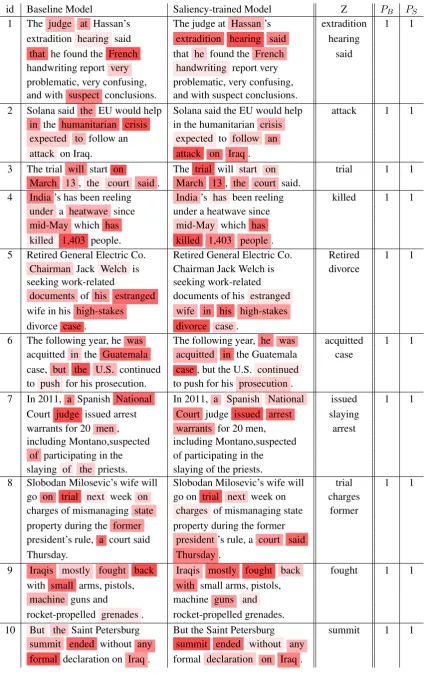
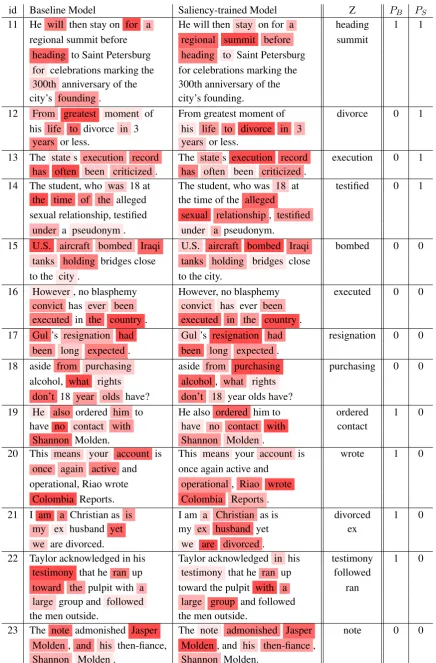
In this section, we empirically analyze the tradi-tionally trained (Baseline Model) and the saliency-trained model (saliency-saliency-trained Model) behaviour by observing the saliency of 23 positive samples from ACE and ERE datasets. Tables 6 and 7 show the top 6 salient words (words with high-est saliency/gradient) of positive samples from ACE or ERE dataset along with their contributory word(s) (Z), the baseline model prediction (PB),
and the saliency-trained model prediction (PS).
Darker red color indicates more salient words. Our observations could be divided into six categories as follow:
• Samples 1-7: Both models correctly predict 1 for these samples. The saliency-trained model successfully pays attention to the ex-pected meaningful words while the base-line model pays attention to mostly irrelevant ones.
• Samples 8-11: Both models correctly pre-dict 1 and pays attention to the contributory words. Yet, we observe lower saliency for
important words and higher saliency for ir-relevant ones.
• Samples 12-14: Here, the baseline model fails to pay attention to the contributory words and predicts 0 while the saliency-trained model one successfully pays attention to them and predicts 1.
• Samples 15-18: Although the models have high saliency for the contributory words, still they could not correctly disambiguate these samples. This observation suggests that having high saliency for important words does not guarantee positive prediction. High saliency for these words indicate their pos-itive contribution toward the pospos-itive predic-tion but still, the model might consider higher probability for negative prediction.
• Samples 19-21: Here, only the baseline model could correctly predict 1. However, the baseline model does not pay attention to the contributory words. In other words, the explanation does not support the prediction (unreliable).
id Baseline Model Saliency-trained Model Z PB PS
1 The judge at Hassan’s The judge at Hassan ’s extradition 1 1 extradition hearing said extradition hearing said hearing
that he found the French that he found the French said handwriting report very handwriting report very
problematic, very confusing, problematic, very confusing, and with suspect conclusions. and with suspect conclusions.
2 Solana said the EU would help Solana said the EU would help attack 1 1 in the humanitarian crisis in the humanitarian crisis
expected to follow an expected to follow an attack on Iraq. attack on Iraq .
3 The trial will start on The trial will start on trial 1 1 March 13 , the court said . March 13 , the court said.
4 India ’s has been reeling India ’s has been reeling killed 1 1 under a heatwave since under a heatwave since
mid-May which has mid-May which has killed 1,403 people. killed 1,403 people .
5 Retired General Electric Co. Retired General Electric Co. Retired 1 1 Chairman Jack Welch is Chairman Jack Welch is divorce
seeking work-related seeking work-related documents of his estranged documents of his estranged wife in his high-stakes wife in his high-stakes divorce case . divorce case .
6 The following year, he was The following year, he was acquitted 1 1 acquitted in the Guatemala acquitted in the Guatemala case
case, but the U.S. continued case , but the U.S. continued to push for his prosecution. to push for his prosecution .
7 In 2011, a Spanish National In 2011, a Spanish National issued 1 1 Court judge issued arrest Court judge issued arrest slaying
warrants for 20 men , warrants for 20 men, arrest including Montano,suspected including Montano,suspected
of participating in the of participating in the slaying of the priests. slaying of the priests.
8 Slobodan Milosevic’s wife will Slobodan Milosevic’s wife will trial 1 1 go on trial next week on go on trial next week on charges
charges of mismanaging state charges of mismanaging state former property during the former property during the former
president’s rule, a court said president ’s rule, a court said
Thursday. Thursday .
9 Iraqis mostly fought back Iraqis mostly fought back fought 1 1 with small arms, pistols, with small arms, pistols,
machine guns and machine guns and rocket-propelled grenades . rocket-propelled grenades.
10 But the Saint Petersburg But the Saint Petersburg summit 1 1 summit ended without any summit ended without any
[image:9.595.87.512.60.736.2]formal declaration on Iraq . formal declaration on Iraq .
id Baseline Model Saliency-trained Model Z PB PS
11 He will then stay on for a He will then stay on for a heading 1 1 regional summit before regional summit before summit
heading to Saint Petersburg heading to Saint Petersburg for celebrations marking the for celebrations marking the 300th anniversary of the 300th anniversary of the city’s founding . city’s founding.
12 From greatest moment of From greatest moment of divorce 0 1 his life to divorce in 3 his life to divorce in 3
years or less. years or less.
13 The state s execution record The state s execution record execution 0 1 has often been criticized . has often been criticized .
14 The student, who was 18 at The student, who was 18 at testified 0 1 the time of the alleged the time of the alleged
sexual relationship, testified sexual relationship , testified under a pseudonym . under a pseudonym.
15 U.S. aircraft bombed Iraqi U.S. aircraft bombed Iraqi bombed 0 0 tanks holding bridges close tanks holding bridges close
to the city . to the city.
16 However , no blasphemy However, no blasphemy executed 0 0 convict has ever been convict has ever been
executed in the country . executed in the country .
17 Gul ’s resignation had Gul ’s resignation had resignation 0 0 been long expected . been long expected .
18 aside from purchasing aside from purchasing purchasing 0 0 alcohol, what rights alcohol , what rights
don’t 18 year olds have? don’t 18 year olds have?
19 He also ordered him to He also ordered him to ordered 1 0 have no contact with have no contact with contact
Shannon Molden. Shannon Molden .
20 This means your account is This means your account is wrote 1 0 once again active and once again active and
operational, Riao wrote operational , Riao wrote Colombia Reports. Colombia Reports .
21 I am a Christian as is I am a Christian as is divorced 1 0 my ex husband yet my ex husband yet ex
we are divorced. we are divorced .
22 Taylor acknowledged in his Taylor acknowledged in his testimony 1 0 testimony that he ran up testimony that he ran up followed
toward the pulpit with a toward the pulpit with a ran large group and followed large group and followed
the men outside. the men outside.
23 The note admonished Jasper The note admonished Jasper note 0 0 Molden , and his then-fiance, Molden , and his then-fiance ,
[image:10.595.81.518.60.724.2]Shannon Molden . Shannon Molden.