151
Graph-Based Semi-Supervised Learning for
Natural Language Understanding
Zimeng Qiu†,‡, Eunah Cho‡, Xiaochun Ma‡, William M. Campbell‡ †Electrical & Computer Engineering Department, Carnegie Mellon University
‡Amazon Alexa AI
[email protected], {eunahch,mxiaochu,cmpw}@amazon.com
Abstract
Semi-supervised learning is an efficient method to augment training data automati-cally from unlabeled data. Development of many natural language understanding (NLU) applications has a challenge where unlabeled data is relatively abundant while labeled data is rather limited.
In this work, we propose transductive graph-based semi-supervised learning models as well as their inductive variants for NLU. We evalu-ate the approach’s applicability using publicly available NLU data and models. In order to find similar utterances and construct a graph, we use a paraphrase detection model. Results show that applying the inductive graph-based semi-supervised learning can improve the er-ror rate of the NLU model by 5%.
1 Introduction
Natural language understanding (NLU) technol-ogy is an important component for a dialog sys-tem and is commonly used in voice assistants (e.g., Amazon Alexa, Google Home, Siri). An NLU system takes recognized speech input and pro-duces intent, domain, and slots for the utterance to support the user request (Tur and De Mori,2011). For example, for a user request “turn off the lights in living room” the NLU system might generate domain Device, intent Light-Control, and slot values of “off” forOffTriggerand “living room” forLocation.
It is crucial for an NLU system to be able to add further support and improve performance in an in-cremental manner. An efficient method for this is semi-supervised learning (SSL), especially when only small amount of labeled data is available. In contrast with supervised learning algorithms, SSL algorithms can improve their performance by leveraging information in unlabeled data. Some recent results (Laine and Aila,2017;Miyato et al.,
2019;Tarvainen and Valpola, 2017) have shown that semi-supervised learning could reach perfor-mance of purely supervised learning in certain sce-narios.
Currently, most NLU models rely on the utter-ance text and its annotation to learn domain, in-tent, and slots of the utterance. However, this does not scale to unlabeled data. In this work, we aim to find and represent the relationship between labeled and unlabeled data in a non-Euclidean space, a graph, for SSL. We show that graph-based SSL is a high-performant method which improves an NLU model by leveraging unlabeled data.
In order to represent the labeled and unlabeled data in a graph, we used a paraphrase detection model. Nodes and edges in the graph represent utterances and paraphrase relations respectively. Given the constructed graph, a transductive graph model was applied for node classification, which in our case is intent classification (IC) for each utterance. We used an NLU Slot Gated Model (SGM) (Goo et al.,2018) to obtain slot labels. Ex-periments on the SNIPS data set show that we can achieve 5% error reduction on the slot error rate.
The rest of the paper is structured as follows: Section 2 reviews work related to our approach. Section3describes the graph-based SSL methods we propose in this paper followed by a descrip-tion of the paraphrase measures used to construct a graph. Section5describes the experimental setup. We share results and analysis in Section6. Section
7shows conclusions.
2 Related Work
Over the past few years, many deep learning ap-proaches have been extended to NLU tasks—e.g., intent classification and slot filling (Liu and Lane,
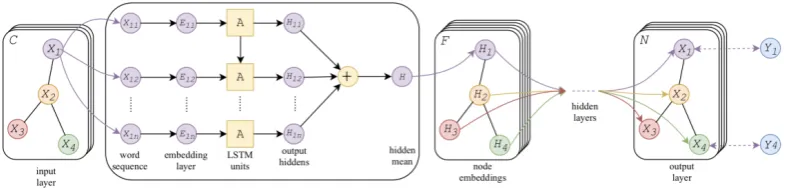
Figure 1: TGCN model architecture.
performance with much less manually annotated data compared to purely supervised learning.
Aliannejadi et al. (2017) applies graph-based supervised learning of Conditional Random Fields (CRF) for Spoken Language Understanding (SLU) on unaligned data.
Lan et al.(2018) proposes an adversarial multi-task learning method by merging a bidirectional language model (BLM) and a slot tagging model (STM). As a secondary objective, the BLM is used to learn generalized and unsupervised knowledge with abundant unlabeled data and improve the per-formance of STM on unseen data samples.
Cho et al. (2019a) generates paraphrases and uses them to enhance the training set in a semi-supervised learning setting for NLU. The aug-mented data is used jointly for domain classifica-tion, intent classification and slot filling.
The recent rise of neural networks has brought significant advances in a large number of machine learning tasks. While deep learning techniques have achieved huge success, their performance on non-Euclidean data is not as good as on Euclidean data. The complexity of graph structures is a sig-nificant challenge to most of existing deep learn-ing algorithms and this complexity has drawn the attention of community to extend deep learning al-gorithms to graph data which in turn inspired var-ious methods for Graph Neural Networks (GNN) (Kipf and Welling,2017;Velickovic et al.,2018;
Yang et al.,2018;Zhang et al.,2018a;Tran,2018;
Xinyi and Chen,2019).
GNNs can be applied in a supervised, semi-supervised, or purely unsupervised manner for dif-ferent tasks. For instance, graph convolutional networks (GCN) (Kipf and Welling,2017) could be used in a semi-supervised way for node-level classification (Kipf and Welling, 2017), in a su-pervised way for graph-level classification (Zhang et al., 2018b;Ying et al., 2018; Pan et al., 2016,
2017), and in an unsupervised way for graph em-bedding (Hamilton et al.,2017;Kipf and Welling,
2016;Pan et al.,2018;Yang et al.,2018).
To the best of our knowledge, our work is the first approach to apply a text-based graph struc-ture for SSL for NLU. We evaluate our method on a publicly available data set in order to show its applicability.
3 Graph Methods
We propose two transductive graph models for semi-supervised learning NLU tasks, Text Graph Convolutional Network (TGCN) and Text Graph Beam Search (TeGrabS), as well as their induc-tive versions, Pseudo labeling with TGCN ( PL-TGCN) and Pseudo labeling with TeGrabS (
PL-TeGrabS).
3.1 Transductive Models
In a semi-supervised learning setting, we have the following data sets, D =
{Xtrain,Xunlabeled,Xtest}. In inductive
sce-narios, labels of Xtestand Xunlabeledare unknown
to model, and the model sees Xunlabeled during
training but Xtest is unseen. In transductive
scenarios, the model sees Xtest and Xunlabeled at
training time.
In our task, transductive models learn para-phrase patterns among utterances from a given graph, then they are applied as auxiliary models in the NLU model pseudo-labeling pipeline. By doing this, we make the determination of input ut-terances labels become a parametric function of the features and thus obtain inductive variants of transductive models.
3.1.1 TeGrabS
Auxiliary model
Unlablled data Lablled data
Unlablled data
predictions
NLU model
training set
X2
X4
X1
[image:3.595.119.477.62.152.2]X3
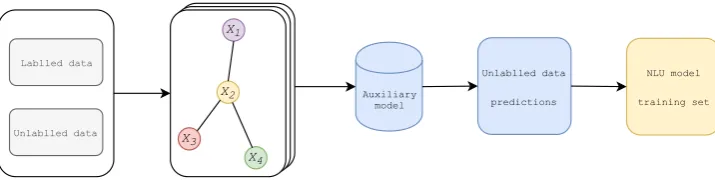
Figure 2: Inductive semi-supervised learning pipeline.
at each time step, random sample a node from the current node’s neighbors as the next node. The sampling process can be regarded as a Markov chain: the transition is represented by hop from one node to another with the weight of the edge between two nodes is the transition probabilities.
p(n0|n) =Wn,n0 (1)
where n0 is a candidate for next node, Wn,n0 is weight of edge betweennandn0. Probability of a whole transition is modelled as equation below:
p(n0, n1,· · ·, nm) = m−1
Y
i=0
Wi,i+1 (2)
If a transition does not have available next node candidates (i.e., the current node does not have any neighbors), this transition will be stopped and the beam width is reduced by 1. The beam search will be terminated when all transitions either meet the maximum number of hops limit or are stopped due to the current node not having any neighbors. Pseudocode of TeGrabS is shown as Algorithm??
in the Appendix.
3.1.2 TGCN
GCN has been commonly applied on graph data in recent years (Kipf and Welling,2017;Hamilton et al.,2017;Zhang et al.,2018b;Ying et al.,2018;
Pan et al., 2016, 2017; Kipf and Welling, 2016;
Pan et al.,2018;Yang et al.,2018). However, to the best of our knowledge, few researchers have attempted to use it for text graphs.
Here we propose our GCN-based transduc-tive text-graph semi-supervised learning model, TGCN. The model architecture is shown in Fig-ure 1. The input is a text graph including nodes {X1, X2,· · · , Xi} and edges where each node
represents a unique utterance. We use an embed-ding layer followed by LSTM cells as a feature extractor; Xij, Eij andHij are token, word
em-bedding, and LSTM hidden state forj-th word in
i-th utterance, respectively.
Ei =
1
n
X
w∈Xi
Ew (3)
wherenis the length of utteranceXi. We compute
the average sum of each token’s hidden state in utterance as the node feature.
Hi =
1
n
n
X
j=0
Hij (4)
Inspired by the original GCN architecture de-sign (Kipf and Welling,2017), the features are fed into a two-layer graph convolution network. The first graph convolution layer is followed by ReLU units,
F(l+1)=σ(De− 1 2AeDe−
1
2F(l)W(l)) (5)
where Ae = A +IN is the adjacency matrix of
the undirected graph with self-connections added,
IN is the identity matrix,Deii=PjAeij andW(l)
is a layer-specific trainable weight matrix. σ(·) is an activation function, which is ReLU in our case.F(l)is the matrix of activations inl-th layer,
F(0)=H.
And the output of second graph convolution layer is passed through a softmax layer to get dis-tribution over all classes per node.
Y =Softmax(F(2)) (6)
3.2 Inductive Models
Usage of transductive models is limited to cer-tain test cases that have been seen by model dur-ing traindur-ing. For an NLU system to support user queries, it is crucial to be able to generalize to un-seen data. Thus, we use our proposed transduc-tive models as an auxiliary model in an inductransduc-tive semi-supervised learning pipeline, which is shown as Figure2.
of unlabeled dataXunlabeled as mentioned in
pre-vious section. We apply paraphrase detection model on bothXtrain andXunlabeledto find
pair-wise paraphrase relations between utterances. De-tails of the paraphrase detection model is given in Section4.
For each utterance, we first find all its para-phrases as adjacency lists. We then build graph based on the adjacency lists. Transductive mod-els (TeGrabS, TGCN, etc.) are applied as auxil-iary model as shown in the graph, to predict labels for unlabeled data Xunlabeled from both labeled
data and graph structure. Finally, predictions of
Xunlabeledare fed into NLU model training set to
re-train the NLU model and test on the unseen test set.
Based on the transductive TeGrabS and TGCN, here we propose their inductive variants, named Pseudo-Labeling with Text-Graph Beam Search (PL-TeGrabS) and Pseudo-Labeling with TextGCN (PL-TGCN) where TeGrabS and TGCN are used as auxiliary models in the afore-mentioned inductive semi-supervised learning pipeline, respectively.
4 Paraphrase Detection for Graph Construction
In this work, we leveraged paraphrase learning to find potential paraphrases in the data set and con-struct a graph. In real-world applications, this could be obtained from analyzing usage pattern, such as repetition or rephrase of user requests. In this work, we apply the paraphrase classification model on the NLU utterances to retrieve the para-phrase pairs within the data. We then construct the graph where paraphrases are connected.
In this section, we explain how the paraphrase model is trained as well as the construction of the graph.
4.1 Paraphrase Embedding Learning
In order to obtain embedding for paraphrases, we used a word averaging model. In this approach, once a word embedding matrix is learned, we av-erage them over a sequence:
g(x) = 1
n
n
X
i
Wxi
w (7)
whereWw is a word embedding matrix.
Parame-ters are learned by minimizing an objective
func-tion with a margin, as described inWieting et al.
(2016a).
For embedding learning, we used the PPDB-S data set (Pavlick et al.,2015), which comprises 1.5 million paraphrase pairs.
4.2 Paraphrase Classification
Using the embeddings, we trained a model that outputs a score as an indicative for the pair to be paraphrases of each other. In the model, we used the embedding approach described in Section4.1
and obtain an embeddingefor each utterance. For a pair of utterancesu1 andu2, we combine their
embeddings in the following way:
h= [eu1, eu2,|eu1 −eu2|, eu1×eu2] (8)
where we concatenate each utterance’s embed-ding, element-wise difference and product be-tween the two.
We then used a fully-connected network to out-put the probability for two utterances being para-phrases. We used two 100-dimension hidden lay-ers with ReLU activation (Nair and Hinton,2010) for the task. Further details of the embedding learning and classification model can be found in
Cho et al.(2019b).
To train the paraphrase classification model, we used a back-translated paraphrase corpus ( Wiet-ing and Gimpel,2017). For positive examples, we randomly selected 1.4M paraphrase pairs from the corpus. For negative examples, we randomly pair up utterances within the corpus so that the utter-ances in the pair are not paraphrases of each other. In the end, we obtained 2.8M pairs of data, with balanced positive and negative labels.
Using the method above leads to an F-score of 98.39on a test set with balanced 20K pairs. Note that the performance of classification model is ex-pected to regress when applied on the target task data, due to the domain mismatch between the sizable, publicly available paraphrase corpus ( Wi-eting and Gimpel, 2017) and the NLU task data (Coucke et al.,2018).
In this work, we consider paraphrase pairs whose score returned by the model is higher than a threshold θ = 0.99. Detailed statistics on the constructed graph can be found in Section6.
5 Experimental Setup
Intent Utterances with slot labels
searchFlight find me a flight from [origin](Paris) to [destination](New York) searchFlight I need a flight leaving [date](this weekend) to [destination](Berlin)
[image:5.595.79.527.155.250.2]searchFlight show me flights to go to [destination](new york) leaving [date](this evening)
[image:5.595.80.287.290.360.2]Table 1: Examples of the SNIPS Dataset.
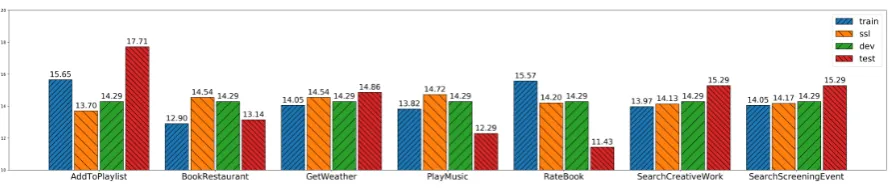
Figure 3: Intent distribution in SNIPS Train, SSL, Dev and Test sets.
No. Utterances
Train 1,310
SSL candidate (unlablled) 11,774
Dev 700
Test 700
Table 2: SNIPS data statistics.
used for training and evaluating the suggested SSL approach. We also describe the NLU model used in this work, followed by description on the com-parative systems.
5.1 Data
To evaluate the proposed model, experiments were performed on SNIPS dataset (Coucke et al.,2018), which is collected from the SNIPS personal voice assistant. This data comes with a pre-cut train, dev, and test sets, which contain 13,084, 700 and 700 utterances respectively. There are 72 slot la-bels and 7 intent types for the training set. Ex-ample utterances from the SNIPS data is shown in Table1.
Designing a real-world application often faces with a challenge where there is an abundant amount of unlabeled data, but only a limited amount of labeled data. In order to simulate this scenario, we split the training data portion further, so that only 10% of the labeled training data is used for model training. The rest 90% of the la-beled training data would be considered as candi-dates for SSL. Thus, we did not rely on the an-notated labels in the SSL portion of the training data, but consider this as an unlabeled data and try
to learn them from SSL process. Overall dataset statistics is given in Table2, intent distributions in Train, SSL, Dev and Test set are shown in Figure
3.
5.2 NLU System Description
The NLU model we used is a Slot-Gated attention-based bidirectional long short-term memory Model (SGM) (Goo et al., 2018). In our setting, the full-attention setup was used, which achieves the best performance in the paper. We used the default hyper-parameters from the code base. For TGCN and TeGrabS, graph structure was used to determine intent labels of unlabelled SSL candi-dates. Then, since Slot-Gated model leverages in-tent classification results to make slot predictions, graph SSL actually also helps in filling slots.
5.3 Comparative systems
In order to explore the effectiveness of the SSL ap-proaches we discuss in this work, we rely on two comparative systems. First system (“Baseline”) is trained only on training data in Table2, with-out applying SSL. In the second system Pseudo Labelling Baseline (“PL-Baseline”), we applied SSL, more specifically, pseudo labelling, but with-out leveraging the graph structure. For this sys-tem, we first trained the Baseline then infer labels for unlabeled data Xunlabeled with Baseline.
Af-ter givingXunlabeledpseudo labels, we put it into
NLU model training set, along withXtrain, to
What is the weather forecast
tomorrow in french
What s the weather forecast for seychelles
What s the temperature
today in griffin
What s the weather like in serbia What s the humidity right
now in aguila
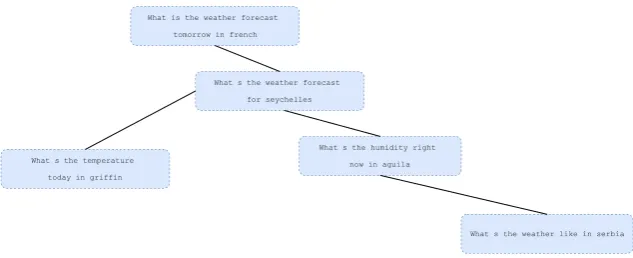
Figure 4: Excerpt of constructed graph using SNIPS data. Graph is constructed to represent utterance similarity using a paraphrase measure.
Model IC Acc. IC F1 Slot F1 SER
Baseline* 92.57 92.52 59.30 67.43 PL-Baseline 92.86 92.03 59.61 68.71 PL-TGCN 93.14 92.48 63.95 63.86
[image:6.595.140.457.60.189.2]PL-TeGrabS 73.43 72.95 58.02 73.71
Table 3: Transductive results on SNIPS data. *Baseline for Snips dataset is Slot Gated Modeling (Goo et al.,2018).
5.4 Evaluation
We report IC accuracy, F1 score, slot F1 and Slot Error Rate (SER) as metrics to measure the perfor-mance of the models.
SER is a metric used to combine intent classifi-cation accuracy and the slot classificlassifi-cation accuracy in a single score. It is defined as:
SER= S+I+D
S+D+C
where S is number of substitution errors for intents or slots, I is the number of insertion errors for in-tents or slots, D is the number of deletion errors for intents or slots, and C is the number of correct slots and intents.
6 Results
In this section, we first discuss the constructed graph using paraphrase measures. We then report the inductive SSL performance with graph meth-ods as auxiliary models.
6.1 Constructed Graph
The paraphrase graph is built based on the train and SSL candidate set as we discussed in previ-ous sections. Figure4is a part of the constructed graph, from which we can observe paraphrase pat-terns among connected components. We have also confirmed that neighbors in this excerpt share the
same intent (GetWeather) as well as similar slots.
The whole graph contains 12,895 nodes (which indicates that there are duplicates in SNIPS dataset), 52,876 edges when we set the paraphrase thresholdθ= 0.99.
6.2 Inductive Results
We evaluated baselines and our proposed models on the SNIPS dataset. Intent classification and slot filling experiment results are shown in Table3.
We can observe that PL-TGCN outperformed other models on intent classification accuracy. However, this model is slightly defeated by base-line on intent classification F1-score. Our anal-ysis revealed that PL-TGCN tends to predict more utterances into AddToPlaylist instead of PlayMusic, compared to baseline. Since
gate in SGM, leading to a great reduction on SER.
7 Conclusion and Future Work
In this work, we proposed transductive graph-based semi-supervised learning models as well as their inductive variants for NLU. In order to find similar utterances and construct a graph, we use a paraphrase detection model. To the best of our knowledge, our work is the first approach to ap-ply text based graph structure for an SSL of NLU. We evaluate our method’s applicability on publicly available data and model. Results show that ap-plying the inductive graph-based semi-supervised learning can reduce the error rate of the NLU model by 5%.
In the future, we will extend our work on other public datasets, explore methods to directly pre-dict slots with transductive graph models. We will also make further research on applying other SSL techniques, e.g. iterative bootstrapping, instead of pseudo-labelling.
References
Mohammad Aliannejadi, Masoud Kiaeeha, Shahram Khadivi, and Saeed Shiry Ghidary. 2017. Graph-based semi-supervised conditional random fields for spoken language understanding using unaligned data.CoRR, abs/1701.08533.
Eunah Cho, He Xie, and William M Campbell. 2019a. Paraphrase generation for semi-supervised learning in nlu. In Proceedings of the Workshop on Meth-ods for Optimizing and Evaluating Neural Language Generation, pages 45–54.
Eunah Cho, He Xie, John Lalor, Varun Kumar, and William M Campbell. 2019b. Efficient semi-supervised learning for natural language understand-ing by optimizunderstand-ing diversity.
Alice Coucke, Alaa Saade, Adrien Ball, Th´eodore Bluche, Alexandre Caulier, David Leroy, Cl´ement Doumouro, Thibault Gisselbrecht, Francesco Calt-agirone, Thibaut Lavril, Ma¨el Primet, and Joseph Dureau. 2018. Snips voice platform: an embedded spoken language understanding system for private-by-design voice interfaces.CoRR, abs/1805.10190.
Chih-Wen Goo, Guang Gao, Yun-Kai Hsu, Chih-Li Huo, Tsung-Chieh Chen, Keng-Wei Hsu, and Yun-Nung Chen. 2018.Slot-gated modeling for joint slot filling and intent prediction. In Proceedings of the 2018 Conference of the North American Chapter of the Association for Computational Linguistics: Hu-man Language Technologies, NAACL-HLT, New Or-leans, Louisiana, USA, June 1-6, 2018, Volume 2 (Short Papers), pages 753–757.
William L. Hamilton, Zhitao Ying, and Jure Leskovec. 2017. Inductive representation learning on large graphs. InAdvances in Neural Information Process-ing Systems 30: Annual Conference on Neural In-formation Processing Systems 2017, 4-9 December 2017, Long Beach, CA, USA, pages 1024–1034.
Thomas N. Kipf and Max Welling. 2016. Variational graph auto-encoders.CoRR, abs/1611.07308.
Thomas N. Kipf and Max Welling. 2017. Semi-supervised classification with graph convolutional networks. In 5th International Conference on Learning Representations, ICLR 2017, Toulon, France, April 24-26, 2017, Conference Track Pro-ceedings.
Samuli Laine and Timo Aila. 2017. Temporal ensem-bling for semi-supervised learning. In 5th Inter-national Conference on Learning Representations, ICLR 2017, Toulon, France, April 24-26, 2017, Con-ference Track Proceedings.
Ouyu Lan, Su Zhu, and Kai Yu. 2018. Semi-supervised training using adversarial multi-task learning for spoken language understanding. In2018 IEEE In-ternational Conference on Acoustics, Speech and Signal Processing, ICASSP 2018, Calgary, AB, Canada, April 15-20, 2018, pages 6049–6053.
Bing Liu and Ian Lane. 2016. Attention-based recur-rent neural network models for joint intent detection and slot filling. InInterspeech 2016, 17th Annual Conference of the International Speech Communica-tion AssociaCommunica-tion, San Francisco, CA, USA, Septem-ber 8-12, 2016, pages 685–689.
Takeru Miyato, Shin-ichi Maeda, Masanori Koyama, and Shin Ishii. 2019. Virtual adversarial training: A regularization method for supervised and semi-supervised learning. IEEE Trans. Pattern Anal. Mach. Intell., 41(8):1979–1993.
Vinod Nair and Geoffrey E Hinton. 2010. Rectified linear units improve restricted boltzmann machines. InProceedings of the 27th international conference on machine learning (ICML-10), pages 807–814.
Shirui Pan, Ruiqi Hu, Guodong Long, Jing Jiang, Lina Yao, and Chengqi Zhang. 2018. Adversarially reg-ularized graph autoencoder for graph embedding. InProceedings of the Twenty-Seventh International Joint Conference on Artificial Intelligence, IJCAI 2018, July 13-19, 2018, Stockholm, Sweden., pages 2609–2615.
Shirui Pan, Jia Wu, Xingquan Zhu, Guodong Long, and Chengqi Zhang. 2017. Task sensitive feature exploration and learning for multitask graph classi-fication.IEEE Trans. Cybernetics, 47(3):744–758.
Ellie Pavlick, Pushpendre Rastogi, Juri Ganitkevitch, Benjamin Van Durme, and Chris Callison-Burch. 2015. Ppdb 2.0: Better paraphrase ranking, fine-grained entailment relations, word embeddings, and style classification. InProceedings of the 53rd An-nual Meeting of the Association for Computational Linguistics and the 7th International Joint Confer-ence on Natural Language Processing (Volume 2: Short Papers), volume 2, pages 425–430.
Antti Tarvainen and Harri Valpola. 2017. Mean teach-ers are better role models: Weight-averaged consis-tency targets improve semi-supervised deep learning results. InAdvances in Neural Information Process-ing Systems 30: Annual Conference on Neural In-formation Processing Systems 2017, 4-9 December 2017, Long Beach, CA, USA, pages 1195–1204.
Phi Vu Tran. 2018. Learning to make predictions on graphs with autoencoders. In 5th IEEE Interna-tional Conference on Data Science and Advanced Analytics, DSAA 2018, Turin, Italy, October 1-3, 2018, pages 237–245.
Gokhan Tur and Renato De Mori. 2011. Spoken lan-guage understanding: Systems for extracting seman-tic information from speech. John Wiley & Sons.
Petar Velickovic, Guillem Cucurull, Arantxa Casanova, Adriana Romero, Pietro Li`o, and Yoshua Bengio. 2018. Graph attention networks. In 6th Inter-national Conference on Learning Representations, ICLR 2018, Vancouver, BC, Canada, April 30 - May 3, 2018, Conference Track Proceedings.
John Wieting, Mohit Bansal, Kevin Gimpel, and Karen Livescu. 2016a. Towards universal paraphrastic sen-tence embeddings. International Conference on Learning Representations (ICLR).
John Wieting and Kevin Gimpel. 2017. Paranmt-50m: Pushing the limits of paraphrastic sentence embed-dings with millions of machine translations. arXiv preprint arXiv:1711.05732.
Zhang Xinyi and Lihui Chen. 2019. Capsule graph neural network. In 7th International Conference on Learning Representations, ICLR 2019, New Or-leans, LA, USA, May 6-9, 2019.
Zhilin Yang, Junbo Jake Zhao, Bhuwan Dhingra, Kaiming He, William W. Cohen, Ruslan Salakhut-dinov, and Yann LeCun. 2018. Glomo: Unsuper-vised learning of transferable relational graphs. In
Advances in Neural Information Processing Systems 31: Annual Conference on Neural Information Pro-cessing Systems 2018, NeurIPS 2018, 3-8 December 2018, Montr´eal, Canada., pages 8964–8975.
Zhitao Ying, Jiaxuan You, Christopher Morris, Xi-ang Ren, William L. Hamilton, and Jure Leskovec. 2018. Hierarchical graph representation learning with differentiable pooling. InAdvances in Neural Information Processing Systems 31: Annual Con-ference on Neural Information Processing Systems
2018, NeurIPS 2018, 3-8 December 2018, Montr´eal, Canada., pages 4805–4815.
Jiani Zhang, Xingjian Shi, Junyuan Xie, Hao Ma, Ir-win King, and Dit-Yan Yeung. 2018a. Gaan: Gated attention networks for learning on large and spa-tiotemporal graphs. In Proceedings of the Thirty-Fourth Conference on Uncertainty in Artificial Intel-ligence, UAI 2018, Monterey, California, USA, Au-gust 6-10, 2018, pages 339–349.