Robust Document Representations for
Cross-Lingual Information Retrieval in Low-Resource Settings
Mahsa Yarmohammadi1, Xutai Ma2, Sorami Hisamoto3, Muhammad Rahman4, Yiming Wang5, Hainan Xu6, Daniel Povey7, Philipp Koehn8and Kevin Duh9
Center for Language and Speech Processing, Johns Hopkins University, Baltimore, MD, USA
{mahsa1,xutai ma2,sorami3,mahbubur4,yiming.wang5,phi8}@jhu.edu {hainan.xv6,dpovey7}@gmail.com [email protected]9
Abstract
The goal of cross-lingual information re-trieval (CLIR) is to find relevant docu-ments written in languages different from that of the query. Robustness to transla-tion errors is one of the main challenges for CLIR, especially in low-resource settings where there is limited training data for building machine translation (MT) systems or bilingual dictionaries. If the test col-lection contains speech documents, addi-tional errors from automatic speech recog-nition (ASR) makes translation even more difficult. We propose a robust document representation that combines N-best trans-lations and a novel bag-of-phrases out-put from various ASR/MT systems. We perform a comprehensive empirical analy-sis on three challenging collections; they consist of Somali, Swahili, and Tagalog speech/text documents to be retrieved by English queries. By comparing various ASR/MT systems with different error pro-files, our results demonstrate that a richer document representation can consistently overcome issues in low translation accu-racy for CLIR in low-resource settings.
1 Introduction
Cross-lingual Information Retrieval (CLIR) is a search task where the user’s query is written in a language different from that of the documents in the collection. There are some important niche applications, for example, a local news reporter
c
2019 The authors. This article is licensed under a Creative Commons 4.0 licence, no derivative works, attribution, CC-BY-ND.
searching foreign-language news-feeds to obtain different perspectives for her story, or a patent writer exploring the patents in another country to understand prior art before submitting her applica-tion, or an aid worker monitoring the social media of a disaster-affected area, looking for unmet needs and new emergencies. In all these scenarios, CLIR increases the user base by enabling users who are not proficient in the foreign language to produc-tively participate as knowledge workers. Even if the user requires manual translations of the re-trieved documents to complete her task, CLIR can at least provide a triage/filtering step.
CLIR performance depends critically on the ac-curacy of its underlying machine translation or bilingual dictionary component. Recent advances in MT suggest that it is now ever more possi-ble to build CLIR for practical use. In particu-lar, the availability of large amounts of parallel text in some language-pairs (e.g. English sen-tences and their aligned German translations from European Parliamentary proceedings) had led to dramatic improvements in MT quality. How-ever, there are many language-pairs–what we term ”low-resource” settings–where parallel text is lim-ited and the challenge is to make CLIR robust to translation errors. Missing words in translation may lead to degradation in recall, while extrane-ous words may lead to degradation in precision.
in-dexing the N-best translations from MT leads to better CLIR than indexing only the 1-best (most-likely) translation. We also propose a novel bag-of-phrases document representation and show that it can be effectively combined with the N-best doc-ument representations. The idea behind the bag-of-phrases translation is the fact that less strict syn-tax is required in a CLIR system, which is of-ten based on keyword search. The bag-of-phrases method relaxes the strict language grammar in the target language when producing translations, and instead, emphasizes the selection of translation words.
We perform comprehensive experiments on three low-resource test collections from the IARPA MATERIAL project (OpenCLIR Evalua-tion, 2018), where the documents are in Somali, Swahili, and Tagalog and the queries are in En-glish. The inclusion of speech documents (au-dio files) in this collection means that automatic speech recognition (ASR) has to be run before MT, leading to further challenges in translation accuracy. Our results demonstrate that a rich document representation containing many transla-tion hypotheses consistently improves CLIR per-formance in these low-resource settings.
2 Related Work
The key component in CLIR is translation, to resolve language gap between documents and queries. An appropriate approach is query lation (Oard et al., 2008), where the query is trans-lated into the desired language based on a dictio-nary (Pirkola et al., 2001), or parallel corpora (Du-mais et al., 1996). Query translation often suf-fers from translation ambiguity due to the limited amount of context in short queries. Another ap-proach is document translation (Croft et al., 1991), which can produce more precise translation due to having more context. Several studies have com-pared the query translation and document transla-tion approaches (Nie, 2010; Dwivedi and Chandra, 2016).
In recent years, deep neural networks have shown significant results on NLP tasks such as machine translation (Bahdanau et al., 2014), how-ever, applying such models to information re-trieval tasks has had relatively less positive results (Craswell et al., 2016). The reason is that, first, IR tasks are fundamentally different from NLP tasks, and second, the application of neural networks to
IR problems has been under-explored. Recently some work on CLIR adopt word embedding ap-proaches to use unlabeled text to learn the repre-sentations in unsupervised manner, and use them for document search (Vuli´c and Moens, 2015; Litschko et al., 2018; Josifoski et al., 2019). Such methods allow to learn representations from com-parable data or independent monolingual data and alleviate the need for full-fledged machine trans-lation. However, these methods are mostly useful when operating at Web scale, such as searching in Wikipedia articles, is considered. In this study, we focus on searching on a limited set of given docu-ments in foreign low-resource language.
3 Task
The goal of the task we focus on this paper is to develop ASR, MT, and IR methods to most ef-ficiently respond to queries against multilingual speech and text data in low-resource languages. The system will take English queries as input, and returns retrieved documents relevant to the queries as output. To resolve language differences in doc-uments and queries, we focus on the document translation approach: all source documents in the foreign low-resource language are translated into English before search. Since some of the source documents are speech documents (audio files), we first run our ASR system on those to convert them to text before translation.
For each input query, the translated speech and text documents are searched via standard mono-lingual information retrieval approaches (e.g., BM25), which match words between query and document. Translation errors will naturally make this retrieval step more difficult. The retrieved doc-uments are sorted according to their match scores, and we evaluate performance by comparing with the true (human-labeled) relevance ranking using standard metrics like Mean Averaged Precision (MAP).
4 Methods
4.1 Index and Search
Our CLIR engine is based on the document trans-lation approach, where all foreign documents are translated beforehand and the English is what is indexed. We use a pre-existing search engine im-plementation Elasticsearch1to index, search, and
Foreign speech
document ASR
B o P Foreign text
document
English Index
English query Retrieved
documents Speech
MT
Text MT
N-best
N-best
N-best
B o P
B o P
B o P
B o P
[image:3.595.90.515.82.315.2]B o P
Figure 1:N-best+Bag-of-Phrases document representations for CLIR.
rank our translated documents. We use a standard built-in English analyzer to pre-process the docu-ment and query text. The analyzer conducts tok-enization, word stemming, and stop word removal. We parse input query strings and convert them into Elasticsearch executable JSON format, then use those to retrieve search results from the Elastic-search engine. We use Okapi BM25 (Robertson et al., 2009) algorithm to score the documents. BM25 is a popular algorithm to rank documents based on the relevance to a given query. We tuned the BM25 hyper parameters (for term frequency normaliza-tion and document length normalizanormaliza-tion), for each language to get the best CLIR performance. Fi-nally the document ranking scores for each query are passed to the evaluation. CLIR performance is evaluated using the standard Mean Average Preci-sion (MAP) measure.
4.2 Document Representations
To increase recall of documents and prevent error propagation from potential ASR or MT errors, we added multiple hypotheses capability to our CLIR pipeline. We implemented three types of pipelines, N-best decoding, bag-of-phrases, and combination of the two representations.
N-best decoding For speech documents, first, ASR generates N-best list for each input segment. Then MT decodes each of the ASR segment tran-scripts, generating M-best translations. The result
is an N×M list, which is indexed into the IR sys-tem with equal weighting. We explored two varia-tions of N-best decoding, first where the full N×M matrix is included in the document to be indexed. The second variation is where we sub-sample the full N×M matrix to its diagonal elements, that is the best translation of the best ASR output, the sec-ond best translation of the secsec-ond best ASR output, and so on and so forth. We did not notice gains in the CLIR performance from including the full matrix in the document as opposed to including only its diagonals. This shows that the redundancy of hypotheses in the full matrix is not necessary for CLIR. For simplicity, we only present results where N=M. For text documents, MT generates N-best translations of each sentence.
Bag-of-PhrasesFor speech documents, first, ASR generates N-best list for each input segment. Then we use the phrase-based MT system to generate all possible phrases whose source side matches the ASR transcripts. In other words, we output all the translation options but do not perform a full decod-ing search with language models. For each input segment, all of the output phrases are concatenated together to form the bag-of-phrases for that seg-ment. ForN > 1, bag-of-phrases of all of N-best
lists are considered. These bag-of-phrases are then indexed into the IR system. The same procedure is applied to each sentence in text documents.
Bag-of-ime andikwa na Mwandishi Wetu and
written author
has our
is has been
it has it it is been have
recorded written , is written By written on
with by , and and the
reporter writer Journalist
Our :
written our
recorded written , is written By written on
Our :
and with by , and and the
author reporter
writer Journalist
and with by , and and the
author reporter
writer Journalist
our Our : author
reporter writer Journalist
[image:4.595.73.297.74.329.2]our Our :
Figure 2:Bag-of-phrases (BoP) representation of the Swahili sentence “Imeandikwa na Mwandishi Wetu”. The phrases in the boxes are all possible phrases that can be extracted from the phrase-based decoder.
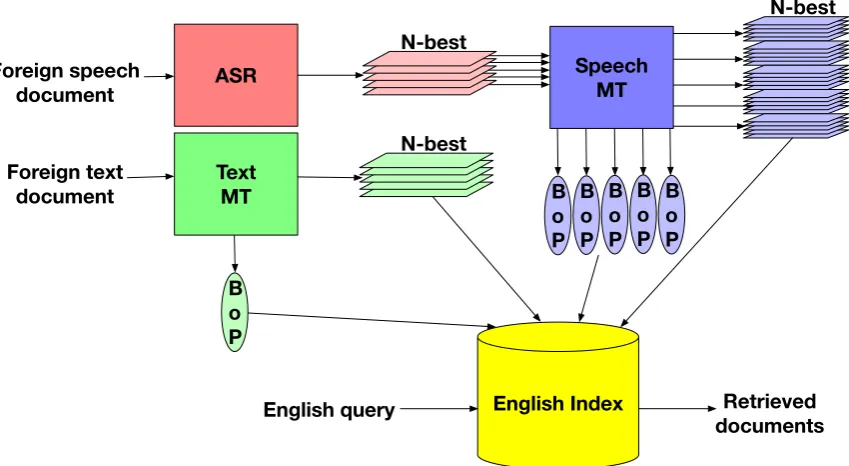
Phrases Our IR system allows multiple “views” of the same document. We can index on both N-best decoding and bag-of-phrases (BoP). The search function will score documents based on how well the query matches either of the views. As shown in Figure 1, foreign text documents are run through a text MT system to produce N-best and BoP outputs. Foreign speech documents are first run through the ASR system to be transcribed to N-best hypotheses. The hypotheses are then run through the speech MT system, which is the same as the text MT system but adapted to inter-face better with ASR, to produce N-best and BoP outputs. Finally, N-best and BoP outputs from for-eign speech and text documents are indexed and searched in response to English queries and rele-vant documents are retrieved.
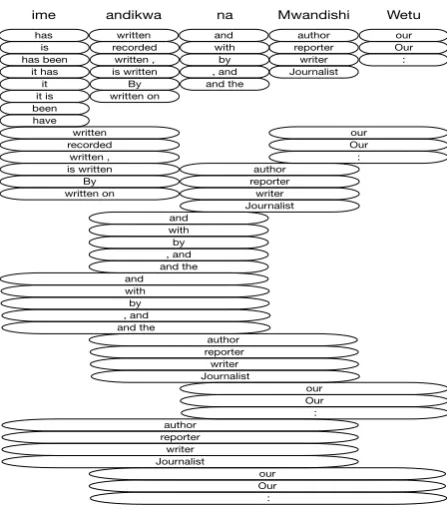
By indexing and searching both N-best and BoP representations we not only consider the most ac-curate translations achieved via N-best but also take advantage of additional lexical variety pro-vided by BoP. Figure 2 shows all possible phrases from the phrase-based MT decoder for the ex-ample input sentence ”Imeandikwa na Mwandishi Wetu” in Swahili. These phrases, form the BoP representation of that sentence, and as can be seen, a variety of translations for different input spans
are produced (e.g., the translations “author”, “re-porter”, “writer”, and “Journalist” for the Swahili word “Mwandishi”). The N-best (N=5) transla-tions of the sentence are all the same sentence “it has been written by our writer” with different prob-abilities. Although the N-best output is a descent translation of the input in this example, it does not have as much word diversity as we could get from the BoP translation, thus hurting the retrieval of documents relevant to the query. For example, the word “Journalist” that is present in the BoP rep-resentation does not appear in the top 100 transla-tions of the N-best representation. Thus, if a query includes that specific word, the chance of retriev-ing the document decreases if only the N-best rep-resentation is searched.
5 Data
5.1 CLIR Data
Given a query the system should detect which doc-uments out of a set of docdoc-uments are responsive to the query. Queries are English word strings that may contain words from any part of speech. There are different types of queries such as a lexical query consisting of a single word (e.g., “ocean”), a lexical query consisting of a multiple words (e.g., “bicycle race”), or conceptual queries that are sub-ject to semantic expansion (e.g., “expiration+”). The set of documents includes speech and text doc-uments from different genres. Table 1 shows the number of queries and documents we used for test-ing our CLIR system. Number of text documents is almost as twice as number of speech documents in each language.
5.2 ASR and MT Data
To train our ASR systems, we used ”train” and ”tune” data, which are transcribed conversational audio, as training and development sets. In addi-tion, we used a large amount of untranscribed au-dio, the ”unlabaled” set, for semi-supervised train-ing of the acoustic model, as described in Section 6.1.
# queries (English)
# documents (Foreign) speech text total
Somali 442 279 559 838
Swahili 547 266 547 813 Tagalog 537 315 529 844
[image:4.595.308.517.682.754.2]ASR Length (hours)
train ∼40
tune ∼10
unlabeled ∼250
test ∼20
MT train (# Eng tokens) test (#sent) baseline crawled
[image:5.595.116.482.71.144.2]Somali 800k 1.7M 9.5k Swahili 808k 5.2M 11.7k Tagalog 759k 12.3M 11.4k
Table 2:ASR and MT data statistics.
We used parallel corpora (bitext) of around 800k English words to train our MT systems for trans-lating from Somali, Swahili, or Tagalog to English. This data is provided in the BUILD package of the MATERIAL project and contains news, top-ical, and blog texts with provided source URLs. In addition, we harvested and filtered bitext from Web to augment this baseline bitext. We made this data publicly available2. It is important to filter web bitext to reduce noise. We filtered the web bitext using Zipporah (Xu and Koehn, 2017) and chose filter thresholds optimized on tune sets. The crawled data improved the MT system by 1 point BLEU or more for these languages. We also added monolingual WMT news and LDC Gigaword data, which include 8.2 billion English tokens in total to train the language models of our MT systems.
The IR system indexes and searches ”test” doc-uments that are either speech or text. There are around 20 hours of test speech data and 10k for-eign sentences of test text data for each language. We have the reference transcripts and translations of ”test”, hence, we can measure the performance of our ASR and MT systems on the test set in terms of WER and BLEU scores, and also investigate how ASR/MT systems with different WER/BLEU scores impact CLIR. Table 2 shows the statistics of the ASR and MT data. For information about the number of test speech and text documents in each language see Table 1.
6 Experimental Setup 6.1 ASR system
Our ASR system follows normal pattern for Kaldi-based (Povey et al., 2011) system build. Our recipe is publicly available at GitHub3.
Acoustic and language model. We use GMM training to create alignments and lattice-free MMI-trained neural network (Povey et al., 2016) with factorized TDNN (Povey et al., 2018). We
gen-2http://www.paracrawl.eu/
3https://github.com/kaldi-asr/kaldi/tree/
master/egs/material
erate lattices with n-gram ARPA-style language model and re-score them with an n-best RNN lan-guage model (Xu et al., 2018a; Xu et al., 2018b). Source-side bitext and crawled monolingual data are used in building the n-gram LM, RNNLM re-scoring, as well as extending the baseline lexicon.
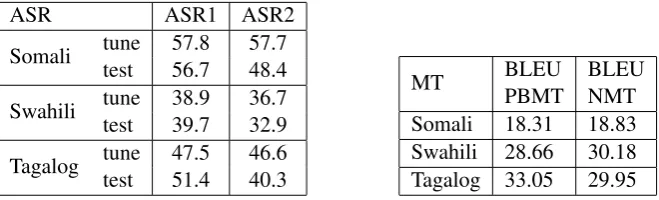
In addition to supervised training, we ran semi-supervised training of acoustic models using the extension of lattice-free MMI to semi-supervised scenarios (Manohar et al., 2018). We added un-labeled audio to the un-labeled audio in the training set to train the acoustic model. Table 3 shows the WER improvements from supervised to semi-supervised setup for Somali, Swahili, and Taga-log. To study the effect of ASR errors on CLIR, we tried both supervised and semi-supervised ASR systems in our experiments.
ASR input and output. Test data come in long unsegmented files of over a minute. To deal with this, we split the input into equal-size (15 second) slightly overlapping segments and stitch together the ASR outputs. For consistency, we lower-case all text resources that are used in training the ASR system, which include transcripts and external re-sources for language modeling (source-side bitext, web crawled monolingual text). As a result, the ASR output would be all lower-case. However, the machine translation system expects inputs that have been tokenized and true-cased. Thus, we post-process ASR output to normalize punctua-tion, tokenize, and true-case using the models and scripts that are used in MT training and decoding. This post-processing helps passing names through the MT system, and improves the IR performance.
6.2 MT System
ASR ASR1 ASR2 Somali tunetest 57.856.7 57.748.4
Swahili tunetest 38.939.7 36.732.9
Tagalog tunetest 47.551.4 46.640.3
[image:6.595.135.465.71.171.2]MT BLEUPBMT BLEUNMT Somali 18.31 18.83 Swahili 28.66 30.18 Tagalog 33.05 29.95
Table 3:%WER for supervised (ASR1) and semi-supervised (ASR2) systems, BLEU scores for PBMT and NMT systems.
length of 80, grow-diag-final-and symmetriza-tion of GIZA++ alignments, an interpolated Kneser-Ney smoothed 5-gram language model with KenLM (Heafield, 2011) used at runtime, hierarchical lexicalized reordering (Galley and Manning, 2008), a lexically-driven 5-gram opera-tion sequence model (OSM) (Durrani et al., 2013) with count bin features (Chiang et al., 2009), a distortion limit of 6, maximum phrase-length of 5, 200-best translation options, compact phrase table (Junczys-Dowmunt, 2012) minimum Bayes risk decoding (Kumar and Byrne, 2004), cube pruning (Huang and Chiang, 2007), with a stack-size of 1000 during tuning and 5000 during test. We optimize feature function weights with k-best MIRA (Cherry and Foster, 2012).
The NMT systems are LSTM sequence-to-sequence models (Luong et al., 2015). The layer size is 512, and the number of layers is 4 for Swahili and Tagalog, 2 for Somali. The models were developed using the Fairseq4 toolkit. For NMT, we applied Byte Pair Encoding (BPE) (Sen-nrich et al., 2016) to split word into subword seg-ments for both source and target languages. The number of BPE operations is 3000 for all three languages. We observed improvements in BLEU scores under small BPE settings for all three lan-guage pairs.
We filtered noisy crawled bitext using Zipporah (Xu and Koehn, 2017) and applied the unsuper-vised morphology induction tool Morfessor (Vir-pioja et al., 2013) to split words up into putative morphemes, with keeping numbers and names un-changed. We noticed that splitting the words to morphemes improves BLEU scores for Somali and Swahili, but does not help for Tagalog.
To better translate speech documents, we built systems that are adapted to interface better with ASR, which we refer to as speech MT systems. For
4We used a PyTorch implementation :https://github.
com/pytorch/fairseq
building speech MT systems, we removed punc-tuation and spelled out the numbers in the bitext before training the MT systems, which both im-proved BLEU scores.
7 Results
We run our CLIR system using document rep-resentations based on a combination of N-best transcriptions/translations and the novel bag-of-phrases output from ASR/MT. A simple baseline for comparison is the query translation approach, where each word in English query is translated into its most likely foreign word using dictionary extracted from bitext. This baseline achieves the MAP scores of 0.0967, 0.1204, 0.2293 for Somali, Swahili, and Tagalog respectively, which all are in-ferior to the results we present in this section.
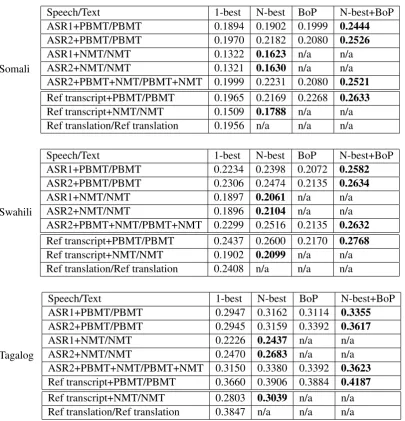
Table 4 shows MAP scores for different MT/ASR and document representation combina-tions for the three languages. For N-best and BoP representations, the results for N = 5 are shown
in the table. For text, top 5 translations for each sentence are combined and indexed as the N-best document. For speech, 5 translations of the diag-onal of the ASR × MT matrix for each speech segment are combined and indexed as the N-best document. For speech, BoP is the aggregation of bag-of-phrases translations of top 5 ASR outputs.
Somali
Speech/Text 1-best N-best BoP N-best+BoP
ASR1+PBMT/PBMT 0.1894 0.1902 0.1999 0.2444
ASR2+PBMT/PBMT 0.1970 0.2182 0.2080 0.2526
ASR1+NMT/NMT 0.1322 0.1623 n/a n/a
ASR2+NMT/NMT 0.1321 0.1630 n/a n/a
ASR2+PBMT+NMT/PBMT+NMT 0.1999 0.2231 0.2080 0.2521
Ref transcript+PBMT/PBMT 0.1965 0.2169 0.2268 0.2633
Ref transcript+NMT/NMT 0.1509 0.1788 n/a n/a Ref translation/Ref translation 0.1956 n/a n/a n/a
Swahili
Speech/Text 1-best N-best BoP N-best+BoP
ASR1+PBMT/PBMT 0.2234 0.2398 0.2072 0.2582
ASR2+PBMT/PBMT 0.2306 0.2474 0.2135 0.2634
ASR1+NMT/NMT 0.1897 0.2061 n/a n/a
ASR2+NMT/NMT 0.1896 0.2104 n/a n/a
ASR2+PBMT+NMT/PBMT+NMT 0.2299 0.2516 0.2135 0.2632
Ref transcript+PBMT/PBMT 0.2437 0.2600 0.2170 0.2768
Ref transcript+NMT/NMT 0.1902 0.2099 n/a n/a Ref translation/Ref translation 0.2408 n/a n/a n/a
Tagalog
Speech/Text 1-best N-best BoP N-best+BoP
ASR1+PBMT/PBMT 0.2947 0.3162 0.3114 0.3355
ASR2+PBMT/PBMT 0.2945 0.3159 0.3392 0.3617
ASR1+NMT/NMT 0.2226 0.2437 n/a n/a
ASR2+NMT/NMT 0.2470 0.2683 n/a n/a
ASR2+PBMT+NMT/PBMT+NMT 0.3150 0.3380 0.3392 0.3623
Ref transcript+PBMT/PBMT 0.3660 0.3906 0.3884 0.4187
[image:7.595.73.479.94.516.2]Ref transcript+NMT/NMT 0.2803 0.3039 n/a n/a Ref translation/Ref translation 0.3847 n/a n/a n/a
Table 4:MAP scores for various ASR/MT systems and document representations (N=5) on Somali, Swahili, and Tagalog test sets.
Table 1
recall_1000 0 0.1 0.2 0.3 0.4 0.5 0.6 0.7 0.8 0.9 1
PBMT 1-best 135 1 6 9 14 5 28 20 8 18 198
PBMT N-best 131 1 6 8 14 4 26 18 10 18 206
PBMT BoP 86 0 2 4 4 4 23 21 13 15 270
PBMT
N-best+BoP 79 0 3 3 5 3 21 21 13 16 278
PBMT+NMT
N-best+BoP 74 0 3 4 5 2 20 18 16 14 286
recall_1000 0 0<x<0.1 0.1<=x<0.2 0.2<=x<0.3 0.3<=x<0.4 0.4<=x<0.5 0.5<=x<0.6 0.6<=x<0.7 0.7<=x<0.8 0.8<=x<0.9 1
PBMT 1-best 93 0 3 6 10 4 32 17 11 9 361
PBMT N-best 92 0 3 6 10 3 29 16 11 11 366
PBMT BoP 81 0 0 9 8 6 23 14 4 3 399
PBMT
N-best+BoP 53 0 0 5 6 4 20 14 5 4 436
PBMT+NMT
N-best+BoP 48 0 0 6 4 4 21 16 4 4 440
recall_1000 0 0<x<0.1 0.1<=x<0.2 0.2<=x<0.3 0.3<=x<0.4 0.4<=x<0.5 0.5<=x<0.6 0.6<=x<0.7 0.7<=x<0.8 0.8<=x<0.9 1
PBMT 1-best 101 1 3 4 16 5 33 20 11 23 320
PBMT N-best 99 1 3 4 14 5 34 21 11 23 322
PBMT BoP 54 0 2 2 6 1 17 15 10 13 417
PBMT
N-best+BoP 51 0 2 3 5 1 17 12 12 13 421
PBMT+NMT
N-best+BoP 47 0 2 0 6 1 15 13 11 11 431
Number of Queries
0 75 150 225 300
Recall@1000 Somali
0 0.1 0.2 0.3 0.4 0.5 0.6 0.7 0.8 0.9 1 0 125 250 375 500
Recall@1000 Swahili
0 0.1 0.2 0.3 0.4 0.5 0.6 0.7 0.8 0.9 1
PBMT 1-best PBMT N-best PBMT BoP PBMT N-best+BoP PBMT+NMT N-best+BoP
0 125 250 375 500
Recall@1000 Tagalog
0 0.1 0.2 0.3 0.4 0.5 0.6 0.7 0.8 0.9 1
Number of Queries
0 75 150 225 300
Recall@1000
0 0.1 0.2 0.3 0.4 0.5 0.6 0.7 0.8 0.9 1 PBMT 1-best
PBMT N-best PBMT BoP PBMT N-best+BoP PBMT+NMT N-best+BoP
Figure 3:Per query recall@1000 for different systems.
[image:7.595.73.525.607.726.2]match between the query and the document.5 We also observe that the MAP scores from the ASR systems with lower word error rate (ASR2) are in general better than those from the ASR systems with higher word error rate (ASR1). This observa-tion underscores the impact of a high quality ASR system on improving the performance of CLIR.
We noticed that NMT has much higher missed detection rate compared to PBMT, which turns into a low MAP score. Although the NMT model has comparable BLEU score, high missed detec-tion indicate that NMT somehow fails to pro-duce the tokens that IR system is interested in. More investigation of the reason is future work. We also use NMT translations as an additional field to PBMT translations (ASR2+PBMT+NMT / PBMT+NMT). We can observe that there is a small improvement over PBMT N-best+BoP method for Tagalog. We plotted number of queries versus the recall after 1000 documents are re-trieved for different systems. As Figure 3 shows, when using N-best, BoP, N-best+BoP, and NMT as an additional feature, the number of queries with 0 recall decreases consistently in all three languages. This indicates that a richer document representa-tion is indeed helping in retrieving relevant docu-ments.
8 Conclusion and Future Work
The key component in CLIR is translation. The ob-jective of translation in CLIR is different from Ma-chine Translation tasks, as in information retrieval settings the goal is to retrieve relevant documents rather than having a high quality translation per se. In this study, we augmented high quality transla-tion through N-best lists with the lexical variety of translation required for IR through BoP transla-tions. We explored combinations of ASR and MT systems with different error profiles, and showed that our proposed N-best+BoP representation con-sistently performs well for CLIR on all three low-resource languages we studied. We plan to con-duct various error analyses in future work to cate-gorize the error types in our end-to-end CLIR tem, as well as comparing PBMT and NMT sys-tems. Another interesting future direction is to re-investigate these representations in the context of
5Note that these results are not necessary our best results,
since we have not tuned for scoring function and various other hyper-parameters. This exercise is meant to compare multi-ple systems in a simmulti-ple setting that varies only the document representation.
high-resource languages and stronger component systems, to contrast with the low-resource setting.
Acknowledgments
This work is supported in part by the Office of the Director of National Intelligence, Intelligence Ad-vanced Research Projects Activity (IARPA), via contract #FA8650-17-C-9115. The views and con-clusions contained herein are those of the authors and should not be interpreted as necessarily rep-resenting the official policies, either expressed or implied, of the sponsors.
References
Bahdanau, Dzmitry, Kyunghyun Cho, and Yoshua Ben-gio. 2014. Neural machine translation by jointly learning to align and translate. arXiv preprint arXiv:1409.0473.
Cherry, Colin and George Foster. 2012. Batch tuning strategies for statistical machine translation. In Pro-ceedings of the 2012 Conference of the NAACL-HLT, pages 427–436. Association for Computational Lin-guistics.
Chiang, David, Kevin Knight, and Wei Wang. 2009. 11,001 new features for statistical machine transla-tion. InProceedings of the 2009 Conference of the NAACL-HLT, pages 218–226. Association for Com-putational Linguistics.
Craswell, Nick, W. Bruce Croft, Jiafeng Guo, Maarten de Rke, and Bhaskar Mitra. 2016. Re-port on the SIGIR 2016 workshop on Neural Infor-mation Retrieval (Neu-IR). SIGIR Forum, 50(2):96– 103, December.
Croft, W Bruce, Howard R Turtle, and David D Lewis. 1991. The use of phrases and structured queries in information retrieval. In Proceedings of the 14th ACM SIGIR conference, pages 32–45.
Dumais, Susan T., Thomas K. Landauer, and Michael L. Littman. 1996. Automatic cross-linguistic information retrieval using latent seman-tic indexing. InProceedings of SIGIR Workshop on cross-Linguistic information retrieval, pages 16–23. Durrani, Nadir, Alexander Fraser, Helmut Schmid,
Hieu Hoang, and Philipp Koehn. 2013. Can markov models over minimal translation units help phrase-based smt? InProceedings of the 51st Annual Meet-ing of the ACL, volume 2, pages 399–405.
Dwivedi, Sanjay and Ganesh Chandra. 2016. A survey on cross language information retrieval. Int’l Jour-nal on Cybernetics & Informatics, 5:127–142, 02. Galley, Michel and Christopher D Manning. 2008.
EMNLP, pages 848–856. Association for Computa-tional Linguistics.
Heafield, Kenneth. 2011. KenLM: Faster and smaller language model queries. InProceedings of the sixth workshop on statistical machine translation, pages 187–197. Association for Computational Linguis-tics.
Huang, Liang and David Chiang. 2007. Forest rescor-ing: Faster decoding with integrated language mod-els. InProceedings of the 45th annual meeting of the ACL, pages 144–151.
Josifoski, Martin, Ivan S. Paskov, Hristo S. Paskov, Martin Jaggi, and Robert West. 2019. Crosslingual document embedding as reduced-rank ridge regres-sion. In Proceedings of the 12 ACM International Conference on WSDM, pages 744–752.
Junczys-Dowmunt, Marcin. 2012. A phrase table with-out phrases: Rank encoding for better phrase table compression. In Proceedings of the 16th Annual Conference of the European Association for Machine Translation.
Koehn, Philipp, Hieu Hoang, Alexandra Birch, Chris Callison-Burch, Marcello Federico, Nicola Bertoldi, Brooke Cowan, Wade Shen, Christine Moran, Richard Zens, Chris Dyer, Ondrej Bojar, Alexandra Constantin, and Evan Herbst. 2007. Moses: Open source toolkit for statistical machine translation. In
Proceedings of the 45th Annual Meeting of the ACL, pages 177–180.
Kumar, Shankar and William Byrne. 2004. Minimum bayes-risk decoding for statistical machine transla-tion. InProceedings of the Human Language Tech-nology Conference of the HLT-NAACL 2004. Litschko, Robert, Goran Glavaˇs, Simone Paolo
Ponzetto, and Ivan Vuli´c. 2018. Unsupervised cross-lingual information retrieval using monolin-gual data only. InThe 41st International ACM SIGIR Conference, pages 1253–1256.
Luong, Thang, Hieu Pham, and Christopher D. Man-ning. 2015. Effective approaches to attention-based neural machine translation. In Proceedings of the 2015 Conference on EMNLP, pages 1412–1421. Manohar, Vimal, Hossein Hadian, Daniel Povey, and
Sanjeev Khudanpur. 2018. Semi-supervised train-ing of acoustic models ustrain-ing lattice-free mmi. In
2018 IEEE ICASSP Conference, pages 4844–4848. Nie, Jian-Yun. 2010. Cross-Language Information
Re-trieval. Morgan and Claypool.
Oard, Douglas W, Daqing He, and Jianqiang Wang. 2008. User-assisted query translation for interac-tive cross-language information retrieval. Informa-tion Processing & Management, 44(1):181–211. OpenCLIR Evaluation. 2018. https:
//www.nist.gov/itl/iad/mig/ openclir-evaluation.
Pirkola, Ari, Turid Hedlund, Heikki Keskustalo, and Kalervo J¨arvelin. 2001. Dictionary-based cross-language information retrieval: Problems, methods, and research findings. Information retrieval, 4(3-4):209–230.
Povey, Daniel, Arnab Ghoshal, Gilles Boulianne, Lukas Burget, Ondrej Glembek, Nagendra Goel, Mirko Hannemann, Petr Motlicek, Yanmin Qian, Petr Schwarz, Jan Silovsky, Georg Stemmer, and Karel Vesely. 2011. The kaldi speech recognition toolkit. InIEEE 2011 Workshop on ASRU.
Povey, Daniel, Vijayaditya Peddinti, Daniel Galvez, Pe-gah Ghahremani, Vimal Manohar, Xingyu Na, Yim-ing Wang, and Sanjeev Khudanpur. 2016. Purely sequence-trained neural networks for asr based on lattice-free mmi. InInterspeech 2016, pages 2751– 2755.
Povey, Daniel, Gaofeng Cheng, Yiming Wang, Ke Li, Hainan Xu, Mahsa Yarmohammadi, and Sanjeev Khudanpur. 2018. Semi-orthogonal low-rank ma-trix factorization for deep neural networks. InProc. Interspeech 2018, pages 3743–3747.
Robertson, Stephen, Hugo Zaragoza, et al. 2009. The probabilistic relevance framework: BM25 and be-yond.Foundations and TrendsR in Information
Re-trieval, 3(4):333–389.
Sennrich, Rico, Barry Haddow, and Alexandra Birch. 2016. Neural machine translation of rare words with subword units. InProceedings of the 54th Annual Meeting of the ACL, pages 1715–1725.
Virpioja, Sami, Peter Smit, Stig-Arne Gronroos, and Mikko Kurimo. 2013. Morfessor 2.0: Python im-plementation and extensions for morfessor baseline. Technical report.
Vuli´c, Ivan and Marie-Francine Moens. 2015. Mono-lingual and cross-Mono-lingual information retrieval mod-els based on (bilingual) word embeddings. In Pro-ceedings of the 38th International ACM SIGIR Con-ference, pages 363–372.
Xu, Hainan and Philipp Koehn. 2017. Zipporah: a fast and scalable data cleaning system for noisy web-crawled parallel corpora. InProceedings of the 2017 Conference on EMNLP, pages 2945–2950.
Xu, Hainan, Tongfei Chen, Dongji Gao, Yiming Wang, Ke Li, Nagendra Goel, Yishay Carmiel, Daniel Povey, and Sanjeev Khudanpur. 2018a. A pruned rnnlm lattice-rescoring algorithm for auto-matic speech recognition. In 2018 IEEE ICASSP Conference, pages 5929–5933.