198
Improving Human Needs Categorization of Events with Semantic
Classification
Haibo Ding∗, Ellen Riloff†, Zhe Feng∗
∗
Bosch Research and Technology Center, Sunnyvale, CA 94085, USA
†School of Computing, University of Utah, Salt Lake City, UT 84112, USA
{haibo.ding,zhe.feng2}@us.bosch.com, [email protected]
Abstract
Human Needs categories have been used to characterize the reason why an affective event is positive or negative. For example,“I got the flu”and“I got fired”are both negative (unde-sirable) events, but getting the flu is a Health problem while getting fired is a Financial problem. Previous work created learning mod-els to assign events to Human Needs categories based on their words and contexts. In this paper, we introduce an intermediate step that assigns words to relevant semantic concepts. We create lightly supervised models that learn to label words with respect to 10 semantic concepts associated with Human Needs cat-egories, and incorporate these labels as fea-tures for event categorization. Our results show that recognizing relevant semantic con-cepts improves both the recall and precision of Human Needs categorization for events.
1 Introduction
Affective eventshave a positive or negative impact on the people who experience the event. For ex-ample, being hired for a job is typically a bene-ficial (positive) event, but being fired is usually a detrimental (negative) event. Recognizing affec-tive events is critical to understand people’s mo-tivations, goals, desires, and empathy in narrative stories and conversations. Previous research has proposed several methods to recognize affective events and their polarity (e.g., (Deng et al.,2013; Vu et al.,2014;Reed et al.,2017;Ding and Riloff, 2016)). To achieve a deeper level of understand-ing,Ding and Riloff(2018a) further classified af-fective events into categories associated with the-ories of Human Needs (Maslow et al.,1970; Max-Neef et al., 1991) in psychology: Physiological,
Health, Leisure, Social, Finance, and Cognition, to characterize the reason for the event’s affective polarity. For example, breaking your arm is a neg-ative event because it violates a need to maintain
one’sHealth, but fighting with your spouse is neg-ative because it violates a need for goodSocial re-lations with friends and family.
Human Needs categories naturally align with several broad conceptual classes, and we hypoth-esized that learning to recognize relevant seman-tic concepts would lead to more effective Human Needs categorization. For example, the Physiolog-icalneed corresponds to basic functions such as breathing, sleeping, eating, and drinking. Learn-ing to recognize FOOD/DRINK concepts should
help identify events that belong to this category. Broadly, semantic concepts should help in two ways. First, semantic features are more gen-eral than words, which can suffer from sparsity. Second, given semantic features, a classifier can directly learn interactions between them, which should be more robust than interactions between individual words.
In this paper, we present lightly supervised clas-sifiers that label words with respect to 10 se-mantic concepts associated with Human Needs categories: EMOTION,ENTERTAINMENT,EQUIP
-MENT, FOOD/DRINK, INTERPERSONAL, MEDI
-CAL, MENTAL-PROCESS, MONEY/JOB, PEOPLE, andOTHER. Seed words for each semantic class are used as supervision, and pre-trained embed-ding vectors are used as word features. We explore three classification models: logistic regression, instance-based learning, and prototypical neural networks (Snell et al.,2017). Finally, the semantic class predictions are used as features for Human Needs event categorization, improving both recall and precision for this task.
2 Related Work
2013), tweets (Li et al.,2014), news (Deng et al., 2013;Deng and Wiebe,2014), and personal blogs (Ding and Riloff, 2016; Reed et al., 2017; Ding and Riloff, 2018b). Recently, Ding et al. (2018) further characterized affective events in terms of human needs categories: Physiological, Health,
Leisure, Social, Financial, Cognition, and Free-dom, which can explain why an event is positive or negative. Subsequently, Ding and Riloff (2018a) designed supervised learning models and a semi-supervised co-training model to assign affective events to Human Needs categories.
Our work exploits recent advances in dis-tributed word representations and semantic em-beddings (e.g., (Mikolov et al., 2013; Penning-ton et al.,2014;Peters et al.,2018;Devlin et al., 2018)), and is related to domain adaptation of word embeddings (e.g., (Sarma et al.,2018)). But we aim to recognize a specific set of semantic concepts, rather than a specialized domain with domain-specific texts. The LIWC dictionary (Pen-nebaker et al., 2007) contains word lists for se-mantic categories that are similar to our targeted semantic concepts, but its coverage is insufficient. Our work is also related to semantic lexicon induc-tion (Thelen and Riloff,2002;McIntosh and Cur-ran,2009;Qadir and Riloff, 2012;De Benedictis et al., 2013;Gupta and Manning, 2015), contex-tual semantic tagging (Huang and Riloff, 2010), and fine-grained entity recognition (Fleischman and Hovy,2002;Ling and Weld,2012). Our goal, however, is not to generate a dictionary, or assign semantic meanings in sentence contexts. Instead, our classifier learns to recognize words that belong to a small set of relevant semantic classes based only on their pre-trained embedding vectors.
3 Lightly Supervised Semantic Classification
We hypothesized that Human Needs categoriza-tion would benefit from recognizing words that be-long to the 10 semantic concepts listed in Table1, based on our analysis of the Human Needs def-initions presented in (Ding et al., 2018). In this section, we present lightly supervised models that learn to assign words to these classes.
3.1 Seeding
The input to our classifiers is a small set of seed words for each targeted semantic class. The affec-tive events data set that we will use for our study
ENTERTAINMENT: play game movie story trip party birthday song music video
INTERPERSONAL: meet visit kiss share lie relation-ship hug marry agree admit
MENTAL-PROCESS: know remember read guess dream forget understand explain study memory
MEDICAL: die hurt pain kill sick blood hospital dead drug surgery
MONEY/JOB: job pay money deal sell business price sale purchase dollar
EQUIPMENT: car phone computer bike camera chair boat machine desk laptop
FOOD/DRINK: eat water food dinner drink lunch breakfast cake meal chocolate
PEOPLE: people friend guy girl man kid mom someone everyone family
EMOTION: good love nice fun bad happy best better smile enjoy laugh hate kind beautiful wrong amazing awesome funny crazy worry
OTHER: be have do get go time say make think take day come look thing tell start way try last year
Table 1: Semantic Concepts and Seed Words
(Section5) was generated from the ICWSM 2009 and 2011 blog corpora (Burton et al.,2009,2011), so we selected seed words from these corpora as well. We used the following procedure to iden-tify commonly used words for each category: we sorted all word lemmas by frequency and selected thektop-ranked words belonging to each seman-tic concept. We setk=10 for all classes, except we set k=20 for EMOTION and OTHER because they
are extremely large categories.1 Table1shows the seeds selected for each semantic class.
3.2 Classification
We created three classification models: logistic re-gression, instance-based learning, and prototyp-ical neural networks. For all three classifiers, we used the Word2Vec 300D pre-trained embed-dings (Mikolov et al., 2013) as features. The seed words served as training examples, along with 500 randomly selected unlabeled words as additional seeds for the OTHERcategory, since it needs to represent a large and diverse “None-of-the-Above” class.
The first model is a one-vs.-rest logistic regres-sion classifier, built using the scikit-learn toolkit (Pedregosa et al.,2011) with default parameters.
The second model uses instance-based classifi-cation. This method first creates a prototype rep-resentation for each semantic class as the mean of the word embeddings of its seeds. Given a new
1Thekvalues were chosen arbitrarily without
word, a probability distribution is computed over the semantic classes as the softmax of the negative Euclidean distance to each class prototype. The class with the highest probability is chosen.
The third model uses prototypical neural net-works (Snell et al.,2017), which have performed well on “few-shot” learning tasks with limited la-beled training data, because of its simple induc-tive bias. We created a single layer feed-forward network with ReLU activations as the embedding function f. To learn parameters for f, we use the same training algorithm asSnell et al.(2017) except that we train on all semantic classes in each training episode, and both the support set and query set consist of 5 randomly selected examples per class. During training, we use the following parameters: the dimension of the embedding rep-resentation layer is 32, the learning rate is .01, and the weight decay is .0001. We train the model for 20 epochs with 100 episodes for each epoch.
To predict the class label for a new word, the process is the same as the instance-based model, except that the learned embedding is used. First, we create a prototype embeddingck for each se-mantic class k using Equation 1, where Sk con-tains all the labeled seed words for classk.
ck=
1
|Sk| X
xi∈Sk
f(xi) (1)
Given a new word, a probability distribution over the classes is computed as the softmax of the neg-ative Euclidean distance d to each prototype, as shown in Equation2.
p(y=k|x) = Pexp(−d(f(x),ck))
k0exp(−d(f(x),ck0)) (2)
4 Human Needs Categorization
Our goal is to explore whether semantic classifi-cation of terms can improve Human Needs cate-gorization of affective events. Toward this end, we used the Human Needs categorization frame-work described inDing and Riloff(2018a) which is a co-training model that iteratively trains two models with different views of the data: (1) an
event expression classifierthat uses the words in an event expression as input, and (2) anevent con-text classifierthat uses the sentence contexts that mention an event as input. An event expression is represented as a tuple consisting of 4 compo-nents: (Agent, Predicate, Theme, PP). The event
expression classifier is a logistic regression model that takes the embedding of an event expression as input, which is computed as the average over the embeddings of its individual words. The architec-ture and models are the same, but in this paper we aim to improve the event expression classifier by incorporating semantic classification.
Given an event expression, we extract two types of semantic features from the head words of its 4 components. For each of the 4 head words, we cre-ate 10 real-valued features representing the confi-dence scores produced by the classifier for each of the 10 semantic classes. In addition, we create 10 binary features (one per semantic class) indi-cating whetheranyof the head words belongs to each class, based on the classifier’s predicted la-bels. Consequently, for each event expression the semantic classifier generates 50 semantic features.
5 Evaluation
We conducted two sets of experiments to evaluate the impact of our semantic classifiers. First, we show the results of adding semantic features to the event expression classifier for Human Needs cate-gorization. Second, we evaluate the impact of the enhanced event expression classifier in the full co-training model. We used the evaluation data set created by Ding and Riloff (2018a), which con-tains 542 affective events with manually assigned Human Needs labels. To ensure a fair comparison, we used the same evaluation settings: we perform 3-fold cross-validation on the evaluation data and report the average Precision, Recall, and F1 scores over the folds.
5.1 Human Needs Categorization Results
Features Precision Recall F1 Embed (D&R2018a) 64.2 51.7 54.8 Sem:InstBased 53.7 42.4 45.1 Sem:LR 72.3 46.8 52.0 Sem:ProtoNets 63.1 48.8 52.4 Embed+Sem:InstBased 64.2 55.2 58.1 Embed+Sem:LR 68.7 57.3 60.8 Embed+Sem:ProtoNets 67.5 58.7 61.9
Table 2: Results for Human Needs Categorization with Event Expression Classifiers
achieve an F1 score2 ≥.52, which is not far be-low the performance of the D&R model that uses embedding features.
The last three rows of Table2show results for the event expression classifier with features for
both the event expression embedding and the 50 semantic features produced by one of our three se-mantic classifiers. All of these models outperform the original D&R model. The best model, Pro-toNets, substantially improves Human Needs cat-egorization from 54.8%→61.9%.
Human Need D&R2018a Our Results Category Pr R F1 Pr R F1 Physio 81 68 74 86.7 68.3 76.3
Health 68 50 57 71.6 59.3 64.8
Leisure 69 63 66 74.8 64.0 68.8
Social 68 79 73 73.9 82.4 77.9
Finance 67 44 52 60.5 47.8 52.9
Cognition 92 46 58 83.8 54.2 65.5
Emotion 64 74 69 65.5 74.2 69.6
None 48 52 50 49.0 53.3 51.1
AVG 69.7 59.5 62.4 70.7 62.9 65.9
Table 3: Results for Human Needs Categorization with Co-Training Models
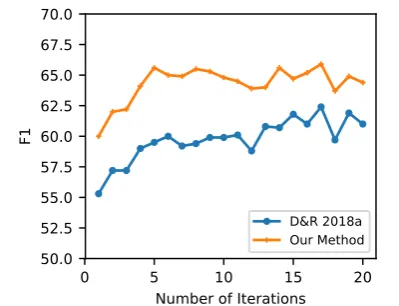
In the next set of experiments, we evaluated the impact of the new event expression classifier in the co-training model for Human Needs catego-rization. Table3shows the results for the original co-training model reported in our previous work (Ding and Riloff,2018a) alongside the results for our enhanced co-training model, which is identical except that we replaced the original event expres-sion classifier with our Embed+Sem:ProtoNets model. We used the same experimental settings, running our co-training model for 20 iterations and reporting the best results3. Table3shows the Pre-cision (Pr), Recall (R), and F1 scores for each
2Note that this result is the average F1 score over the
cross-validation folds, not the F1 score of the average pre-cision and average recall.
3Our co-training method achieved the best result after 17
iterations.
Human Needs category and the macro-averaged (AVG) scores. The enhanced co-training model improves performance on every Human Needs cat-egory, increasing the average F1 score from 62.4% to 65.9%.
0 5 10 15 20 Number of Iterations 50.0
52.5 55.0 57.5 60.0 62.5 65.0 67.5 70.0
F1
[image:4.595.316.516.144.297.2]D&R 2018a Our Method
Figure 1: Performance of Co-training Models with Se-mantic Class Features at Different Iterations
Figure 1 shows the performance of the origi-nal co-training method D&R2018a and our new method with semantic features learned by Em-bed+Sem:ProtoNets model after each iteration. This result shows that enhancing the event expres-sion classifier with semantic features helps the co-training model improve more rapidly and achieve better performance than the original model for each iteration.
5.2 Analysis of Semantic Classification
We also informally evaluated the quality of the semantic labels assigned by the semantic classi-fier, to better understand its strengths and weak-nesses. One of the authors assigned each word4 in the evaluation data to one of the 10 semantic classes. Then we compared these human labels to the predicted labels from the semantic classifier.
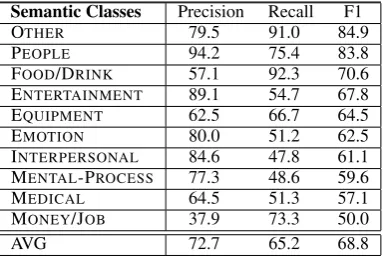
Table4shows the performance for each seman-tic class. Overall, the classifier achieved a macro-averaged F1 score of 68.8%. Performance across the semantic classes varies, with several classes achieving high precision and high or moderate re-call (OTHER, PEOPLE, ENTERTAINMENT, EMO -TION, INTERPERSONAL, MENTAL-PROCESS), a few achieving high recall but low to moderate pre-cision (FOOD/DRINK, MONEY/JOB), and a few
with moderate recall and precision (EQUIPMENT, MEDICAL). Overall, these results demonstrate
[image:4.595.75.289.363.480.2]Semantic Classes Precision Recall F1 OTHER 79.5 91.0 84.9 PEOPLE 94.2 75.4 83.8 FOOD/DRINK 57.1 92.3 70.6 ENTERTAINMENT 89.1 54.7 67.8 EQUIPMENT 62.5 66.7 64.5 EMOTION 80.0 51.2 62.5 INTERPERSONAL 84.6 47.8 61.1 MENTAL-PROCESS 77.3 48.6 59.6 MEDICAL 64.5 51.3 57.1 MONEY/JOB 37.9 73.3 50.0 AVG 72.7 65.2 68.8
Table 4: Semantic Classification Results
that the semantic classifier produced fairly good predictions for most categories given only light su-pervision. One could almost certainly further im-prove these scores with more seed examples or by incorporating readily available external resources for categories such as EMOTION and MEDICAL, which would likely yield further gains for Human Needs categorization. More generally, our lightly supervised approach for training a semantic clas-sifier demonstrates that one can rapidly create a classifier for a specific set of semantic concepts that are important for an application domain.
hI, gain, pleasureEMOTION,i
hI, be, busy, with my homeworkMENTAL-PROCESSi hwe, finish, tourENTERTAINMENT,i
hour pizzaFOOD/DRINK, arrive, ,i hmy eye, hurtMEDICAL, badEMOTION, ,i hI, try to cooperateINTERPERSONAL, ,i
hI, danceENTERTAINMENT, , with my momPEOPLEi hI, danceENTERTAINMENT, , with my friendPEOPLE i hI, not function, , at workMONEY/JOBi
hday, be, magicalEMOTION,i
hpeoplePEOPLE, buyMONEY/JOB, home,i hwe, grow, hungryFOOD/DRINK,i hI, forgetMENTAL-PROCESS, paper,i
hI, not learnMENTAL-PROCESS, something,i hI, buyMONEY/JOB, filmENTERTAINMENT,i
[image:5.595.75.293.404.635.2]hhouse phoneEQUIPMENT, not workMONEY/JOB, ,i hepiduralMEDICAL, start to workMONEY/JOB, ,i
Table 5: Examples of Affective Events with Automati-cally Predicted Semantic Classes
Table 5 presents some examples of affective events and their semantic classes that are as-signed by the Prototypical Networks Model. All the unlabeled words in the table were as-signed to OTHER class5. Besides the words
5In our experiments, we did not apply the semantic
clas-(e.g., “pleasureEMOTION”, “pizzaFOOD/DRINK”,
“cooperateINTERPERSONAL”) that were classified
correctly, some words in events also received incorrect semantic category labels. For example, the “work” in “house phone not work” and “epidural start to work” was incorrectly classified to MONEY/JOB, which suggests that it may be
beneficial to further improve the performance of semantic categorization of words in events by considering the contextual meaning of polyse-mous words. In addition, our set of semantic classes was selected based on our intuition about what concepts are most relevant to the human needs categories, but it might be worthwhile for future work to more thoroughly explore a large set of semantic concepts.
6 Conclusions
We proposed to improve human needs categoriza-tion of affective events by adding semantic fea-tures that classify terms into related semantic con-cepts. We designed lightly supervised models that learn to classify words with respect to semantic concepts using only their pre-trained word embed-ding vectors and seed words as training data. We then showed that representing semantic concepts improves both the precision and recall for Human Needs categorization of events.
Acknowledgements
This material is based in part upon work supported by the National Science Foundation under Grant Number IIS-1619394. Any opinions, findings, and conclusions or recommendations expressed in this material are those of the authors and do not nec-essarily reflect the views of the National Science Foundation. The authors thank Tianyu Jiang for his feedback and comments on the paper.
References
Kevin Burton, Akshay Java, and Ian Soboroff. 2009. The ICWSM 2009 Spinn3r dataset. InThird Annual Conference on Weblogs and Social Media.
Kevin Burton, Niels Kasch, and Ian Soboroff. 2011. The ICWSM 2011 Spinn3r dataset. InProceedings of the Annual Conference on Weblogs and Social Media.
Flavio De Benedictis, Stefano Faralli, and Roberto Navigli. 2013. Glossboot: Bootstrapping multilin-gual domain glossaries from the web. In Proceed-ings of the 51st Annual Meeting of the Association for Computational Linguistics.
Lingjia Deng, Yoonjung Choi, and Janyce Wiebe. 2013. Benefactive/malefactive event and writer at-titude annotation. InProceedings of the 51st Annual Meeting of the Association for Computational Lin-guistics.
Lingjia Deng and Janyce Wiebe. 2014. Sentiment propagation via implicature constraints. In Proceed-ings of the 14th Conference of the European Chapter of the Association for Computational Linguistics.
Jacob Devlin, Ming-Wei Chang, Kenton Lee, and Kristina Toutanova. 2018. Bert: Pre-training of deep bidirectional transformers for language understand-ing. arXiv preprint arXiv:1810.04805.
Haibo Ding, Tianyu Jiang, and Ellen Riloff. 2018. Why is an event affective? classifying affective events based on human needs. Inthe AAAI-18 Work-shop on Affective Content Analysis.
Haibo Ding and Ellen Riloff. 2016. Acquiring knowl-edge of affective events from blogs using label prop-agation. InProceedings of the AAAI Conference on Artificial Intelligence.
Haibo Ding and Ellen Riloff. 2018a. Human needs cat-egorization of affective events using labeled and un-labeled data. In Proceedings of the 2018 Confer-ence of the North American Chapter of the Associ-ation for ComputAssoci-ational Linguistics: Human Lan-guage Technologies (NAACL 2018).
Haibo Ding and Ellen Riloff. 2018b. Weakly super-vised induction of affective events by optimizing semantic consistency. InProceedings of the AAAI Conference on Artificial Intelligence.
Michael Fleischman and Eduard Hovy. 2002. Fine grained classification of named entities. In Proceed-ings of the 19th International Conference on Com-putational Linguistics.
A. Goyal, E. Riloff, and H. Daum´e III. 2013. A Com-putational Model for Plot Units. Computational In-telligence, 29(3):466–488.
Sonal Gupta and Christopher D Manning. 2015. Dis-tributed representations of words to guide boot-strapped entity classifiers. In Proceedings of the 2015 Conference of the North American Chapter of the Association for Computational Linguistics: Hu-man Language Technologies.
Ruihong Huang and Ellen Riloff. 2010. Inducing domain-specific semantic class taggers from (al-most) nothing. In Proceedings of the 48th Annual Meeting of the Association for Computational Lin-guistics.
Jiwei Li, Alan Ritter, Claire Cardie, and Eduard Hovy. 2014. Major life event extraction from twitter based on congratulations/condolences speech acts. In Pro-ceedings of Empirical Methods in Natural Language Processing.
Xiao Ling and Daniel S Weld. 2012. Fine-grained en-tity recognition. In Twenty-Sixth AAAI Conference on Artificial Intelligence.
Abraham Harold Maslow, Robert Frager, James Fadi-man, Cynthia McReynolds, and Ruth Cox. 1970.
Motivation and personality, volume 2. Harper & Row New York.
Manfred Max-Neef, Antonio Elizalde, and Martin Hopenhayn. 1991. Human Scale Development: Conception, Application and Further Reflections. The Apex Press.
T. McIntosh and J. Curran. 2009. Reducing semantic drift with bagging and distributional similarity. In
Proceedings of the 47th Annual Meeting of the As-sociation for Computational Linguistics.
Tomas Mikolov, Ilya Sutskever, Kai Chen, Greg S Cor-rado, and Jeff Dean. 2013. Distributed representa-tions of words and phrases and their compositional-ity. InAdvances in neural information processing systems.
F. Pedregosa, G. Varoquaux, A. Gramfort, V. Michel, B. Thirion, O. Grisel, M. Blondel, P. Pretten-hofer, R. Weiss, V. Dubourg, J. Vanderplas, A. Pas-sos, D. Cournapeau, M. Brucher, M. Perrot, and E. Duchesnay. 2011. Scikit-learn: Machine learning in Python. Journal of Machine Learning Research, 12:2825–2830.
James W Pennebaker, Roger J Booth, and Martha E Francis. 2007. Linguistic inquiry and word count: LIWC2007.Austin, TX: liwc.net.
Jeffrey Pennington, Richard Socher, and Christopher D Manning. 2014. GloVe: Global vectors for word representation. InProceedings of the Conference on Empirical Methods in Natural Language Process-ing.
Matthew E. Peters, Mark Neumann, Mohit Iyyer, Matt Gardner, Christopher Clark, Kenton Lee, and Luke Zettlemoyer. 2018. Deep contextualized word repre-sentations. InProceedings of the 2018 Conference of the North American Chapter of the Association for Computational Linguistics (NAACL 2018).
Ashequl Qadir and Ellen Riloff. 2012. Ensemble-based semantic lexicon induction for semantic tagging. In
Proceedings of the First Joint Conference on Lex-ical and Computational Semantics. Association for Computational Linguistics.
P. Sarma, Y. Liang, and W. Sethares. 2018. Domain adapted word embeddings for improved sentiment classification. In Proceedings of the ACL 2018 Workshop on Deep Learning Approaches for Low-Resource NLP.
Jake Snell, Kevin Swersky, and Richard Zemel. 2017. Prototypical networks for few-shot learning. In Ad-vances in Neural Information Processing Systems.
M. Thelen and E. Riloff. 2002. A bootstrapping method for learning semantic lexicons using extrac-tion pattern contexts. In Proceedings of the 2002 Conference on Empirical Methods in Natural Lan-guage Processing.