540
Amrita School of Engineering - CSE at SemEval-2019 Task 6:
Manipulating Attention with Temporal Convolutional Neural Network for
Offense Identification and Classification
Murali Sridharan, Swapna T R
Department of Computer Science and Engineering Amrita School of Engineering, Coimbatore,
Amrita Vishwa Vidhyapeetham, India
[email protected],tr [email protected]
Abstract
With the proliferation and ubiquity of smart gadgets and smart devices, across the world, data generated by them has been growing at exponential rates, in particular social media platforms like Facebook, Twitter and Insta-gram have been generating voluminous data on a daily basis. According to Twitter’s us-age statistics, about 500 million tweets are generated each day. While the tweets reflect the users’ opinions on several events across the world, there are tweets which are offen-sive in nature that need to be tagged under the hateful conduct policy of Twitter. Of-fensive tweets have to be identified, captured and processed further, for a variety of reasons, which include i) identifying offensive tweets in order to prevent violent/abusive behaviour in Twitter (or any social media for that mat-ter), ii) creating and maintaining a history of offensive tweets for individual users (would be helpful in creating meta-data for user pro-file), iii) inferring the sentiment of the users on particular event/issue/topic . We(CodaLab Team/User Name: murali sr) have em-ployed neural network models which manip-ulate attention with Temporal Convolutional Neural Network for the three shared sub-tasks i) ATT-TCN (ATTention based Temporal Convolutional Neural Network) employed for shared sub-task A that yielded a best macro-F1 score of 0.46, ii) SAE-ATT-TCN(Self At-tentive Embedding-ATTention based Tempo-ral Convolutional NeuTempo-ral Network) employed for shared sub-task B and sub-task C that yielded best macro-F1 score of 0.61 and 0.51 respectively. Among the two variants ATT-TCN and SAE-ATT-ATT-TCN, the latter performed better.
1 Introduction
In the prevailing digital era, Deep Learning has penetrated almost all industry verticals and
afforded several researchers an effective tool, in handling voluminous data and deriving mean-ingful inferences. Initially, (LeCun et al., 1998) invented Convolutional Neural Network (CNN) model for extraction of local features, which later proved to be the standard choice for Computer Vision tasks. (Hochreiter and Schmidhuber,1997) the introduced LSTM (Long Short Term Mem-ory) architecture, which went on to become the standard choice for Natural Language Processing (sequence) tasks due to the implicit ordering of the sequence data in words and sentences. Then several architectures, combining LSTM with CNN were introduced that went on to become successful for NLP tasks as well. Deep Learning techniques have leaped forward through multiple NLP tasks such as Modeling, Classification, Translation, Summarization, etc., and have proved to be better compared to traditional techniques.
Ever since social media has become ubiquitous there have been individuals who take gratuitous advantage of the anonymous nature of social me-dia platforms, and engage themselves in rude and offensive communications. Such behaviour that prohibit free flow of communication and violate acceptable usage policy has necessitated to iden-tify and capture the offensive posts, comments, etc., in order to prevent the dissemination of abu-sive behaviour in social media. (Zampieri et al.,
2019b) focused on this aspect and organized a classification task with a particular focus on Twit-ter posts; unlike predictions of positive or negative sentiments, this task has three shared sub-tasks, in-tended to identify and capture the offense target as an entity. The task includes three shared sub-tasks that include:
iii) Sub-Task C: Offense target identification. i) Sub-Task A: Offensive language identifica-tion in which posts are categorized into Offensive or Not Offensive. Recently (Bai et al.,2018) em-pirically concluded that the association between sequence modeling and recurrent neural networks should be reconsidered and established that con-volutional networks are ought to be considered for sequence modeling tasks. The TCN model can be extended followed by introduction of Attention to the output of Embedding layer and TCN layer ii) Sub-Task B: Offense type categorization in which the Offense type is categorized into either targeted or untargeted. The objective here is to understand sentence structure by emulating the re-lationship between words. The sequence of words is crucial to capture the essence of sentence unlike the practice of mere focus on constituent parts of a sentence in the previous model. Based on (Lin et al.,2017), minor modifications are injected into the previous model employed in sub-task A, and introduced self-attention for embedding further to aggregate the relationship between words in a sen-tence and stacked attention layer, at the output of each dilated convolution blocks. iii) Sub-Task C: Identification of target offense in which the who, the offense is aimed at is identified and cate-gorized into Individual, Group or Other. The same model used in the previous sub-task B is employed for this sub-task as well.
2 Related Work
In the recent past, multiple NLP tasks and pa-pers have explored Offense identification which include (bullying, aggression, hate-speech, ob-scenity, insults and identity threat). (Fortuna and Nunes, 2018) has elaborately surveyed several approaches employed for automatic detection of hate speech.
(Yin et al.,2009) was one of the first to address recognition of offensive language by employing supervised classification technique along with manually developed n-gram regex matches and, contextual attributes that considered the intensity of abuse in preceding sentences. (Sood et al.,
2012) indicated that certain banned words when used in appropriate manner and context, does not warrant to be categorized as abusive/offensive. Further, they showed a considerably improved scheme of profanity detection, by incorporating lists and distance metric, which enabled
identifi-cation and categorization of un-normalized terms like ”@$$” or ”m0r0n”. (Chen et al.,2012) used lexical and parser features, for detecting com-ments from YouTube that are offensive. Without any preset semantics of toxic content, they came up with the tool that could be manipulated through a modifiable threshold. This threshold was to be treated as a measure of toxicity, filtering the online toxic content, prior to display of contents in the client’s browser. Their work incorporated Support Vector Machines (SVMs) classifiers, which included regex (manually developed), n-gram, black-lists and dependency parse features, which achieved higher precision and recall values. (Dadvar et al., 2013) affirmed that user context was crucial in the bonafide detection of cyber-bullying. (Djuric et al., 2015) highlighted the effectiveness of comment embeddings in detection of hate speech, by joint modelling comments and words using Continuous-Bag of Words (C-BOW) to generate a low dimensional embedding. The embedding is passed to binary classifier for hate speech detection. (Mehdad and Tetreault, 2016) explored the significance of features to the extent of character to word and weighed the importance of each attribute. Since the style of comments, in online forums, vary from person to person, and often includes sub-standard profane English (i.e. ”f u c k e r”), learning how adjacent characters communicate with each other reveal more about the abusiveness of a comment as a whole.
(Vijayan et al.,2017) surveyed the pros and cons of several techniques of machine learning and deep learning in their comprehensive study of text classification algorithms. (Malmasi and Zampieri,
proposed a typology, to capture the similarity and difference between sub-tasks, and discuss their role, involved in annotating data and emulating feature construction. Their work was instru-mental in identifying if the offense was targeted towards an individual or an entity, and whether the offensive language was explicit or implicit. (Zhang et al., 2018) introduced a new method, combining Convolutional Neural Network (CNN) and Gated Recurrent Unit (GRU) to perform a compartive evaluation on public datasets, and set new benchmarks, in Hate Speech Detection on Twitter.
3 Methodology and Data
[image:3.595.319.513.72.195.2]Besides being fast and parallel, the important as-pect of TCN is causal convolution, its capability to take any arbitrary length sequence and generate an output sequence of the same arbitrary input length.
Figure 1: Temporal Convolutional Neural Network
Ever since (Bahdanau et al., 2014) introduced attention mechanism in NLP, for machine transla-tion there have been multiple advances in memory related tasks. Further (Yin et al.,2016) established that attention based CNN performed better than at-tention based LSTM (Long Short Term Memory) for the answer selection task.
Here in Sub-Task A:Offense Identification, TCN was extended for sub-task A, with attention mechanism. Instead of the conventional dropout layer, a simple attention mechanism is applied at the output of embedding layer and at the output of TCN before classification layer, as illustrated in Figure 2 and Figure 3. The intention is to avoid random dropout of constituent data, which might be crucial, and introduce a mechanism with the ability, to selectively focus on input and capi-talize on the crucial contributing parameters with
Figure 2: Temporal Convolutional Neural Network with Attention layer at the output of Embedding layer
varying attention weights and contextual vectors. ReLu (Nair and Hinton, 2010) activation is used for DilatedConvolution1D (Yu and Koltun,2015) and softmax (Bridle,1990) is used at the final clas-sification layer.
Figure 3: Temporal Convolutional Neural Network with Attention layer at the output of TCN before final Classification
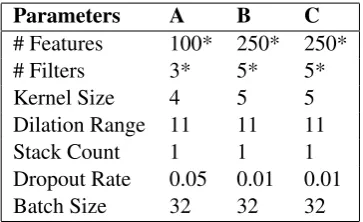
Parameters A B C
# Features 100* 250* 250*
# Filters 3* 5* 5*
Kernel Size 4 5 5
Dilation Range 11 11 11
Stack Count 1 1 1
Dropout Rate 0.05 0.01 0.01
Batch Size 32 32 32
Table 1: Hyper-parameters for each Sub-Task A, B and C respectively. Parameters are in numbers. *x102
[image:3.595.312.525.344.465.2] [image:3.595.75.294.356.483.2] [image:3.595.326.508.542.653.2]Figure 4: Temporal Convolutional Neural Network with Attention layer at the output of each Dilated-Conv1D and
Self-Attention is introduced for characteriza-tion of multiple locacharacteriza-tion of the tokens, a sentence has, in addition to extraction of semantic features. Additionally, Attention layer is stacked at the output of every ’d’ dilated convolution blocks, to augment the contextual vectors, as illustrated in Figure 4. For Sub-Task C:Offense Target Identification, the model used in the sub-task B was employed to identify and categorize the target of the posts into Individual (IND), Group (GRP) and Other (OTH) classes. For all the variants, binary cross-entropy loss function is employed with the focus on categorical accuracy.
The methods employed for gathering the data, preparation and compilation of dataset, used in Of-fensEval shared task is described inZampieri et al.
(2019a). Two additional datasets, Kaggle Toxic Comment Classification dataset and TRAC-1 Ag-gression Identification in Social Media Shared Task dataset were used for sub-task A and sub-task B respectively.
In 2018, Kaggle hosted a Toxic Comment Clas-sification competition in association with Jigsaw, which focused on classifying Wikipedia com-ments into one of six categories: insult, obscene, severe toxic, threat & identity hate and toxic. The instances which do not fall into one of the six cat-egories are clean. All the six toxic catcat-egories are mapped to Offensive (OFF) class and the clean in-stances are mapped to Not Offensive (NOT) class. The mapped instances were combined with the training dataset, provided for sub-task A, which produced a total of 172811 instances, of which 20625 instances were Offensive and 152186
in-Figure 5: Shared Sub-Task A, training data instance share (OFF and NOT)
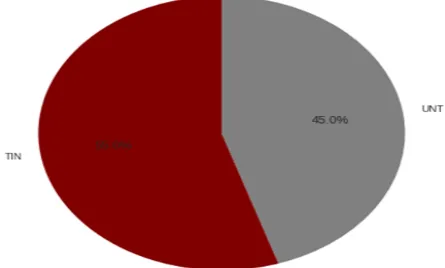
Figure 6: Shared Sub-Task B, training data instance share (TIN and UNT)
stances were clean, as depicted in Figure 5. For the training data of Sub-Task B, TRAC-1 data ( Ku-mar et al.,2018) was used, in addition to the pro-vided training data, producing a total of 14174 instances containing 7799 Targeted Insults and Threats (TIN), and 6375 Untargeted (UNT) in-stances. No other additional training dataset was used, apart from the provided dataset for Sub-Task C. It comprised of 3876 Offensive instances, of which 1074 Offensive instances belong to Individ-ual (IND) category, 2407 Offensive instances be-long to Group (GRP) category and 395 Offensive instances target belong to (OTH) category.
4 Results
[image:4.595.79.290.72.194.2] [image:4.595.309.532.255.389.2]Figure 7: Shared Sub-Task C, training data instance share (IND, GRP and OTH)
B and Sub-Task C produced an overall accuracy of 75.83% and 61.5% (best of 3 for Evaluation Test data @CodaLab), respectively. The neural network model generation, fine-tuning and the evaluation test data prediction, all the activities have been executed in Google Colaboratory environment, utilizing the on hand GPU hardware accelerator. The cross validation results, and the detailed evaluation test data results have been listed in the tables accordingly.
System Accuracy
Base ATT-TCN 0.9477
SAE-ATT-TCN1 0.7144 SAE-ATT-TCN2 0.7215
Table 2: Cross-Validation Results for Sub-Tasks A,1B
and2C respectively.
System F1 (macro) Accuracy
All NOT baseline 0.4189 0.7209
All OFF baseline 0.2182 0.2790
[image:5.595.73.521.63.204.2]Base ATT-TCN 0.4682 0.6581
Table 3: CodaLab Test Results for Sub-Task A.
System F1 (macro) Accuracy
All TIN baseline 0.4702 0.8875
All UNT baseline 0.1011 0.1125
SAE-ATT-TCN 0.6164 0.7583
Table 4: CodaLab Test Results for Sub-Task B.
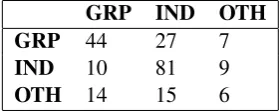
The confusion matrices for the best performing variant of each Sub-Task have been depicted in Ta-ble 6, TaTa-ble 7 & TaTa-ble 8. In TaTa-ble 6, for
Sub-System F1 (macro) Accuracy
All GRP baseline 0.1787 0.3662
All IND baseline 0.2130 0.4695
All OTH baseline 0.0941 0.1643
SAE-ATT-TCN 0.5132 0.615
Table 5: CodaLab Test Results for Sub-Task C.
NOT OFF
[image:5.595.365.469.166.208.2]NOT 540 80 OFF 214 26
Table 6: Sub-Task A, Confusion Matrix for Base ATT-TCN at threshold 0.45
TIN UNT TIN 164 49
[image:5.595.366.468.253.295.2]UNT 9 18
Table 7: Sub-Task B, Confusion Matrix for SAE-ATT-TCN at threshold 0.70
GRP IND OTH
GRP 44 27 7
IND 10 81 9
[image:5.595.346.486.341.397.2]OTH 14 15 6
Table 8: Sub-Task C, Confusion Matrix for SAE-ATT-TCN at threshold 0.55
Task A, it is evident that the number of NOT Of-fensive instances (540) have been predicted cor-rectly attributing to the higher count of training data instances for that class, and count of correct Offensive (OFF) instances prediction is less at-tributing to the less training instances for that cate-gory. The higher number of false positives for the Sub-Task A clearly indicate not so good classifi-cation performance of the variant ATT-TCN. The higher number of true positives for Targeted In-sult and Threat (164 TIN instances), and the lesser true negatives (18 UNT instances), in Table 7, in-dicate the model has better generalization ability, and performed significantly better, compared to the previous model.
In Table 8, it is clear that the Group (GRP) offense target classification is predicted correctly compared to Other (OTH), and Individual (IND) categories respectively.
5 Conclusion
[image:5.595.111.254.414.471.2]base model ATT-TCN. From Sub-Task A, we learned that rather than going ahead with random sampling for train and test split, proceeding with a categorical split, to the best possible even ratio, would increase the generalization ability. When the dataset has class imbalance ratio, retaining even number of instances for each class as much as possible, would ensure normal distribution of the instances for each class. Such data distribution would not be skewed for a particular class which ensure better generalization capability leading to improved classification accuracy. We note that processing the sequence in both the directions (forward and backward) would further improve the classification performance attributing to better context and semantic representation learning capabilities. We are working on Bi-Directional Attention based Temporal Convolutional Network model. Our participation in the SemEval 2019: Task 6 competition has been a very good learning experience for our team, and we are eager to learn from other best performing entries.
Acknowledgement
Our team would like thank and appreciate the Se-mEval 2019 organizing team for affording an op-portunity to participate in such classification task. We look forward to additional NLP classification tasks.
References
Dzmitry Bahdanau, Yoshua Bengio, and Kyunghyun Cho. 2014. Neural machine translation by jointly learning to align and translate. arXiv preprint arXiv:1409.0473.
Shaojie Bai, J Zico Kolter, and Vladlen Koltun. 2018. An empirical evaluation of generic convolu-tional and recurrent networks for sequence model-ing. arXiv preprint arXiv:1803.01271.
John S. Bridle. 1990. Probabilistic interpretation of feedforward classification network outputs, with re-lationships to statistical pattern recognition. In Neu-rocomputing.
Ying Chen, Yilu Zhou, Sencun Zhu, and Heng Xu. 2012. Detecting offensive language in social media to protect adolescent online safety. In2012 Inter-national Conference on Privacy, Security, Risk and Trust and 2012 International Conference on Social Computing, pages 71–80. IEEE.
Maral Dadvar, Franciska de Jong, Roeland Ordelman, and Dolf Trieschnigg. 2013. Improving
cyberbul-lying detection with user context. In Advances in Information Retrieval, pages 693–696. Springer.
Nemanja Djuric, Jing Zhou, Robin Morris, Mihajlo Gr-bovic, Vladan Radosavljevic, and Narayan Bhamidi-pati. 2015. Hate speech detection with comment embeddings. In Proceedings of the 24th Interna-tional Conference on World Wide Web Companion, pages 29–30. International World Wide Web Con-ferences Steering Committee.
Paula Fortuna and S´ergio Nunes. 2018. A Survey on Automatic Detection of Hate Speech in Text. ACM Computing Surveys (CSUR), 51(4):85.
Bj¨orn Gamb¨ack and Utpal Kumar Sikdar. 2017. Using Convolutional Neural Networks to Classify Hate-speech. In Proceedings of the First Workshop on Abusive Language Online, pages 85–90.
Sepp Hochreiter and J¨urgen Schmidhuber. 1997. Long short-term memory. Neural computation, 9(8):1735–1780.
Ritesh Kumar, Shervin Malmasi, Atul Kr. Ojha, and Marcos Zampieri. 2018. Benchmarking Aggression Identification in Social Media. InProceedings of the First Workshop on Trolling, Aggression and Cyber-bullying (TRAC), Santa Fe, USA.
Yann LeCun, L´eon Bottou, Yoshua Bengio, Patrick Haffner, et al. 1998. Gradient-based learning ap-plied to document recognition. Proceedings of the IEEE, 86(11):2278–2324.
Zhouhan Lin, Mo Yu, Cicero Nogueira dos San-tos, Minwei Feng, Bing Xiang, Bowen Zhou, and Yoshua Bengio. 2017. A structured self-attentive sentence embedding. arXiv preprint arXiv:1703.03130.
Shervin Malmasi and Marcos Zampieri. 2017. Detect-ing Hate Speech in Social Media. InProceedings of the International Conference Recent Advances in Natural Language Processing (RANLP), pages 467– 472.
Yashar Mehdad and Joel Tetreault. 2016. Do charac-ters abuse more than words? InProceedings of the 17th Annual Meeting of the Special Interest Group on Discourse and Dialogue, pages 299–303.
Vinod Nair and Geoffrey E. Hinton. 2010. Rectified linear units improve restricted boltzmann machines. InProceedings of the 27th International Conference on International Conference on Machine Learning.
Sara Owsley Sood, Elizabeth Churchill, and Judd Antin. 2012. Using crowdsourcing to improve pro-fanity detection. In 2012 AAAI Spring Symposium Series.
Zeerak Waseem, Thomas Davidson, Dana Warmsley, and Ingmar Weber. 2017. Understanding Abuse: A Typology of Abusive Language Detection Subtasks. In Proceedings of the First Workshop on Abusive Langauge Online.
Dawei Yin, Brian D Davison, April Kontostathis, Zhenzhen Xue, Liangjie Hong, and Lynne Edwards. 2009. Detection of harassment on web 2.0. Pro-ceedings of the Content Analysis in the WEB, 2:1–7.
Wenpeng Yin, Bowen Zhou, Bing Xiang, and Hinrich Sch¨utze. 2016. Abcnn: Attention-based convolu-tional neural network for modeling sentence pairs. Transactions of the Association for Computational Linguistics, 4:259–272.
Fisher Yu and Vladlen Koltun. 2015. Multi-scale con-text aggregation by dilated convolutions.
Marcos Zampieri, Shervin Malmasi, Preslav Nakov, Sara Rosenthal, Noura Farra, and Ritesh Kumar. 2019a. Predicting the Type and Target of Offensive Posts in Social Media. InProceedings of NAACL.
Marcos Zampieri, Shervin Malmasi, Preslav Nakov, Sara Rosenthal, Noura Farra, and Ritesh Kumar. 2019b. SemEval-2019 Task 6: Identifying and Cat-egorizing Offensive Language in Social Media (Of-fensEval). InProceedings of The 13th International Workshop on Semantic Evaluation (SemEval).