Using Term Position Similarity and Language Modeling for
Bilingual Document Alignment
Thanh C. Le, Hoa Trong Vu, Jonathan Oberl¨ander, Ondˇrej Bojar Charles University in Prague
Faculty of Mathematics and Physics Institute of Formal and Applied Linguistics
{thanhlct, hoavutrongvn, jonathan.oberlaender}@gmail.com [email protected]
Abstract
The WMT Bilingual Document Align-ment Task requires systems to assign source pages to their “translations”, in a big space of possible pairs. We present four methods: The first one uses the term position similarity between candidate doc-ument pairs. The second method requires automatically translated versions of the target text, and matches them with the can-didates. The third and fourth methods try to overcome some of the challenges pre-sented by the nature of the corpus, by considering the string similarity of source URL and candidate URL, and combining the first two approaches.
1 Introduction
Parallel data play an essential role in training of statistical machine translation (MT) systems. While big collections have been already created, e.g. the corpus OPUS (Tiedemann, 2012), the World Wide Web remains a largely underex-ploited source. That is the motivation for the shared task “Bilingual Document Alignment” of the ACL 2016 workshop First Conference on Ma-chine Translation (WMT16) which requires par-ticipants to align web page in one language to their translation counterparts in another language.
Given a large collection of documents, the first step in extracting parallel data is to organize the documents into heaps by the language they are written in. For two languages of interest, a brute-force approach would consider all pairs of docu-ments from the two heaps. Since the number of possible pairings is too high, it is necessary to em-ploy some broad and fast heuristics to filter out the obviously wrong pairs.
Some approaches to the task rely on document metadata (e.g. the similarity of document URLs or language tags within URLs), some emphasize more the actual content of the documents. Previ-ous work (Rapp, 1999; Ma and Liberman, 1999) focused on document alignment by counting word co-occurrences between source and target docu-ments in a fixed-size window. More recently, methods from cross-lingual information retrieval (CLIR) have been used (Snover et al., 2008; Ab-dul Rauf and Schwenk, 2011), ranking lists of tar-get documents given a source document by a prob-abilistic model. Locality sensitive hashing has also been applied (Krstovski and Smith, 2011).
In this paper, we describe our attempt. The rest of the paper is organized as follows: In Section 2, we describe the methods we used in our four sub-mitted systems. Section 3 describes our experi-mental setup and compares the results of the pro-posed methods. We conclude the paper and dis-cuss possible future improvements in Section 4.
2 Methods
We submitted four different systems: UFAL-1 uses term position similarity (especially rare terms) between documents. UFAL-2 uses lan-guage modeling on automatically translated docu-ments to perform the matching. UFAL-3 reorders the results of UFAL-2 to take into account the sim-ilarity in the URL structure, and UFAL-4 com-bines UFAL-3 and UFAL-1 to further improve the results.
2.1 Term position similarity (UFAL-1)
Two similar languages such as English and French can easily share a portion of their lexicons, es-pecially proper names, some acronyms and num-bers are likely to keep their forms after transla-tion. If two documents are mutual translations, the sequence of positions of those terms should be correlated. Much past research (Ma and Liber-man, 1999; Rapp, 1999) has exploited these fea-tures, using a fixed-size window and counting the co-occurrences in this range. This method, however, requires considerable tuning of param-eters, and if two shared terms are located out-side of the window, no credit will be added. In this work, we consider similarity which not only takes into account co-occurrences of terms but also their positions. This metric also assumes that co-occurrences of rare terms are more important than those of common terms. Experiments below show that our method performs much better than the fixed-window method.
Our term position similarity is defined as fol-lows:
ρ(S, T) = X
t∈S∩T
log(1 + max(c) ct
)·
· Nt X
i
lS− |piSt−piTt|
lS (1)
Here S, T are the source and target docu-ments, respectively, S ∩T is the set containing
all terms which occurs in both documents,Nt =
min(|St|,|Tt|) where St, Tt is the number of
oc-currences of term t in the respective document.
The length of the source document is denotedlS.
pi
St is the position ofi-th occurrence of the term
tin the source document and similarly for the
tar-get document (piTt). Finally, ct is the total
[image:2.595.308.536.62.135.2]num-ber occurrences oftin the data set andmax(c)is
Figure 1: The noisy channel model for Bilingual Document Alignment
the total number of occurrences of the most fre-quent term in all the source documents. In sum,
log(1 +max(ctc))is a weight to promote the
impor-tance of rare terms and the inner sumPNti mea-sures the relative displacement of the termwinS
compared toT.
To increase the number of terms contributing to the metric result, we employ a bilingual dictionary and translate all words from target document that do not appear in the source into their most frequent translation.
The submission using this method is called
UFAL-1.
2.2 Language model-based approach (UFAL-2)
In contrast to the method in Section 2.1, the ap-proach labeled UFAL-2 relies on automatic trans-lation from one side to the other (either source-to-target or vice versa). With documents on both sides converted to one language, we then treat the task as a noisy channel problem, similarly to many works of information retrieval based on language modelling techniques (Ponte and Croft, 1998; Zhai and Lafferty, 2001; Xu et al., 2001).
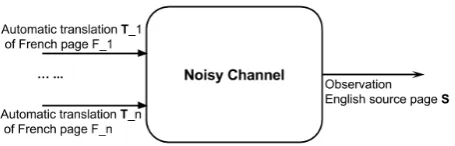
Specifically, we assume that the observed out-put is the source pageS, damaged by noisy
trans-fer of some target pageT. Through decoding, we want to find the target pageTthat most likely lead
to the observed output S. The process is
visual-ized in Figure 1. Therefore, like in the noisy chan-nel model (Brill and Moore, 2000), to decode the inputT, we estimate the probability ofTgiven the
output observationS,P(T|S). Following Bayes’ rule, the problem is characterized by Equation 2:
P(T|S) = P(S|T)P(T)
P(S) (2)
(At this stage, it is no longer important, thatTwas
As our final aim is to find the bestTthat causes the outputS, we can ignore the denominatorP(S)in
Equation 2, since it is the same for every value of
T. So we have the problem equation as follows:
Tbest= argmax T
P(S|T)
| {z } generative model
prior z }| {
P(T) (3)
Since estimating the generative modelP(S|T) in
Equation 3 is intractable, we assume conditional independence of termsti, tj ∈SgivenT:
P(S|T) =P(t1, ..., t|S||T)≈ |S|
Y
i=1
P(ti|T) (4)
To slightly speed up the computation in Equa-tion 4, we can group all occurrences of the same term together as in Equation 5. To avoid an un-derflow problem, we move the computation to log space, see Equation 6:
P(S|T)≈ Y distinctt∈S
P(t|T)tfS (5)
log(P(S|T))≈ X
distinctt∈S
tfSlog(P(t|T)) (6)
wheretfS is the number of occurrences of the term
t in S. The remaining problem is to estimate P(t|T). Fortunately, this can be achieved
sim-ply using maximum likelihood estimation (Scholz, 1985) and it turns out to be the unigram language model (LM) as follows:
P(t|T) = tfT
|T| (7)
where tfT is the number of occurrences of the
term t in T. In order to avoid zero
probabil-ities, a smoothing technique is necessary. We used Jelinek-Mercer smoothing (Jelinek, 1980). The estimation at document level in Equation 7 is smoothed with the estimation over the domain level,P(t|D), whereDis the set of all page
trans-lations available for webdomainDof pageT. We
additionally use add-one smoothing forP(t|D)to
make sure the model handles well also terms never seen in the webdomain data.
[image:3.595.307.530.62.211.2]Back to prior in the problem equation (Equa-tion 3), it may be used to integrate very useful in-formation for each target French page. For exam-ple, a French page that has been selected to be a pair with another page should have a lower prior
Figure 2: Performance of UFAL-2 on individual webdomains in the training set
for the next prediction. The prior may also re-flect the difference in length ofT andS, avoiding
the alignment of pages differing too much. Here, for simplicity, we use uniform distribution as the prior. The final equation ranking target French pages T with respect to a given English source
documentSis thus:
Tbest= argmax T
X
distinctt∈S
tfSlog(λP(t|T)
+(1−λ)P(t|D)) (8)
whereP(t|D), as mentioned, is the probability of the termtoccurring in the webdomainDand the
parameterλof Jelinek-Mercer smoothing is set to 0.5. We submit this method for evaluation under the labelUFAL-2.
2.3 Optimizing for top-1 evaluation (UFAL-3)
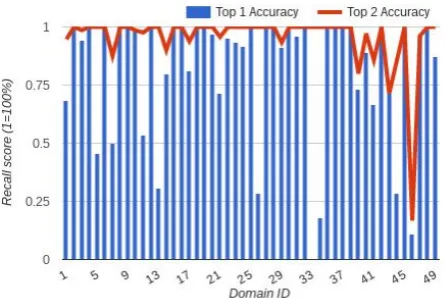
We noticed that there were many cases where sev-eral documents contained the same (or almost the same) text, which therefore get scored (roughly) the same by each of UFAL-1 and UFAL-2. This issue will create noise that can harm us in the eval-uation of the shared task, as can be seen in Fig-ure 2: There is a significant difference between the top 1 and top 2 accuracy of our UFAL-2 sys-tem from Section 2.2, see e.g. the webdomains 5, 7, 13 (kusu.com), or 34 (www.eu2007.de). While both the 1stbest and the 2ndbest top
offi-cial scoring will be based on a single-best answer.1
A closer investigation reveals that the URLs that are marked correct in the training data are usually the ones most similar to the source URL. We there-fore look at the top 10 candidates from the UFAL-2, and choose the candidate that is within some threshold of the top result and closest in Leven-shtein distance from the source URL. The thresh-old value of 85 was obtained experimentally on the training data. The result after this refinement is submitted for the evaluation under the name
UFAL-3.
2.4 Combining UFAL-3 and UFAL-1 into UFAL-4
We now have the outputs of two methods, UFAL-1 and UFAL-3 (as a replacement of UFAL-2), and we would like to combine them to one method. Since the result of UFAL-3 is very good (see Sec-tion 3.2), we decided to report UFAL-3 in most cases and resort to UFAL-1 only if we do not trust the proposal of UFAL-3.
To estimate the certainty of UFAL-3 predic-tion, we use Kullback-Leibler divergence (Kull-back and Leibler, 1951) and measure how mis-matching the predicted pair of documents is. To do so, we model the English source text and transla-tion of the predicted candidate as multinomial dis-tributions, and then compute the KL-divergence to see what their distance is. In particular, a higher KL-score presents a bigger distance between the pairs, in other words, they are less likely to be a correct pair.
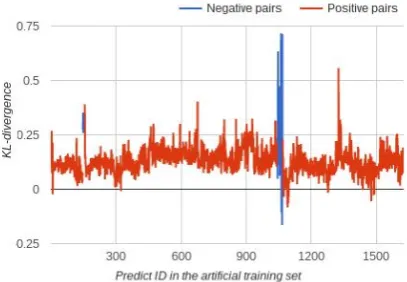
Given the overall good performance of UFAL-3, there are not many negative examples to opti-mize the threshold for rejecting the predicted pair. We solve the issue by artificially creating new neg-ative cases: we remove automatic translations of correct target French pages for two webdomains, rerun the predictions and then compute the KL-divergence for all predicted pairs. The result of 1624 pairs predicted is reported in Figure 3, in which the artificial negative examples are high-lighted with a blue line.
Based on observations for the modified training data, we set the threshold to0.35. If the KL diver-gence for a pair of documents predicted by UFAL-3 exceeds this value, the pair is considered a wrong prediction. In that case, we use the method from
1We were told by the organizers later that the test set does
[image:4.595.325.529.66.207.2]not suffer from this problem of many very similar pages.
Figure 3: KL-divergence for all 1624 predicted pairs in the modified training set where two cor-rect translations are removed.
Section 2.1 (UFAL-1) with the bilingual dictio-nary size of 5000 entries. Similar to the method from Section 2.3 (UFAL-3), we consider the top 2 candidates and choose the one with a lower Lev-enshtein distance. We call this combined method
UFAL-4in the evaluation.
3 Experiments 3.1 Experimental setup
We used the data published with the Shared Task on Bilingual Document Alignment (WMT 2016), containing roughly 4200 million pairs, in which 1624 pairs have been labeled as mutual transla-tions to serve as a development set.
Work on information extraction typically uses precision and recall of the extracted information as an evaluation measure. However, in this task, manually classifying all possible pairs is impos-sible, so the true recall cannot be established. The organizers thus decided to evaluate the meth-ods on the recallwithin the fixed set of document pairs, the development set released prior submis-sion deadline and the official test set disclosed only with the final results.
While the official scores are top-1 recall (i.e. the recall taking the single-best prediction for each input sentence), we also evaluate our systems at top 2 and top 5 outputs because, as discussed in Section 2.3, the there are many documents with the same content, but the development set of pairs mentions only one of them.
Systems Dictionary
size Baseline Fixedwindow positionTerm
0 67.92 78.94 88.30 1000 67.92 80.6 88.36
5000 67.92 81.9 89.53 (UFAL-1) 10000 67.92 85.71 91.63
[image:5.595.331.500.63.159.2]25000 67.92 88.73 94.27 50000 67.92 90.76 96.06
Table 1: Recall measures by baseline system, sys-tem using fixed-size window method and syssys-tem using term position similarity
documents bigger than 2. Afterwards, all docu-ments are ranked by the discussed methods. The first 1, 2 or 5 ranked documents with score higher than a threshold are reported.
In the first experiment, we prepare three sys-tems for comparison. We use the provided base-line system in the mentioned shared task which simply finds matching URLs by discarding lan-guage identifiers, such asen,f r. We also
imple-ment a fixed-size window method as described in Ma and Liberman (1999). We compare the fixed-size window method with our term position simi-larity in 6 tests with increasing size of the under-lying bilingual dictionary. This dictionary is ob-tained by running IBM Model 2 implemented by Dyer et al. (2013) on the translations of the data set provided by the organizers. We extract the 50000 most frequent word alignments f r −en having P(en | f r) > 0.7 and then randomly draw a subset of this dictionary for each test. The variant with 5000 entries is our submission called UFAL-1. If two documents have an identical score, the one having a shorter URL is preferred.
In the second experiment, we compare the term position similarity method (UFAL-1) with the language model-based approach (UFAL-2 and UFAL-3) and the combination method (UFAL-4). The term position similarity method uses a bilin-gual dictionary containing 5000 entries. Auto-matic translations for all target documents were provided by the organizers who used a baseline Moses setup trained on Europarl and the News Commentary corpus.
3.2 Experiment result
The results for first experiment are in Table 1. From these results, we can clearly see that term
Method Top 1 Top 2 Top 5Recall
Baseline 67.92 UFAL-1 89.53
UFAL-2 88.40 97.40 98.30 UFAL-3 93.70
[image:5.595.73.315.69.185.2]UFAL-4 94.70
Table 2: Result on the development set
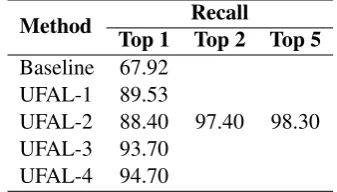
position similarity outperforms the fixed-size win-dow method and surpasses the baseline system with around 20% even without a bilingual tionary. By increasing size of the bilingual dic-tionary up to 50000 entries, we can boost up the term position similarity method by 8% to96.06%. However, there are still a number of avenues for improvement. First, as we found that our method encountered many errors on the webdo-main www.luontoportti.com that contains extremely specialized words not covered by our dictionary, this makes a domain-based bilingual dictionary one of the most desirable potential im-provements. Secondly, the term position similarity method is very sensitive to the case when a tar-get document contains source language text, be-cause it increases the co-occurrence rate between two documents. Any errors in language identifi-cation can thus adversely affect the final extracted parallel corpus.
We present the results of the second experiment in Table 2. The improved methods UFAL-3 and UFAL-4 show significant gains, achieving 93.7% and 94.7% in recall. We also clearly see the re-markable changes in recall for the top match vs. top two matches caused by the similar documents in the corpus, as discussed in Section 2.3.
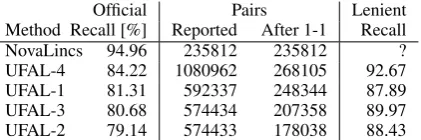
Official Pairs Lenient Method Recall [%] Reported After 1-1 Recall NovaLincs 94.96 235812 235812 ? UFAL-4 84.22 1080962 268105 92.67 UFAL-1 81.31 592337 248344 87.89 UFAL-3 80.68 574434 207358 89.97 UFAL-2 79.14 574433 178038 88.43
Table 3: The winner and our methods on the offi-cial test set.
After this style of deduplication, the number of pairs reduces to about 268k, slightly higher than the number of pairs reported by the winner.
The official test set results are in line with our observation on the development set: term posi-tion similarity (UFAL-1) performs well (although not as well as on the development set) and the two variations of the noisy-channel approach are slightly worse, with UFAL-3 (URL similarity) bet-ter than UFAL-2. The combination (UFAL-4) is the best of our methods.
We note that for systems like ours that produce all URL pairs they deem good enough, the 1-1 deduplication may be too strict. We thus also re-port a lenient form of the recall: whenever a pair of URLs from the test set appears (as an unordered pair) among the pairs produced by our method, we give a credit for it. As seen in the last column of Table 3, the noisy-channel methods seem bet-ter than bet-term position similarity in this measure. Considering that UFAL-2 and UFAL-3 produced slightly fewer pairs than UFAL-1, it may seem that they are more precise. This however need not be the case; the set of pairs produced by the systems is again too large for manual validation so the true precision cannot be evaluated.
4 Conclusion and future work
In this paper, we presented four systems for the Bilingual Document Alignment shared task. These system all perform well on the provided de-velopment set (roughly 90% accuracy for top 1 recall) as well as on the official test set (above 80%; about in the middle of all the participating methods). One system, UFAL-1, uses term posi-tion similarity. The second system, UFAL-2, uses a probabilistic model inspired by language mod-elling and the noisy channel model. Two others systems, UFAL-3 and 4, are improvements of the two former ones, where UFAL-3 tries to overcome the fact that content is repeated in a web-based cor-pus and UFAL-4 is a more advanced combination
of UFAL-3 and 1.
Several refinements of the proposed approaches are worth further investigation. In particular, a sys-tematic method of creating a bilingual dictionary dedicated for each specific webdomain should in-crease the accuracy of the term position similar-ity method. For the language model approach, it might be valuable to use a more comprehen-sive generative model (e.g. bi/tri-gram language model). Adding a prior might also enhance model accuracy. Another potential for the LM-based ap-proach is, instead of depending on translations of target pages, to apply a bilingual dictionary or a translation model directly for the generative pro-cess.
The method of UFAL-3 still misses some of the straightforward cases of URL mapping. For in-stance, it might be advisable to use a more scific variant of edit distance variant, e.g. to pe-nalize changes in special characters like “/” or “?” compared to normal word characters.
Beyond our submissions to the shared task, we suggest that more attention should be paid to the evaluation method. The problem of repeated or very similar content on the web is omnipresent, so any attempt to handle it is likely to improve the re-liability of top-1 recall measurements, improving the bilingual alignment task itself.
Acknowledgments
This work has received funding from the European Union’s Horizon 2020 research and innovation programme under grant agreement no. 644402 (HimL).
Computational resources were supplied by the Ministry of Education, Youth and Sports of the Czech Republic under the Projects CESNET (Project No. LM2015042) and CERIT-Scientific Cloud (Project No. LM2015085) provided within the program Projects of Large Research, Develop-ment and Innovations Infrastructures.
References
Sadaf Abdul Rauf and Holger Schwenk. 2011. Parallel sentence generation from comparable corpora for improved smt.Machine Translation
25(4):341–375.
Linguistics. Association for Computational Lin-guistics, pages 286–293.
Chris Dyer, Victor Chahuneau, and Noah A Smith. 2013. A simple, fast, and effective reparameter-ization of ibm model 2. Association for Com-putational Linguistics.
Frederick Jelinek. 1980. Interpolated estimation of markov source parameters from sparse data.
Pattern recognition in practice.
Kriste Krstovski and David A. Smith. 2011. A minimally supervised approach for detecting and ranking document translation pairs. In
Proceedings of the Sixth Workshop on Statisti-cal Machine Translation. Association for Com-putational Linguistics, Stroudsburg, PA, USA, WMT ’11, pages 207–216.
Solomon Kullback and Richard A Leibler. 1951. On information and sufficiency. The annals of mathematical statistics22(1):79–86.
Xiaoyi Ma and Mark Liberman. 1999. Bits: A method for bilingual text search over the web. In Machine Translation Summit VII. Citeseer, pages 538–542.
Jay M Ponte and W Bruce Croft. 1998. A language modeling approach to information retrieval. In
Proceedings of the 21st annual international ACM SIGIR conference on Research and de-velopment in information retrieval. ACM, pages 275–281.
Reinhard Rapp. 1999. Automatic identification of word translations from unrelated english and german corpora. In Proceedings of the 37th annual meeting of the Association for Compu-tational Linguistics on CompuCompu-tational Linguis-tics. Association for Computational Linguistics, pages 519–526.
FW Scholz. 1985. Maximum likelihood estima-tion. Encyclopedia of Statistical Sciences. Matthew Snover, Bonnie Dorr, and Richard
Schwartz. 2008. Language and translation model adaptation using comparable corpora. In
Proceedings of the Conference on Empirical Methods in Natural Language Processing. As-sociation for Computational Linguistics, pages 857–866.
J¨org Tiedemann. 2012. Parallel Data, Tools and Interfaces in OPUS. In Nicoletta Cal-zolari (Conference Chair), Khalid Choukri, Thierry Declerck, Mehmet Ugur Dogan, Bente
Maegaard, Joseph Mariani, Jan Odijk, and Stelios Piperidis, editors, Proceedings of the Eight International Conference on Language Resources and Evaluation (LREC’12). Euro-pean Language Resources Association (ELRA), Istanbul, Turkey.