The yield of sugar beet roots and their techno-logical value result from complex relationships between the genetic potential of the grown cul-tivar expressed inter alia by the quality of the seed material, the site factors and the production technologies used. Factors that determine the large and good quality yields of sugar beet are known and widely described in the domestic and world literature (Stibbe and Märländer 2002, Kenter et al. 2006, Wyszyński 2006, Hoffmann et al. 2009, Rašovský and Pačuta 2016, Pačuta et al. 2017a,b).
In comparison with other species of agricultural plants, high quality of seeds is an essential factor determining the production and economic success of sugar beet cultivation. Seeds of good quality guarantee high, fast and steady emergence and
largely determine the plant growth, development and yield (Mukasa et al. 2003).
The quality assessment of sugar beet seeds is based mainly on biological properties, which are a consequence of a group of traits and factors re-sulting from their anatomical and morphological structure as well as conditions during germination and emergence (Apostolides and Goulas 1998, Sadeghian and Yavari 2004, Catusse et al. 2011).
Since the early eighties of the last century, in-tensive research has been carried out to develop effective methods for improving the quality of sugar beet seeds that could be suitable to apply on a large scale (Durrant and Mash 1990). One of the methods for improving the germination and vigour of seeds and the development of sugar beet
seed-The effect of seed priming on field emergence and root yield
of sugar beet
Beata MICHALSKA-KLIMCZAK
1, Zdzisław WYSZYŃSKI
1, Vladimír PAČUTA
2,*,
Marek RAŠOVSKÝ
2, Agnieszka RÓŻAŃSKA
11Department of Agronomy, Warsaw University of Life Sciences – SGGW, Warsaw, Poland 2Department of Crop Production, Faculty of Agrobiology and Food Resources,
Slovak University of Agriculture in Nitra, Nitra, Slovak Republic *Corresponding author: [email protected]
ABSTRACT
Michalska-Klimczak B., Wyszyński Z., Pačuta V., Rašovský M., Różańska A. (2018): The effect of seed priming on field emergence and root yield of sugar beet. Plant Soil Environ., 64: 227–232.
The effect of sugar beet seed (primed and non-primed) on field emergence and root yield of sugar beet was exam-ined. The experiment was realized in the years 2012–2014 at an Experiment Field Station of Warsaw University of Life Sciences – SGGW Faculty of Agriculture and Biology in Skierniewice (51°97'N, 20°19'E) in Poland. The experi-mental factor was diversified seed material of the same cultivar of sugar beet – typical seeds, traditionally prepared for sowing (non-primed seeds) and seeds before sowing, subjected to the process of priming. On average for the three years of the study, no significant effect of seed priming on the field emergence was found. On the other hand, the sugar beet emergence on plots with primed seeds was faster, more even and uniform. Seed priming, on aver-age for the three years of the study, significantly increased the mean root mass during harvest. In contrast, priming the seeds did not cause an increase in the final plant density. No significant effect of seed priming on root yield was found, both on average for the studied period and in particular years of the study.
lings is the priming technique (Rush 1991, Capron et al. 2000). Priming seeds allows for reduction in their sensitivity to adverse environmental factors. It consists in controlled hydration of seeds until the beginning of metabolic activity, but without emergence of the radicle (Kockelmann and Meyer 2006, Paparella et al. 2015).
The priming technique consists in using solid substances as water carriers in various time com-binations and with diversified humidity (Halmer 2003). These substances must be characterized by high porosity, low chemical activity, must not be toxic to seeds and must be easy to separate after the process has been completed. After hydration, the seeds are slowly dried. The cycles of humidification and drying can be repeated several times. During hydration, the initial stages of germination are induced, so germination is faster and more even. Seeds subjected to hydration provide earlier and synchronized emergence. However, the physiologi-cal nature of priming processes is still not fully understood. It is still unclear when, where and how the positive aspects of these methods mani-fest (Thomas et al. 1994, De los Reyes et al. 2003). According to growers, the most important advan-tages of primed seed material include: faster growth and development of plants, their greater levelling in the field, ease of application of weed control pro-grams and simultaneous and even emergence and formation of roots with the even shape and size that facilitate their harvesting (Heyes et al. 1997).
The aim of the study was to evaluate the effect of primed and non-primed seeds of the same cultivar and seed material on the course of field emergence (size, emergence rate and emergence uniformity) and the yield of sugar beet roots.
MATERIAL AND METHODS
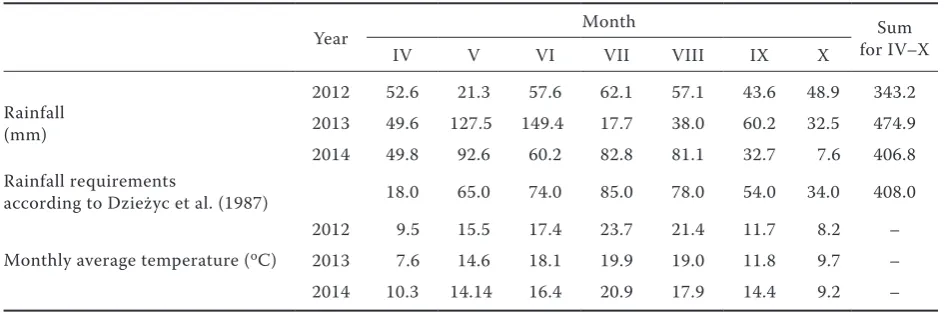
In the years 2012–2014, a field experiment with sugar beet was carried out in an experimental field of the Department of Agronomy at the Faculty Experimental Station of the Faculty of Agriculture and Biology of Warsaw University of Life Sciences – SGGW in Warsaw, located in Skierniewice (51°97'N, 20°19'E) in the central region of Poland. The ex-periment was established on Luvisols (FAO 2014), top-gley soils, formed from sandy loam and light loam on sandy-silty loam. They were characterized by slightly acidic reaction and high phosphorus content as well as medium potassium and mag-nesium content. The previous crop for sugar beet in each year of the study was winter wheat. After harvesting, the field was cultivated and stubble breaking with harrowing was performed. Cattle manure at a rate of 35 t/ha as well as phosphorus and potassium fertilizers (35.2 kg P/ha and 132.8 kg K/ha) were ploughed in with fall ploughing with-out upright furrow-slice to a depth of 25–30 cm. Weather conditions during the vegetation period of sugar beet in individual years of the study are shown in Table 1.
[image:2.595.62.538.600.757.2]The study was performed as a one-factor ment established in 4 replications. The experi-mental factor was introduced as diversified seed material of the same cultivar of sugar beet (cv. Janosik) – typical seeds, traditionally prepared for sowing (non-primed seeds) and seeds subjected to the process of priming before sowing (primed seeds). Janosik is a monogerm, diploid cultivar resistant to rhizomania, from the Polish breeding company Kutnowska Hodowla Buraka Cukrowego (KHBC). This sugar beet cultivar represents the
Table 1. Weather conditions in the vegetation period during 2012–2014
Year Month for IV–XSum
IV V VI VII VIII IX X
Rainfall (mm)
2012 52.6 21.3 57.6 62.1 57.1 43.6 48.9 343.2
2013 49.6 127.5 149.4 17.7 38.0 60.2 32.5 474.9
2014 49.8 92.6 60.2 82.8 81.1 32.7 7.6 406.8
Rainfall requirements
according to Dzieżyc et al. (1987) 18.0 65.0 74.0 85.0 78.0 54.0 34.0 408.0
Monthly average temperature (oC)
2012 9.5 15.5 17.4 23.7 21.4 11.7 8.2 –
2013 7.6 14.6 18.1 19.9 19.0 11.8 9.7 –
normal (N) type with high root yield and tech-nological sugar yield (low molasses component contents in roots). Priming of the seeds of this cultivar was prepared by method used in KHBC (label ‘Quick Beet’). This priming method was solid matrix priming also known as matricondi-tioning. It allows control of water uptake. During this treatment, seeds, mixed with a solid insoluble matrix of particles and water slowly imbibe to reach an equilibrium hydration level just below that required for radicle protrusion (Halmer 2003). Details of this priming technology are patented. Primed and non-primed seeds were pelleted in accordance with the technology used by KHBC.
The total number of plots was 8. Each plot in-cluded 6 rows with a length of 16 m and an area of 43.2 m2. External rows on plots 1 and 6 and 0.5-meter edge strips of each plot were assumed as a protective belt. The area to be harvested was 21.6 m2. Primed and non-primed single-seed sugar beet balls with a size of 3.5–4.75 mm and LGC 98.0% were sown at 17.2 cm intervals in a row.
Plant emergence was assessed since its start in the four central rows of each plot. Every day, successive emerging plants were marked and counted. New plants emerging during the subsequent observation days were marked with a different colour of the label (Stibbe and Märländer 2002). Data concern-ing the emergence of individual plants allowed the calculation of the field emergence (FE) as well as emergence rate and uniformity.
Field emergence is the quotient of the number of plants after emergence and the number of beet-seed balls sown from single-grain sowing (every 17.2 cm), expressed as a percentage (%).
Emergence rate and emergence uniformity were calculated using the Pieper’s coefficient:
Pieper’s coefficient = Σ (dn × an)/Σ an
Where: dn – successive day of emergence; an – number of plants emerged on a given day; Σ an – total number of emerged plants.
Emergence rate – the average time (days) of the emergence of one plant is the result of the quotient of the sum of products obtained from multiplying the number of plants emerging on a given day (an) by the number of days from sowing (dn) and the total number of emerged plants (Σan).
Emergence uniformity – the average time (in days) of emergence duration is also the result of the quotient of the sum of products obtained from
multiplying the number of plants emerging on a given day (an) by the number of days counted not from the date of sowing (dn), but from the date of the first emerged plant. Emergence uniformity means the average period (days) of emergence duration.
During harvest, roots from each plot were count-ed, divided into fractions with a mass of ≤ 300, 301–600, 601–900, 901–1200 and > 1200 g and weighed. On this basis, plant density, mean root mass and root yield as well as its structure from the plot were obtained. The obtained results were sub-jected to statistical analysis using the Statgraphics 4.1 software and the Excel spreadsheet. In order to determine the effect of the experimental factor on the analysed traits, analysis of variance was performed and multiple comparisons were made using the Tukey’s test, and the significance level α = 0.05 was assumed to compare the averages.
RESULTS AND DISCUSSION
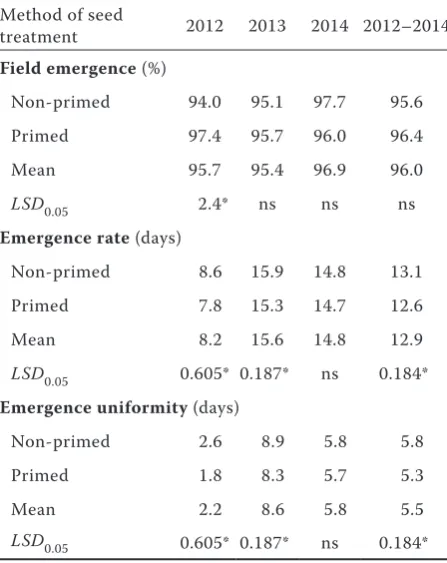
In the study of sugar beet carried out in 2012– 2014, two types of seed material of the same culti-var were compared, both primed and non-primed seeds. Plant emergence was evaluated by analysing the field emergence as well as emergence rate and uniformity. The field emergence was high and on average for the three years of the study, it was 96.0%, regardless of the type of seed material (Table 2). The highest field emergence of 96.9% was obtained in 2014, the year with the highest mean temperature of April. On average for the three years of the study, no significant effect of seed priming on the field emergence was found. Similarly, the effect of primed seeds on field emergence was not found by Thomas et al. (1994) and Mukasa et al. (2003). In contrast, an increase in field emergence from 5% to 8% as a result of the priming technique was obtained by Durrant and Loads (1987). In the present study, the FE of primed seeds was higher by 3.4% (absolute value) in 2012.
and in 2012 and 2013 by 0.8 and 0.6 day, respectively. Similarly, plants from primed seeds in comparison with plants from seeds without priming were char-acterized by a greater emergence uniformity by 0.5 day on average for the three years of the study and by 0.8 and 0.6 day, respectively, in 2012 and 2013. A similar effect of the priming procedure on the emergence rate was found by Mukasa et al. (2003). Thomas et al. (1994), Jarvis and Patchet (1998) in turn showed a shorter period of emergence of sugar beet plants from primed seeds.
The root yield of sugar beet from the area unit is determined by the yield components, i.e. the final plant density and mean root mass during harvest. Seed priming, on average for the three years of the study, significantly increased the mean root mass during harvest. It was larger in combination with primed seeds by 44.2 g, i.e. by 7.4% (Table 4). In contrast, priming the seeds did not cause an increase in the final plant density; it was even lower than that found at plots with non-primed seeds. As a result, there was no increase in the
[image:4.595.304.532.114.311.2]root yield resulting from priming sugar beet seeds. No significant effect of seed priming on root yield was found, both on average for the studied period and in particular years of the study. In the study by Heyes et al. (1997), seed priming treatment increased root yield on average by about 2.0%. However, the studies by Mukasa et al. (2003) and Draycott (2006) did not show the effect of priming
Table 2. Field emergence, emergence rate and uniformity of sugar beet plants in years 2012–2014
Method of seed
treatment 2012 2013 2014 2012–2014
Field emergence (%)
Non-primed 94.0 95.1 97.7 95.6
Primed 97.4 95.7 96.0 96.4
Mean 95.7 95.4 96.9 96.0
LSD0.05 2.4* ns ns ns
Emergence rate (days)
Non-primed 8.6 15.9 14.8 13.1
Primed 7.8 15.3 14.7 12.6
Mean 8.2 15.6 14.8 12.9
LSD0.05 0.605* 0.187* ns 0.184*
Emergence uniformity (days)
Non-primed 2.6 8.9 5.8 5.8
Primed 1.8 8.3 5.7 5.3
Mean 2.2 8.6 5.8 5.5
LSD0.05 0.605* 0.187* ns 0.184*
[image:4.595.64.288.127.409.2]*Significant mean difference at the level α = 0.05; ns – not significant mean difference at the level α = 0.05. LSD – least significant difference
Table 3. Root and leaves yield (t/ha) in years 2012–2014
Method of seed
treatment 2012 2013 2014 2012–2014
Root yield (t/ha)
Non-primed 58.5 58.7 53.6 57.0
Primed 60.5 65.0 54.2 59.9
Mean 59.5 61.8 53.9 58.4
LSD0.05 ns ns ns ns
Leaves yield (t/ha)
Non-primed 23.8 25.8 22.5 24.0
Primed 26.1 27.0 27.0 26.7
Mean 24.9 26.4 24.7 25.3
LSD0.05 ns ns ns ns
*Significant mean difference at the level α = 0.05; ns – not significant mean difference at the level α = 0.05. LSD – least significant difference
Table 4. Final plant density and average root mass in years 2012–2014
Method of seed
treatment 2012 2013 2014 2012–2014
Final plant density (thousand/ha)
Non-primed 95.3 99.9 92.3 95.8
Primed 91.3 97.1 93.1 93.8
Mean 93.3 98.5 92.7 94.8
LSD0.05 ns ns ns ns
Average mass of root (kg)
Non-primed 613.8 587.6 580.3 593.9
Primed 662.6 669.4 582.2 638.1
Mean 638.2 628.5 581.2 616.0
LSD0.05 31.81* 48.2* ns 27.11*
[image:4.595.305.532.518.716.2]on the sugar beet root yield. The leaf yield was larger with primed seeds in all years of the study (Table 3), but the differences were not statistically significant.
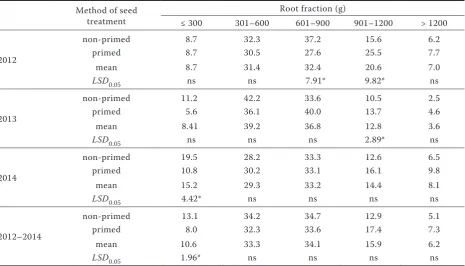
An analysis of sugar beet root yield structure indicates the highest proportion of two fractions: 301–600 g and 601–900 g in the root mass yield, both in the combination with primed and non-primed seeds (Table 5). Their proportion in the root yield in combination with non-primed seeds was 34.2% and 34.7%, and in combination with primed seeds it was 32.3% and 33.6%, respectively. In the combination with primed seeds, a significantly smaller proportion of the smallest roots fraction weighing ≤ 300 g was found in the root mass yield. The proportion of root mass of this fraction was lower by 5.1% (absolute value) in the combination with primed seeds. Differences in the proportion of root masses in the yield of the other fractions were not significant.
Finally, it can be concluded that sugar beet seed priming did not affect the field emergence, but it increased the emergence rate and uniformity. The use of primed seeds increased the average root weight; however, with a smaller final plant density, it did not increase the root yield.
REFERENCES
Apostolides G., Goulas C. (1998): Seed crop environment and processing effects on sugar beet (Beta vulgaris L.) certified hybrid variety seed quality. Seed Science and Technology, 26: 223–235.
Capron I., Corbineau F., Dacher F., Job C., Côme D., Job D. (2000): Sugar beet seed priming: Effects of priming conditions on ger-mination, solubilization of 11-S globulin and accumulation of LEA proteins. Seed Science Research, 10: 243–254.
Catusse J., Meinhard J., Job C., Strub J.M., Fischer U., Pestsova E., Westhoff P., van Dorsselaer A., Job D. (2011): Proteomics reveals potential biomarkers of seed vigor in sugar beet. Pro-teomics, 11: 1569–1580.
De Los Reyes B.G., Myers S.J., McGrath J.M. (2003): Differential induction of glyoxylate cycle enzymes by stress as a marker for seedling vigor in sugar beet (Beta vulgaris). Molecular Genetics and Genomics, 269: 692–698.
Draycott A.P. (2006): The advantage of advantage on sugar beet? British Sugar Beet Review, 74: 13–17.
Durrant M.J., Loads A.H. (1987): Experiments to determine the optimum advancement of sugar-beet seed. Seed Science and Technology, 15: 185–196.
[image:5.595.66.532.113.379.2]Durrant M.J., Mash S.J. (1990): Sugar beet seed treatments and early sowing. Seed Science and Technology, 18: 839–850. Table 5. Structure of sugar beet root yield (%) as related to the mass of distinguished fractions in years 2012–2014
Method of seed treatment
Root fraction (g)
≤ 300 301–600 601–900 901–1200 > 1200
2012
non-primed 8.7 32.3 37.2 15.6 6.2
primed 8.7 30.5 27.6 25.5 7.7
mean 8.7 31.4 32.4 20.6 7.0
LSD0.05 ns ns 7.91* 9.82* ns
2013
non-primed 11.2 42.2 33.6 10.5 2.5
primed 5.6 36.1 40.0 13.7 4.6
mean 8.41 39.2 36.8 12.8 3.6
LSD0.05 ns ns ns 2.89* ns
2014
non-primed 19.5 28.2 33.3 12.6 6.5
primed 10.8 30.2 33.1 16.1 9.8
mean 15.2 29.3 33.2 14.4 8.1
LSD0.05 4.42* ns ns ns ns
2012–2014
non-primed 13.1 34.2 34.7 12.9 5.1
primed 8.0 32.3 33.6 17.4 7.3
mean 10.6 33.3 34.1 15.9 6.2
LSD0.05 1.96* ns ns ns ns
Dziezyc J., Nowak L., Panek K. (1987): The decade indicators of the rainfall needs of the crops cultivated in Poland. Zeszyty Problemowe Postępów Nauk Rolniczych, 314: 11–33. (In Polish) FAO (2014): World Reference Base for Soil Resources. Rome,
World Soil Resources Reports No. 106.
Halmer P. (2003): Methods to improve seed performance in the field. In: Benech-Arnold R.L., Sánchez R.A. (eds.): Handbook of Seed Physiology: Application to Agriculture. Philadelphia, Haworth Press, 125–166.
Heyes V., Osborne B., Halmer P., Hughes M. (1997): Advanced sugar beet seed goes international. British Sugar Beet Review, 67: 39–41.
Hoffmann C.M., Huijbregts T., van Swaaij N., Jansen R. (2009): Impact of different environments in Europe on yield and qu-ality of sugar beet genotypes. European Journal of Agronomy, 30: 17–26.
Jarvis P.J., Patchett M.R. (1998): The effect of seed advancement treatment on the yield quality and bolting susceptibility of sugar beet crop. Aspects of Applied Biology, 52: 39–44.
Kenter C., Hoffmann C.M., Märländer B. (2006): Effects of weather variables on sugar beet yield development (Beta vulgaris L.). European Journal of Agronomy, 24: 62–69.
Kockelmann A., Meyer U. (2006): Seed production and quality. In: Draycott A.P. (ed.): Sugar Beet. Hoboken, Blackwell Pub-lishing Ltd., 89–113.
Mukasa Y., Takahashi H., Taguchi K., Ogata N., Okazaki K., Tanaka M. (2003): Accumulation of soluble sugar in true seeds by pri-ming of sugar beet seeds and the effects of pripri-ming on growth and yield of drilled plants. Plant Production Science, 6: 74–82. Pačuta V., Rašovský M., Buday M. (2017a): Influence of weather
conditions, variety and biopreparations Alga 300 P and K and
Alga 600 on root yield, sugar content and polarized sugar yield of sugar beet. Listy cukrovarnické a řepařské, 133: 96–100. Pačuta V., Rašovský M., Černý I. (2017b): Influence of weather
conditions, variety and biopreparations Alga 300 P, K and Alga 600 on molasses components, white sugar content and white sugar yield of sugar beet. Listy cukrovarnické a řepařské, 133: 232–236.
Paparella S., Araújo S.S., Rossi G., Wijayasinghe M., Carbonera D., Balestrazzi A. (2015): Seed priming: State of the art and new perspectives. Plant Cell Reports, 34: 1281–1293. Rašovský M., Pačuta V. (2016): Influence of selected agrotechnical
measures and climate conditions on root yield and digestion of sugar beet. Journal of Central European Agriculture, 17: 1070–1081.
Rush C.M. (1991): Comparison of seed priming techniques with regard to seedling emergence and Pythium damping-off in sugar beet. Phytopathology, 81: 878–882.
Sadeghian S.Y., Yavari N. (2004): Effect of water-deficit stress on germination and early seedling growth in sugar beet. Journal of Agronomy and Crop Science, 190: 138–144.
Stibbe C., Märländer B. (2002): Field emergence dynamics signi-ficance to intraspecific competition and growth efficiency in sugar beet (Beta vulgaris L.). European Journal of Agronomy, 17: 161–171.
Thomas T.H., Jaggard K.W., Durrant M.J., Mash S.J. (1994): The physiological advancement of sugar beet seed. In: Martin T. (ed.): Seed Treatment: Progress and Prospects. Brackwell, British Crop Protection Council, 391–396.
Wyszyński Z. (2006): Variability of the number and arrangement of plants in a sugar beet canopy under environmental and agro-technical factors. Science Agriculture Bohemica, 37: 133–139.