A b s t r a c t. Germination and sugar beet yield after seed sti-mulation were investigated. The seeds came from the energ'hill technology and were subject to laser irradiation. The experiments were conducted in the laboratory and field conditions. Lengthening of germinal roots and hypocotyls was observed. A positive effect of the stimulation on the morphological features was observed for the Eh seeds and laser irradiation applied in a three-fold dose. The energ'hill seeds exhibited a significantly higher content of carote-noids in seedlings and an increase in the content of chlorophylls. Laser light irradiation favourably modified the ratio of chlorophyll a to b. The leaves and roots of plants developed from the energ'hill and irradiated seeds were characterized by higher dry matter content thanin non-stimulated seeds. Seed stimulation had a posi-tive influence on yielding and the saccharose content.
K e y w o r d s: sugar beet, seed stimulation, germination, yield
INTRODUCTION
Seeds are the basic material for plant production. Its pro-per preparation, including pre-sowing seed processing, can be one of the ways of improving seed vitality and, as a result, lead to better crop yield (Chenaet al., 2005; Marinkoviæet al., 2008; Sunet al., 2002; Vasilevski, 2003).
Seedlings that are more vigorous develop into more vi-gorous plants and they are characterized by better growth and better tolerance to unfavourable environmental con-ditions. They are also more resistant to pathogen infestation, thus they do not require extensive chemical protection. Nowadays, physical factors are frequently used in pre-sowing seed stimulation (Aladjadjiyan, 2007; Delibaltova and Ivanova, 2006). This process belongs to agricultural measures, whose aim is to prepare seeds for sowing and which have a positive influence on considerable accele-ration and uniformity of seeds germination as well as on
ob-taining abundant good-quality yield. Physical factors used in pre-sowing stimulation of seed material include white light, laser irradiation (Muszyñski and G³adyszewska, 2008; Podleœnyet al., 2001, Samuilov and Garifulina, 2007), mag-netic field (Rochalska, 2005), and microwave radiation (Wójciket al., 2004).
Another important factor is the intensity of the photo-synthesis process. Chlorophylls together with carotenoids take part in light absorption in the light-dependent phase of photosynthesis (Kacharavaet al., 2009). The intensity of the process depends largely on their amount in plant leaves. When plants are in the initial phase of growth and develop-ment, the amount of pigments in the first leaves determines to a considerable degree the intensity of seedling mass gain.
In the experiments carried out by Sun et al. (2002), Hernandezet al. (2010) with the application of laser light as the sugar beet improving factor, different doses of laser rays He-Ne, in 1-, 2-, 3- and 4 multiple of the basic dose were used. The authors observed an increase in the yield and sugar content under the influence of laser application.
Some reports about the positive influence of laser irra-diation on the yielding level and on the saccharose content prove the necessity of further research in order to find out more about reactions of cultivars and their interaction with growing conditions.
The aim of the research was to establish the influence of stimulation of pre-sowing sugar beet-seed balls on the ger-mination ability and the content of photosynthetic pigments in hypocotyls. From a practical point of view, it was also interesting to estimate the influence of seed stimulation on yielding and technological qualities of roots.
Int. Agrophys., 2013, 27, 195-201 doi: 10.2478/v10247-012-0085-8
Effect of seed stimulation on germination and sugar beet yield
U. Proœba-Bia³czyk
1*, H. Szajsner
2, E. Grzyœ
3, A. Demczuk
3, E. Saca³a
3, and K. B¹k
41Department of Crop Production,2Department of Genetics, Plant Breeding and Seed Production,3Department of Nutrition of Plants; Wroc³aw University of Environmental and Life Sciences, Norwida 25/27, 50-375 Wroc³aw , Poland
4
Syngenta Seeds, Pow¹zkowska 44c, 01-797 Warszawa, Poland
Received February 14, 2012; accepted May 15, 2012
© 2013 Institute of Agrophysics, Polish Academy of Sciences *Corresponding author e-mail: [email protected]
A A
Agggrrroooppphhyhyysssiiicccsss
MATERIAL AND METHODS
The laboratory research and field experiments were conducted in 2009 and 2010. In the research on germination, standard seeds (control C) prepared in the energ'hill techno-logy (Eh) and irradiated seeds were analyzed. The seeds were irradiated with a semiconductor laser (CTL - 1106 MX, wavelength 670 nm, laser power 200 mW). The energ'hill technology is based on priming, which triggers initial phases of germination in seeds. As a result, the enzy-mes synthesizing proteins are activated and the metabolism of spare materials begins.
The following doses were used: threefold (D3), fivefold (D5), sevenfold (D7) and tenfold (D10) of the basic dose equivalent to 2.5 10-2J cm-1. The material of the sugar beet Tiziana cultivar (sugar type) was placed in a germination apparatus in the conditions of controlled temperature and humidity, according to ISTA (2008). Furthermore, measu-rements of the morphological features of seedlings obtained from the examined seeds were carried out, namely of the length of roots and cotyledons together with hypocotyls.
The content of carotenoids and chlorophylls (chl a, chl b, sum of chlorophylls) in the leaves of sugar beet seedlings was estimated using a spectrophotometer. Pigments were extracted by means of 80% acetone, whereas the absorbance was measured using a spectrophotometer CECIL CE 2011 at a wavelength of 470, 647 and 663 nm. The content of pig-ments was given in mg g-1of fresh weight (FW).
In the research, the content of photosynthetic pigments in was determined the seedlings and in the field experiments the plants obtained from the standard seeds, the Eh seeds, and the laser stimulated seeds in two doses D5 and D7.
The main criterion for assessment of sugar beet produc-tivity during the growing season was the dry matter content, and during harvesting – root mass, saccharose, and molasses forming substances, and some biometric features of the root: length, width, and thickness. During plant vegetation in the first decades of July, August, September, and October 15 plant samples and, during harvesting, whole plants from the area of 12 m2were collected. The parameters of the root tech-nological value – the saccharose and K, Na and N –aamino acids content was marked on an automatic Venema line.
The field experiment was carried out on soils classified as Haplic Luvisols (FAO WRB, 2007) developed from sandy loam underlain by a sandy clay loam (soil texture – according to the Polish classification of soil grain size distribution, PTG, 2008, based on USDA). The soils were slightly acidic in reaction (pH 5.9-6.4).
The sugar beet vegetation proceeded in thermal condi-tions that did not impede plant development. The mean tem-peratures in 2009 and 2010 were similar to the temtem-peratures of the last 30 years. The precipitation distribution was cha-racterized by large fluctuation especially from June to Sep-tember during the intensive growth of root mass and sac-charose accumulation. Precipitation that was twice as high as the average monthly rainfall for the last 30 years occurred in June and July 2009 and in August and September in 2010.
The laboratory research and field experiments were conducted by means of the independent series method in three replications. Statistical relations were obtained with the use of analysis of variance. The F-test was applied to estimate the significance of differences between the variants used in the experiment and Duncan test to isolate homo-genous groups.
RESULTS
In the experiment, a significant influence of laser light and Eh technology on the energy and germination capacity was not observed.
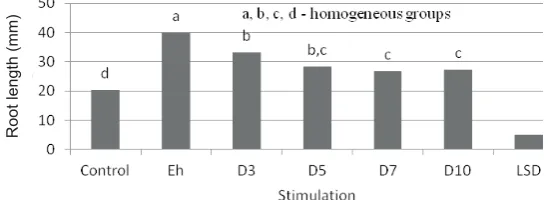
The length of roots showed significant diversity under the influence of the laser light doses applied. Sugar beet formed four homogenous groups according to the length of roots. Significantly, the longest roots were produced by seed-lings from the Eh cultivation (39.8 mm). Roots obtained after using all the laser light doses belonged to the second and third group, and their lengths ranged from 33.2 to 27.3 mm. The fourth group with substantially the shortest roots compri-zed the control combination (non-irradiated beet seed balls) with the root length of 20.5 mm (Fig. 1).
As to the length of cotyledons and hypocotyls, the statis-tical analysis revealed a significant difference between the laser light doses. A significant influence of the D3 dose on the values of this feature was observed (21.05 mm). Doses D5,
Fig. 1.Effect of stimulation of sugar beet seeds on the root length (mm).
Root
length
D7 and D10 constituted one homogenous group with the va-lue obtained for the controlie16.75 mm (Fig. 2). Seedlings from the Eh seeds were characterized by substantially the longest cotyledons and hypocotyls (26.35 mm).
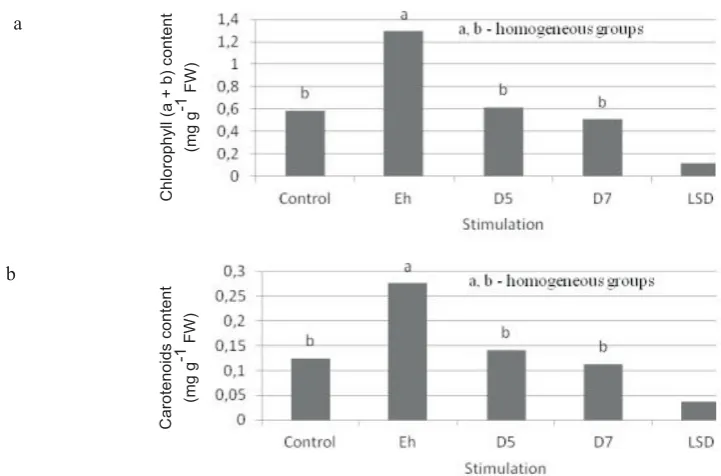
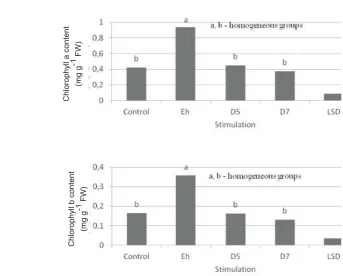
In seedlings obtained from the Eh seeds, the content of carotenoids and chlorophylls exceeded twice their amount obtained both for the control and in the seedlings from the laser-irradiated seeds (Fig. 3). As to the carotenoids and the total chlorophyll (chl a + chl b) in the leaves, a significant in-crease in their content was observed in the seedlings obtain-ed from the Eh seobtain-eds. Their amount was twice as big as their amount in the leaves of the control seeds. No significantly higher amount of chlorophylls in the seedlings obtained from the laser-stimulated seeds was observed. The content of both forms of chlorophylls (chl a and chl b) in the leaves of beet seedlings was the highest, similarly as the sum of chlorophylls in the seedlings obtained from the Eh seeds (Fig. 4). The chlorophyll a content in the leaves was higher than the chlorophyll b content. The ratio of chlorophyll a to chlorophyll b was 2.57 to 2.86 depending on the examined
object: 2.57 in the cotyledons obtained from the standard seeds, 2.62 in the seeds from Eh, 2.75 and 2.86 in the irradia-ted seeds (doses D5 and D7).
Seed improvement in the Eh technology and their stimu-lation with laser radiation modified the dry matter content in leaves and in roots (Figs 5, 6). The leaves of plants obtained from the stimulated seeds in July, August and September contained more dry matter than the leaves obtained from the non-stimulated seeds. The leaves from the irradiated seeds (dose D7) in August and September contained the biggest amount of dry matter. Seed improvement in the Eh tech-nology and their stimulation with laser radiation had an in-fluence on the dry matter content in roots. In July, the roots of plants obtained from irradiated seeds, in the sevenfold dose, contained the biggest amount of dry matter. The roots from the Eh seeds and those irradiated with the five-fold dose (homogenous group) were characterized by a lower level of dry matter. Plants from the non-stimulated seeds had the lowest level of dry matter. In August, the dry matter content from the stimulated seeds was also higher.
Fig. 2.Effect of stimulation of sugar beet seeds on the hypocotyl length (mm).
a
Fig. 3.Effect of stimulation of sugar beet seeds on the content of: a – chlorophyll (a + b), b – carotenoids in the leaves of seedlings. b
Chlorophy
ll
(a
+
b
)
c
ontent
(mg
g
-1
FW
)
Hy
pocoty
l
length
(mm)
Stimulation
Carotenoids
content
(mg
g
-1
FW
Fig. 4.Effect of stimulation of sugar beet seeds on the content of : a – chlorophyll a, b – chlorophyll b in the leaves of seedlings. b
Fig. 5.Effect of stimulation of sugar beet seeds on the dry matter content in the leaves (%). *ID – insignificant difference.
Fig. 6.Effect of stimulation of sugar beet seeds on the dry matter content in the roots (%). Explanations as in Fig. 5. a
Chlorophy
ll
a
c
ontent
(mg
g
-1
FW
)
Chlorophy
ll
b
c
ontent
(mg
g
-1
FW
)
Dry
m
atter
in
leaves
(%)
Dry
m
atter
in
roots
Seed stimulation had a positive influence on the yield-ing and saccharose content in roots and modified the content of molasses forming substances – N-aamino acids as well as the concentration of sodium and potassium cations (Table 1). Plants obtained from the Eh seeds and those stimulated with the laser exhibited a higher yield than those from the non-stimulated seeds. In the roots of the plants obtained from the stimulated seeds, a higher concentration of sucrose was noted. Particularly favourable for the sucrose content was the influence of laser light in the D7 dose. Laser irradiation at this dose caused a significant increase in the sucrose con-tent in relation to the concon-tent in the roots of the plants deve-loped from the non-stimulated seeds by 0.78%, and in rela-tion to the seeds from the Eh technology by 0.36%. Roots developed from the Eh seeds, however, were characterized by a significantly lower concentration of N-aamino acids and sodium and potassium cations in comparison with the non-stimulated and laser-stimulated seeds.
The effect of pre-sowing seed stimulation manifested itself in the mass of a single root and in some morphological features of the roots (Table 1). The roots of plants obtained from the stimulated seeds were characterized by higher mass than those from the non-stimulated seeds; they were also longer and thinner.
DISCUSSION
In the literature concerning the influence of laser radia-tion on plant material, a few publicaradia-tions, apart from the pre-sent one, describe the impact of semiconductor laser light (Hernandez et al., 2010; Michtchenko and Hernandez, 2010). Most research has been focused on the influence of helium-neon (He-Ne) gas laser irradiation. In 2007, Drozd and Szajsner carried out research comparing the influence of
both types of laser light on early developmental phases of Spring wheat (Banti variety). Higher efficiency of grain irradiation was observed for the semiconductor laser light. It resulted in higher energy and germination ability as well as stimulation of the morphological features of the seedlings. In the described experiments, no significant improvement of the germination ability of beet seed balls under the influence of seed stimulation was observed due to the high germina-tion ability in the control materials. In the research, a fa-vourable influence of laser light and the Eh method on the lengthening of roots and hypocotyls in sugar beet was ob-served. This proves that the changes evoked both in the irra-diated seeds (Delibaltova and Ivanova, 2006; Hernandezet al., 2010; Michtchenko and Hernandez, 2010) and in the seeds from the Eh technology cause changes in the dynamics of the development of the obtained seedlings. In the litera-ture concerning the influence of laser irradiation on plant material, there is no information on the impact of the semi-conductor laser used in our research.
The favourable influence of seed laser irradiation on germination process and on seedling emergence was de-monstrated, among others, by Muszyñski and G³adysze-wska (2008); Michtchenko and Hernandez (2010). In their research, higher efficiency of threefold rather than fivefold irradiation of seeds was observed. Similarly, in our research, the threefold irradiation dose turned out to be the most effi-cient for Tiziana (diploid forms) causing stimulation re-sulting in significant lengthening of the root and hypocotyl. Diploid forms show higher sensitivity to laser irradiation than polyploid forms (Drozd and Szajsner, 2007).
Carotenoids, likewise chlorophylls, take part in light absorption in the process of photosynthesis. Yet, apart from this fact, carotenoids belong to the non-enzymatic substances present in plants participating in the process of inactivating
Parameter Control Eh
Laser
LSD
D5 D7
Yield of roots (t ha-1) 62.50 69.30 67.50 66.90 4.40
Sucrose (%) 15.71 16.13 16.30 16.49 0.18
N-aamino acid (mmol kg-1mash) 22.20 20.30 21.80 21.90 1.54
Sodium (mmol kg-1mash) 3.18 2.68 2.99 2.95 0.35
Potassium (mmol kg-1mash) 34.80 32.80 33.90 34.60 1.30
Mass of root (g) 0.852 0.955 0.925 0.940 0.075
Length of root (cm) 20.1 22.3 21.9 21.8 1.6
Width of root (cm) 15.9 13.9 14.1 12.7 1.3
Thickness of root (cm) 13.8 13.2 12.2 11.4 0.8
of the reactive oxygen forms (Kacharavaet al., 2009). Plants with higher amounts of carotenoids are usually characte-rized by higher resistance to unfavourable environmental conditions.
The increase in the chlorophyll content can have a posi-tive impact on the photosynthesis process in beet seedlings. In the studies of other authors, there is information that treat-ment of sugar beet with changeable magnetic field enhances the chlorophyll content in leaves during the vegetation pe-riod from 8 to 16%, depending on the year (Rochalska, 2005). The content of photosynthetic pigments in leaves is only one of the factors having influence on the intensity of the photo-synthesis process. According to some authors (Siddiquiet al., 2006), their content in sugar beet leaves is not closely con-nected with the intensity of the photosynthesis process. It should be stressed that the chlorophyll content in plant leaves is not only the measure of photosynthesis intensity but also the indicator of the nitrogen content in plants (Pulkrabeket al., 2001).
The research confirmed, as already indicated by other authors, the influence of seed improvement on sugar beet productivity (Pietruszewski and Wójcik, 2000; Rochalska, 2005; Wójciket al., 2004). The plants obtained from the Eh technology seeds as well as the plants from the seeds irra-diated with laser were characterized by higher productivity than those obtained from the standard (control) beet-seed balls. In the leaves of plants developed from the stimulated seeds, from July to September, the dry matter concentration was higher than in the leaves of plants from the non-stimu-lated seeds. This tendency was observed in the leaves of plants obtained from the seeds improved in the Eh techno-logy well as from the irradiated seeds. The results of field and laboratory experiments show the possibility of modi-fication of the yielding level and root technological quality under the influence of the Eh technology and seed stimu-lation with laser light.
CONCLUSIONS
1. The positive effect of stimulation on the morpho-logical features was observed for the energ'hill technology and laser irradiation in the threefold dose.
2. Energ'hill technology ensured a significantly higher content of carotenoids in sugar beet seedlings and an in-crease in the chlorophyll content in leaves.
3. Laser light irradiation favourably modified the ration of chlorophyll a to chlorophyll b.
4. Plants obtained from the energ'hill seeds and stimu-lated by laser irradiation were characterized by a higher con-centration of dry matter in the leaves and roots during vege-tation, whereas during harvest they had a higher yielding level than plants developed from the standard seeds.
5. Seed stimulation, especially laser irradiation, had a po-sitive influence on the saccharose content.
6. Under the influence of seed preparation in the energ' hill technology, a reduction of molasses forming substances - N-aamino acids as well as sodium and potassium cations was observed.
REFERENCES
Aladjadjiyan A., 2007.The use of physical methods for plant growing stimulation in Bulgaria. J. Central Eur. Agric., 8(3), 369-380.
Chena Y.P., Yue M., and Wanga X.L., 2005.Influence of He-Ne laser irradiation on seeds thermodynamic parameters and growth of Isatis indogotica. Plant Sci., 168(3), 601-606.
Delibaltova V. and Ivanova R., 2006.Impact of the pre-sowing irradiation of seeds by helium-neon laser on the dynamics of development of some cotton varieties. J. Environ. Protection Ecol., 7(4), 909-917.
Drozd D. and Szajsner H., 2007.Effect of application of pre-sowing laser stimulation on bare-grained oat genotypes. Acta Agrophysica, 148, 583-589.
FAO WRB,2007.World Reference Base for Soil Resources. FAO, ISRIC, ISSS Press, Rome, Italy.
Hernandez A.C., Dominguez P.A., Cruz O.A., Ivanov R., Caballo C.A., and Zepeda B.R., 2010. Laser in agriculture. Int. Agrophys., 24, 407-422.
ISTA, 2008. International Rules for Seed Testing. Int. Seed Testing Association Press, Bassersdorf, CH, Switzerland.
Kacharava N., Chanishvili S., Badridze G., Chkhubianishvili E., and Janukashvili N., 2009.Effect of seed irradiation on the content of antioxidants in leaves of kidney bean, cabbage and beet cultivars. Australian J. Crop Sci., 3(3), 137-145.
Marinkoviæ B., Grujiæ M., Marinkoviæ D., Crnobarac J., Marinkoviæ J., Jaæimoviæ G., and Mircov D.V., 2008.Use of biophysical methods to improve yields and quality of agricultural products. J. Agric. Sci., 53(3), 235-241.
Michtchenko A. and Hernandez M., 2010.Photobiostimulation of germination and early growth of wheat seeds (Triticum aestivum L) by a 980 nm semiconductor laser. Revista Cubana de Fisica, 27(2B), 271-274.
Muszyñski S. and G³adyszewska B., 2008.Representation of He-Ne laser irradiation effect on radish seeds with selected germination indices. Int. Agrophysics, 22, 151-157.
Pietruszewski S. and Wójcik S., 2000.Effect of magnetic field on yield of sugar beet cultivar Kalwia and Polko (in Polish). In¿ynieria Rolnicza, 5(16), 207-210.
Podleœny J., Misiak L., and Koper R., 2001.Concentration of three radicals in faba bean seeds after the pre-sowing treatment of the seeds with laser light. Int. Agrophysics, 15, 185-189.
PTG,2008.Particle size distribution and textural classes of soils and mineral materials - classification of Polish Society of Soil Sciences. Roczn. Glebozn., 60(2), 5-16.
Pulkrabek J., Jozefyova L., Famera O., and Stepanek P., 2001.
Differences in chlorophyll content in leaves of sugar beet. Rostlinna Vyroba, 47(6), 241-246.
Samuilov F.D. and Garifullina R.L., 2007.Effect of laser irra-diation on microviscosity of aquenous medium in imbibing maize see as studied with a spain prob method. Russian J. Plant Physiol., 54(1), 128-131.
Siddiqui M.H., Khan M.M.A., Khan M.N., Mohammad F., and Naeem M., 2006.Hill reaction, photosynthesis and chloro-phyll content in non-sugar-producing (Turnip, Brassica rapaL.) and sugar-producing (sugar beet,Beta vulgarisL.) root crop plants. Turkish J. Biol., 30, 153-155.
Sun H.N., Feng L., and Zhang X.Y., 2002.Analysis on the effect of sugar beet seeds irradiated with He-Ne laser (in Chinese). Sugar Crops China, http://en.cnki.com.cn/Article_en/ CJFDTOTAL-ZGTI200202007.htm
Vasilevski G., 2003.Perspectives of the application of biophysical methods in sustainable agriculture. Bulgarian J. Plant Phy-siol., Special Issue, 179-186.