L
Journal of Alloys and Compounds 252 (1997) 53–58
Structure and magnetic ordering in the defect compound ErGe
1.831 , a a ,
*
b c cO. Oleksyn
, P. Schobinger-Papamantellos
, C. Ritter , C.H. de Groot , K.H.J. Buschow
a
¨ ¨
Laboratorium f ur Kristallographie, ETHZ, CH-8092 Zurich, Switzerland
b
´
Institut Laue-Langevin, 156X, 38042 Grenoble Cedex, France
c
Van der Waals-Zeeman Institute, University of Amsterdam, 1018 XE Amsterdam, The Netherlands Received 2 September 1996
Abstract
The crystal structure and the magnetic ordering of the novel orthorhombic compound ErGe22x has been studied by neutron powder diffraction and magnetic measurements. The crystal structure belongs to the DyGe1.85-type (space group Cmc2 ). ErGe1 22x (x50.17(2)) orders antiferromagnetically below TN56 K with a uniaxial magnetic moment arrangement. The magnetic cell has the same size as the
173
chemical unit cell (q50). The magnetic space group is Cmc2 (Sh1 36 ). At T51.5 K the magnetic moments of the two erbium sites have the same ordered magnetic moment value of 7.63(6) mB/ Er and are coupled antiferromagnetically along the a direction.
1. Introduction atmosphere. The purity of the starting materials was 99.9%
for Er and 99.99% for Ge, the weight loss after melting The germanium / silicon rich concentration range (65– was less then 2 wt%. The ingot was annealed in vacuum at 75% Ge / Si) of the (T, x) phase diagrams of the erbium 1070 K for three weeks and then quenched to room germanium / silicon systems [1] comprise a large variety of temperature. The purity of the sample was examined by phases that are presently studied by many investigators X-ray powder diffraction.
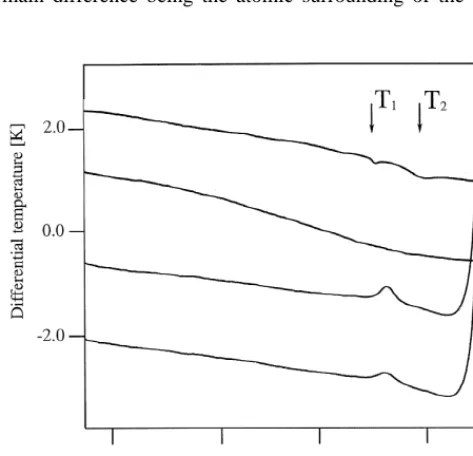
[2,3] because of their interesting electric and magnetic The thermal analysis was performed on a powdered and properties in view of potential applications in microelec- finely packed sample, under argon atmosphere in an tronics. Several of these phases display homogeneity alumina crucible using a Perkin-Elmer thermal analysis regions and give rise to polymorphic transformations as a system. Two thermal effects were observed upon heating, function of temperature and composition. In this respect while during cooling only one effect was visible (Fig. 1). the compound ErGe2 is of particular interest as it is The broadness of the peaks in the DTA trace does not reported to undergo two polymorphic transformations at allow us to define the transformation temperatures precise-1080 K and 1205 K. The crystal structure of all modi- ly. The values estimated by us are 1165 K and 1220 K, fications is unknown. The present investigation deals with differing from those reported in [1]. The powder when the determination of the crystal structure and magnetic heated up to 1273 K did not give any indication of melting. properties of the low temperature modification of the
ErGe phase.2
3. Magnetic measurements
2. Sample preparation and differential thermal Magnetic measurements were made with a SQUID
analysis (DTA) magnetometer. The high temperature data (50–300 K)
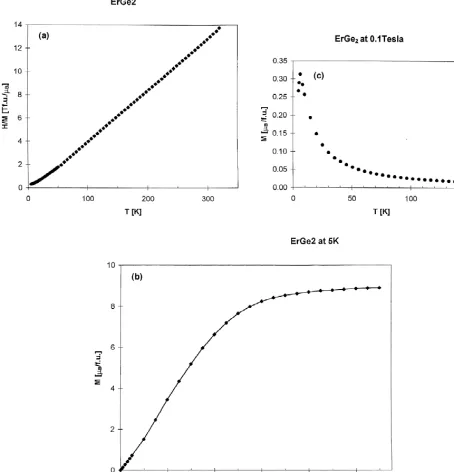
show Curie Weiss behaviour (see Fig. 2a) with m 510.3eff A polycrystalline sample of the nominal composition mB/ Er and a Curie Weiss intercept of Q 58 K. TheP ErGe was prepared by arc melting in an purified argon2 temperature dependence of the magnetisation measured in a field of 0.1 T (see Fig. 2b) shows that ErGe2 orders antiferromagnetically at about T 56 K.
*Corresponding author. N
1 The field dependence of the magnetisation at 5 K is
On leave from Institute of Inorganic Chemistry, Lviv State University,
Lviv, Ukraine. displayed in Fig. 2c. These data confirm the
antiferro-0925-8388 / 97 / $17.00 1997 Elsevier Science S.A. All rights reserved
transition at about 0.5 T. In the regime of parallel Er powder data of the D2B instrument and the comparable moments observed in the highest field strength considered absolute values of the neutron coherent scattering length the moment value is seen to be approximately equal to the for Er and Ge atoms did not allow us to clarify the free ion value 9 mB/ Er atom. existence of a centre of symmetry. The refinement con-verged for both models: Rn55.9% and Rwp515.6%, Rexp5
2
12.6%, x 51.55 for Cmcm and Rn55.8% and Rwp5 2
4. Neutron diffraction 15.8%, Rexp512.5%, x 51.61 for Cmc2 (Table 1a). On1
the other hand, a physically more reasonable model is in Neutron diffraction experiments were carried out at the favour of the noncentrosymmetric Cmc21 group. The facilities of the ILL reactor (Grenoble). The data at 1.5 and action of the plane m is associated with a doubling of thez
80 K were collected on the D2B diffractometer l51.549 multiplicity of the Ge4 site 4(a) in Cmc2 leading, to the1
˚
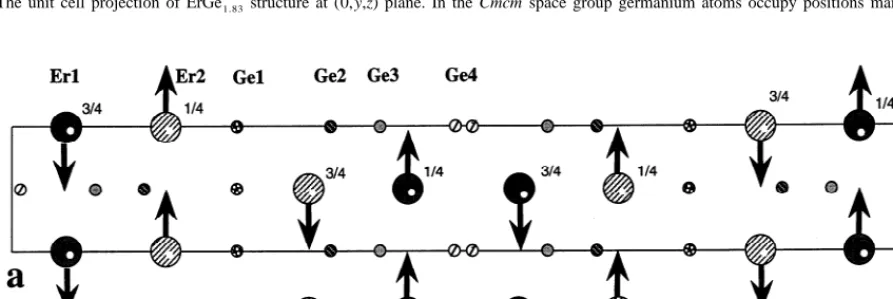
A. The step increment in 2u was 0.058. The data analysis 8(f) site in Cmcm. As can be seen in Fig. 4 this results in
˚
was performed by the Fullprof program [4]. non realistic interatomic distancesd50.732(8) A between the Ge4 atoms in the latter model. The profile fit shown in
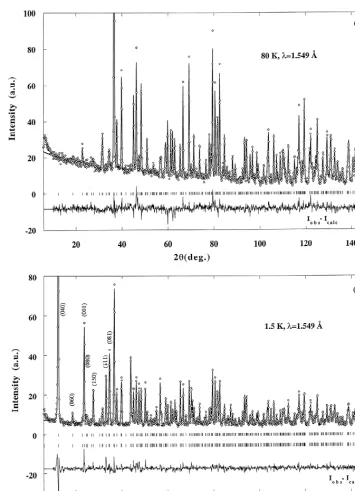
4.1. Crystal structure Fig. 3 is based on the Cmc2 space group.1
´
The 80 K data collected well above the Neel
tempera-4.2. Magnetic structure ture (paramagnetic state) are displayed in Fig. 3(top part).
The diffraction pattern was indexed by using the CSD [5]
The data obtained in the magnetically ordered state at package in the C-centred orthorhombic lattice with unit
T51.5 K were indexed with the same C-centred unit cell
˚
cell constants a¯4.05, b¯29.49, c¯3.88 A. Three distinct
as found for the nuclear reflections (q50). There are four structural models although with similar unit cell
dimen-magnetic space groups associated with the dimen-magnetic C sions and composition are known in the literature for the
lattice and this wave vector [9,10]. All of them except the compounds DyGe1.85 [6], DyGe1.9 [7], Sm Co4 12xGe [8].7 trivial one would allow ferromagnetic modes. The possible Satisfactory agreement between the experimental and
magnetic modes are given in Table 2. Two independent Er calculated profiles was obtained only for the model with
atoms occupy the 4(a) special Wyckoff position located in the atomic arrangement of the DyGe1.85structure type. As the mirror plane m . The refinement of magnetic intensities
x
pointed out in the X-ray single crystal analysis [6] of the
showed that the Er magnetic moments (see Fig. 5) are DyGe1.85compound the observed reflection conditions are oriented along the a axis and that the atoms (1) (0, y,z) and compatible with two space groups: Cmcm and Cmc21 (2) (0,2y,1 / 21z) related by the screw operation 2 have
1z
which differ in the presence of a centre of symmetry, the 31
opposite signs (the magnetic form factor used for Er is main difference being the atomic surrounding of the Ge4
from [11]). This arrangement remains invariant under the assumption of the trivial magnetic space group Cmc21
173
(Sh36 ). The good agreement between the experimental and the calculated pattern (Fig. 3) and the low values of the reliability factors Rn53.8%, Rm57.3%, Rwp518.2%,
2
Rexp513.0%, x 51.96 (Table 1) can be taken as evidence for the correctness of the magnetic model proposed. The ordered moment value 7.63(1) mB/ Er at 1.5 K is lower
31
than the free-ion value of Er and (gJm 59mB B). The Er atoms related by the screw axis 2 operation and neigh-1 bouring Er atoms occupying different symmetry sites have their moments oppositely aligned. This gives rise to the uniaxial antiferromagnetic structure shown in Fig. 5. The interlayer interaction for both Er sublattices for layers at z51 / 4 or 3 / 4 is ferromagnetic while the intralayer inter-action is antiferromagnetic.
5. Concluding remarks
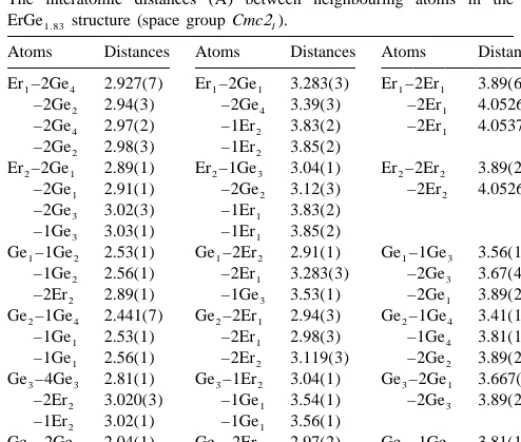
[image:2.612.31.268.475.703.2]We have confirmed the existence of a compound close to a 1:2 ratio in the ErGe system. The composition
Fig. 1. Results of differential thermal analysis: heating (a) and cooling (b)
Fig. 2. (a) Temperature dependence of the reciprocal susceptibility of a sample of the nominal composition ErGe measured in a field of 1 T. (b)2
Temperature dependence of the magnetisation measured in 0.1 T. (c) Field dependence of the magnetisation at 5 K.
0.17(2)). The existence of thermal effects in the DTA the present investigation. Alternatively the structure can be traces is in agreement with the fact that three polymorphic described as a linear combination of intergrown fragments modifications occur, but the transformation temperature of the AlB and the ZrSi structure types (Fig. 6). Three2 2 values obtained by us differ from those reported in [1]. bands of (Er ) trigonal prisms with X-atoms in the centre6 The investigated crystal structure adds a further repre- with parallel alignment of their axes alternate with col-sentative to the large family of nonstoichiometric RX22x umns of empty tetragonal antiprisms (Er Ge ). Interatomic4 4 compounds (R5rare-earth, X5Si, Ge) known to occur for distances are strongly dependent on the size of the rare a variety of distinct structures. earth atoms and in ErGe1.83 (Table 3) they are indicative A common feature of the mentioned structures is a of covalent Ge–Ge bonding. Shortening of the distances
˚
stacking of paired layers built of triangular prisms and between the Ge –Ge4 4 atoms (2.04(1) A) relative to the
˚
[image:3.612.60.514.69.541.2]Fig. 3. Observed, calculated and difference neutron diagrams of ErGe1.83germanide: (a, top part) measured at 80 K (paramagnetic state); (b, bottom part) measured at 1.5 K (magnetically ordered state).
The magnetic structure found at 1.5 K corresponds to a magnetic measurements have shown that the antiferro-uniaxial antiferromagnetic arrangement of the Er moments magnetic structure can be broken already in comparatively along the a- direction. The thermodynamically most stable small external magnetic fields.
Table 1
Refined parameters from neutron data of ErGe1.83(space group Cmc2 ). All atoms occupy 4(a) sites with coordinates (0,y,z). For defining the origin the Er11
atom is fixed at z50.750. The data refer to results obtained (a) at 80 K in the paramagnetic state, (b) at 1.5 K in the magnetically ordered state magnetic
173
space group Cmc2 (Sh1 36).
Temperature 80 K 1.5 K
2 ˚ 2 2 ˚ 2
Atom y z Biso10 (A) y z Biso10 (A)
Er1 0.0603(1) 0.750 0.32(6) 0.0609(1) 0.750 0.32(9) Er2 0.1726(1) 0.245(3) 0.16(5) 0.1710(1) 0.249(4) 0.16(8) Ge1 0.3521(1) 0.248(3) 0.64(4) 0.3529(2) 0.268(4) 0.6(1) Ge2 0.4078(1) 0.742(3) 0.72(4) 0.4074(2) 0.744(4) 0.72(9) Ge3 0.2515(1) 0.742(3) 0.54(5) 0.2499(2) 0.765(4) 0.54(9) Ge4 0.5104(1) 0.337(3) 1.7(2) 0.5101(5) 0.347(4) 1.7(3)
occup. Ge4 0.67(2) 0.64(2)
mx Er[mB] - - - 7.63(6)
˚ ˚ ˚
a(A), b(A), c(A) 4.05263(7) 29.4964(5) 3.88712(6) 4.05234(7) 29.4850(8) 3.88456(9)
R %, R %n m 5.78, - 3.80, 7.26
2
[image:5.612.161.402.294.355.2]Rwp%, Rexp%,x 15.8, 12.5, 1.61 18.2, 13.0, 1.96 Table 2
The magnetic space groups of Cmc2 associated with the magnetic C1
lattice and q50.
Magnetic space group x y z
173
Cmc2 (Sh1 36) Gx -
-174
9
Cm9c2 (Sh1 36) - Fy Gz
175
9
Cmc92 (Sh1 36) Fx -
-176
Cm9c92 (Sh1 36) - Gy Fz
The magnetic modes F(1111) and G(1212) are of the 4(a) site. The signs refer to the atoms (1) (0, y,z); (2) (0,2y,z11 / 2); (3) (1 / 2, y11 / 2,z11 / 2); (4) (1 / 2,2y11 / 2,z11 / 2).
Fig. 4. The unit cell projection of ErGe1.83structure at (0, y,z) plane. In the Cmcm space group germanium atoms occupy positions marked as Ge4 and
*
Ge4 .
[image:5.612.60.506.398.527.2] [image:5.612.61.508.565.714.2]Fig. 6. Alternating stacking along the b axis of triangular [Er ] prisms and tetragonal [Er Ge ] antiprisms in ErGe6 4 4 1.83structure. The fragments of AlB and2
[image:6.612.28.289.343.564.2]ZrSi structures types are extracted.2
Table 3 References
˚
The interatomic distances (A) between neighbouring atoms in the ErGe1.83 structure (space group Cmc2 ).1
[1] V.N. Eremenko and I.M. Obushenko, Non-ferrous Metal Res., 9(3) Atoms Distances Atoms Distances Atoms Distances
(1981) 216.
Er –2Ge1 4 2.927(7) Er –2Ge1 1 3.283(3) Er –2Er1 1 3.89(6) [2] J.V. Duboz, P.A. Badoz, A.Perie et al., Appl. Surf. Sci., 38 (1989) –2Ge2 2.94(3) –2Ge4 3.39(3) –2Er1 4.0526(1) 711.
–2Ge4 2.97(2) –1Er2 3.83(2) –2Er1 4.0537(1) [3] F.P. Netzer, J. Phys.: Condens. Matter, 7 (1995) 991–1022. –2Ge2 2.98(3) –1Er2 3.85(2) [4] J. Rodriguez-Carvajal, Physica B, 192 (1993) 55–69.
Er –2Ge2 1 2.89(1) Er –1Ge2 3 3.04(1) Er –2Er2 2 3.89(2) [5] L.G. Akselrud, Yu.N. Grin, P.Yu. Zavalij, V.K. Pecharsky and V.S. –2Ge1 2.91(1) –2Ge2 3.12(3) –2Er2 4.0526(1) Fundamensky, Proc. XIIth Europ. Crystallogr. Meeting, Moscow, –2Ge3 3.02(3) –1Er1 3.83(2) August1989, VINITI, Moscow, 1989, p. 155.
–1Ge3 3.03(1) –1Er1 3.85(2) [6] I.R. Mokra, V.K. Pecharsky, Z.M. Shpyrka, O.I. Bodak, V.K. Belsky Ge –1Ge1 2 2.53(1) Ge –2Er1 2 2.91(1) Ge –1Ge1 3 3.56(1) and I.E. Pats, Dop. AN Ukr. SSR, Ser. B, 3 (1989) 48.
–1Ge2 2.56(1) –2Er1 3.283(3) –2Ge3 3.67(4) [7] P. Schobinger-Papamantellos, D.B. de Mooij and K.H.J. Buschow, –2Er2 2.89(1) –1Ge3 3.53(1) –2Ge1 3.89(2) J. Less-Commom Metals, 163 (1992) 319.
Ge –1Ge2 4 2.441(7) Ge –2Er2 1 2.94(3) Ge –1Ge2 4 3.41(1) [8] O.Ya. Mruz, V.K. Pecharsky, O.I. Bodak and B.O. Bruskov, Dop. AN –1Ge1 2.53(1) –2Er1 2.98(3) –1Ge4 3.81(1) Ukr. SSR, Ser. B, 6 (1987) 51–53.
–1Ge1 2.56(1) –2Er2 3.119(3) –2Ge2 3.89(2) [9] V.A. Koptzik, Shubnikov Groups (Moscow 1966).
Ge –4Ge3 3 2.81(1) Ge –1Er3 2 3.04(1) Ge –2Ge3 1 3.667(4) [10] W. Ospechowski and R. Guccione, in G.T. Rado and H. Suhl (eds.), –2Er2 3.020(3) –1Ge1 3.54(1) –2Ge3 3.89(2) Magnetism IIA, Academic Press, London, 1965, Ch 3, p. 105. –1Er2 3.02(1) –1Ge1 3.56(1) [11] A.C.C. Wilson (ed.), International Tables for Crystallography, Vol. Ge –2Ge4 4 2.04(1) Ge –2Er4 1 2.97(2) Ge –1Ge4 2 3.81(1) C, Kluwer Academic Publishers Dodrecht / Boston / London, 1992.
–1Ge2 2.441(7) –2Er1 3.39(3) –2Ge4 3.89(1) [12] P. Schobinger-Papamantellos, D.B. de Mooij and K.H.J. Busehow, –2Er1 2.927(7) –1Ge2 3.41(1) J. Alloys Compounds, 144 (1988) 265–274.
[13] P. Schobinger-Papamantellos, J. Rodriguez-Carvajal, T. Janssen and K.H.J. Buschow, Proc. Int. Conf. Aperiodic Crystals, Les
Diab-lerets, Switzerland, 18 –22 Sept., 1994, p. 302.
Acknowledgments [14] P. Schobinger-Papamantellos, T. Janssen and K.H.J. Buschow, J.
Mag. Magn. Mat., 154 (1996) 29.
This work is financially supported by the Swiss National [15] P. Schobinger-Papamantellos, G. Andre, J. Rodriguez-Carvajal, C.H. de Groot and K.H.J. Buschow, J. Alloys Compounds, 232 (1996)