Helen Heneghan
11267045
Supervisor: Dr. Damian Murchan
EXPLORING TEACHERS’
CONCEPTIONS AND IMPLEMENTATION
OF
DIFFERENTIATED READING
IN
PRIMARY AND ELEMENTARY SCHOOLS.
Thesis submitted for the degree of PhD
School of Education
Trinity College Dublin
i
CONFERENCE PRESENTATIONS ARISING FROM THE CURRENT THESIS
International Conference Presentations1. Heneghan, H. (2017). Exploring Teachers' implementation of Differentiated Reading. BERA Conference, (British Educational Research Association), University of Sussex, Sep. 6, 2017.
2. Heneghan, H. (2017). Differentiated Reading: Connections and Contradictions. UKLA Conference, (U. K. Literacy Association), Glasgow 1st July, 2017.
3. Heneghan, H. (2016). ‘Meaningful Learning’ and Vygotsky’s Zone of Proximal
Development – Foundation of Differentiated Reading? ECER Conference,
Dublin, UCD. August 26, 2016.
4. Heneghan, H. (2016). Meaningful Learning and Diversity – Teachers’ Self-reported Differentiated Reading Implementation in Two Case Studies in Diverse Cultural Contexts -2016 UKLA Conference, Bristol, July 9.
5. Heneghan, H. (2015). Exploring Teachers’ Capacity to Implement Effective Differentiated Reading in Irish Primary Schools and in Texan Elementary Schools – Two Case Studies - 2015 BERA Conference, Sep. 15-17 2015. Queen’s University, Belfast.
6. Heneghan, H. (2015). Meaningful Learning and Transitions - Teachers’ Self-reported Implementation of Differentiated Reading in Relation to the Zone of Proximal Development – 2015 ECER Conference, Budapest, September 8-11, 2015.
7. Heneghan, H. (2015). Re-assessing Differentiated Reading – Teachers’ Perspectives UKLA Conference, July 12, Nottingham, UK.
8. Heneghan, H. (2014). Teachers’ Understanding and Implementation of Differentiated Reading in Dublin and Houston Primary Schools - 2014 BERA Conference,
(British Educational Research Association). Sep 25 London.
9. Heneghan, H. (2014). Differentiated Reading - Responding to Diversity – 2014 UKLA Conference, July 4-6 on behalf of Sussex University, Brighton, UK.
National Conferences
10. Heneghan, H. (2016). Diversity and Meaningful Learning - Differentiated Reading
implementation in two diverse cultural contexts – 2016 LAI Conference, (Literacy Association of Ireland), Marino College of Education, Sep 30 2016.
11. Heneghan, H. (2015). Presentation and Panel Discussion – Research Methods for Teachers Hibernia Research Conference Day in UCD, (Elan Theatre) on June 4, 2016.
ii 13. Heneghan, H. (2015). To what extent is the implementation of Differentiated Reading impacted by teachers’ understanding of meaningful learning and transition in relation to the Zone of Proximal Development? – 2015 LAI Conference, (Literacy Association of Ireland), Marino College of Education, Sep 2015
14. Heneghan, H. (2015). Presentation and Panel Discussion – Mixed Methods Research – Hibernia Research Conference Day in UCD ( Newman Building), on Sep 5 2015.
15. Heneghan, H. (2015). Meaningful Learning and Promoting Confidence and Self-reliance in all Students –Teachers’ Self-reported Differentiated Reading Implementation – IATSE Conference, Drumcondra, Dublin, June 12-13, 2015.
16. Heneghan, H. (2015). Presentation and Panel Discussion – Teaching, Learning and Assessment – Hibernia Research Conference Day in UCD on June 27, 2015.
17. Heneghan, H. (2014). Differentiated Reading in Primary and Elementary Schools – Two Case Studies in Dublin and in Houston – 2014 RAI Conference, (Reading Association of Ireland), Marino College of Education, Sep 26, 2014
18. Heneghan, H. (2014). Facilitating Factors involved in Effective Differentiated Reading - IRMSS Conference, Mary Immaculate College of Education, Limerick, June 7.
19. Heneghan, H. & Murchan, D. (2014). Enhancing Teachers Capacity to Implement Effective Differentiated Reading – ESAI Conference, April 10-12. Athlone, Co. Westmeath.
20. Heneghan, H. (2013). Differentiated Reading. RAI Conference, Marino Inst. of Ed. Sep.28.
TCD Postgraduate Conferences
21. Heneghan, H. (2015). Differentiated Reading – Responding to Diversity and Meaningful Learning through the ZPD. - PGR Conference, TCD – June 20.
22. Heneghan, H. (2015). Teachers’ Perspectives on Differentiated Reading – Three minute research presentation – Postgraduate Research Conference, TCD - April 28 2015.
23. Heneghan, H. (2014). Teachers’ Perspectives on Implementation of Differentiated Reading in Dublin and Houston Schools - PGR Research Conference, TCD – June 21.
24. Heneghan, H. (2014). Factors that Facilitate and Hinder Differentiated Reading – Three minute research presentation – PGR Conference, TCD - May 7.
25. Heneghan, H. (2013). Differentiated Reading Instruction – Utopia or Reality? Postgraduate Research Conference – TCD - June 15 2013
iii
TABLE OF CONTENTS
List of Tables ... x
List of Figures ... xiii
List of Appendices ... xiv
Acknowledgements ... xv
Declaration ... xvi
Abstract ... xvii
Summary ... xviii
Glossary ... xx
Acronyms ... xxi
Chapter One: Introduction ... 1
1.0 Chapter Overview ... 1
1.1 Introduction ... 1
1.2 Context and Rationale of this Research ... 3
1.3 Purpose of this Research ... 4
1.4 Key Concepts ... 5
1.4.1 Differentiated Reading (DR) ... 5
1.4.2 Zone of Proximal Development (ZPD) ... 6
1.4.3 Content, Process, and Product ... 7
1.5 Overview of Dissertation ... 7
Chapter Two: Framing an Analysis of Differentiated Reading using Vygotskian Learning Theory ... 9
2.0 Introduction ... 9
2.1 Theories of Learning ... 9
2.2 Vygotsky’s Theories on Learning and Development ... 10
2.2.1 Cultural Historical (CH) Theory ... 11
2.2.2 Dialectical Synthesis ... 12
2.2.3 Role of Language ... 14
2.2.3.1 Ego-centric Speech ... 15
2.2.3.2 Inner Speech ... 15
2.2.4 Zone of Proximal Development (ZPD) ... 18
2.2.4.1 The Social Situation of Development (SSD) ... 18
2.2.5 The Relationship of the ZPD to CH Theory ... 20
2.3 ZPD and Collaboration ... 21
2.4 ZPD and Differentiated Reading ... 23
2.4.1 Establishing ZPD through Collaboration ... 24
2.4.2 Oral Language ... 25
2.4.3 Establishing ZPD through Imitation ... 26
2.4.4 Creating Meaning through Dialogue ... 27
2.4.5 Consciousness and Dialogue ... 29
2.5 Relationship of DR to Vygotsky and Reading ... 32
2.5.1 Similarities between the ZPD and DR ... 34
iv
2.6 Perceived Difficulties with Vygotsky’s Theories on Education ... 36
2.7 Key Messages from Vygotsky’s Literature ... 37
2.8 Interpretations of Vygotsky’s Literature by Vygotskian Scholars ... 39
2.9 Conclusion ... 41
Chapter Three: Educational Systems in Dublin, Ireland and in Houston, Texas, US. ... 43
3.0 Introduction ... 43
3.1 Education System in Dublin, Ireland ... 43
3.1.1 Primary Education... 43
3.1.2 The Primary Curriculum ... 44
3.1.3 The Cultural Historical Context of Irish Primary (National) Education ... 45
3.1.3.1 The Influence of Church and State ... 45
3.1.3.2 The Irish Language ... 46
3.1.4 Delivering Equality of Opportunity in Schools, (DEIS) ... 47
3.2 The Education System in the United States ... 49
3.2.1 The Education System in Texas ... 50
3.2.2 The Elementary Curriculum ... 51
3.2.3 Elementary Schools ... 51
3.2.4 Cultural Historical Context of Elementary Education in the US... 52
3.2.4.1 European Settlers/Colonists ... 52
3.2.4.2 Native Americans ... 53
3.2.4.3 African Americans ... 53
3.2.4.4 Eugenics ... 54
3.2.5 Disadvantaged Schools in the US ... 55
3.2.6 Education Programmes for Disadvantaged Students in the US ... 56
Chapter Four: Literature Review – Differentiated Reading ... 59
4.0 Introduction ... 59
4.1 Differentiated Instruction ... 60
4.2 Differentiated Reading (DR) ... 61
4.3 Differentiated Reading Models ... 63
4.3.1 The Response to Intervention (RTI) Model ... 65
4.3.1.1 Response to Intervention (RtI) Research ... 67
4.3.2 Schoolwide Enrichment Model (SEM-R) ... 68
4.3.2.1 Schoolwide Enrichment Model (SEM-R) Research ... 68
4.4 DR Research Studies ... 72
4.4.1 Limitations of Selected DR Studies ... 75
4.4.2 Key Messages Emanating from the Empirical Review ... 76
4.4.3 Impact of Research on Current Study ... 78
4.4.4 Irish Primary Education Policy in Relation to DR Research ... 79
4.5.1 Teachers’ Conceptions of DR ... 82
4.5.2 DR Implementation ... 83
4.5.3 Teachers’ Response to Students’ Learning Needs ... 86
4.6 Reading ... 86
4.6.1 Effective Teachers and the Teaching of Reading ... 90
v
4.7 Modification of Content, Process, and Product ... 95
4.7.1 Content ... 97
4.7.2 Process ... 98
4.7.3 Product ... 98
4.7.4 Learning Environment ... 99
4.8 Obstacles to DR ... 100
4.9 Facilitating Factors ... 103
4.9.1 Assessment ... 105
4.9.2 Flexible Group-work ... 108
4.10 Elements Associated with Vygotsky’s ZPD that are Relevant to DR ... 110
4.10.1 Oral Language ... 110
4.10.2 Modelling/Imitation ... 112
4.10.3 Collaboration ... 113
4.10.4 Comprehension and Meaning-Making... 115
4.11 Chapter Four Summary ... 118
Chapter Five: Methodology ... 121
5.0 Introduction ... 121
5.1 Research Structure ... 121
5.1.1 Study Design guided by the Literature Review ... 123
5.1.2 Theoretical Considerations ... 125
5.1.3. Case Study ... 128
5.2 The Questionnaire ... 129
5.2.1 Questionnaire – First Pilot Study ... 129
5.2.2 Questionnaire – Second Pilot Study ... 129
5.2.3 Main Questionnaire ... 130
5.2.4 Research Sampling and Procedure ... 131
5.2.5 Questionnaire Data Analysis ... 133
5.3 Lesson-Plan Evaluations ... 133
5.3.1 Lesson-Plan Evaluation Design and Content ... 134
5.3.2 Lesson-Plan Pilot Study ... 134
5.3.3 Lesson-Plan Procedure ... 135
5.4 Semi-Structured Interviews ... 136
5.4.1 Semi-Structured Interview Design and Content ... 136
5.4.2 Interview Pilot Study ... 137
5.4.3 Interview Procedure ... 137
5.4.4 Lesson-Plan Evaluation and Interview Analysis... 138
5.5 Ethics, Confidentiality, Reliability and Validity ... 140
5.5.1 Research Approval ... 140
5.5.2 The Hawthorne Effect ... 141
The Hawthorne effect, ... 141
5.5.3 Validity, Reliability and Possible Threats to Data Interpretation ... 141
5.5.4 Minimising the Researcher’s Impact on Participants ... 142
vi
Chapter Six: Findings from the Dublin Case Study ... 144
6.0 Introduction ... 144
6.1 Participating Schools and Teachers ... 145
6.1.1 Profile of Survey Participants ... 146
6.1.2 Profile of Lesson–Plan Evaluation Participants (B1-5) ... 147
6.1.3 Profile of Dublin Interviewees (C1-5) ... 147
6.2 Results ... 148
6.3 Teachers Conceptions about DR ... 149
6.3.1. Teachers’ Understanding of DR ... 149
6.3.2 Impact of DR on Reading and Comprehension ... 150
6.3.3 DR Implementation ... 150
6.3.4 The DR Environment ... 151
6.3.5 Assessment ... 152
6.3.6 Evaluating Students’ Reading Readiness ... 154
6.4 Factors Informing DR ... 155
6.4.1 Reading ... 156
6.4.2 Class Texts ... 157
6.4.3 Flexible Grouping ... 158
6.4.4 Summary ... 161
6.5 Differentiating Content, Process and Product ... 162
6.5.1 Differentiation by Content ... 163
6.5.2 Differentiation by Process ... 164
6.5.3 Differentiation by Product... 165
6.5.4 Resources ... 166
6.5.5 Thematic Analysis of Five Lesson-plan Evaluations and Five Interviews ... 166
6.5.6 Summary ... 168
6.6 Factors Facilitating DR ... 169
6.7 Perceived Obstacles to DR ... 171
6.7.1 Summary ... 173
6.8 Elements Associated with Vygotsky’s ZPD that are Relevant to DR ... 173
6.8.1 Language as a Tool ... 173
6.8.2 Modelling/Imitation ... 175
6.8.3 Collaboration ... 176
6.8.4 Comprehension and Meaning-making ... 176
6.8.5 Summary ... 178
6.9 Chapter Summary ... 179
Chapter Seven: Findings from the Houston Case Study ... 182
7.0 Introduction ... 182
7.1. Participating Schools and Teachers ... 182
7.1.1 Profile of Survey Participants ... 183
7.1.2 Profile of Lesson–Plan Evaluation Participants (Y1-5) ... 184
7.1.3 Profile of Five Houston Interviewees (Y1-5) ... 184
7.2 Results ... 185
vii
7.3.1. Teachers’ Understanding of DR ... 185
7.3.2 Impact of DR on Reading and Comprehension ... 186
7.3.3 DR Implementation ... 187
7.3.4 The DR Environment ... 187
7.3.5 Assessment ... 189
7.3.6 Evaluating Students’ Reading Readiness ... 191
7.4 Factors Informing DR ... 193
7.4.1 Types of Reading ... 194
7.4.2 Class Texts ... 195
7.4.3 Flexible Grouping ... 196
7.4.4 Summary ... 197
7.5 Differentiating Content, Process and Product ... 198
7.5.1 Differentiation by Content ... 198
7.5.2 Differentiation by Process ... 200
7.5.3 Differentiation by Product ... 201
7.5.4 Resources ... 203
7.5.5 Thematic Analysis of Lesson-plans and Interviews... 203
7.5.6 Summary of DR implementation through Content, Process and Product ... 204
7.6 Factors Facilitating DR ... 205
7.7 Perceived Obstacles to DR ... 206
7.8 Elements Associated with Vygotsky’s ZPD that are Relevant to DR ... 208
7.8.1 Language as a Tool ... 208
7.8.2 Modelling/Imitation ... 210
7.8.3 Collaboration ... 210
7.8.4 Comprehension and Meaning-making ... 212
7.8.5 Summary ... 214
7.9 Chapter Summary ... 215
Chapter Eight: Case Study Analysis ... 219
8.0 Introduction ... 219
8.1 Participating Schools and Teachers... 220
8.1.1 Similarities ... 220
8.1.2 Differences ... 221
8.1.3 Less-experienced and Experienced Teachers... 222
8.1.4 Teachers in Advantaged and Disadvantaged Schools ... 223
8.2 Conceptions about DR and DR implementation ... 226
8.2.1 Teachers Conceptions about DR ... 226
8.2.2 Impact of DR on Reading and Comprehension ... 228
8.3 Reasons for DR Implementation ... 229
8.3.1 Differencesin Reasons for DR Implementation ... 229
8.4 Differentiating Content, Process and Product ... 230
8.4.1 Similarities in Relation to Content, Process and Product ... 230
8.4.2 Differences in differentiating Product, Process and Content ... 232
8.5 DR Environment ... 233
viii
8.5.2 Differences in a DR Environment ... 234
8.5.3 Flexible Groups ... 235
8.5.4 Assessment ... 236
8.5.5 DR Elements ... 238
8.5.5.1 Similarities in DR Elements ... 238
8.5.5.2 Differences in DR Elements ... 239
8.5.6 Reading Practices ... 239
8.5.7 Class Texts ... 241
8.6 Factors that Facilitate and Hinder DR ... 242
8.6.1 Similar Factors found in Dublin and Houston... 242
8.6.2 Different Factors in Dublin and Houston ... 243
8.6.3 Perceived Obstacles to DR ... 244
8.6.3.1 Similar Obstacles ... 244
8.6.3.2 Differences in Obstacles ... 245
8.6.4 Teachers’ DR Practices: Summary ... 246
8.7 Elements Associated with Vygotsky’s ZPD that are Relevant to DR ... 248
8.7.1 Oral Language - Language as a Tool ... 248
8.7.1.1 Similarities ... 249
8.7.2 Modelling/Imitation ... 249
8.7.2.1 Similarities ... 251
8.7.2.2 Differences... 251
8.7.3 Collaboration ... 251
8.7.3.1 Similarities ... 252
8.7.3.2 Differences... 253
8.7.4 Comprehension and Meaning-making ... 253
8.7.4.1 Comprehension Strategies - Similarities ... 254
8.7.4.2 Differences... 256
8.7.4.3 Meaning-Making ... 256
8.7.4.4 Discussion ... 257
8.7.4.5 Literacy Circles ... 259
8.7.5 Summary ... 261
8.7.5.1 Similarities ... 262
8.7.5.2 Differences... 262
8.8 Differences between the Survey Data and the Qualitative Data ... 262
8.8.1 Survey Data - Differences between Dublin and Houston ... 263
8.8.2 Qualitative Data - Differences between Dublin and Houston ... 264
8.9 Chapter Summary ... 265
8.9.1 Similarities ... 265
8.9.2 Differences ... 267
Chapter Nine: Conclusions and Implications ... 269
9.0 Introduction ... 269
9.1 Context of this Study ... 269
9.2 Overall Conclusions ... 269
ix
9.3.1 Question One: Teachers’ Conceptions about DR ... 271
9.3.2 Question Two: Modification of Content, Process, and Product Related to DR Practices ... 271
9.3.3 Question Three: Factors that Facilitate and Hinder DR Implementation ... 273
9.3.4 Question Four: Elements Associated with Vygotsky’s ZPD that are Relevant to DR ... 273
9.4 Significance and Contribution of Current Thesis ... 276
9.5 Personal Reflection on the Research Journey ... 278
9.6 Limitations of this Research ... 280
9.7 Recommendations ... 280
9.8 Conclusion ... 281
Bibliography ... 283
Appendix A-1: Final Questionnaire Dublin ... 349
Appendix A-2: Final Questionnaire Houston Extract p. 12 ... 355
Appendix A-3: Pilot Questionnaire ... 357
Appendix A-4: Pilot Survey Feedback Sheet ... 361
Appendix B-1: Final DR Lesson-plan Evaluation Template ... 362
Appendix B-2: Lesson-plan Email and Consent Form ... 364
Appendix B-3: Pilot Lesson-plan Feedback Sheet ... 365
Appendix B-4: Lesson-plan Evaluation Sample - Houston (Y2) ... 366
Appendix B-5: Lesson-plan Sample – Houston - Y2 ... 369
Appendix C-1: Final Interview Questions ... 370
Appendix C-2: Interview Email and Consent Form ... 371
Appendix C–3: Pilot Interview Feedback Sheet ... 372
Appendix C–4: Interview Sample Transcript - Dublin ... 373
Appendix D: Research Ethics Approval, Trinity College Dublin ... 374
Appendix E: Letters and Correspondence ... 375
Appendix E–1: Letter to Principal/Headteacher ... 375
x
LIST OF TABLES
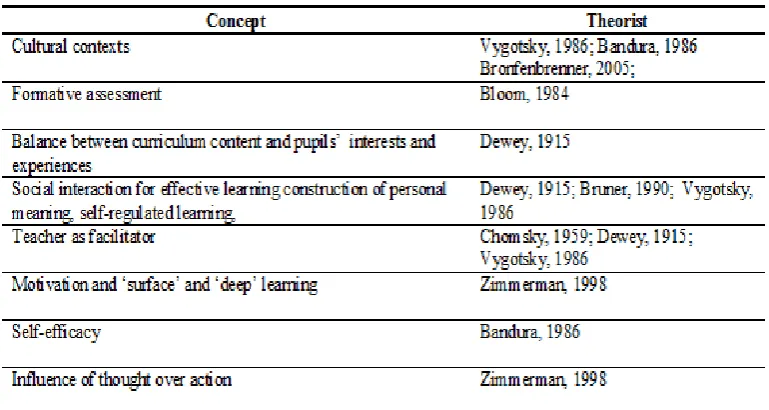
Table 2.1: DR Concepts and Learning Theorists ... 9
Table 2.2: Differences between Vygotsky and Piaget ... 11
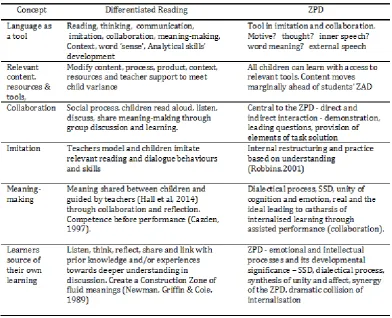
Table 2.3: Similarities between the DR and ZPD ... 34
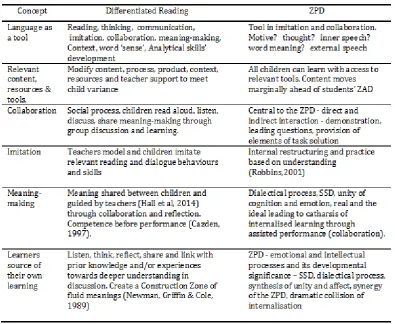
Table 2.4: Discrepancies between DR and ZPD and Possible Solutions ... 35
Table 3.1: Similarities between the Two Educational Systems ... 57
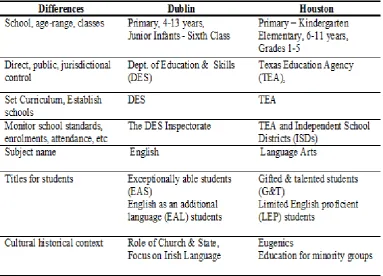
Table 3.2: Differences between Dublin and Houston Educational Systems ... 58
Table 4.1: DR Models ... 63
Table 4.2: Grade-level Differentiation Plan (Walpole & McKenna, 2009, p. 7) ... 66
Table 4.3: Six Categories That Motivate Children’s Reading (Opitz & Ford (2008, p. 13) based on Edmunds and Bauserman (2006) ... 88
Table 4.4: Four Perspectives on Reading ... 89
Table 4.5: Practices of Effective Teachers across Eight Reviews and Studies ... 91
Table 4.6: DR Component Modification ... 95
Table 5.1: Mixed Method Approach ... 122
Table 5.2: Different Terms between Dublin and Houston ... 131
Table 5.3: Sample Schools and Teachers ... 132
Table 5.4: Lesson-Plan Evaluation Participants (B1-5); (Y1-5) ... 135
Table 5.5: Ten Interviewees (C1-5); (Z1-5)... 138
Table 6.1: Coding of Respondents (n=645). ... 144
Table 6.2: Dublin (n=330) Teacher Gender and Class Size (percentage) ... 146
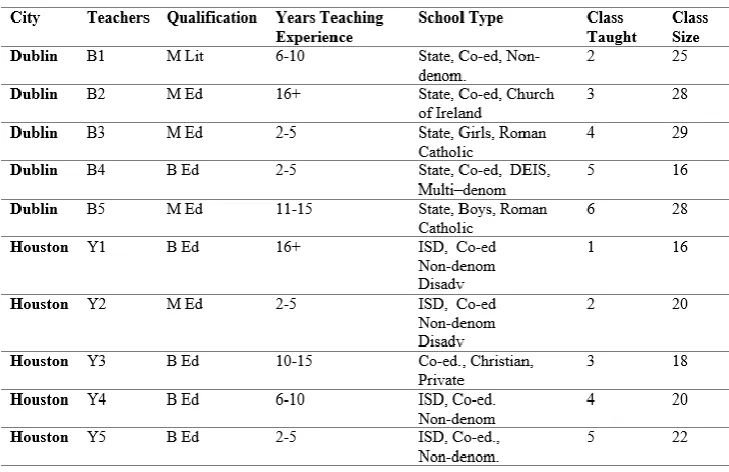
Table 6.3: Dublin Lesson-Plan Evaluation Participants (B1-5) ... 147
Table 6.4: Dublin: Five Interviewees (C1-5). ... 148
Table 6.5: Dublin: Themes based on Research Questions and Literature Review ... 148
Table 6.6: Dublin: Teachers’ Conceptions of DR (n=227 – 69%). ... 149
Table 6.7: Dublin: DR Implementation ... 151
Table 6.8: Dublin (n=330): DR Environment%... 151
Table 6.9 Dublin (n=330): Assessment Employed in DR... 153
Table 6.10: Dublin (n=330): Evaluating Children’s Reading Readiness (%) ... 154
Table 6.11: Dublin (n=330): Factors Informing Teachers’ DR (percentage) ... 155
Table 6.12: Dublin (n=10): LP Respondents and Interviewees: Types of Reading Employed... 156
Table 6.13: Dublin (n=330): Importance of Flexible Groups ... 158
Table 6.15: Dublin (n=330): Flexible Groups for Different Activities ... 159
Table 6.15: Dublin (n=330): Frequency of Flexible Groups (%). ... 159
Table 6.16: Dublin (n=330): Groupings used by LP Respondents and Interviewees ... 160
Table 6.17: Dublin (n=330): Process, Product and Content. (% Teachers) ... 162
Table 6.18: Dublin (n=330): Differentiation by Content (% Teachers) ... 163
Table 6.19: Dublin (n=330): Differentiation by Process. (% Teachers) ... 164
Table 6.20: Dublin: Differentiation by Product (% Teachers) ... 166
Table 6.21: Dublin (n=10): Themes of LP Respondents and Interviewees ... 167
Table 6.22: Dublin (n=10): Themes - Interviewees and LP respondents ... 167
xi
Table 6.24: Dublin: Interviewees: DR Facilitating Factors ... 170
Table 6.25: Dublin (n=330): Obstacles to DR ... 171
Table 7.1: Houston: Coding of Respondents (n=315) ... 182
Table 7.2: Houston (n=315): Teacher Gender and Class Size (Percentage) ... 183
Table 7.3: Houston: Lesson-Plan Evaluation Participants (Y1-5) ... 184
Table 7.4: Houston: Interviewees (Z1-5)... 184
Table 7.5: Houston: Teachers’ Conceptions of DR ... 186
Table 7.6: Houston: DR Implementation... 187
Table 7.7: Houston (n=315): DR Environment (Percentage) ... 187
Table 7.8: Houston (n=315: DR Facilitating Factors(Percentage) ... 188
Table 7.9: Houston (n=315): Assessment data employed in DR (Percentage) ... 189
Table 7.10: Houston (n=315): Evaluating Children’s Reading Readiness ... 191
Table 7.11: Houston (n=315): Factors Informing DR (percentage) ... 193
Table 7.12: Houston: LP Respondents and Interviewees: Types of Reading Employed ... 194
Table 7.13: Houston (n=315): Importance of Flexible Groups ... 196
Table 7.14: Houston (n=315): Flexible Groups for Different Activities ... 196
Table 7.15: Houston (n=315): Frequency of Flexible Groups. ... 196
Table 7.16: Houston: Five LP Respondents and Five Interviewees - Groupings Employed ... 197
Table 7.17: Houston (n=315): Process, Product and Content, (%) ... 198
Table 7.18: Houston (n=315): Differentiation by Content (%) ... 199
Table 7.19: Houston: Differentiation by Process (% Teachers) ... 200
Table 7.20: Houston: Differentiation by Product (% Teachers) ... 201
Table 7.21: Houston: Themes of Five LP Respondents and Five Interviewees ... 203
Table 7.22: Houston (n=10): Combined Themes - Interviewees and LP respondents ... 204
Table 7.23: Houston (n=315): Factors facilitating DR (Percentage) ... 205
Table 7.24: Houston Interviewees: DR Facilitating Factors ... 206
Table 7.25: Houston (n=315): Obstacles to DR (Percentage) ... 206
Table 8.1: Themes based on Research Questions and Literature Review ... 219
Table 8.2: Coding of Respondents and Schools ... 220
Table 8.3: Similarities – Teachers and Schools ... 220
Table 8.4: Differences – Schools and Teachers ... 221
Table 8.5: Dublin and Houston: Years Teaching Experience % ... 222
Table 8.6: Dublin and Houston: DR Implementation: Less Experienced and Experienced Teachers ... 222
Table 8.7: Dublin and Houston: DR Practices: Teachers in Advantaged and Disadvantaged Schools 224
Table 8.8: Similarities: Teachers’ Conceptions of DR ... 227
Table 8.9: Differences: Teachers’ Conceptions of DR ... 227
Table 8.10: Reasons for DR Implementation ... 229
Table 8.11: Content, Process and Product ... 230
Table 8.12: Dublin and Houston: Elements in Differentiation by Process ... 230
Table 8.13: Dublin and Houston: Differentiation by Content ... 231
Table 8.14: Elements in Differentiation by Product ... 232
Table 8.15: Dublin and Houston: Elements in a DR Environment ... 233
xii
Table 8.17: Frequency of DR Elements Employed by Teachers ... 238
Table 8.18: LP respondents and Interviewees: Reading Practices Employed ... 240
Table 8.18: Dublin and Houston: Factors Facilitating DR ... 242
Table 8.19: Houston and Dublin Interviewees: DR Facilitating Factors. ... 243
Table 8.20: Dublin and Houston: Obstacles to DR ... 244
Table 8.21: Dublin and Houston: Collaboration ... 252
Table 8.22: Comprehension Strategies – Ten Interviewees and Ten LP respondents ... 255
Table 8.23: Survey Data: Differences between Dublin and Houston ... 264
xiii
LIST OF FIGURES
Figure 4.1: Themes Based on Literature Review and Research Questions ... 59
Figure 4.2: A Differentiation Research Model, adapted from Hall, 2002 (Smit & Humpert, 2012, p. 1154). 60 Figure 4.3: Differentiated Reading Instruction System (Walpole & McKenna, 2000, p. 160) ... 62
Figure 4.4: Tiered Instruction (Walpole & McKenna, 2009, p. 5) ... 66
Figure 4.5: A Continuum of Assessment Methods (NCCA, 2007, p. 13) ... 106
Figure 4.6: Instructional Cycle Informed by Assessment (Opitz & Ford, 2008, p. 28). ... 107
Figure 4.7: Fisher and Frey (2007) Adaptation of the ‘GRRM’ (Pearson & Gallagher, 1983). ... 113
Figure 5.1: An Overview of the Research Design ... 123
Figure 6.1: Dublin: Participating Schools ... 145
xiv
LIST OF APPENDICES
Appendix A - 1 Final Questionnaire Dublin
Appendix A - 2 Final Questionnaire Houston Extract p. 1-2
Appendix A –3 Pilot Questionnaire
Appendix A - 4 Pilot Survey Feedback Sheet
Appendix B - 1 Final DR Lesson-plan Evaluation Template
Appendix B - 2 Lesson-plan Email and Consent Form
Appendix B - 3 Pilot Lesson-plan Evaluation
Appendix B - 4 Pilot Lesson-plan Feedback Sheet
Appendix B - 5 Lesson-plan Evaluation Sample - Houston (Y2)
Appendix B - 6 Lesson-plan Sample – Houston - Y2
Appendix C - 1 Final Interview Questions
Appendix C - 2 Interview Email and Consent Form
Appendix C - 3 Pilot Interview Questions
Appendix C - 4 Pilot Interview Feedback Sheet
Appendix C - 5 Interview Sample Transcript – Dublin
Appendix C - 6 Interview Sample Summary - Dublin
Appendix D Trinity College Dublin Research Approval Letter
Appendix E - 1 Letter to Principal/Headteacher
xv
ACKNOWLEDGEMENTS
I wish to extend my gratitude and appreciation to my supervisor, Dr. Damian Murchan for his
professional guidance throughout this research.
I wish to thank most sincerely all 645 teachers and pilot teachers for their valuable contribution to this
research. This research would not have been possible without their willing input. I wish to
acknowledge the support and co-operation of the sixty-two schools, teachers, principals and
administration staff in Dublin, Ireland and in the two ISDs in Houston, Texas, US who accommodated
this research.
My gratitude is also extended to my proof-readers Patricia and Gráinne, and to all the contributors to
my presentations at national and international conferences whose thought-provoking responses aided
this research.
I would also like to thank my dear Mum and Dad, RIP, both deceased, who ignited in me a love of
learning, integrity and resilience. To my very special, inspirational sisters – Margaret, Mary, and
Anne, I thank you for your support, encouragement and advice in all my endeavours.
I wish to thank most sincerely my two exceptional children, Deirdre and Eoghan for your love,
understanding and encouragement during my PhD journey. Finally, thank you to my wonderful
husband, Dave, my soulmate, for your love, encouragement and support during this PhD course. A
very sincere thank you to all!
xvi
DECLARATION
I declare that this thesis is a presentation of my original work and the investigation and written work is
entirely my own work. All contributions from others have been acknowledged and referenced. I
declare that no portion of the work has been submitted for a degree or qualification at this or any other
university or any institute of learning.
I agree to deposit this thesis in the University’s open access institutional repository or allow the library
to do so on my behalf, subject to Irish Copyright Legislation and Trinity College Library conditions of
use acknowledgement.
Helen Heneghan 17/12/2017.
xvii
ABSTRACT
Reading is an essential life skill and an important component of learning. Effective teachers encourage and sustain children’s desire to read, restructuring teaching and learning activities to meet pupil variance towards the provision of achievable goals and meaningful learning. Demographic changes in recent years have heralded increased cultural diversity in primary, and elementary schools. Recent policy initiatives, including the Primary Language Curriculum (DES, 2015) and the ‘Every Student Succeeds Act’ (ESSA, 2015) have renewed focus on literacy approaches that promote literacy and accommodate pupil variance in different school contexts. Differentiated reading (DR) is one instructional model that is compatible with these literacy strategies and responds to learner variance.
This study explored teachers’ conceptions about DR. It investigated teachers’ implementation of DR through content, process and product. It explored the implementation of learner-responsive, teacher-facilitated activities. Two case studies in diverse cultural contexts (Dublin, Ireland and Houston, Texas, US), provided data from questionnaires (n=645), lesson-plan evaluations (n=10) and interviews (n=10) with teachers located in 62 schools. Findings from qualitative data from this case study, using a sequential, mixed method design, supported survey data apart from minor exceptions, thus supporting the validity of the findings.
xviii
SUMMARY
Reading is an essential life skill and an important component of learning. Effective teachers encourage and sustain children’s desire to read, restructuring teaching and learning activities to meet pupil
variance towards the provision of achievable goals and meaningful learning. Demographic changes in
recent years have heralded increased cultural diversity in primary, and elementary schools. Recent policy initiatives, including the Primary Language Curriculum (DES, 2015) and the ‘Every Student Succeeds Act’ (ESSA, 2015) have renewed focus on literacy approaches that promote literacy and
accommodate pupil variance in different school contexts. Differentiated reading (DR) is one
instructional model that is compatible with these literacy strategies and responds to learner variance.
This research explored teachers’ conceptions about DR. It investigated teachers’ implementation of
DR through content, process and product. It explored the implementation of learner-responsive,
teacher-facilitated activities. Two case studies in diverse cultural contexts (Dublin, Ireland and
Houston, Texas, US), provided data from questionnaires (n=645), lesson-plan evaluations (n=10) and
interviews (n=10) with teachers located in 62 schools. Findings from qualitative data from this case
study, using a sequential, mixed method design, supported survey data apart from minor exceptions,
thus supporting the validity of the findings.
Findings indicate that most of the teacher participants in Dublin and in Houston employed similar
practices, even though they taught in different educational systems in culturally diverse contexts. The
majority of teachers implemented DR because of school initiative and personal interest. Most teachers
received no pre-service DR professional development while Houston teachers received more DR
professional development than Dublin teachers. Teachers demonstrated a fair understanding of DR and defined DR by matching content and process to children’s individual needs and setting individual
goals. Findings indicate a positive response to DR from teachers while also indicating the desire for
relevant DR professional development, especially observation of effective DR lessons. Most teachers
differentiated process, some modified product and fewer teachers differentiated content to meet pupil
variance. The main facilitating factors in DR were individual goals, positive learning environment, and
preparation and structure. The two main obstacles to DR were lack of time and class size. Analysis
revealed that the Houston participants incorporated flexible groups, varied teacher support, child-centred activities, activity and text choices, assessment and identified students’ needs and interests
more frequently than the Dublin participants, and ranked student misbehaviour and pressure to cover
standardized test material as significant obstacles. Meanwhile, the Dublin participants incorporated
more oral activities and student self-evaluation, engaged in discussion with other teachers and parents,
modelled think-alouds, reading aloud and silent reading and emphasised reading for enjoyment more
frequently than the Houston participants, and identified a lack of training and resources as major
xix but Houston participants implemented individual goals and differentiated concepts/skills more
frequently.
Recommendations at a policy level include the provision of relevant, on-going, in-service DR
professional development and resources, including teacher observation of effective DR lessons,
specific DR group-work management and DR teacher-modelling skills. At a school level, more school
support, incorporating a whole school DR policy and additional resources, including sustained teacher
support, print-rich environments and a wide range of varied genres and texts, are recommended.
Recommendations at a teacher level include teacher modelling of reading, discussion and
comprehension skills, flexible groups and literacy circles to facilitate meaning-making and increased,
regular integration of varied class texts and genres including award-winning children’s publications
and peer recommendations towards the creation of collaborative learning environments. These
findings and recommendations can help shape future policies and guidelines for teachers, schools,
professional development, and pre-service teacher education. This study is significant for a number of
reasons as it provides; the explicit theoretical framing of DR in relation to Vygotsky’s ZPD;
empirically explored concepts within two unique large datasets, in two diverse locations; and novel insights into teachers’ perspectives and implementation of DR in the two specific locations studied in
xx
GLOSSARY
This glossary briefly defines key terms employed in this thesis.
Differentiated Instruction (DI) involves a restructuring of teaching and learning activities, directed by continuous assessment, where content, process and product are modified to meet pupil variance. It
provides flexible grouping, varied teacher support, tiered and flexible learner-responsive,
teacher-facilitated activities. Each child has an achievable, realistic goal.
Differentiated Reading (DR) Teachers match children with appropriate reading tasks, enabling positive experiences in reading and learning that involve meaning-making and reflective reading.
Teachers adjust the pace, support, and kind of instruction provided, using flexible groups in response
to children’s needs, readiness levels, previous learning experience, and interests. Continuous
assessment data guides teaching/learning strategies, derived from collaborative activities with
students.
Content covers what teachers teach, why they teach it, what learners need to understand/do in a given area and what skills/concepts are essential. Teachers can differentiate the content material and also
differentiate how pupils can access that material.
Process demonstrates how skills/concepts are taught and the methods and activities employed. It covers the different activity types/levels/methods that children use to acquire and practice key
concepts/skills. Process begins when children stop receiving information and start to work on
‘sense-making activities’.
Product enables children to demonstrate what they know, understand, can do, explain, simulate or transfer/extend the learned knowledge to new contexts.
Zone of Proximal Development (ZPD) applies to the ideas/cognitive skills a child has almost mastered. Intellectual and emotional development of cognitive functions occurs as a single process
where children can be the source of their learning. Using the ZPD, the teacher or knowledgeable peer
helps the child move from assisted performance through guided apprenticeship to independent
xxi
ACRONYMS
CPD Continuing Professional Development
CSI Comprehension Strategy Instruction
DEAR Drop Everything and Read
DES Department of Education and Skills
DEIS Delivering Equality of Opportunity in Schools
DI Differentiated Instruction
DR Differentiated Reading
EAL English as an Additional Language
EAS Exceptionally Able Students
EFL English as a Foreign Language
ESSA Every Student Succeeds Act (2015)
G&T Gifted and Talented Students
GUI Growing Up in Ireland Report
GRRM Gradual Release of Responsibility Model
HMF Higher Mental Functions
IDEA Individuals with Disabilities Education Act (2004)
IRA International Reading Association (now ILA, International Literacy Association) NA ’09 National Assessments of English Reading and Mathematics in Primary Schools NA ’14 National Assessments of English Reading and Mathematics in Primary Schools
NAEP US National Assessment of Educational Progress
NAERM National Assessment of English Reading and Maths (2014)
NCCA National Council for Curriculum and Assessment
NCLB No Child Left Behind Act (2001)
NCRTI National Center on Response to Intervention
NCSE US National Council for Special Education.
NELP US National Early Literacy Panel.
NICHHD US National Institute of Child Health and Human Development.
NRP National Reading Panel (2000)
OECD Organisation for Economic Co-operation and Development
PDST Professional Development Service for Teachers
PIRLS Progress in International Reading Literacy Study
PISA Programme for International Student Assessment
PLC Primary Language Curriculum (2015)
PSC Primary School Curriculum (1999)
PSEC Primary School English Curriculum (1999)
RAI Reading Association of Ireland
RtI Response to Intervention
SEM-R Schoolwide Enrichment Model–Reading
SEN Special Educational Needs
SLD Specific Learning Disabilities
SSP School Support Programme under DEIS
TEA Texas Education Agency
TSI Transactional Strategies Instruction
1
Chapter One: Introduction
Reading allows every citizen of this nation and the world to assume civic responsibility… Teachers in every educational setting are the individuals who bear the greatest ethical and political responsibility for promoting the power of reading… It is an aspect of our job to promote literacy… Students who lack basic reading skills cannot learn to their full capacity (hooks, 2010, p. 132).
1.0 Chapter Overview
This thesis explores teachers’ implementation of differentiated reading (DR) in two case studies in
diverse cultural contexts in primary schools in Dublin, Ireland, and in elementary schools in Houston,
Texas, US. The aim of this research is to explore the nature and extent of DR practices, with a view to
informing policy, practice and research in this important area. This first chapter outlines the current
research and presents the underpinning rationale for this study. Key concepts, related to this research
are defined including differentiation, differentiated reading, content, process, product, and zone of
proximal development (ZPD). The research framework and four research questions are then presented
and the methodology employed is briefly discussed. Finally, an overview of the nine chapters is
provided.
1.1 Introduction
Reading is a basic life skill and students’ mastery of reading impacts on their academic and career
success (Clark, 2014). Teachers attempt to meet curriculum requirements and pupil variance with
relevant reading instruction. Teachers need to ‘differentiate both reading content and instruction to
enable all students to make continuous progress in reading’ (Firmender et al., 2013, p.3).
Recent school reforms call for enhanced quality of instruction for all learners. In Ireland, the teaching
of reading has been impacted by the 1999 Primary Curriculum (DES), Literacy and Numeracy
Strategy (DES, 2011) and the Primary Language Curriculum (PLC), (DES, 2015). In America, literacy
initiatives and standards movements include the No Child Left Behind Act (NCLB, 2001) and Every
Student Succeeds Act (ESSA, 2015). Conflicting evidence from successive national surveys e.g. US
National Assessment of Educational Progress (NAEP, 2009; 2011; 2013); the Irish 2009 and 2014
National Assessments of Mathematics and English Reading (Eivers, Close, Shiel, Millar, Clerkin,
Gilleece & Kiniry, 2010; Shiel, Kavanagh & Millar, 2014); international surveys e.g. Programme for
International Student Assessment (PISA), (OECD, 2009; 2012; 2015); and Progress in International
Reading Literacy Study, (PIRLS), (OECD, 2006; 2011; 2016) surveys in student literacy performance,
have resulted in renewed focus on approaches to literacy in primary/elementary schools. In the 2016
2 while American Fourth Graders’ overall reading achievement score declined by seven points since
2011 (Mullis, Martin, Foy & Hooper 2017). While PISA provides data on second-level students’
assessment, the PISA’s findings prompts reforms at other levels. The PISA literacy results indicated
that Ireland had dropped from sixth place (2006), to seventeenth place (2009) and increased to seventh
place (2012) and fifth place in 2015 (OECD, 2016). Meanwhile, the US PISA Literacy results reveal
that the US had increased from 57th place (2006) to fourteenth place (2009) but dropped down to 24th place in both 2012 and 2015 (OECD, 2016). These conflicting results in literacy levels of
fifteen-year-olds renewed focus on improving literacy instruction. The Literacy and Numeracy Strategy (DES,
2011) set targets for schools from 2011 to 2020, resulting in increased time allocation for literacy
instruction in schools, increased assessment measures and professional development for teachers. The
PLC (DES, 2015) aims to promote language development, reading acquisition, and comprehension
development through differentiated progression continua towards increasing children’s literacy skills
(Kennedy et al., 2012). In the US, the bipartisan 2015 ESSA Act reduced the federal test-based
accountability system, expanded individual state responsibility for schools, and aims to ensure that all
children receive an education. The 2001 NCLB required that schools make adequate yearly student
progress (AYP) and that all pupils be proficient in reading and maths by 2014. The ESSA eliminated
both requirements and also included school quality or student success indicators allowing for
meaningful differentiation, such as student or educator engagement, or school climate and safety.
Research reports (Eivers et al., 2010; Hall & Harding, 2003; Kennedy, Dunphy, Dwyer, Hayes, McPhillips, Marsh, O’Connor & Shiel, 2012; NRP, 2000; Taylor, Pearson, Peterson & Rodriguez,
2005; Williams & Baumann, 2008) and curriculum reviews (DES, 2013; 2010; 2005a; NCCA, 2010;
2005) have resulted in recent policy initiatives (NCLB, ESSA, Literacy & Numeracy Strategy; PLC)
prioritising reading, teaching/learning strategies, the role of assessment, and the provision of
achievable goals for all students. Differentiated reading (DR) is one instructional model that is
compatible with curricular and literacy policies, while also responding to learner variance in
primary/elementary schools. However, mandates from the NCLB (U.S. Department of Education,
2001) resulted in some teachers having very little time or support for DR as they implemented district
core reading programmes (Block, Parris, Reed, Whiteley, & Cleveland, 2007; DeWitz, Jones, &
Leahy, 2007). Meanwhile, the recent PLC in Ireland supports differentiation and teachers are encouraged to match children’s development against ‘progression continua’ and focus on children’s
3
1.2 Context and Rationale of this Research
Differentiated instruction in reading has been implemented in the Interschool Districts (ISDs) in
Houston, Texas for over ten years. Continuous professional development on differentiated instruction
has been provided by the ISDs for all elementary teachers who participated in this research. The
introduction of the PLC, (DES, 2015), officially encourages differentiation in Irish primary schools as teachers match children’s levels in language, reading and writing against the eight ‘progression
continua’ and plan instruction accordingly. The PLC aims to help pupils explore, receive and create
meaning (DES, 2015). The Professional Development Service for Teachers (PDST), the teacher
education section of the DES, provides onsite training days to all primary schools on differentiation
following the PLC. The PDST also offers workshops, classroom modelling, summer courses, website
resources and publications.
From the 1980s onwards, differentiation was implemented in some primary schools in Ireland but the term ‘differentiation’ was not widely employed. One consultation paper in Ireland highlighted the
differentiated strengths of the 1971 Curriculum which
had a lot to offer in terms of approaches and it would be important not to lose this methodology e.g. the whole approach to planning groupwork enabled students to work away at their own pace. The preparation and training for teachers ensured all students’ levels of ability were catered for… Teachers need a differentiated approach (DES/NCCA, 2004, p. 14).
In the national review of the 1999 Curriculum, the Inspectorate reported that differentiation was poor
and recommended increased planning for differentiation and more collaboration between mainstream
and specialist teachers (DES, 2005). However, there were limited differentiation guidelines or training
available to Irish primary teachers during this period. Meanwhile ISDs provided differentiation
training and guidelines to all elementary teachers in Houston, US. In this context, the researcher sought to explore teachers’ understanding and implementation of DR in both jurisdictions. Houston
participants received differentiation training and Houston schools have implemented DR for over ten
years. This research, conducted between 2013-2015 preceeded the PLC differentiation training so
some Dublin participants received little or no differentiation training. It is possible that Dublin
teachers could learn from the Houston teachers’ DR practices in terms of classroom management,
strategies and policy formation.
How do teachers differentiate reading? The research base in this area is sparse and “further research is
required if teachers are to understand the nature of effective differentiated reading instruction”
(Ankrum & Bean, 2008, p. 137). One purpose of this research was to examine best differentiation
practices and similarities and differences in DR practice, if any, between the two different cultural
contexts. This study explored teachers’ implementation of DR through content, process, and product
and it identified the DR practices employed by teachers. Some research was conducted on DR in the
4 conducted in Ireland to the reseracher’s knowledge. Demographic changes, academic diversity,
special education, inclusion, and children presenting with English as a second language make the
challenge of meeting pupil variance an inevitable part of teaching in regular classrooms
(Darling-Hammond, Wise, & Klein, 1999; Meier, 1995). Teachers attempt to enhance literacy instruction for
learners and to reduce segregation of children with reading problems in regular classrooms (Allington,
2003). Many classrooms have become increasingly diverse in terms of the cultural, linguistic and
diverse backgrounds of children attending (Guild, 2001; Hall, 2002; McAdamis, 2001; McCoy &
Ketterlin-Geller, 2004). Teachers can use DR to meet the needs of diverse pupil populations. The
inclusion of children with special educational needs, (SEN), Ireland; students with English as an
additional language, (EAL), Ireland, or English as a foreign language, (EFL), America; exceptionally
able students, (EAS), Ireland or gifted and talented students (G&T), America; reflect this growing
diversity (Mulroy & Eddinger, 2003; NCCA, 2006; 2007). Every teacher needs to acknowledge the differences among students in a classroom, encouraging students’ strengths while accommodating
their limitations (Guild, 2001; Mulroy & Eddinger, 2003) in classroom management. This study also
explored the facilitating factors and perceived obstacles to DR from teachers’ perspectives through a
mixed method approach (Mertens, 2010).
1.3 Purpose of this Research
The overall aim of this study is to gain an understanding of teachers’ knowledge and implementation
of DR through the multiple elements of content, process, and product. This will be the first study, to the researcher’s knowledge, to explore teachers’ knowledge and implementation of DR within two
diverse cultural and educational contexts in two different continents, primary schools in Dublin,
Ireland, and elementary schools in Houston, Texas. This will be achieved by:
Exploring teachers’ perspectives on and experiences of DR implementation
Investigating the degree to which teachers systematically incorporate modification of content,
process and product in their DR implementation
Identifying the school, classroom and individual factors that facilitate and hinder DR
5 The four research questions underpinning this study are:
1. What are teachers’ conceptions about differentiated reading and associated pedagogical
practices?
2. To what extent is the modification of content, process and product related to differentiated
reading pedagogical practices?
3. What factors facilitate and hinder differentiated reading implementation?
4. To what extent are elements associated with Vygotsky’s zone of proximal development (ZPD) relevant to teachers’ understanding and implementation of differentiated reading?
This section discussed the rationale for this study, the limited DR guidelines, and training available in Ireland and the scarcity of DR research from teachers’ perspectives conducted in the US. This will be
discussed in more detail in Chapter Four. The context for the research, arising from demographic
changes and the need to meet pupil variance, has been discussed, concluding with the four research
questions. The next section will define the relevant terminology employed in this research.
1.4 Key Concepts
Key concepts in this research include differentiated reading (DR), the zone of proximal development
(ZPD), content, process, and product. These concepts will be defined to provide a working definition
for the purpose of this research (see Glossary, p. xviii).
1.4.1 Differentiated Reading (DR)
DR involves a restructuring of teaching and learning activities directed by continuous assessment to
provide meaningful and developmentally appropriate learner-responsive, teacher-facilitated activities
(Firmender, Reis & Sweeney, 2013). DR is student-oriented and collaborative, where students are successfully and meaningfully challenged (Subban, 2006; Smit & Humpert, 2012). Children’s learning needs direct the teacher’s instructional planning, derived from thoughtful diagnosis of learning needs,
purposeful strategies, and activities, designed to address specific needs (Sharabi, 2009;
Shaunessy-Dedrick, Evans, Ferron & Lindo, 2015). Teachers focus on the same key principles for all students,
but vary the instructional process, the pace, the product, and the rate toward understanding these
concepts (Firmender et al., 2013; Tobin & McInnes, 2008). Research suggests that differentiation is an
instructional approach that can benefit pupil variance (Neber, Finsterwald, & Urban, 2001), cultural
and linguistic backgrounds (Ankrum & Bean, 2008). Key factors involve the use of continuous formative assessment, children’s prior knowledge, readiness, interest levels, motivation, learning
styles, and cultural and social factors (Tobin & McInnes, 2008). DR responds to learner variance
through the integration of assessment and instruction, modification of content, process, and product
and the emphasis on critical skills/concepts in content to meet individual pupil’s needs (Tieso, 2003;
6 flexible groups, tiered activities, flexible groups, scaffolding, enrichment, acceleration (Firmender et
al., 2013), and flexible pacing and teacher support (Ankrum, 2006), station teaching (Daly, 2015),
learning centres, compacting, conferencing, discussion and individual goals. Research has shown that
providing identical reading instruction for different ability children can adversely affect reading
achievement, as low and middle achieving pupils performance suffered and higher ability children
produced modest improvement (McGill-Franzen, Zmach, Solic, & Zeig, 2006; Schumm, Moody, &
Vaughn, 2000). Other research proposes that the achievement gap in schools can be lowered by
differentiation (Allington, 2005). DR is based on principles of good practice grounded in
socio-cultural theory, specifically Vygotsky’s learning theories and the zone of proximal development
(ZPD).
1.4.2 Zone of Proximal Development (ZPD)
Some researchers believe that Vygotsky’s social constructivist learning theory is pivotal in the
redevelopment and restructuring of classroom management and instructional strategies to
accommodate pupil variance and provides a theoretical framework for DR (Goldfarb, 2000;
Shambaugh & Magliaro, 2001). Using the ZPD, the teacher helps the child move from assisted
performance through guided apprenticeship to independent attainment. Through scaffolding, teacher
support/assistance or social mediation, the child internalises the expected concepts/
behaviours/strategies to complete a set goal. Children are more receptive to instruction within their
ZPD, as it represents the next logical step in their learning, which is just above their current level of
independent capability. Cultural contexts, guided participation, and social tools are parts of children’s
learning processes (Vygotsky, 1962), and DR instruction aims to accommodate these processes. Vygotsky’s learning theory incorporates the child’s intellectual development, the transitions from one
stage of mastery to another and the multifaceted social interactions of learning activities within the
classroom (1978). Vygotsky examined the complex relationships between language and thought, as
well as learning, imitation and play. Social interactions between children and teachers/significant
others in their lives significantly influence children’s higher order thought processes and
interpretations of events. Vygotsky suggested that children’s language develops in interaction with
others and is social in origin (1986). He stated that communicating with others was important in
developing ways of thinking and abstract thought, interpreting experiences, as well as developing
language and peer tutoring (1962). The ZPD considers the development of higher mental or cognitive
functions from inside the child. Intellectual and emotional development occurs as a single process
within the ZPD (1986). Students become aware of themselves as the source of their actions and
activity within the ZPD, so it is important that teachers try to create conditions in which children are
the source of their learning. By considering students’ potential, teachers can plan strategic instruction
that encourages a sequence of inner-developmental processes in children through collaborative
interactions, leading to further development. Key components within the ZPD are personal
7 careful assessment of the child’s readiness level, collaboration with the teacher and
internalization/transformation of learning to achieve meaningful learning. Guided participation and
support, and meaningful learning are core DR elements.
1.4.3 Content, Process, and Product
Content, process, and product are discussed in detail in Chapter Four (Section 4.7). For now, the three
terms are briefly defined. Differentiating content refers to changes in the material presented to
children, what learners need to learn, or how pupils should access information. It involves
modification of the learning rate, including the point at which children begin study, the rate at which
they learn, and the point at which they leave an area of study. It also allows for opportunities for
learner-selected areas of study within and across disciplines, modifications of the complexity in the
study area, and a multidisciplinary approach to learning.
Differentiating process involves methods and activities, where children work to make sense of the
content, involving learning and using higher/lower order thinking skills (creative and critical thinking
and problem solving). It incorporates the application of abstract thinking skills to pupil-appropriate
content, resulting in products at a level appropriate for the children’s abilities and integration of core
competencies and abstract thinking skills.
Differentiating product involves activities that allow children to apply and extend what they have
learned. It uses multiple forms to communicate learning, incorporating different opportunities to
present information and assess learning. The next section provides a synopsis of the chapters.
1.5 Overview of Dissertation
Chapter Two offers a theoretical framework for DR. The instructional implications of Vygotsky's
theories of learning, where development and learning are viewed as culturally determined and
historically situated, are investigated. The collaborative nature of the learning process is discussed, and
the implications for DR are outlined. Some similarities and differences between traditionally accepted views of DR and Vygotsky’s ZPD are presented and perceived difficulties with the application of Vygotsky’s theories on education are discussed.
Chapter Three provides a brief overview of schooling and curricular areas in Primary Schools in
Dublin, Ireland, and in Elementary Schools in Houston, Texas. Cultural historical contexts and
educational programmes for disadvantaged students in both jurisdictions are briefly discussed. Finally,
similarities and differences will be outlined between the two systems.
Chapter Four presents a review of the literature on differentiated instruction, (DR) and effective
literacy practices. Various DR models and DR elements including assessment, flexible groups,
8 process, and product. The role of oral language, collaboration, modelling, comprehension, and
meaning-making will be investigated. Differentiation has been acknowledged as helpful in meeting
pupil variance, yet research has proven that teachers inconsistently employ differentiation (Reis et al.,
2004). Relevant findings from DR research will be discussed.
Chapter Five presents the research design and methodology employed to meet the research objectives.
This pragmatic, sequential, mixed method approach (Onwuegbuzie & Teddlie, 2002) is comprised of a
questionnaire (n=645), lesson-plan evaluations (n=10), and semi-structured interviews (n=10), The
two case studies incorporated a cross-sectional sample of elementary teachers in Houston, Texas, US,
and primary teachers in Dublin, Ireland across 62 schools. The initial questionnaire, delivered to a
population of 1200, explored and generalised teachers’ use of DR, involving a positivist, empirical
approach, where DR was reduced to discrete areas of content, process and product. Ten DR lesson–
plan evaluations were analysed and provided practical implementation of theory and DR practices.
The respondents submitted the completed reflection template with their original lesson-plan. Finally,
ten semi-structured interviews enabled in-depth qualitative analysis of teachers’ DR conceptions and
practices.
The subsequent three chapters present the findings and analysis of this research, including quantitative
data and data derived from the thematic analysis. Chapter Six presents the Dublin DR Case Study
findings from the Survey (n=330), five lesson-plan evaluations, and five semi-structured interviews.
Chapter Seven provides the Houston findings from the survey (n=315), lesson-plan evaluations (n=5),
and semi-structured interviews (n=5). Chapter Eight provides an analysis of the quantitative and
qualitative findings. Findings identify selected school, classroom and individual related factors that shape teachers’ perspectives on and practices in relation to DR. The study highlights key enabling
variables that support and facilitate DR in schools. Current research indicates that the teachers’
response to DR is positive, while also indicating the desire for more DR guidelines, staff support, and
continuing professional development.
Chapter Nine discusses the conclusions and recommendations arising from this research at school,
teacher and policy level to overcome perceived obstacles in relation to the four research questions,
research and previous literature. The strengths and limitations of this study are discussed. The
research findings can help towards the creation of understanding of DR and present practical,
workable practices that can be employed in classrooms through content, process and product. The
thesis concludes with practical implications of the findings and future research implications.
The next chapter, Chapter Two, presents the theoretical framework underpinning DR and the
9
Chapter Two: Framing an Analysis of Differentiated Reading using
Vygotskian Learning Theory
2.0 Introduction
In this chapter, the theoretical basis for differentiated reading (DR) is examined through Vygotsky’s
learning theories and the zone of proximal development (ZPD). The chapter examines the classroom
instructional implications of Vygotsky's theories of learning, where development and learning are
viewed as culturally determined and historically situated. The collaborative nature of the learning
process is discussed, and the implications for DR are outlined. Specific elements of the ZPD are
discussed in relation to DR, including the role of language, imitation, collaboration, creating meaning
through dialogue and children as the source of their own learning. Some similarities and differences
between traditionally accepted views of DR and Vygotsky’s ZPD are outlined. Perceived difficulties with the application of Vygotsky’s theories on education are discussed.
2.1 Theories of Learning
The theoretical works of Vygotsky (1962, 1978, 1986), and others, create a theoretical framework for
DR to meet pupil variance. These theories form a philosophical base from which teachers can develop
their own philosophy and provide a structured approach to DR (discussed in Chapter Four, section
[image:33.595.119.504.499.704.2]4.4). Important DR elements share concepts with other learning theories.
10 Behaviourism focuses on actions and learning by reinforcement, observation and association e.g. Bloom’s formative assessment (1984), and Bandura’s modelling (1986). Cognitive theory emphasises understanding a person’s thought processes in order to understand that person. Dewey’s concept of
teachers presenting content to students who construct meaning between the old and the new
information is embodied in DR (1915). The concept of the teacher as a facilitator and guide rather than
a presenter of knowledge (Dewey, 1915) is important in DR. Affective styles influences students’
learning, e.g. flow (Csikszentmihalyi, 1997) and intrinsic motivation (Zimmerman, 1998), are central
to DR and in helping students develop into self-directed learners. Differentiated instruction is
supported by elements of different learning theories. However, this research will focus on the relevance of Vygotsky’s Learning theories to DR.
2.2 Vygotsky’s Theories on Learning and Development
Lev Vygotsky (1896-1934), a Russian psychologist and educationalist, conducted rigorous research and proposed that cultural contexts, guided participation and social tools are parts of children’s
learning processes and mental development (Ivic, 2000). Development must be considered in the
social context and occurs in collaboration with more knowledgeable others - teachers/peers who model
and provide children with the tools (language, signs and symbols) required to obtain knowledge (Lantolf, 2008). Vygotsky‘s social constructivist learning theory (1962), developed by Wertsch
(1991), poses significant considerations for restructuring of instructional strategies and classroom
management to accommodate child variance (Flem, Moen & Gudmundsdottir, 2000; Goldfarb, 2000;
Riddle & Dabbagh, 1999; Rueda, Shambaugh & Magliaro, 2001). Development is a process where
both affective and cognitive processes are embodied in the sociocultural environment in which the
child grows. Vygotsky was interested in identifying cognition and human aspects of behaviour
(Kozulin, 1990), including sociocultural history (development of human cultures); ontogenesis
(individual development); microgenesis (development occurring during learning/activity); and
phylogenesis or human evolution (Wertsch, 1991; Shabani et al., 2010). Development does not
happen in a linear fashion and may incur progression and regression. Different functions have
different developmental levels and conceptualisation leading to meaning-making. According to Vygotsky, children cannot develop concepts ‘unless they are conceptualised within an appropriate conceptual framework,’ only then can the child abstract meaning from the experience and ‘new similar
experiences can then be integrated into the conceptual framework’ (Murphy, 2012, p. 178). Both
Vygotsky and Piaget argued that children thought differently to adults. According to Vygotsky,
learning leads to development while Piaget stated that development leads to learning. Table 2.2
11 Table 2.2: Differences between Vygotsky and Piaget
Both development or internally driven change and learning or externally driven change are in constant
interaction and one is not possible without the other, or is more important than the other. Vygotsky rejected the learning theorists’ view that development is strictly the accumulation of the child’s
learning and stated th