University of Dublin
Trinity College
Examining Special Education Teacher Learning in
Mathematics
A thesis written in fulfilment of the requirements for the degree of Doctor in Philosophy (Ph.D.)
2017
Stella Long
Supervisor:
i
Declaration
I hereby declare that this thesis is my own work and has not been submitted as an exercise for a degree at this or any other university.
I agree to deposit this thesis in the University’s open access institutional repository or allow the Library to do so on my behalf, subject to Irish Copyright Legislation and Trinity College Library conditions of use and acknowledgement.
Name: Stella Long
Signed:
Date:
ii
Plagiarism
I have read and I understand the plagiarism provisions in the General Regulations of the University Calendar for the current year, found at http://www.tcd.ie/calendar.
I have also completed the Online Tutorial on avoiding plagiarism “Ready Steady Write”, located at http://tcd-ie.libguides.com/plagiarism/ready-steady-write.
Name: Stella Long
Signed:
iii
Acknowledgements
The completion of this thesis was a team effort. Many people shared this journey with me.
This research could not have been undertaken without the support of the Graduates of the PGDSEN programme (2012/13). I appreciated and valued your good will and the time you gave to me.
The supervisor of this thesis, Professor Michael Shevlin, School of Education, Trinity College Dublin, encouraged and guided me throughout the process. I gained from the wisdom of your words. Thank you most sincerely. It was my privilege to work with you.
I wish to acknowledge the support of Dr. Patsy Daly, Head of the Department of Educational Psychology, Inclusive and Special Education, Mary Immaculate College, Limerick. I am grateful also for the collegial support of the SEN team.
A special thank you to the team who helped bring this work to its final conclusion. Thank you to Siobhán O’Sullivan, Ursula Doherty, Emily and Andrew Long for your assistance with proof reading and editing. Thank you to Aine Finucane, Librarian, Mary Immaculate College for your ongoing support with Endnote.
I am very fortunate to have good friends who walked many steps of this thesis with me - Alison, Siobhán and Eucharia. We got there!
iv
Summary
The purpose of this research study was to understand the factors, individual and contextual, influencing special education teachers acquisition of knowledge and skills for teaching mathematics to pupils with Special Educational Needs (SEN). The study also sought to understand the perceptions and experiences of the participants, of the influence of the mathematics input on a Post Graduate Diploma in Special
Educational Needs (PGDSEN) programme on their acquisition of new knowledge and skills. Finally, the understandings of the participants of the transfer of their learning to classroom practice was examined. Barriers and facilitating factors influencing the implementation of their new practices were elicited.
Concerns have been expressed about attainment levels in mathematics (Department of Education and Skills, 2011f; National Mathematics Advisory Panel, 2008). Research has established that developing teacher mathematical knowledge increases the attainment levels of pupils (Hill, Rowan, & Lowenberg Ball, 2005). Some teachers acknowledge that they do not have the necessary skills and knowledge to teach pupils with SEN (Black-Hawkins, 2014). Continuing Professional Development (CPD) is vital to ensure that special education teachers are supported in meeting the specific challenge of teaching mathematics to pupils with SEN (Maccini & Gagcon, 2002). However, professional development for teachers in special education has received “little attention to date” (Florian, 2010a, p. xix).
The literature review for this study provides a contextual framework and justification for the research. Inclusive education has placed additional demands on teachers (Greer & Meyen, 2009). Practising teachers perceive that CPD is their route to the acquisition of the specialist knowledge required in inclusive education settings (Ware, Butler, Robertson, O'Donnell, & Gould, 2011). Some pupils find it difficult to learn mathematics and therefore require skilled teaching (Chinn & Ashcroft, 2007; National Council for Curriculum and Assessment, 2007). Although the knowledge base in mathematics difficulties is not as well developed as that of literacy, there is a base of evidence based practices to guide and support teachers to provide quality instruction to pupils with learning difficulties in mathematics (Gersten & Newman-Gonchar, 2011).
The research question and embedded questions which served to elicit the data for this study are as follows:
What factors influence special educators’ teaching of mathematics to pupils with SEN?
What are the individual teacher factors influencing special educators’
v
What are the contextual factors influencing special educators’ acquisition of
knowledge and skills in mathematics?
What are the special educators’ perceptions and experiences of the
influence of the mathematics input on the PGDSEN programme on their acquisition of knowledge and skills in mathematics?
What are the special educators’ understandings of the transfer of their
learning to classroom practice?
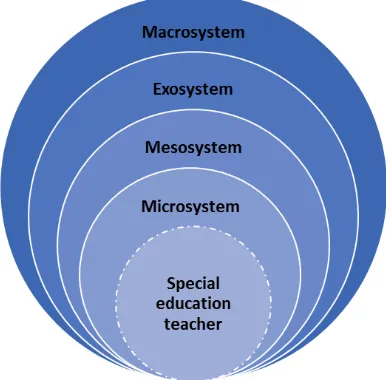
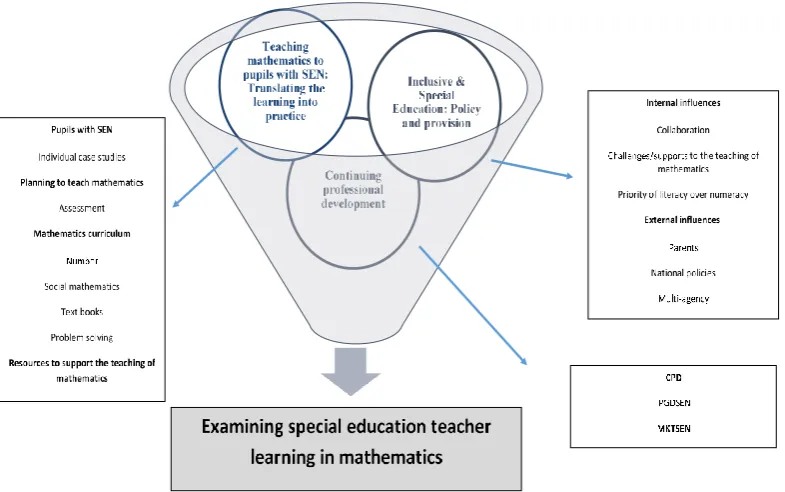
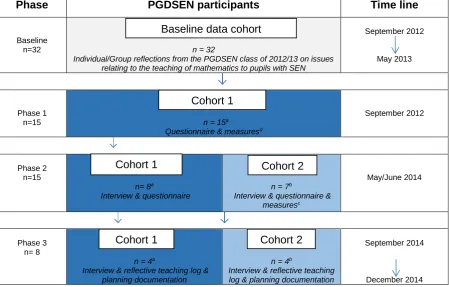
Set within a constructivist paradigm, a case study design proved to be an appropriate means of gaining an in-depth insight into the phenomenon, special education teacher learning in mathematics. The study was conducted in four phases over a 30 month period. Primarily qualitative in nature, the data collection methods included questionnaires, measures, interviews, document analysis and reflective diaries. The data were analysed thematically. The themes which emerged from the data were; Inclusive and special education: Policy and provision; CPD and Translating the learning into practice: Teaching mathematics to pupils with SEN. Bronfenbrenner’s (1979) ecological theory provided a framework to identify, organise and understand the complexity and interaction of factors influencing special education teacher learning and the subsequent transfer to practice of new knowledge and skills in the present research study.
vi
Table of Contents
Declaration... i
Plagiarism ... ii
Acknowledgements ... iii
Summary ... iv
Table of Contents ... vi
List of Figures ... xiv
List of Tables ... xv
List of Appendices ... xvi
List of Acronyms ... xvii
Chapter 1: Introduction... 1
1.1 Introduction ... 1
1.2 Rationale ... 3
1.3 The Research Question ... 4
1.4 Thesis Outline ... 5
Chapter 2: Literature Review ... 6
2.1 Introduction ... 6
2.2 Inclusion ... 6
2.2.1 Understandings of inclusion ... 7
2.2.2 Inclusion in practice ... 8
2.2.2.1 Inclusive pedagogy ... 8
2.2.2.2 Teacher preparation for inclusion ... 9
2.2.2.3 Whole-school approaches to inclusive practice ... 10
2.2.3 Factors associated with effective inclusion ... 10
2.2.4 Summary ... 12
2.3 Inclusive and Special Education: Policy And Provision ...13
2.3.1 Policy development - International contexts ... 13
2.3.2 Policy development – Ireland ... 14
2.3.2.1 Report of the Special Education Review Committee (SERC) ... 15
2.3.2.2 Parental litigation ... 16
2.3.2.3 The Education Act, (1998) ... 16
2.3.2.4 The Education for Persons with Special Educational Needs Act (EPSEN), (2004) ... 17
vii
2.3.3 Summary ... 20
2.3.4 Provision for pupils with SEN in the Republic of Ireland ... 20
2.3.4.1 Special schools ... 20
2.3.4.2 Special classes ... 21
2.3.4.3 Mainstream schools ... 22
2.3.4.3.1 Learning support teachers ... 22
2.3.4.3.2 Resource teachers ... 23
2.3.4.4 Special Needs Assistants (SNAs) ... 24
2.3.4.5 The General Allocation Model (GAM) ... 25
2.3.4.6 DES initiatives to develop teaching and learning in schools ... 26
2.3.5 Summary ... 28
2.4 Conclusion ...28
2.5 Continuing Professional Development (CPD) ...29
2.5.1 Continuing professional development – A definition ... 29
2.5.2 Policy ... 29
2.5.3 Provision ... 31
2.5.3.1 Developments in the 1990s ... 31
2.5.3.2 National support programmes ... 32
2.5.3.2.1 Primary Curriculum Support Programme (PCSP). ... 32
2.5.3.2.2 Regional Curriculum Support Service. ... 33
2.5.3.2.3 School Development Planning Support (SDPS). ... 33
2.5.3.2.4 Professional Development Service for Teachers (PDST). ... 34
2.5.3.3 CPD in inclusive settings ... 34
2.5.3.4 In-service provision. ... 35
2.5.3.4.1 Special Education Support Service (SESS). ... 36
2.5.3.5 Discussion of current issues... 37
2.6 Conclusion ...39
2.7 Translating Learning into Practice -Teaching Mathematics to Pupils with SEN ...39
2.7.1 Terminology ... 40
2.7.2 Factors impacting the acquisition of mathematical skills ... 43
2.7.2.1 Subject content ... 43
2.7.2.2 The pupil ... 44
2.7.2.3 Opportunities for learning mathematics ... 46
2.7.3 Supporting pupils with mathematics difficulties ... 47
2.7.3.1 Providing additional support – A continuum of support ... 47
2.7.3.2 Intervention programme ... 50
2.7.3.3 Evidence-based instructional approaches ... 51
2.8 Conclusion ...51
2.9 Chapter Conclusion ...52
viii
3.1 Introduction ...54
3.2 Theoretical Framework – A Rationale ...54
3.3 Bronfenbrenner’s (1979) Ecological Theory ...56
3.4 Application of Bronfenbrenner’s (1979) Theory to Current Research Study ...59
3.5 Conclusion ...62
Chapter 4: Methodology ... 63
4.1 Introduction ...63
4.2 Research Topic ...63
4.3 Research Purpose ...64
4.4 Statement of Research Question ...65
4.5 Research Paradigm ...66
4.6 Researcher Reflexivity ...68
4.7 Research Design: Case Study ...70
4.7.1 Rationale ... 70
4.7.2 Definition ... 71
4.7.3 Key characteristics ... 72
4.7.4 Conducting a case study: The procedure ... 73
4.7.5 Issues for consideration in case study research ... 75
4.7.5.1 The participants ... 75
4.7.5.2 Data collection ... 75
4.7.5.3 Interviews ... 75
4.7.5.4 Documentation ... 78
4.7.5.5 Questionnaire ... 79
4.7.5.6 Data management, analysis and interpretation ... 82
4.7.5.6.1 Overview of framework. ... 82
4.7.5.6.2 Preparation and organisation of the data. ... 83
4.7.5.6.2.1 Computer assisted qualitative data analysis software (CAQDAS). ... 84
4.7.5.6.3 Exploring and coding the data. ... 85
4.7.5.6.4 Using codes to build descriptions and themes. ... 86
4.7.5.6.5 Representation and reporting of findings. ... 88
4.7.5.6.6 Interpretation of findings. ... 89
4.7.5.6.7 Validation of findings. ... 89
4.7.5.6.7.1 Triangulation. ... 90
4.7.5.6.7.2 Member checking. ... 91
4.7.5.6.7.3 Auditing the study. ... 91
4.7.5.6.8 Generalisation/transferability. ... 92
4.7.5.7 Ethical considerations ... 93
4.8 Outline of Current Research Study ...95
ix
4.8.2 PGDSEN programme ... 96
4.8.3 PGDSEN programme: Mathematics ... 97
4.8.4 Phases of the research study ... 98
4.8.5 Baseline data phase ... 99
4.8.6 Phase 1 ... 100
4.8.6.1 Measures. ... 101
4.8.6.1.1 Mathematics Anxiety Scale-UK (MAS-UK) (Hunt et al., 2011). ... 102
4.8.6.1.2 Sentiments, Attitudes, and Concerns about Inclusive Education Revised (SACIE-R) Scale (Forlin et al., 2011). ... 102
4.8.6.1.3 Mathematics Teaching Efficacy Beliefs Instrument (MTEBI) (Enochs et al., 2000)... 103
4.8.6.1.4 Diagnostic Teacher Assessment in Mathematics and Science (DTAMS). .... ... 104
4.8.7 Phase 2 ... 105
4.8.8 Phase 3 ... 106
4.9 Chapter Conclusion ... 107
Chapter 5: Presentation of Findings ... 108
5.1 Introduction ... 108
5.2 Findings: Baseline Phase ... 108
5.2.1 Theme 1: Inclusive and special education: Policy and provision ... 109
5.2.2 Theme 2: Continuing professional development ... 110
5.2.2.1 A focus on new learning ... 110
5.2.2.2 Reflections on new learning ... 113
5.2.2.3 Summary ... 115
5.2.3 Theme 3: Translating the learning into practice: Teaching mathematics to pupils with SEN ... 116
5.2.3.1 Social mathematics ... 116
5.2.3.2 Participants perceptions on changes to classroom practice ... 118
5.2.3.3 Summary ... 119
5.2.4 Baseline phase: Summary of findings ... 119
5.3 Findings: Phase 1 ... 121
5.3.1 Overview of data set (Cohort 1, Phase 1) ... 121
5.3.2 Sentiments, Attitudes and Concerns about Inclusive Education (SACIE-R) ... 123
5.3.2.1 Summary of SACIE-R findings ... 124
5.3.3 Mathematics Teaching Efficacy Beliefs Instrument (MTEBI) ... 125
5.3.3.1 Summary of MTEBI findings... 127
5.3.4 Diagnostic Teacher Assessment in Mathematics and Science (DTAMS) ... 127
5.3.4.1 Summary of DTAMS ... 129
5.3.5 Mathematics Anxiety Scale-UK (MAS-UK) ... 129
5.3.5.1 Summary of MAS-UK ... 131
5.3.6 Phase 1: Summary of findings ... 131
5.4 Findings: Phase 2 ... 132
x
5.4.1.1 Cohort 1 ... 132
5.4.1.2 Cohort 2 ... 133
5.4.2 Sentiments, Attitudes and Concerns about Inclusive Education Revised Scale (SACIE-R)... 135
5.4.2.1 Summary of SACIE-R findings ... 137
5.4.3 Mathematics Teaching Efficacy Beliefs Instrument (MTEBI) ... 137
5.4.3.1 Summary of MTEBI findings... 138
5.4.4 Mathematics Anxiety Scale-UK (MAS-UK) ... 138
5.4.4.1 Summary of MAS-UK ... 140
5.4.5 Phase 2: Summary of measures (Cohort 2) ... 140
5.4.6 Over view of measures ( Cohort 1, Phase 1; Cohort 2, Phase 2) ... 140
5.4.7 Theme 1: Inclusive and special education: Policy and provision ... 142
5.4.7.1 External influences on provision... 142
5.4.7.1.1 National policies. ... 142
5.4.7.1.2 Standardised testing in mathematics. ... 144
5.4.7.1.3 Staged approach to assessment, identification and programme planning .... ... 145
5.4.7.1.4 Summary: External influences on provision ... 145
5.4.7.2 Internal influences on provision ... 146
5.4.7.2.1 SNAs... 146
5.4.7.2.2 Role of the principal ... 147
5.4.7.2.3 EAL pupils ... 148
5.4.7.2.4 Priority of literacy over numeracy ... 149
5.4.7.2.5 Collaboration with class teachers ... 150
5.4.7.2.5.1 Intervention programmes in mathematics: Cohort 1. ... 150
5.4.7.2.5.2 Co-teaching: Cohort 1. ... 152
5.4.7.2.5.3 Interventions programmes in mathematics: Cohort 2 ... 152
5.4.7.2.5.4 Co-teaching: Cohort 2. ... 153
5.4.7.2.6 Challenges to the teaching of mathematics to pupils with SEN ... 155
5.4.7.2.7 Summary: Internal influences on provision ... 158
5.4.7.2.8 Summary - Theme 1: Inclusive education: Policy and provision ... 158
5.4.8 Theme 2: Continuing professional development (CPD) ... 159
5.4.8.1 Teaching mathematics to pupils with SEN – teacher perspectives ... 159
5.4.8.2 CPD – perceptions and experiences ... 161
5.4.8.3 PGDSEN programme: Acquiring knowledge, skills and understanding in ... mathematics ... 162
5.4.8.4 Summary – Theme 2: Continuing professional development ... 163
5.4.9 Theme 3: Translating the learning into practice -Teaching mathematics to pupils with SEN ... 164
5.4.9.1 Teaching mathematics to pupils with SEN- Participants’ case loads ... 164
5.4.9.2 Assessment ... 167
5.4.9.3 Number ... 170
5.4.9.4 Social mathematics ... 171
5.4.9.5 Resources to support the teaching of mathematics ... 172
5.4.9.6 Summary - Theme 3: Translating the learning into practice – Teaching mathematics to pupils with SEN ... 172
xi
5.5 Findings: Phase 3 ... 175
5.5.1 Overview of data set (Cohort 1 and Cohort 2, Phase 3) ... 175
5.5.2 Theme 1: Inclusive and special education: Policy and provision ... 176
5.5.2.1 External influences on provision... 176
5.5.2.1.1 National policies ... 176
5.5.2.2 Internal influences on provision ... 177
5.5.2.2.1 Supports to the teaching of mathematics. ... 177
5.5.2.2.2 Challenges to the teaching of mathematics. ... 178
5.5.2.3 Priority of literacy over mathematics ... 179
5.5.2.4 Summary - Theme 1: Inclusive and special education: Policy and provision 179 5.5.3 Theme 2: Continuing professional development (CPD) ... 180
5.5.3.1 CPD – perceptions and experiences ... 181
5.5.3.2 PGDSEN programme – acquiring knowledge, skills and understanding in mathematics ... 182
5.5.3.3 Summary – Theme 2: Continuing professional development (CPD) ... 184
5.5.4 Theme 3: Translating the learning into practice – Teaching mathematics to pupils with SEN ... 184
5.5.4.1 Individual case studies (Cohort 1, Phase 3) ... 184
5.5.4.2 Individual case study - Dan ... 186
5.5.4.2.1 Discussion – Participant 2. ... 189
5.5.4.3 Individual case study: Johnny ... 191
5.5.4.3.1 Discussion – Participant P7 ... 194
5.5.4.4 Individual case study: Amy ... 194
5.5.4.4.1 Discussion – Participant P17 ... 196
5.5.4.5 Individual case study: Kevin ... 197
5.5.4.5.1 Discussion – Participant P25 ... 199
5.5.4.6 Summary of individual case studies (Cohort 1, Phase 3) ... 199
5.5.4.7 Individual case studies (Cohort 2, Phase 3) ... 200
5.5.4.8 Individual case study: Gina and Jenny ... 202
5.5.4.8.1 Discussion – Participant P10 ... 203
5.5.4.9 Individual case study: 4th class ... 204
5.5.4.9.1 Discussion – Participant P15 ... 206
5.5.4.10 Individual case study: 2nd class ... 206
5.5.4.10.1 Discussion – Participant P18 ... 207
5.5.4.11 Individual case study: Fred ... 207
5.5.4.11.1 Discussion – Participant P28 ... 209
5.5.4.12 Summary of individual case studies (Cohort 2, Phase 3) ... 210
5.5.5 Phase 3: Summary of findings ... 210
Chapter 6: Discussion ... 213
6.1 Introduction ... 213
6.2 Inclusive and Special Education: Policy and Provision ... 213
6.2.1 School leaders (principals) ... 213
6.2.2 Special needs assistants ... 214
6.2.3 Standardised testing ... 216
xii
6.2.5 Collaboration between LS/RT and class teacher ... 217
6.2.6 Priority of literacy over numeracy ... 220
6.2.7 Summary ... 221
6.3 Continuing Professional Development ... 222
6.3.1 Teacher knowledge in SEN ... 222
6.3.2 CPD in SEN ... 222
6.3.3 What do special education teachers want to learn? ... 223
6.3.4 Influence of CPD ... 224
6.3.5 Summary ... 226
6.4 Teaching Mathematics to Pupils with SEN: Translating Learning into Practice ... 226
6.4.1 Assessment ... 226
6.4.2 Number ... 231
6.4.3 Social mathematics ... 232
6.4.4 Summary ... 234
6.5 An Ecological Perspective on Special Education Teacher Learning in Mathematics ... 234
6.5.1 The special education teacher ... 235
6.5.2 The microsystem ... 235
6.5.3 The mesosystem ... 236
6.5.4 The exosystem ... 237
6.5.5 The macrosystem ... 238
6.5.6 Summary ... 238
6.6 Conclusion ... 239
Chapter 7: Conclusion ... 240
7.1 Introduction ... 240
7.2 The Research Question ... 240
7.3 Findings ... 241
7.3.1 What are the individual teacher factors influencing special education teachers’ acquisition of knowledge and skills in mathematics? ... 242
7.3.2 What are the contextual factors influencing special educators’ acquisition of knowledge and skills in mathematics? ... 243
7.3.3 What are the special educators’ perceptions and experiences of the influence of the mathematics input on the PGDSEN programme on their acquisition of knowledge and skills in mathematics? ... 244
7.3.4 What are the special educators’ understandings of the transfer of their learning to classroom practice? ... 244
7.4 Implications and Recommendations ... 245
7.4.1 Policy ... 246
7.4.2 Provision ... 247
xiii
7.6 Contribution to the research ... 249
7.7 Suggestions for Further Research ... 249
7.8 Conclusion ... 250
References ... 252
xiv
List of Figures
Figure 2.1 Continuum of support (Department of Education and Skills, 2007a) ... 48
Figure 2.2 Assessment, intervention and review process (Department of Education and Skills, 2007a, p. 5). ... 48
Figure 3.1 Ecological perspective on human development (Bronfenbrenner, 1979) ... 57
Figure 3.2 An ecological perspective on special education teacher learning in mathematics - Adapted from (Greene et al., 2010) ... 60
Figure 4.1 Theoretical perspective (Grix, 2004; Hamilton & Corbett-Whittier, 2013; Mertens, 2015). ... 68
Figure 4.2 Analyzing and interpreting qualitative data: Six step framework (Creswell, 2012, p. 236). ... 83
Figure 4.3 Final themes (Phase 3) ... 88
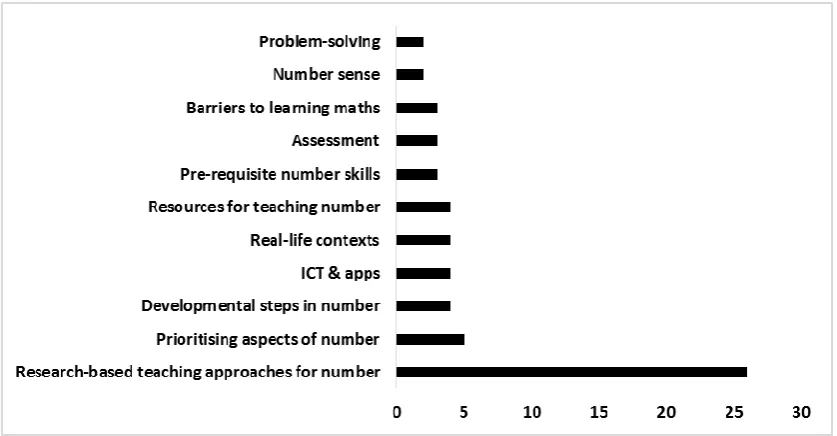
Figure 5.1 KWL grid – What I know about teaching number to pupils with SEN ... 111
Figure 5.2 KWL grid – What I want to know about teaching number to pupils with SEN 111 Figure 5.3 Relevance of lectures on mathematics to the participants’ needs. . ... 114
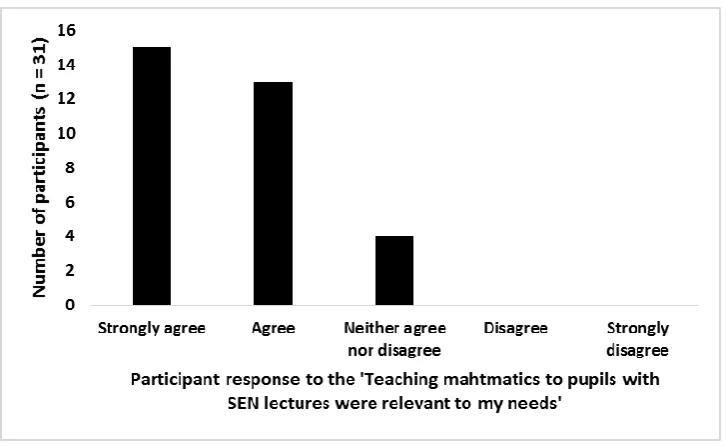
Figure 5.4 Lecture of most relevance to the PGDSEN programme participants ... 114
Figure 5.5 Lecture of least relevance to the PGDSEN programme participants ... 115
Figure 5.6 “The CPD I have received on teaching mathematics to pupils with SEN will influence pupil achievement levels in mathematics in my school” ... 119
Figure 5.7 Participants’ teaching experience in special education ... 122
Figure 5.8 SACIE-R – Subscale mean scores (Cohort 1, Phase 1) ... 124
Figure 5.9 MTEBI subscale mean scores (Cohort 1, Phase 1) ... 126
Figure 5.10 DTAMS Mean scores(Cohort 1, Phase 1) ... 128
Figure 5.11 MAS-UK scores (Cohort 1, Phase 1) ... 130
Figure 5.12SACIE-R – Mean scores (Cohort 2, Phase 2) ... 136
Figure 5.13 MTEBI mean scores (Cohort 2, Phase 2) ... 137
Figure 5.14 Mathematics Anxiety Scale-UK (Cohort 2, Phase 2) ... 139
xv
List of Tables
Table 2.1 Mathematics Difficulties – Terminology ... 41
Table 4.1 Response Rate ... 82
Table 4.2 Overview of Research Phases ... 98
Table 4.3 Overview of Baseline Data Set ... 99
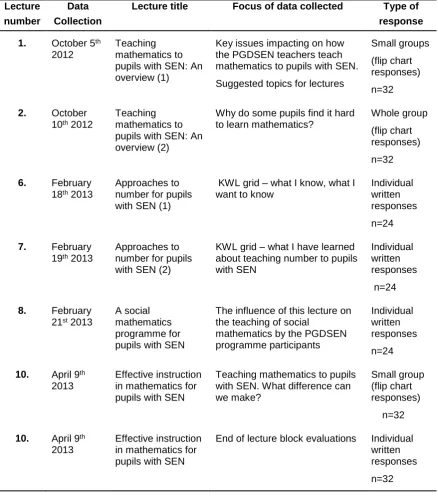
Table 4.4 Overview of Baseline Data Collection ... 100
Table 4.5 Measures (Phase 1) ... 101
Table 4.6 Types of Knowledge Assessed in the DTAMS (CRiMSTeD, 2016a) ... 105
Table 4.7 Overview of Phase 2 Data Set ... 105
Table 4.8 Overview of Phase 3 Data Set ... 107
Table 5.1 Issues Impacting on the Teaching of Mathematics to Pupils with SEN ... 109
Table 5.2 KWL grid: What I have Learned about Teaching Number to Pupils with SEN ... 112
Table 5.3 Teaching Positions (Cohort 1, Phase 2) ... 122
Table 5.4 SACIE-R Scores (Phase 1, Cohort 1) ... 123
Table 5.5 MTEBI Overall Scores (Phase 1, Cohort 1) ... 125
Table 5.6 DTAMS Scores (Cohort 1, Phase 1) ... 128
Table 5.7 MAS-UK Scores (Cohort 1, Phase 1) ... 130
Table 5.8 Teaching Positions (Cohort 1, Phase 2) ... 132
Table 5.9 Profile of Schools (Cohort 1, Phase 2) ... 133
Table 5.10 Participants Teaching Positions (Cohort 2, Phase 2) ... 134
Table 5.11 Profile of Schools (Cohort 2, Phase 2) ... 134
Table 5.12 SACIE-R Scores (Cohort 2, Phase 2) ... 135
Table 5.13 MTEBI Scores (Cohort 2, Phase 2) ... 137
Table 5.14 Mathematics Anxiety Scale-UK: (Cohort 2, Phase 2) ... 139
Table 5.15 Overview of Measures (Cohort 1, Phase 1; Cohort 2, Phase 2)... 141
Table 5.16 Teaching Positions (Cohort 1 and Cohort 2, Phase 3) ... 176
Table 5.17Overview of Individual Case Studies (Cohort 1, Phase 3) ... 185
xvi
List of Appendices
Appendix A Semi-Structured Interview Schedule (Phase 3) Appendix B Sample of Participant’s Reflective Journal (Phase 3) Appendix C Questionnaire (Phase 1)
Appendix D Codebook (Phase 2)
Appendix E First Cycle Codes (Phase 2)
Appendix F Second Cycle Codes: Emerging Themes- Phase 2 (Version 1) Appendix G Emerging Themes - Phase 2 (Version 2)
Appendix H Themes Phase 2 – Visual Representation (Version 1) Appendix I Themes Phase 2 – Visual Representation (Version 2) Appendix J Themes Phase 2 – Visual Representation (Final) Appendix K Ethics
Appendix L Participant Information Form Appendix M Consent Form (Phase 1)
Appendix N Mathematics Anxiety Scale – UK (MAS-UK) (Hunt et al., 2011) Appendix O Mathematics Teaching Efficacy Beliefs Instrument – MTEBI (Enochs,
Smith & Huinker 2000)
Appendix P The Sentiments, Attitudes, and Concerns about Inclusive Education Scale Revised (SACIE-R) (Forlin, Earle, Loreman & Sharma 2011) Appendix Q Example of Diagnostic Teacher Assessments in Mathematics and
Science (CRiMSTeD, 2016a)- Whole Number & Computation subset Appendix R Social Maths - Reflective Sheet
Appendix S Reflective KWL - Number
Appendix T Evaluation: Teaching Mathematics to Pupils with SEN Lectures Appendix U Participant Information Letter and Consent Form (Phase 2) Appendix V Letter and Consent Form to Principal Teachers (Phase 2). Appendix W Questionnaire (Phase 2)
Appendix X Participant Information Form Appendix Y Reflective Journal (Phase 3)
Appendix Z Pupil/Group Profile Template (Phase 3) Appendix AA Interview Schedule (Phase 2)
Appendix BB Overview of Modules: PGDSEN 2012/13
xvii
List of Acronyms
ADHD Attention-Deficit Hyperactivity Disorder
ASD Autism Spectrum Disorder
CPD Continuing Professional Development DEIS Delivering Equality of Opportunity in Schools DES Department of Education and Skills
DD Developmental Dyscalculia
DSM-IV Diagnostic and Statistical Manual of Mental Disorders -IV DTAMS Diagnostic Teacher Assessment in Mathematics and Science
DS Down syndrome
DPMT-R Drumcondra Primary Mathematics Test-Revised DTEN Drumcondra Tests of Early Numeracy
EPSEN Act Education for Persons with Special Educational Needs Act
EP Educational Psychologist
EBD Emotional and Behavioural Disorders EAL English as an Additional Language
EU European Union
EPV Extra Personal Vacation days GAM General Allocation Model
GAM/EAL General Allocation Model/English as an Additional Language
HI Hearing Impairment
HEI Higher Education Institutes ICDU In-Career Development Unit IEP Individual Education Plan
IPLP Individual Profile and Learning Programme ICT Information and Communications Technology ITE Initial Teacher Education
INTO Irish National Teachers Organisation
LD Learning Disabilities
LS Learning Support teacher
LS/RT Learning support/Resource teacher
LA Low Achievers
MD Mathematical Difficulties
MKT Mathematical Knowledge of Teachers MLD Mathematical Learning Disability MAS-UK Mathematics Anxiety Scale-UK
MaLT Mathematics Assessment for Learning and Teaching MTEBI Mathematics Teaching Efficacy Beliefs Instrument MTOE Mathematics Teaching Outcome Expectancy MGLD Mild General Learning Disability
ModGLD Moderate General Learning Disability
xviii NEPS
List of Acronyms (contd.)
National Educational Psychological Service
OECD Organisation for Economic Co-operation and Development PMTE Personal Mathematics Teacher Efficacy
PGDSEN Post Graduate Diploma in Special Educational Needs PCSP Primary Curriculum Support Programme
PLNs Priority Learning Needs
PDST Professional Development Service for Teachers PISA Programme for International Student Assessment SERC Report of the Special Education Review Committee
RD Reflective Diary
RT Resource Teacher
RtI Response to Intervention
SDPS School Development Planning Support
SSE School Self Evaluation
STEBI Science Teaching Efficacy Belief Instrument
SACIE-R Sentiments, Attitudes, and Concerns about Inclusive Education Revised SESS Special Education Support Service
SEN Special Educational Needs
SENO Special Educational Needs Organisers
SNA Special Needs Assistants
SpLD Specific Learning Disability
SSLD Specific Speech and Language Disorder
TES Teacher Education Section
TALIS Teaching and Learning International Survey
UK United Kingdom
USA United States of America
VI Visual Impairment
KWL What I know, What I want to know, What I have learned
WSE Whole School Evaluation
1
1.
Chapter 1: Introduction
“I don’t care what we do in this room as long as we don’t do maths. Ok?”
Johnny, 5th class pupil in conversation with his Resource Teacher (RT) at the beginning of a new school year.
1.1 Introduction
Johnny (aged 11 years) decided he no longer wanted to learn mathematics. He had a Mild General Learning Disability (MGLD), a negative attitude towards mathematics and he experienced mathematics anxiety. I was a newly appointed Resource Teacher (RT) in a mainstream primary school in a rural town and Johnny was one of my first pupils. As a recent graduate of a Post Graduate Diploma in Special Educational Needs (PGDSEN) programme, I was determined that Johnny was going to achieve in mathematics. And so, little by little, mathematics crept into our daily lessons together. Easy mathematics, fun mathematics, social mathematics, short, achievable lessons. The turning point occurred the day Johnny came to my class and said “Can we do maths first today, Miss?” He was finally achieving in mathematics, albeit at a level three years below his peers, and was clearly enjoying his success. His confidence levels increased. As he came to believe that he could learn mathematics, he asked to be challenged in mathematics. His mother told me of her pride in her son’s achievements in mathematics. This story had a happy ending. My personal conviction that all children can learn mathematics has inspired my work as a special education teacher educator.
Developing competency in literacy has traditionally taken precedence over mathematics (Berch & Mazzocco, 2007; Geary, 2011). However, society today demands higher standards in mathematics and the importance of mathematical competence for all pupils is now well established (Bryant & Bryant, 2008; Peterson Miller, 2009). In fact, the National Mathematics Advisory Panel (2008), an influential US report, argues that mathematical competency increases both career opportunities and higher income prospects. Yet, attainment levels in mathematics are of concern
nationally and internationally (Department of Education and Skills, 2011f; Kilpatrick, Swafford, Findell, & Council, 2001; National Mathematics Advisory Panel, 2008). International measures of attainment levels in mathematics in the United States (US) indicate that performance there is behind that in other countries (Kilpatrick et al., 2001). Forbringer and Fuchs (2014) refer to the findings of the National Assessment of
2
achieved results which were “at or above the proficient level in mathematics” (p. xi). Similarly in Ireland, National Assessments of Mathematics Achievement (NAMA) carried out in 2004 found that there was no change in achievement in mathematics in the years following the introduction of the revised curriculum (Eivers & Clerkin, 2013). More recently, the performance of 15 year old pupils in the Republic of Ireland was described as “below average” in the Programme for International Student Assessment (PISA) 2009 tests (Department of Education and Skills, 2011f). Intensive efforts are underway here and elsewhere to increase the achievement levels of all pupils in mathematics including those with Special Educational Needs (SEN) (Department of Education and Skills, 2011e, 2011f).
Unfortunately, about 5% to 7% of children find learning mathematics difficult (Geary, 2011; Gersten, Chard, et al., 2009). Most researchers agree that the teacher is a critical influence on pupil achievement in mathematics (Hill et al., 2005; National Mathematics Advisory Panel, 2008). Research has established that developing a teacher mathematical knowledge base i.e. a knowledge of content and pedagogy, increases the attainment levels of her pupils (Hill et al., 2005). In addition to a knowledge of the subject content and its associated pedagogy, evidence based instructional approaches and assessment measures, special education mathematics teachers require a knowledge of the learning characteristics of their pupils and a knowledge of assistive technology to support their teaching (Brownell, Sindelar, Kiely, & Danielson, 2010; Chinn & Ashcroft, 2007; Mastropieri, Scruggs, & Mills, 2011; van Garderen, Thomas, Stormont, & Lembke, 2013).
In recent years, national and international policy directives have influenced the trend to inclusive educational provision in the Republic of Ireland (Government of Ireland, 2004; UNESCO, 1994). Teachers play a central role in creating inclusive practices in schools (Rouse, 2008; Shevlin, Winter, & Flynn, 2013) and generally express positive attitudes towards inclusion (Shevlin et al., 2009). However, the inclusion of pupils with SEN in mainstream schools has placed additional demands on teachers (Ainscow, 2014; Greer & Meyen, 2009). Teaching in inclusive settings not only demands positive teacher attitudes, values and beliefs to inclusion but also requires supports at systems level including time and resources (Forlin, 2010a). Researchers agree that some teachers feel they do not have the necessary skills and knowledge to teach pupils with SEN (Black-Hawkins, 2014; Jordan, Schwartz, & McGhie-Richmond, 2009; Ring & Travers, 2005) and that their Initial Teacher
3
acquisition of the specialist knowledge required to fulfil their special education teaching duties (Ware et al., 2011). Maccini and Gagcon (2002) contend that CPD is vital for special education teachers to support them with the specific challenges of teaching mathematics to pupils with SEN. Recent studies indicate the positive influence of CPD on the teaching practices of special education teachers (Rose, Shevlin, Winter, & O'Raw, 2015).
The Combined Post-Graduate Diploma Programme of Continuing Professional Development for Teachers involved in Learning Support and Special Education (PGDSEN) is an accredited, funded CPD programme offered by the Department of Education and Skills (DES) to teachers working in special education in the Republic of Ireland (Department of Education and Skills, 2012a). This programme, offered by seven Higher Education Institutes (HEI) nationwide provides the focus for the current study. The researcher, a special education teacher educator in one of the seven HEI host institutions, had responsibility for the design and delivery of the mathematics input on the PGDSEN programme. This input provides the focus for the current study.
1.2 Rationale
The researcher’s experiences as a Learning Support/Resource Teacher (LS/RT) provided the initial stimulus for this study. Overcoming negative pupil attitude, resulting from years of failure in mathematics class proved to be a formidable
endeavour. Drawing on the skills and knowledge she acquired on a post graduate programme in SEN, she developed and taught successful mathematics intervention programmes to pupils with SEN. Positive outcomes were noted both in terms of pupil outcomes and pupil attitudes towards mathematics. In her subsequent role as special education teacher educator, the researcher developed and presented the input on mathematics for special education teachers engaging on a PGDSEN programme over a ten year time frame.
This research study therefore, occurred at an opportune time to consider the perceptions of special education teachers on the influence of the mathematics input on a PGDSEN programme on their learning and furthermore to consider their
understandings of the ensuing changes in their practice. Given that Sindelar, Brownell, and Billingsley (2010) consider that school context has the capacity to influence the implementation of CPD, it was important also to consider the range of contextual factors influencing the transfer of special education teacher learning to practice.
4
literature base that exists in this aspect of special education (Feng & Sass, 2010), this research study will provide a valuable contribution to the literature base on CPD in mathematics for special education teachers and the transfer of their learning into classroom practice. The findings will be useful for policy makers, practitioners and researchers alike.
1.3 The Research Question
The purpose of the study was to better understand the factors, individual and contextual, which influenced special education teachers’ acquisition of knowledge and skills for teaching mathematics to pupils with SEN. The study also sought to
understand the perceptions and experiences of the participants, of the influence of the mathematics input on the PGDSEN programme on their acquisition of new knowledge and skills and their understandings of the subsequent transfer of this learning to their practice in classrooms. The findings will therefore add to the existing limited knowledge base on special education teacher learning in mathematics.
The research question and embedded questions which directed this study are as follows:
What factors influence special educators’ teaching of mathematics to pupils with SEN?
1. What are the individual teacher factors influencing special educators’ acquisition of knowledge and skills in mathematics?
2. What are the contextual factors influencing special educators’ acquisition of knowledge and skills in mathematics?
3. What are the special educators’ perceptions and experiences of the influence of the mathematics input on the PGDSEN programme on their acquisition of knowledge and skills in mathematics?
4. What are the special educators’ understandings of the transfer of their learning to classroom practice?
The primary/special school teacher cohort of the PGDSEN programme
5
the participants’ schools in Phases 2 and 3 yielded insights into the perceptions of the participants of their learning and of their understandings of the transfer of their new knowledge to their practice.
1.4 Thesis Outline
This thesis is presented in seven chapters. Chapter one presents the rationale and the research questions which guide the research. A thematic review of the
literature is presented in chapter two. Four themes guide the analysis of the literature. The first theme, Inclusion, situates the research study within the context of inclusive educational provision for pupils with SEN. The second theme, Inclusive and special education: Policy and provision examines the influence of inclusive policy
developments nationally and internationally on the development of inclusive educational provision in Ireland. Current provision for pupils with SEN in Ireland is outlined. The third theme, Continuing professional development (CPD) provides the context for the PGDSEN programme, the focus of this study. The final theme,
Translating learning into practice: Teaching mathematics to pupils with SEN discusses and interprets the terminology associated with learning difficulties in mathematics. It subsequently explores issues relating to the teaching and learning of mathematics to pupils with SEN. The third chapter presents the theoretical framework for the study. Bronnfenbrenner’s (1979) ecological theory permitted a broader analysis of the
interconnecting factors which supported and negated the acquisition and dissemination of the expertise of the participants following their completion of the PGDSEN
6
2.
Chapter 2: Literature Review
2.1 Introduction
This literature review aims to establish the literature base relating to special education teacher learning in mathematics for pupils with SEN within an inclusive education system (Creswell, 2012; Robson, 2011). The thematic literature review will identify the existing knowledge base and areas within the literature requiring further development (Rose, Shevlin, Winter, & O’Raw, 2010). The literature relating to each of the four inter-dependent themes of Inclusion, Inclusive and special education: Policy and provision, Continuing professional development and Translating the learning into practice - Teaching mathematics to pupils with SEN will be presented, discussed and analysed, and will thereby provide a clear context and justification for the current study (Hart, 1998).
In tandem with the move towards inclusive education, education for pupils with SEN continues to change and evolve within a framework of international and national policy directives (Winter & O'Raw, 2010). The first theme, Inclusion, begins with a discussion of the concept of inclusion and presents current research on inclusive practices in Ireland. The second theme, Inclusive and special education: Policy and provision outlines the development of inclusive and special educational policy in international and national contexts. Education provision for pupils with SEN in Ireland today will be discussed and presented. The third theme, Continuing professional development, outlines policy developments in CPD. It focuses specifically on CPD for special educators, giving particular attention to the PGDSEN programme, within the context of the continuum of teacher education. The fourth and final theme, Translating the learning to practice - Teaching mathematics to pupils with SEN, clarifies the terminology associated with mathematical learning difficulties and examines the difficulties experienced by pupils with SEN when learning mathematics. The final section of this theme presents a framework for the teaching and learning of mathematics to pupils with SEN.
2.2 Inclusion
7
diversity of its pupils (Ainscow, 2014; Ferguson, 2008). Led by inclusive whole school approaches in the United States of America (USA), following the passing of the Education for All Handicapped Children Act (1975), the globalisation of inclusion has resulted in the passing of legislation in all European Union (EU) countries to “promote or require inclusion” (Winter & O'Raw, 2010, p. 3). New practices involve changing cultures and structures for all pupils (Ferguson, 2008; Mittler, 2000). The process of inclusive education is a complex task and one which is dependent on factors both within and external to the school (Ainscow, 2014; Mittler, 2000; UNESCO, 2005). The adoption of inclusive practices also involves changes in pedagogical practice for teachers (Forlin, 2010b; Graham & Jahnukainen, 2011).
2.2.1 Understandings of inclusion
Definitions of inclusion abound and vary in their interpretations (Ainscow, 2007b; Armstrong, 2011; Brownell, Smith, Crockett, & Griffin, 2012; Farrell, 2012; Florian, 2008; Westwood, 2013) depending on the context in which they are used, the purpose of the term or who is using it (Armstrong, 2011; Peters, 2007). The absence of a universal definition bears testimony to the controversy the concept generates (Griffin & Shevlin, 2011; Rose et al., 2015) .
8
Inclusive education in the United Kingdom (UK) and in Ireland has adopted a “flexible continuum of provision” (Westwood, 2013, p. 2), ranging from inclusion in mainstream schools, special classes in mainstream schools or special schools
(Department of Education and Skills, 2007a). The continuum of provision promoted in Ireland is reflected in Winter and O’Raw’s (2010) model which views inclusion “as a dynamic system that encompasses mainstream schools, special classes, special schools and the wider community” (p. 47). Winter and O’Raw (2010) further elaborate and define inclusive education in the Irish context as a process of
addressing and responding to the diversity of needs of learners through enabling participation in learning, cultures, and communities; and
removing barriers to education through the accommodation and provision of appropriate structures and arrangements, to enable each learner to achieve the maximum benefit from his/her attendance at school. (p. 39).
2.2.2 Inclusion in practice
Given the uncertainty and ambiguity which exists in the literature in its efforts to define inclusion (Ainscow, 2007a; Giangreco, Carter, Doyle, & Suter, 2010), inclusive practices in schools will vary from setting to setting informed by the conceptual understanding of inclusion in that context (Florian & Spratt, 2013; McLeskey & Waldron, 2002; Winter & O'Raw, 2010).
Inclusive practice, while generally based on the concept of accommodating all learners within the classroom (Ainscow, 2014; Winter & O'Raw, 2010) and “addressing differences where necessary” (Westwood, 2013, p. ix), also has a broad remit both within and outside of the classroom. Common features of inclusive practices in the literature include positive teacher attitudes, a whole-school culture or community of practice to inclusive education (Ainscow & Sandill, 2010), the provision of CPD for teachers in inclusive practices (Forlin, 2010a), effective leadership for inclusion and the development of Individual Education Plans (IEPs) for some pupils (Winter & O'Raw, 2010).
2.2.2.1 Inclusive pedagogy
The view expressed by Ainscow (2007a, 2014), that teachers form the nucleus of inclusive education practices is widely acknowledged in the literature. Shevlin et al. (2013) recognise that inclusive practice relies on “teacher knowledge, skills,
9
interestthat the teachers in Ring and Traver’s (2005) study, were of the opinion that a “specialist pedagogy” was necessary to teach pupils with SEN (p. 48). In contrast, some researchers, such as Lewis and Norwich (2005, 2007), query the need for
specific teaching strategies to teach pupils with SEN, given that all teachers endeavour to teach the same curriculum objectives to all learners in their classes. It is noteworthy that Lewis and Norwich (2005) admit that some teaching strategies relevant for low attaining pupils may not be suitable for high attaining pupils, suggesting that there is some flexibility in their views on inclusive pedagogy.
Lignugaris/Kraft and Harris (2014) argue that, just as the role of the general educator and the special educator isquite different, so too is the preparation required. Similar views are expressed by Leko and Brownell (2009).They suggest that “special educators need to know how to assist teachers in delivering content area instruction as well as in providing intensive instruction to students with disabilities on key strategies, concepts and skills” (Leko & Brownell, 2009, p. 65). In support of their views, they refer to the work of Vaughn, Moody & Schumm’s (1998) view who emphasise that evidence based instructional approaches such as direct instruction “define what is ‘special’ about special education” (Leko & Brownell, 2009, p. 65).
2.2.2.2 Teacher preparation for inclusion
10
Several studies undertaken in Ireland highlight the critical need to offer teachers the opportunity to enhance their knowledge and skills in key areas of special education. For example, the special education teachers in a study by O'Gorman and Drudy (2010) requested upskilling in areas of learning difficulties, assessment techniques, teaching strategies and mathematics. Similarly, the findings of Shevlin et al. (2008) and Rose et al. (2015) underline the need for teachers to develop their skills in using assessment strategies. In another study conducted by Travers et al. (2010), teachers were found to require CPD to enable them to develop IEPs.
2.2.2.3 Whole-school approaches to inclusive practice
Inclusive education demands a whole-school response by all members of the school community (Shevlin et al., 2008). Given that “all schools are not equally inclusive” (National Council for Special Education, 2006b, p. 161), the creation of inclusive schools may require additional resources and training as well as changes to existing practices (National Council for Special Education, 2006b; Winter & O'Raw, 2010). The critical role of the principal in promoting inclusive school cultures and in leading whole school approaches to inclusive practices is highlighted in a study conducted by Banks et al. (2016). The results of this research suggest that, the
principal plays a key role in the effective management by influencing the way “teacher expertise in special class settings is used” (Banks et al., 2016, p. 6).
The development of a whole school plan or policy on SEN is a legislative
requirement of each school (Government of Ireland, 1998). School policies are required to outline, for example, procedures for assessment, differentiation and developing IEPs (Winter & O'Raw, 2010). Research undertaken by O'Gorman and Drudy (2011) and by Shevlin et al. (2009) that while most schools in Ireland had school policies for the inclusion of pupils with SEN, there were instances where the development of such policies was in progress and instances where existing policies were found to be outdated, did not reflect current policy or legislation or were exclusionary in nature (Rose et al., 2015). These practices are at variances with the views of Winter and O’Raw (2010) who emphasise that policies on SEN should “be kept under review and regularly evaluated” (p. 60).
2.2.3 Factors associated with effective inclusion
11
undertaken by Shevlin et al. (2009) supports this finding. However, a certain scepticism about inclusion was observed in some teachers in the study of Travers et al. (2010). Teachers in their study indicated that the lack of time for planning and their lack of skills in SEN impacted on their abilities to include children with SEN (Travers et al., 2010). Teachers in a study undertaken by Shevlin et al., (2013) supported these findings and also indicated that the absence of adequate funding for resources and the lack of external supports for SEN posed difficulties in their efforts to promote inclusive
practices. Furthermore, there is evidence to suggest that teachers who are not involved in inclusive practices have more negative attitudes to inclusion (Avramidis & Norwich, 2002). It is suggested that negative attitudes can be difficult to change (Shevlin et al., 2008), and can often be attributed to a lack of expertise in SEN (Westwood, 2013). Attitudes may, however, be changed by training in special education, which has been found to have a positive influence on teacher attitudes towards inclusion (Avramidis & Norwich, 2002).
The nature and extent of the collaboration between the class teacher and the special education teacher is a core factor in successful inclusive practice (Shevlin et al., 2008). However, Westwood (2013) points out that the lack of such collaboration presents an obstacle to inclusion. Shevlin et al., (2008) share Westwood’s (2013) views as their research outlines the challenges that exist for collaboration. They point to the reduced opportunities for collaboration, given the preference of some class teachers for the withdrawal model of support. The facilitation of specific collaborative opportunities outside of the school day for class teachers and special education teachers to liaise and plan together, for the development of intervention programmes and IEPs, for liaising with parents and Special Needs Assistants (SNAs) is strongly recommended in the literature (O'Gorman & Drudy, 2011; Ring & Travers, 2005; Shevlin et al., 2009; Travers et al., 2010; Westwood, 2013).
12
Six models of co-teaching, including team teaching and station teaching, have been clearly identified in the literature (Friend, 2014; Murphy & Scantlebury, 2010; Villa, Thousand, & Nevin, 2008). Although a popular inclusive instructional model (Cook, McDuffie, Oshita, & Cothren Cook, 2011), the limited research base on co-teaching to date is largely descriptive and discusses the logistics of co-co-teaching rather than being evaluative (Cook et al., 2011; Hanover Research, 2012). Following their review of the literature, Cook et al. (2011) cite Zigmond and Magiera’s (2001)
recommendation that “co-teaching be used with caution” (Cook et al., 2011, p. 148).
The provision of additional support for pupils with SEN in Ireland in the mainstream classroom was first advocated in the Report of the Special Education Review Committee (SERC) (1993) and later specifically outlined as a model for providing additional support to pupils with SEN by the Department of Education and Skills (2005c). Travers et al.’s (2010) study on inclusion in primary and post-primary schools in Ireland found evidence of team teaching in all schools. However, in another study examining the benefits of the withdrawal model in mathematics, Travers (2011) stated that 95% of the learning support teachers continued to support pupils in
mathematics, using the withdrawal model. The approach was favoured because “it was easier to spend longer on a particular topic, there was less distraction and easier to keep the pupils on task” (Travers, 2011, p. 469). While team teaching was evident in a more recent study by Rose et al. (2015), the researchers found that Learning
Support/Resource Teachers (LS/RTs) were predominantly using an individual or small group withdrawal model as a means of providing additional support to pupils with SEN. It can be concluded, therefore, that while co-teaching is in place in some classrooms, the withdrawal model remains a common approach to providing support for pupils with SEN (Kinsella, Murtagh, & Senior, 2014).
2.2.4 Summary
In common with educational systems internationally, the education system in Ireland has moved towards the provision of an inclusive education for all learners. This shift towards inclusion, directed by policy and legislation, has not been without its challenges. While increased resources to schools have enabled the inclusive
13
2.3 Inclusive and Special Education: Policy And Provision
Educational provision for pupils with SEN has changed dramatically in recent years. While education for those with disabilities was first noted in Europe in the mid eighteenth century and in the USA in the following years, such provision was of a segregated, institutional nature provided by those with humanitarian philosophies and evangelical approaches (Winzer, 2007). The mid 1900s saw the publication of
international policy statements asserting the rights of every citizen to education and thereby heralded the concept of inclusive education as we know it today. This section will trace the development of special education provision in both international and national contexts. The concept of inclusion in a special education context will be discussed and analyzed. The final section of this theme outlines the nature of special educational provision in Ireland.
2.3.1 Policy development - International contexts
The right to education for all children, including those with SEN was established and endorsed in international policy documents (UNESCO, 1990; United Nations, 1948). Compulsory elementary education requirements (United Nations, 1948) resulted in the development of educational structures to educate a diverse population (Florian, 2007) and were influenced by a number of international declarations (UNESCO, 1994; United Nations, 1975, 2006). The World Declaration on Education for All and its accompanying Framework for Action (UNESCO, 1990) stated in Article 3.5 that the “learning needs of the disabled demand special attention” and also stated that procedures be put in place to provide for such education as an “integral part of the education system”. The education of children with SEN was subsequently identified and defined in the Salamanca Statement and Framework for Action (UNESCO, 1994), a widely acknowledged key document supporting inclusive education in the context of equal access to education for all. (Ainscow, 2007a; Vislie, 2003). It clearly stated “that those with special education needs must have access to regular schools which should accommodate them with a child-centered pedagogy capable of meeting those needs” (UNESCO, 1994, p. viii). Due to the commitment of the international community, including Ireland, the Salamanca Statement’s definition of inclusive education has influenced policy and practice on a global level (Peters, 2007; Rose et al., 2015).
The publication of the Dakar Framework for Action in 2000 provided a
14
that the broad vision of Education for All as an inclusive concept was reflected in national government and funding agency policies” (UNESCO, 2000, p. 14). While reaffirming that the “learning needs of all young people are met through equitable access to appropriate learning and life skills programmes” (UNESCO, 2000, p. 8), it noted the changes in inclusion from preparing children with special needs to “fit into existing schools” to “preparing schools so that they can deliberately reach out to all children” (UNESCO, 1990, p. 18).
In response to the international declarations in respect of the right to education for all (UNESCO, 1994; United Nations, 1948), individual countries developed policies and practices in education incorporating inclusive education (Griffin & Shevlin, 2011). For example, the passing of the Education for All Handicapped Children Act (1975) in the USA initiated such reform (Griffin & Shevlin, 2011). Subsequent legislation, including the Individuals with Disabilities Education Improvement Act (2004) and the
No Child Left Behind Act (2001), continue to guide inclusive education (Meaney, Kiernan, & Monahan, 2005; Rouse & McLauglin, 2007) in the USA.
Influenced by the publication of the Warnock Report (Warnock, 1978), the passing of the Education Act (1981) in the United Kingdom (UK) (Evans, 2007) and the
Salamanca Statement (UNESCO, 1994), education for pupils with SEN in the 1980s in the UK was grounded in the principles of equity and equal opportunities for all (Winzer, 2007). Special educational needs were defined according to a need for services (Peters, 2007) as opposed to the practice of placing children with disabilities in distinct medical categories (Evans, 2007). Policy and legislation in the UK such as the Code of Practice on the Identification and Assessment of Special Educational Needs (1994), the Special Educational Needs and Disability Act (SENDA) (2001), and the Removing Barriers to Achievement (2004) strategy (DfES, 2004) ensured the right for pupils with SEN to mainstream education (Rouse & McLauglin, 2007). The provision of CPD for teachers in SEN was a key action plan in the UK government’s strategy for SEN,
Removing Barriers to Achievement (DfES, 2004).
2.3.2 Policy development – Ireland
15
2.3.2.1 Report of the Special Education Review Committee (SERC)
While the Irish government committed to the provision of an education for children with disabilities when it became a signatory of the Convention on the Rights of the Child (UNESCO, 1989) in 1992, it was the publication of the Report of the Special Education Review Committee (SERC) in 1993 which laid the cornerstone for the development of inclusive educational provision for children with SEN (Carey, 2005; Meegan & MacPhail, 2006; NCCA, 1999; Shevlin et al., 2008; Stevens & O'Moore, 2009; Swan, 1994). Its two fold remit included reporting on existing special educational provision and making recommendations for future provision (Department of Education and Skills, 1993). In so doing, the SERC Report presented a structured alternative to a special education system which had relied on charitable input to date (Griffin & Shevlin, 2011). The Report interpreted special education as “any educational provision which is
designed to cater for pupils with SEN, and is additional to or different from the provision which is generally made in ordinary classes for pupils of the same age” (Department of Education and Skills, 1993, p. 18).
A number of principles were presented in the SERC Report with the aim of guiding the development of special education provision in Ireland (Department of Education and Skills, 1993). These included the right to education for all children, the provision of a continuum of educational provision, collaboration with parents in decision making and State resourcing for special educational provision (Department of
Education and Skills, 1993). While the role of special schools in special educational provision was acknowledged, inclusion in mainstream schools was to occur where possible (Department of Education and Skills, 1993). Subsequent policy developments within the DES enabled the inclusion of children with SEN in mainstream educational settings (Shevlin, Kenny, & Loxley, 2008). Categories of disability were clearly defined in the report (Department of Education and Skills, 1993), despite trends in other
jurisdictions to avoid such terminology (Warnock, 1978).
The findings and recommendations of the SERC Report (Department of Education and Skills, 1993) with regard to the training of teachers in special education are of particular relevance to the current research study. It noted that the “success of special educational provision for pupils with SEN is the quality of their teachers” (Department of Education and Skills, 1993, p. 70). It made a number of
16
special education CPD opportunities that exist today for teachers including the PGDSEN programme owe their origin to the recommendations of the SERC Report
(Griffin & Shevlin, 2011).
Given the educational contexts of the time, the primary focus of the SERC Report on resourcing issues, while necessary, inevitably overlooked philosophical aspects such as exploring the rationale for the use of categories to identify disabilities (Griffin & Shevlin, 2011). Although there was some criticisms from parents of children with autism and from disability groups (Griffin & Shevlin, 2011; Stevens & O'Moore, 2009), the framework of provision and associated continuum of services suggested in the SERC Report provided the building blocks for the development of special
educational provision as it is in Ireland today (Carey, 2005; Griffin & Shevlin, 2011; MacGiolla Phádraig, 2007; Meegan & MacPhail, 2006; NCCA, 1999).
2.3.2.2 Parental litigation
In reviewing the development of policy and practices in special education, the influence and impact of parental litigation (Shevlin et al., 2008; Swan, 1994) on the State to provide for education appropriate to the particular needs of their children with SEN is worthy of consideration (Carey, 2005). In the 1990s, a number of court cases were taken by parents against the state in their demands for an education (Carey, 2005; Stevens & O'Moore, 2009) that would meet the specific needs of their children. Two such cases illustrated this thrust by parents, namely the O’Donoghue case in 1993 (Stevens & O'Moore, 2009) and the Sinnott case later in 2000 (Carey, 2005; Griffin & Shevlin, 2011). Following the judgments, the State was required to provide education for children with SEN until they reached their 18th birthday based on their educational needs as opposed to their medical needs (Carey, 2005; Griffin & Shevlin, 2011; Meaney et al., 2005; Meegan & MacPhail, 2006; Whyte, 2002). The influence of the O’Donoughe case was evident in the subsequent publication of the Education Act
(1998) which ensured provision for the education of all persons with SEN (Shevlin et al., 2008; Whyte, 2002).
2.3.2.3 The Education Act, (1998)
Influenced by the recommendations of the SERC Report (1993)
(Kinsella & Senior, 2008), the Education Act of 1998 made provision for “the education
17
education were outlined for the first time (Flood, 2010; Meegan & MacPhail, 2006) and schools were required to “provide for the educational needs of all students” (Winter & O’Raw, 2010, p. 6). Special educational needs were defined in the Act in Section 2 (1) as “the educational needs of students who have a disability and the educational needs of exceptionally able students” (Government of Ireland, 1998, p. 8). However, criticism was levelled at the Act as it was perceived that its definition of SEN was not reflective of that proposed by the SERCReport (1993) (Banks & McCoy, 2011). The definition of a disability related to the medical model and ignored other “critical environmental and contextual issues” (Griffin & Shevlin, 2011, p. 58) such as “adverse social, emotional or material circumstances” that may additionally result in the presence of learning
disabilities (MacGiolla Phádraig, 2007, p. 292). It therefore, excluded some children from receiving provision under the Act (MacGiolla Phádraig, 2007). While the
Education Act, (1998) was significant in terms of its proposals for the provision of educational interventions for pupils with SEN, financial constraints with regard to the provision of resources were noted (Flood, 2010; Meaney et al., 2005). Critics of the Act
argue that it therefore did not have a rights-based focus and that it did not provide for all the recommendations of the SERC Report (1993) (Kinsella & Senior, 2008: Drudy & Kinsella, 2009). The Education Act, (1998), did however, pave the way for subsequent legislation, including the Education for Persons with Special Educational Needs Act
(EPSEN) (2004) which further developed the inclusion process.
2.3.2.4 The Education for Persons with Special Educational Needs Act (EPSEN),
(2004)
18
required that an education plan be prepared by a team for those accessing this provision (Meaney et al., 2005). The EPSEN Act, (2004) afforded a key role to the principal teacher in overseeing the implementation of inclusive education. It required that the whole school community be involved in inclusive educational provision (Government of Ireland, 2004). Although the Act did acknowledge the continued requirement for special schools for some children (Rose et al., 2015), it did not, however, provide any guidelines for special schools. This lack of guidance has made special schools “feel vulnerable with the drive towards inclusion” (Shevlin et al., 2008, p. 148).
Critiques of the enabling inclusive legislation outlined above note the
entitlement to inclusive education is based on the availability of resources to fund such provision (Drudy & Kinsella, 2009; Shevlin & Rose, 2008). This therefore limits the “rights focus” of the legislation for such special educational provision to that of a “provider focus” (Drudy & Kinsella, 2009, p. 660). Access to additional special educational resources, including additional teaching hours provided for by Resource Teachers is determined by professional identification of special educational needs (Department of Education & Skills, 2005) by the National Educational Psychological Service (NEPS) or by the Scheme for Commissioning Psychological Assessments (SCPA) (Department of Education & Skills, 2016) provided for by the DES. However, these services have limited resources and consequently some parents seek
professional identification of their children’s special educational needs outside of these services in order to access additional support within the educational system. The obvious inequity in the system lends further support to the criticism of the “provider focus” nature of the EPSEN Act (Drudy & Kinsella, 2009).
The economic circumstances in the years following the publication of the
EPSEN Act (2004) resulted in the failure by the than Government and indeed
19
and his colleagues argue that this practice suggests that schools are adopting a “reflective and experimental approach” to IEPs and that this “emergent approach” may in fact contribute to the future implementation of policy in this regard (Rose et al., 2012, p. 115).
The specific demands on schools, under the direction of school principals to implement inclusive approaches as outlined in the EPSEN Act is proving challenging for many schools (Griffin & Shevlin, 2011; Meaney, Kiernan & Monahan, 2005). Rose et al., (2015) noted in their longitudinal research on special educational needs in Irish schools, that policy development at school level did not mirror policy developments at national level. This resulted in the lack of substantial changes in inclusive school policies in schools (Rose et al., 2015).
Although sections of the EPSEN Act relating to assessment and education plans have been deferred due to financial restraints on budgets (Flood, 2010; Rose et al., 2015), the legislation has impacted positively on aspects of the development of inclusive approaches to education (Drudy & Kinsella, 2009), notably in respect of the provision of resources to support inclusive education (Meegan & MacPhail, 2006). However, it is acknowledged that “inclusion policy and practice have yet to become firmly embedded in Irish schools” (Shevlin et al., 2013, p. 1120). Evidence from their research prompt Rose et al., (2015) and Travers et al., (2010) to advocate for the immediate implementation of the EPSEN Act (2004) in order to marry the concepts of inclusive policy and inclusive practice in Irish schools.
2.3.2.5 The National Council for Special Education (NCSE)
The National Council for Special Education (NCSE) was established under the remit of the EPSEN Act, 2004 (Government of Ireland, 2004; Shevlin et al., 2013) to provide for the organisation and provision of resources and support the continuum of special education provision as outlined in the Act (Flood, 2010; Griffin & Shevlin, 2011). The appointment of Special Education Needs Organisers (SENOs) on a regional basis support the identification and assessment of special needs and the co-ordination of the necessary resources (Flood, 2010; Griffin & Shevlin, 2011). The NCSE has published a number of comprehensive research reports including for example an evaluation of education provision for students with Autism Spectrum Disorder (ASD) (Daly et al., 2016) and a longitudinal study examining experiences and outcomes for pupils with SEN in Irish schools (Rose et al., 2015). In its advisory role to the Minister for
20
2.3.3 Summary
The principle of inclusion as outlined by the Salamanca Statement (UNESCO, 1994) has been supported by legislative and strategy documents (European Agency for Development in Special Needs Education, 2003) including the Education