Expanding the Language model in a low-resource hybrid MT system
George Tambouratzis Sokratis Sofianopoulos Marina Vassiliou
ILSP, Athena R.C ILSP, Athena R.C ILSP, Athena R.C
[email protected] [email protected] [email protected]
Abstract
The present article investigates the fusion of different language models to improve transla-tion accuracy. A hybrid MT system, recently-developed in the European Commission-funded PRESEMT project that combines ex-ample-based MT and Statistical MT princi-ples is used as a starting point. In this article, the syntactically-defined phrasal language models (NPs, VPs etc.) used by this MT sys-tem are supplemented by n-gram language models to improve translation accuracy. For specific structural patterns, n-gram statistics are consulted to determine whether the pat-tern instantiations are corroborated. Experi-ments indicate improveExperi-ments in translation accuracy.
1 Introduction
Currently a major part of cutting-edge research in MT revolves around the statistical machine translation (SMT) paradigm. SMT has been in-spired by the use of statistical methods to create language models for a number of applications including speech recognition. A number of dif-ferent translation models of increasing complex-ity and translation accuracy have been developed (Brown et al., 1993). Today, several packages for developing statistical language models are avail-able for free use, including SRI (Stolke et al., 2011), thus supporting research into statistical methods. A main reason for the widespread adoption of SMT is that it is directly amenable to new language pairs using the same algorithms. An integrated framework (MOSES) has been developed for the creation of SMT systems (Koehn et al., 2007). The more recent develop-ments of SMT are summarised by Koehn (2010). One particular advance in SMT has been the in-tegration of syntactically motivated phrases in order to establish correspondences between source language (SL) and target language (TL) (Koehn et al., 2003). Recently SMT has been enhanced by using different levels of abstraction e.g. word, lemma or part-of-speech (PoS), in
fac-tored SMT models so as to improve SMT per-formance (Koehn & Hoang, 2007).
The drawback of SMT is that SL-to-TL paral-lel corpora of the order of millions of tokens are required to extract meaningful models for trans-lation. Such corpora are hard to obtain, particu-larly for less resourced languages. For this rea-son, SMT researchers are increasingly investigat-ing the extraction of information from monolin-gual corpora, including lexica (Koehn & Knight, 2002 & Klementiev et al., 2012), restructuring (Nuhn et al., 2012) and topic-specific informa-tion (Su et al., 2011).
As an alternative to pure SMT, the use of less specialised but more readily available resources has been proposed. Even if such approaches do not provide a translation quality as high as SMT, their ability to develop MT systems with very limited resources confers to them an important advantage. Carbonell et al. (2006) have proposed an MT method that requires no parallel text, but relies on a full-form bilingual dictionary and a decoder using long-range context. Other systems using low-cost resources include METIS (Dologlou et al., 2003) and METIS-II (Markan-tonatou et al., 2009), which are based only on large monolingual corpora to translate SL texts.
Another recent trend in MT has been towards hybrid MT systems, which combine characteris-tics from multiple MT paradigms. The idea is that by fusing characteristics from different para-digms, a better translation performance can be attained (Wu et al., 2005). In the present article, the PRESEMT hybrid MT method using pre-dominantly monolingual corpora (Sofianopoulos et al., 2012 & Tambouratzis et al., 2013) is ex-tended by integrating n-gram information to im-prove the translation accuracy. The focus of the article is on how to extract, as comprehensively as possible, information from monolingual cor-pora by combining multiple models, to allow a higher quality translation.
A review of the base MT system is performed in section 2. The TL language model is then de-tailed, allowing new work to be presented in sec-tion 3. More specifically, via an error analysis, n-gram based extensions are proposed to augment
the language model. Experiments are presented in section 4 and discussed in section 5.
2 The hybrid MT methodology in brief
The PRESEMT methodology can be broken down into the pre-processing stage, the post-processing stage and two translation steps each of which addresses different aspects of the trans-lation process. The first transtrans-lation step estab-lishes the structure of the translation by perform-ing a structural transformation of the source side phrases based on a small bilingual corpus, to capture long range reordering. The second step makes lexical choices and performs local word reordering within each phrase. By dividing the translation process in these two steps the chal-lenging task of both local and long distance reor-dering is addressed.
Phrase-based SMT systems give accurate translations for language pairs that only require a limited number of short-range reorderings. On the contrary, when translating between languages with free word order, these models prove ineffi-cient. Instead, reordering models need to be built, which require large parallel training data, as various reordering challenges must be tackled.
2.1 Pre-processing
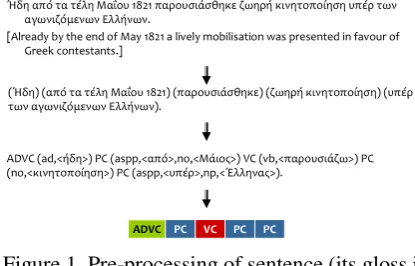
This involves PoS tagging, lemmatising and shallow syntactic parsing (chunking) of the source text. In terms of resources, the methodol-ogy utilises a bilingual lemma dictionary, an ex-tensive TL monolingual corpus, annotated with PoS tags, lemmas and syntactic phrases (chunks), and a very small parallel corpus of 200 sen-tences, with tagged and lemmatised source side and tagged, lemmatised and chunked target side. The bilingual corpus provides samples of the structural transformation from SL to TL. During this phase, the translation methodology ports the chunking from the TL- to the SL-side, alleviating the need for an additional parser in SL. An ex-ample of the pre-processing stage is shown in Figure 1, for a sentence translated from Greek to English. For this sentence, the chunk structure is shown at the bottom part of Figure 1.
2.2 Structure Selection
Structure selection transforms the input text us-ing the limited bilus-ingual corpus as a structural knowledge base, closely resembling the “transla-tion by analogy” aspect of EBMT systems (Hut-chins, 2005). Using available structural informa-tion, namely the order of syntactic phrases, the
PoS tag of the head token of each phrase and the case of the head token (if available), we retrieve the most similar source side sentence from the parallel corpus. Based on the alignment informa-tion from the bilingual corpus between SL and TL, the input sentence structure is transformed to the structure of the target side translation.
For the retrieval of the most similar source side sentence, an algorithm from the dynamic programming paradigm is adopted (Sofianopou-los et al., 2012), treating the structure selection process as a sequence alignment, aligning the input sentence to an SL side sentence from the aligned parallel corpus and assigning a similarity score. The implementation is based on the Smith-Waterman algorithm (Smith and Smith-Waterman, 1981), initially proposed for similarity detection between protein sequences. The algorithm finds the optimal local alignment between the two in-put sequences at clause level.
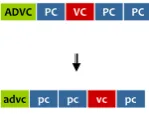
The similarity of two clauses is calculated by taking into account the edit operations (replace-ment, insertion or removal) that must be applied to the input sentence in order to transform it to a source side sentence from the corpus. Each of these operations has an associated cost, consid-ered as a system parameter. The parallel corpus sentence that achieves the highest similarity score is the most similar one to the input source sentence. For the example of Figure 1, the com-parison of the SL sentence structure to the paral-lel corpus is schematically depicted in Figure 2. The resulting TL sentence structure is shown in Figure 3 in terms of phrase types and heads.
Ήδη από τα τέλη Μαΐου 1821 παρουσιάσθηκε ζωηρή κινητοποίηση υπέρ των αγωνιζόμενων Ελλήνων.
[Already by the end of May 1821 a lively mobilisation was presented in favour of Greek contestants.]
(Ήδη) (από τα τέλη Μαΐου 1821) (παρουσιάσθηκε) (ζωηρή κινητοποίηση) (υπέρ των αγωνιζόμενων Ελλήνων).
ADVC (ad,<ήδη>) PC (aspp,<από>,no,<Mάιος>) VC (vb,<παρουσιάζω>) PC (no,<κινητοποίηση>) PC (aspp,<υπέρ>,np,<Έλληνας>).
[image:2.595.307.515.521.654.2]ADVC PC VC PC PC ADVC PC VC PC PC
SL-side TL-side
advc pc pc vc pc PC VC ADVC PC
PC VC ADVC PC pc advc vc pc
PC VC PC pc vc pc
PC VC PC
PC VC PC pc pc vc
[image:3.595.81.280.69.210.2]ADVC PC VC PC PC ADVC PC VC PC PC
Figure 2. Comparing sentence structure to paral-lel corpus templates, to determine the
best-matching SL structure (here, the 4th entry).
ADVC (ad,<ήδη>) PC (aspp,<από>,no,<Mάιος>) VC (vb,<παρουσιάζω>) PC (no,<κινητοποίηση>) PC (aspp,<υπέρ>,np,<Έλληνας>).
ADVC PC VC PC PC
ADVC (ad,<ήδη>) PC (aspp,<από>,no,<Mάιος>) VC (vb,<παρουσιάζω>) PC (no,<κινητοποίηση>) PC (aspp,<υπέρ>,np,<Έλληνας>).
ADVC PC VC PC PC ADVC PC VC PC PC
advc pc pc vc pc
advc (rb,<already>) pc (in,<of>,nn,<May>) pc (nn,<mobilisation>) vc (vv,<present>) pc (in,<in>,nn,<Greek>).
advc pc pc vc pc advc pc pc vc pc
advc (rb,<already>) pc (in,<of>,nn,<May>) pc (nn,<mobilisation>) vc (vv,<present>) pc (in,<in>,nn,<Greek>).
Figure 3. SL-to-TL Structure transformation based on the chosen parallel corpus template.
2.3 Translation equivalent selection
This second translation step performs word trans-lation disambiguation, local word reordering within each syntactic phrase as well as addition and/or deletion of auxiliary verbs, articles and prepositions. All of the above are performed by using a syntactic phrase model extracted from a purely monolingual TL corpus. The final transla-tion is produced by the token generatransla-tion compo-nent, since all processing during the translation process is lemma-based.
Each sentence contained within the text to be translated is processed separately, so there is no exploitation of inter-sentential information. The first task is to select the correct TL translation of each word. The second task involves establishing the correct word order within each phrase. For each phrase of the sentence being translated, the algorithm searches the TL phrase model for simi-lar phrases. All retrieved TL phrases are pared to the phrase to be translated. The com-parison is based on the words included, their tags and lemmas and any other morphological fea-tures (case, number etc.). The stable-marriage algorithm (Gale & Shapley, 1962) is applied for
calculating the similarity and aligning the words of a phrase pair.
This word reordering process is performed si-multaneously with the translation disambigua-tion, using the same TL phrase model. During word reordering the algorithm also resolves is-sues regarding the insertion or deletion of articles and other auxiliary tokens. Though translation equivalent selection implements several tasks simultaneously, it produces encouraging results when translating from Greek (a free-word order language) to English (an SVO language).
2.4 Post-processing
In this stage, a token generator is applied to the lemmas of the translated sentences together with the morphological features of their equivalent source words, to produce the final word forms.
2.5 Comparison of the method to SMT
In the proposed methodology, the structure selec-tion step performs long distance reordering with-out resorting to syntactic parsers and withwith-out employing any rules. In phrase-based SMT, long distance reordering is performed by either using SL syntax, with the use of complex reordering rules, or by using syntactic trees.
The similarity calculation algorithms used in the two translation steps of the proposed method are of a similar nature to the extraction of trans-lation models in factored-based SMT. In SMT, different matrices are created for each model (i.e. one for lemmas and another one for PoS tags), while in the methodology studied here lemmas and tags are handled at the same time.
The main advantage of the method studied here is its ability to create a functioning MT sys-tem with a parallel corpus of only a few sen-tences (200 sensen-tences in the present experi-ments). On the contrary, it would not be possible to create a working SMT with such a corpus.
3 Information extraction from the monolingual corpus
3.1 Standard indexed phrase model
[image:3.595.136.211.313.370.2]Both these types of information are extracted from one model. More specifically, during pre-processing of the corpus, a phrase model is es-tablished that provides the micro-structural in-formation on the translation output, to determine intra-phrasal word order. The model is stored in a file structure, where a separate file is created for phrases according to their (i) type, (ii) head and (iii) head PoS tag.
The TL phrases are then organised in a hash map that allows the storage of multiple values for each key, using as a key the three aforemen-tioned criteria. For each phrase the number of occurrences within the corpus is also retained. Each hash map is stored independently in a file for very fast access by the search algorithm. As a result of this process hundreds of thousands of files are generated, one for each combination of the three aforementioned criteria. Each file is of a small size and thus can be retrieved quickly.
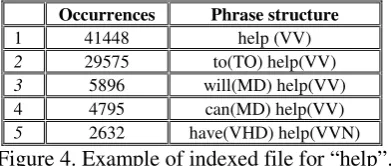
For creating the model used here, a corpus of 30,000 documents has been processed for the TL, where each document contains a concatena-tion of independent texts of approximately 1MByte in size. The resulting phrase model con-sists of 380,000 distinct files, apportioned into 12,000 files of adjectival chunks, 348,000 of noun chunks, 17,000 of verb chunks and 3,000 of adverbial chunks. A sample of the indexed file corresponding to verb phrases with head ‘help’ is shown in Figure 4.
Occurrences Phrase structure
1 41448 help (VV)
2 29575 to(TO) help(VV)
3 5896 will(MD) help(VV)
4 4795 can(MD) help(VV)
[image:4.595.303.530.123.265.2]5 2632 have(VHD) help(VVN)
Figure 4. Example of indexed file for “help”.
3.2 Error analysis on translation output
In Table 1, the translation accuracy attained by the proposed hybrid approach in comparison to established systems is displayed. The proposed method occupies the middle ground between the two higher performing SMT-based systems (Bing and Google) and the Systran and World-Lingo commercial systems.
Though the BLEU score of the proposed method is 0.17 BLEU points lower than the Google score, the proposed method achieves what is a respectable score with a parallel corpus of only 200 sentences. Though the exact re-sources for Google or Bing are not disclosed, it is widely agreed that they are at least 3 orders of
magnitude larger (very likely even more) justify-ing the lower scores achieved by the proposed low-resource method.
Number of sentences 200 Resources stand.
Reference translations 1 Language
pair EL–EN Metrics
MT config.
BLEU NIST
Me-teor TER
PRESEMT-baseline 0.3462 6.974 0.3947 51.05 Google 0.5259 8.538 0.4609 42.23
Bing 0.4974 8.279 0.4524 34.18
SYSTRAN 0.2930 6.466 0.3830 49.72
[image:4.595.84.280.475.558.2]WorldLingo 0.2659 5.998 0.3666 50.63
Table 1. Values of performance metrics for data-set1, using the baseline version of the proposed
method and other established systems.
The n-gram method proposed in this article for supplementary language modelling is intended to identify recurring errors in the output or to verify translation choices made by the indexed mono-lingual model. The errors mainly concern gen-eration of tokens out of lemmata, positioning of tokens within phrases as well as disambiguation choices. An indicative list of errors encountered for Greek to English translation follows:
Article introduction & deletion: Given that there is no 1:1 mapping between Greek and Eng-lish concerning the use of the definite article, it is essential to check whether it is correctly intro-duced in specific cases (e.g. before proper names).
Generation of verb forms: Specific errors of the MT system involve cases of active/passive voice mismatches between SL and TL and depo-nent verbs, i.e. active verbs with mediopassive morphology. For example, the Greek deponent verb "έρχοµαι" (come) is translated to “be come” by the system token generation component that takes into account the verb’s passive morphology in SL. This erroneous translation should be cor-rected to “come”, i.e. the auxiliary verb “be” must be deleted.
In-phrase token order: The correct ordering of tokens within a given phrase (which occasion-ally fails to be established by the proposed sys-tem) can be verified via the n-gram model.
avail-able. The n-gram model may be accessed to identify the appropriate preposition.
Double preposition: Prepositions appearing in succession within a sentence need to be re-duced to one. For instance, the translation of the NP “κατάτη διάρκειατηςπολιορκίας” (= during the siege) results in a prepositional sequence (“during of”) due to the translation of the indi-vidual parts as follows:
κατάτηδιάρκεια = during της = of the
πολιορκίας = siege
In this example a single preposition is needed.
3.3 Introducing n-gram models
A new model based on n-gram appearances is intended to supplement phrase-based information already extracted from the monolingual corpus (cf. section 3.1). As the monolingual corpus is already lemmatised, both lemma and token-based n-grams are extracted. To simplify processing, no phrase-boundary information is retained in the n-gram models.
One issue is how the n-gram model will be combined with the indexed phrase model of the hybrid MT algorithm. The new n-gram model can be applied at the same stage of the transla-tion process. Alternatively, n-grams can be ap-plied after the indexed phrase model, for verifi-cation or revision of the translation produced by using the indexed corpus. Then, the indexed phrase model generates a first translation, which represents a hypothesis Hi, upon which a number of tests are performed. If the n-gram model cor-roborates this hypothesis, no modification is ap-plied, whilst if the n-gram likelihood estimates lead to the rejection of the hypothesis, the trans-lation is revised accordingly.
Having adopted this set-up, the main task is to specify the hypotheses to be tested. To that end, a data-driven approach based on the findings of the error analysis (cf. section 3.2) is used.
The creation of the TL n-gram model is straightforward and employs the publicly avail-able SRILM tool (Stolke et al., 2011) to extract n-gram probabilities. Both 2-gram and 3-gram models have been extracted, creating both token-based and lemma-token-based models to support que-ries in factored representation levels. The n-gram models have used 20,000 documents in English, each document being an assimilation of web-posted texts with a cumulative size of 1 Mbyte (harvested without any restrictions in terms of domain). Following a pre-processing to remove words with non-English characters, the final
cor-pus contains a total of 707.6 million tokens and forms part of the EnTenTen corpus1. When cre-ating both 2-grams and 3-grams, Witten-Bell smoothing is used and all n-grams with less than 5 occurrences are filtered out to reduce the model size. Each n-gram model contains circa 25 mil-lion entries, which are the SRILM-derived loga-rithms of probabilities.
3.4 Establishing translation hypotheses
A set of hypotheses has been established based on the error analysis, to improve the translation quality. Each hypothesis is expressed by a mathematical formula which checks the likeli-hood of an gram, via either the lemma-based n-gram model (the relevant entry being denoted as p_lem(), i.e. the probability of the n-gram of lemmas) or the token-based model (the relevant entry being denoted as p_tok). The relevant 2-gram or 3-2-gram model is consulted depending on whether the number of arguments is 2 or 3.
Hypothesis H1: This hypothesis checks for the
existence of a deponent verb, i.e. verb which is in passive voice in SL but has an active voice trans-lation. Instead of externally providing a list of deponent verbs in Greek, the n-gram model is used to determine translations for which the verb is always in active voice, by searching the fre-quency-of-occurrence in the TL corpus. As an example of a correct rejection of hypothesis H1,
consider the verb “κοιµάµαι” [to sleep] which is translated by the hybrid MT system into “be slept” as in SL this verb has a medio-passive morphology. As the pattern “be slept” is ex-tremely infrequent in the monolingual corpus, hypothesis H1 is rejected and lemma “be” is cor-rectly deleted, to translate “κoιµάµαι” into “sleep”. The corresponding hypothesis is:
H1 :p_lem (A,B)>thres_h1,
where Lem (A)=”be” and PoS(B) =”VVN”
If the aforementioned hypothesis does not hold, (i.e. the probability of the 2-gram formed by the auxiliary verb with lemma B is very rare) then H1 is rejected and the auxiliary verb is
de-leted, as expressed by the following formula:
If (H1== false) then {A, B} → {B}
Hypothesis H2: This hypothesis checks the
in-clusion of an article, within a trigram of word forms. If this hypothesis is rejected based on n-gram evidence, the article is deleted. Hypothesis
1http://www.sketchengine.co.uk/documentation/wiki/Corpor
H2 is expressed as follows, where thres_h2 is a
minimum threshold margin:
H2: min{p_lem(A,the),p_lem(the,B)} - p_lem(A;B) <
thres_h2
An example of correctly rejecting H2 is for
tri-gram {see, the, France}, which is revised to {see, France}.
If (H2 == false) then {A, the, B} → {A, B}
Hypothesis H3: This hypothesis is used to
han-dle cases where two consecutive prepositions exist (for prepositions the PoS tag is “IN”). In this case one of these prepositions must be de-leted, based on the n-gram information. This process is expressed as follows:
H3 : max((p_lem(A;B),p_lem(A,C)), where PoS(A)==”IN”
& PoS(B)==”IN”
If (H3==TRUE) then {A, B, C} → {A, C} or {B, C}
Hypothesis H4: This hypothesis checks if there
exists a more suitable preposition than the one currently selected for a given trigram {A, B, C}, where PoS(B) = “IN”. H4 is expressed as:
H4: p_lem(A,B,C)-max(p_lem(A,D,C)>thres_h4 ,
for all D where PoS{D}==“IN”.
If this hypothesis is rejected, B is replaced by D:
If (H4==FALSE) then ({A,B,C} → {A,D,C}
Hypothesis H5: This hypothesis checks if for a
bigram, the wordforms might be replaced by the corresponding lemmas, as the wordform-based pattern is too infrequent. This is formulated as:
H5: p_tok(A,B)- p_tok(lem(A),lem(B)) > thres_h5
An example application would involve proc-essing bigram {can, is} and revising it into the correct {can, be} by rejecting H5:
If (H5==FALSE) then {A,B } → {lem(A),lem(B)}
Similarly, H5 can revise the plural form “in-formations” to the correct “information”.
Hypothesis H6: This hypothesis also handles
article deletion, by studying however bigrams, rather than trigrams, (cf. H1). This hypothesis is
that the bigram frequency exceeds a given threshold value (thres_6).
H6 :p_lem(2-gram(A, B))>thres_h6, where PoS(A)=”DT”
If H6 is rejected, the corresponding article is
deleted, as indicated by the following formula:
If (H6==FALSE) then {A,B} → {B}
4 Objective Evaluation Experiments
4.1 Experiment design
The experiments reported in the present article focus on the Greek – English language pair, the reason being that this is the language pair for which the most extensive experimentation has been reported for the PRESEMT system (Tam-bouratzis et al., 2013). Thus, improvements in the translation accuracy will be more difficult to attain. Two datasets are used to evaluate transla-tion accuracy, a development set (dataset1) and a test set (dataset2), each containing 200 sentences of length ranging from 7 to 40 tokens. These sets of sentences are readily available for download over the project website2. Two versions of the bilingual lexicon have been used, a base version and an expanded one.
Both sets are manually translated by Greek na-tive speakers and then cross-checked by English native speakers, with one reference translation per sentence. A range of evaluation metrics are employed, namely BLEU (Papineni et al., 2002), NIST (NIST 2002), Meteor (Denkowski and La-vie, 2011) and TER (Snover et al., 2006).
4.2 Experimental results
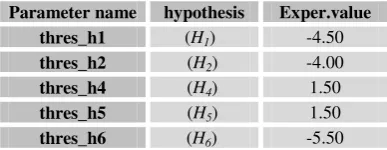
The exact sequence with which hypotheses are tested affects the results of the translation, since only one hypothesis is allowed to be applied to each sentence token at present. This simplifies the evaluation of the hypotheses’ effectiveness. As a result, hypotheses are applied in strict order (i.e. first H1, then H2 etc.). The threshold values
of Table 2 were settled upon via limited experi-mentation using sentences from dataset1.
Hypothesis testing was applied to both data-sets. Notably, dataset1 has been used in the de-velopment of the MT systems and thus the re-sults obtained with dataset2 should be considered the most representative ones, as they are
pletely unbiased and the set of sentences was unseen before the experiment and was only translated once. The number of times each hy-pothesis is tested for each dataset is quoted in Table 3, for both the standard (denoted as “stand”) and the enriched resources (“enrich”).
Parameter name hypothesis Exper.value thres_h1 (H1)chk4 -4.50
thres_h2 (H2)chk5 -4.00
thres_h4 (H4)Ch k8 1.50
thres_h5 (H5)chk2 1.50
[image:7.595.83.277.161.236.2]thres_h6 (H6)Ch k11 -5.50
Table 2. Parameter values for experiments
Hypothesis activations per experiment
dataset 1 dataset 2
Resource stand. enrich. stand. enrich
H1 6 6 13 10
H2 1 1 0 0
H3 2 3 3 3
H4 7 8 9 8
H5 68 68 62 68
[image:7.595.305.526.186.298.2]H6 32 32 32 44
Table 3. Tested hypotheses per dataset
Since the first four hypotheses are only acti-vated a few times each, when reporting the re-sults, the applications of hypotheses H1 to H4 are grouped together. As hypotheses 5 and 6 are tested more frequently, the application of each one of them is reported separately.
Number of sentences 200 Resources stand.
Reference
transla-tions 1
Language
pair EL–EN Metrics
MT config.
BLEU NIST Meteor TER Baseline 0.3462 6.974 0.3947 51.05
H1 to H4 0.3479 6.985 0.3941 50.84
H1 to H5 0.3503 7.006 0.3944 50.80
[image:7.595.80.282.267.388.2]H1 to H6 0.3517 7.049 0.3935 50.42
Table 4. Metric scores for dataset1, using the standard language resources, for the baseline
sys-tem and for different hypotheses.
In Table 4, the results are depicted for the four MT objective evaluation metrics, when using dataset 1. For each metric, the configuration giv-ing the highest score is depicted in boldface. As can be seen, the best BLEU score is obtained when checking all 6 hypotheses, and the same applies to NIST and TER. On the contrary, for Meteor the best result is obtained without
resort-ing to the n-gram model information. Still the difference in Meteor scores is minor (less than 0.3%). The improvements in BLEU, NIST and TER are respectively +1.6%, +1.0% and -1.2% over the baseline, when using all 6 hypotheses. Furthermore, as the number of hypotheses to be tested increases, the performance for all three metrics is improved.
Number of sentences 200 Resources enrich.
Reference
transla-tions 1
Language
pair EL–EN Metrics
MT config.
BLEU NIST Meteor TER Baseline 0.3518 7.046 0.3997 50.14
H1 to H4 0.3518 7.054 0.3990 50.00
H1 to H5 0.3541 7.094 0.3995 49.72
H1 to H6 0.3551 7.135 0.3984 49.37
Table 5. Metric scores for dataset1, using en-riched language resources, for different systems.
In Table 5, the same experiment is repeated using an enriched set of lexical resources includ-ing a bilinclud-ingual lexicon with higher coverage. No-tably, on a case-by-case comparison, the scores in Table 5 are higher than those of Table 4, con-firming the benefits of using enriched lexical resources. Focusing on Table 5, and comparing the MT configurations without and with hy-pothesis testing, the results obtained are qualita-tively similar to those of Table 4. Again, the best scores for Meteor are obtained when no hypothe-ses are tested. On the other hand, for the other metrics the n-gram modeling coupled with hy-pothesis testing results in an improvement to the scores obtained. The improvements obtained amount to approximately 1.0% for each one of BLEU, NIST and TER, over the baseline system scores indicating a measurable improvement.
[image:7.595.71.290.501.616.2]Number of sentences 200 Resources stand.
Reference
transla-tions 1
Language
pair EL–EN Metrics
MT config.
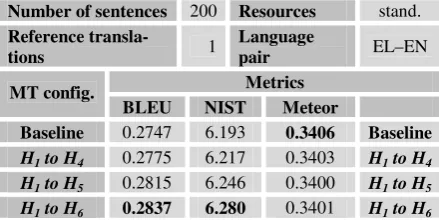
BLEU NIST Meteor
Baseline 0.2747 6.193 0.3406 Baseline
H1 to H4 0.2775 6.217 0.3403 H1 to H4
H1 to H5 0.2815 6.246 0.3400 H1 to H5
[image:8.595.70.290.73.183.2]H1 to H6 0.2837 6.280 0.3401 H1 to H6
Table 6. Metric scores for dataset2, using stan-dard language resources, for different systems.
Number of sentences 200 Resources enrich.
Reference
transla-tions 1 Language pair EL–EN Metrics
MT config.
BLEU NIST Meteor TER Baseline 0.3008 6.541 0.3784 55.21
H1 to H4 0.3059 6.569 0.3790 54.96
H1 to H5 0.3105 6.593 0.3791 54.75
[image:8.595.70.290.224.336.2]H1 to H6 0.3096 6.643 0.3779 54.64
Table 7. Metric scores for dataset2, using en-riched language resources, for different systems.
Using the enriched resources, as indicated in Table 7, the best results for BLEU and Meteor are obtained with hypotheses 1 to 5, while for NIST and TER the best results are obtained when all six hypotheses are tested. In the case of Me-teor any improvement is marginal (of the order of 0.2%). The improvements of the other metrics are more substantial, being 3.3% for BLEU, 1.6% for NIST and 1.0% for TER.
A statistical analysis has been undertaken to determine whether the additional n-gram model-ling improves significantly the translation scores. More specifically, paired t-tests were carried out to determine whether the difference in translation accuracy was statistically significant, comparing the MT accuracy obtained with all six hypothe-ses versus the baseline system. Two populations were formed by scoring independently each translated sentence with each one of the NIST, BLEU and TER metrics, for dataset2. It was found that when using the standard resources (cf. Table 6), the translations were scored by TER to be significantly better when using the 6 hypothe-ses, in comparison to the baseline system, while for BLEU and NIST the translations for the 2 systems were equivalent (at a 0.05 confidence level). When using the enriched resources, no statistically significant difference was detected for any metric at a 0.05 confidence level, but significant differences were detected for all 3 metrics at a 0.10 confidence level (cf. Table 7).
5 Discussion
According to the experimental results, the addi-tion of a new model in the hybrid MT system has contributed to an improved translation quality. These improvements have been achieved using a limited experimentation time and only a few hy-potheses on what is an extensively developed language pair, for the proposed MT methodol-ogy. It is likely that as the suite of hypotheses is increased, larger improvements in objective met-rics can be obtained.
When applying the hypotheses, the initial sys-tem translation is available both at token-level and at lemma-level. Out of the 6 hypotheses tested here, 5 involve token-based information and only one involves lemmas. If additional hy-potheses are added operating on lemmas, a fur-ther improvement is expected.
Notably, the new n-gram modelling requires no collection or annotation of additional re-sources. The use of an established software package (SRILM) for assembling an n-gram da-tabase, via which hypotheses are rejected or con-firmed, results in a straightforward implementa-tion. In addition, multiple models can be effec-tively combined to improve translation accuracy by investigating different language aspects.
An interesting point is that the n-gram models created are factored (i.e. including information at both lemma and token level). Thus, different types of queries may be supported, to improve translation quality.
6 Future work
The experiments reported here have shown that improvements can be achieved, without specify-ing in detail the templates searched for, but al-lowing for more general formulations.
One aspect which should be addressed in fu-ture work concerns evaluation. Currently, this is limited to objective metrics. Still it is well-worth investigating the extent to which translation im-provement is reflected by subjective metrics, which are the preferred instrument for quality evaluation (Callison-Burch at al., 2011).
In addition, it is possible to achieve further improvements if the hypothesis templates are made more detailed, by supplementing the lexi-cal information by detailed PoS information.
Another observation concerns the manner in which the two distinct language models are ap-plied. In the present article, n-grams are used to correct a translation already established via the phrase indexed model, having a second-level, error-checking role. It is possible, however, to revise the mode of application of the language models, so that instead of a sequential applica-tion, the two model families are consulted at the same time. This leads to an MT system that ex-ploits the information from multiple models con-currently, and is the focus of future research.
Acknowledgements
The research leading to these results has received funding from the POLYTROPON project (KRIPIS-GSRT, MIS: 448306).
References
Chris Callison-Burch, Philip Koehn, Christof Monz, and Omar F. Zaidan. 2011. Findings of the 2011Workshop on Statistical Machine Translation. Proceedings of the 6th Workshop on Statistical Machine Translation, pp. 22–64, Edinburgh, Scotland, UK, July 30–31, 2011.
Jaime Carbonell, Steve Klein, David Miller, Mi-chael Steinbaum, Tomer Grassiany, and Jochen Frey. 2006. Context-Based Machine Translation. Proceedings of the 7th Confer-ence of the Association for Machine Transla-tion in the Americas, pages 19-28.
Michael Denkowski and Alon Lavie. 2011. Me-teor 1.3: Automatic Metric for Reliable Opti-mization and Evaluation of Machine
Transla-tion Systems. EMNLP 2011 Workshop on
Sta-tistical Machine Translation, Edinburgh, Scot-land, pp. 85-91.
Yannis Dologlou, Stella Markantonatou, Olga Yannoutsou, Soula Fourla, and Nikos Ioan-nou. 2003. Using Monolingual Corpora for Statistical Machine Translation: The METIS
System. Proceedings of the EAMT-CLAW’03
Workshop, Dublin, Ireland, 15-17 May, pp. 61-68.
David Gale and Lloyd S. Shapley. 1962. College Admissions and the Stability of Marriage. American Mathematical Monthly, Vol. 69, pp. 9-14.
John Hutchins. 2005. Example-Based Machine Translation: a Review and Commentary. Ma-chine Translation, Vol. 19, pp.197-211.
Alexandre Klementiev, Ann Irvine, Chris Calli-son-Burch and David Yarowsky. 2012. To-ward Statistical Machine Translation without Parallel Corpora. Proceedings of EACL2012, Avignon, France, 23-25 April, pp. 130-140.
Philip Koehn. 2010. Statistical Machine Transla-tion. Cambridge University Press, Cambridge.
Philipp Koehn and Kevin Knight. 2002. Learning a Translation Lexicon from Monolingual Cor-pora. Proceedings of the ACL-02 workshop on Unsupervised lexical acquisition, Vol.9, pp.9-16.
Philipp Koehn, Franz Josef Och, and Daniel Marcu, Statistical Phrase-Based Translation, Proceedings of HLT/NAACL-2003 Confer-ence, Vol.1, pp.48-54.
Philip Koehn, Hieu Hoang, Alexandra Birch, Chris Callison Burch, Marcello Federico, Ni-cola Bertoldi, Brooke Cowan, Wade Shen, Christine Moran, Richard Zens, Chris Dyer, Ondrej Bojar, Alexandra Constantin, and Evan Herbst. 2007. Moses: Open Source Toolkit for Statistical Machine Translation. Proceedings of the ACL-2007 Demo & Posters Sessions, Prague, June 2007, pp. 177-180.
Philipp Koehn, and Hieu Hoang. 2007. Factored Translation Models. Proceedings of the 2007 Joint Conference on Empirical Methods in Natural Language Processing and Computa-tional Natural Language Learning, Prague, Czech Republic, pp. 868-876.
Stella Markantonatou, Sokratis Sofianopoulos, Olga Yannoutsou, and Marina Vassiliou. 2009. Hybrid Machine Translation for Low-
and Middle- Density Languages. Language
Engineering for Lesser-Studied Languages, S.
Nirenburg (ed.), pp.243-274. IOS Press. ISBN: 978-1-58603-954-7
NIST 2002. Automatic Evaluation of Machine Translation Quality Using n-gram Co-occurrences Statistics.
Kishore Papineni, Salim Roukos, Todd Ward, and Wei-Jing Zhu. 2002. BLEU: A Method for Automatic Evaluation of Machine Transla-tion. 40th Annual Meeting of the Association for Computational Linguistics, Philadelphia, USA, pp. 311-318.
Temple F. Smith, and Michael S. Waterman. 1981. Identification of Common Molecular Subsequences. Journal of Molecular Biology, Vol. 147, pp. 195-197.
Matthew Snover, Bonnie Dorr, Richard
Schwartz, Linnea Micciulla, and John Mak-houl. 2006. A Study of Translation Edit Rate
with Targeted Human Annotation. In
Proceed-ings of the 7th Conference of the Association for Machine Translation in the Americas, Cambridge, Massachusetts, USA, pp. 223-231.
Sokratis Sofianopoulos, Marina Vassiliou, and George Tambouratzis. 2012. Implementing a
language-independent MT methodology. In
Proceedings of the First Workshop on Multi-lingual Modeling, held within the ACL-2012 Conference, Jeju, Republic of Korea, 13 July, pp.1-10.
George Tambouratzis, Sokratis Sofianopoulos, and Marina Vassiliou (2013)
Language-independent hybrid MT with PRESEMT. In
Proceedings of HYTRA-2013 Workshop, held
within the ACL-2013 Conference, Sofia, Bul-garia, 8 August, pp. 123-130.
Vladimir I. Levenshtein (1966): Binary codes capable of correcting deletions, insertions, and reversals. Soviet Physics Doklady, Vol. 10, pp. 707–710.
Peter F. Brown, Stephen A. Della Pietra, Vincent J. Della Pietra, and Robert L. Mercer (1993) The Mathematics of Statistical Machine Translation: Parameter Estimation, Computa-tional Linguistics.
Andreas Stolcke, Jing Zheng, Wen Wang, and Victor Abrash (2011) SRILM at Sixteen:
Up-date and Outlook. Proceedings of IEEE
Auto-matic Speech Recognition and Understanding
Workshop, December 2011.
Jinsong Su, Hua Wu, Haifeng Wang, Yidong Chen, Xiaodong Shi, Huailin Dong, and Qun Liu (2012) Translation Model Adaptation for Statistical Machine Translation with
Monolin-gual Topic Information. Proceedings of
ACL2012, Jeju, Republic of Korea, pp. 459-468.