
THE RAPID SYNTHESIS OF
b
-NITROSTYRENES UNDER
MICROWAVE IRRADIATION
WITHOUT SOLVENT
Cunde Wang* and Song Wang
Department of Chemistry, Yangzhou University, Yangzhou 225002, P.R. China
ABSTRACT
The b-nitrostyrenes (3a–l) were prepared by condensation of benzaldehydes with nitromethane in the presence of K2CO3/Al2O3 under microwave irradiation without solvent.
They were characterized by IR, 1H-NMR, and elemental analysis.
Many reports dealing with the biological activity of b-nitrostyrene stated that it had a detrimental effect on sects and on the growth of fungi and that it could be used for the protective treatment of textiles, leather, and other organic materials. Generally,b-nitrostyrenes were synthesized by con-densation with benzaldehydes and nitromethane. And the concon-densation was usually been catalyzed by (a) bases such as alcoholic potassium hydroxide, aqueous sodium hydroxide or alcoholic methylamine[1]; (b) buffer solutions containing a conjugate acid–base pair such as ammonium acetate in
3481
acetic acid[2]; (c) salts such as zinc chloride or potassium fluoride in the presence of dimethylammonium chloride in refluxing toluene solution.[3] Recently many studies have shown that some organic reactions are faster and more efficient under microwave irradiation in the solid state than in solution.[4,5] To develop a more reliable procedure for b-nitrostyrenes, we have found thatb-nitrostyrenes were conveniently obtained under mild con-ditions by the reaction between benzaldehydes and nitromethane in the presence of potassium carbonate under microwave irradiation without solvent (Sch. 1). The optimum proportions of the reagents involved
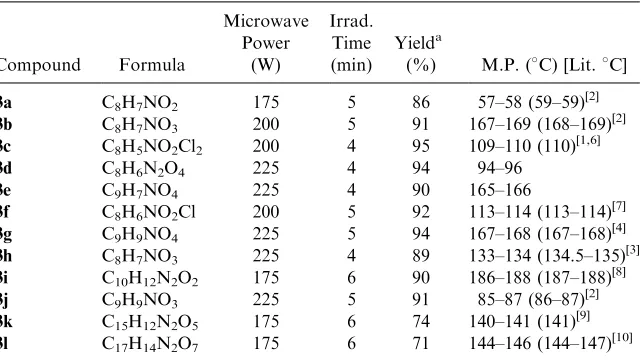
Table 1. Preparation of Compounds3
Compound Formula
Microwave Power
(W)
Irrad. Time (min)
Yielda
(%) M.P. (C) [Lit.C]
3a C8H7NO2 175 5 86 57–58 (59–59)[2]
3b C8H7NO3 200 5 91 167–169 (168–169)[2]
3c C8H5NO2Cl2 200 4 95 109–110 (110)[1,6]
3d C8H6N2O4 225 4 94 94–96
3e C9H7NO4 225 4 90 165–166
3f C8H6NO2Cl 200 5 92 113–114 (113–114)[7]
3g C9H9NO4 225 5 94 167–168 (167–168)[4]
3h C8H7NO3 225 4 89 133–134 (134.5–135)[3]
3i C10H12N2O2 175 6 90 186–188 (187–188)[8]
3j C9H9NO3 225 5 91 85–87 (86–87)[2]
3k C15H12N2O5 175 6 74 140–141 (141)
[9]
3l C17H14N2O7 175 6 71 144–146 (144–147)[10]
a
Isolated yield.
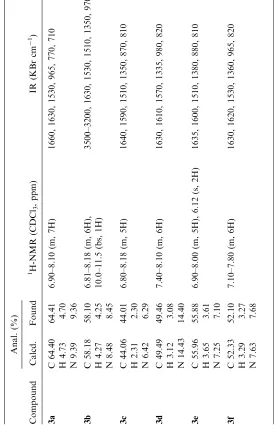
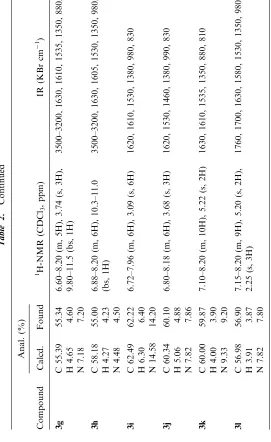
have been experimentally determined. The best reaction time and microwave power have been selected also under microwave irradiation without solvent (Table 1). All the products have been fully characterized on the basis of their microanalytical and spectral data (Table 2).
In conclusion, we developed a procedure for the efficient preparation of b-nitrostyrenes (3) from benzaldehydes and nitromethane with excellent yields (71–95%). The final products were easily isolated and purified directly by silica gel chromatography. The simplicity of the experimental procedure, direct conversion of benzaldehydes tob-nitrostyrenes (3) in the presence of the catalyst K2CO3/Al2O3, quick reaction times (4–6 min) and lower power
(175–225 W) made this method more attractive than others known in literature.
EXPERIMENTAL
Melting points were uncorrected, elemental analytical data were obtained using a model 240 elementary instrument. IR spectra were mea-sured using a model 408 infrared spectrometer, 1H NMR spectra were recorded on a JNM-90Q spectrometer using TMS as internal standard (CDCl3solutions).
General Procedure for the Preparation ofb-Nitrostyrenes (3a–l)
A mixture of 5 mmol benzaldehyde, 1.53 g (25 mmol) nitromethane and 0.35 g potassium carbonate was finely ground by agate mortar and pestle and was mixed with 5 g aluminum oxide (150 mesh). The mixture was then put in a 25 mL beaker and introduced into a Galan WP750A domestic microwave oven. Microwave irradiation was carried out for the appropriate time and at the power indicated (see Table 1). The mixture was cooled to ambient temperature, then water and nitromethane were removed by reduced pressure. The residue was purified by silica gel chromatography (petroleum ether [60–90C]/ethyl acetate/dichloromethane, 1 : 1 : 0.3) to give the product (3a–l). The structures of all products were identified on the basis of elemental analytical data, IR, and1H NMR data (see Table 2).
REFERENCES
3. Dauzonne, D.; Royer, R. Synthesis1984,12, 1054–1057.
4. (a) Toda, F.; Tanaka, K.; Iwata. J. Org. Chem. 1989,54, 3007–3009; (b) Rosini, G.; Ballini, R. Synthesis1985,6, 515.
5. (a) Wang, C.D.; Shi, X.Z.; Xie, R. J. Synth. Commun. 1997, 27(14), 2517; (b) Wang, C.D.; Lu, J.; Shi, X.Z.; Feng, Y.H. Synth. Commun. 1999,29(17), 3057.
6. Butler, G.E.; Carter, M.E. J. Am. Chem. Soc.1950,72, 2303. 7. Carter, M.E. J. Polym. Sci. Polym. Chem. Ed. 1978,16(5), 937. 8. Teichmann, H. Tetra. Lett.1977,33, 2889–2892.
9. Arrid Ek; Bernhard Witkop. J. Am. Chem. Soc.1954,76, 5579. 10. Antonio Delgado; Jon Clardy. J. Org. Chem.1993,58, 2862–2866.
![4 (4 Bromophenyl) 2,5 diethoxycarbonyl 6 methylthieno[2,3 b]pyridine](data:image/gif;base64,R0lGODlhAQABAIAAAP///wAAACH5BAEAAAAALAAAAAABAAEAAAICRAEAOw==)