A Wizard-of-Oz Study on A Non-Task-Oriented Dialog Systems That
Reacts to User Engagement
Zhou Yu, Leah Nicolich-Henkin, Alan W Black and Alex I. Rudnicky School of Computer Science
Carnegie Mellon University
{zhouyu,leah.nh,awb,air}@cs.cmu.edu
Abstract
In this paper, we describe a system that re-acts to both possible system breakdowns and low user engagement with a set of conversational strategies. These general strategies reduce the number of inappro-priate responses and produce better user engagement. We also found that a system that reacts to both possible system break-downs and low user engagement is rated by both experts and non-experts as hav-ing better overall user engagement com-pared to a system that only reacts to pos-sible system breakdowns. We argue that for non-task-oriented systems we should optimize on both system response appro-priateness and user engagement. We also found that apart from making the system response appropriate, funny and provoca-tive responses can also lead to better user engagement. On the other hand, short ap-propriate responses, such as “Yes” or “No” can lead to decreased user engagement. We will use these findings to further im-prove our system.
1 Introduction
Non-task-oriented conversational systems do not have a stated goal to work towards. Nevertheless, they are useful for many purposes, such as keep-ing elderly people company and helpkeep-ing second language learners improve conversation and com-munication skills. More importantly, they can be combined with task-oriented systems to act as a transition smoother or a rapport builder for com-plex tasks that require user cooperation. They have potential wide use in education, medical and ser-vice domains.
There are a variety of existing methods to generate responses for non-task-oriented systems,
such as machine translation (Ritter et al., 2011), retrieval-based response selection (Banchs and Li, 2012), and sequence-to-sequence recurrent neural network (Vinyals and Le, 2015). All aim to im-prove system coherence, but none of them focus on the experience of the user. Conversation is an interaction that involves two parties, so only im-proving the system side of the conversation is in-sufficient. In an extreme case, if the system is al-ways appropriate, but is a boring and passive con-versational partner, users would not stay interested in the conversation or come back a second time. Thus we argue that user engagement should be considered a critical part of a functional system. Previous researchers found that users who com-pleted a task with a system but disliked the expe-rience would not come back to use the system a second time. In a non-task-oriented system, the user experience is even more crucial, because the ultimate goal is to keep users in the interaction as long as possible, or have them come back as fre-quently as possible. Previously systems have not tried to improve user experience, mostly because these systems are text-based, and do not have ac-cess to the user’s behaviors aside from typed text. In this paper, we define user engagement as the interest to continue the conversation in each turn. We study the construct using a multimodal dialog system that is able to process and produce audio-visual behaviors. Making the system aware of user engagement is considered crucial in creating user stickiness in interaction designs. Better user en-gagement leads to a better experience, and in turn attracts repeat users. We argue that a good system should not only be coherent and appropriate but should also be engaging.
We describe a multimodal non-task-oriented conversational system that optimizes its perfor-mance on both system coherence and user engage-ment. The system reacts to both user engagement and system generation confidence in real time
ing a set of active conversational strategies. Sys-tem generation confidence is defined as the con-fidence that the generated response is considered appropriate with respect to the previous user ut-terance. Although the user engagement metric is produced by an expert in a Wizard-of-Oz setting, it is the first step towards a fully automated en-gagement reactive system. Previously very little research addressed reactive systems due to the dif-ficulty of modeling the users and the lack of audio-visual data. We also make the audioaudio-visual data along with the annotations available.
2 Related Work
Many experiments have shown that an agent re-acting to a user’s behavior or internal state leads to better user experience. In an in-car navigation setting, a system that reacts to the user’s cogni-tive load was shown to have better user experience (Kousidis et al., 2014). In a direction giving set-ting, a system that reacts to user’s attention was shown to be preferred (Yu et al., 2015a). In a tutor-ing setttutor-ing, a system that reacts to the user’s disen-gagement resulted in better learning gain (Forbes-Riley and Litman, 2012). In task-oriented systems users have a concrete reason to interact with the system. However, in a non-task-oriented setting, user engagement is the sole reason for the user to stay in the conversation, making it an ideal situa-tion for engagement study. In this paper, we focus on making the system reactive to user engagement in real time in an everyday chatting setting.
In human-human conversations, engagement has been studied extensively. Engagement is con-sidered important in designing interactive systems. Some believe engagement is correlated with im-mersiveness (Lombard and Ditton, 1997). For ex-ample, how immersed a user is in the interaction plays a key role in measuring the interaction qual-ity. Some believe engagement is related to the level of psychological presence (i.e. focus) dur-ing a certain task (Abadi et al., 2013), for example how long the user is focused on the robot (Moshk-ina et al., 2014). Some define engagement as “the value a participant in an interaction attributes to the goal of being together with the other partici-pant(s) and of continuing the interaction” (Peters et al., 2005). In this paper, we define engagement as the interest to continue the conversation. Be-cause the goal of a non-task-oriented system is to keep the user interacting with the system
voluntar-ily, making users have the interest to continue is critical.
A lot of conversational strategies have been pro-posed in previous work to avoid generating in-coherent utterances in non-task-oriented conver-sations, such as introducing topics, (e.g. “Let’s talk about favorite foods!” in (Higashinaka et al., 2014)) and asking the user to explain missing words. (Schmidt et al., 2015). In this paper, we propose a set of strategies that actively deal with both user engagement and system response appro-priateness.
3 System Design and User Experiment Setting
The base system used is Multimodal TickTock, which generates system responses by retriev-ing the most similar utterance in a conversation database using a key word matching method (Yu et al., 2015b). It takes spoken utterances from the user as input and produces synthesized speech as output. A cartoon face signals whether it is speak-ing or not, and can present some basic expressions. This clearly artificial design aims to avoid the un-canny valley dilemma, so that the users do not ex-pect realistic human-like behaviors from the sys-tem. It has the capability to collect and extract audio-visual features, such as head and face move-ment (Baltrusaitis et al., 2012), in real time. These features are not used in this experiment, but will be incorporated as part of automatic engagement recognition in the future.
We designed six strategies based on previous lit-erature to deal with possible system breakdowns and to improve user engagement.
1. Switch Topics(switch): propose a new topic other than the current topic, such as “Let’s talk about sports.”
2. Initiate activities(initiation): propose an ac-tivity to do together, such as “Do you want to see the latest Star Wars movie together?”. 3. End topics with an open question (end):
close the current topic using an open ques-tion, such as “Could you tell me something interesting?”.
5. Refer Back to A Previously Engaged Topic
(refer back): refer back to the previous en-gaging topic. We keep a list of utterances that have resulted in high user engagement. This strategy will refer the user back to the most recently engaged turn. For example: “Previ-ously, you said ‘I like music’, do you want to talk more about that?”
Each strategy has a set of surface forms to choose from in order to avoid repetition. For example, the
switchstrategy has several forms, such as, “How about we talk about sports?” and “Let’s talk about sports.”
We designed two versions of Multimodal Tick-Tock: REL and REL+ENG. The REL system uses the strategies above to deal with low system eration confidence (system breakdown). The gen-eration confidence is the weighted score of match-ing key words between the user input and the cho-sen utterance from the database. The REL+ENG system uses the strategies to deal with low sys-tem generation confidence, and in addition reacts to low user engagement. One caveat is that the re-fer backstrategy is not available for the REL sys-tem. In the REL+ENG system, a trained expert annotates the user’s engagement as soon as the user finishes the utterance. A randomly selected strategy triggers whenever the user engagement is ‘Strongly Disengaged’ or ‘Disengaged’. Any non-task-oriented system can adopt the above policy and strategies with minor system adjustments.
For systems that use other response generation methods, the confidence score can be computed using other metrics. For example, a neural net-work generation system (Vinyals and Le, 2015) can use the posterior probability for the confidence score.
In order to avoid culture and language profi-ciency confound, all participants in the study are originally from North America. Gender was bal-anced as well. We had 10 people (6 males) interact with REL and 12 people (7 males) interact with REL+ENG. Participants were all university stu-dents and none of them had interacted with a mul-timodal dialog system before. There are no repeat users in the two groups. We also collected how frequently they use spoken dialog systems, such as Apple Siri, in the after-experiment user survey in the REL+ENG study, and found that 25% of them have used dialog systems frequently. In the future, we hope to collect a more balanced dataset to test
this factor’s influence.
[image:3.595.308.527.290.388.2]An example dialog of a user interacting with REL is shown in Table 1. In Turn 5, the system used theswitchstrategy to deal with the fact that it was unable to retrieve a response with similar content to the user’s utterance. An example dia-log from REL+ENG is shown in Table 2. In Turn 3, the system used the initiation strategy to deal with the fact that the user was not engaged in the previous turn. Figure 1 is a snapshot of an exam-ple video recording of one of the interactions. The blue box represents the head-tracking results, and the red dots represent face-tracking. Together with the audio-visual recordings, we have also made all the annotations and manual transcriptions avail-able1.
Figure 1: Screen shot of an example conversation recording
4 Annotations
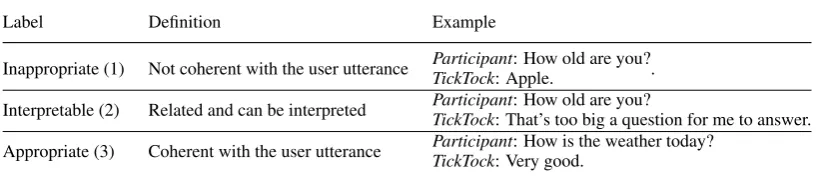
We annotated each conversational exchange with user engagement and system response appropri-ateness. One conversational exchange includes one speech segment from the system and the fol-lowing speech segment from the user. The engage-ment is a rating based on the user’s performance during the entire turn, while the system’s appro-priateness is a rating with respect to the user’s ut-terance in the previous turn. User engagement is defined as “user’s interest to continue the conver-sation”, and the system appropriateness as “the co-herence and appropriateness of the system utter-ance given the context”. Table 3 and 4 describe the user engagement annotation scheme and the system appropriateness annotation scheme respec-tively. For turns when users failed to respond, we label the engagement as 0. We labeled the turns that the system failed to understand the user and asked the user to repeat to be 0 in appropriate-ness. We exclude all these turns in the analysis
Turn Participant TickTock
1 Your noise is a question mark, I think that’s interesting. Of course, what’s your idea? 2 I think it fits you perfectly. Let me see, his nose is still broke. 3 Do you want me to make your nose broken? Ah, yes, why did you ask me for this?
4 Because I thought you might mind. Well, I am not getting into specifics about what doctor treated him, how he was treated.
5 You have not been treated yet. That is in the future. Let me see, by the way, are you interested in movies? 6 Yes, I watch movies sometimes. Great.
Table 1: An example conversation in REL
Turn Participant TickTock
1 How are you I think so, any thoughts?
2 How are you doing? I am fine, how are you, any thought?
3 Any thought? Let me see, do you want to go to my friends’ party tonight? 4 No I have a lot of work to do. I can’t go. Everyday?
Table 2: An example conversation in REL+ENG
in order to avoid adding system failure in the anal-ysis. The inter-annotator agreement between the two experts is high (kappa = 0.73) in appropri-ateness, but the agreement between the two ex-perts in annotating engagement is relatively lower (kappa =0.43). However, if we collapse the rat-ing for “strongly disengaged” with “disengaged” and “very engaged” with “engaged”, our agree-ment improves (kappa = 0.67).
5 Evaluation
To evaluate the efficacy of the strategies, we also conducted an Amazon Mechanical Turk study to test if a non-expert would agree with the experts about which system elicits better user engagement. We selected video recordings with participants who are not familiar with dialog systems. There are only five participants in the REL dataset and nine participants in the REL+ENG dataset who meet this requirement. In order to balance the two sets, we randomly selected five participants from the nine in the REL+ENG. We picked one video from each dataset to form a A/B comparison study. In total there are 25 pairs, and we recruited three raters for each pair. Nobody rated the same pair twice. We ask them to watch the two videos and then compare them through a set of questions in-cluding “Which system resulted in a better user experience?”, “Which system would you rather in-teract with?” and “Which person seemed more en-thusiastic about talking to the system”. In addi-tion, we also included some factual question re-lated to the video content in order to test if the rater had watched the video, which all of them had. Raters are allowed to watch the two videos multi-ple times. The limitations of such a comparison
is that some system failures, such as ASR failure, may affect the quality of the conversation, which may be a confound. In the task, we specifically asked the users to overlook these system defects, but they still commented on these issues in their feedback. We will collect more examples in the future to balance the influence of system defects.
6 Quantitative Analysis and Results
In this section, we first discuss whether the de-signed strategies are useful in avoiding system in-appropriateness and improving user engagement. Then, we discuss whether both experts and non-experts who watched the video recordings of the interactions prefer a system that reacts to both low user engagement and system inappropriate-ness over a system that only reacts to low system appropriateness. In addition, we discuss the rela-tionship between system appropriateness and user engagement. In the end, we discuss the relation-ship and methods to elicit user engagement and user experience.
6.1 Strategies and System Appropriateness
Label Definition Description
1 Strongly Disengaged Shows no interest in the conversation, not responding or engaged in other things. 2 Disengaged Shows little interest to continue the conversation, passivelyinteracts with his conversational partner.
[image:5.595.95.505.225.313.2]3 Neither Disengagednor Engaged Interacts with the conversational partner, showing neitherinterest nor lack of interest to continue the conversation. 4 Engaged Shows mild interest to continue the conversation. 5 Strongly Engaged Shows a lot of interest to continue the conversation andactively contributes to the conversation.
Table 3: Engagement annotation scale and definition.
Label Definition Example
Inappropriate (1) Not coherent with the user utterance ParticipantTickTock: Apple.: How old are you?.
Interpretable (2) Related and can be interpreted ParticipantTickTock: That’s too big a question for me to answer.: How old are you? Appropriate (3) Coherent with the user utterance ParticipantTickTock: Very good.: How is the weather today?
Table 4: Appropriateness rating scheme.
in REL and REL+ENG respectively. The percent-age is higher in REL+ENG than REL mostly due to the introduction of refer back strategy, which the REL system could not use because it does not track the user’s engagement. Compared to REL, which doesn’t react to low system response gen-eration confidence, REL+ENG successfully made 69% of inappropriate turns to be “Interpretable” or “Appropriate”.
Each strategy has a different effect on improv-ing the system’s appropriateness. Among them, the refer back strategy leads to more appropri-ate responses in general, but happens infrequently, due to its strict trigger condition. It can only be triggered if the user previously had a high engage-ment utterance. The initiation strategy leads to more interpretable responses overall, because ut-terances like “Do you want to go to my friend’s party?” actively seek user consent. Even though it may seem abrupt in some contexts, the transition will usually be considered to be interpretable. The
jokestrategy has a high probability of being inap-propriate. However, if the joke fits the context, it may be appropriate. For example,
TickTock: “Let’s talk about politics.”
User: “I don’t know too much about politics.”
TickTock: “Let me tell you something, politicians and diapers have one thing in common, they both need to be changed regularly.”
However, if the joke is out of the context, it will leave the participant with an impression that Tick-Tock is saying random things.
In the future, we intend to track the topic of the conversation, and design specific jokes with re-spect to conversation topic. We intend to design additional strategies, such as performing ground-ing requests on out-of-vocabulary words (Schmidt et al., 2015), to address possible system break-downs, and we will also implement a policy to control when to use which strategy.
6.2 Strategies and User Engagement
REL REL+ENG
[image:6.595.87.512.61.172.2]Strategy Total InApp Inter App Total InApp Inter App switch 46 13(28%) 27(59%) 6(13%) 32 6(19%) 18(56%) 8(25%) initiation 10 2(20%) 6(60%) 2(20%) 18 0(0%) 8(44%) 10(56%) end 29 14(48%) 13(45%) 2(17%) 16 6(38%) 8(50%) 2(13%) joke 10 5(50%) 2(20%) 3(30%) 20 14(70%) 0(0%) 6(30%) refer back - - - - 12 0(0%) 6(50%) 6(50%) Total 95 34(35%) 48(51%) 13(14%) 98 26(27%) 40(41%) 32(33%) Table 5: System appropriateness distribution when two systems react to possible system breakdowns.
higher.
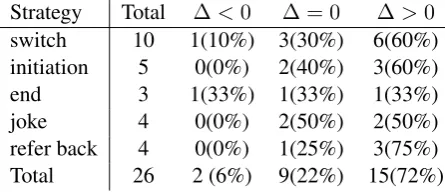
For each strategy, the chance of improving the user’s engagement is different. The refer back
strategy is the most effective strategy: 75% of the time, it leads to better user engagement. We be-lieve this is because once the system refers back to what the user said before, the user feels that the agent is somewhat intelligent and in turn in-creases his/her interest to continue the conversa-tion, to find what else the system can do. For the
switch and end strategies, there are examples of them both reducing and increasing user engage-ment. When we looked at the specific cases where the user engagement decreased, we found that those utterances are rated as inappropriate given the context. This leads us to believe that during the selection of what strategies we should use to re-act to user’s low engagement, we should also con-sider whether the system utterance would be ap-propriate. We also examined the turns that did not improve or decreased user engagement and found that they are towards the end of the conversation, when the user lost interest and ended the conver-sation regardless of what the system said.
Strategy Total ∆<0 ∆ = 0 ∆>0
switch 10 1(10%) 3(30%) 6(60%) initiation 5 0(0%) 2(40%) 3(60%) end 3 1(33%) 1(33%) 1(33%) joke 4 0(0%) 2(50%) 2(50%) refer back 4 0(0%) 1(25%) 3(75%) Total 26 2 (6%) 9(22%) 15(72%) Table 6: User engagement change distribution when system reacts to low user engagement.
6.3 Third-person Preference
In our study, we found that a system that reacts to low user engagement and possible system break-downs is rated as having better user engagement and experience compared to a system that only
reacts to possible system breakdowns. This rat-ing held true for both experts and non-experts. We performed an unbalanced Student’s t-test on expert-rated user engagement of turns in REL and REL+ENG and found the engagement ratings are statistically different (p < 0.05). REL+ENG has more user engagement (REL: Mean = 3.09 (SD = 0.62); REL+ENG: Mean = 3.51 (SD = 0.78). A t-test on utterances that are not produced by de-signed strategies shows the two systems are not statistically different in terms of user engagement (p = 0.13). This suggests that the difference in user engagement is mostly due to the utterances that are produced by strategies. Experts also rated the interaction for overall user experience and we found that REL+ENG interactions are rated sig-nificantly higher than REL system overall (p <
0.05).
In REL+ENG, 37% of the strategies were trig-gered to react to low user engagement and 63% were used to deal with low generation confidence. Among the strategies that were triggered to react to low user engagement, 72% of them lead to user engagement improvement. We believe the abil-ity to react to low user engagement is the reason that REL+ENG has more user engagement than REL. Another reason is that REL+ENG has an ex-tra sex-trategy,refer back, which in general performs best in improving user engagement. In the user survey, one of the participants also mentioned that he likes the REL+ENG system because it actively proposes engaging topics.
[image:6.595.73.296.550.646.2]significantly more user engagement than the REL system. This conclusion is also true when the sys-tems are judged on which leads to a better user ex-perience. We examined the three tasks on which the REL system is rated higher than REL+ENG and found that two of them involved the same in-teraction produced by REL. In that inin-teraction, the user is very actively interpreting the system’s ut-terance and responding with interesting questions. Table 1 shows a part of that interaction.
6.4 System Appropriateness and User Engagement
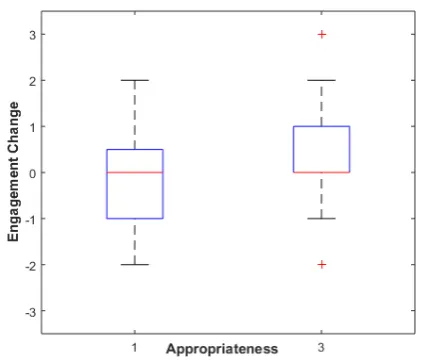
In the conversations produced using REL, an un-balanced Student’s t-test of engagement change between turns that are appropriate and ones that are inappropriate shows that turns that are ap-propriate (Mean =−0.01, (SD=0.84)) have sig-nificantly (p = 0.03) better engagement change than turns that are inappropriate (Mean = 0.33, (SD=0.92)). Figure 2 shows a box plot of the re-sulting engagement change from appropriate and inappropriate responses. The figure suggests that having appropriate responses leads to better en-gagement change overall. However some inap-propriate responses lead to positive engagement change as well. The same trend is found in con-versations produced by REL+ENG.
We tested the hypothesis with respect to each strategy via an unbalanced Student’s t-test. The hypothesis holds for theswitch,initiationandjoke
strategies. It did not hold for theendstrategy, but this is probably because there were very few ex-amples ofendbeing triggered and rated appropri-ate, making it hard to yield any statistical signif-icance. In addition, across all responses, we find some outliers, where even though the system’s re-sponse is appropriate the user’s engagement de-creased. This may happen when the system pro-vides a simple ‘yes’ or ‘no’ answer, when the sys-tem interrupts the user, or when the user misun-derstands the system. Some users are not famil-iar with synthetic voices and misheard the system, and thus thought the system was inappropriate.
We believe that in the future we can improve our system’s turn-taking mechanism and try to tune the system retrieval method to prefer longer re-sponses. This will help to overcome the issue that even appropriate answers can lead to a decrease in user engagement. Since appropriate system re-sponses make users more engaged, are all the
pos-Figure 2: User engagement change with respect to system appropriateness in REL.
itive engagement changes the result of appropri-ate responses? We performed an unbalanced t-test of the appropriateness values between turns that have positive engagement change (Mean = 1.79 (SD = 0.82)) and turns that have negative engage-ment change (Mean = 1.53 (SD = 0.67)) and found that they are statistically significant (p < 0.05). We examined the recordings of conversations and found that there are other factors that contribute to the engagement change other than the system’s ap-propriateness. For example, funny comments and provocative utterances on the part of the system can also increase user engagement. In Table 1, the system response in Turn 4 is only rated as “Inter-pretable,” and yet it leads to an increase in user en-gagement. The speaker even smiled when replying to the system. In another interaction, “Don’t talk to an idiot, because they will drag you down to the same level and beat you with experience.” is rated as “Inappropriate” with respect to the previ-ous user utterance. However the user reacted to it with increased engagement and asked the sys-tem: “Are you calling me an idiot, TickTock?”. We conclude that being appropriate is important to achieve better user engagement, however it is not the only way.
6.5 User Engagement and User Experience
[image:7.595.309.521.64.244.2]is, the more engaged the user is, and the more pos-itive the user is towards the system, the better the user experience the user has. We designed the sur-vey carefully so these three questions are not next to each another, in order to avoid people’s ten-dency to equate these questions. Exact matches between users’ rating on their overall engagement (Mean = 2.75 (SD = 0.75)) and their positivity to-wards the system are found. This is surprising yet possible, since normal users may not differ-entiate between the two questions: “How engaged you felt during the interaction?” and “How posi-tive you felt towards TickTock during the interac-tion?”. They may internalize that being positive to your partner is the same as being engaged in the conversation. The overall user experience (Mean = 2.83 (SD = 0.71)) is also highly correlated (ρ= 0.92) with both user engagement and user positiv-ity towards the system. Our finding suggests that improving user engagement is critical to eliciting better user experience in an everyday chatting set-ting. However, our sample size (12) is relatively small, and we plan to include more users in the study in the future.
Another question is whether users really know what “user experience” is. In future studies, we plan to include questions that are more specific such as, “Would you want to interact with the sys-tem again?”, “Would you invite your friend to in-teract with the system?” and “Do you think the system is easy to talk to?”.
7 Qualitative Results
After the users interacted with REL+ENG, we asked them to fill out a survey. We asked the users what they liked and disliked about the sys-tem, and for their suggestions for how to improve the system. A number of participants commented on the visual aspects of the system, mentioning that they liked the cartoon face and that it smiles a lot. Two participants said they liked the system because it actively proposes engaging topics, and tells jokes. This supports our hypothesis that our designed strategies are useful in increasing user engagement. Three users disliked the system be-cause of its incoherence. Two users could not un-derstand the synthesizer very well, which made them unsure whether answers were inappropriate or whether they had simply misunderstood the sys-tem. Two participants also complained that the system interrupted them sometimes and one
par-ticipant mentioned that the system changes topics too often.
One participant suggested displaying subtitles below TickTock’s face so that people would be able to comprehend the system’s utterances bet-ter. Another participant proposed that TickTock should start the conversation with a topic to dis-cuss in order to avoid the cognitive load imposed by the user’s coming up with topics. We will con-sider both suggestions in our future studies.
8 Conclusion and Future Work
We designed and deployed a non-task-oriented conversational system powered with a set of de-signed strategies that not only reacts to possible system breakdowns but also monitors user engage-ment in real time in a Wizard-of-Oz implemen-tation. The system reacts to user engagement or system breakdown respectively by randomly se-lecting one of the designed strategies whenever the user’s engagement is low or the system’s re-sponse generation confidence is low. In the study, our designed strategies are shown to be useful in increasing the system’s appropriateness as well as in increasing the user’s engagement. We found that appropriateness leads to better user engage-ment. However not all improved user engagement is elicited by appropriate responses. Sometimes, provocative and funny responses also work.
In a third-person study, experts rated the system that reacts to both low user engagement and low generation confidence as having more overall user engagement than the system that only reacts to low generation confidence. In an Amazon Mechanical Turk study, we found non-experts agreed with ex-perts. We conclude that the improvement gained by reacting to user’s engagement is generally rec-ognizable.
One caveat is that due to the lack of a user sur-vey in the REL study, we could not directly com-pare the self-reported engagement or user experi-ence to determine which system is better. Thus, we plan to ask people to interact with both sys-tems and report which system they like better and which system they think is more engaging.
References
Mojtaba Khomami Abadi, Jacopo Staiano, Alessandro Cappelletti, Massimo Zancanaro, and Nicu Sebe. 2013. Multimodal engagement classification for af-fective cinema. In2013 Humaine Association Con-ference on Affective Computing and Intelligent In-teraction, ACII 2013, Geneva, Switzerland, Septem-ber 2-5, 2013, pages 411–416.
Tadas Baltrusaitis, Peter Robinson, and L Morency. 2012. 3D constrained local model for rigid and non-rigid facial tracking. InProceedings of International Conference on Computer Vision and Pattern Recog-nition (CVPR), pages 2610–2617. IEEE.
Rafael E Banchs and Haizhou Li. 2012. Iris: a chat-oriented dialogue system based on the vector space model. In Proceedings of the ACL 2012 System Demonstrations, pages 37–42. Association for Com-putational Linguistics.
Katherine Forbes-Riley and Diane J. Litman. 2012. Adapting to multiple affective states in spoken di-alogue. InProceedings of the SIGDIAL, Seoul Na-tional University, Seoul, South Korea, pages 217– 226.
Ryuichiro Higashinaka, Kenji Imamura, Toyomi Me-guro, Chiaki Miyazaki, Nozomi Kobayashi, Hiroaki Sugiyama, Toru Hirano, Toshiro Makino, and Yoshi-hiro Matsuo. 2014. Towards an open-domain con-versational system fully based on natural language processing. InCOLING, pages 928–939.
Spyros Kousidis, Casey Kennington, Timo Baumann, Hendrik Buschmeier, Stefan Kopp, and David Schlangen. 2014. A multimodal in-car dialogue system that tracks the driver’s attention. In Proceed-ings of the 16th International Conference on Multi-modal Interaction, pages 26–33. ACM.
M Lombard and T Ditton. 1997. At the heart of it all: The concept of presence, journal of com-puter mediated-communication. Journal of Com-puter Mediated Communication, 3(2).
Lilia Moshkina, Susan Trickett, and J. Gregory Trafton. 2014. Social engagement in public places: A tale of one robot. In Proceedings of the 2014 ACM/IEEE International Conference on Human-robot Interac-tion, HRI ’14, pages 382–389, New York, NY, USA. ACM.
Christopher Peters, Catherine Pelachaud, Elisabetta Bevacqua, Maurizio Mancini, and Isabella Poggi. 2005. A model of attention and interest using gaze behavior. InIntelligent Virtual Agents, 5th Interna-tional Working Conference, IVA 2005, Kos, Greece, September 12-14, 2005, Proceedings, pages 229– 240.
Alan Ritter, Colin Cherry, and William B Dolan. 2011. Data-driven response generation in social media. In
Proceedings of the conference on empirical methods in natural language processing, pages 583–593. As-sociation for Computational Linguistics.
Maria Schmidt, Jan Niehues, and Alex Waibel. 2015. Towards an open-domain social dialog system. In
Proceedings of the 6th International Workshop Se-ries on Spoken Dialog Systems, pages 124–129. Oriol Vinyals and Quoc Le. 2015. A neural
conver-sational model. ICML Deep Learning Workshop 2015.