When do we laugh?
Ye Tian1, Chiara Mazzocconi2 & Jonathan Ginzburg2,3 1Laboratoire Linguistique Formelle (UMR 7110)
&2CLILLAC-ARP (EA 3967) &3Laboratoire d’Excellence (LabEx)—EFL
Universit´e Paris-Diderot, Paris, France
Abstract
Studies on laughter in dialogue have pro-posed resolving what laughter isabout by looking at what laughter follows. This paper investigates the sequential relation between the laughter and the laughable. We propose a semantic/pragmatic ac-count treating laughter as a gestural event anaphor referring to a laughable. Data from a French and Chinese dialogue cor-pus suggest a rather free time alignment between laughter and laughable. Laughter can occur (long) before, during, or (long) after the laughable. Our results chal-lenge the assumption that what laughter follows is what it is about, and thus ques-tion claims which rely on this assumpques-tion.
1 Introduction
Studies about laughter in interaction have been mainly focused on the acoustic or perceptual fea-tures, and often observations of the events preced-ing to it have been the base for claims concernpreced-ing what laughter is about. (Provine, 1993) made a claim that has been subsequently adopted in much of the literature: laughter is, for the most part, not related to humour, because it is found to most
fre-quentlyfollowbanal comments. Similar reasoning
has been adopted by several other studies on the kind of situations that elicit laughter. The deduc-tion process in these studies rely on an important yet untested assumption: what laughterfollowsis what it is about. Our paper investigates this as-sumption. We first briefly discuss previous stud-ies on laughter in interaction; we then argue for a semantic/pragmatic account in which we treat laughter as a gestural event anaphora referring to alaughable. We present a corpus study of laugh-ables and evaluate our results against previous pro-posals.
1.1 Studies on what laughter is about
In (Provine, 1993), the researcher observed nat-ural conversations, and “when an observer heard laughter, she recorded in a notebook the com-ment immediately preceding the laughter and if the speaker and/or the audience laughed, the gen-der, and the estimated age of the speaker and the audience [...]. A laugh episode was defined as the occurrence of audible laughter and included any laughter by speaker or audience that followed within an estimated 1 s of the initial laugh event. The laugh episode included the last comment by a speaker if it occurred within an estimated 1 s pre-ceding the onset of the initial laughter. A laugh episode was terminated if an estimated 1 s passed without speaker or audience laughter, or if either the speaker or the audience spoke.”. They found that “Only about 10-20% of episodes were esti-mated by the observers to be humorous” (Provine, 1993), and thus derived the conclusion which is now widely adopted in the literature: laughter is, for the most part, not related to humour but about social interaction. An additional conclusion based on this study is that laughter never interrupts speech but “punctuates” it occurring exclusively at phrase boundaries.
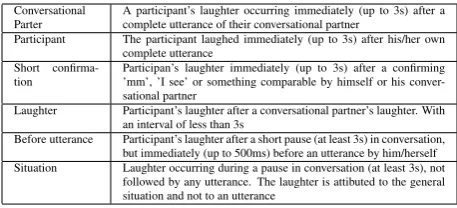
Similarly, (Vettin and Todt, 2004) used exclu-sively timing parameters – i.e., what precedes and what follows the laugh (within a threshold of 3s) – to distinguish 6 different contexts (see table 1) for laughter occurrence to support claims about situa-tions that elicit laughter.
1.2 Weaknesses
In (Provine, 1993), the author assumed that laugh-ter always immediately follows the laughable. Not only do the methods described above provide im-precise data (timing information was estimated during observation), it prevents the possibility of recording any data where laughter does not follow the laughable. In addition, even when the
Conversational
Parter A participant’s laughter occurring immediately (up to 3s) after acomplete utterance of their conversational partner Participant The participant laughed immediately (up to 3s) after his/her own
complete utterance Short
confirma-tion Participan’s laughter immediately (up to 3s) after a confirming’mm’, ’I see’ or something comparable by himself or his conver-sational partner
Laughter Participant’s laughter after a conversational partner’s laughter. With an interval of less than 3s
Before utterance Participant’s laughter after a short pause (at least 3s) in conversation, but immediately (up to 500ms) before an utterance by him/herself Situation Laughter occurring during a pause in conversation (at least 3s), not
[image:2.595.71.300.61.165.2]followed by any utterance. The laughter is attibuted to the general situation and not to an utterance
Table 1: Vetting and Todt, 2004 - Context classification
ment that immediately precedes laughter is the
actual trigger for a laugh, and it is not “amus-ing” in itself (i.e. it is a “banal comment”), it doesn’t necessarily entail that thelaughableis not humourous. The funniness might arise from the “banal comment” in relation to the previous utter-ance, the context of the interaction, shared experi-ences between the speakers, world knowledge and cultural conventions. For example, in (1) “what’s funny” resides in the implicit content that the ut-terance refers to. In (2), the preceding utut-terance is funny only in relation to the context.
(1) A: Do you remember that time? B and A:<laughter/ >.
Laughable= the enriched denotation of ‘that time’. (2) (Context: the speakers are discussing the plan of an
imagined shared apartment, and they have already planned two bathrooms).
A: I want another bathroom. B:<laughter/ > Laughable= “I want another bathroom”
(Vettin and Todt, 2004) is methodologically more precise than (Provine, 1993), and they al-low for the possibility that in addition to laughter occurring after the laughable, a laughter may pre-cede an utterance, or occur during an exophoric situation. However, this analysis excludes laugh-ters that occur in the middle of or overlaps with an utterance, and it uses exclusively timing pa-rameters to determine what laughter is about (as illustrated in figure 1). For example, whether a laugh is considered to be about the preceding ut-terance or about the following utut-terance is decided purely on the difference in the length of gaps with the two utterances. Crucially, the conclusion is also drawn assuming an adjacency relationship be-tween laughter and laughable.
2 Laughter as an event anaphor
We argue that previous studies have ignored
analysing the laughable because they did not
at-tempt to integrate their account with an explicit
semantic/pragmatic module on the basis of which
content is computed.1 The sole recent exception
to this, as far as we are aware, is the account of (Ginzburg et al., 2015), which sketches an infor-mation state–based account of the meaning and use of laughter in dialogue.
Taking this as a starting point, we argue that laughter is a gestural event anaphor, whose mean-ing contains two dimensions: one dimension about the arousal and the other about the trigger or the laughable. In line with (Morreall, 1983) we think that laughter effects a “positive psychologi-cal shift”, and the “arousal” dimension signals the amplitude in the shift.2. The positive
psycholog-ical shift is triggered by an appraisal of an event - the laughablel, and the second dimension com-municates the type of the appraisal. (Ginzburg et al., 2015) propose two basic types of meaning in thelaughabledimension: the person laughing may express her perception of the laughablelas being
incongruous, or just thatlis enjoyable (playful). We propose that in addition, certain uses of laugh-ter in dialogue may suggest the need for a third possible type: expressing thatlis a socially close
ingroupsituation.
2.1 Formal treatment of laughter
Here we sketch a formal semantic and pragmatic treatment of laughter. On the approach developed in KoS (Ginzburg, 2012), information states com-prise a private part and the dialogue gameboard that represents information arising from publi-cized interactions. In addition to tracking shared assumptions/visual space, Moves, and QUD, the
dialogue gameboard also tracks topoi and
en-thymemesthat conversational participants exploit during an interaction (e.g., in reasoning about rhetorical relations.). Here topoi represent general inferential patterns (e.g., given two routes choose
1This is not the case for some theories of humour, e.g.,
that due to (Raskin, 1985), who offers a reasonably explicit account of incongruity emanating from verbal content with-out, however, attempting to offer a theory of laughter in con-versation.
2The amplitudes in the shift depend on both the trigger
the shortest one) represented as functions from records to record types, and enthymemes are in-stances of topoi (e.g.,given that the route via Wal-nut street is shorter than the route via Alma choose Walnut street). An enthymeme belongs to a topos if its domain type is a subtype of the domain type of the topos.
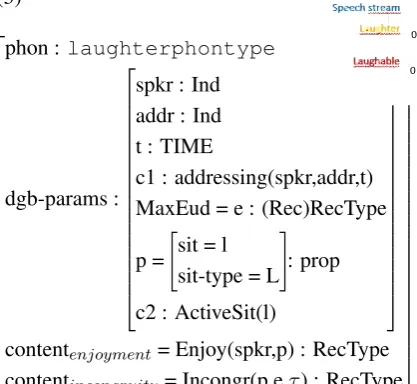
(Ginzburg et al., 2015) posit distinct, though quite similar lexical entries for enjoyment and in-congruous laughter. For reasons of space in (3) we exhibit a unified entry with two distinct con-tents. (3) associates an enjoyment laugh with the laugher’s judgement of a proposition whose situ-ational componentlisactiveas enjoyable; for in-congruity, a laugh marks a proposition whose situ-ational componentlisactiveasincongruous, rel-ative to the currently maximal enthymeme under discussion. (3) makes appeal to a notion of an ac-tive situation. This pertains to the accessible sit-uational antecedents of a laughter act, given that (Ginzburg et al., 2015) proposed viewing laughter as an event anaphor. However, given the existence of a significant amount of speech laughter, as we discuss below, this notion apparently needs to be rethought somewhat, viewing laughter in gestural terms. This requires interfacing the two channels, a problem we will not address here, though see (Rieser, 2015) for a recent discussion in the con-text of manual gesture.
(3)
phon :laughterphontype
dgb-params :
spkr : Ind addr : Ind t : TIME
c1 : addressing(spkr,addr,t) MaxEud = e : (Rec)RecType
p =
"
sit = l sit-type = L
#
: prop
c2 : ActiveSit(l)
contentenjoyment= Enjoy(spkr,p) : RecType
contentincongruity = Incongr(p,e,τ) : RecType
The dialogue gameboard parameters utilised in the account of (Ginzburg et al., 2015) are all ‘informational’ or utterance related ones. How-ever, in order to deal with notions such as arousal and psychological shift, one needs to introduce also parameters that track appraisal (see e.g.,
(Scherer, 2009)). For current purposes, we
men-tion merely one such parameter we dub
pleas-antness that relates to the appraisal issue—in Scherer’s formulation—Is the event intrinsically pleasant or unpleasant?. We assume that this pa-rameter is scalar in value, with positive and neg-ative values corresponding to varying degrees of pleasantness or unpleasantness.
This enables us to formulate conversational rules of the form ‘if A laughs and pleasantness is set to k, then reset pleasantness to k +θ(α)’, where
αis a parameter corresponding to arousal.
2.2 Research questions
The study is part of a broader project where we analyse laughter using a multi-layered scheme and propose a semantic/ pragmatic account of the meaning and effects of laughter. The focus of the current study is the positioning of laughter in rela-tion to its laughable.
Our account suggests that resolving the
[image:3.595.78.287.477.669.2]laugh-ableis crucial for deriving the content of a laugh-ter event. We hypothesize that laughlaugh-ter is not al-ways adjacent to its laughable. Rather, the sequen-tial distribution between laughter and laughable is somewhat free, illustrated in Figure 2. We hypoth-esize that laughter can occur before, during and after the laughable, and that it is possible for inter-vening materials to occur between a laughter event and its laughable.
Figure 1: Temporal misalignment speech stream, laughter and laughable
In more detail, we make the following hypothe-ses in relation to our research questions:
Q1: Does laughter always follow its laughable? –If not, does laughter-laughable alignment differ among different types of laughters? We hypothesize that laughter can occur be-fore, during or after the laughable; laughter and laughable should not have a one-to-one relationship: one laughable can be the refer-ent of several laughter evrefer-ents.
Q2: Does laughter interrupt speech?
We hypothesize that laughter can occur both at utterance boundaries and at utterance-medial position.
Q3: Is laughter-laughable alignment pattern lan-guage specific?
We hypothesize that language/culture influence alignment and thus predict to find differences between, in this case, French and Chinese.
3 Material and method
3.1 Corpus
We analyzed a portion of the DUEL corpus (Hough et al., 2016a) The corpus consists of 30 dyads (10 per language)/ 24 hours of natural, face-to-face, loosely task-directed dialogue in French, Mandarin Chinese and German. Each dyad con-versed in three tasks which in total lasted around 45 minutes. The three tasks used were:
1. Dream Apartment: the participants are told that they are to share a large open-plan apart-ment, and will receive a large amount of money to furnish and decorate it. They dis-cuss the layout, furnishing and decoration de-cisions;
2. Film Script: The participants spend 15 min-utes creating a scene for a film in which something embarrassing happens to the main character;
3. Border control: one participant plays the role of a traveller attempting to pass through the border control of an imagined country, and is interviewed by an officer. The trav-eller has a personal situation that disfavours him/her in this interview. The officer asks questions that are general as well as spe-cific. In addition, the traveller happens to be a parent-in-law of the officer.
The corpus is transcribed in the target language and glossed in English. Disfluency, laughter, and exclamations are annotated. The current pa-per presents analysis of laughter in two dyads in French and Chinese (3 tasks x 2 pairs x 2 lan-guages).
3.2 Audio-video coding of laughter
Coding was conducted by the first and second au-thors and by 2 trained, but na¨ıve to the aim of the study, masters students: each video was observed until a laugh occurred. The coder detected the ex-act onset and offset in Praat (Boersma and others, 2002), and conducted a multi-layer analysis as ex-plained shortly. A laugh was identified referring to the same criteria used in (Nwokah et al., 1994), based on the facial expression and vocalization de-scriptions of laughter elaborated by (Apte, 1985) and (Ekman and Friesen, 1975). Following (Ur-bain and Dutoit, 2011) we counted laughter offset (final laughter in-breath inhalation) as part of the laughter event itself, thus resulting in laughter tim-ings longer than other authors (Bachorowski and Owren, 2001; Rothg¨anger et al., 1998).
All laughter events were categorised according to different parameters: formal and contextual as-pects, semantic meaning and functions (see Table 2). The formal and contextual level analysis in-clude whether a laughter overlaps speech (speech laugh), whether it co-occurs with or immediately follows a partner’s laughter (dyadic/ antiphonal laughter), and its position in relation to the laugh-able. The semantic meaning level analysis include perceived arousal and whether it contains an el-ement of incongruity could be identified by the coders. The function analysis codes the effect of laughter on the interaction, and distinguishes whether the effect is cooperative, i.e., promotes in-teraction (e.g. showing enjoyment, smoothing) or non-cooperative, i.e., in some way disaffects in-teraction (e.g., mocking or evade questions). Due to space constraints and current focus, we do not provide a detailed explanation of the multi-level laughter coding scheme, for which see (Mazzoc-coni et al., 2016). Reliability was assessed by hav-ing a masters student as a second coder for 10% of the material observed. Percentage agreements between the two coders for French and Chinese data averaged respectively 87% and 87.76, with
an overall Krippendorff α (Krippendorff, 2012)
across all tiers of 0.672 and 0.636.
Figure 2: Laughter coding parameters
3.3 Identifying laughables
We consider as the laughable the event which, af-ter appraisal, produces a positive psychological shift in the laugher. We distinguish three different kinds of laughable types: described events, met-alinguistic stimuli and exophoric events. We also mark whether they originated from the laugher him/herself or by the partner.
(4) Described eventA: il y a (un: + un) de mes potes? idiot comme il est, qui (<p = pose>po- < /p> qui pose) un steak sur le rebord (de: + du) balcon? B:<laughter/ >.<laughspeech>ils sont bizarres tes potes< /laughspeech>
(Translation) A: There is (one + one) of my buddies, stupid as he is, who put a steak on the border of the: of the balcony B:<laughter/ >. <laughspeech> you have weird buddies< /laughspeech>
Laughable= “who put a steak on the border of the bal-cony”: described event
(5) Metalinguistic stimuli B: Alors je viens pour {euh} avoir mon passeport? pour Inra:schabella? <laughter/ >
(Translation) B: So I’m here for, euh, having my pass-port? for Inraschabella?<laughter/ >
Laughable= “Inraschabella” (linguistic form, laugh af-ter laugher’s speech)
(6) Exophoric event The examiner is asking A to move the arms because of technical issues A: move-ment arms mimicking a robot B:<laughter/ > A: <laughter/ >
Laughable=the way A moved his arms: exophoric event
3.4 Audio-video coding of laughable
Every time a laugh was identified, coders would mark on the Praat TextGrid, based on personal in-ference, the laughable the laugh would refer to.
The time boundaries were marked, the content (whether verbal or not) was annotated and an in-dex was assigned in order to map laughter (or mul-tiple laughters) and laughable. Laughables were classified according to three main categories: de-scribed, metalinguistic and exhophoric event. Re-liability of type assignement was assessed by hav-ing a masters student as a second coder for 10% of the material observed. Percentage agreements be-tween the two coders for French and Chinese
aver-aged 92.5% with a Krippendorffα(Krippendorff,
2012) of 0.77.
4 Results
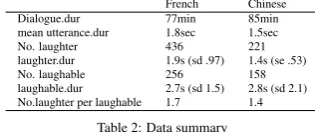
In our data sample (summarized in Table2), laugh-ter is very frequent, constituting 17% of the con-versation duration in French and 7.2% in Chinese. Each laughable is ”laughed about” more than once (1.7 times in French and 1.4 times in Chinese).
French Chinese Dialogue.dur 77min 85min mean utterance.dur 1.8sec 1.5sec No. laughter 436 221 laughter.dur 1.9s (sd .97) 1.4s (se .53) No. laughable 256 158 laughable.dur 2.7s (sd 1.5) 2.8s (sd 2.1) No.laughter per laughable 1.7 1.4
Table 2: Data summary
4.1 Does laughter always follow the laughable?
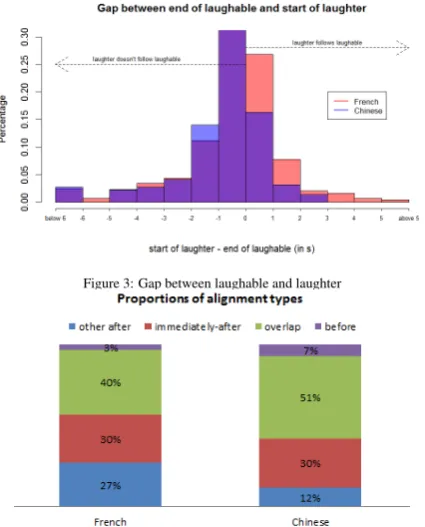
[image:5.595.335.493.543.609.2]af-ter the laughable. In general, laughs in Chinese are more likely to overlap with the laughable than in French. The distribution varies over a wide range. Table 3 summarizes the gaps between the bound-aries of laughter and laughable, and figure 3 plots specifically the gap between the end of the laugh-able and the start of laughter. They show that it is common for laughs to start before, during and after the laughable. When a laugh has no overlap with its laughable, they are not always adjacent to each other (average utterance duration is under 2 seconds while the gap can be up to 10 seconds). In the following example, the first two instances of speech laugh refer to a laughable in a later ut-terance.
(7) 那个老师(要他+要求小诗) 用“不约而同”造 句 子, 后 来 小 明<laughspeech>就 想 了 一 想< /laughspeech>, 然后说呃说呃这样吧? <laughspeech>(我 就+小 诗)< /laughspeech> 就想了想说,呃:呃:我在路上碰见一个美女,然后我 就问她,约吗?<laughspeech>然后美女说,滚,我 们不约儿童< /laughspeech>.
(Translation) B: The teacher asked Xiaoshi to make a sentence with ”bu yue er tong” (coinciden-tally together). Xiaoshi <laughspeech> then <laughspeech/ > thought about it, and said, uh, <laughspeech> (I + Xiaoshi)<laughspeech/ > thought about it and said, uh, uh I saw a pretty girl in the street, and I asked her ”shall we go for a date?”, and <laughspeech> the girl said “shouldn’t date chil-dren”<laughspeech/ >.(note: “shouldn’t date chil-dren” is phonologically identical to ”incidentally to-gether”)
Laughable= “the girl said ‘shouldn’t date children’ ”
Based on whether laughter occurs entirely outside or overlapping with the laughable, we grouped the laughters into 4 alignment cate-gories: “before”, “overlap”, “immediately after” and “other after” (see figure 4). We found that in both languages, laughters that immediately follow (within 0.3s) the laughable constitute 30% . There are more overlapping laughters in Chinese than in French (χ2(1)=6.9,p= .008).
Fr Ch
(in seconds) mean sd range mean sd range start.L-start.LB 2.2 2.4 -9.4 -13.7 1.3 2.3 -19.6 - 9.6 end.L-end.LB 1.4 2.3 -12.8 - 11.6 0.5 2.6 -24.6 - 5.2 start.L-end.LB -0.5 2.3 -13.9 - 8.4 -0.9 2.6 -25.1 - 3.0
Table 3: Time alignment of laughter (“L”) and laughable (“LB”)
4.2 Does laughter-laughable alignment differ among different “types” of laughables and laughters?
[image:6.595.310.523.66.330.2]Our analysis mainly focuses on the distinction be-tween self and partner produced laughables, and
Figure 3: Gap between laughable and laughter
Figure 4: laughters before, after or overlapping with laughable
between speech laugh and laughter bouts, pre-sented separately below. Due to space constraints, the effect of the rest of the tiers are not discussed.
4.2.1 Self vs. partner produced laughables
We coded whether the laughables are described events, meta-linguistic, or exophoric events. In our corpus described events are the common-est (92% in French and 89% in Chinese), fol-lowed by exophoric laughables (7% in French and 10%). Metalinguistic (1% in both languages) laughables are rare, so we grouped them with de-scribed events in the current analysis. On aver-age, there are more self-produced than partner-produced laughables, supporting the idea that speakers laugh more often than the audience. In-terestingly, 3% of the laughables are jointly pro-duced (one person finishing the other’s sentence, or both saying roughly the same thing at the same time) (see (8)). With the former two categories, we also coded whether the laughable is produced by the laugher or her partner, which allow us to compare our results with studies of “speaker” or “audience” laughter.
(8) (totally overlapping turns are italicized)
B: c’est une personne qui est aux toilettes dans <laughter> des toilettes publiques A:
telephone et l’autre il lui croit qu’il parle . C’est genant <laughter/ >
(Translation) B: it is a person who is in the bathroom in<laughter>in public bathroomA:<laughter>
Ah yes yes a guy who is talking in the next stall
<laughter/ > B: in <laughter>in public bath-roomexactly but the other is on the phone and the other thinks he is speaking with him. That’s embarrassing <laughter/ >
Laughable= “exactly but the other is on the phone and the other thinks he is speaking with him”
We found that laughters about a partner-produced laughable start later than those about a self-produced laughable, but still the average start-ing time is before the end of the laughable. With partner-produced laughables, the average gap be-tween the end of laughable and start of laughter is -0.02s in French and -0.3s in Chinese, while with self-produced laughables, the average gap is -0.7s in French and -1.3s in Chinese.
4.2.2 Speech laugh vs. laughter bouts
Laughter frequently overlaps with speech. 36% of laughter events in French and 47% of laughter events in Chinese contain speech laughter. Speech laughter is on average 0.3 seconds longer than stand alone laughter bouts. Speech laughs over-lap with the laughable more than laughter bouts. 52% of speech laughters in French and 70% in Chinese overlap with the laughables. In compar-ison, 33% of laughter bouts in French and 34% in Chinese overlap with the laughable. The rea-son why speech laugh more often overlap with the laughables is likely to do with the difference in function between speech laugh and laughter bouts. Laughters that mark an upcoming laughable most frequently overlaps with speech, and these laugh-ter events are also ones that tend to stretch until the middle or the end of the laughable. A more detailed analysis of the function/effect of laughter is reported in (Mazzocconi et al., 2016).
Notice that not all speech laughs overlap with the laughable, suggesting that often, laughter that occurs with speech is not about the co-occurring speech (47.8% in French and 30% in Chinese). In the following example, speaker B says that she’ll take the bigger bedroom, and laughs. Speaker A joins the laughter but starts a new utterance.
(9) B: okay. les chambres maintenant A:alo:rs F euh: bon ´evidemment F euh: B: je prends la plus grande <laughter/ >A: c’est l`a<laughter>o`u il y a un probl`eme t’vois< /laughter>
(Translation) B: okay. the bedrooms now A: well euh: well obviously euh: B: I take the bigger one <laughter/ >A: It’s there<laughspeech>where there is a problem you see< /laughspeech> Laughable= “je prends la plus grande”
4.3 Does laughter interrupt speech?
We investigated whether laughter occurs at utterance-medial positions when one party is speaking, and when the partner is speaking.
Does laughter interrupt partners’ utter-ances? Yes. We found that 51.8% of laughter bouts in French and 56.7% of laughter bouts in Chinese start during the partner’s utterances (not necessarily laughables), for example:
(10) B: pour faire un mur de son quoi<laughspeech>en fait c’est une<english>ra:ve< /english>notre appartement< /laughspeech>A:<laughter/ > (Translation) B: to create a sound barrier which <laughspeech>in fact it is a rave, our apartment < /laughspeech>A:<laughter/ >
Laughable= “in fact it is a rave, our apartment”
Does laughter interrupt one’s own utter-ances?
We found 14 laughter bouts (5%) in French and 12 (8.6%) in Chinese that occurred in
utterance-medial positions. These proportions are
sta-tistically higher than zero: French χ2(1)=12.3,
p=.0004; Chinese χ2(1)=10.5, p=.001. Most of
these interruptions at not at phrase boundaries. For example:
(11) 那你之前有没有啊:.有过什 么... <laughter/ > <laughter>犯罪记录吗?
(Translation) Do you have, uh, have any <laughter/ >criminal records?
Laughable= “criminal records”
5 Discussion
1. Time alignment between laughter and laugh-able is rather free.
— Laughter and laughable does not have a one-to-one relationship. A laughable can be referred to by more than one laughters. — Contrary to popular belief, only 30% of laughters occur immediately after the laugh-able. Laughters frequently start during the laughable (more so with “speaker” laughter than “audience“ laughter).
— Laughters can occur long before or long after the laughable, and not be adjacent to their laughable.
— Between 30 to 50 percent of speech laughs do not overlap with the laughable, suggesting that frequently laughs are not about the co-occurring speech.
If looking just at laughter bouts, about 40% occur immediately after the laughable.
2. Laughter-laughable alignment may differ de-pending on the different “types” of laugh-able and laughter. Specifically, laughters about a partner-produced laughable (audi-ence laughter) start later than those about a self-produced laughable (speaker laughter). Speech laughs occur earlier than laughter bouts, and overlaps more with the laughable.
3. Comparing Chinese and French, the majority of the patterns are similar, except that in Chi-nese, laughs are more likely to overlap with the laughable than in French. This provides an initial indication that while certain aspects of laughter behaviour are influenced by cul-ture/language, generally we use laughter sim-ilarly in interaction.3
4. Laughter does interrupt speech: we often
laugh when others are speaking (half of all laughter bouts) and occasionally we insert stand-alone laughters mid-sentence (less than 10%). Moreover, very frequently laughter overlaps speech (around 40% of all laugh-ters).
The relatively free alignment between laughter and speech seems analogous at a first approxima-tion to the relaapproxima-tion between manual gesture and speech (Rieser, 2015). We propose to consider
3Of course a caveat to this conclusion is the small number
of speakers for each language. We will expand the study with more speakers and more genres of interaction.
laughter as a verbal gesture, having an indepen-dent channel from speech, with which it commu-nicates through an interface.
5.1 Is laughter rarely about funny stimuli?
Our results discredit the method of inferring what the laughter is about by looking at the elements that immediately precede or follow it. Therefore, previous conclusions using this method should be revisited (Provine, 1993; Provine, 1996; Provine, 2001; Provine and Emmorey, 2006; Vettin and Todt, 2004). One such conclusion is that because they follow “banal comments”, laughter is mostly about not about funny stimuli. We have shown that the logic does not hold, as very often, those preceding “banal comments” are not the laugh-ables. And even if they are, the “funniness” or incongruity may reside between the laughable and something else, e.g., the context of occurrence, world knowledge, cultural norms, experiences, in-formational and intentional states shared between interlocutors. For example, in the following ex-change, the exchange seems rather banal, but in fact, they are laughing about the exophoric situa-tion that they are acting.
(12) A: Oh comment allez-vous? <laughter/ >B: c¸a va et toi? tu vas bien? A : tr`es bien merci:
(Translation) A: Oh how are you? <laughter/ >B: fine and you? are you ok? A: very well thanks Laughable= exophoric situation (they started acting)
Exactly what proportion of laughables contain funny incongruity is a topic for further research. For now, our results questions the validity of ex-isting proposals on this score.
5.2 Laughter Punctuating Speech?
punctuation effect of laughter holds even for sign-ers, and possibly is not a simple physical con-straint that determines the placement of laughter in dialogues, but due to a higher order linguistic ordered structure (Provine, 2006).
On the surface, their findings in speakers and signers are similar: speakers do not stop mid-sentence to insert a laugh, and signers do not laugh while signing a sentence. However, this “simi-larity” may be a difference in disguise. We have shown that speakers frequently overlap laughter and speech. If it were indeed true that signers do not laugh while signing, it raises the question why speech laughter is common for speakers but rare for signers. (Provine and Emmory, 2006) hypoth-esised that the placement of laughter in dialogue is controlled by a higher linguistic ordered structure, where laughter is secondary to language. There-fore, even when the two don’t occur in competing channels, e.g., for signers, laughter still only oc-curs at phrase boundaries.
We argue for a different explanation. Assum-ing speech laughter data (laughter that overlaps utterances) were not excluded in the ASL study as they were in spoken dialogue studies, in deaf signers, since the laughter is perceived only vi-sually and involves marked facial movements, it would interfere with the perception of the message conveyed by language. In sign languages, body and face movements constitute important com-municative elements at all linguistic levels from phonology to morphology, semantics, syntax and prosody (Liddell, 1978; Campbell, 1999). Despite the fact that emotional facial expressions can over-lap with linguistic facial movements (Dachkovsky and Sandler, 2009), a laugh, implying a signifi-cant alteration of facial configuration (see identifi-cation of a laughter episode) could be excessively disruptive for the message aimed to be conveyed. While in verbal language the laughter signal can be completely fused in the speech as a paralinguis-tic feature (Crystal, 1976) and used in a sophisti-cated manner to enrich and facilitate communica-tion, (Nwokah et al., 1999) report that not even from an acoustic perspective is laughter secondary to speech: when co-occurring the laugh indeed does not resemble the speech spectral patterns nor does the speech resemble the laughter ones, but together they create a new idiosyncratic pattern. Laughter is fully meaningful and communicative in itself, universally across cultures, and the
emo-tional components that it carries are not secondary to speech or trivial.
6 Conclusion and future work
Our study provides the first systematic analysis of laughables, and demonstrates the existence of a corpus, the DUEL corpus (Hough et al., 2016b) in which less than a third of the laughs immediately follow their referents. Instead, the laugh can oc-cur before, during or after the laughable with wide time ranges. In addition, laughterdoes“interrupt” speech: we frequently start laughing in the middle of an utterance of the interlocutor or of ourselves (often speech-laugh). Our results challenge the as-sumption that what laughter follows is what it is about, and thus question previous claims based on this assumption.
In future work, we will study to what extent laughter-laughable alignment differs by the func-tion/effect of laughter, and what the limit is for the “free” alignment. This work may be useful for di-alogue systems which allows a computer agent to generate laughter at appropriate times depending on the type and location of the laughable.
Acknowledgments
References
Mahadev L Apte. 1985. Humor and laughter: An an-thropological approach. Cornell Univ Pr.
Jo-Anne Bachorowski and Michael J Owren. 2001. Not all laughs are alike: Voiced but not unvoiced laughter readily elicits positive affect. Psychologi-cal Science, 12(3):252–257.
Paul Boersma et al. 2002. Praat, a system for do-ing phonetics by computer. Glot international, 5(9/10):341–345.
Ruth Campbell. 1999. Categorical perception of face actions: Their role in sign language and in commu-nicative facial displays. The Quarterly Journal of Experimental Psychology: Section A, 52(1):67–95. David Crystal. 1976. Prosodic systems and intonation
in English, volume 1. CUP Archive.
Svetlana Dachkovsky and Wendy Sandler. 2009. Vi-sual intonation in the prosody of a sign language. Language and Speech, 52(2-3):287–314.
Paul Ekman and Wallace V Friesen. 1975. Unmask-ing the face: A guide to recognizUnmask-ing emotions from facial cues.
Jonathan Ginzburg, Ellen Breitholtz, Robin Cooper, Ju-lian Hough, and Ye Tian. 2015. Understanding laughter. In Proceedings of the 20th Amsterdam Colloquium, University of Amsterdam.
Jonathan Ginzburg. 2012. The Interactive Stance: Meaning for Conversation. Oxford University Press, Oxford.
Julian Hough, Ye Tian, Laura de Ruiter, Simon Betz, David Schlangen, and Jonathan Ginzburg. 2016a. Duel: A multi-lingual multimodal dialogue corpus for disfluency, exclamations and laughter. In 10th edition of the Language Resources and Evaluation Conference.
Julian Hough, Ye Tian, Laura de Ruiter, Simon Betz, David Schlangen, and Jonathan Ginzburg. 2016b. Duel: A multi-lingual multimodal dialogue corpus for disfluency, exclamations and laughter. In Pro-ceedings of LREC 2016.
Klaus Krippendorff. 2012.Content analysis: An intro-duction to its methodology. Sage.
Scott K Liddell. 1978. Nonmanual signals and relative clauses in american sign language. Understanding language through sign language research, pages 59– 90.
Chiara Mazzocconi, Ye Tian, and Jonathan Ginzburg. 2016. Multi-layered analysis of laughter. In Pro-ceedings of SemDial 2016 (JerSem), the 20th Work-shop on the Semantics and Pragmatics of Dialogue. John Morreall. 1983. Taking laughter seriously.
SUNY Press.
Evangeline E Nwokah, Hui-Chin Hsu, Olga Dobrowol-ska, and Alan Fogel. 1994. The development of laughter in mother-infant communication: Timing parameters and temporal sequences. Infant Behav-ior and Development, 17(1):23–35.
Evangeline E Nwokah, Hui-Chin Hsu, Patricia Davies, and Alan Fogel. 1999. The integration of laughter and speech in vocal communicationa dynamic sys-tems perspective. Journal of Speech, Language, and Hearing Research, 42(4):880–894.
Robert R Provine and Karen Emmorey. 2006. Laugh-ter among deaf signers. Journal of Deaf Studies and Deaf Education, 11(4):403–409.
Robert R. Provine. 1993. Laughter punctuates speech: Linguistic, social and gender contexts of laughter. Ethology, 95(4):291–298.
Robert R Provine. 1996. Laughter. American scientist, 84(1):38–45.
Robert R Provine. 2001. Laughter: A scientific inves-tigation. Penguin.
V. Raskin. 1985.Semantic mechanisms of humor, vol-ume 24. Springer.
Hannes Rieser. 2015. When hands talk to mouth. ges-ture and speech as autonomous communicating pro-cesses. SEMDIAL 2015 goDIAL, page 122. Hartmut Rothg¨anger, Gertrud Hauser, Aldo Carlo
Cap-pellini, and Assunta Guidotti. 1998. Analysis of laughter and speech sounds in italian and german students.Naturwissenschaften, 85(8):394–402. Klaus R Scherer. 2009. The dynamic architecture
of emotion: Evidence for the component process model. Cognition and emotion, 23(7):1307–1351. J´erˆome Urbain and Thierry Dutoit. 2011. A
pho-netic analysis of natural laughter, for use in au-tomatic laughter processing systems. In Affective Computing and Intelligent Interaction, pages 397– 406. Springer.