Monads as a Solution for Generalized Opacity
Gianluca Giorgolo
University of Oxford University of Oxford and Carleton UniversityAsh Asudeh
{gianluca.giorgolo,ash.asudeh}@ling-phil.ox.ac.uk
Abstract
In this paper we discuss a conservative ex-tension of the simply-typed lambda calcu-lus in order to model a class of expres-sions that generalize the notion of opaque contexts. Our extension is based on previ-ous work in the semantics of programming languages aimed at providing a mathemat-ical characterization of computations that produce some kind ofside effect (Moggi, 1989), and is based on the notion of mon-ads, a construction in category theory that, intuitively, maps a collection of “simple” values and “simple” functions into a more complex value space, in a canonical way. The main advantages of our approach with respect to traditional analyses of opacity are the fact that we are able to explain in a uniform way a set of different but re-lated phenomena, and that we do so in a principled way that has been shown to also explain other linguistic phenomena (Shan, 2001).
1 Introduction
Opaque contexts have been an active area of re-search in natural language semantics since Frege’s original discussion of the puzzle (Frege, 1892). A sentence like (1) has a non-contradictory interpre-tation despite the fact that the two referring expres-sionsHesperusandPhosphorusrefer to the same entity, the planet we know as Venus.
(1) Reza doesn’t believe Hesperus is Phos-phorus.
The fact that a sentence like (1) includes the modal believehas influenced much of the analy-ses proposed in the literature, and has linked the phenomenon with the notion of modality. In this paper we challenge this view and try to position
data like (1) inside a larger framework that also includes other types of expressions.
We decompose examples like (1) along two di-mensions: the presence or absence of a modal ex-pression, and the way in which we multiply re-fer to the same individual. In the case of (1), we have a modal and we use two different co-referring expressions. Examples (2)-(4) complete the land-scape of possible combinations:
(2) Dr. Octopus punched Spider-Man but he didn’t punch Spider-Man.
(3) Mary Jane loves Peter Parker but she doesn’t love Spider-Man.
(4) Reza doesn’t believe Jesus is Jesus. (2) is clearly a contradictory statement, as we predicate of Dr. Octopus that he has the property of having punched Spider-Man and its negation. Notice that in this example there is no modal and the exact same expression is used twice to refer to the object individual. In the case of (3) we still have no modal and we use two different but co-referring expressions to refer to the same in-dividual. However in this case the statement has a non-contradictory reading. Similarly (4) has a non-contradictory reading, which states that, ac-cording to the speaker, Reza doesn’t believe that the entity he (Reza) calls Jesus is the entity that the speaker calls Jesus (e.g., is not the same individual or does not have the same properties). This case is symmetrical to (3), as here we have a modal ex-pression but the same exex-pression is used twice to refer to the same individual.
If the relevant reading of (4) is difficult to get, consider an alternative kind of scenario, as in (5), in which the subject of the sentence, Kim, suffers from Capgras Syndrome1and thinks that Sandy is
an impostor. The speaker says:
1From Wikipedia: “[Capgras syndrome] is a disorder in which a person holds a delusion that a friend, spouse,
(5) Kim doesn’t believe Sandy is Sandy Given the definition of Capgras Syndrome (in fn. 1), there is a clear non-contradictory reading available here, in which the speaker is stating that Kim does not believe that the entity in question, that the speaker and (other non-Capgras-sufferers) would call Sandy, is the entity that she associate with the name Sandy.
We propose an analysis of the non-contradictory cases based on the intuition that the apparently co-referential expressions are in fact interpreted us-ing different interpretation functions, which cor-respond to different perspectives that are pitted against each other in the sentences. Furthermore, we propose that modal expressions are not the only ones capable of introducing a shift of perspective, but also that verbs that involve some kind of men-tal attitude of the subject towards the object have the same effect.
Notice that this last observation distinguishes our approach from one where a sentence like (3) is interpreted as simply saying that Mary Jane loves only oneguiseof the entity that corresponds to Pe-ter Parker but not another one. The problem with this interpretation is that if it is indeed the case that different co-referring expressions simply pick out different guises of the same individual, then a sentence like (6) should have a non-contradictory reading, while this seems not to be the case. (6) Dr. Octopus killed Spider-Man but he
didn’t kill Peter Parker.
While a guise-based interpretation is compatible with our analysis2, it is also necessary to correctly
model the different behaviour of verbs like love with respect to others like punchorkill. In fact, we need to model the difference between, for ex-ample,killandmurder, sincemurderdoes involve a mental attitude of intention and the correspond-ing sentence to (6) is not necessarily contradictory: (7) Dr. Octopus murdered Spider-Man but he
didn’t murder Peter Parker.
The implementation of our analysis is based on monads. Monads are a construction in category theory that defines a canonical way to map a set of objects and functions that we may consider as ent, or other close family member has been replaced by an identical-looking impostor.”
2Indeed, one way to understand guises is as different ways in which we interpret a referring term (Heim, 1998).
simple into a more complex object and function space. They have been successfully used in the semantics of programming languages to charac-terise computations that are not “pure”. By pure we mean code objects that are totally referentially transparent (i.e. do not depend on external factors and return the same results given the same input independently of their execution context), and also that do not have effects on the “real world”. In contrast, monads are used to model computations that for example read from or write to a file, that depend on some random process or whose return value is non-deterministic.
In our case we will use the monad that describe values that are made dependent on some exter-nal factor, commonly known in the functioexter-nal pro-gramming literature as the Reader monad.3 We
will represent linguistic expressions that can be as-signed potentially different interpretations as func-tions from interpretation indices to values. Effec-tively we will construct a different type of lexicon that does not represent only the linguistic knowl-edge of a single speaker but also her (possibly par-tial) knowledge of the language of other speak-ers. So, for example, we will claim that (4) can be assigned a non-contradictory reading because the speaker’s lexicon also includes the information regarding Reza’s interpretation of the nameJesus and therefore makes it possible for the speaker to use the same expression, in combination with a verb such asbelieve, to actually refer to two dif-ferent entities. In one case we will argue that the nameJesusis interpreted using the speaker’s pretation while in the other case it is Reza’s inter-pretation that is used.
Notice that we can apply our analysis to any natural language expression that may have differ-ent interpretations. This means that, for exam-ple, we can extend our analysis, which is limited to referring expressions here for space reasons, to other cases, such as the standard examples involv-ing ideally synonymous predicates likegroundhog andwoodchuck(see, e.g., Fox and Lappin (2005)). The paper is organised as follows: in section 2 we discuss the technical details of our analysis; in section 3 we discuss our analyses of the moti-vating examples; section 4 compares our approach with a standard approach to opacity; we conclude in section 5.
2 Monads and interpretation functions To avoid introducing the complexities of the cat-egorical formalism, we introduce monads as they are usually encountered in the computer science literature. A monad is defined as a tripleh♦, η, ?i. ♦is what we call a functor, in our case a mapping between types and functions. We call the com-ponent of ♦ that maps between types ♦1, while
the one that maps between functions♦2. In our
case ♦1 will map each type to a new type that
corresponds to the original type with an added interpretation index parameter. Formally, if i is the type of interpretation indices, then ♦1 maps
any type τ to i → τ. In terms of functions, ♦2 maps any function f : τ → δ to a function
f0 : (i → τ) → i → δ. ♦
2 corresponds to
func-tion composifunc-tion:
♦2(f) =λg.λi.f(g(i)) (8)
In what follows the component♦2will not be used
so we will use ♦as an abbreviation for♦1. This
means that we will write♦τ for the typei→τ. η (pronounced “unit”) is a polymorphic func-tion that maps inhabitants of a typeτto inhabitants of its image under♦, formally η : ∀τ.τ → ♦τ. Using the computational metaphor,η should em-bed a value in a computation that returns that value without any side-effect. In our caseηshould sim-ply add a vacuous parameter to the value:
η(x) =λi.x (9)
? (pronounced “bind”) is a polymorphic func-tion of type∀τ.∀δ.♦τ → (τ → ♦δ) → ♦δ, and acts as a sort of enhanced functional application.4
Again using the computational metaphor, ?takes care of combining the side effects of the argument and the function and returns the resulting compu-tation. In the case of the monad we are interested in,?is defined as in (10).
a ? f =λi.f(a(i))(i) (10)
Another fundamental property of ? is that, by imposing an order of evaluation, it will provide us with an additional scoping mechanism distinct from standard functional application. This will al-low us to correctly capture the multiple readings 4We use for?the argument order as it is normally used in functional programming. We could swap the arguments and make it look more like standard functional application. Also, we write?in infix notation.
associated with the expressions under considera-tion.
We thus add two operators, η and ?, to the lambda calculus and the reductions work as ex-pected for (9) and (10). These reductions are im-plicit in our analyses in section 3.
2.1 Compositional logic
For composing the meanings of linguistic re-sources we use a logical calculus adapted for the linear case5from the one introduced by Benton et
al. (1998). The calculus is based on a language with two connectives corresponding to our type constructors: (, a binary connective, that corre-sponds to (linear) functional types, and♦, a unary connective, that represents monadic types.
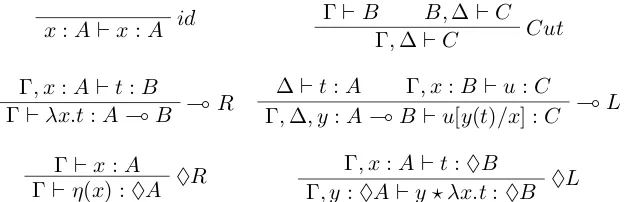
The logical calculus is described by the proof rules in figure 1. The rules come annotated with lambda terms that characterise the Curry-Howard correspondence between proofs and meaning terms. Here we assume a Lexical Functional Grammar-like setup (Dalrymple, 2001), where a syntactic and functional grammar component feeds the semantic component with lexical re-sources already marked with respect to their predicate-argument relationships. Alternatively we could modify the calculus to a categorial set-ting, by introducing a structural connective, and using directional versions of the implication con-nective together with purely structural rules to control the compositional process.
We can prove that the Cut rule is admissible, therefore the calculus becomes an effective (al-though inefficient) way of computing the meaning of a linguistic expression.
A key advantage we gain from the monadic ap-proach is that we are not forced to generalize all lexical entries to the “worst case”. With the log-ical setup we have just described we can in fact freely mix monadic and non monadic resources. For example, in our logic we can combine a pure version of a binary function with arguments that are either pure or monadic, as the following are all
id
x:A`x:A Γ`BΓ,∆`B,C∆`C Cut
Γ, x:A`t:B
(R
Γ`λx.t:A(B
∆`t:A Γ, x:B`u:C
(L
Γ,∆, y :A(B `u[y(t)/x] :C
Γ`x:A ♦R
[image:4.595.144.457.61.162.2]Γ`η(x) :♦A Γ, yΓ:, x♦A:`Ay ? λx.t`t:♦B:♦B ♦L
Figure 1: Sequent calculus for a fragment of multiplicative linear logic enriched with a monadic modality, together with a Curry-Howard correspondence between formulae and meaning terms.
provable theorems in this logic.
A(B (C, A, B `♦C (11) A(B (C,♦A, B`♦C (12) A(B (C, A,♦B `♦C (13) A(B (C,♦A,♦B `♦C (14) In contrast, the following is not a theorem in the logic:
A(B (C, I (A, I (B 6`I (C (15) In general, then, if we were to simply lift the type of the lexical resources whose interpretation may be dependent on a specific point of view, we would be forced to lift all linguistic expressions that may combine with them, thus generalizing to the worst case after all.
The monadic machinery also achieves a higher level of compositionality. In principle we could directly encode our monad using the→type con-structor, with linear implication,(, on the logical side. However this alternative encoding wouldn’t have the same deductive properties. Compare the pattern of inferences we have for the monadic type, in (11)–(14), with the equivalent one for the simple type:
A(B (C, A, B `C (16) A(B (C, I (A, B `I (C (17) A(B (C, A, I (B `I (C (18) A(B (C, I (A, I (B` (19)
I (I (C
In the case of the simple type, the final formula we derive depends in some non-trivial way on the en-tire collection of resources on the left-hand side of the sequent. In contrast in the case of the monadic type, the same type can be derived for all config-urations. What is important is that we can pre-dict the final formula without having to consider
the entire set of resources available. This shows that the compositionality of our monadic approach cannot be equivalently recapitulated in a simple type theory.
3 Examples
The starting point for the analysis of examples (1)-(4) is the lexicon in table 1. The lexicon represents the linguistic knowledge of the speaker, and at the same time her knowledge about other agents’ grammars.
Most lexical entries are standard, since we do not need to change the type and denotation of lex-ical items that are not involved in the phenomena under discussion. So, for instance, logical opera-tors such asnotandbutare interpreted in the stan-dard non-monadic way, as is a verb likepunchor kill. Referring expressions that are possibly con-tentious, in the sense that they can be interpreted differently by the speaker and other agents, instead have the monadic type ♦e. This is reflected in their denotation by the fact that their value varies according to an interpretation index. We use a special indexσ to refer to the speaker’s own per-spective, and assume that this is the default index used whenever no other index is specifically in-troduced. For example, in the case of the name Spider-Man, the speaker is aware of his secret identity and therefore interprets it as another name for the individual Peter Parker, while Mary Jane and Dr. Octopus consider Spider-Man a different entity from Peter Parker.
WORD DENOTATION TYPE
Reza rσ e
Kim kσ e
Dr. Octopus oσ e
Mary Jane mjσ e
Peter Parker ppσ e
not λp.¬p t→t
but λp.λq.p∧q t→t→t is λx.λy.x=y e→e→t punch λo.λs.punch(s)(o) e→e→t believe λc.λs.λi.B(s)(c(κ(s))) ♦t→e→♦t love λo.λs.λi.love(s)(o(κ(s))) ♦e→e→♦t
Hesperus λi. (
esr ifi=r,
vσ ifi=σ ♦e
Phosphorus λi. (
msr ifi=r,
vσ ifi=σ ♦e
Spider-Man λi. (
smi ifi=oori=mj,
ppσ ifi=σ ♦e
Jesus λi.
(
jr ifi=r,
jσ ifi=σ ♦e
Sandy λi.
(
impk ifi=k,
[image:5.595.152.448.60.391.2]sσ ifi=σ ♦e
Table 1: Speaker’s lexicon
fact that different agents may have distinct equiv-alencies between entities. For example, Reza in our model does not equate the evening star and the morning star, but the speaker equates them with each other and with Venus. Therefore, the speaker’s lexicon in table 1 represents the fact that the speaker’s epistemic model includes what the speaker knows about other agents’ models, e.g. that Reza has a distinct denotation (from the speaker) for Hesperus, that Mary Jane has a dis-tinct representation for Spider-Man, that Kim has a distinct representation for Sandy, etc.
The other special lexical entries in our lexicon are those for verbs likebelieveandlove. The two entries are similar in the sense that they both take an already monadic resource and actively supply a specific interpretation index that corresponds to the subject of the verbs. The functionκmaps each entity to the corresponding interpretation index, i.e. κ : e → i. For example, in the lexical en-tries forbelieveandlove,κmaps the subject to the interpretation index of the subject. Thus, the entry forbelieveuses the subject’s point of view as the perspective used to evaluate its entire complement,
whilelovechanges the interpretation of its object relative to the perspective of its subject. However we will see that the interaction of these lexical en-tries and the evaluation order imposed by?will al-low us to let the complement of a verb likebelieve and the object of a verb likeloveescape the spe-cific effect of forcing the subject point of view, and instead we will be able to derive readings in which the arguments of the verb are interpreted using the speaker’s point of view.
Figure 2 reports the four non-equivalent read-ings that we derive in our system for example (1), repeated here as (20).6
(20) Reza doesn’t believe that Hesperus is Phosphorus.
JbelieveK(JHesperusK? λx.JPhosphorusK? λy.η(JisK(x)(y)))(JRezaK)? λz.η(JnotK(z)) (21)
JHesperusK? λx.JbelieveK(JPhosphorusK? λy.η(JisK(x)(y)))(JRezaK)? λz.η(JnotK(z)) (22)
JPhosphorusK? λx.JbelieveK(JHesperusK? λy.η(JisK(y)(x)))(JRezaK)? λz.η(JnotK(z)) (23)
JHesperusK? λx.JPhosphorusK? λy.JbelieveK(η(JisK(x)(y)))(JRezaK)? λz.η(JnotK(z)) (24)
Figure 2: Non-equivalent readings forReza doesn’t believe Hesperus is Phosphorus.
reading would not be contradictory in an epistemic model (such as Reza’s model) where the evening star and the morning star are not the same entity.
¬B(r)(esr=msr) (25)
In the case of (22) and (23) we get a similar ef-fect although here we mix the epistemic models, and one of the referring expressions is interpreted under the speaker perspective while the other is again interpreted under Reza’s perspective. For these two readings we obtain respectively the truth conditions in (26) and (27).
¬B(r)(vσ =msr) (26)
¬B(r)(vσ =esr) (27)
Finally for (24) we get the contradictory reading that Reza does not believe that Venus is Venus, as both referring expressions are evaluated using the speaker’s interpretation index.
¬B(r)(vσ =vσ) (28)
The different contexts for the interpretation of referring expressions are completely determined by the order in which we evaluate monadic re-sources. This means that, just by looking at the linear order of the lambda order, we can check whether a referring expression is evaluated inside the scope of a perspective changing operator such asbelieve, or if it is interpreted using the standard interpretation.
If we consider a case like sentence (2), we ought to get only a contradictory reading as the statement is intuitively contradictory. Our analysis produces a single reading that indeed corresponds to a con-tradictory interpretation:
JSpider-ManK? λx.JSpider-ManK? λy.η(JbutK(JpunchK(JDr. OctopusK)(x)) (JnotK(JpunchK(JDr. OctopusK)(y)))) (29)
The verb punch is not a verb that can change the interpretation perspective and therefore the po-tentially controversial name Spider-Man is preted in both instances using the speaker’s inter-pretation index. The result are unsatisfiable truth conditions, as expected:
punch(oσ)(ppσ)∧ ¬punch(oσ)(ppσ) (30)
In contrast a verb likeloveis defined in our lex-icon as possibly changing the interpretation per-spective of its object to that of its subject. There-fore in the case of a sentence like (3), we ex-pect one reading where the potentially contentious name Spider-Man is interpreted according to the subject oflove, Mary Jane. This is in fact the re-sult we obtain. Figure 3 reports the two readings that our framework generates for (3).
Reading (31), corresponds to the non contradic-tory interpretation of sentence (3), where Spider-Man is interpreted according to Mary Jane’s per-spective and therefore is assigned an entity differ-ent from Peter Parker:
love(mjσ)(ppσ)∧ ¬love(mjσ)(smmj) (33)
Reading (32) instead generates unsatisfiable truth conditions, as Spider-Man is identified with Peter Parker according to the speaker’s interpretation:
love(mjσ)(ppσ)∧ ¬love(mjσ)(ppσ) (34)
Our last example, (4), repeated here as (35), is particularly interesting as we are not aware of pre-vious work that discusses this type of sentence. The non-contradictory reading that this sentence has seems to be connected specifically to two dif-ferent interpretations of the same name, Jesus, both under the syntactic scope of the modal be-lieve.
JloveK(η(JPeter ParkerK))(JMary JaneK)? λp.JloveK(JSpider-ManK)(JMary JaneK)?
λq.η(JbutK(p)(JnotK(q))) (31)
JloveK(η(JPeter ParkerK))(JMary JaneK)? λp.JSpider-ManK? λx.JloveK(η(x))(JMary JaneK)? λq.η(JbutK(p)(JnotK(q))) (32)
Figure 3: Non-equivalent readings forMary Jane loves Peter Parker but she doesn’t love Spider-Man.
JbelieveK(JJesusK? λx.JJesusK? λy.η(JisK(x)(y)))(JRezaK)? λz.η(JnotK(z)) (36)
JJesusK? λx.JJesusK? λy.JbelieveK(η(JisK(x)(y)))(JRezaK)? λz.η(JnotK(z)) (37)
JJesusK? λx.JbelieveK(JJesusK? λy.η(JisK(x)(y)))(JRezaK)? λz.η(JnotK(z)) (38)
Figure 4: Non-equivalent readings forReza doesn’t believe Jesus is Jesus.
Our system generates three non-equivalent read-ings, reported here in figure 4.7
Reading (36) and (37) corresponds to two con-tradictory readings of the sentence: in the first case both instances of the name Jesus are inter-preted from the subject perspective and therefore attribute to Reza the non-belief in a tautology, sim-ilarly in the second case, even though in this case the two names are interpreted from the perspec-tive of the speaker. In contrast the reading in (38) corresponds to the interpretation that assigns two different referents to the two instances of the name Jesus, producing the truth conditions in (39) which are satisfiable in a suitable model.
¬B(r)(jσ =jr) (39)
The analysis of the Capgras example (5), re-peated in (40), is equivalent; the non-contradictory reading is shown in (41).
(40) Kim doesn’t believe Sandy is Sandy. ¬B(k)(sσ =impk) (41) We use impk as the speaker’s representation of the “impostor” that Kim thinks has taken the place of Sandy.
More generally, there are again three non-equivalent readings, including the one above, which are just those in figure 4, with JJesusK re-placed byJSandyKandJRezaKreplaced byJKimK. 7Again, there are six readings that correspond to different proofs, but given the commutative behaviour of the Reader monad, the fact that equality is commutative, and the fact that we have in this case two identical lexical items, only three of them are non-equivalent readings.
4 Comparison with traditional approaches
In this section we try to sketch how a traditional approach to opaque contexts, such as one based on a de dicto/de re ambiguity with respect to a modal operator, would fare in the analysis of (4), our most challenging example.
agent’s model).
However, such an approach would present a number of rather serious problems. The first is connected with the assumption that names are scopeless. This is a common hypothesis in natural language semantics and indeed if we model names as generalized quantifiers they can be proven to be scopeless (Zimmermann, 1993). But this is prob-lematic for our example. In fact we would predict that both instances of the name Jesus escape the scope ofbelieve. The resulting reading would bind the quantified individual to the interpretation of Je-susin the actual world. In this way we only cap-ture the non-satisfiable reading. To save the sco-pal approach we would need to assume that names in fact are sometimes interpreted in the scope of modal operators.
One way to do this would be to set up our se-mantic derivations so that they allow different sco-pal relations between quantifiers and other opera-tors. The problem with this solution is that for sen-tences like (4) we generate twelve different deriva-tions, some of which do not correspond to valid readings of the sentence.
Even assuming that we find a satisfactory solu-tion for these problems, the scopal approach can-not really capture the intuitions behind opacity in all contexts. Consider again (4) and assume that there are two views about Jesus: Jesus as a divine being and Jesus as a human being. Assume that Je-sus is a human being in the actual world and that Reza is an atheist, then the only possible reading is the non-satisfiable one, as the referent for Jesus will be the same in the actual world and all acces-sible Reza-belief-worlds. The problem is that the scopal approach assumes a single modal model, while in this case it seems that there are two doxas-tic models, Reza’s model and the speaker’s model, under discussion. In contrast, in our approach the relevant part of Reza’s model is embedded inside the speaker’s model and interpretation indices in-dicate which interpretation belongs to Reza and which to the speaker.
Finally an account of modality in terms of sco-pal properties is necessarily limited to cases in which modal operators are present. While this may be a valid position in the case of typical in-tensional verbs likeseek orwant, it would not be clear how we could extend this approach to cases like 3, as the verb love has no clear modal con-notation. Thus, the scopal approach would not be
sufficiently general. 5 Conclusion
We started by discussing a diverse collection of expressions that share the common property of showing nontrivial referential behaviours. We have proposed a common analysis of all these expressions in terms of a combination of differ-ent interpretation contexts. We have claimed that the switch to a different interpretation context is triggered by specific lexical items, such as modal verbs but also verbs that express some kind of mental attitude of the subject of the verb towards its object. The context switch is not obligatory, as witnessed by the multiple readings that the sen-tences discussed seem to have. We implemented our analysis using monads. The main idea of our formal implementation is that referring ex-pressions that have a potential dependency from an interpretation context can be implemented as functions from interpretation indices to fully in-terpreted values. Similarly, the linguistic triggers for context switch are implemented in the lexi-con as functions that can modify the interpreta-tion context of their arguments. Monads allow us to freely combine these “lifted” meanings with standard ones, avoiding in this way to generalize our lexicon to the worst case. We have also seen how more traditional approaches, while capable of dealing with some of the examples we discuss, are not capable of providing a generalised explanation of the observed phenomena.
Acknowledgements
References
Ash Asudeh. 2012. The Logic of Pronominal
Resump-tion. Oxford Studies in Theoretical Linguistics.
Ox-ford University Press, New York.
Nick Benton, G. M. Bierman, and Valeria de Paiva. 1998. Computational types from a logical
per-spective. Journal of Functional Programming,
8(2):177–193.
Mary Dalrymple. 2001.Lexical Functional Grammar.
Academic Press, San Diego, CA.
Chris Fox and Shalom Lappin. 2005. Foundations of
Intensional Semantics. Blackwell, Oxford.
Gottlob Frege. 1892. ¨Uber Sinn und Bedeutung.
Zeitschrift f¨ur Philosophie und philosophische
Kri-tik, 100:25–50.
Gottlob Frege. 1952. On sense and reference. In
Pe-ter T. Geach and Max Black, editors, Translations
from the Philosophical Writings of Gottlob Frege, pages 56–78. Blackwell, Oxford. Translation of Frege (1892).
Irene Heim. 1998. Anaphora and semantic interpreta-tion: A reinterpretation of Reinhart’s approach. In
Uli Sauerland and Orin Percus, editors, The
Inter-pretive Tract, volume 25 ofMIT Working Papers in Linguistics, pages 205–246. MITWPL, Cambridge, MA.
Saul Kripke. 1972. Naming and necessity. In Donald
Davidson and Gilbert Harman, editors,Semantics of
Natural Language, pages 253–355. Reidel.
Eugenio Moggi. 1989. Computational
lambda-calculus and monads. InLICS, pages 14–23. IEEE
Computer Society.
Michael Moortgat. 2011. Categorial type logics. In Johan van Benthem and Alice ter Meulen, editors, Handbook of Logic and Language, pages 95–179. Elsevier, second edition.
Chung-chieh Shan. 2001. Monads for natural
lan-guage semantics. In Kristina Striegnitz, editor,
Pro-ceedings of the ESSLLI-2001 Student Session, pages 285–298. 13th European Summer School in Logic, Language and Information.
Thomas Ede Zimmermann. 1993. Scopeless
quanti-fiers and operators. Journal of Philosophical Logic,