Multi-Task Learning for Improved Discriminative Training in SMT
Patrick Simianer and Stefan Riezler
Department of Computational Linguistics Heidelberg University
69120 Heidelberg, Germany
{simianer,riezler}@cl.uni-heidelberg.de
Abstract
Multi-task learning has been shown to be effective in various applications, including discriminative SMT. We present an exper-imental evaluation of the question whether multi-task learning depends on a “natu-ral” division of data into tasks that bal-ance shared and individual knowledge, or whether its inherent regularization makes multi-task learning a broadly applicable remedy against overfitting. To investi-gate this question, we compare “natural” tasks defined as sections of the Interna-tional Patent Classification versus “ran-dom” tasks defined as random shards in the context of patent SMT. We find that both versions of multi-task learning im-prove equally well over independent and pooled baselines, and gain nearly 2 BLEU points over standard MERT tuning. 1 Introduction
Multi-task learning is motivated by situations where a number of statistical models need to be es-timated from data belonging to different tasks. It is assumed that the data are not completely indepen-dent of one another as they share some common-alities, yet they differ enough to counter a simple pooling of data. The goal of multi-task learning is to take advantage of commonalities among tasks by learning a shared model without neglecting in-dividual knowledge. For example, Obozinski et al. (2010) present an optical character recognition scenario where data consist of samples of hand-written characters from several writers. While the styles of different writers vary, it is expected that there are also commonalities on a pixel- or stroke-level that are shared across writers. Chapelle et al. (2011) present a scenario where data from search engine query logs are available for different coun-tries. While the rankings for some queries will
have to be country-specific (they cite “football” as a query requiring different rankings in the US and the UK), a large fraction of queries will be country-insensitive. W¨aschle and Riezler (2012b) present multi-task learning for statistical machine translation (SMT) of patents from different classes (so-called sections) according to the International Patent Classification (IPC)1. While the vocabulary
may differ between the different IPC sections, spe-cific legal jargon and a typical textual structure will be shared across IPC sections. As shown in the cited works, treating data from different writ-ers, countries, or IPC classes as data from differ-ent tasks, and applying generic multi-task learning to the specific scenario, improves learning results over learning independent or pooled models.
The research question we ask in this paper is as follows: Is multi-task learning dependent on a “natural” task structure in the data, where shared and individual knowledge is properly balanced? Or can multi-task learning be seen as a general regularization technique that prevents overfitting irrespective of the task structure in the data?
We investigate this research question on the ex-ample of discriminative training for patent trans-lation, using the algorithm for multi-task learn-ing with `1/`2 regularization presented by Simi-aner et al. (2012). We compare multi-task learning on “natural” tasks given by IPC sections to multi-task learning on “random” multi-tasks given by random shards and to baseline models trained on indepen-dent tasks and pooled tasks. We find that both versions of multi-task learning improve over inde-pendent or pooled training. However, differences between multi-task learning on IPC tasks and ran-dom tasks are small. This points to a more general regularization effect of multi-task learning and in-dicates a broad applicability of multi-task learning techniques. Another advantage of the `1/`2 reg-1http://wipo.int/classifications/ipc/ en/
ularization technique of Simianer et al. (2012) is a considerable efficiency gain due to paralleliza-tion and iterative feature selecparalleliza-tion that makes the algorithm suitable for big data applications and for large-scale training with millions of sparse fea-tures. Last but not least, our best result for multi-task learning improves by nearly 2 BLEU points over the standard MERT baseline.
2 Related Work
Multi-task learning is an active area in machine learning, dating back at least to Caruana (1997). A regularization perspective was introduced by Ev-geniou and Pontil (2004), who formalize the cen-tral idea of trading off optimality of parameter vec-tors for each task-specific model and closeness of these model parameters to the average parame-ter vector across models in an SVM framework. Equivalent formalizations replace parameter reg-ularization by Bayesian prior distributions on the parameters (Finkel and Manning, 2009) or by aug-mentation of the feature space with domain inde-pendent features (Daum´e, 2007). Besides SVMs, several learning algorithms have been extended to the multi-task scenario in a parameter regu-larization setting, e.g., perceptron-type algorithms (Dredze et al., 2010) or boosting (Chapelle et al., 2011). Further variants include different for-malizations of norms for parameter regularization, e.g.,`1/`2 regularization (Obozinski et al., 2010) or `1/`∞ regularization (Quattoni et al., 2009), where only the features that are most important across all tasks are kept in the model.
Early research on multi-task learning for SMT has investigated pooling of IPC sections, with larger pools improving results (Utiyama and Isa-hara, 2007; Tinsley et al., 2010; Ceaus¸u et al., 2011). W¨aschle and Riezler (2012b) apply multi-task learning to multi-tasks defined as IPC sections and compare patent translation on independent tasks, pooled tasks, and multi-task learning, using same-sized training data. They show small but sta-tistically significant improvements for multi-task learning over independent and pooled training. Duh et al. (2010) introduce random tasks as n-best lists of translations and showed significant im-provements by applying various multi-task learn-ing techniques to discriminative reranklearn-ing. Song et al. (2011) define tasks as bootstrap samples from the development set and show significant im-provements for a bagging-based system
combina-tion over individual MERT training.
In this paper we apply the multi-task learning technique of Simianer et al. (2012) to tasks de-fined as IPC sections and to random tasks. Their algorithm can be seen as a weight-based back-ward feature elimination variant of Obozinski et al. (2010)’s gradient-based forward feature selec-tion algorithm for `1/`2 regularization. The lat-ter approach is related to the general methodol-ogy of using block norms to select entire groups of features jointly. For example, such groups can be defined as non-overlapping subsets of features (Yuan and Lin, 2006), or as hierarchical groups of features (Zhao et al., 2009), or they can be grouped by the general structure of the prediction problem (Martins et al., 2011). However, these approaches are concerned with grouping features within a single prediction problem whereas multi-task learning adds an orthogonal layer of multiple task-specific prediction problems. By virtue of av-eraging selected weights after each epoch, the al-gorithm of Simianer et al. (2012) is related to Mc-Donald et al. (2010)’s iterative mixing procedure. This algorithm is itself related to the bagging pro-cedure of Breiman (1996), if random shards are considered from the perspective of random sam-ples. In both cases averaging helps to reduce the variance of the per-sample classifiers.
3 Multi-task Learning for Discriminative Training in SMT
In multi-task learning, we have data points
{(xi
z, yzi), i= 1, . . . , Nz, z= 1, . . . , Z}, sampled
from a distributionPz on X×Y. The subscript
zindexes tasks and the superscriptiindexes i.i.d.
data for each task. For the application of discrimi-native ranking in SMT, the spaceXcan be thought
of as feature representations of n-best translations, and the spaceY denotes corresponding sentence-level BLEU scores.2 We assume thatP
z is
differ-ent for each task but that the Pz’s are related as,
for example, considered in Evgeniou and Pontil (2004). The standard approach is to fit an inde-pendent model involving aD-dimensional
param-eter vectorwzfor each taskz. In multi-task
learn-ing, we consider aZ-by-DmatrixW = (wdz)z,d
of stackedD-dimensional row vectorswz, andZ
-dimensional column vectorswdof weights
asso-ciated with featuredacross tasks. The central
al-2See Duh et al. (2010) for a similar formalization for the
gorithms in most multi-task learning techniques can be characterized as a form of regularization that enforces closeness of task-specific parameter vectors to shared parameter vectors, or promotes sparse models that only contain features that are shared across tasks. In this paper, we will fol-low the approach of Simianer et al. (2012), who formalize multi-task learning as a distributed fea-ture selection algorithm using `1/`2 regulariza-tion. `1/`2regularization can be described as pe-nalizing weightsW by the weighted`1/`2 norm, which is defined following Obozinski et al. (2010), as
λ||W||1,2 =λ
D
X
d=1
||wd||2.
Each`2 norm of a weight columnwd represents the relevance of the corresponding feature across tasks. The `1 sum of the `2 norms enforces a selection of features by encouraging several fea-ture columnswd to be0 and others to have high
weights across all tasks. This results in shrinking the matrix to the features that are useful across all tasks.
Simianer et al. (2012) achieve this behavior by the following weight-based iterative feature elimi-nation algorithm that is wrapped around a stochas-tic gradient descent (SGD) algorithm for pairwise ranking (Shen and Joshi, 2005):
Algorithm 1Multi-task SGD
Get data forZtasks, each includingSsentences; distribute to machines.
Initializev←0.
for epochst←0. . . T −1:do
for all tasksz∈ {1. . . Z}:parallel do
wz,t,0,0←v
for all sentencesi∈ {0. . . S−1}:do
Decodeithinput withwz,t,i,0. for all pairsj∈ {0. . . P −1}:do
wz,t,i,j+1←wz,t,i,j−η∇lj(wz,t,i,j)
end for
wz,t,i+1,0←wz,t,i,P
end for end for
Stack weightsW←[w1,t,S,0|. . .|wZ,t,S,0]T
Select topKfeature columns ofWby`2norm fork←1. . . Kdo
v[k] = 1
Z Z P z=1
W[z][k].
end for end for returnv
The innermost loop of the algorithm computes an SGD update based on the subgradient∇lj of a
pairwise loss function. `1/`2-based feature selec-tion is done after each epoch of SGD training for
each task in parallel. The`2 norm of the weights is computed for each feature column across tasks; features are sorted by this value; K top features
are kept in the model; reduced weight vectors are mixed and the result is re-sent to each task-specific model to start another epoch of parallel training for each task.
We compare two different loss functions for pairwise ranking, one corresponding to the orig-inal perceptron algorithm (Rosenblatt, 1958), and an improved version called the margin perceptron (Collobert and Bengio, 2004). To create train-ing data for a pairwise ranktrain-ing setup, we gener-ate preference pairs by ordering translations ac-cording to smoothed sentence-wise BLEU score (Nakov et al., 2012). Let each translation candi-date in the n-best list be represented by a feature vectorx ∈ IRD: For notational convenience, we
denote by xj a preference pairxj = (x(1)j ,x
(2)
j )
wherex(1)j is ordered abovex(2)j w.r.t. BLEU.
Fur-thermore, we use the shorthand¯xj = x(1)j −x(2)j
to denote aD-dimensional difference vector
repre-senting an input pattern. For completeness, a label
y= +1can be assigned to patterns¯xjwherex(1)j
is ordered above x(2)j (y = −1otherwise),
how-ever, since the ordering relation is antisymmetric, we can consider an ordering in one direction and omit the label entirely.
The original perceptron algorithm is based on the following hinge loss-type objective function:
lj(w) = (− hw,¯xj i)+
where(a)+ = max(0, a) , w ∈ IRD is a weight vector, and h·,·i denotes the standard vector dot product. Instantiating SGD to the stochastic sub-gradient
∇lj(w) =
(
−¯xj if hw,¯xji ≤0,
0 else.
leads to the perceptron algorithm for pairwise ranking (Shen and Joshi, 2005).
Collobert and Bengio (2004) presented a ver-sion of perceptron learning that includes a margin term in order to control the capacity and thus the generalization performance. Their margin percep-tron algorithm follows from applying SGD to the loss function
with the following stochastic subgradient
∇lj(w) =
(
−¯xj if hw,¯xji<1,
0 else.
Collobert and Bengio (2004) argue that the use of a margin term justifies not using an explicit regu-larization, thus making the margin perceptron an efficient and effective learning machine.
4 Experiments
4.1 Data & System Setup
For training, development and testing, we use data extracted from the PatTR3 corpus for the
experi-ments in W¨aschle and Riezler (2012b). Training data consists of about 1.2 million German-English parallel sentences. We translate from German into English. German compound words were split us-ing the technique of Koehn and Knight (2003). We use the SCFG decoder cdec (Dyer et al., 2010)4
and build grammars using its implementation of the suffix array extraction method described in Lopez (2007). Word alignments are built from all parallel data using mgiza5and the Moses scripts6.
SCFG models use the same settings as described in Chiang (2007). We built a modified Kneser-Ney smoothed 5-gram language model using the English side of the training data and performed querying with KenLM (Heafield, 2011)7.
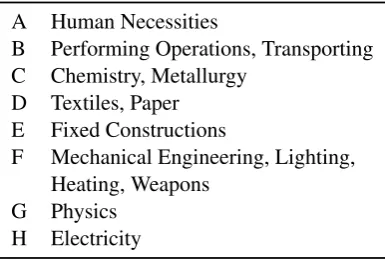
The International Patent Classification (IPC) categorizes patents hierarchically into 8 sections, 120 classes, 600 subclasses, down to 70,000 sub-groups at the leaf level. The eight top classes (called sections) are listed in Table 1.
Typically, a patent belongs to more than one section, with one section chosen as main classi-fication. Our development and test sets for each of the classes, A to H, comprise 2,000 sentences each, originating from a patent with the respec-tive class. These sets were built so that there is no overlap of development sets and test sets, and no overlap between sets of different classes. These eight test sets are referred to as independent test sets. Furthermore, we test on a combined set,
3http://www.cl.uni-heidelberg.de/ statnlpgroup/pattr
4https://github.com/redpony/cdec 5http://www.kyloo.net/software/doku. php/mgiza:overview
6http://www.statmt.org/moses/?n=Moses. SupportTools
7http://kheafield.com/code/kenlm/ estimation/
A Human Necessities
B Performing Operations, Transporting C Chemistry, Metallurgy
D Textiles, Paper E Fixed Constructions
F Mechanical Engineering, Lighting, Heating, Weapons
[image:4.595.320.513.62.192.2]G Physics H Electricity
Table 1: IPC top levelsections.
calledpooled-cat, that is constructed by concate-nating the independent sets. Additionally we use twopooledsets for development and testing, each containing 2,000 sentences with all classes evenly represented.
Our tuning baseline is an implementation of hy-pergraph MERT (Kumar et al., 2009), directly op-timizing IBM BLEU4 (Papineni et al., 2002). Fur-thermore, we present a regularization baseline by applying`1 regularization with clipping (Carpen-ter, 2008; Tsuruoka et al., 2009) to the standard pairwise ranking perceptron. All pairwise ranking methods use a smoothed sentence-wise BLEU+1 score (Nakov et al., 2012) to create gold standard rankings. Our multi-task learning experiments are based on pairwise ranking perceptrons that differ in their objective, corresponding either to the orig-inalperceptronor to themargin-perceptron. Both versions of the perceptron are used forsingle-task tuning and multi-task tuning. In the multi-task setting, we compare three different methods for defining a task: “natural” tasks given byIPC sec-tions where each independent data set is consid-ered as task; “random” tasks, defined bysharding where data is shuffled and split once, tasks are kept fixed throughout, and byreshardingwhere after an epoch data is shuffled and new random tasks are constructed. In all cases a task/shard is defined to contain 2,000 sentences8, resulting in eight shards
for each setting. The number of features selected after each epoch was set toK= 100,000.
For all perceptron runs, the following meta pa-rameters were fixed: A cube pruning pop limit of 200 and non-terminal span limit of 15; 100-best lists with unique entries; constant learning rate; multipartite pair selection. Single-task perceptron runs onindependent andpooledtasks were done
8This number is determined by the size of the original
single-task tuning indep.0 pooled1 pooled-cat2
pooled test – 51.18 51.22 A 54.92 0255.27 055.17
B 51.53 51.48 0151.69
C 1256.31 255.90 55.74
D 49.94 050.33 050.26
E 149.19 48.97 149.13
F 1251.26 51.02 51.12
G 149.61 49.44 49.55
H 49.38 49.50 0149.67
average test 51.52 51.49 51.54
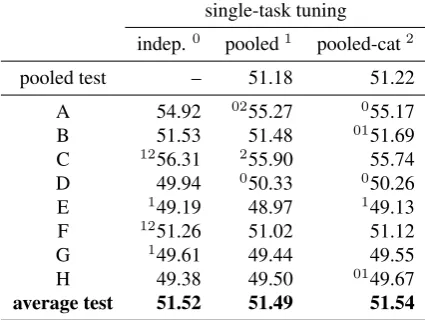
Table 2: BLEU4 results of MERT baseline using dense features for three different tuning sets: independent (sepa-rate tuning sets for each IPC class),pooledandpooled-cat (concatenated independentsets). Significant superior per-formance over other systems in the same row is denoted by prefixed numbers. The first row shows, e.g., that the result of pooled1 is significantly better than independent 0, and
pooled-cat2.
for 15 epochs; multi-task perceptron runs used 10 epochs. Single-task tuning onpooled-catdata increases computation time by a factor of eight which makes this setup infeasible in practice. For the sake of comparison we performed 10 epochs in this setup.
MERT (with default parameters) is used to op-timize the weights of 12 dense default features; eight translation model features, a word penalty, the passthrough weight, the language model (LM) score, and an LM out-of-vocabulary penalty. Per-ceptron training allows to add millions of sparse features which are directly derived from grammar rules: rule shape, rule identifier, bigrams in rule source and target. For a further explanation of these features see Simianer et al. (2012).
For testing we measured IBM BLEU4 on tok-enized and lowercased data. Significance results were obtained by approximate randomization tests using the approach of Clark et al. (2011)9 to
ac-count for optimizer instability. Tuning methods with a random component (MERT, randomized experiments) were repeated three times, scores re-ported in the tables are averaged over optimizer runs.
4.2 Experimental Results
In single-task tuning mode, systems are tuned on the eightindependentdata sets separately, the pooleddata set, and the independent data sets
con-9https://github.com/jhclark/multeval
single-task tuning
indep.0 pooled1 pooled-cat2
pooled test – 50.75 152.08
A 155.11 54.32 0155.94
B 152.61 50.84 152.57
C 56.18 56.11 0156.75
D 150.68 49.48 0151.22
E 150.27 48.69 150.01
F 151.68 50.71 151.95
G 149.90 49.06 0150.51
H 150.48 49.16 150.53
average test 52.11 51.05 52.44
[image:5.595.74.287.67.227.2]model size 430,092.5 457,428 1,574,259
Table 3: BLEU4 results for standardperceptron with`1
reg-ularizationbaseline using sparse rule features, tuned on in-dependent,pooledandpooled-catsets. Prefixed superscripts denote a significant improvement over the result in the same row indicated by the superscript.
catenated (pooled-cat). Testing is done on each of the eight IPC sections separately, and on apooled testset of 2,000 sentences where all sections are equally represented. Furthermore, we report aver-age testresults over runs for all independent data sets.
Results for the MERT baseline are shown in Table 2: Neither pooling nor concatenating inde-pendent sets leads to significant performance im-provements on all sets with averaged scores being nearly identical.
Evaluation results obtained with the standard perceptron algorithm (Table 4) show improve-ments over MERT insingle-task tuningmode. The gain onpooled-cat data shows that in contrast to MERT training on 12 dense features, discrimi-native training using large feature sets is able to benefit from large data sets. However, since the pooled-cat scenario increases computation time by a factor of 8, it is quite infeasible when used with large sets of sparse features. Single-task tun-ing on a small set of pooleddata seems to show overfitting behavior.
Table 3 shows evaluation results for a regular-ization baseline that applies`1regularization with clippingto the the single-task tuned standard per-ceptron in Table 4. We see gains in BLEU on in-dependent and pooled-cat tuning data, but not on the small pooled data set.
single-task tuning multi-task tuning
indep.0 pooled1 pooled-cat2 IPC3 sharding4 resharding5
pooled test – 51.33 1 51.77 1252.56 1252.54 1252.60
A 54.79 54.76 0155.31 01256.35 01256.22 01256.21
B 1252.45 51.30 152.19 01252.78 012352.98 01252.96
C 256.62 56.65 156.12 0124557.76 01257.30 01257.44
D 150.75 49.88 150.63 0124551.54 01251.33 01251.20
E 149.70 49.23 0149.92 01250.51 01250.52 01250.38
F 151.60 51.09 151.71 01252.28 01252.43 01252.32
G 149.50 49.06 0149.97 01250.84 01250.88 01250.74
H 149.77 49.50 0150.64 01251.16 01251.07 01251.10
average test 51.90 51.42 52.06 52.90 52.84 52.79
[image:6.595.102.498.63.246.2]model size 366,869.4 448,359 1,478,049 100,000 100,000 100,000
Table 4: BLEU4 results for standardperceptronalgorithm using sparse rule features, tuned in single-task mode onindependent, pooled, andpooled-catsets, and in multi-task mode on eight tasks taken fromIPCsections or by random(re)sharding. Prefixed superscripts denote a significant improvement over the result in the same row indicated by the superscript.
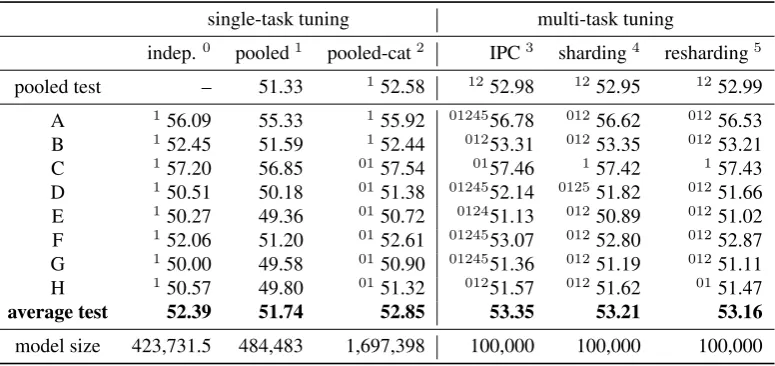
single-task tuning multi-task tuning
indep.0 pooled1 pooled-cat2 IPC3 sharding4 resharding5
pooled test – 51.33 152.58 1252.98 1252.95 1252.99
A 156.09 55.33 155.92 0124556.78 01256.62 01256.53
B 152.45 51.59 152.44 01253.31 01253.35 01253.21
C 157.20 56.85 0157.54 0157.46 157.42 157.43
D 150.51 50.18 0151.38 0124552.14 012551.82 01251.66
E 150.27 49.36 0150.72 012451.13 01250.89 01251.02
F 152.06 51.20 0152.61 0124553.07 01252.80 01252.87
G 150.00 49.58 0150.90 0124551.36 01251.19 01251.11
H 150.57 49.80 0151.32 01251.57 01251.62 0151.47
average test 52.39 51.74 52.85 53.35 53.21 53.16
model size 423,731.5 484,483 1,697,398 100,000 100,000 100,000
Table 5: BLEU4 results formargin-perceptronalgorithm using sparse rule features, tuned in single-task mode onindependent tasks, and in multi-task mode on eight tasks taken fromIPCsections or by random(re)sharding. Prefixed superscripts denote a significant improvement over the result in the same row indicated by the superscript.
single-task tuning on small data. We see improve-ments in BLEU over single-task tuning on small and large tuning data sets. Concerning our initial research questions, we see that the performance difference between “natural” tasks (IPC) and “ran-dom” tasks is not conclusive. However, multi-task learning using `1/`2 regularization consis-tently outperforms the standard perceptron under
`1 regularization as shown in Table 3 and MERT tuning as shown in Table 2.
Table 5 shows the evaluation results of the margin-perceptron algorithm. Evaluation results onsingle-task tuningshow that this algorithm im-proves over the standard perceptron (Table 4), even in its `1-regularized version (Table 3), on all tuning sets. Results for multi-task tuning
show improvements over the same scenario for the standard perceptron (Table 4). This means that the improvements due to the orthogonal regular-ization techniques in example space and feature space, namely large-margin learning and multi-task learning, add up. A comparison between single-task and multi-task tuning modes of the margin-perceptron shows a gain for the latter sce-narios. Differences between multi-task learning on IPC classes versus random sharding or re-shardingare again small, with the best overall re-sult obtained by multi-task learning of the margin-perceptron on IPC classes.
[image:6.595.106.494.297.480.2]to parallelization and due to iterative feature se-lection. As shown in the last rows of Tables 3-5 , the average size is around 400K features for inde-pendently tuned models and around 1.6M features for models tuned on pooled-cat data. In multi-task learning, models can be iteratively cut to 100K shared features whose weights are tuned in par-allel.
5 Conclusion
We presented an experimental investigation of the question whether the power of multi-task learning depends on data structured along tasks that exhibit a proper balance of shared and individual knowl-edge, or whether its inherent feature selection and regularization makes multi-task learning a widely applicable remedy against overfitting. We com-pared multi-task patent SMT for “natural” tasks of IPC sections and “random” tasks of shards in distributed learning. Both versions of multi-task learning yield significant improvements over in-dependent and pooled training, however, the dif-ference between “natural” and “random” tasks is marginal. This is an indication for the useful-ness of multi-task learning as a generic regulariza-tion tool. Considering also the efficiency gained by iterative feature selection, the`1/`2 regulariza-tion algorithm presented in Simianer et al. (2012) presents itself as an efficient and effective learning algorithm for general big data and sparse feature applications. Furthermore, the improvements by multi-task feature selection add up with improve-ments by large-margin learning, delivering overall improvements of nearly 2 BLEU points over the standard MERT baseline.
Our research question regarding the superiority of “natural” or “random” tasks was shown to be undetermined for the application of patent trans-lation. The obvious question for future work is if and how a task division can be found that improves multi-task learning over our current results. Such an investigation will have to explore various sim-ilarity metrics and clustering techniques for IPC sub-classes (W¨aschle and Riezler, 2012a), e.g., for the goal of optimizing clustering with respect to the ratio of between-cluster to within-cluster sim-ilarity for a given metric. However, the final crite-rion for the usefulness of a clustering is necessar-ily application specific (von Luxburg et al., 2012), in our case specific to patent translation perfor-mance. Nevertheless, we hope that the presented
and future work will prove useful and generaliz-able for related multi-task learning scenarios.
Acknowledgments
The research presented in this paper was supported in part by DFG grant “Cross-language Learning-to-Rank for Patent Retrieval”.
References
Leo Breiman. 1996. Bagging predictors. Machine Learning, 24:123–140.
Bob Carpenter. 2008. Lazy sparse stochastic gradient descent for regularized multinomial logistic regres-sion. Technical report, Alias-i.
Rich Caruana. 1997. Multitask learning. Journal of Machine Learning Research, 28.
Alexandru Ceaus¸u, John Tinsley, Jian Zhang, and Andy Way. 2011. Experiments on domain adaptation for patent machine translation in the PLuTO project. In
Proceedings of the 15th Conference of the European Association for Machine Translation (EAMT 2011), Leuven, Belgium.
Olivier Chapelle, Pannagadatta Shivaswamy, Srinivas Vadrevu, Kilian Weinberger, Ya Zhang, and Belle Tseng. 2011. Boosted multi-task learning.Machine Learning.
David Chiang. 2007. Hierarchical phrase-based trans-lation.Computational Linguistics, 33.
Jonathan Clark, Chris Dyer, Alon Lavie, and Noah Smith. 2011. Better hypothesis testing for statis-tical machine translation: Controlling for optimizer instability. InProceedings of the 49th Annual Meet-ing of the Association for Computational LMeet-inguistics (ACL’11), Portland, OR.
Ronan Collobert and Samy Bengio. 2004. Links be-tween perceptrons, MLPs, and SVMs. In Proceed-ings of the 21st International Conference on Ma-chine Learning (ICML’04), Banff, Canada.
Hal Daum´e. 2007. Frustratingly easy domain adap-tation. In Proceedings of the 45th Annual Meet-ing of the Association for Computational LMeet-inguistics (ACL’07), Prague, Czech Republic.
Mark Dredze, Alex Kulesza, and Koby Crammer. 2010. Multi-domain learning by confidence-weighted parameter combination. Machine Learn-ing, 79:123–149.
Chris Dyer, Adam Lopez, Juri Ganitkevitch, Johnathan Weese, Ferhan Ture, Phil Blunsom, Hendra Seti-awan, Vladimir Eidelman, and Philip Resnik. 2010. cdec: A decoder, alignment, and learning framework for finite-state and context-free translation models. InProceedings of the 48th Annual Meeting of the As-sociation for Computational Linguistics (ACL’10).
Theodoros Evgeniou and Massimiliano Pontil. 2004. Regularized multi-task learning. InProceedings of the 10th ACM SIGKDD conference on knowledge discovery and data mining (KDD’04), Seattle, WA.
Jenny Rose Finkel and Christopher D. Manning. 2009. Hierarchical Bayesian domain adaptation. In Pro-ceedings of the Conference of the North American Chapter of the Association for Computational Lin-guistics - Human Language Technologies (NAACL-HLT’09), Boulder, CO.
Kenneth Heafield. 2011. KenLM: faster and smaller language model queries. In Proceedings of the Sixth Workshop on Statistical Machine Translation (WMT’11), Edinburgh, UK.
Philipp Koehn and Kevin Knight. 2003. Empirical methods for compound splitting. InProceedings of the 10th conference on European chapter of the As-sociation for Computational Linguistics (EACL’03), Budapest, Hungary.
Shankar Kumar, Wolfgang Macherey, Chris Dyer, and Franz Och. 2009. Efficient minimum error rate training and minimum Bayes-risk decoding for translation hypergraphs and lattices. InProceedings of the 47th Annual Meeting of the Association for Computational Linguistics and the 4th IJCNLP of the AFNLP (ACL-IJCNLP’09, Suntec, Singapore.
Adam Lopez. 2007. Hierarchical phrase-based trans-lation with suffix arrays. InProceedings of EMNLP-CoNLL, Prague, Czech Republic.
Andr´e F. T. Martins, Noah A. Smith, Pedro M. Q. Aguiar, and M´ario A. T. Figueiredo. 2011. Struc-tured sparsity in strucStruc-tured prediction. In Proceed-ings of the 2011 Conference on Empirical Methods in Natural Language Processing, Edinburgh, Scot-land.
Ryan McDonald, Keith Hall, and Gideon Mann. 2010. Distributed training strategies for the structured per-ceptron. InProceedings of Human Language Tech-nologies: The 11th Annual Conference of the North American Chapter of the Association for Computa-tional Linguistics (NAACL-HLT’10), Los Angeles, CA.
Preslav Nakov, Francisco Guzm´an, and Stephan Vogel. 2012. Optimizing for sentence-level bleu+1 yields short translations. InProceedings of the 24th Inter-national Conference on Computational Linguistics (COLING 2012), Bombay, India.
Guillaume Obozinski, Ben Taskar, and Michael I. Jor-dan. 2010. Joint covariate selection and joint sub-space selection for multiple classification problems.
Statistics and Computing, 20:231–252.
Kishore Papineni, Salim Roukos, Todd Ward, and Wei-Jing Zhu. 2002. Bleu: a method for automatic eval-uation of machine translation. In Proceedings of the 40th Annual Meeting on Association for Com-putational Linguistics, ACL ’02, pages 311–318, Stroudsburg, PA, USA. Association for Computa-tional Linguistics.
Ariadna Quattoni, Xavier Carreras, Michael Collins, and Trevor Darrell. 2009. An efficient projec-tion for`1,∞regularization. InProceedings of the 26th International Conference on Machine Learning (ICML’09), Montreal, Canada.
Frank Rosenblatt. 1958. The perceptron: A probabilis-tic model for information storage and organization in the brain. Psychological Review, 65(6).
Libin Shen and Aravind K. Joshi. 2005. Ranking and reranking with perceptron. Journal of Machine Learning Research, 60(1-3):73–96.
Patrick Simianer, Stefan Riezler, and Chris Dyer. 2012. Joint feature selection in distributed stochas-tic learning for large-scale discriminative training in SMT. InProceedings of the 50th Annual Meeting of the Association for Computational Linguistics (ACL 2012), Jeju, Korea.
Linfeng Song, Haitao Mi, Yajuan L¨u, and Qun Liu. 2011. Bagging-based system combination for do-main adaptation. InProceedings of MT Summit XIII, Xiamen, China.
John Tinsley, Andy Way, and Paraic Sheridan. 2010. PLuTO: MT for online patent translation. In Pro-ceedings of the 9th Conference of the Association for Machine Translation in the Americas (AMTA 2010), Denver, CO.
Yoshimasa Tsuruoka, Jun’ichi Tsujii, and Sophia Ana-niadou. 2009. Stochastic gradient descent training for`1-regularized log-linear models with cumulative
penalty. In Proceedings of the 47th Annual Meet-ing of the Association for Computational LMeet-inguistics (ACL-IJCNLP’09), Singapore.
Masao Utiyama and Hitoshi Isahara. 2007. A Japanese-English patent parallel corpus. In Pro-ceedings of MT Summit XI, Copenhagen, Denmark.
Ulrike von Luxburg, Robert C. Williamson, and Is-abelle Guyon. 2012. Clustering: Science or art? InProceedings of the ICML 2011 Workshop on Un-supervised and Transfer Learning, Bellevue, WA.
Katharina W¨aschle and Stefan Riezler. 2012b. Struc-tural and topical dimensions in multi-task patent translation. InProceedings of the 13th Conference of the European Chapter of the Association for Com-putational Linguistics, Avignon, France.
Ming Yuan and Yi Lin. 2006. Model selection and estimation in regression with grouped variables.
J.R.Statist.Soc.B, 68(1):49–67.