Performance Evaluation of Complex Wavelet Packet
Modulation (CWPM) System over Multipath Rayleigh
Fading Channel
Hikmat N. Abdullah, Fadhil S. Hasan
Electrical Engineering Department, Al-Mustansiryah University, Baghdad, Iraq. Email: [email protected], [email protected]
Received April 5th, 2012; revised May 1st, 2012; accepted May 15th, 2012
ABSTRACT
In this paper a novel multicarrier modulation system called Complex Wavelet Packet Modulation (CWPM) has been proposed. It is based on using the Complex Wavelet Transform (CWT) together with the Wavelet Packet Modulation (WPM). The proposed system has been tested for communication over flat and frequency selective Rayleigh fading channels and its performance has been compared with some other multicarrier systems. The simulation results show that the performance of the proposed CWPM system has the best performance in all types of channel considered as com- pared with OFDM, Slantlet based OFDM, FRAT based OFDM and WPM systems. Furthermore, the proposed scheme has less PAPR as compared with the traditional WPM multicarrier system.
Keywords: Multicarrier Modulation; Wavelet Packet Modulation; Complex Wavelet Transform
1. Introduction
Multicarrier modulation (MCM) [1] based on the discrete Fourier transform (DFT) has been adopted as the modu- lation/demodulation scheme of choice in several digital communications standards. These include wire line sys- tems such as digital subscriber lines (DSL), wireless sys- tems such as digital audio and terrestrial video broadcast (DAB/DVB-T), local area networks such as IEEE 802.11a/g/n, and metropolitan area networks such as IEEE802.16a, where it is commonly known as orthogo- nal frequency-division multiplexing (OFDM).
In recent years different types of multicarrier modula- tion are produced like slantlet based OFDM [2], FRAT based OFDM [3,4] and wavelet based OFDM [5-8]. Wavelet packet Modulation (WPM) [9] is a carrierless that uses a filtering and defiltering technique to convey orthogonal multi-sub-band information from transmitter to receiver. WPM shares all the benefits of multicarrier technique and exhibits further benefit such as higher ef- ficiency due to elimination of guard interval (GI). It is considered as one of wavelet transforms which are well localized both in time and frequency domain, while si- nusoid waveforms are only localized in frequency but not in time domain. The wavelet and subband transform ap- plications in communications are viewed in [9]. Besides the features mentioned previously, WPM has additional attractive features inherited from the wavelet packet
modulation: the Wavelet Transform (WT) is widely adopted in image/video and speech coding. Its use for modulation/demodulation on frequency-selective chan- nels results in a better integrated system design and a reduced overall implementation cost. The WPT uses only real arithmetic, as opposed to the complex-valued DFT. This reduces the signal-processing complexity/power consumption, but it suffers from three major limitations: shift sensitivity, poor directionality, and absence of phase information. To solve these problems, Complex wavelet transform (CWT) [10] are proposed and applied in many signal processing applications especially in image proc- essing applications [11-13].
In this paper, the principles of CWT are applied to WPM in order to improve its performance introducing a novel multicarrier communication scheme called com- plex wavelet packet modulation (CWPM). The rest of the paper is arranged as follows: the next section reviews the discrete wavelet packet transform. Section 3 presents the proposed complex wavelet packet modulation system. Section 4 shows the simulation results while the con-clusions deduced through the work are given in Section 5.
2. Discrete Wavelet Packet Transform
(DWPT)
2
2
n h n h n k k
(2)
1n
g n h L n 1
k
(3)
where usually h(n) and g(n) are low-pass and high-pass filters, respectively, and L is the span of the filters. The QMFs h(n) and g(n) are recursively used to define the sequence of basis functions φn(t), called wavelet packets as follows:
2n t k zh k n 2t
(4)
2n1 t k zg k 2t
n k
(5)Wavelet packets have the following orthogonality pro- perties:
,
n t j n t k j k
(6)
2n t j , 2n1 t k
0 (7)
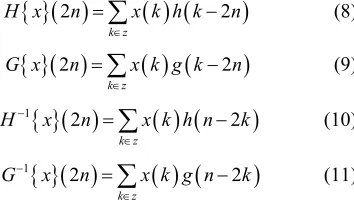
where .,. is the inner product of functions and δ(.) is the delta function. Based on h(n) and g(n), and the cor- responding reversed filters h(−n) and g(−n), four opera- tors (H−1, G−1, H and G) are defined that can be used to construct a wavelet packet tree. H and G are the down- sampling convolution operators and H−1 and G−1 are up- sampling deconvolution operators. The four operators acting on the sequence of samples x(n) are defined as follows [12]:
2
2
k z
H x n x k h k n
(8)
2
2
k z
G x n x k g k n
(9)
1 2 2
k z
H x n x k h n k
(10)
1 2 2
k z
G x n x k g n k
[image:2.595.309.536.390.516.2] [image:2.595.109.286.510.610.2]
(11)Figure 1 shows the construction of these operators. The operators H and G can be used to decompose (ana- lyze) any discrete function x(n) on the space l2(z) into two orthogonal subspaces l2(z). Each decomposition (H or G) step results in two coefficient vectors each half the length of the input vector keeping the total length of data unchanged. This operation can be iterated by cascading the operators for multiple numbers of steps. In this itera- tive decomposition procedure, the output coefficient vectors have size reduced at each step by 2 so that even-
the original input vector from the coefficients vectors. The IDWPT is a series of upsampling filtering processes defined by the operators H−1 and G−1. Figure 2 shows a full DWPT tree (on the left side) and a full IDWPT tree (on the right side) which are used in the WPM system for demodulation and modulation, respectively.
3. Complex Wavelet Packet Modulation
(CWPM)
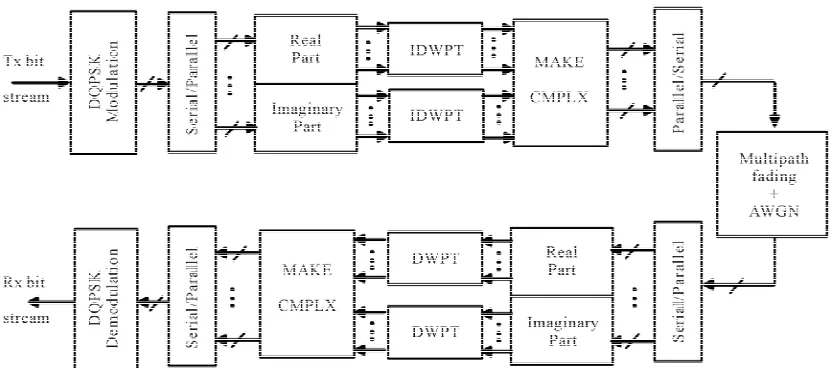
[image:2.595.309.537.556.707.2]Figure 3 illustrates the block diagram of proposed CWPM transceiver. CWPM system employs two filter banks performs Inverse Discrete Wavelet Packet Transform (IDWPT) placed at transmitter side, and Discrete Wave- let Packet Transform (DWPT) placed at the receiver side. The block “MAKE CMPLX” accepts two N-dimensional real vectors as inputs. Its output is an N-dimensional complex vector whose ith complex element is formed from the ith real elements of the two input vectors. The
Figure 1. Example of a figure caption analysis and synthesis filters using H, G, H−1, G−1 operators.
Figure 2. Wavelet packet trees: analysis/DWPT (demodula- ion) and synthesis/IDWPT (modulation).
Figure 3. Block diagram of CWPM system (arrows with astrike indicate complex quantities).
input to the inverse wavelet transform is DQPSK com- plex symbols, therefore, there are two IDWPT blocks, one for real symbols and the other for imaginary symbols. The outputs of two IDWPT are combined together in complex form to introduce the transmitted signal x[n]. The transmitted signal is constructed as the sum of N
waveforms φj[k] individually modulated with the DQPSK symbols as follows:
1 ,
1 ,
0 0
N N
k j j k j j
k j j
x n a n kN i b n k
N (12)
where ak,j, bk,j are the real and the imaginary constella- tions of the encoded kth data symbol modulating the jth wavelet packet basis function respectively. The IDWPT synthesizes a discrete representation of the transmitted signal as the sum of N waveforms shifted in time that embed information about the data symbols. The DWPT at the receiver recovers the transmitted symbols ak,j, bk,j through the analysis formula exploiting orthogonality properties of DWPT and is schematically represented in the right side of Figure 2.
4. Simulation Results
The performance results of the proposed CWPM system are obtained using MATLAB. These results are com- pared WPM, traditional OFDM (FFT based OFDM), Slantlet based OFDM and FRAT-OFDM systems over different channel models: the AWGN channel, the flat Rayleigh fading channel, and the frequency selective Rayleigh fading channel. OFDM is cyclically extended with guard sample 0.25 N and the number of carriers is taken to be 128. The type of wavelet family used was db6. For fading channels, two paths for the signal are considered. The second path delay was 8 Ts with a cor-
responding gain of −8 dB, where Ts is the sampling time. The Doppler spread factor (fdTs) is changed during the simulations to take one of the following values: 0.0025, 0.0075 and 0.015.
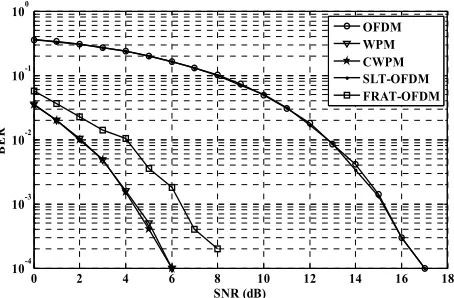
Figure 4 shows the performance of the proposed CWPM system in AWGN channel as compared with other systems mentioned above. It’s clearly shown that the proposed CWPM system has almost the same per- formance of WPM system but better than OFDM sys- tems. For instant at BER = 10−3, CWPM has about 2 dB gain in SNR over FRAT-OFDM system while it has about 11 dB gain over OFDM and SLT-OFDM systems.
Figures 5-7 show the performance of proposed CWPM system as compared with other types of multi- carrier modulation considered over flat Rayleigh fading channel for Doppler spread factors fdTs = 0.0025, 0.0075, and 0.015 respectively. From these figures, it can be seen
0 2 4 6 8 10 12 14 16 18 10-4
10-3 10-2 10-1 100
SNR (dB)
BER
OFDM WPM CWPM SLT-OFDM FRAT-OFDM
0 2 4 6 8 10 12 14 16 18 10-4
10-3 10-2
SNR (dB)
BE
[image:4.595.60.287.98.247.2]R
Figure 5. BER performance of CWPM in flat fading chan- nel, fdTs = 0.0025.
0 2 4 6 8 10 12 14 16 18 10-4
10-3 10-2 10-1 100
SNR (dB)
BE
R
[image:4.595.61.287.291.476.2]OFDM WPM CWPM SLT-OFDM FRAT-OFDM
Figure 6. BER performance of CWPM in flat fading chan- nel, fdTs = 0.0075.
0 2 4 6 8 10 12 14 16 18 10-4
10-3 10-2 10-1 100
SNR (dB)
BE
R
OFDM WPM CWPM SLT-OFDM FRAT-OFDM
Figure 7. BER performance of CWPM in flat fading chan- nel, fdTs = 0.015.
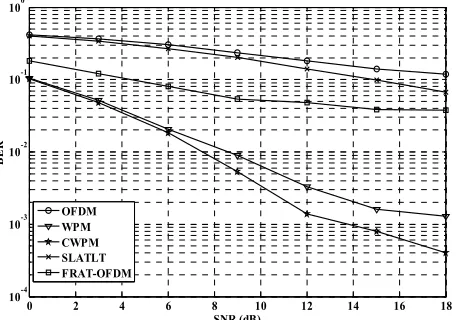
Figures 8-10 show the performance of proposed CWPM system as compared with other types of multi- carrier modulation considered over selective Rayleigh fading channel for Doppler spread factors fdTs= 0.0025, 0.0075, and 0.015 respectively. Once again the perform- ance of the proposed system is superior than other ones including WPM different Doppler spread factors. For example, at BER = 10−3 CWPM has about 3 dB gain in SNR over WPM system when fdTs = 0.015 while other OFDM systems fail to achieve such a BER value at mo- derate SNR values.
4.1. The Effect of Wavelet Family
Three wavelet packets from three different families are used for this simulation namely Daubechies wavelet packets with order 6, db6, Symmlets wavelet packets with order 6 (sym6), and Coiflets wavelet packets with order 2, (coif2). These families are chosen because they are orthogonal and have compact support (i.e., fast de- caying time, which results in good localization in both time and frequency). The filter length is taken to be L = 12. Figure 11 shows BER versus SNR for these three wavelet families for CWPM system for N = 128 over selective Rayleigh fading channel with Doppler spread factor fdTs = 0.015. From this figure, it’s shown that Daubechies family gives the best BER performance.
[image:4.595.61.287.520.707.2]4.2. The Effect of Filter Length
Figure 12 shows the BER performance of CWPM over selective fading channel with fdTs = 0.015 for three wave- let packets from Daubechies family, namely Haar, db3, db6, db9 and db12 which have filter lengths, L = 2, 6, 12, 18 and 24 respectively. From this figure, it is shown that the increase of the filter length would enhance the BER performance. However, it is worth noted that as the filter length increases the data rate would be decreased. So, the selection of filter length should take in to account the necessary optimization process.
4.3. The Effect of Subcarrier Number
0 2 4 6 8 10 12 14 16 18 10-4
10-3 10-2 10-1 100
SNR (dB)
BE
R
[image:5.595.61.288.94.283.2]OFDM WPM CWPM SLT-OFDM FRAT-OFDM
Figure 8. BER performance of CWPM in selective fading channel, fdTs = 0.0025.
0 2 4 6 8 10 12 14 16 18 10-4
10-3 10-2 10-1 100
SNR (dB)
BER
[image:5.595.311.539.98.277.2]OFDM WPM CWPM SLT-OFDM FRAT-OFDM
Figure 9. BER performance of CWPM in selective fading channel, fdTs = 0.0075.
0 2 4 6 8 10 12 14 16 18 10-4
10-3 10-2 10-1 100
SNR (dB)
BE
R
OFDM WPM CWPM SLATLT FRAT-OFDM
Figure 10. BER performance of CWPM in selective fading channel, fdTs = 0.015.
0 2 4 6 8 10 12 14 16 18 10-4
10-3 10-2 10-1 100
SNR (dB)
BE
R
db6, L=12 sym6, L=12 coif2, L=12
Figure 11. Effect of wavelet family on the BER perform- ance.
0 2 4 6 8 10 12 14 16 18 10-4
10-3 10-2 10-1 100
SNR (dB)
BER
[image:5.595.310.539.322.480.2]N=64 N=128 N=256 N=512
Figure 12. Effect of filter length on the BER performance.
0 2 4 6 8 10 12 14 16 18 10-4
10-3 10-2 10-1 100
SNR (dB)
BER
[image:5.595.61.288.326.502.2]N=64 N=128 N=256 N=512
Figure 13. Effect of filter length on the BER performance.
[image:5.595.312.537.505.673.2]4.4. PAPR Results
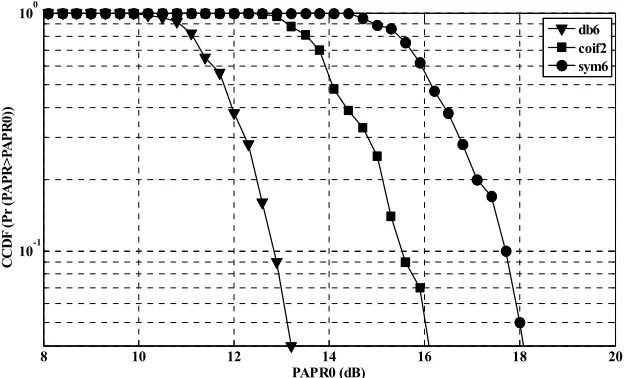
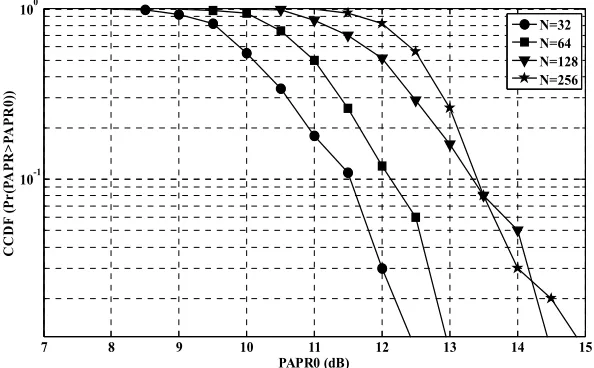
[image:5.595.60.288.546.706.2]ures 15 and 16 show the CCDF of the PAPR of the pro-posed CWPM system after applying several wavelet families have the same filter length, L = 12 and various filter lengths of the Daubechies wavelet family respec-tively. All the configurations are taken to have 128 carri-ers. From these figures, one can easily see that Daube-chies has the least PAPR as compared with other families and that the increase the filter length will increase PAPR of CWPM system. Finally, Figure 17 shows the CCDF of the PAPR of CWPM system for different number of subcarriers. From this figure, it is shown than the in- crease of subcarrier numbers will increase the PAPR of the system.
CWPM is an efficient multicarrier scheme when working in flat and frequency selective Rayleigh fading channels. In AWGN channel, CWPM has almost the same per- formance of WPM scheme. The Change of wavelet fa- mily type and filter length and the number of subcarriers used in CWPM will effect on its BER performance. Daubechies family gives the best performance and as the filter length increases the performance is improved. The effect of changing the subcarriers is as this number is increased the performance of CWPM tends to be de- graded. CCDF has been used as a measure of PAPR effect in CWPM as the case in other MC systems. It has been
6 8 10 12 14 16 18
10-1 100
PAPR0 (dB)
C
CDF
(
P
r
(P
AP
R>
PAP
R
0)
)
[image:6.595.143.452.328.493.2]OFDM Theory CWPM WPM
Figure 14. CCDF of the PAPR of CWPM and other MC systems.
8 10 12 14 16 18 20
10-1 100
PAPR0 (dB)
CC
DF
(P
r
(P
A
P
R
>P
AP
R0
))
db6 coif2 sym6
[image:6.595.142.456.527.716.2]8 9 10 11 12 13 14 15 16 10-1
100
PAPR0(dB)
CCD
F
(
P
r (
PAP
R>
PA
P
R
0)
)
[image:7.595.152.448.99.272.2]haar db3 db6 db9 db12
Figure 16. CCDF of PAPR for the CWPM and other MC systems for different filter lengths of Daubechies family.
7 8 9 10 11 12 13 14 15
10-1 100
PAPR0 (dB)
CC
DF
(
P
r(
PA
P
R
>
PA
P
R
0)
)
N=32 N=64 N=128 N=256
Figure 17. CCDF of PAPR for the CWPM and other MC systems for different number of subcarriers.
shown that the PAPR of CWPM is greater than OFDM and but less than WPM system. The type of wavelet fa- mily and filter length has also impact on PAPR. Daube- chies gives the least PAPR among families considered in the study.
REFERENCES
[1] J. Bingham, “Multicarrier Modulation for Data Transmis-sion: An Idea Whose Time Has Come,” IEEE
Communi-cations Magazine, Vol. 28, No. 5, 1990, pp. 5-14.
doi:10.1109/35.54342
[2] S. A. K. Ali, “Design and Implementation of Slantlet Based Polynomial Cancellation Coding-OFDM System Using FPGA,” M.Sc. Thesis, Mustansiriya University, Baghdad, 2009.
[3] A. H. Kattoush, W. A. Mahmoud, A. Shaheen and A. Ghodayyah, “The Performance of Proposed One Dimen-sional Serial Radon Based OFDM System under Different
Channel Conditions,” International Journal of Computers,
Systems and Signals, Vol. 9, No. 2, 2008, pp. 3-16.
[4] A. H. Kattoush, W. A. M. Al-Jawher, S. M. Abbas and A. T. Shaheen, “A N-Radon Based OFDM Transceivers De-sign and Performance Simulation over Different Channel Models,” Wireless Personal Communications, Vol. 58, No. 4, 2011, pp. 695-711.
doi:10.1007/s11277-009-9902-1
[5] M. J. Manglani, “Wavelet Modulation in Gaussian and Rayleigh Fading Channels,” M.Sc. Thesis, Virginia Poly-technic Institute and State University, Blacksburg, 2001. [6] A. Jamin and P. Mahonen, “Wavelet Packet Modulation
for Wireless Communication,” Wireless Communications
and Mobile Computing Journal, Vol. 5, No. 2, 2005, pp.
123-137.
[image:7.595.148.445.304.488.2]“Waveled and Subband Transforms: Fundamentals and Communication Applications,” IEEE Communications Ma-
gazine, Vol. 35, No. 12, 1997, pp. 104-115.
doi:10.1109/35.642839
[10] P. D. Shukla, “Complex Wavelet Transform and Their Applications,” M.Phil., University of Strathclyde, Glas-gow, 2003.
[11] H. N. Abdullah, S. A. Jabir and A. N. Mohammed, “Complex Discrete Wavelet Transform-Based Image
[13] P.-L. Shui, Z.-F. Zhou and J.-X. Li, “Image Denoising Algorithm via Best Wavelet Packet Base Using Wiener Cost Function,” IET Image Processing Magazine, Vol. 1, No. 3, 2007, pp. 311-318. doi:10.1049/iet-ipr:20060222 [14] M. Baro and J. Ilow, “PAPR Reduction in Wavelet
Packet Modulation Using Tree Pruning,” Vehicular Tech-
nology Conference VTC2007-Spring, Dublin, 22-24 April