
z
RESEARCH ARTICLE
KINETICS AND MECHANISTIC STUDY OF OXIDATION OF NICOTINAMIDE BY BROMAMINE-T IN
HYDROCHLORIC ACID MEDIUM CATALYZED BY Ru(III) ION
*1
Chandrashekar,
2Radhika R. T.,
3Venkatesha, B. M. and
4Ananda, S.
1
Department of Chemistry, PES College of Engineering Mandya-571401, India
2Department of Chemistry Maharani’s Science College for Women, Mysore, India
3Department of Chemistry, Yuvaraja´s College, University of Mysore, Mysore - 570005, India
4Department of Studies in Chemistry, Manasagangothri, University of Mysore-570006, India
ARTICLE INFO ABSTRACT
Oxidation of nicotinamide by bromamine-T (BAT) have been studied in HCl medium catalyzed by Ru(III) at 303K. The reaction rate shows first order dependence on (oxidant), (Ru(III)), inverse fractional order on (H+) and fractional order on (nicotinamide). Addition of halide ions and the
reduction product of BAT, p-toluenesulphonamide and dielectric constant of the medium do not have any significant effect on the reaction rate. The reaction was studied at different temperatures and activation parameters were evaluated. Mechanisms proposed and the derived rate law is consistent with the observed kinetics.
Copyright © Chandrashekar et al. This is an open access article distributed under the Creative Commons Attribution License, which permits unrestricted use, distribution, and reproduction in any medium, provided the original work is properly cited.
INTRODUCTION
Nicotinamide is the amide of nicotinic acid (vitamin-B3). It is a
water soluble vitamin and is part of the vitamin B group. Nicotinamide is produced from niacin in human beings. Niacin is converted to nicotinamide when it is taken in amount greater than what is needed by the body. Nicotinamide acts as anti-inflammatory (Niven 2006), anxiolytic (anti-anxiety) agent (Tallman et al., 1980) and also acts as a chemo and radio sensitizing agent by enhancing tumor blood flow, there by reducing tumour hypoxia. Nicotinamide is an activator of sirtuins but it inhibits at higher doses. Nicotinamide and isonicotinamide were oxidized using permanganate ion in acidic medium by Sharma et al. (2008). L Avigliano et al. (1986) have reported the oxidation of nicotinamide coenzyme dimers by one electron-accepting protein. Mohammed et al. (1986) have reported kinetics of the oxidation of reduced nicotinamide adenine dinucleotide by horse radish peroxidase. However a very few kinetic investigation of nicotinamide have been reported. There are no informations available on the oxidation by haloamines. The present studies were undertaken to investigate the kinetic aspects of oxidation of nicotinamide by bromamine-T. Mechanistic studies of the oxidation of diverse organic substrates by these organic haloamines have been reported previously (Venkatesha et al., 1992; Venkatesha
*Corresponding author: Chandrashekar
Department of Chemistry, PES College of Engineering Mandya-571401, India.
et al., 1995; Saldana et al., 2002). We now report a detailed
investigation of the kinetics of oxidation of nicotinamide by bromamine-T in acid solution catalysed by Ru(III) at 303K.
Experimental
Bromamine-T (BAT, p-CH3C6H4SO2NBrNa) was prepared by
standard procedure and its purity was checked iodometrically and through UV, IR and 13C NMR spectral data (Nair and Indrasenan 1976; Ahmed et al., 1980). Aqueous solution of BAT was prepared, standardized by the iodometric method and preserved in amber colored bottle. Aqueous solution of nicotinamide was prepared using triply distilled water. All other chemicals were of analytical grade. Triply distilled water was used for preparing aqueous solutions.
Kinetic Measurements
Mixtures containing requisite amounts of substrate, NaClO4,
Ru(III) and HCl were equilibrated at 303K. To this was added a measured amount of pre-equilibrated aqueous solution of BAT of known concentration. The progress of the reaction was monitored iodometrically for two half lives by withdrawing aliquots of the reaction mixture at regular time intervals. The pseudo first order rate constants calculated were reproducible with ± 3%. Regression analysis of experimental data was carried out on origin 5.0 HP computer to obtain regression coefficient.
ISSN: 0975-833X
Available online at http://www.journalcra.com
International Journal of Current Research
Vol. 6, Issue, 01, pp.4567-4571, January, 2014
INTERNATIONAL JOURNAL OF CURRENT RESEARCH
Article History:
Received 05thSeptember, 2013
Received in revised form 26thSeptember, 2013
Accepted 19thDecember, 2013
Published online 26thJanuary, 2014
Key words:
Oxidation, Kinetics, Nicotinamide, Bromamine-T, Ru(III) catalyst.
z
RESEARCH ARTICLE
KINETICS AND MECHANISTIC STUDY OF OXIDATION OF NICOTINAMIDE BY BROMAMINE-T IN
HYDROCHLORIC ACID MEDIUM CATALYZED BY Ru(III) ION
*1
Chandrashekar,
2Radhika R. T.,
3Venkatesha, B. M. and
4Ananda, S.
1
Department of Chemistry, PES College of Engineering Mandya-571401, India
2Department of Chemistry Maharani’s Science College for Women, Mysore, India
3Department of Chemistry, Yuvaraja´s College, University of Mysore, Mysore - 570005, India
4Department of Studies in Chemistry, Manasagangothri, University of Mysore-570006, India
ARTICLE INFO ABSTRACT
Oxidation of nicotinamide by bromamine-T (BAT) have been studied in HCl medium catalyzed by Ru(III) at 303K. The reaction rate shows first order dependence on (oxidant), (Ru(III)), inverse fractional order on (H+) and fractional order on (nicotinamide). Addition of halide ions and the
reduction product of BAT, p-toluenesulphonamide and dielectric constant of the medium do not have any significant effect on the reaction rate. The reaction was studied at different temperatures and activation parameters were evaluated. Mechanisms proposed and the derived rate law is consistent with the observed kinetics.
Copyright © Chandrashekar et al. This is an open access article distributed under the Creative Commons Attribution License, which permits unrestricted use, distribution, and reproduction in any medium, provided the original work is properly cited.
INTRODUCTION
Nicotinamide is the amide of nicotinic acid (vitamin-B3). It is a
water soluble vitamin and is part of the vitamin B group. Nicotinamide is produced from niacin in human beings. Niacin is converted to nicotinamide when it is taken in amount greater than what is needed by the body. Nicotinamide acts as anti-inflammatory (Niven 2006), anxiolytic (anti-anxiety) agent (Tallman et al., 1980) and also acts as a chemo and radio sensitizing agent by enhancing tumor blood flow, there by reducing tumour hypoxia. Nicotinamide is an activator of sirtuins but it inhibits at higher doses. Nicotinamide and isonicotinamide were oxidized using permanganate ion in acidic medium by Sharma et al. (2008). L Avigliano et al. (1986) have reported the oxidation of nicotinamide coenzyme dimers by one electron-accepting protein. Mohammed et al. (1986) have reported kinetics of the oxidation of reduced nicotinamide adenine dinucleotide by horse radish peroxidase. However a very few kinetic investigation of nicotinamide have been reported. There are no informations available on the oxidation by haloamines. The present studies were undertaken to investigate the kinetic aspects of oxidation of nicotinamide by bromamine-T. Mechanistic studies of the oxidation of diverse organic substrates by these organic haloamines have been reported previously (Venkatesha et al., 1992; Venkatesha
*Corresponding author: Chandrashekar
Department of Chemistry, PES College of Engineering Mandya-571401, India.
et al., 1995; Saldana et al., 2002). We now report a detailed
investigation of the kinetics of oxidation of nicotinamide by bromamine-T in acid solution catalysed by Ru(III) at 303K.
Experimental
Bromamine-T (BAT, p-CH3C6H4SO2NBrNa) was prepared by
standard procedure and its purity was checked iodometrically and through UV, IR and 13C NMR spectral data (Nair and Indrasenan 1976; Ahmed et al., 1980). Aqueous solution of BAT was prepared, standardized by the iodometric method and preserved in amber colored bottle. Aqueous solution of nicotinamide was prepared using triply distilled water. All other chemicals were of analytical grade. Triply distilled water was used for preparing aqueous solutions.
Kinetic Measurements
Mixtures containing requisite amounts of substrate, NaClO4,
Ru(III) and HCl were equilibrated at 303K. To this was added a measured amount of pre-equilibrated aqueous solution of BAT of known concentration. The progress of the reaction was monitored iodometrically for two half lives by withdrawing aliquots of the reaction mixture at regular time intervals. The pseudo first order rate constants calculated were reproducible with ± 3%. Regression analysis of experimental data was carried out on origin 5.0 HP computer to obtain regression coefficient.
ISSN: 0975-833X
Available online at http://www.journalcra.com
International Journal of Current Research
Vol. 6, Issue, 01, pp.4567-4571, January, 2014
INTERNATIONAL JOURNAL OF CURRENT RESEARCH
Article History:
Received 05thSeptember, 2013
Received in revised form 26thSeptember, 2013
Accepted 19thDecember, 2013
Published online 26thJanuary, 2014
Key words:
Oxidation, Kinetics, Nicotinamide, Bromamine-T, Ru(III) catalyst.
z
RESEARCH ARTICLE
KINETICS AND MECHANISTIC STUDY OF OXIDATION OF NICOTINAMIDE BY BROMAMINE-T IN
HYDROCHLORIC ACID MEDIUM CATALYZED BY Ru(III) ION
*1
Chandrashekar,
2Radhika R. T.,
3Venkatesha, B. M. and
4Ananda, S.
1
Department of Chemistry, PES College of Engineering Mandya-571401, India
2Department of Chemistry Maharani’s Science College for Women, Mysore, India
3Department of Chemistry, Yuvaraja´s College, University of Mysore, Mysore - 570005, India
4Department of Studies in Chemistry, Manasagangothri, University of Mysore-570006, India
ARTICLE INFO ABSTRACT
Oxidation of nicotinamide by bromamine-T (BAT) have been studied in HCl medium catalyzed by Ru(III) at 303K. The reaction rate shows first order dependence on (oxidant), (Ru(III)), inverse fractional order on (H+) and fractional order on (nicotinamide). Addition of halide ions and the
reduction product of BAT, p-toluenesulphonamide and dielectric constant of the medium do not have any significant effect on the reaction rate. The reaction was studied at different temperatures and activation parameters were evaluated. Mechanisms proposed and the derived rate law is consistent with the observed kinetics.
Copyright © Chandrashekar et al. This is an open access article distributed under the Creative Commons Attribution License, which permits unrestricted use, distribution, and reproduction in any medium, provided the original work is properly cited.
INTRODUCTION
Nicotinamide is the amide of nicotinic acid (vitamin-B3). It is a
water soluble vitamin and is part of the vitamin B group. Nicotinamide is produced from niacin in human beings. Niacin is converted to nicotinamide when it is taken in amount greater than what is needed by the body. Nicotinamide acts as anti-inflammatory (Niven 2006), anxiolytic (anti-anxiety) agent (Tallman et al., 1980) and also acts as a chemo and radio sensitizing agent by enhancing tumor blood flow, there by reducing tumour hypoxia. Nicotinamide is an activator of sirtuins but it inhibits at higher doses. Nicotinamide and isonicotinamide were oxidized using permanganate ion in acidic medium by Sharma et al. (2008). L Avigliano et al. (1986) have reported the oxidation of nicotinamide coenzyme dimers by one electron-accepting protein. Mohammed et al. (1986) have reported kinetics of the oxidation of reduced nicotinamide adenine dinucleotide by horse radish peroxidase. However a very few kinetic investigation of nicotinamide have been reported. There are no informations available on the oxidation by haloamines. The present studies were undertaken to investigate the kinetic aspects of oxidation of nicotinamide by bromamine-T. Mechanistic studies of the oxidation of diverse organic substrates by these organic haloamines have been reported previously (Venkatesha et al., 1992; Venkatesha
*Corresponding author: Chandrashekar
Department of Chemistry, PES College of Engineering Mandya-571401, India.
et al., 1995; Saldana et al., 2002). We now report a detailed
investigation of the kinetics of oxidation of nicotinamide by bromamine-T in acid solution catalysed by Ru(III) at 303K.
Experimental
Bromamine-T (BAT, p-CH3C6H4SO2NBrNa) was prepared by
standard procedure and its purity was checked iodometrically and through UV, IR and 13C NMR spectral data (Nair and Indrasenan 1976; Ahmed et al., 1980). Aqueous solution of BAT was prepared, standardized by the iodometric method and preserved in amber colored bottle. Aqueous solution of nicotinamide was prepared using triply distilled water. All other chemicals were of analytical grade. Triply distilled water was used for preparing aqueous solutions.
Kinetic Measurements
Mixtures containing requisite amounts of substrate, NaClO4,
Ru(III) and HCl were equilibrated at 303K. To this was added a measured amount of pre-equilibrated aqueous solution of BAT of known concentration. The progress of the reaction was monitored iodometrically for two half lives by withdrawing aliquots of the reaction mixture at regular time intervals. The pseudo first order rate constants calculated were reproducible with ± 3%. Regression analysis of experimental data was carried out on origin 5.0 HP computer to obtain regression coefficient.
ISSN: 0975-833X
Available online at http://www.journalcra.com
International Journal of Current Research
Vol. 6, Issue, 01, pp.4567-4571, January, 2014
INTERNATIONAL JOURNAL OF CURRENT RESEARCH
Article History:
Received 05thSeptember, 2013
Received in revised form 26thSeptember, 2013
Accepted 19thDecember, 2013
Published online 26thJanuary, 2014
Key words:
Stoichiometry
Investigations under the conditions [BAT] >> [Substrate] revealed that one mole of BAT was consumed by one mole of substrate. The stoichiometry of oxidation is illustrated as in equation (1)
C6H6N2O + ArSO2NBrNa + H2O C6H6N2O2+ Na+
N.Amide BAT
+ Br-+ ArSO2NH2 … (1)
[image:2.595.44.291.257.503.2]The presence of 6-hydroxy nicotinamide which is the oxidation product of nicotinamide in the reaction mixture was detected by LCMS mass spectra (Figure 1).
Figure 1. GC-Mass Spectra of 6-hydroxy nicotinamide with molecular peak (133)
Product analysis
[image:2.595.301.563.282.407.2]The reaction mixture in the stoichiometric ratio in the presence of acid medium catalysis by ruthenium chloride was allowed to progress for 24 hours at 303K. After completion of the reaction (monitored by TLC), the reaction mixture was neutralized and the products were extracted with ether. The organic products were subjected to spot tests and chromatographic analysis (TLC method). The product was 6-hydroxy nicotinamide. For example, the GC-MS data for nicotinamide obtained on a 17A Shimadzu gas chromatograph with LCMS-2010A Shimadzu mass spectrometer showed a molecular ion peak at 133 amu (Figure.1) clearly confirming the formation of 6-hydroxy nicotinamide. The reaction product, toluenesulphonamide (ArSO2NH2) was detected by paper chromatography
(Mahadevappa and Gowda 1975). Benzyl alcohol saturated with water was used as the solvent with 0.5% vanillin in 1% HCl in ethanol as spray reagent (Rf= 0.905).
RESULTS
Effect of reactant concentration on the rate
Under the conditions [substrate] >> [BAT]0, plots of log [titre
[image:2.595.351.514.582.661.2]value] versus time are linear (r = 0.9943) indicating a first order dependence of rate on [oxidant]. The pseudo first order rate constants k´ are given in Table 1. The values of k´ remain unaffected with a change in [BAT] confirming the first order dependence on [BAT]. The rate increased with increase in [nicotinamide] (Table 1) and plot of log k´ versus log [nicotinamide] was linear with fractional slopes indicating the fractional order dependence of rate on [nicotinamide].
Table 1. Effect of varying reactant concentration on the rate
[HCl] = 24.0 × 10⁻⁴mol dm-3, [Ru(III)] = 1.243× 10⁻⁶mol dm-3, µ = 0.2 mol
dm-3; T = 303K
Effect of [HCl] on the rate
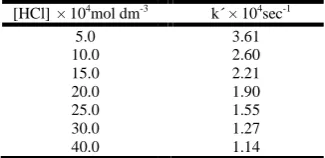
The reaction was studied with varying [HCl] at constant [BAT], [Nicotinamide], [Ru(III)], ionic strength and temperature. The rate of reaction decreased with increase in [HCl] (r = 0.9915). The plot of log k´ versus log [HCl] was linear with negative slope equal to less than unity indicating inverse fractional order in [HCl] Table 2.
Table 2. Effect of varying [HCl] on the rate
[Nicotinamide]0 = 2.0 × 10⁻³ mol dm-3, [BAT] = 2.0 × 10⁻⁴ mol dm-3,
[Ru(III)] = 1.243× 10⁻⁶mol dm-3, µ = 0.2 mol dm-3, T = 303K.
[HCl] × 104mol dm-3 k´ × 104sec-1 5.0 10.0 15.0 20.0 25.0 30.0 40.0 3.61 2.60 2.21 1.90 1.55 1.27 1.14
Effect of [H+] on the rate
At constant [BAT], [nicotinamide] and [Cl-], the rate of reaction decreased with increase in [H+] (r = 0.9966). The plot of log k´ versus log [H+] was linear with negative slope equal to less than unity (-0.51) indicating an inverse fractional order in [H+].
[BAT] x 104 mol dm-3 103[Nicotinamide] mol dm-3 104k´ (s-1)
1.15 1.61 2.00 2.53 2.99 2.00 2.00 2.00 2.00 2.00 2.00 2.00 2.00 2.00 2.00 2.00 2.00 1.00 1.50 2.00 3.00 4.00 5.00 6.00 3.93 3.79 3.30 3.40 3.42 2.42 2.81 3.32 4.08 4.78 5.30 5.75 Stoichiometry
Investigations under the conditions [BAT] >> [Substrate] revealed that one mole of BAT was consumed by one mole of substrate. The stoichiometry of oxidation is illustrated as in equation (1)
C6H6N2O + ArSO2NBrNa + H2O C6H6N2O2+ Na+
N.Amide BAT
+ Br-+ ArSO2NH2 … (1)
The presence of 6-hydroxy nicotinamide which is the oxidation product of nicotinamide in the reaction mixture was detected by LCMS mass spectra (Figure 1).
Figure 1. GC-Mass Spectra of 6-hydroxy nicotinamide with molecular peak (133)
Product analysis
The reaction mixture in the stoichiometric ratio in the presence of acid medium catalysis by ruthenium chloride was allowed to progress for 24 hours at 303K. After completion of the reaction (monitored by TLC), the reaction mixture was neutralized and the products were extracted with ether. The organic products were subjected to spot tests and chromatographic analysis (TLC method). The product was 6-hydroxy nicotinamide. For example, the GC-MS data for nicotinamide obtained on a 17A Shimadzu gas chromatograph with LCMS-2010A Shimadzu mass spectrometer showed a molecular ion peak at 133 amu (Figure.1) clearly confirming the formation of 6-hydroxy nicotinamide. The reaction product, toluenesulphonamide (ArSO2NH2) was detected by paper chromatography
(Mahadevappa and Gowda 1975). Benzyl alcohol saturated with water was used as the solvent with 0.5% vanillin in 1% HCl in ethanol as spray reagent (Rf= 0.905).
RESULTS
Effect of reactant concentration on the rate
Under the conditions [substrate] >> [BAT]0, plots of log [titre
value] versus time are linear (r = 0.9943) indicating a first order dependence of rate on [oxidant]. The pseudo first order rate constants k´ are given in Table 1. The values of k´ remain unaffected with a change in [BAT] confirming the first order dependence on [BAT]. The rate increased with increase in [nicotinamide] (Table 1) and plot of log k´ versus log [nicotinamide] was linear with fractional slopes indicating the fractional order dependence of rate on [nicotinamide].
Table 1. Effect of varying reactant concentration on the rate
[HCl] = 24.0 × 10⁻⁴mol dm-3, [Ru(III)] = 1.243× 10⁻⁶mol dm-3, µ = 0.2 mol
dm-3; T = 303K
Effect of [HCl] on the rate
The reaction was studied with varying [HCl] at constant [BAT], [Nicotinamide], [Ru(III)], ionic strength and temperature. The rate of reaction decreased with increase in [HCl] (r = 0.9915). The plot of log k´ versus log [HCl] was linear with negative slope equal to less than unity indicating inverse fractional order in [HCl] Table 2.
Table 2. Effect of varying [HCl] on the rate
[Nicotinamide]0 = 2.0 × 10⁻³ mol dm-3, [BAT] = 2.0 × 10⁻⁴ mol dm-3,
[Ru(III)] = 1.243× 10⁻⁶mol dm-3, µ = 0.2 mol dm-3, T = 303K.
[HCl] × 104mol dm-3 k´ × 104sec-1 5.0 10.0 15.0 20.0 25.0 30.0 40.0 3.61 2.60 2.21 1.90 1.55 1.27 1.14
Effect of [H+] on the rate
At constant [BAT], [nicotinamide] and [Cl-], the rate of reaction decreased with increase in [H+] (r = 0.9966). The plot of log k´ versus log [H+] was linear with negative slope equal to less than unity (-0.51) indicating an inverse fractional order in [H+].
[BAT] x 104 mol dm-3 103[Nicotinamide] mol dm-3 104k´ (s-1)
1.15 1.61 2.00 2.53 2.99 2.00 2.00 2.00 2.00 2.00 2.00 2.00 2.00 2.00 2.00 2.00 2.00 1.00 1.50 2.00 3.00 4.00 5.00 6.00 3.93 3.79 3.30 3.40 3.42 2.42 2.81 3.32 4.08 4.78 5.30 5.75 Stoichiometry
Investigations under the conditions [BAT] >> [Substrate] revealed that one mole of BAT was consumed by one mole of substrate. The stoichiometry of oxidation is illustrated as in equation (1)
C6H6N2O + ArSO2NBrNa + H2O C6H6N2O2+ Na+
N.Amide BAT
+ Br-+ ArSO2NH2 … (1)
The presence of 6-hydroxy nicotinamide which is the oxidation product of nicotinamide in the reaction mixture was detected by LCMS mass spectra (Figure 1).
Figure 1. GC-Mass Spectra of 6-hydroxy nicotinamide with molecular peak (133)
Product analysis
The reaction mixture in the stoichiometric ratio in the presence of acid medium catalysis by ruthenium chloride was allowed to progress for 24 hours at 303K. After completion of the reaction (monitored by TLC), the reaction mixture was neutralized and the products were extracted with ether. The organic products were subjected to spot tests and chromatographic analysis (TLC method). The product was 6-hydroxy nicotinamide. For example, the GC-MS data for nicotinamide obtained on a 17A Shimadzu gas chromatograph with LCMS-2010A Shimadzu mass spectrometer showed a molecular ion peak at 133 amu (Figure.1) clearly confirming the formation of 6-hydroxy nicotinamide. The reaction product, toluenesulphonamide (ArSO2NH2) was detected by paper chromatography
(Mahadevappa and Gowda 1975). Benzyl alcohol saturated with water was used as the solvent with 0.5% vanillin in 1% HCl in ethanol as spray reagent (Rf= 0.905).
RESULTS
Effect of reactant concentration on the rate
Under the conditions [substrate] >> [BAT]0, plots of log [titre
value] versus time are linear (r = 0.9943) indicating a first order dependence of rate on [oxidant]. The pseudo first order rate constants k´ are given in Table 1. The values of k´ remain unaffected with a change in [BAT] confirming the first order dependence on [BAT]. The rate increased with increase in [nicotinamide] (Table 1) and plot of log k´ versus log [nicotinamide] was linear with fractional slopes indicating the fractional order dependence of rate on [nicotinamide].
Table 1. Effect of varying reactant concentration on the rate
[HCl] = 24.0 × 10⁻⁴mol dm-3, [Ru(III)] = 1.243× 10⁻⁶mol dm-3, µ = 0.2 mol
dm-3; T = 303K
Effect of [HCl] on the rate
The reaction was studied with varying [HCl] at constant [BAT], [Nicotinamide], [Ru(III)], ionic strength and temperature. The rate of reaction decreased with increase in [HCl] (r = 0.9915). The plot of log k´ versus log [HCl] was linear with negative slope equal to less than unity indicating inverse fractional order in [HCl] Table 2.
Table 2. Effect of varying [HCl] on the rate
[Nicotinamide]0 = 2.0 × 10⁻³ mol dm-3, [BAT] = 2.0 × 10⁻⁴ mol dm-3,
[Ru(III)] = 1.243× 10⁻⁶mol dm-3, µ = 0.2 mol dm-3, T = 303K.
[HCl] × 104mol dm-3 k´ × 104sec-1 5.0 10.0 15.0 20.0 25.0 30.0 40.0 3.61 2.60 2.21 1.90 1.55 1.27 1.14
Effect of [H+] on the rate
At constant [BAT], [nicotinamide] and [Cl-], the rate of reaction decreased with increase in [H+] (r = 0.9966). The plot of log k´ versus log [H+] was linear with negative slope equal to less than unity (-0.51) indicating an inverse fractional order in [H+].
[BAT] x 104 mol dm-3 103[Nicotinamide] mol dm-3 104k´ (s-1)
Effect of [Ru(III)] ion on the rate
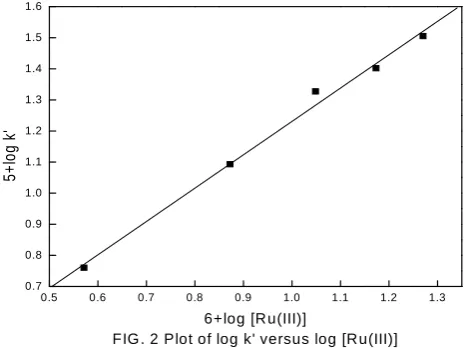
The rate increased with increase in [Ru(III)] and plots of log k´ versus log [Ru(III)] was linear with unit slope indicating a first order dependence of rate on [Ru(III)] (Figure 2).
0.5 0.6 0.7 0.8 0.9 1.0 1.1 1.2 1.3 0.7
0.8 0.9 1.0 1.1 1.2 1.3 1.4 1.5 1.6
5
+
lo
g
k
'
6+log [R u(III)]
FIG . 2 Plot of log k' versus log [R u(III)]
[Nicotinamide]0 = 2.0 × 10⁻³mol dm-3, [BAT] = 2.0 × 10⁻⁴ mol dm-3, [HCl]
= 24.0× 10⁻⁴mol dm-3, µ = 0.2 mol dm-3, T = 303K.
Effect of halide ions and ionic strength on the rate
Addition of Cl-ion in the form of NaCl (2.4 x 10⁻³–10.4 x 10⁻³mol dm-3) and Br-ion in the form NaBr (5.0 x 10⁻⁵–18.0 x 10⁻⁵mol dm-3) had no effect on the rate of reaction. Hence, the dependence of the rate on [HCl] reflected the effect of [H+] only on the reaction.
Effect of toluenesulphonamide and dielectric constant on the rate
Addition of reaction product p-toluenesulphonamide (5.0 x 10⁻⁵
– 20.0 x 10⁻⁵ mol dm-3) and variation of methanol content (0-20%) in acid medium had no effect on the reaction rate.
Effect of temperature on the rate
[image:3.595.43.278.127.301.2]The reaction was studied by varying different temperatures in the range 298K to 313K and the values of k´ were determined (Table 3) from the pseudo first order plots. The energy of activation Ea was calculated from the Arrhenius plot of log k´ versus 1/T.
Table 3. Effect of temperature on the rate of reaction and thermodynamic parameters for the Ru(III) catalysed oxidation of nicotinamide by BAT in
HCl medium
[Nicotinamide]0 = 2.0 × 10⁻³mol dm-3, [BAT] = 2.0 × 10⁻⁴ mol dm-3, [HCl] =
24.0 × 10⁻⁴mol dm-3, [Ru(III)] = 1.243× 10⁻⁶ mol dm-3, µ = 0.2 mol dm-3,
Temperature(K) k´ × 104(sec-1) Thermodynamic parameters
298 2.44 Ea = 56.44 kJ mol-1
303 3.20 H≠= 53.88 kJ mol-1
308 5.69 S≠= -133.52 JK-1mol-1 313 7.67 G≠= 95.01 kJ mol-1
318 9.39
Test for free radicals
Tests performed for the presence of free radicals by adding the reaction mixture to acrylamide solution were negative. The absence of polymerization shows that the free radical species,
in situ are not formed in the reaction.
DISCUSSION AND MECHANISM
Pryde and Soper (1926, 1931), Morris et al. (1948), Bishop and Jennings (1962) have shown the existence of similar equilibria in acid and alkaline solutions of N-metallo N-haloaryl sulphonamides, bromamine-T (ArSO2NBrNa) which is similar
to its chloramine analogues, as chloramine-T behaves as a strong electrolyte in aqueous solutions forming different species as in equation (2–6)
ArSO2NBrNa ArSO2NBr-+ Na+ ... (2)
ArSO2NBr
-+ H+ ArSO2NHBr … (3)
ArSO2NHBr-+ H2O ArSO2NH2+ HOBr … (4)
2ArSO2NHBr ArSO2NH2+ ArSO2NBr…(5)
HOBr + H+ H2O+Br ...(6)
In acidic medium the probable oxidizing species are the free acid (ArSO2NHBr), dibromamine-B (ArSO2NBr2), HOBr or
H2O+Br. In the present study of nicotinamide oxidation, the
reaction shows a first order in [BAT]0, [RuCl3] and fractional
order in [substrate], and fractional order retardation on [H+]. Based on the preceding discussion, a mechanism (Scheme 1) is proposed to account for the experimental observations. Electronic spectral studies of Cady and Connick (1958) and Connick and Fine (1960) reveal that species such as [RuCl5(H2O)]2- [RuCl4(H2O)2]-, [RuCl3(H2O)3],
[RuCl2(H2O)4]+ and [RuCl(H2O)5]2+ do not exist in aqueous
solutions of RuCl3. A study of oxidation states of ruthenium
has shown that Ru((III) exists in the following equilibrium (Back house et al., 1950; Darfokratova 1963; Griffith 1967) in acid medium.
[Ru(III)Cl6]3-+ H2O [Ru(III)Cl5(H2O)]2-+ Cl
-…..(7)
Singh et al. (1984, 1967) employed the above equilibrium in Ru(III) catalyzed BAT oxidation of some primary alcohols in acid medium and in the Ru(III) catalyzed oxidation of diethylgycol and methyl diethyleneglycol by N-bromoacetamide (NBA) in HClO4
medium. However in the present case addition of Cl-ion in the form of NaCl at fixed (H+), no effect on the rate indicating that [Ru(III)Cl6]3- is the most likely catalyzing species. The inverse
fractional order in [H+] indicates that the deprotonation of ArSO2N+H2Br results in the formation of ArSO2NHBr which is
likely to be the active oxidizing species. Based on the preceding discussion, a mechanism (Scheme 1) is proposed to account for the experimental observations.
K1
ArSO2N+H2Br ArSO2NHBr + H ... (i)
K2
ArSO2NHBr + S X ... (ii)
k3
X +Ru (III) X´ slow ...(iii)
X´ X´´+ Ru(III) fast ... (iv)
X´´ Product ... (v)
Scheme–1
Rate = - [ ] = k3[X] [Ru(III)] … (8)
From step (ii) [ArSO2NHBr] =
[ ]
[ ] … (9)
From step (i) [ArSO2N+H2Br] =
[ ] [ ]
[ArSO2N+H2Br] = [ ][ ]
[ ] ...(10)
Total effective concentration of [BAT]t
[BAT]t= [ArSO2N+H2Br] + [ArSO2NHBr] + [X] ... (11)
[BAT]t= [ ] [ [ ]] + [ ][ ]+ [X] ...(12)
[BAT]t= [X] [ ][ ]+ [ ]+ 1
= [X] [ ] [ ]
[ ] [X] = [ ] [ ]
[ ] [ ] …(13)
Rate = [ ][ ][ ( )]
[ ] [ ] …(14)
...(14) This is in good agreement with the experimental results. A
detailed mechanism of Ru(III) catalyzed oxidation of nicotinamide by BAT in HCl medium is given in Scheme 2. Since rate = k´ under pseudo first order condition of [Nicotinamide] >> [BAT], the rate equation (14) can be transformed into equation
k´ = [ ][ ( )]
[ ] [ ] …(15)
′= [ ][ ( )]+
[ ]
[ ][ ( )]+ [ ( )] ...(16) Or
′= [ ] [ ( )]
[ ] +
[ ( )] ...(17)
Or
′ =
[ ]
[ ][ ( )]+ [ ][ ( )]+ [ ( )] … (18)
Plots 1 k versus
[ ] at constant [H
+] and [Ru(III)] from
equation (17) and 1/k′versus [H+] at constant [S] and [Ru(III)] from equation (18) were found to be linear (Figure 3 and Figure 4). From the intercepts and slopes of the plots, the values of K1, K2 and k3 were evaluated. The protonation
constant (KP =1 K ) value obtained, 18.40 for the species
ArSO2NHBr is in good agreement with the previously
published work (Venkatesha et al., 1993) and (Ananda et al., 1998). This gives indirect evidence for the proposed mechanism of the scheme 1. The thermodynamic parameters Ea,H≠,S≠, andG≠ were calculated as shown in Table 3. The moderate value of enthalpy of activation is supportive for the proposed mechanism in scheme 1. The high negative value
of entropy of activation (S≠) indicates the formation of a rigid transition state by associative process.
200 400 600 800 1000 2000
2500 3000 3500 4000 4500
1
/k'
1/[S]
FIG.3 Plot of 1/k' versus 1/[S]
[BAT] = 20.0 × 10⁻⁵mol dm-3;[HCl] = 24.0 × 10⁻⁴mol dm-3; [Ru (III)] = 1.243× 10⁻⁴
mol dm-3;µ = 0.2 mol dm-3; T = 303K.
0 5 10 15 20 25 30 35 40 45
2000 3000 4000 5000 6000 7000 8000 9000
1
/k
'
[image:4.595.311.553.319.532.2][H+] x 10-4
FIG. 4 Plot of 1/k' versus [H+]
[Nicotinamide]0 = 2.0 × 10⁻³mol dm-3, [BAT] = 2.0 × 10⁻⁴ mol dm-3,
[Ru(III)] = 1.243× 10⁻⁶mol dm-3, µ = 0.2 mol dm-3, T = 303K.
A r S O2N H2B r A r S O2N H B r + H
+ +
N
NH2 O
N
NH2 O
.
. .
. Ar
O
O N H
Br
Ar O
N Br
H
O
..
+
SS
[image:4.595.307.540.604.777.2]N
NH2 O
Br N
NH2 O
.
. .
.
Ar O
N Br
H
O
ArSO2NH
+
.. .
. [RuCl6]3
[RuCl6]3
-+
(X') +
-N
NH2 O
Br
N
NH2 O
Br
(X'') ...
.
[RuCl6] 3
[RuCl6] 3
-+
(X')
+
+
N
Br
NH2 O
N O H
H Br
NH2 H
N
NH2 O
O H N
NH2 O
H O
+
- H+
- HBr O
H
H ..
6 - hydroxy nicotinamide
ArSO2NH H ArSO2NH
-+
+ 2Scheme 2. A reaction path for the oxidation of nicotinamide by BAT
REFERENCES
Ahmed. M. S., Mahadevappa. D.S., 1980. Bromamine-B as a new oxidimetric titrant.Talanta, 27, 669.
Ananda S., Jagadeesha M.B. and Ramananda M.G. 1998. Kinetics of oxidation of cysteine by Bromamine-T in H2SO4 medium. Asian Journal of Chemistry, Vol 10
No. 4, 937-946.
Avigliano L., Carelli V., Casini A., Finazzi-Agro A. Liberatore F. and Rossi A., 1986. Oxidation of nicotinamide coenzyme dimers by one electron-accepting protein.
Biochem. J. 1:237(3) 919-922.
Back house J.R., Doyer F.D. and Shales N. 1950. Chemistry of Ru(IV) Potential of the quadrivalent/trivalent Ru couple in HCl. Proc. Roy. Soc, 83, 146.
Bishop, E. and Jennings, 1962. Titrimetric analysis with chloramine-T-1: the status of chloramine-T as a titremetric reagent. Talanta 1, 197-212 (1958); 8, 22, 34, 697 (1961): 9, 581.
Cady H.H. and Connick R.E., The determination of the formulas of aqueous ruthenium (III) species by means of Ion-exchange resin: Ru+3, RuCl+2 and RuCl2+", J Am Chem Soc, vol. 80, 1958, p.2646-2652; 32.
Connick R.E. and Fine D.A. 1960. Ruthenium (III) chloride complexses: RuCl2+. J. American, Chem. Soc, 82, 4187.
Darfokratova. 1963. “Analytical Chemistry of Ruthenium”
Academy of Sciences, USSR PP 54, 71 and 97.
Griffith W.P.,1967. “The Chemistry of Rare platinum metals”
Interscience Newyork, P.(4).
Mahadevappa. D.S., and Gowda. N.M.M. 1975. Estimation of glutathione with chloramine-T and dichloramine-T. Talanta, 22, 771-773.
Mohammed A., Kashem H. and Brian Dunford., 1986. Kinetics of the oxidation of reduced nicotinamide adenine dinucleotide by horse radish peroxidase. Biochemistry and
cell Biology, 64 (4): 323-327.
Morris J.C., Salazar J.A. and Wineman M.A., 1948. Equilibrium studies on chlorocompounds. The ionization constant of N-Chloro-p-toluenesulphonamide. J. Am. Chem. Soc, 70, 2036.
Nair C.G.R., Indrasenan P, 1976. New redox titrants in non aqueous or partially aqueous medium-VI- Potentiometric determination using dibromamine-T and some further applications of dichloramine-T. Talanta, 23, 239-241. Niven N.M., 2006. Pharmacologic doses of Nicotinamide in
the treatment of inflammatory Skin conditions a review. Cutis 77 (1 suppl): 11-6. PMID 168774.
Pryde B. G. and Soper F.G., 1931. The interaction of anilides and hypochlorous acid. J. Chem. Soc; 1582 (1926) and 1510-1514.
Saldana, R.J.D., Ananda S., Venkatesha B.M. and Madegowda N.M., 2002. Oxidation of psychotropic drugs by chloramine-T in acid medium; A kinetic study using spectrophotometry. Journal of Molecular structure. 606, 147-154.
Sharma Ashok, Mudgal Punit, K. and Gupta, K.S., 2008.
‘Nicotinamide and Isonicotinamide was oxidized using permanganate ion in acidic medium’Journal of the Indian Chemical Society, Vol, 85 PP 920-925.
Singh B., Singh N.B. and Saxena B.B.L., 1984. J. Ind Chem.
Soc, 61, 319.
Singh B., Singh P.K. and Dingh D., 1998. J.Mol Cat, 78, 207. Tallman J.F., Paul S.M., Skolnick P and Gallager D.W., 1980.
Receptors for the age of Anxiety Pharmacology of the
Benzodiazepines Science, 207 (4428): 274-81.
Venkatesha B.M., Ananda S. and Mahadevappa. D.S. 1992. Oxidation of Indole by N-Sodio-N- chlorobenzenesul phonamide (chloramine-T) in alkaline medium catalysed by Os(VII): A kinetic and mechanistic satudy. Journal of
physical organic Chemistry. 5, 373-383.
Venkatesha B.M., Ananda S. and Mahadevappa. D.S. 1993. Kinetics ofoxidation of chloroaceticacids by sodium-N-bromop-toluenesulphonamide (Bromamine-T) HCl medium and catalysed by Ru(III)ion. Indian Journal of Chemistry (India), 32A pp 128-135.
Venkatesha B.M., Ananda S., Mahadevappa. D.S. and Madegowda N.M. 1995. Kinetics and mechanistic studies of Indigocaramine oxidation by chloramine-T and chlorine in acidic buffer medium. International Journal of Chemical
Kinetics. 27, 663-676.
![FIG. 4 Plot of 1/k' versus [H+]](https://thumb-us.123doks.com/thumbv2/123dok_us/9283995.422448/4.595.311.553.319.532/fig-plot-of-k-versus-h.webp)
