Simplified Bethe–Salpeter Description of Basic
Pseudoscalar-Meson Features
Wolfgang Lucha1,∗
1Institute for High Energy Physics, Austrian Academy of Sciences, Nikolsdorfergasse 18,
A-1050 Vienna, Austria
Abstract.We assess a description of pseudoscalar mesons as pseudo-Goldstone bosons by its compatibility with some Gell-Mann–Oakes–Renner-type relation.
1 Pseudoscalar Mesons of Goldstone Nature
Goldstone’s theorem necessitates the presence of a massless boson in the spectrum of physical particles for any spontaneously broken chiral symmetry of quantum chromodynamics (QCD); these hypothetical Goldstone bosons are identified with the ground-state pseudoscalar mesons (pions, kaons,η). Their finite (but comparatively small) masses are attributed to the additional explicit breakdown of the chiral symmetries of QCD enforced by nonvanishing quark masses. We analyze the Goldstone-boson nature of the lightest pseudoscalar mesons by means of a formalism [1–4] situated somewhere between the fully relativistic Bethe–Salpeter description of bound states [5], with several still to be resolved inherent obstacles, and the latter’s extreme instantaneous limit, represented by its three-dimensional reduction devised by Salpeter [6]. A rather promising tool to judge the merits of such kind of intermediate framework proves to be, among others, the fulfilment of (generalized) Gell-Mann–Oakes–Renner-type relations [7] by characteristic features (viz., decay constants or condensates) of light pseudoscalar mesons [8].
2 Quark–Antiquark Bound-State Formalism
The homogeneous Bethe–Salpeter equation describes, in Poincaré-covariant manner, a bound state|B(P)�of massMand momentumP,formed by two particles of relative momentump,by
its Bethe–Salpeter amplitudeΦ(p,P).One ingredientare the constituents’ full propagators, in the case of spin-1
2fermionsigiven by massMi(p2) and wave-function renormalizationZi(p2):
Si(p)= iZi(p 2)
/
p−Mi(p2)+iε , /p≡p µ
γµ, ε↓0, i=1,2.
Theother ingredientare the interactions responsible for bound-state formation. Ignoring their dependence on time components of momentaandthe above propagators’ dependence on zero momentum componentssquaredled to a bound-state equation [1] for a Salpeter amplitude [6]
φ(p)∝
dp0Φ(p,P),
interpretable as equal-time bound-state wave function. An integral kernelK(p,q) captures the entirety of, by assumption instantaneous, effective interactions of all bound-state constituents.
The bound-state equation proposed in Ref. [1], formulated in terms of the kinetic energies,
Ei(p)≡
�
p2+M2 i(p2),
and the energy projectors onto positive and negative energies of the bound-state constituentsi,
Λ±i(p)≡ Ei(p)±γ0[γ·p+Mi(p
2)]
2Ei(p) ,
reads, for the case of fermion–antifermion bound states in the center-of-momentum frame [1],
φ(p)=Z1(p2)Z2(p2)
� d3q (2π)3
Λ
+
1(p)γ0[K(p,q)φ(q)]Λ−2(p)γ0 �
M−E1(p)−E2(p)
− Λ
−
1(p)γ0[K(p,q)φ(q)]Λ+2(p)γ0 �
M+E1(p)+E2(p) .
For any one-particle states|B(P)�normalized according to the Lorentz-invariant condition
�B(P)|B(P′)�=(2π)32P
0δ(3)(P−P′),
the normalization condition for the corresponding Salpeter amplitudesφ(p) is given by [9–11]
� d3p (2π)3Tr
�
φ†(p)γ0[γ·p+M1(p
2)]
E1(p) φ(p) �
=2P0.
3 Assuming Generalized Flavour Symmetry
Things simplify considerably if the propagator functions of involved fermion and antifermion happen to be identical,M1(p2)=M2(p2) andZ1(p2)=Z2(p2); the Salpeter amplitude of every pseudoscalar bound state is then fully defined by just two Lorentz-scalar components,ϕ1,2(p):
φ(p)= √1 3
�
ϕ1(p)γ0[γ·p+M(p 2)]
E(p) +ϕ2(p) �
γ5.
ForK(p,q) compatible with spherical and rather specific Fierz symmetries of the effective interactions, our bound-state equation governingφ(p) collapses to an eigenvalue problem [12] fixing the radial partsϕ1,2(p),p≡ |p|,ofϕ1,2(p),with a single, spherically symmetric potential V(r),r≡ |x|,encoding the configuration-space interactions between bound-state constituents:
E(p)ϕ2(p)+2Z
2(p2)
πp
∞ �
0
dq qdrsin(p r) sin(q r)V(r)ϕ2(q)= M� 2 ϕ1(p),
E(p)ϕ1(p)= M�
2 ϕ2(p). (1)
0
5
10
15
20
0
100
200
300
0
5
10
15
20
0
100
200
300
r
GeV
1V
r
GeV
Figure 1.Effective interquark central potentialV(r) pinned down by inverting the radial Bethe–Salpeter
problem (1) for a Salpeter-amplitude input derived from some quark-propagator model solution [18, 19]. The almost flatness of the potentialV(r) near the origin in combination with its extraordinarily steep rise to infinity renders the form ofV(r) pretty close but clearly not identical to that of a square-well potential.
4 Pseudoscalar-Meson Properties Revisited
Consequently, we have to look for different and more significant criteria which allow us to appraise the reasonableness of any inversion considerations. Fortunately, this proves to be not too difficult: Equating the residues of pseudoscalar-meson pole terms in both axial-vector and pseudoscalar vertex functions entering into the axial-vector Ward–Takahashi identity of QCD expressing the invariance of QCD under chiral transformations leads to a generalization [7] of the Gell-Mann–Oakes–Renner relation [26]; this innovation relates, for a pseudoscalar bound state|B(P)�,its (weak)decay constant fB,defined in terms of the axial-vector quark current by
�0|: ¯ψ1(0)γµγ5ψ2(0):|B(P)�=ifBPµ,
— which, consequently, may be found by projection ofφ(p) onto the axial-vector current,i.e.,
fB ∝
d3pTr[γ
0γ5φ(p)]
— and itsin-hadron condensate[7] (universalizing the notion of quark vacuum condensates)1
CB≡ �0|: ¯ψ1(0)γ5ψ2(0):|B(P)� ∝
d3pTr[γ 5φ(p)]
to the massMBof this pseudoscalar bound state and the two relevant quark mass parameters in the QCD Lagrangian [7]. For the simpler case of equal quark massesm,this relationship reads
fBM2B=2mCB. (2)
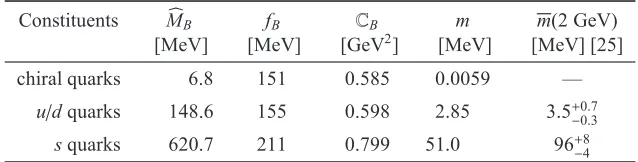
Compatibility with Eq. (2) may be inspected by solving our formalism with the previously established potentialV(r) for bound states of chiral,u/d,andsquarks, taking advantage of the appropriate model propagator functions [18, 19]. Comparison of the quark massesm,fixed by the thus determined values ofMB,fB,andCB,with the current-quark massesm(µ) in modified minimal subtraction at scaleµproves that our findings formare in the right ballpark (Table 1).
Table 1.Predictions of the Bethe–Salpeter-inspired bound-state equation (1), with effective interaction
potentialV(r) as depicted in Fig. 1, for massesMB, decay constants fBand in-meson condensatesCBof the lightest pseudoscalar mesons, and confrontation of the quark-mass parametersmresulting from the more general Gell-Mann–Oakes–Renner relation (2) with their minimal-subtraction counterpartsm(µ).
Constituents MB fB CB m m(2 GeV)
[MeV] [MeV] [GeV2] [MeV] [MeV] [25]
chiral quarks 6.8 151 0.585 0.0059 —
u/dquarks 148.6 155 0.598 2.85 3.5+0.7
−0.3
squarks 620.7 211 0.799 51.0 96+−84
5 Summary of Findings and Conclusions
In order to establish whether or not it is justified to lend trust to the outcomes of an approach to bound states proposed some time ago [1] and residing, as far as its compatibility with Poincaré covariance is concerned, somewhere in the vast range between bound-state descriptions along the ideas of Salpeter and Bethe, on the one hand, and static approximations, on the other hand, we evaluated the performance of the investigated framework’s predictions for those properties of the lightest pseudoscalar mesons that happen to be related by an advancement of the insight gained by Gell-Mann, Oakes, and Renner [26]: In brief, the formalism of Ref. [1] is still alive.
References
[1] W. Lucha and F. F. Schöberl, J. Phys. G31(2005) 1133, arXiv:hep-th/0507281. [2] W. Lucha and F. F. Schöberl, Int. J. Mod. Phys. A31(2016) 1650202, arXiv:1606.04781
[hep-ph].
[3] W. Lucha, EPJ Web Conf.129(2016) 00047, arXiv:1607.02426 [hep-ph]. [4] W. Lucha, EPJ Web Conf.137(2017) 13009, arXiv:1609.01474 [hep-ph]. [5] E. E. Salpeter and H. A. Bethe, Phys. Rev.84(1951) 1232.
[6] E. E. Salpeter, Phys. Rev.87(1952) 328.
[7] P. Maris, C. D. Roberts, and P. C. Tandy, Phys. Lett. B420(1998) 267, arXiv:nucl-th/ 9707003.
[8] W. Lucha and F. F. Schöberl, Int. J. Mod. Phys. A33(2018) 1850047, arXiv:1801.00264 [hep-ph].
[9] J.-F. Lagaë, Phys. Rev. D45(1992) 305.
[10] J. Resag, C. R. Münz, B. C. Metsch, and H. R. Petry, Nucl. Phys. A578(1994) 397, arXiv:nucl-th/9307026.
[11] M. G. Olsson, S. Veseli, and K. Williams, Phys. Rev. D52(1995) 5141, arXiv:hep-ph/ 9503477.
[12] Z.-F. Li, W. Lucha, and F. F. Schöberl, Phys. Rev. D76(2007) 125028, arXiv:0707.3202 [hep-ph].
[13] W. Lucha and F. F. Schöberl, Phys. Rev. D87(2013) 016009, arXiv:1211.4716 [hep-ph].
[14] W. Lucha, Proc. Sci., EPS-HEP 2013 (2013) 007, arXiv:1308.3130 [hep-ph].
[15] W. Lucha and F. F. Schöberl, Phys. Rev. D92(2015) 076005, arXiv:1508.02951 [hep-ph].
[16] W. Lucha and F. F. Schöberl, Phys. Rev. D93(2016) 056006, arXiv:1602.02356 [hep-ph].
[17] W. Lucha and F. F. Schöberl, Phys. Rev. D93(2016) 096005, arXiv:1603.08745 [hep-ph].
[18] P. Maris and P. C. Tandy, Phys. Rev. C60(1999) 055214, arXiv:nucl-th/9905056. [19] P. Maris, inProceedings of the International Conference on Quark Confinement and
the Hadron Spectrum IV, editors W. Lucha and K. Maung Maung (World Scientific, Singapore, 2002), p. 163, arXiv:nucl-th/0009064.
[20] W. Lucha and F. F. Schöberl, Phys. Rev. A56(1997) 139, arXiv:hep-ph/9609322. [21] W. Lucha and F. F. Schöberl, Int. J. Mod. Phys. A 14 (1999) 2309, arXiv:hep-ph/
9812368.
[22] W. Lucha, K. Maung Maung, and F. F. Schöberl, Phys. Rev. D 63 (2001) 056002, arXiv:hep-ph/0009185.
[23] W. Lucha, K. Maung Maung, and F. F. Schöberl, Phys. Rev. D 64 (2001) 036007, arXiv:hep-ph/0011235.
[24] W. Lucha and F. F. Schöberl, Recent Res. Dev. Phys.5 (2004) 1423, arXiv:hep-ph/ 0408184.
[25] C. Patrignaniet al.(Particle Data Group), Chin. Phys. C40(2016) 100001. [26] M. Gell-Mann, R. J. Oakes, and B. Renner, Phys. Rev.175(1968) 2195.
![Figure 1. Effective interquark central potential V(r) pinned down by inverting the radial Bethe–Salpeterproblem (1) for a Salpeter-amplitude input derived from some quark-propagator model solution [18, 19].The almost flatness of the potential V(r) near the origin in combination with its extraordinarily steep riseto infinity renders the form of V(r) pretty close but clearly not identical to that of a square-well potential.](https://thumb-us.123doks.com/thumbv2/123dok_us/8029872.1336128/3.482.59.431.70.376/eective-interquark-salpeterproblem-amplitude-propagator-atness-combination-extraordinarily.webp)