Low Complexity Precoded Greedy Power Allocation
Algorithms for OFDM Communication Systems
Najib A. Odhah, Moawad I. Dessouky, Waleed Al-Hanafy, Fathi E. Abd El-Samie
Department of Electronics and Electrical Communications, Faculty of Electronic Engineering, Menoufia University, Menouf, Egypt. Email: {najib_odhah, dr_moawad, waleed_alhanafy, fathi_sayed}@yahoo.com
Received July 2nd,2011; revised January 10th, 2012; accepted February 29th, 2012
ABSTRACT
In this paper, an enhanced greedy bit and power allocation algorithms for orthogonal frequency division multiplexing (OFDM) communication systems are introduced. These algorithms combine low complexity greedy power allocation algorithms with a simplified maximum ratio combining (MRC) precoding technique at the transmitter for maximizing the average data throughput of OFDM communication systems. Results of computer simulations show that precoding is an effective technique for improving the throughput performance of the proposed bit and power allocation algorithms.
Keywords: OFDM; Uniform Power Allocation; Greedy Algorithm; Throughput Enhancement; MRC Precoding
1. Introduction
Multicarrier modulation (MCM) is a powerful transmis- sion technique that provides improved performance in various communication fields; it introduces important benefits as efficient bandwidth optimization, enhanced spectrum utilization, low equalization complexity, and multiuser potentiality. Moreover, it is widely used in new application fields, such as power line communications (PLC) [1-3], and wireless local area networks (WLANs) [4-6] due to its recognized value to confront various channel impairments, including frequency selectivity, intersymbol interference (ISI), and impulse noise.
Two important MCM techniques that have wide spread use are OFDM [6] mainly employed in wireless applica- tions, and discrete multitone (DMT) [7] used in wireline systems. In conventional wireless OFDM systems, all subcarriers employ the same signal constellation. How- ever, the overall error probability is dominated by the subcarriers with the worst performance. To improve sys- tem performance and throughput, adaptive bit and power allocation algorithms can be employed, where the signal constellation size and power distribution vary according to the measured signal-to-noise ratio (SNR) values across the subcarriers [8].
The bit and power allocation is a constraint optimiza- tion problem, and generally two cases are of practical interest; rate maximization (RM) and margin maximiza- tion (MM), where the objective is the maximization of the achievable data rate or the achievable system margin, respectively. A rate-optimal algorithm known as the greedy power allocation (GPA) algorithm [9,10], of which a num-
ber of different variations have emerged constraining ei- ther the average bit error rate (BER) [8] or the total power [11]. For a good review of greedy algorithms, please re- fer to [1]. Suboptimal GPA algorithms, whereby the bit and power re-allocation are performed in groups of sub- carriers are proposed in [12], resulting in low complex- ity algorithms compared with the GPA algorithm.
An MRC precoding technique is proposed to enhance the low complexity GPA algorithms proposed in [12] for OFDM signal transmission in hostile environments and to simplify receiver complexity by transferring the signal processing to the transmitter. For high speed communi- cations, the channel is changing faster than it can be es- timated and fed back to the transmitter. So adaptive bit and power allocation algorithms perform poorly. Other means for mitigating the effect of fading should be used [13]. In this paper, enhanced adaptive bit and power al- location algorithms for OFDM communication systems are introduced. These algorithms combine low com- plexity bit and power allocation algorithms and a simpli- fied precoding technique at the OFDM transmitter for data throughput enhancement. The proposed system op- erates in time division duplex (TDD) mode in which the channel reciprocity between alterative uplink and downlink transmissions is exploited to feed the channel state in- formation (CSI) back to the transmitter side.
clusions are given in Section 5.
2. Bit and Power Allocation for OFDM
System
OFDM is a promising technique for achieving the high data rate transmission required for wireless multimedia services over time dispersive multipath channels [14]. To improve the OFDM system throughput, adaptive bit and power allocations are employed.
2.1. Problem Definition
The problem of the maximization of the transmission rate over the OFDM wireless system is considered, where the multipath channel characterized by a finite impulse re- sponse (FIR) vector h
h h0 1hL
of order L is con- verted to an N-subcarriers system with different gains, 1, 2, 3, ,
n
g n N. The nth subcarrier experiencing the gain gn will be used to transmit n bits per symbol.
The following constrained optimization problem must be solved to determine the optimum bit and power alloca- tions to maximize the OFDM system throughput
b
1 max
N
n n
b
subject totarget max
, 1
, , and
N
n t e n e n
n
p p p p b b
,n (1)where n and n are the bit and power allocated to the
nth subcarrier to achieve a bit error rate (BER) of e n, , t
is the total power budget, and is the maximum number of permissible allocated bits per subcarrier .
b p
p p
max
b
The nth subcarrier power to noise ratio can be defined as follows:
2
0
CNR n
n
g N
(2)
where 0 is the noise power at the receiver, and the
SNR of this subcarrier is
N
CNR
n pn n
(3) Symbols of bk-bits, 2 k can be loaded to
the subcarrier with the minimum required SNR [12,15] of
log
k
b M
k QAM
2 1
2 QAM
2 1
for BPSK 2
1 1 log
1
3 2 1 1
for M-ary QAM
e
k k e
k
k
Q P
M P M
Q
M
(4)
where Mk is the maximum permissible QAM constel-
lation by the transmission system and is the inverse of a well-known Q function that is the tail probability of the standard normal distribution [15]. The solution of the
constrained optimization problem in (1) can be divided into two steps, uniform power allocation (UPA) initiali- zation step and the GPA algorithm. Both of them are described below.
1
Q
2.2. Uniform Power Allocation (UPA) Algorithm
The steps of UPA algorithm can be summarized as fol- lows [12]:
1) Calculate QAM for all k
Mk , and the
target BER using (4).
1 k K
t P
target
e e
P P
2) Allocate the total power budget between all subcarriers, equally, as follows
CNR t CNR
n n n
P P
N
n (5)
3) Redistribute subcarriers according to their SNRs
n
into QAM groups Gk, bounded by QAM
levels and with and
0 k K
QAM 0
QAM
k
QAM
1
k
0
QA
M
K i.e.
QAM
QAM
1
k
k n
4) Load subcarriers within each Gk group with QAM
constellation Mk such that the total allocated bits of this
group is
UPA UPA
, log
k k
k n k
n G n G
B b
2Mk (6)with B0UPA0 and the total excess power for this group
QAM
excess nkCNR
k
k
n G n
P
k
(7)
5) The total number of the system allocated bits and the used power for the UPA algorithm are
UPA UPA
1
K
k k
B B
(8)used excess excess
UPA
1
K
t t
k
P P P P P
(9)The total excess power produced by the UPA algorithm is well exploited by a number of algorithms, and this represents a useful indication about the efficient utiliza- tion of the total transmit power Pt.
2.3. Full Greedy Power Allocation (GPA) Algorithm
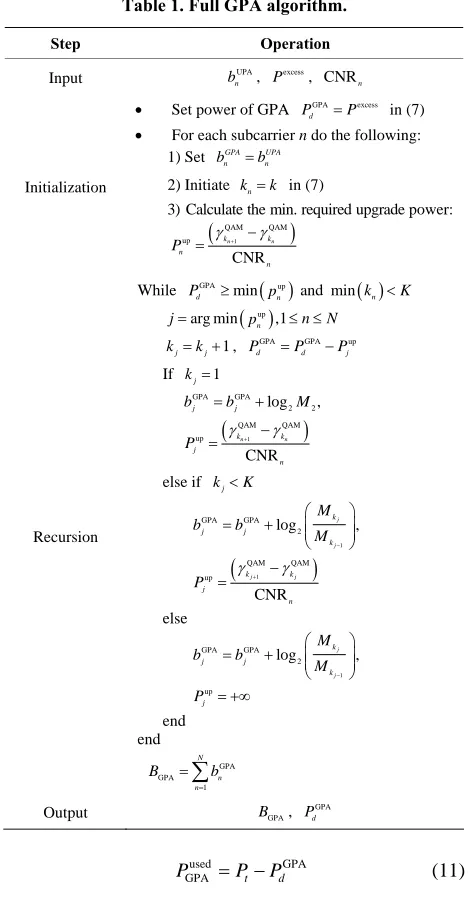
The GPA algorithm [1,9,10,12] is based on the initializa- tion step described above. This algorithm performs an iterative re-distribution of the excess power of the UPA algorithm. Applying the steps described in Table 1, re- sulting in an overall system allocated bits and used power given, respectively, by
GPA GPA
1
N
n n
B b
(10)Table 1. Full GPA algorithm.
Step Operation
Input UPA
n
b , excess,
P CNRn
Initialization
Set power of GPA GPA excess
d
P P in (7)
For each subcarrier n do the following:
1) Set GPA UPA
n n
b b
k k
2) Initiate n in (7)
3) Calculate the min. required upgrade power:
1
QAM QAM up CNR n n k k n n
P
Recursion
While GPA up
min and min
d n
P p kn K
up
arg min n ,1
j p n
1
k k GPA GPA
P P
N up P j j 1 j k
, d d j
If
1
GPA GPA 2 2 QAM QAM up log CNR n n j j k k j n b b
P
,
M
else if kjK
1 1 GPA GPA 2 QAM QAM up log , CNR j j j j k j j k k k j n M b b MP
else 1 GPA GPA 2 up
log j ,
j k j j k j M b b M P end end GPA GPA 1 N n n B b
Output BGPA,
GPA
d
P
used GPA
GPA t d
P P P (11)
3. The Proposed Pre-Coded Bit and Power
Allocation Algorithms
Bit and power allocation algorithms for OFDM systems with equalization at the receiver have been studied in the literature. However, applying bit and power allocation algorithms with pre-coding techniques is still new, and there are a lot of open issues. In this paper, hybrid algo- rithms comprising the low complexity bit and power al- location algorithms in [12] and a pre-coding technique [16] will be proposed and studied.
3.1. MRC Pre-Coding Technique
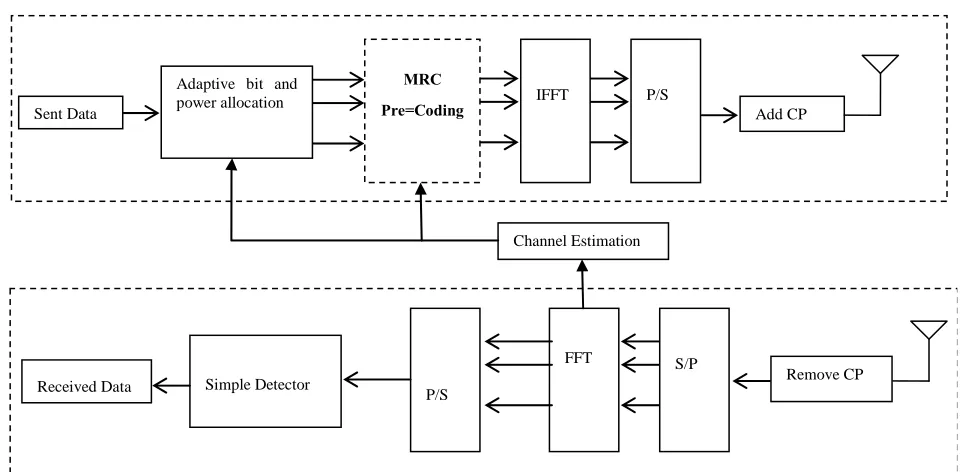
A MRC pre-coding is proposed for enhancing the bit and power allocation of OFDM system as shown in Figure 1, where it is based on correcting the phase and weighting
the amplitude of each subcarrier [16]. The signal model of MRC Pre-coded OFDM system is described as follows
H
Λ Λ
R X W (12) where R is the N1 received signal vector, Λ is an
NN diagonal channel matrix containing the frequency domain channel coefficient of each subcarrier, ΛH is
NNcomplex conjugate transpose of Λ, X is an N1
transmitted signal vector, and W is an additive white Gaussian noise (AWGN) vector. The subcarrier gain
n
1
N
th
n
g in (2) is replaced by MRC pre-coded subcarrier gain
th
n
H nn
Λ . Based on the new pre-coded channel co- efficients described above, UPA algorithm is re-applied to determine new subcarriers bit allocation pre-UPA
k and
new total excess power for each QAM level group as defined in (6) and (7), respectively. Three enhanced low-complexity greedy algorithms are proposed and studied to efficiently utilize the new total excess power of the Pre-UPA algorithm. These algorithms are Pre-coded QAM-Level GPA (Pre-LGPA) algorithm, Pre-coded Po- wer Moving up GPA (Pre-MuGPA) algorithm, and Pre- coded Power Moving down GPA (Pre-MdGPA) algo- rithm.
B
excess
k
P
3.2. Pre-LGPA Algorithm
The direct application of the GPA algorithm is computa- tionally very complex, because at each iteration, exhaus- tive sorting and searching algorithms of all subcarriers are required as shown in Table 1. A simplified tech- nique of the GPA algorithm can be obtained if the sub- carriers are firstly divided into QAM groups Gk,
0 k K according to their SNRs.
The GPA algorithm is therefore independently applied to each group k. The Pre-LGPA algorithm is well de-
scribed in Table 2 where it permits upgrading to the next QAM level only and therefore may leave some left-over power
G
LO
Pk for each QAM group , resulting in a total left-over power of
k G 1 excess pre-LGPA 0 K LO LO k K k
P P P
(13)The Pre-LGPA algorithm has to be executed K times, once for each QAM group resulting in an overall system that allocates bits and power according to
1 pre-LGPA pre-UPA pre-LGPA 0 K k K k
B B B
(14)and
used
pre-LGPA pre-LGPA
LO t
P PP (15)
3.3. Pre-MuGPA Algorithm
The Pre-LGPA algorithm results in an unused LO k
Sent Data
Adaptive bit and power allocation
MRC
Pre=Coding IFFT P/S Add CP
Received Data Simple Detector
FFT S/P
Remove CP P/S
[image:4.595.56.537.79.315.2]Channel Estimation
[image:4.595.59.285.358.603.2]Figure 1. The architecture of the proposed scheme for OFDM system.
Table 2. Pre-LGPA algorithm.
Step Operation
Input
Pre-UPA
n
b , , ,CNRn
excess
k
p QAM QAM QAM
, n1 n
d k k k
Initialization
k
n G
calculate the min. required upgrade
power:
QAM , up
CNR
d k n
n
p
Pre-L
and
GPA Pre-UPA
n n
b b LO excess
k k
p p
Recursion
While min(LO up)
k n
p p
up
arg min( n) k
j p n
up
LO LO
G
k k n
p p p
If k = 0
Pre-LGPA up
, log2 2,
n k n
b M p
else
QAM QAM
1
Pre-LGPA 1 up
, log2 ,
CNR
j j
k k
k
n k n
k n
M
b p
M
end end
Pre-LGPA Pre-LGPA ,
k
k n k
n G
B b
Pre-LGPA
Output Bk , LO k
p
each QAM group. This residual power can be exploited by a second stage, whereby it is proposed to move this power upwards starting from the lowest QAM group. This modifies the Pre-LGPA algorithm by considering the left-over power 0
LO
P of the QAM group 0 after run-
ning the Pre-LGPA algorithm on that group, and assigning this power for redistribution to group 1. Any left-over
power after running Pre-LGPA algorithm on 1 is then
passed further upwards to G2, and so forth. At the
algorithmic iteration, the Pre-MuGPA algorithm is work-
ing with k and tries to allocate the sum of the excess
power missed by the Pre-UPA algorithm of that group as well as the left-over power resulting from the application of the Pre-LGPA algorithm to the previous group k 1
G G
G
th
k
G
G i.e. 1
excess PLO
k
P k . Finally, the left-over power resulting from the QAM group Gk1 is added to the excess power
of the Kth
QAM group to end up with a final
left-over power given by:
excess
K
P P
1
P
e 1
LO K
pre-MuGPA
LO xcess
K
P (16) The overall number of the system allocated bits and the used power of this algorithm are, respectively, given by:
pre
B B
-MuGPA
k
pre-UPA
K
B
pre-MuGPA 0
k used
K
(17)pre-MuGPA pre-MuGPA
LO t
P P P (18)
3.4. Pre-Md GPA Algorithm
LO k
P
The residual power resulting from the Pre-LGPA algorithm can be exploited by a second algorithm called pre-coded moving down GPA (Pre-MdGPA) algorithm, whereby it is proposed to move the residual power downwards starting from the highest QAM group GK1
to the lowest QAM group 0, at the k
th
stage this algo- rithm applies the Pre-LGPA algorithm for the available power that comprises both the excess power missed by the Pre-UPA algorithm of the previous QAM group k 1
G
G
and the left-over power of the previous stage. This will finally result in a left-over power of
excess 0
P
pre-LO
MdGPA 0
LO
The overall system allocated data bits and the used power of this algorithm are, respectively, given by:
1
pre-MdGPA pre-UPA
pre-MdGPA 0
K
k K
k
B B B
(20)used
pre-MdGPA pre-MdGPA
LO t
P P P (21)
4. Simulation and Discussions
In this section, computer simulations are carried out to evaluate the performance of the proposed pre-coded bit and power allocation algorithms. For comparison purpose, the non precoded bit and power allocation algorithms are also simulated. Simulation parameters are listed in Table 3. Channel coefficients are obtained from complex Gaus- sian process with zero mean and unit variance through ensemble averages across 1000 channel realizations for various levels of SNRs using QAM modulation schemes, with the maximum permissible
QAM level of constellation size which is
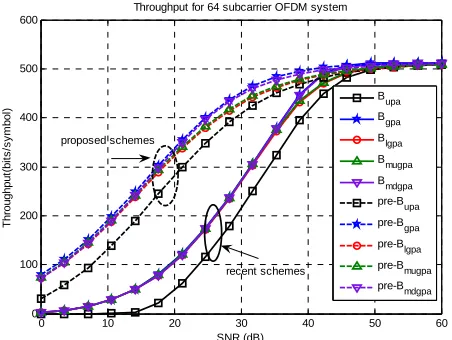
equivalent to 8 bits per data symbol The total average system throughput is studied and shown in Figures 2 and 3 for the recent (non pre-coded) [12] and proposed (pre- coded) bit and power allocation algorithms with 6 and 12-tabs FIR filters, respectively.
2 ,k [2 4 6 8]
k
M k
256
K
[image:5.595.309.535.88.258.2]M
Figure 2 shows that the optimum throughput is achi-
[image:5.595.310.536.302.474.2]eved by the GPA algorithm in each of the recent and proposed algorithms. However, because of its very large computational complexity, low complexity algorithms are proposed to efficiently use the power budget. These are pre-LGPA, Pre-MuGPA and Pre-MdGPA algorithms. The two proposed MuGPA and MdGPA with and without the MRC pre-coding approach the optimum power allocation GPA algorithm in two distinct SNR regions. MuGPA performs better at low SNRs, while MdGPA performs better at higher SNRs. The proposed precoded algorithms satisfy about 250 bits per symbol throughput enhancement over the non precoded algorithms. Figure 3 shows that the throughput is improved by about 50 bits per symbol for 12-taps FIR over 6-taps FIR filters due to the multi- path diversity of the MRC precoding.
Figure 4 shows the average system throughput versus
[image:5.595.310.535.518.706.2]target BER at SNR = 30 dB. Intuitively, throughput is
Table 3. Simulation parameters.
Parameter Value
Multipath Channel 6 and 12 tap FIR
Subcarriers Number ( N ) 64
QAM Level Constellation [ 4 16 64 256]
Precoding MRC
Bit and Power Allocation UPA, GPA, LGPA, MuGPA, and MdGPA Channel Estimation Perfect Channel Estimation
0 10 20 30 40 50 60
0 100 200 300 400 500 600
SNR (dB)
T
h
rou
ghput
(bi
ts
/s
y
m
b
ol
)
Throughput for 64 subcarrier OFDM system
Bupa Bgpa Blgpa Bmugpa Bmdgpa pre-Bupa pre-Bgpa pre-Blgpa pre-Bmugpa pre-Bmdgpa proposed schemes
recent schemes
Figure 2. Average system throughput for 64-subcarrier OFDM system with target BER = 10–3 and 6-tap FIR.
0 10 20 30 40 50 60
0 100 200 300 400 500 600
SNR (dB)
T
hr
ou
ghp
ut
(bi
ts
/s
y
m
b
ol
)
Throughput for 64 subcarrier OFDM system
Bupa Bgpa Blgpa Bmugpa Bmdgpa pre-Bupa pre-Bgpa pre-Blgpa pre-Bmugpa pre-Bmdgpa proposed schemes
recent schemes
Figure 3. Average system throughput for 64-subcarrier OFDM system with target BER = 10–3 and 12-tap FIR.
10-7 10-6 10-5 10-4 10-3
100 150 200 250 300 350 400 450 500
BER
T
hr
oug
hput
(b
it
s
/s
y
m
bol
)
Throughput for 64 sub. OFDM system , SNR=30
10-4 232
234 236 238 240 242
Bupa Bgpa Blgpa B
mugpa Bmdgpa pre-Bupa pre-Bgpa pre-Blgpa pre-Bmugpa pre-Bmdgpa
[image:5.595.56.282.628.735.2]increasing with the increase of target BER. The pre-coded algorithms outperform the non precoded algorithms. The pre-MdGPA achieves about 210 bits/symbol throughput enhancement over pre-MuGPA at target BER = 10–7 and 180 bits/symbol at BER = 10–3. This can be attributed to low variation with target BER for pre-coded algorithms compared with the non pre-coded algorithms. Also the pre-MdGPA is better than pre-MuGPA at all target BERs.
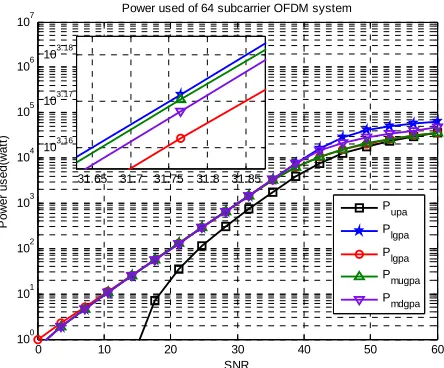
Figure 5 shows the used power by all algorithms as a
function of the power budget at target BER 10–3. The UPA with and without precoding exhibits the worst per- formance. The other algorithms are better than UPA in utilizing the transmit power. At low SNRs, all algorithms use approximately all power budget for bit and power allocations with different throughput performance as shown in Figure 2. At high SNRs, LGPA and MuGPA algorithms with and without pre-coding approaches the UPA algorithm due to the increase of highest QAM level excess power, which is missed by both of them, and therefore deteriorates their performances. Since Figure 5 is crowded; it is subdivided into two figures; Figures 6 and 7 for the recent and the proposed algorithms, respec- tively.
5. Conclusions
The optimum solution of the discrete bit and power allo-cation problem is provided by the greedy algorithm, which operates across all subcarriers but it is computa- tionally very expensive. Therefore, in this paper subop- timal low complexity alternatives have been explored in a manner in which the greedy algorithm is applied through subsets of subcarriers, which are grouped according to the QAM levels assigned to them in the uniform power allocation stage. MRC precoding is proposed to en- hance the throughput performance of these low complexity
0 10 20 30 40 50 60
100 101 102 103 104 105 106
SNR
P
o
we
r us
ed
(w
a
tt
)
Power used of 64 subcarrier OFDM system
Pupa Pgpa Plgpa Pmugpa Pmdgpa pre-Pupa pre-Pgpa pre-Plgpa pre-P
mugpa
[image:6.595.312.534.86.270.2]pre-Pmdgpa
Figure 5. The power used (watt) with target SNR (dB) variation at target BER = 10–3 for all algorithms.
0 10 20 30 40 50 60
100 101 102 103 104 105 106 107
SNR
P
ow
er
us
ed(
w
at
t)
Power used of 64 subcarrier OFDM system
31.65 31.7 31.75 31.8 31.85 103.16
103.17 103.18
Pupa Plgpa Plgpa P
mugpa Pmdgpa
Figure 6. The power used (watt) with target SNR (dB) variation at target BER = 10–3 for the recent algorithms.
0 10 20 30 40 50 60
100 101 102 103 104 105 106 107
SNR
P
ow
er
us
ed
(w
a
tt
)
Power used of 64 subcarrier OFDM system
10.5 10.55 10.6 10.65 10.7 101.04
101.06
[image:6.595.313.533.310.489.2]pre-Pupa pre-Pgpa pre-Plgpa pre-Pmugpa pre-Pmdgpa
Figure 7. The Power used (watt) with target SNR (dB) variation at target BER = 10–3 for the proposed algorithms.
algorithms, the proposed precoded bit and power alloca- tion algorithms outperform the non-pre-equalized algo- rithms and introduce less variation with target BER. Pre- MuGPA approaches GPA algorithm at low SNRs whereas Pre-MdGPA approaches GPA algorithm and outperforms Pre-MuGPA at high SNRs.
REFERENCES
[1] N. Papandreou and T. Antonakopoulos, “Bit and Power Allocation in Constrained Multicarrier Systems: The Sin- gle-User Case,” EURASIP Journal on Advances in Signal Processing, Vol. 2008, 2008, pp. 1-14.
doi:10.1155/2008/643081
[2] E. Biglieri, “Coding and Modulation for a Horrible Chan- nel,” IEEE Communication Magazine, Vol. 41, No. 5, 2003, pp. 92-98.doi:10.1109/MCOM.2003.1200107
[image:6.595.63.282.526.707.2]ceiver at the Heart of the PHY Layer of an in-Home Power Line Communication Local Area Network,” IEEE Communication Magazine, Vol. 41, No. 4, 2003, pp. 48- 53.doi:10.1109/MCOM.2003.1193974
[4] R. van Nee and R. Prasad, “OFDM for Wireless Multi- media Communications,” Artech House, Boston, 2000.
[5] R. van Nee, G. Awater, M. Morikura, H. Takanashi, M. Webster and K. W. Halford, “New High-Rate Wireless LAN Standards,” IEEE Communication Magazine, Vol. 37, No. 12, 1999, pp. 82-88. doi:10.1109/35.809389
[6] J. Heiskala and J. Terry, “OFDM Wireless LANs: A Theo- retical and Practical Guide,” Sams, Indianapolis, 2002.
[7] J. M. Cioffi, “A Multicarrier Primer,” ANSI Contribution T1E1.4/91-157, Clearfield, FLA, 1991.
[8] A. M. Wyglinski, F. Labeau and P. Kabal, “Bit Loading with BER Constraint for Multicarrier Systems,” IEEE Transactions on Wireless Communication, Vol. 4, No. 4, 2005, pp. 1383-1387. doi:10.1109/TWC.2005.850313
[9] J. Campello, “Optimal Discrete Bit Loading for Multicar- rier Modulation Systems,” IEEE International Symposium on Information Theory, Stanford, 16-21 August 1998, p. 193.
[10] J. Campello, “Practical Bit Loading for DMT,” IEEE In- ternational Conference on Communications, Vol. 2, 1999,
pp. 801-805.
[11] L. Zeng, S. McGrath and E. Cano, “Rate Maximization for Multiband OFDM Ultra Wideband Systems Using Adaptive Power and Bit Loading Algorithm,” IEEE Fifth Advanced International Conference Telecommunication, Venice/Mestre, May 2009, pp. 369-374.
[12] W. Al-Hanafy and S. Weiss, “Greedy Power Allocation for Multicarrier Systems with Reduced Complexity,”
URSI National Radio Science Conference, Menofia Uni- versity, 16-18 March 2010, Article ID 27156.
[13] A. J. Goldsmith and S.-G. Chua, “Variable-Rate Variable- Power MQAM for Fading Channels,” IEEE Transactions on Communication, Vol. 45, No. 10, 1997, pp. 1218-1230.
doi:10.1109/26.634685
[14] A. Ghosh and R. Muhamed, “Fundamentals of WiMAX: Understanding Broadband Wireless Networking,” Pren- tice Hall, New York, 2007.
[15] A. Goldsmith, “Wireless Communications,” Cambridge University Press, Cambridge, 2005.