© 2019, IRJET | Impact Factor value: 7.34 | ISO 9001:2008 Certified Journal
| Page 1686
STRENGTH AND DURABILITY PROPERTIES OF CONCRETE WITH
PARTIAL REPLACEMENT OF CEMENT WITH METAKAOLINE AND
MARBLE DUST
G. AshaLakshmi
1, P. Sai Pravallika
21
M. Tech Scholar, Department of Civil Engineering, ST. Mary’s Group of Institutions Guntur, Andhra Pradesh, India
2
Asst Professor, Department of Civil Engineering, ST. Mary’s Group of Institutions Guntur, Andhra Pradesh, India
---***---
ABSTRACT:
Ordinary Portland cement (OPC) is conventionally used as the primary binder to produce concrete. Theamount of the Co2 released during the manufacture of OPC due to the calcinations of limestone and combustion of fossil fuel is in the order of one ton for every ton of OPC produced. Attempts are made to reduce the use of Portland cement in concrete are receiving much attention due to environment-related. In the present study Metakaolin and marble duat used as a partial replacement for cement. Metakaolin is a calcinied clay and It is a Dehydroxylated form of the clay mineral Kaolinite. Stone having higher percentage of Kaolinite are known as china clay or kaolin was traditionally used in the manufacture of porcelain ceramic material. The particle size of Metakaolin is smaller than cement particles and where as Marble dust is obtained from cutting and manufacturing industries of marble. In India near about 3500 metric tons of marble dust slurry per day is generated. So, Marble dust is very easily available with very less cost. Kaolinite is also called as green pozzolana because it emits less co2. This paper presents results of an experimental program to determine mechanical properties of concrete with metakaoline and marble dust is replaced with cement with the known percentages
such as 0%,5%+5%,7.5%+7.5%,10%+10%,12.5%+12.5%,15%+15% for the grade of M30.
Key Words: Metakaolin, Marble Powder, Compressive strength, Split-Tensile strength.
1. INTRODUCTION
1.1 General
In construction Industry, consumption of cement is increasing day by day as well as cost is also increasing so to reduce the consumption of cement, partial replacement with Metakaolin and Marble powder was done in this study. Metakaolin is a calcinied clay and easily available in Gujarat, Maharashtra & Bombay etc. It is a Dehydroxylated form of the clay mineral Kaolinite. Stone having higher percentage of Kaolinite are known as china clay or kaolin was traditionally used in the manufacture of porcelain i.e. ceramic material. The particle size of Metakaolin is smaller than cement particles. Marble dust is obtained from cutting and manufacturing industries of marble. In India near about 3500 metric tons of marble dust slurry per day is generated. So, Marble dust is very easily available with very less cost. Some of industries used to wash out this marble powder with water in natural streams which cause water pollution and is harmful for our environment. So, it is advisory to use marble dust as partial replacement with cement as it has properties similar to cement and one of good pozzolanas. Similarly use of Metakaolin leads to Green concrete, because during production of Metakaolin concrete there is no emission of carbon dioxide Since there is large emission of carbon dioxide in manufacturing of cement and clinker, results in 3-5% increase in greenhouse gasses and global warming.
The growing concern of resource depletion and global pollution has challenged many researchers to seek and develop new materials relying on renewable resources. These include the use of by-products and waste materials for building construction. The high cost of conventional building materials is a major factor affecting construction in India. In developing countries where abundant agricultural and industrial wastes are discharged, these wastes can be used for various purposes in construction industry. This will have double the advantages, reduction in the cost of construction material and also as a means of disposal of wastes. Thus the approach is logical, worthy and attributable. Therefore an
attempt has been made in this study to utilize the metakaoline and waste marblepowder is used as a partial replacement
of cement in the development of low cost concrete. So a study on various strength and durability properties of these
materials is carried out. Also suitable measures have to be adopted for attaining the target strength.
1.2 Construction Waste
© 2019, IRJET | Impact Factor value: 7.34 | ISO 9001:2008 Certified Journal
| Page 1687
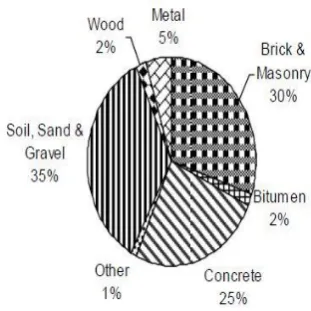
often contain materials that include: concrete, asphalt, wood, metals, gypsum, plastics and salvaged building components. It is a challenging task to handle C&D waste because it is bulky, heavy and inert and also mixture of various materials of different characteristics. It is also difficult to choose any suitable disposal method, for example, it cannot be incinerated due to its high density and inertness.Figure 1: Marble dust waste from construction Industry.
Figure 2: Different constituents of C&D waste.
1.3 Marble dust
It is an essential component of igneous and metamorphic rocks. The size varies from specimens weighing a metric ton to minute particles that sparkle in rock surfaces. The crushed marble powder used in the experiments is in a form of white powdered, which replaces fine aggregate from the conventional concrete. The particle size used ranges from 10 to 45μm
1.4 Scope of the Work
The aim of the present study is to use naturally available and low cost metakaoline and marble dust as a partial replacement to cement in concrete and to recycle the Construction waste materials so that to reduce environmental pollution.
1.5 Objectives of the Research
Objectives of the study as follows:
1. To study mechanical properties such as compressive strength at the end of 7, 14 and 28 days of curing by partially
replacing cement with metakaoline and marble powder under normal curing.
2. To reduce environmental pollution by utilizing waste material in concrete.
3. To make Eco-friendly concrete
[image:2.595.207.363.324.480.2]© 2019, IRJET | Impact Factor value: 7.34 | ISO 9001:2008 Certified Journal
| Page 1688
5. To investigate the feasibility of the combination of metakaoline and marble powder in concrete by determining its
compressive strength and tensile strength.
2. MATERIALS
Cement: OPC 53 grade cement from a single batch will be used throughout the course of the project work. The properties of cement used are shown in table below.
Table 1. The properties of cement
Coarse aggregate: The crushed aggregate was used from the local quarry. In this experiment the aggregate was used of 20mm down and tested as per IS: 2386-1963(I, II, III) specification. The properties of coarse aggregate are shown in Table determination. The properties of coarse total are appeared in Table underneath:
Table 2. Properties of coarse aggregate
S.NO PROPERTIES PHYSICAL TEST RESULTS
1 Specific Gravity 2.73
2 Water absorption 2.22%
3 Bulk Density 1.68
4 crushing value 13.98%
5 Impact value 12.71%
6 Fineness Modulus 7.89
Fine Aggregate: locally available sand was used. The sand was conforming to zone IV as per IS: 383-1987. The properties of fine aggregate are shown in Table
Table 3. Properties of fine aggregate
S.NO PROPERTIES PHYSICAL TEST RESULTS
1 Specific Gravity 2.60
2 Water absorption 0.87%
3 Bulk Density 1.61 g /cc
4 Silt Content 2.67 %
5 Impact value 12.71%
6 Fineness Modulus 3.82
Water: Water conforming to the requirements of BIS: 456-2000 is found to be suitable for making concrete. It is generally stated that water fit for drinking is fit for making concrete.
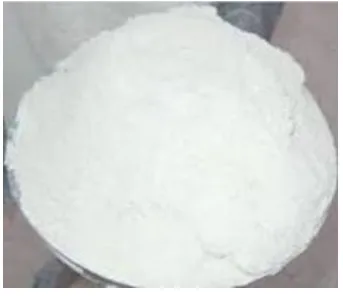
Marble dust: It is an essential component of igneous and metamorphic rocks. The size varies from specimens weighing a metric ton to minute particles that sparkle in rock surfaces. The crushed marble powder used in the experiments is in a form of white powdered marble flour, which replaces fine aggregate from the conventional concrete. The particle size used ranges from 10 to 45μm
S.NO PHYSICAL PROPERTIES TEST RESULTS
1. Specific Gravity 3.10
2. Standard Consistency 33%
3. Initial Setting Time 33 minutes.
4. Final Setting Time 356 minutes.
© 2019, IRJET | Impact Factor value: 7.34 | ISO 9001:2008 Certified Journal
| Page 1689
Figure 3: marble dust powderTable 4. Properties of marble dust
Properties Marble dust
Specific gravity 2.56
Bulk density 1340kg/m3
Percentage of Void 46.58%
Fineness modulus 3.38
Metakaoline
Metakaoline is a pozzolanic probably the most effective pozzolanic material for use in concrete. It is a product that is manufactured for use rather than a by-product and is formed when china clay, the mineral kaolin, is heated to a temperature between 600 and 800ºC.
Figure 4: Metakaoline powder
Table 5. Properties of Metakaoline
Properties metakaoline
Specific gravity 3.28
Bulk density 1005kg/m3
Percentage of Void 41.83%
[image:4.595.212.384.473.621.2] [image:4.595.207.392.670.747.2]© 2019, IRJET | Impact Factor value: 7.34 | ISO 9001:2008 Certified Journal
| Page 1690
3. EXPERIMENTAL RESULTS
Table 6. Mix details for M30 concrete (1:1.65:2.95)
Nominal concrete (NC) = Cement + Sand + CA
Compressive Strength of metakaoline and marble dust replaced Concrete
Following are the mixes considered for the study
1 - 5% metakaoline + 5% marble dust + 99%cement
2 - 5% metakaoline + 10% marble dust + cement
3 - 10% metakaoline + 10% marble dust +cement
4 - 10% metakaoline + 15% marble dust + cement
Weigh batching is done for all materials. All aggregates used in the mix were weighed under surface dry conditions.
[image:5.595.61.538.390.733.2]3.1 Compressive strength of cubes of size 15x15x15cm is tested after 7,14,28 days
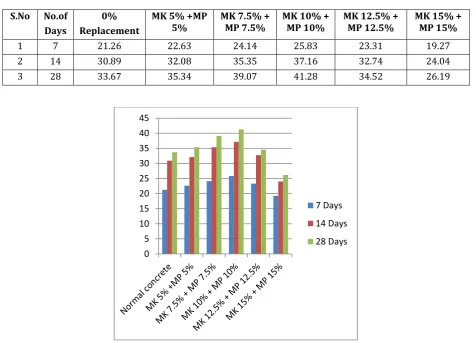
Table 7: Compressive strength of concrete cubes for 7,14,28 days
S.No No.of Days
0% Replacement
MK 5% +MP
5% MK 7.5% + MP 7.5% MK 10% + MP 10% MK 12.5% + MP 12.5% MK 15% + MP 15%
1 7 21.26 22.63 24.14 25.83 23.31 19.27
2 14 30.89 32.08 35.35 37.16 32.74 24.04
3 28 33.67 35.34 39.07 41.28 34.52 26.19
Figure 5: Graph the concrete replaced with Metakaoline a Marble dust 10%+10% has given more strength
0 5 10 15 20 25 30 35 40 45
7 Days
14 Days
28 Days
Cement Fine aggregate Coarse aggregate w/c ratio
© 2019, IRJET | Impact Factor value: 7.34 | ISO 9001:2008 Certified Journal
| Page 1691
Result: It is seen that from the Graph that the concrete replaced with Metakaoline and Marble dust at 10% + 10 % has given Maximum strength which is 41.28 KN/M2 [image:6.595.63.533.170.551.2]3.2 Split Tensile Test of Cylinders of Size 15x30 cm after 7 14, 28 days
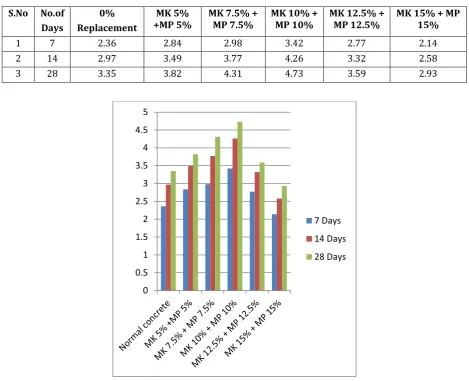
Table 8: Split tensile test results of concrete cylinders for 7,14, 28 days
Figure 6: Graph the concrete replaced with Metakaoline a Marble dust 10%+10% has given more strength
Result: It is seen that from the Graph that the concrete replaced with Metakaoline a Marble dust 10% + 10 % has given Maximum strength which is 4.73 KN/M2
4. Conclusions
1. From the Test results we find that metakaoline and marble dust can be use for partial replacement in concrete.
2. The compressive strength of concrete is more at 10%+10% replacement of metakaoline and marble dust.
3. The Cylinder strength of concrete is more at 10%+10% replacement of metakaoline and marble dust.
4. Due to increase of percentages of metakaoline and marble dust the strength of the concrete is reducing.
5. Workability of concrete is also reducing due o increase in percentage of metakaoline and marble dust.
6. Strength and durability of concrete is increase
7. Eco-friendly by reducing of CO2
5. Reference
1. Abdullah Anwar et.al (2014): Study of Compressive Strength of Concrete by Partial Replacement of Cement with
Marble Dust Powder. Ird Indian ISSN (Print
0 0.5 1 1.5 2 2.5 3 3.5 4 4.5 5
7 Days
14 Days
28 Days
S.No No.of Days
0% Replacement
MK 5%
+MP 5% MK 7.5% + MP 7.5% MK 10% + MP 10% MK 12.5% + MP 12.5% MK 15% + MP 15%
1 7 2.36 2.84 2.98 3.42 2.77 2.14
2 14 2.97 3.49 3.77 4.26 3.32 2.58
© 2019, IRJET | Impact Factor value: 7.34 | ISO 9001:2008 Certified Journal
| Page 1692
2. Sanjay N. Patil et.al (2014): Metakaolin- Pozzolanic Material For Cement in High Strength Concrete . (IOSR-JMCE)
ISSN: 2278- 1684, PP: 46-4.
3. J.M. Khatib et.al (2012): High Volume Metakaolin as Cement Replacement in Mortar. World Journal of Chemistry,
ISSN 1817- 3128, © IDOSI Publications, DOI: 10.5829/idosi.wjc.2012.7.1.251.
4. Prof. P.A. Shirule et.al (2012) Partial Replacement of Cement with Marble Dust Powder. International Journal of
Advanced Engineering Research and Studies E-ISSN2249–8974 IJAERS/Vol. I/ Issue III/April-June, 2012/175-177.
5. B.B.Sabir et.al (2001)Metakaolin and calcined clays as pozzolanas for concrete:a review.Cement & concrete
composites 23(2001) 441-454. [6] Hassan A. Mohamadien et.al (2012) The Effect of marble powder and silica fume as partial replacement for cement on mortar. ISSN 0976 – 4399, PP 418-428.
6. V. M. Sounthararajan and A. Sivakumar (2013) Effect of the lime content in marble powder for producing high