1 Title: Facilitation of an end-of-life care programme into practice within UK nursing care homes: a mixed-methods study
Short Title: Facilitation of end-of-life care into practice Abstract
Background: The predicted demographic changes internationally have implications for the nature of care that older people receive and place of care as they age. Healthcare policy now promotes the implementation of end-of-life care interventions to improve care delivery within different settings. The Gold Standards Framework in Care Homes (GSFCH) programme is one end-of-life care initiative recommended by the English Department of Health. Only a small number of care homes that start the programme complete it, which raises questions about the implementation process.
Aim: To identify the type, role, impact and cost of facilitation when implementing the GSFCH programme into nursing care home practice.
Design: A mixed-methods study.
Setting: Nursing care homes in south-east England.
Participants: Staff from 38 nursing care homes undertaking the GSFCH programme. Staff in 24 nursing care homes received high facilitation. Of those, 12 also received action learning. The remaining 14 nursing care homes received usual local facilitation of the GSFCH programme.
Methods: Study data were collected from staff employed within nursing care homes (home managers and GSFCH coordinators) and external facilitators associated with the homes. Data collection included interviews, surveys and facilitator activity logs. Following separate quantitative (descriptive statistics) and qualitative (template) data analysis the data sets were integrated by ‘following a thread’. This paper reports study data in relation to facilitation.
Results: Three facilitation approaches were provided to nursing home staff when implementing the GSFCH programme: ‘fitting it in’ facilitation; ‘as requested’ facilitation; and ‘being present’ facilitation. ‘Being present’ facilitation most effectively enabled the completion of the programme, through to accreditation. However, it was not sufficient to just be present. Without mastery and commitment, from all participants, including the external facilitator, learning and initiation of change failed to occur. Implementation of the programme required an external facilitator who could mediate multi-layered learning at an individual, organisational and appreciative system level. The cost savings in the study outweighed the cost of providing a ‘being present’ approach to facilitation.
2 Background
The predicted demographic changes internationally have implications for the nature of care that older people receive and place of care as they age. By 2050, 22% of the global population will be 60 years or over (Rutherford, 2012). With 80% of all deaths occurring in people aged 65 years or older, usually from serious chronic diseases, all countries should consider how they meet the increasing need for care in that population (Costantini and Lunder, 2012). Recently, the Organisation for Economic Co-operation and Development (OECD) stated: ‘Population ageing has increased the demand for long-term care, with spending increasing more than for any other type of health care’ (OECD, 2017:11). That statement highlights the importance of planning cost-effective care provision for future populations. Low levels of palliative care delivery in care homes has led to countries being encouraged to share examples of initiatives that improve palliative care delivery in long-term care settings (Froggatt and Reitinger, 2013; Froggatt et al., 2017).
Using the UK as an example, annual deaths in England and Wales have been predicted to increase from 501,424 in 2014 to 635,814 in 2040 (Bone et al., 2017). It has also been predicted that by 2040 the most common place of death will be in a care home (Bone et al., 2017). It is, therefore, not surprising that English healthcare policy is promoting the implementation of end-of-life care interventions in the care home setting (Department of Health, 2008). That is of particular importance for a nursing care home where 56% of residents currently die within a year of admission (Kinley et al., 2014a).
Whilst end-of-life care delivery has been a feature of English and UK policy for the last 50 years (Fallon and Smyth, 2008), it was only formalised in England in 2008 with the publication of the End of Life Care Strategy (Department of Health, 2008). That resulted in the promotion of end-of-life care interventions at a national level. However, national policies provided little guidance about potential outcomes or how to translate recommendations into practice (Department of Health, 2008; National Palliative and End of Life Care Partnership, 2015). To date, the process by which high-quality end-of-life care is implemented has been variable and driven by local interpretation and commissioning criteria. Therefore, although end-of-life care in the UK has received international acclaim (The Economist Intelligence Unit, 2015), and continues to be nationally driven, policy implementation within care settings varies from one locality to another.
3 Table 1: Phases and core components of the Gold Standards Framework in Care Homes (GSFCH) programme
Phases of the GSFCH programme
Activities and purpose within each phase
Preliminary phase
Activities: The care home managers hold internal meetings for staff, family and residents to inform them about the GSFCH programme. Letters about the GSFCH programme are sent to residents, families and external healthcare professionals, including the general practitioner and specialist palliative care service.
Purpose: Awareness of the GSFCH programme is established both within the care home and between the care home and external professionals.
Implementation phase
Activities: Four workshops are held to which nominated care home staff (known as the GSFCH coordinators) attend and who then take responsibility for implementing the programme back in their respective care homes.
Purpose: The GSFCH coordinators are encouraged to translate the information provided at the workshops into standard practice within their specific care home.
Consolidation phase
Activities: A file of evidence is compiled pertaining to 20 specified standards to evidence the implementation of the GSFCH programme into daily practice. The portfolio is then submitted to the central GSF team to be assessed for GSFCH accreditation.
Purpose: To complete the programme and become an accredited GSFCH. As the care home staff work towards accreditation the principles of the GSFCH are embedded in the care home culture. The portfolio enables the NCHs to evidence that they are providing, ‘… the right care, for the right person, in the right place, at the right time...everytime’ (GSF Centre CIC, 2012a).
Source: Gold Standards Framework Centre CIC (2011) Core component
of the GSFCH programme
Activities and purpose of each core component
Coding meetings
Activities: Monthly review meetings are established, within the NCH, where all residents are discussed. Each resident is coded according to the time that staff feel they have to live (‘A’ = years, ‘B’ = Months, ‘C’ = weeks and ‘D’ = days).
Purpose: The code then shapes the care individual residents require. External healthcare professionals are encouraged to attend. It additionally provides time for teaching, learning and staff support. After Death
Analysis
Activities: This involves reviewing deceased residents’ records, extracting specific details relating to their end-of-life care and reflecting on the death of the resident. It is undertaken at the start of the GSFCH programme, after the workshops and as they start accreditation.
Purpose: It acts as an audit tool to enable the NCH staff to review the end-of-life care they provided to a specific resident and learn from it. Significant
Event Analysis
Activities: Reflection occurs on issues that cause concern, or after the death of a resident, with completion of specific documentation.
4 Completion of the GSFCH programme occurs when the care home becomes accredited. At the time of the current study (2012), there were 17,808 care homes in England. Of those, 2,500 care homes had undertaken the programme. With 328 listed as accredited, the national average of care homes gaining accreditation, at that time, was no greater than 13% (GSF Centre CIC, 2012a,b). Accessing and implementing the GSFCH programme requires significant resources. In light of the current economic climate the low number of care homes completing the GSFCH programme through to accreditation raises questions about how the programme is facilitated.
Support from an external facilitator to care homes implementing the GSFCH programme is recommended by those who developed the programme (Thomas et al., 2005) and who have evaluated it (Clifford et al., 2007). However, it has never been a prerequisite to a care home starting the programme. As external facilitators are not employed by the GSF central team there is: no agreed model of best practice; little evidence about how facilitation of the programme should be provided; no knowledge of what such provision costs or how it could be funded; and limited evidence of outcomes that result from its provision. It is known that the level of facilitation required when implementing change into practice is influenced by both context and evidence (Kitson et al., 1998). Although previous research studies took that into account and identified that high facilitation in the care home setting was important, the specific format of facilitation was not identified (Hockley et al., 2010). As a consequence, where facilitation of the GSFCH programme is provided, different approaches exist.
In 2008, the GSF central team commissioned a regional training centre to provide a yearly GSFCH programme. A Care Home Project Team was established at the regional training centre specifically to provide facilitation for the GSFCH programme. With no evidence to guide the model of GSFCH facilitation, two studies (a cluster randomised controlled trial (CRCT) and a mixed-methods study) were undertaken to evaluate different levels of facilitation.
The results of the CRCT have been published elsewhere (Kinley et al., 2014b). That study examined the effect of using high facilitation. It compared two approaches: high facilitation (HF) and high facilitation and action learning (HF+AL). All 24 nursing care homes (NCHs) that took part in the trial were provided with structured HF, which included the appointment of at least two GSFCH coordinators in each home who attended a four-day training programme (Macmillan Cancer Relief, 2011). In addition, during the first year, an external facilitator visited the NCH two to three times a month and in the second year provided a local sustainability network (Kinley et al., 2014b).
During the visits facilitation was provided to enable learning in a variety of formats, i.e. individually to GSFCH coordinators and organisationally in group format, such as at ‘coding’ meetings, where information about residents was discussed. In addition, 12 of the 24 NCH managers attended nine monthly three-hour learning sets. The facilitated action-learning sets provided an opportunity to learn across the care home system, from one home to another, to develop practice through ‘… a continuous process of learning and reflection, supported by colleagues, with an intention of getting things done’ (McGill and Beaty, 2001:11)
5 trial, but the same data were collected from them. The CRCT was completed and the results demonstrated a significant association between the type of facilitation provided and the NCHs’ completion of the GSFCH programme through to accreditation (Kinley et al., 2014b).
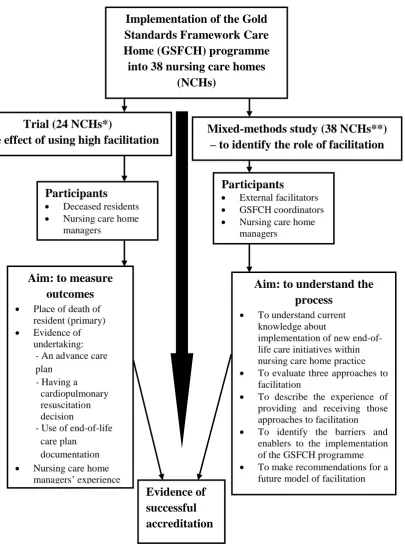
6 *Of the 24 NCHs, 12 received high facilitation (HF) and 12 received high facilitation and action learning (HF+AL)
[image:6.595.54.460.84.632.2]** As well as the 24 NCHs in * an additional 14 NCHs that received usual local facilitation took part. Some had a facilitator and so received local facilitation (LF). Others were unable to locate a facilitator and so received no local facilitation (NLF)
Figure 1: Relationship of the mixed-methods study to the cluster randomised controlled trial.
Implementation of the Gold Standards Framework Care Home (GSFCH) programme into 38 nursing care homes
(NCHs)
Trial (24 NCHs*)
– the effect of using high facilitation Mixed-methods study (38 NCHs**) – to identify the role of facilitation
Participants
Deceased residents Nursing care home
managers
Participants
External facilitators GSFCH coordinators Nursing care home
managers
Aim: to measure outcomes
Place of death of resident (primary) Evidence of
undertaking: - An advance care plan
- Having a cardiopulmonary resuscitation decision
- Use of end-of-life care plan
documentation Nursing care home
managers’ experience of action learning
Aim: to understand the process
To understand current knowledge about
implementation of new end-of-life care initiatives within nursing care home practice To evaluate three approaches to
facilitation
To describe the experience of providing and receiving those approaches to facilitation To identify the barriers and
enablers to the implementation of the GSFCH programme To make recommendations for a
future model of facilitation
7 Aim
To identify the type, role, impact and cost of facilitation when implementing the GSFCH programme into NCH practice.
Design
A mixed-methods study was undertaken owing to the complex nature of the research focus (Farquhar et al., 2011, 2013), the need to ensure fidelity and enable complementarity (Denzin, 1970). Fidelity was assessed through the collection of quantitative data detailing how facilitation was actually delivered. As facilitation was provided over a two-year period, the only way to evidence exactly what facilitation a NCH received was to keep a record of that over time. The data collection also provided a more complete picture (complementarity) about the concept of facilitation, whereby the objective view of the world (from the quantitative data) would be complemented by the subjective view of the world (qualitative data). In addition, the use of O’Cathain’s (2010) framework helped ensure that the study took account of rigour and quality within eight domains: planning quality; design quality; data quality; interpretive rigour; inference transferability; reporting quality; synthesizability; and utility.
Setting
A total of 38 NCHs within south-east England took part in the study.
Participants
The participants were from 38 NCHs undertaking the GSFCH programme. They included: 1. Staff employed by and working within the NCH:
Home manager (M) GSFCH coordinator/s (C)
2. Staff external to the core NCH staff and not employed by them: External facilitator/s (F).
Methods
Qualitative and quantitative data were collected from staff employed within the NCH (home managers and GSFCH coordinators) and external facilitators working with them. Data-collection methods included surveys, interviews and completion of facilitator activity logs. The latter two specifically related to the facilitators. With regard to quantitative data, socio-demographic data were collected from the facilitators, including their role and band. They also completed a facilitator activity log, which was collated monthly, throughout the entire two-year study. It contained information of every contact the facilitator had with each NCH, including the type of contact (email/telephone/visit), duration, activity/activities, who was present and what occurred. In relation to qualitative data, a semi-structured interview was undertaken with the external facilitators at the end of the study. The interview related to the facilitation experience within each specific participating NCH.
8 the home after a death was recorded as organisational leaning; and an educational meeting held for all the home managers in an external venue was recorded as systems learning.
Qualitative data were transcribed verbatim and entered into NVivo 9. Template analysis was then undertaken (Crabtree and Miller, 1999). Checkland’s (1999) Soft Systems Methodology mnemonic CATWOE formed the framework of the coding templates for the initial exploration of the data (Crabtree and Miller, 1999). It took account of the NCH undergoing the change (Customer), the person (in this case the facilitator) implementing the change (Actor), the process of change (Transformation), any external worldwide influences (Worldview), management factors (Owner) and any environmental factors (Environmental constraints). That approach was chosen as Soft Systems Methodology enables mapping an understanding of what a complex organisational unit is doing and therefore is valuable before initiating change. Following population of the CATWOE templates, analysis and interpretation of the data collected occurred by immersion and crystallisation within each of the templates (Crabtree and Miller, 1999).
The quantitative data were analysed first, followed by the qualitative data. Integrating the total data set then occurred through ‘following a thread’ (Moran-Ellis et al., 2004). Any additional concepts emerging from the qualitative data were followed back within the quantitative data, the intention being to generate further knowledge by looking for evidence of resonance across findings (Moran-Ellis et al., 2004). The facilitator-specific data emerging from the initial data analysis is reported here.
Results
At the start of the study, 17 external facilitators provided facilitation of the GSFCH programme to 33 (87%) of the participating NCHs. Five (13%) NCHs had no local external facilitator. There were no missing data.
After reporting the facilitators’ attributes, the results presented relate to the amount of time that facilitation was provided, the format of provision, the external facilitators’ approach to the provision of their role and cost of providing facilitation. The study identified that some of the 14 NCHs in the usual local facilitation group had facilitation provided. That led to the division of the 14 NCHs into two groups: those either receiving local facilitation and those who had no local facilitation. Overall results are given and where possible in relation to the external facilitation provided to NCH staff, i.e. either high facilitation and action learning (HF+AL), high facilitation (HF), local facilitation (LF) or no local facilitation (NLF). Other results are reported in Kinley (2014).
Facilitators’ attributes
9 The external facilitators’ familiarity with, and experience of, the GSFCH programme was similar. Six external facilitators (60%) in the LF group had previous experience as a GSFCH external facilitator. That was also the case for four (57%) of the seven external facilitators within the combined HF groups.
Facilitation time provided
It was intended that facilitation would be provided throughout the GSFCH programme. Two sources of facilitated support were available to the GSFCH coordinators implementing the programme in their NCH - at the regional training centre where workshop-based training was delivered and in the NCHs via the identified external facilitator. Across the four groups, the variation in facilitation time that was provided was considerable, ranging from 2–224 hours (Table 2). The NLF group only received facilitation via the regional training centre. For one of the NCHs in the LF group that had negotiated successfully the assistance of an external facilitator, the total facilitation time received was less than six hours. That was only slightly more assistance, over the two-year period, than one of the NCH in the NLF group.
Table 2: Total facilitation time provided to the nursing care homes
*This facilitation group was subdivided. In this group a facilitator, and therefore access to facilitation, was either provided or not; GSFCH = Gold Standards Framework in Care Home
Format of facilitation provision
The activities undertaken by the facilitators to support NCH staff to implement the GSFCH programme, as recorded in the activity logs, are provided in Figure 2. Table 3 provides a key to the terms used in Figure 2. The activities were initially classified according to the format of facilitation provided and then collated under the format of learning provided, i.e. whether learning was provided to targeted professionals within the home (individual learning) or to groups of individuals either within the home (organisational learning) or external to the home (systems learning). Within each facilitation group the collective time of each facilitation activity across all homes is provided (see Figure 2).
Individual learning occurred with the GSFCH coordinators and the facilitators. NCH managers were encouraged to appoint at least two members of staff as GSFCH coordinators. They all achieved that. However, by the end of the two-year programme, only 11 of the 37 NCHs (30%) had retained their initial two GSFCH coordinators. One NCH closed in the study period. Six had no GSFCH coordinators in post that had attended the GSFCH workshops. When that occurred the role of the external facilitators extended beyond working alongside the GSFCH coordinators. They may then be the only individuals with clarity about what needed to be implemented within the participating NCH. It was therefore crucial that the facilitators themselves also undertook individual learning in order that they too had a Facilitation group (n=number of homes) Total facilitation time over the entire
two-year GSFCH programme (hours)
Range Median
Usual local facilitation* - facilitation was either absent or provided
No local facilitation
(n=5)
2–4.30 3
Local facilitation
(n=9)
5.55–124.27 24.40
High facilitation (n=12) 41.35–163.25 120.18
High facilitation and action learning
(n=12)
10 detailed understanding of the GSFCH programme and how to facilitate its implementation. Such learning was not evident within the LF group, where there was a sense that the external facilitators did not perceive themselves as providing a specific GSFCH external facilitator role:
‘…we’re none of us are specifically GSF but we’re end-of-life facilitators.’ [F7]
Such lack of engagement with the concept of being a GSFCH external facilitator may have arisen because the facilitators were uncertain about what they should be doing. A number of the external facilitators providing the LF approach reported that they were not sure of their role and responsibilities. For example, one stated:
‘…some information of…what am I meant to be…facilitating them to do?…I wasn’t even clear what Gold Standards were initially...it’s not like I’d gone to a course for facilitators for Gold Standards and this…is what you should be doing.’ [F10]
Organisational learning was supported through a number of activities, including coding meetings (Table 1). The facilitators in both HF groups encouraged the NCH to set up coding meetings (where facilitated support ranged from a mean of 11.5 hours in the HF group to 18 hours in the HF+AL). Those meetings provided the opportunity for residents to be discussed and their care planned and agreed upon by the entire team rather than by an individual. Interestingly, the 14 LF NCHs collectively received less facilitated support with that core element of the programme than the HF homes received individually. They had a mean of just 30 minutes across the entire two-year programme. The other main activity where organisational learning occurred was in relation to reflective practice (after death analysis and significant event analysis) (Table 1). Only NCHs in the HF groups received facilitation that supported that format of organisational learning (see Figure 2). Where facilitation was not provided proactively for that activity, its provision to enable organisational learning was minimal.
Systems learning was addressed by the provision of support for NCH staff (including the GSFCH coordinators and NCH managers), in groups with their peers across the NCHs (see Figure 2). However this varied in the different facilitation groups. Learning occurred, across care homes, by the GSFCH coordinators in the HF and HF+AL groups. In the preliminary phase of the programme system, they attended the Macmillan Foundations in Palliative Care for Care Homes training:
‘They met with other co-ordinators who were in exactly the same situation as they were so…they were sort of able to have a support system for themselves...So the co-ordinators knew each other before they attended the first workshop and I think that really helped.’ [F3].
Learning occurred side by side with action learning, for the NCH managers, in the HF+AL group:
‘With the general feedback from the other managers at the session I was able to realise that some of the issues at my home were similar to other homes. So together we were able to solve some of them.’ [M.HF+AL12.000]
11 ‘Training that has been put on by GSF programme, with the added benefit of meeting staff from other homes. It is interesting to hear and share ideas and challenging situations.’ [C.HF+AL8.000]
In the LF group it was suggested that such links would be useful; however, no NCH had taken the initiative to forge such a relationship:
‘It would have been useful for the GSF to arrange buddy system with another home, who you knew was willing to give advice.’ [M.NLF9.000]
Systems learning was also identified as important to the external facilitators:
12 Figure 2: Format of external facilitation and total time provided (hours) to put systems into place within each facilitation group.
0 50 100 150 200 250 300 350 400
HMCM RM
EIH SEA
CM ADA
EOH MFPC
CoM DP
NM 15
0
59
0 8
0
47
0 6
5
46 126
11 115
40
138
83
30
355
73
38
177 144
6
167
36
218
65 73
309
146
60
309
To
tal
co
lle
ctiv
e
faci
litat
io
n
tim
e
(h
rs)
Format of Facilitation
13 Table 3. Key to Figure 2
Approach to the provision of facilitation by an external facilitator
The experience of facilitation, by a nominated external facilitator, was only applicable in three groups (LF, HF and HF+AL). However, in addition, the NCH manager in one of the NLF groups acted as an internal facilitator. External facilitators recognised that the ultimate outcome of their role was the NCH taking on responsibility for the GSFCH programme, in a way that suited them. There was agreement among external facilitators around the core elements of facilitation: provision of support, advice, guidance and helping others to avoid problems; active work; and inspiring a vision for change. However, there was greater disparity in how the role was undertaken in practice. Three approaches to facilitation were identified when implementing the GSFCH programme into practice: ‘being present’ facilitation; ‘fitting it in’ facilitation; and ‘as requested’ facilitation.
‘Being present’ facilitation
The ‘being present’ approach was evident in both HF groups. That format of facilitation provided proactive rather than reactive facilitation:
‘…every time I left the NCH I would set the next date...giving them time to do what we’d planned for them to do...and I would try and say to them, “How long do you think it’ll take you to do this? And I’ll come back then”’. [F1]
‘Being present’ enabled the external facilitators to identify where a NCH needed help. Holding monthly coding meetings within the NCHs is a core element of the GSFCH programme. ‘Being present’ meant one external facilitator noticed that a home was struggling to start the process. Working with staff, the facilitator set up a template on the home’s computer that produced the required documentation. Coding meetings were then started. Providing that type of facilitation role took time, commitment and energy. However, ‘being present’ enabled facilitators to give attention to detail and follow things through.
In one NLF NCH the manager recognised the need for the entire NCH to adopt the principles of the GSFCH programme. She saw the importance of providing face-to-face education sessions for all staff members and acted as the ultimate ‘being present’ facilitator. Her passion and drive empowered her to run internal education sessions and motivate all her staff:
‘She and three members of her staff have taught all the other staff the Macmillan Foundations in Palliative Care. She learnt loads about her staff doing this, e.g.
Format of learning Format of facilitation Key
Individual learning
Nursing care home manager and Gold Standards Framework in Care Homes (GSFCH) coordinator meeting
HMCM
Role modelling RM
Organisational learning
Education within the nursing care home EIH
Significant event analysis SEA
Coding meeting CM
After death analysis ADA
Systems learning
Education outside the nursing care home EOH Macmillan Foundations in Palliative Care training MFPC
GSFCH coordinator meeting CoM
Developing partnerships with other professionals DP
14 multicultural beliefs re death and dying as she has totally multicultural workforce. ...this really helped her develop a relationship with the staff. She hosts as many training events as she can for the community matron, e.g. verification of death. That way her staff go for free.’ [Researcher]
In that home ‘being present’ facilitation was still required but it was provided internally rather than externally. The home manager’s position and GSFCH coordinator role enabled the process to occur. The manager used the opportunity to increase understanding between herself and her team and between the team members. Achieving that involved spending time with her staff and them spending time with each other.
‘Fitting it in’ facilitation
In the LF group, where a facilitation plan was not imposed, other factors acted to shape the format and, therefore, the experience of the facilitation that was provided. One such approach identified was ‘fitting it in’ facilitation.
The external facilitators providing LF had multi-faceted roles, and facilitation was not their major concern/priority. They had often been asked to take the role on, leading to conflict in time management between that and their other roles:
‘…It was something I was asked to do as a part of my job.’ [F8]
In such cases facilitation was often seen as the least important aspect of the job. When undertaking external facilitation in the NCHs, they tended to focus their activity on the key elements of their main role, which were their areas of strength and easier components to fulfil. For example, the main role of one of the external facilitators was in education; therefore, the main focus of her GSFCH facilitation was education. A second example was where an external facilitator’s role was linked to a clinical role:
‘I think because I was...doing, a busy day job, the facilitation was very much an add-on to my then role, and, you know, there was a lot of cadd-onflicts with priorities and things. And although the GSF was a priority, you know, if you’ve got a home in crisis, then that’s clearly a priority.’ [F13]
The lack of clarity around the GSFCH external facilitator role led to local interpretation. However, that did not always occur in relation to an identified need within the nursing home. It was also affected by the other role and responsibilities of the external facilitator:
‘…although facilitator doesn't mean this, for me it's involved a change of policies, writing manuals…’ [F9]
The lack of clarity in how to provide facilitation, alongside the need to juggle time for it alongside other roles, meant that the facilitation offered was what time permitted. Some of the external facilitators in the LF group reported that they had linked their local NCHs together. However, unlike with the HF nursing home network forums, where homes were encouraged to meet as a way of supporting and sustaining change, the approach had been developed as a result of time pressures:
15 session on how they are, but that’s just purely for my reporting.’ [F4]
‘As requested’ facilitation
‘As requested’ facilitation was also identified in the LF group, where a facilitation plan had not been imposed. As with ‘fitting it in facilitation’, various factors acted to shape the format and therefore the experience of the facilitation that was provided.
In the LF approach, rather than building a relationship, the external facilitators tended to rely on the NCHs to approach them for assistance. However, when the onus was left to the home to contact the external facilitator, it did not happen:
‘It’s very ad hoc...it’s just whatever they want and whatever they need really…’Cos that’s the thing, I mean, you can’t, you can’t force yourself on people, can you?…I’ve got to rely on you to get in touch with me and...consequently they haven’t actually…’ [F17]
The lack of contact referred to in the above quotation is also illustrated by comments received from a GSFCH coordinator in the LF group:
‘Had I of known the route I would not have commenced not having a facilitator.’ [C.LF10.00]
However, that NCH did have an external facilitator. Over time, as the onus for facilitation here was one of ‘as requested’ by the NCH staff, and requests did not occur, the GSFCH coordinators in the NCH became unaware of their facilitator’s existence.
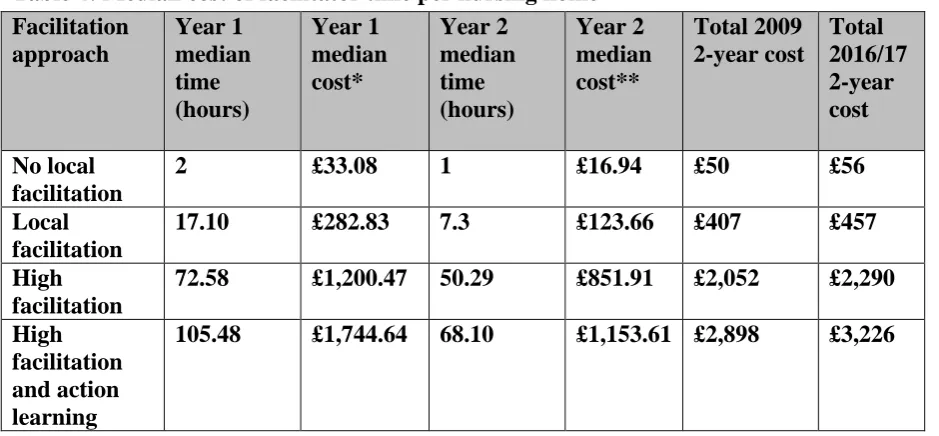
Cost of facilitation
16 Table 4: Median cost of facilitator time per nursing home
*Cost estimated from the then mid-band 7 salary (minus all other costs) ** Cost estimated from the then mid-band 7 salary (minus all other costs)
Discussion
Facilitation of the GSFCH programme has previously been identified as important (Thomas et al., 2005; Clifford et al., 2007; Hockley et al., 2010; Hockley and Kinley, 2016). The CRCT undertaken alongside this study highlighted the value of HF, notably when supported by action learning (Kinley et al., 2014b). This study details how facilitation of the programme was provided within the 38 NCHs in the CRCT, to enable understanding of the outcomes resulting from its provision. What became apparent was that translation of the GSFCH programme into practice required more than the action learning for home managers and a ‘being present’ approach by a facilitator that the CRCT had highlighted (Kinley et al, 2014b). The facilitation provided within the 38 NCHs was directed at individual, organisational or systems level learning (see Figure 2). It was the provision, or absence, of that multi-layered approach to facilitation (enabling learning at individual, organisational and systems level) that impacted on implementation.
Multi-layered learning
Senge et al (1994) identified five elements that were essential to a learning organisation: personal mastery; mental models; shared vision; team learning; and systems thinking. Those elements support the multi-layered approach to learning that emerged from this study’s findings.
Personal mastery: this relates to the individual learning of both the external facilitator and GSFCH coordinators. The facilitator needed to know the GSFCH programme and be able to share the vision of how to implement it into practice within the context of each specific NCH. That may explain why a ‘being present’ approach to facilitation resulted in more NCHs completing the GSFCH programme.
In relation to individual learning, the initial focus of the GSFCH programme is the individual education of GSFCH coordinators in workshops. However, the intended outcome of the programme is one of cultural organisational change (GSF Centre CIC, 2011). Implementation of the GSFCH programme required the associated knowledge and skills to become part of everyone’s practice, not just the practice of individuals. For that, organisational learning as Facilitation approach Year 1 median time (hours) Year 1 median cost* Year 2 median time (hours) Year 2 median cost** Total 2009 2-year cost Total 2016/17 2-year cost No local facilitation
2 £33.08 1 £16.94 £50 £56
Local facilitation
17.10 £282.83 7.3 £123.66 £407 £457
High facilitation
72.58 £1,200.47 50.29 £851.91 £2,052 £2,290 High
facilitation and action learning
17 well as individual learning needed to occur. Senge et al (1994) referred to organisations undergoing such change as learning organisations. Such learning is only possible when attention is provided to Senge et al’s (1994) remaining four elements — mental models, shared vision, team learning and systems thinking.
Mental models: these are individuals’ personal pictures and understanding of the world that shape their actions and decisions. They are not static. Senge et al (1994:267) described an organisation’s culture as, ‘its members’ collective mental models, which is why you cannot change an organisation without investigating its cultural assumptions’. Changing those can only occur with conversations and/or reflection within the system, where individual mental models are discussed or challenged. A strength of the GSFCH programme is that its completion requires putting time aside to reflect on practice. That process can help identify individuals’ mental models. However, it is only a strength of the GSFCH programme if it is translated into practice within the NCH. In this study, without HF and the associated ‘being present’ approach to facilitation, reflective practice failed to occur (see Figure 2). The view of learning from practice and recognition of its importance is not a new. It was described by Wenger (1998:95): ‘…one reason they do not think of their job as learning is that what they learn is their practice…what they learn is not a static matter but the very process of being engaged in, and particularly in developing, an ongoing practice.’
Shared vision: to become a learning organisation, individual GSFCH coordinators needed to transfer the information they learnt at the workshops to the organisation as a whole. To achieve that there needed to be what Hendy and Barlow (2012:351) described as, ‘a significant shift in the ownership of the work’. That shift of ownership can only occur if the organisation is able to grasp a shared vision of the future. In the programme the generation of such a vision was enabled through reflective practice and the coding meetings.
Team learning: a team that learns together will have a greater ability and intelligence than the sum of the individual members’ parts (Senge et al., 1994). To become a learning organisation, the team needs to move forward collectively. The establishment of the coding meetings, the significant event analysis ‘reflective practice’ meetings and the creation of the portfolio of evidence (see Table 1) enabled all members of the internal system of the participating NCHs to learn together. Such activities also ensured the sharing of personal mental models and the creation of a shared vision. Those three elements built on one another. The only NCHs to undertake consistently those activities with their staff were those provided with HF. Where reflective practice had not formed part of structured facilitation of the GSFCH programme (i.e. in the NLF and LF NCHs) there was no mention of it occurring in any of the formats listed above.
18 Whilst this study highlighted the importance of systems thinking (the joining together of a NCH and its internal and external systems) for organisational learning to occur, it showed that that was not enough. Collaboration between such learning organisations created an additional opportunity to learn (i.e. the joining together of a NCH and its internal and external systems with another NCH and its internal and external systems). Blackmore (2005:338) described the term ‘learning systems’ as follows:
‘By learning system I mean inter-connected subsystems, made up of elements and processes that combine for the purposes of learning. The placement of a boundary around this system depends on both perspective and detailed purpose.’
Vickers (1983) conceived the concept of inter-organisational learning, i.e. learning from systems that are in a similar situation. He wrote: ‘….the more uniform the experience of members of a society, the more fully they are likely to share their common language and the more rich it is likely to be’ (Vickers, 1983:42). The establishment and use of learning systems are dependent upon the users’ perception of them, whilst the goal of a learning system is to share joint experiences and create joint learning (Holmqvist, 2003). The joining together of NCHs by the external facilitator created learning systems and in so doing increased the learning potential of those NCHs. That occurred in both HF groups and some of the LF groups. Effort would only be made to maintain links within learning systems that were perceived as worthwhile. Learning within an appreciative learning system is therefore important.
The creation of such appreciative learning systems between the NCHs in the HF groups resulted in learning. The action learning, reported in the CRCT, was one example of an appreciative learning system (NCH managers learning from other NCH managers) but others existed. Learning through such appreciative learning systems required work by the external facilitator to initiate and then maintain them. However, work was also required by the staff in the NCHs in order to attend, participate in, and learn from them. It was their attendance, not their creation that led to the learning.
What was clear is that inter-organisational learning requires a knowledgeable, skilled external facilitator to ensure that a ‘safe’ environment for learning is generated (Van Winkelen, 2010). The external facilitators in the HF group all had a specialist palliative care background and facilitation was the sole role and, therefore, the priority of their job. As facilitation was not the dedicated main role for any of the external facilitators providing a LF approach, the lack of clarity and focus may have meant they did not have to accept responsibility or accountability for the role. External facilitators in the LF group had other responsibilities. Consequently, their performance would probably have been judged with regard to the core aspects of their role and not their facilitation of the GSFCH programme. That may have led to the ‘as requested’ and ‘fitting it in’ approach, described above.
19 The one exception to the model was the NLF home manager who was able to provide the five elements that Senge et al (1994) identified as essential for organisational learning. She was not only knowledgeable and skilled in relation to the GSFCH programme but also connected to and part of her external specialist palliative care service. That was the only NLF NCH to complete the programme through to accreditation. It may be that, over time, if care home managers gain knowledge and skills and establish connections with their external healthcare providers, they will begin to take on more of the facilitation role. However, literature relating to change suggests that the presence of a facilitator who is external to the specific organisation implementing change is valuable (Schwarz, 2002). For example, Hendy and Barlow (2012) found that their process of health system change was enabled when there was a champion who, like the GSFCH external facilitators, was not an internal member of staff. Ross and Roberts (1999) supported such a model of facilitation but had an additional recommendation. They suggested that group learning is improved and change implemented when external facilitators are supported by internal facilitators, who are familiar with the organisation’s culture. The GSFCH coordinators were those internal facilitators.
Given the current economic climate, sourcing funding for such facilitation could be problematic. However, the generalisability of this study’s findings is enhanced when savings in the care system are plotted against the cost of providing facilitation. The CRCT (Kinley et al., 2014b) demonstrated a greater proportional reduction in the number of hospital deaths when HF (10% reduction), or HF+AL (13% reduction) were provided. An admission to hospital of a frail older person that ends in death costs between £2,352 and £3,779 (National End of Life Care Programme, 2012). Ennis et al (2015) demonstrated that it costs £4,223 more if the death of a resident occurs in the hospital rather than in the NCH.
If cost savings are accounted for purely in relation to hospital admission at the end of life, then the cost of providing facilitation within NCHs for the GSFCH programme could be justified. What is crucial is that cost savings are mapped across the system — in this example, the cost of providing facilitation in NCHs can result in cost savings to the acute sector. The national drive to encourage collaborative working across care settings through, for example, in England the Sustainability and Transformation Plans, could enable innovative partnerships to work (NHS England, 2017). Looking beyond cost-effectiveness the CRCT also highlighted additional benefits in relation to implementing the GSFCH programme, e.g. the increased frequency in completion of advance care plan documents (Kinley et al., 2014b).
There were a number of limitations to the study. Data collected related to that which was reported, not observed, to have occurred. Its accuracy relied on the recollection, recording and honesty of the participants. It is also recognised that factors, other than the provision of usual local facilitation, may have played a part in NCHs’ implementation of the GSFCH programme. NCHs, for example, may have sought assistance for end-of-life care training provided via another system (e-learning) or from another professional.
20 safety improvement initiative they were implementing into care homes. They stressed that taking time to understand the context for change is essential. In the current study, Soft Systems Methodology was used to provide that analytical lens. Implementation of change in NCHs required the facilitator to learn about each individual NCH’s context. ‘Being present’ facilitation was essential for that to be achieved. However, ‘being present’ was not enough. It was the facilitator’s individual learning from ‘being present’ that enabled them to provide an appropriate multi-layered approach to learning, specifically tailored to an individual NCH. That ensured that the facilitation provided resulted in change, as it was appropriate to the specific setting of the individual NCH and utilised what was already in place. Further evidence supporting multi-layered learning approaches in care homes in relation to implementing and sustaining the GSFCH and other end-of-life care programmes is now emerging (Hockley and Kinley, 2016; Kinley et al., 2017).
Whilst the study reported here relates to the implementation of the GSFCH programme within the UK, its applicability is being explored on a wider scale. The approach has been adapted and incorporated into a subsequent European Union’s Seventh Framework Programme funded study (Van den Block et al., 2016). However, when implementing initiatives other than those relating to end-of-life care, the value of paying attention to learning at all three levels of learning requires further investigation. The NHS England’s (2016) publication on new models for care homes may begin that process. It highlights the importance of health and social care commissioners, care home staff and owners and service users working together (organisational learning) and care homes engaging in a forum (appreciative systems learning). For now, multi-layered learning should be considered when implementing new initiatives into care homes.
Conclusion
21 References
Blackmore, C., 2005. Learning to appreciate learning systems for environmental decision making: a ‘work-in-progress’ perspective. Systems Research and Behavioral Science. 22, 329-341.
Bone, A., Gomes, B., Etkind, S., Verne, J., Murtagh, F., Evans, C., Higginson, I, 2017. What is the impact of population ageing on the future provision of end-of-life care?: Population-based projections of place of death. Palliative Medicine. 1 October, doi:
10.1177/0269216317734435.
Checkland, P., 1999. Systems Thinking, Systems Practice: Includes a 30-Year Retrospective. John Wiley & Sons Ltd, West Sussex.
Clifford, C., Badger, F., Plumridge, G., Hewison, A.,Thomas K., 2007. Using the Gold Standards Framework in Care Homes: An Evaluation of the Phase 2 Programme. School of Health Sciences, University of Birmingham.
Costantini M., Lunder U., 2012. OPCARE9 – A European perspective on the last days of life. European Journal of Palliative Care. 19, 175-177.
Crabtree, B., Miller, W., 1999. Doing Qualitative Research. 2nd edn. Sage, London.
Denzin, N., 1970, The Research Act: A Theoretical Introduction to Sociological Methods. Butterworth & Co., London.
Department of Health, 2008. End-of-life Care Strategy: Promoting High Quality Care for all Adults at the End of Life. Department of Health, London.
Ennis, L., Kinley, J., Hockley, J., McCone, P, 2015. The cost of providing end of life care for nursing care home residents: a retrospective cohort study. Health Services Management Research. 28, 16-23.
Fallon, M., Smyth, J., 2008. Terminology: the historical perspective, evolution and current usage – room for confusion? European Journal of Cancer. 44, 1069-1071.
Farquhar, M., Ewing, G., Booth, S., 2011. Using mixed methods to develop and evaluate complex interventions in palliative care research. Palliative Medicine. 25, 748-757.
Farquhar, M., Preston, N., Evans, C., Grande, G., Short, V., Bernalia, H., Higginson, I., Todd, C., 2013. Mixed methods research in the development and evaluation of complex
interventions in palliative and end-of-life care: Report on the MORECare Consensus Exercise. Journal of Palliative Medicine. 16, 1550-1560.
Froggatt, K., Reitinger, E., 2013. Palliative Care in Long-Term Care Settings for Older People. EAPC Taskforce 2010–2012 Report. European Association for Palliative Care (EAPC), Belgium.
22 European care homes and nursing homes: application of a typology of implementation. Journal of the American Medication Directors Association. 18, 550.e7–550.e14.
Gold Standards Framework (GSF) Centre CIC, 2011. The GSF Care Homes Training Programme Good Practice Guide. Gold Standards Framework Centre CIC, Shewsbury.
Gold Standards Framework (GSF) Centre CIC, 2012a. Care Homes — The GSF Care Homes Training Programme. GSF Centre CIC, Shrewsbury.
Gold Standards Framework (GSF) Centre CIC, 2012b. Accredited care homes.
http://www.goldstandardsframework.org.uk/accredited-care-homes (accessed 9 February 2018).
Hendy, J., Barlow, J., 2012. The role of the organisational champion in achieving health system change. Social Science and Medicine. 74, 348-355.
Hockley, J., Watson, J., Oxenham, D., Murray, S., 2010. The integrated implementation of two end-of-life care tools in nursing care homes in the UK: an in-depth evaluation. Palliative Medicine. 24, 828-838.
Hockley, J., Kinley, J., 2016. A practice development initiative supporting care home staff deliver high quality end-of-life care. International Journal of Palliative Nursing. 22, 474-481.
Holmqvist, M., (2003). A Dynamic Model of Intra-and Interorganisational learning. Organisational Studies. 24, 95-123.
Kinley, J., 2014. Facilitation of the Gold Standards Framework programme for end of life care in care homes: a mixed methods study. Unpublished PhD thesis. Lancaster University.
Kinley, J., Hockley, J., Stone, L., Dewey, M., Hansford, P., Stewart, R., McCrone, P., Begum, A., Sykes N., 2014a. The provision of care for residents dying in UK nursing care homes. Age and Ageing. 43, 375-379.
Kinley, J., Stone, L., Dewey, M., Levy, J., Stewart, R., McCrone, P., Sykes, N., Hansford, P., Begum, A., Hockley, J., 2014b. The effect of using high facilitation when implementing the Gold Standards Framework in Care Homes programme: a cluster randomised controlled trial. Palliative Medicine. 28, 1099-1109.
Kinley, J., Stone, L., Butt, A., Kenyon, B., Lopes, NS., 2017. Developing, implementing and sustaining an end-of-life care programme in residential care homes. International Journal of Palliative Nursing. 23, 186-193.
Kitson, A., Harvey, G., McCormack, B., 1998. Enabling the implementation of evidence based practice: a conceptual framework. Quality in Health Care. 7, 149-158.
Kitson, A., Rycroft-Malone, J., Harvey, G., McCormack, B., Seers, K., Titchen, A., 2008. Evaluating the successful implementation of evidence into practice using the PARiHS framework: theoretical and practical challenges. Implementation Science. 3, 1,
23 McGill, I., Beaty, L., 2001. Action Learning: A Practitioner’s Guide. 2nd edn. Kogan Page, London.
Macmillan Cancer Relief, 2011. Foundations in Palliative Care. Macmillan Cancer Relief, London.
Manley, K., McCormack, B., 2003. Practice development: purpose, methodology, facilitation and evaluation. Nursing in Critical Care. 8, 22-29.
Marshall, M., de Silva, D., Cruickshank, L., Shand, J., Wei, L., Anderson, J., 2017. What we know about designing an effective improvement intervention (but fail too often to put into practice). BMJ Quality & Safety. 26, 578-582.
Moran-Ellis, J., Alexander, V., Cronin, A., Dickenson, M., Fielding, J., Sleney, J., Thomas H., 2004. Following a thread – an approach to integrating multi-method data sets, in: ESRC Research Methods Programme, Methods Festival Conference, Oxford, July 2004.
National Palliative and End of Life Care Partnership, 2015. Ambitions for Palliative and End of Life Care: A national framework for local action 2015-2020.
http://endoflifecareambitions.org.uk/wp-content/uploads/2015/09/Ambitions-for-Palliative-and-End-of-Life-Care.pdf (accessed 17 February 2018).
National End of Life Care Programme, 2012. Reviewing End of Life Care Costing
Information to Inform the QIPP End of Life Care Workstream. National End of Life Care Intelligence Network, Public Health England, Bristol.
NHS England, 2016. New Care Models: The Framework for Enhanced Health in Care Homes. NHS England, Leeds.
NHS England, 2017. Next Steps on the NHS Five Year Forward View. NHS England, Leeds.
O’Cathain, A., 2010. Assessing the quality of mixed methods research. Towards a
comprehensive framework, in: Tashakkori, A., Teddlie, C. (Eds) Sage Handbook of Mixed Methods in Social & Behavioural Research. SAGE Publications, London, pp. 531-555.
Organisation for Economic Co-operation and Development (OECD), 2017. Health at Glance 2017. OECD Indicators. OECD, Paris, France.
Ross, R., Roberts, C., 1999. Barking and non-barking dogs, in: Senge, P., Kleiner, A., Roberts, C., Ross, R., Roth, G., Smith, B. (Eds) The Dance of Change. Nicholas Brealey Publishing, London, pp. 87-91.
Royal College of Nursing, 2016. Pay Scales for NHS Nursing Staff in England, Wales, Scotland and Northern Ireland from 1 April 2016. Royal College of Nursing, London.
Rutherford, 2012. Population aging: statistics House of Commons.
24 Rycroft-Malone, J., 2004. The PARIS Framework – a framework for guiding the
implementation of evidence-based practice. Journal of Nursing Care Quality. 19, 297-304.
Schwarz, R., 2002. The Skilled Facilitator: A Comprehensive Resource for Consultants, Facilitators, Managers, Trainers, and Coaches. Jossey-Bass, New York.
Senge, P., Kleiner, A., Roberts, C., Ross, R., Roth, G., Smith, B., 1994. The Fifth Discipline Fieldbook: Strategies and Tools for Building a Learning Organisation.. Nicholas Brealey Publishing, London.
The Economist Intelligence Unit, 2015. The 2015 Quality of Death Index. Ranking Palliative Care Across the World. The Economist Intelligence Unit, London.
The End of Life Partnership, 2017. Six Steps for Care Homes. The End of Life Partnership, Sandbach, Cheshire. http://eolp.co.uk/SIXSTEPS/six-steps-for-care-homes/ (accessed 9 February 2018).
Thomas, K., Meehan, H., Maryon, K., 2005. Use of the Gold Standards Framework in Care Homes. Report on the Introduction of the GSF into 12 Care Homes in the Pilot Phase 1 April to December 2004. National GSF Centre, Shrewsbury.
Van den Block, L., Smets, T., van Dop, N., et al., 2016. Comparing palliative care in care homes across Europe (PACE): protocol of a cross-sectional study of deceased residents in 6 EU countries. Journal of the American Medical Directors Association. 17, 566.e1-7.
Van Winkelen, C., 2010. Deriving value from inter-organizational learning collaborations. The Learning Organization. 17, 8-23.
Vickers, G., 1983. Human Systems are Different. Harper & Row, London.