GORST, Jonathan Keith.
Available from Sheffield Hallam University Research Archive (SHURA) at:
http://shura.shu.ac.uk/19707/
This document is the author deposited version. You are advised to consult the
publisher's version if you wish to cite from it.
Published version
GORST, Jonathan Keith. (2000). Modelling customer satisafaction in service
industries. Doctoral, Sheffield Hallam University (United Kingdom)..
Copyright and re-use policy
REFERENCE
Fines are charged at 50p per hour
2 3 SEP 2002
2 4 JUN 2003 S fw V
S p rA
0 8
m i 2mo<>'p —
0 8 JUL 2003
2 t
i a n2004
Q f'i
O iq
-2 M i |
JL
asl2
3 JUN 2006
5V
n
All rights reserved
INFORMATION TO ALL USERS
The q u a lity of this re p ro d u c tio n is d e p e n d e n t u p o n the q u a lity of the c o p y s u b m itte d .
In the unlikely e v e n t that the a u th o r did not send a c o m p le te m a n uscrip t and there are missing p ag e s, these will be n o te d . Also, if m a te ria l had to be re m o v e d ,
a n o te will in d ic a te the d e le tio n .
uest
P roQ uest 10697007
Published by ProQuest LLC(2017). C o p y rig h t of the Dissertation is held by the A uthor.
All rights reserved.
This work is p ro te cte d a g a in s t u n a u th o rize d co pying under Title 17, United States C o d e M icroform Edition © ProQuest LLC.
ProQuest LLC.
789 East Eisenhower Parkway P.O. Box 1346
In Service Industries
Jonathan Keith Gorst
A thesis submitted in partial fulfilment of the requirem ents of Sheffield Hallam University
for the degree of Doctor of Philosophy
Abstract
Modelling Customer Satisfaction In Service Industries
This research considers a Customer Satisfaction Index approach and its relative benefits to the UK community. It is focussed on the service industries in both the public and private sectors. It looks at, and develops the measuring and modelling processes involved and employs a Structural Equation Modelling (SEM) methodology. The research critiques two of the leading methodologies currently available (Maximum Likelihood and Fixed Point Estimation) before selecting one from which to model the whole process.
Throughout the research, three different structural models are considered. These vary in how the different latent variables are connected together, but are based around a core of specific latent variables, which together make up a customer’s total buying experience. Two of the models considered were by other authors, while the third (Sheffield Model) was a direct development of this research.
The data has been collected by the means of a questionnaire. Over the life of the research a generic questionnaire has been developed to produce a tool that is focused on the specific issues that the model requires for it to operate.
The final part of the research contemplates how a company can use the results of the index to pin point where improvements in their customer service provision would have the largest impact on their overall customer satisfaction index score.
The research considers the different aspects of customer satisfaction and their place within a Total Quality Management approach. However, the index is a completely self-contained product, which allows any company to measure how well it is satisfying its customers. The index calculates an index score between one and one hundred. The ultimate aim of the index is for a company’s score to be compared over time, against other companies within the same industry, against other companies from other industries, against the national average and even against company’s throughout Europe and the World, as National Indices operate overseas. In fact, it is envisaged that the index will act as a way for individual companies to benchmark themselves against the best customer service companies in the world.
Acknowledgements
I would like to take this opportunity to acknowledge and thank the following people and organisations for their help during the research.
• William Wallace, Director of Studies, Sheffield Hallam University • Professor Gopal Kanji, Second Supervisor, Sheffield Hallam University
• South Yorkshire Police, in particular, Superintendent John Donnelly, David Wilson and Jim Cassidy
• Yorkshire Purchasing Organisation, in particular, Arthur Haigh, Director, David Phillipson, Acting Director and Stuart Smith, Total Quality Manager
• The Survey & Statistical Research Centre, Sheffield Hallam University, in particularly Dorothy Biggin
Preface
This thesis will take the reader through the research project, which looks at the area of modelling customer satisfaction. This preface acts as an overview to the entire thesis and will steer the reader quickly and easily through the different chapters.
Chapter 1 is the Introduction. It goes through the concept of quality and how this in turn leads to customer satisfaction as a measure of quality. The chapter then goes on to look at customer satisfactions place within an organisation and how it links in with an organisations current Total Quality Programme. The chapter concludes with a section, which looks at some alternative methods of measuring customer satisfaction and why these are not suitable for achieving Business Excellence.
Chapter 2 looks at the rationale and ramifications of using a customer satisfaction index. It outlines what is meant by the term ‘customer satisfaction index’, and what is also meant by the different ‘dimensions’ which form the index.
Chapter 3 covers the methodology. A number of different statistical methods have been used including Factor Analysis, Structural Equation Modelling (SEM) and general empirical studies. A critique of two different SEM methodologies has been included in this chapter along with justification using Partial Least Squares. In addition, a section is included which covers the process of developing the questionnaire.
Chapter 4 looks in detail at the results generated by three different structured models. The different models are compared with different data sets which were collected from both public and private service providers.
Chapter 5 provides an in-depth empirical study into the data collected from the South Yorkshire Police (SYP). Two surveys were carried out with SYP which looked at two different areas of their customer base, domestic and commercial users.
Chapter 6 is a case study looking at the customers of the Yorkshire Purchasing Organisation (YPO). The YPO is a public sector organisation that is jointly owned by a number of local authorities. However, it operates as a private company and actually makes a profit for its shareholders.
C o n ten ts
1
Introduction
Page
10
1.1 Concepts of Quality 11
1.2 Development of Customer Satisfaction 13
1.3 Customer Satisfaction and Organisational Strategy 16 1.4 Interface between Customer Satisfaction \Total Quality Management \ 17
1.5
Business Excellence
Measuring Customer Satisfaction 26
1.6 Conclusion 30
2
Rationale and Ramification of a Customer Satisfaction Index in
32
2.1
the Public \ Private Sector
Introduction - The Public and Private Sector 33
2.2 A Customer Satisfaction Index 35
2.3 The Dimensions 41
2.4 Expectations 43
2.5 Quality - With regard to customer satisfaction 44
2.6 Image 46
2.7 Perceived Value 48
2.8 Customer Satisfaction 49
2.9 Complaints 50
2.10 Loyalty 52
2.11 How will an Index Influence the Public \ Private Sectors? 54
2.12 Conclusion 54
3
Methodology - A Customer Satisfaction Index
56
3.1 Factor Analysis 57
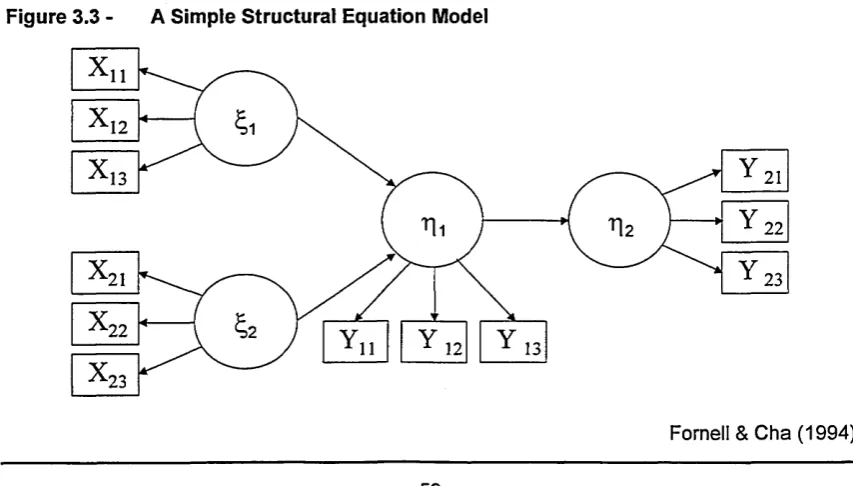
3.2 Structural Equation Modelling 58
3.3 The Maximum Likelihood Method (LISREL) 62 3.4 Fixed Point Estimation (Partial Least Squares) 63 3.5 Critique of Structural Equation Modelling 66
3.6 The Three Models 69
3.7 Survey Methodology - Collecting the Data 71
3.8 Developing the Questionnaire 73
4
Model Development \ Validation \ Data Analysis
87
4.1 Introduction 88
4.2 An Explanation of the Results 89
4.3 Mapping the Data to the Model 90
4.4 The South Yorkshire Police, 1997 91
4.5 The Yorkshire Purchasing Organisation 94 4.6 The 3rd World Congress for Total Quality Management Study 97 4.7 South Yorkshire Police, 1998, Part 12 102 4.8 South Yorkshire Police, 1998, Part 3 106 4.9 The 4th World Congress for Total Quality Management 109 4.10 Comparisons of the same model with different data sets 113
4.11 Critique 119
4.12 Conclusion 120
5
An Empirical Study of the Public Sector Data
122
5.1 Introduction 123
5.2 The Dimensions, as they relate to South Yorkshire Police 124 5.3 Survey 1, South Yorkshire Police, 1997 126 5.4 Survey 2, South Yorkshire Police, 1998 139
5.5 Conclusion 149
6
Public \ Private Case Study
150
6.1 Introduction 151
6.2 Survey Methodology 152
6.3 How the dimensions relate to the respondents 153
6.4 Analysis 154
6.5 Other Results 157
6.6 Critique 158
6.7 Conclusion 158
7
Private Sector Case Study
159
7.1 Introduction 160
7.2 How the dimensions relate to the respondents 160
7.3 1998 World Congress 162
7.4 1999 World Congress 168
8
Customer Satisfaction Seekers Approach
178
8.1 The effect of a rise in one latent variable and its influence on another 179 8.2 World Congress for Total Quality Management, 1999 180
8.3 Reverse calculations 183
8.4 Individual latent variables 184
8.5 Conclusion 190
9
Conclusions and Further Study
191
9.1 Comparisons of the different data sets 192
9.2 Further study 196
1 2 3 4 5 6 7 8 9 10 11 12 13 14 15 16 17 18 19 20 21 22 23 24 25 26 27 28 29 30 251 256 261 265 269 273 277 278 279 293 306 316 320 321 336 340 349 352 361 362 364 372 375 388 390 394 405 407 410 Implementation of PLS
Matrices for the Sheffield Model
South Yorkshire Police, 1997, Questionnaire Yorkshire Purchasing Organisation, Questionnaire
3rd World Congress for Total Quality Management, Questionnaire South Yorkshire Police, 1998, Questionnaire
4th World Congress for Total Quality Management, Questionnaire Covering Letter (South Yorkshire Police, 1997)
Questionnaire Explanation Sheet
Graphs and Tables Pertaining to Chapter 4 Graphs and Tables Pertaining to Chapter 5 Results by question, South Yorkshire Police, 1997 Comments about South Yorkshire Police, 1997 Correlation Results, South Yorkshire Police, 1998 Results by question, South Yorkshire Police, 1998
Cause of complaint comments, South Yorkshire Police, 1998 General comments, South Yorkshire Police, 1998
Graphs and Tables Pertaining to Chapter 6
Results by question, Yorkshire Purchasing Organisation
Cause of complaint comments, Yorkshire Purchasing Organisation General comments, Yorkshire Purchasing Organisation
Graphs and Tables Pertaining to Chapter 7 Correlation Results, World Congress, 1998 Results by question, World Congress, 1998
Cause of complaint comments, World Congress, 1998 General comments, World Congress, 1998
Results by question, World Congress, 1999
Cause of complaint comments, World Congress, 1999 General comments, World Congress, 1999
1.1 Concepts of Quality
An ever-increasing issue in business today, centres on the quality of services that an organisation is providing. Whether the firm is a high street store selling durable goods or a financial institution selling services, the satisfaction of the customer is increasingly of paramount importance. After all, satisfied customers and customer retention should be one of the highest priorities of any business enterprise (Kristensen & Martensen, 1996).
However, how can service be improved? How can a company ensure that its customers are satisfied? More importantly, how can a company ensure that its customers are satisfied enough to secure their return? Many books and journal articles address this subject. The likes of: Deming (1993), Juran (1989), Crosby (1979), Kanji (1990), Oakland (1993) and Zeithaml et al. (1990), to name but a few. These are people who have recognised the importance of good service and to a greater or lesser extent its place in Total Quality Management (TQM).
Increasingly important is the level of service provided by public sector organisations such as the police and local authorities. More and more public sector organisations have to account for the way in which they treat people. The government has introduced the Citizens Charter to highlight what it is reasonable to expect. However, this doesn’t necessarily mean that a quality service will be forthcoming.
Quality is an important issue in the modern competitive business world (Dahlgaard et al., 1998). However, finding a definition that satisfies everyone for every situation is another matter and one that is not a practical solution anyway. Depending on the situation or context of a given product or service will effect the definition of quality. To this end Garvin (1984, 1988), Harvey and Green (1993), Dahlgaard et al. (1998) have suggested five discrete and interrelated definitions of quality.
They are:
• Exceptional • Perfection
• Fitness for purpose • Value for money • Transformative
• Exceptional quality
According to Dahlgaard et al. (1998), there are three variations of the exceptional concept. These are:
• Traditional - The elitist’s view of high quality (Dahlgaard et al., 1998).
• Excellence - The best is required in order to achieve excellence (Dahlgaard et al., 1998). • Standards - Quality is measured by the items which fulfil the minimum standards prescribed
by the producer and can be described as ‘conformance to standards’ (Dahlgaard, et al., 1998).
• Perfection
Depending what a product or service is providing, perfection may be the aim. Indeed according to Crosby’s (1979) ‘Zero Defects’ this is something that all workers should be striving towards.
• Fitness for purpose
This side of quality can be sometimes overlooked. While the perfect product or service is desirable, it also needs to be kept in mind whether or not the product or service will be able to carry out the purpose that it is intended for. A truck maybe the best in its class, economical, comfortable, low loading height etc., but if frozen chickens are the required product to be moved and the truck does not have a cold store facility, then it is not fit for purpose.
• Value for money
Using this definition, quality is described as the price you can afford to pay for your requirements at a reasonable cost, which means quality is compared with the level of specification and is directly related to cost (Dahlgaard, 1998). Therefore, in the purest sense the quality may not be that high, the screws might not all be tightened correctly, or it may not last as long as an alternative. However, in relation to the price that has been paid, it can be seen as being good value for money.
• Transformative
been developed which allow a better quality of print to be produced. Along with developments in the quality of paper production, over time the quality of books has increased but only at approximately the same rate as expectations.
For example, books that were classed as being good quality one hundred years ago would not necessarily be classed in the same category today due to people’s expectations increasing.
Quality has different meanings for different people (Ishikawa (1976), Taguchi (1986), Deming (1982), Kano (1984), Scherkenback (1988), Juran and Gryan (1980)). However, taking the above explanations as a starting point for quality, will provide a base from which a more detailed explanation of measuring customer satisfaction, and the reasons behind why different aspects of customer satisfaction are measured. In ‘Chapter 2 - Rationale and Ramifications of a
Customer Satisfaction Index’, some of these aspects of quality will be further explained along
with how they influence a customers satisfaction.
Besides these definitions of quality there are many more. It would seem that everyone who writes a book on the subject has his or her own particular definition. But what about quality to the customer? One way of attaining the customers’ view of the quality of a product or service is through their satisfaction. Customer Satisfaction is one way of placing hard measures on the quality of a service, relevant to the customers needs and cost restrictions.
For managers to be able to see that service encounters are improving, it is necessary to find some way of measuring the satisfaction of customers, but where has customer satisfaction come from?
1.2 Development of customer satisfaction
Customer satisfaction has been around for a number of years. In the beginning it was probably in the guise of conscientious traders and merchants who had identified that a satisfied customer was likely to return for more of their goods.
In more recent times, Demings’ approach of Total Quality Management’ was a step towards ensuring quality from conception to the final sale of an item or service. Demings’ has always treated the customer as being very important in fact Demings went as far as to say:
The majority of Demings’ work was in Japan and dealt mostly with the production of visible goods. This work was started about forty years ago, helping Japan to become the major economic player that it is today.
Following the second world war, NATO introduced a standard system to ensure that all member countries of the alliance produced standard quality products that could be used by any country. These standards proved to be useful to both suppliers and customers, and in the mid 1970's the British Standards Institute was lobbied to introduce a standard system for non-defence companies, which was not connected to the NATO system. The British Standards Institute’s produced its first standards in 1979.
Following on from this, the International Standards Organisation took the 1979 version of BS5750 as the basis for its own quality standards, the IS09000 series, which it published in 1982. In the ensuing years many companies have attained these standard levels, quoting the standard as a means of ensuring and acquiring continuing business. However, just because a company has been awarded IS09000 or some other quality award, does not necessarily mean that it is producing a product or service that satisfies its customers. There have been instances when companies have gone into liquidation shortly after receiving an award, even the prestigious Baldridge Award, which is awarded in the United States.
Therefore, to ensure an organisation keeps functioning over time it needs to have in place a system for continually assessing what its customers think about it. However, before measurement techniques for customer satisfaction are discussed in more detail, it is worth mentioning that conceptually there are different types of customer satisfaction (Anderson et. al., 1994). At least two different conceptualisations of customer satisfaction can be distinguished:
• transaction specific customer satisfaction • cumulative customer satisfaction (Boulding etal. 1993)
An understanding of these two types of customer satisfaction will help with the understanding of the rest of this thesis.
• Transaction specific customer satisfaction
purchase occasion (Hunt, 1977)
However, the number of encounters that could be classified as solely transaction specific are very few. Purchasers that are one off, such as house buying are often from private individuals who are not concerned with whether the purchaser (customer) is satisfied or not. They are also making a one off sale and are not concerned with the individual returning.
There are many considerations that are taken into account when buying a house such as size and location, therefore, even if the house is being bought from new it does not follow that a customer will repurchase from a particular builder, just because they were satisfied with their previous home.
While customer satisfaction is still important, due to the fact that the customer can cause problems for the builder and carry out negative advertising through word of mouth, its importance is not the same as to the producer of an item that a customer will purchase a number of times.
• Cumulative customer satisfaction
This type of satisfaction is the one that this research is most concerned with. The idea that a previous interaction will effect the expectation the following time. To this extent it could possibly be argued that there is a link from customer loyalty to expectations. Therefore, cumulative customer satisfaction is an overall evaluation based on the total purchase and consumption experience with a good or service overtime (Fornell, 1992; Johnson & Fornell, 1991).
Items that are not purchased that often such as white goods etc., while they may be seen by many as being transaction specific, are in fact part of a long-term cumulative effect. For example, the purchase of a washing machine occurs between every five and ten years. While this might be quite a length of time between purchasers, the manufacturer of the existing washing machine will hope that the existing customer will repurchase one of their products. The chances of repurchase come down to a number of different categories such as, reliability of existing machine, cost of replacement parts, efficiency of service team etc. It is therefore down to the manufacturer to ensure that all these different things are in place if they want to retain the customer.
If we assume that customer satisfaction is a cumulative effect, then its place in an organisation’s strategy is also of great importance. Customer satisfaction will also be an influencing factor in a person’s loyalty to a particular organisation.
1.3 Customer satisfaction and organisational strategy
If the quality gurus are correct, customer satisfaction is an integral part of TQM. Therefore, customer satisfaction is not enough on its own. It needs to be part of a quality process, from raw materials and people entering, to finished goods and services for the customer at the other end. By placing customer satisfaction as one step of a complete process brings about Kanji’s definition of quality:
Quality - “to satisfy customer’s requirements continually.” (Kanji, 1990)
In fact this definition is part of Kanji’s build up to TQM. He goes on to define Total Quality and Total Quality Management as follows:
Total Quality - “is to achieve quality at a low cost” (Kanji, 1990)
Total Quality Management - “is to obtain total quality by involving everyone’s daily
commitment.” (Kanji, 1990)
‘Customer Satisfaction’, is a term used by many different companies and organisations. They use the term to describe the feelings that their customers have following an interaction with one of their members of staff, or, after using one of their products. Many organisations talk about improving customer satisfaction by many different and varied methods, but are these methodologies valid? The straight answer would probably be, if they result in an up turn in sales, particularly from customers returning to use the product or service again and again, then yes. However, these can often be short-term gains, but not, long term profits.
In this ever increasing competitive age, an organisation which is looking to be around for a long time, needs to have a strategy that is focused on the long term as well as the short. This means a strategy that not only concentrates on satisfying the customer at the end of the process, but also looks at the whole process, to see where improvements and cost savings can be made as an aim to increasing profit. Alternatively, in the case of a public sector organisation, providing service excellence for a reasonable cost.
A private sector organisation must make a profit, or shareholders will remove their money and the company will go bankrupt. A public sector organisation must work within budget, providing a service that is acceptable to its customers, otherwise customers will go elsewhere, if possible, or complain to the relevant authorities. Public Sector organisations that operate any way they see fit are becoming a thing of the past. If they don’t measure up, there is always a private company willing to be given the chance to see if it can do better.
Therefore, if a company wants to look to the future and be able to keep on having high levels of customer satisfaction, or indeed wants to improve their level of customer satisfaction, a focused methodology for the whole organisation is required. One such holistic approach is, a Total Quality Management’ (TQM) process.
In order to be able to understand customer satisfaction and how improvements and measurements can be made, it is first necessary to understand where it fits into the holistic approach of TQM. TQM is the way of life for an organisation committed to customer satisfaction through continuous improvement (Kanji & Asher, 1993).
1.4 Interface between Customer Satisfaction \ Total Quality
Management \ Business Excellence
1.4.1 Total Quality Management
Before TQM techniques can be introduced to an organisation, it is necessary to have a workforce and management structure that is willing and open to change. The culture that exists in the company is therefore of paramount importance, and it will more than likely be necessary to change the culture of the company before the way in which the organisation works can be changed. The concept of culture change and the move towards a quality culture has been discussed and written about by a number of different people, the likes of, Atkinson (1990), Brown (1995), Drennan (1992), Kennedy (1993), Kanji & Hiroshi (1997).
TQM comprises many different aspects which look to improve the company as a whole, from the time raw materials enter the factory to the time the finished product goes to the customer and beyond. It is becoming increasingly important for companies to provide after sales support, and important that the raw materials be of a certain standard to ensure a quality product. Therefore, if a company is receiving semi-finished goods to which it carries out a particular process, it might be necessary for its supplier to also have in place TQM principles. This will ensure that the product throughout its production is of a quality level that is as high as possible for the cost that has been incurred.
TQM has its roots going back to the end of the second world war. Japan was left devastated, and its industrialists realised that in order to rebuild their shattered industries, they would have to view quality as a prime ingredient (Kanji & Asher, 1993). They turned to America for help, which replied in the form of Dr Edward Deming and Dr Joseph Juran. These two men talked about the attributes of quality and its place in manufacturing at a time when American companies did not want to know.
Slowly the Japanese began to absorb the ideas that the two men talked about with the quality of their products increasing, until they caught up, and then, overtook their American and European counterparts.
The Deming Cycle Deming’s Fourteen Points The Seven Deadly Diseases
Juran’s Three Basic Steps to Progress Juran’s Ten Steps to Quality Improvement The Pareto Principle
The Juran Trilogy Crosby’s Quality Vaccine
Crosby’s Four Absolutes of Quality Management Crosby’s Fourteen Steps to Quality Improvement Crosby’s Four Absolutes of Leadership
Armand Feigenbaum: Feigenbaum’s Three Steps to Quality Feigenbaum’s Four Deadly Sins
Feigenbaum’s Nineteen Steps to Quality Improvement Genichi Taguchi: The Loss Function
Orthogonal Arrays and Linear Graphs Robustness
Gopal Kanji: The Five Principles and The Eight Core Concepts The Kanji / Asher Quality Pyramid
While each have their own different concepts and principles to achieving total quality, there is also a large amount of overlap in their studies. As a means of explaining TQM in more detail, the work of Kanji & Asher will be used as a basis as their approach leads to a clear understanding of the place of customer satisfaction in TQM.
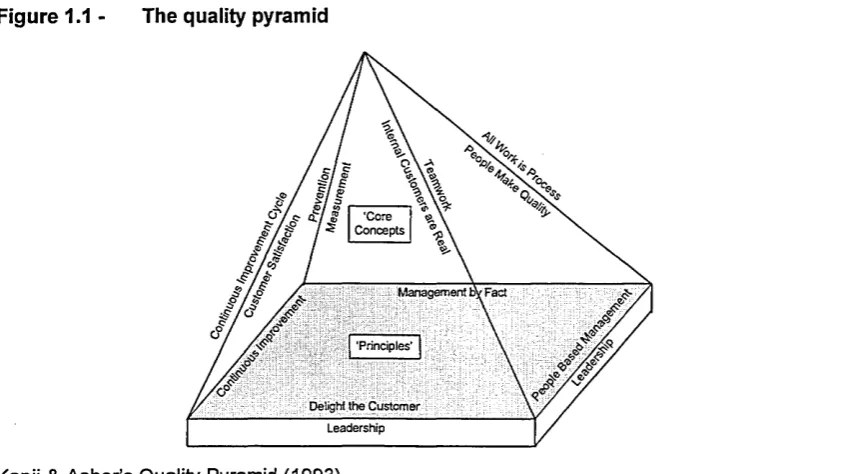
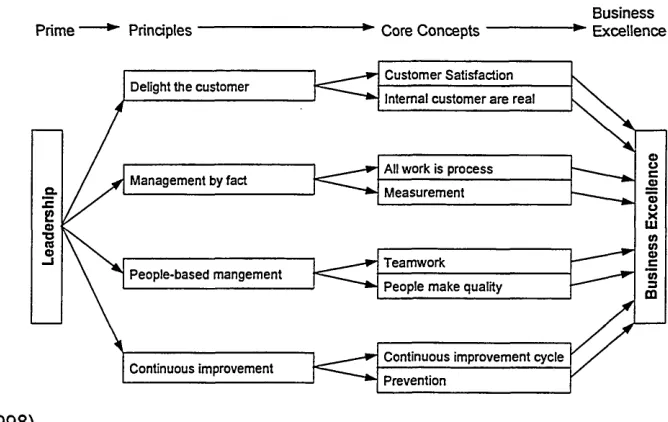
The Kanji & Asher work has been used as a basis for providing the TQM background as their approach contains a strong focus on customer satisfaction while portraying a strong emphasis on a structured approach as can be seen in their Pyramid Model (see figure 1.1). This work has been advanced further by the introduction of the Kanji (1998) Business Excellence Model, (see figure 1.4) which uses the same core concepts as the Pyramid Model, but in a more structured manner.
As an overall definition for TQM, Kanji’s (1990) methodology will in general be adopted throughout the thesis, as it encompasses the concept of customer satisfaction as being a driving force for successful TQM implementation. Kanji’s (1990) definition states: TQM is the way of life of an organisation committed to customer satisfaction through continuous improvement. This way of life varies from organisation to organisation and from one country to another but has certain essential principles which can be implemented to secure greater market share, increase profits and reduce cost’.
Edward Deming:
Joseph Juran:
Kanji’s Principles of TQM
Kanji & Asher (1993) break down TQM into five principles and eight concepts. Leadership forms the base upon which the four principles are built. The other four principles are:
• Delight the customer • Management by fact • People based management • Continuous Improvement
which, correspond with the following eight core concepts:
• Customer satisfaction • Internal customers are real • All work is a process • Measurement • Teamwork
• People make quality
• Continuous improvement cycle • Prevention
[image:23.615.90.516.458.695.2]By integrating these concepts and principles, Kanji & Asher have developed a model, the Quality Pyramid (see figure 1.1), to show off this relationship to the full.
Figure 1.1 -
The quality pyramid
Management bV Fact
Delight the Customer ‘Principles’
'Core Concepts
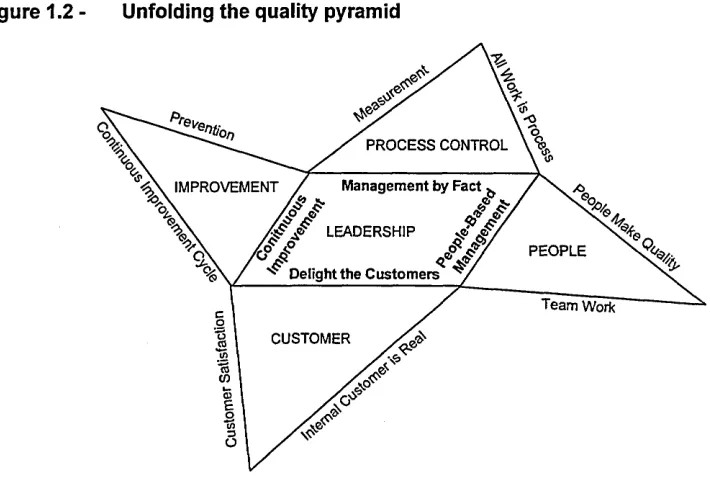
If the pyramid is unfolded, (see figure 1.2), it can be seen that each of the principals has two related concepts.
Figure 1.2 - Unfolding the quality pyramid
\-o
PROCESS CONTROL
Management by Fact IMPROVEMENT
LEADERSHIP
PEOPLE Delight the Customers
Team Work
CUSTOMER
Delight the Customer
Customer satisfaction - Internal customers are real
The idea of delighting customers rather than just satisfying them is a principal that many different quality authors employ (McNealy 1994, Donovan & Samler 1994, Plowman 1994). In delighting customers an organisation is often providing something that the customer had not expected or were not aware of the possibility of such a feature (Barnard & Wallace, 1994). Thus going a little bit further to ensure that the customer was happy with his purchase.
Management by Fact
All work is a process - Measurement
The two concepts that accompany 'Management by Fact’ are ‘measurement’ and ‘all work is a process’. Measurement is an important process, because without measurement you cannot tell whether improvements in efficiency are taking place or not. Measurement can take many different forms. The measuring of costs is one area where it is often seen as being critical if improvement in the whole company is to take place. By cutting costs, an organisation is likely to see an increase in profits. However, measuring costs is quite straight forward, as this is a ‘hard measure’. Costs for materials, staff and other overheads are easy to see and record with the total being the addition of the different costs.
Other types of measurement are not so easy to achieve. Areas such as customer satisfaction are classed as being ‘soft’ measures, and are not so easy to put a single numeric value on. Many different things go to measure how satisfied a customer is, such as what was he expecting to happen? Were his expectations met, improved upon or missed entirely? What was the attitude of the staff member who served him? Several different things go into the satisfaction of a customer, many of which cannot be easily assigned a given number for future comparison.
‘All work is a process’, an obvious statement, but how many times is the significance of this missed? By identifying that every step of the process from raw materials to finished goods is some form of action, it can allow management and employees to see where cost savings and quality improvements can be made. By empowering shop floor workers to look at the processes that they carry out, and asking them to identify areas where improvements in manufacturing (or service) or cost savings can be made, can save an organisation a great deal of time and money while improving the quality of a particular product. Besides these is the added bonus that the employee will feel better about himself and the job that he is doing and bring about an improvement in employee loyalty.
People Based Management
Teamwork - People make quality
relation between how they do their job and the external customer satisfaction. However, as Lon Wagner points out, as TQM moves through the work force, people are told and hopefully come to realise for themselves, that teamwork is the key to success. When employees start believing this and treat fellow workers as internal customers and suppliers, then there is a chance of success for the company.
Continuous Improvement
Continuous improvement cycle - Prevention
Continuous Improvement, a watchword of TQM. In the changing times in which we live, it is important that a company at least keeps up with its competitors, if not leading them in the business that they are involved. The only way in which this can be achieved is to be continually aware and open to the fact that there are alternative ways of carrying out a given process.
Figure 1.3 shows that for any process a loop can be created to indicate the continuous improvement cycle:
Figure 1.3 -
Continuous Improvement Cycle
Return tooriginal process
Given Process
Continue or Not?
A
Assess Impact
Implement
Idea for Improvement
Valid Idea or Not?
Yes \ N o
Return to original process
dissatisfaction from occurring.
Preventing complaints is not enough. Dissatisfaction needs to be prevented, because as the TARP research has shown many people who are dissatisfied and have cause for complaint, don’t challenge their supplier about it but instead take their business elsewhere.
Companies at the leading edge cannot afford to stand still. To stay ahead, the whole organisation must be involved in the constant drive for improvements in quality and service. Continuous improvement is a never-ending journey centred on the concept of starting each day anew with the principle that methods and performances can always be improved (IUKE, 1999).
Leadership
Leadership provides the base upon which the pyramid is built. Without good leadership and management being committed to the process, the chances for success are slim. TQM requires that employees work together as a team. The management of a particular organisation needs to be 100% behind TQM because in the early days especially, when resistance to change is at its strongest, the changes will need to be pushed through and enforced until the workforce comes around to thinking that change is good. Problems with the workforce can be very much dependant on the particular culture that exists in an organisation.
The challenge of leadership is to unite the whole company behind common aims and objectives and to steer the organisation through future change (IUKE, 1999).
One of the main driving forces in the modern business place is to provide Business Excellence as standard. However, how does a company know when it is providing Business Excellence? One such methodology that has been developed to measure just this is Kanji’s (1998) Business Excellence Model.
1.4.2 Business Excellence
Figure 1.4 -
Kanji’s Business Excellence Model
Business Prime Principles--- Core Concepts---Excellence
People-based mangement Management by fact
Continuous improvement
Delight the customer Customer Satisfaction Internal customer are real
All work is process Measurement
Teamwork People make quality
Continuous improvement cycle Prevention
Kanji (1998)
As can be seen in figure 1.4, customer satisfaction plays an important role in achieving business excellence.
This can be linked with the Business Excellence Model as created by the European Foundation for Quality Management (EFQM). Their model also uses customer satisfaction as a way of achieving business excellence. In fact, customer satisfaction is the largest proportion of the model.
However, while the Kanji approach uses a structured model, which indicates how the different dimensions influence each other and takes these influences into account when calculating a business excellence score, the EFQM methodology works differently.
The EFQM approach assigns weights to each of the different dimensions in advance rather than allowing the model to assign a weight as appropriate to the data. There are no linkages between any of the dimensions, thus stopping any of the elements from influencing any of the others. Therefore, the elements are discrete and independent of each other.
The EFQM Model is an ‘indicating’ model while Kanji’s (1998) Business Excellence Model is an ‘improving’ model.
methodologies, which claim to be measures of customer satisfaction.
1.5 Measuring Customer Satisfaction
A number of different techniques and methodologies exist for the measuring of customer satisfaction. Some are more widely accepted than others are. A number of the most used and written about can be seen below:
• SERVQUAL • SERVPERF • SERVCON • Priority Search
• American Customer Satisfaction Index (ACSI)
• The SERVQUAL approach
SERVQUAL is one of the most widely used methods employed for measuring, as its name suggests, SERVice QUALlity. “SERVQUAL is a 22 item instrument for measuring customers’ expectations and perceptions along five quality dimensions (tangibles, reliability, responsiveness, assurance and empathy),” (Zeithaml et al., 1990). Development began in 1983 and has been carried out by A. Parasuraman, Valarie A. Zeithaml and Leonard L. Berry. The aim of SERVQUAL is to indicate where the gaps occur between what customers expect and what they perceive. It was developed in order to provide, “a comprehensive conceptual foundation for understanding and improving service quality," (Zeithaml et al., 1990). It should be kept in mind that service quality can lead to customer satisfaction, but customer satisfaction does not lead to service quality. However, research carried out by Cronin & Taylor (1992) suggests, ‘consumer satisfaction exerts a stronger influence on purchase intentions than does service quality’.
The SERVQUAL methodology can be split into two sections:
I An expectations section. This is a survey containing 22 standard statements. These ascertain the general expectations of a customer concerning a given service.
II A perceptions section. This is a survey containing a corresponding set of 22 statements. These are used to measure a customer’s assessment of a particular company.
- Zeithaml eta!., 1990 - Cronin & Taylor, 1992 - Ruyter& Wetzels, 1996
For example:
The expectations questionnaire will contain a question like the one below:
Strongly
Disagree StronglyAgree 1 Excellent banks will have modem looking
equipment, etc.
1 2 3 4 5 6 7
While the perceptions questionnaire will include in the question the name of the specific company being surveyed.
Strongly Strongly
Disagree Agree
1 The XYZ Bank has modem looking equipment. 1 2 3 4 5 6 7 etc.
The customer is asked to indicate how strongly they agree or disagree with the statement by the use of either a 5 or 7 point Likert scale with 1 being strongly disagree and 5 (7) being strongly agree.
These 22 statements cover the five dimensions of service quality. The five dimensions that were settled upon by Zeithaml et al, (1990) are:
Tangibles Appearance of physical facilities, equipment, personnel, and communication materials.
Reliability Ability to perform the promised service dependably and accurately.
Responsiveness Willingness to help customers and provide prompt service.
Assurance Knowledge and courtesy of employees and their ability to convey trust and confidence.
Empathy Caring, individualised attention the firm provides its customers.
As might be expected, many articles have been written pertaining to the usefulness or not of the SERVQUAL methodology. Teas (1993, 1994) and Cronin & Taylor (1992, 1994) inparticular, have written a number of papers condemning the validity of the technique, while Donnelly (1995, 1996) and Anderson (1995) have written papers which raise the different problems which can arise from implementing the method.
One other aspect to bear in mind is that SERVQUAL does not necessarily measure customer satisfaction. SERVQUAL measures service quality, which as stated above can lead to customer satisfaction. As Carlzon (1987) points out, ‘while SERVQUAL tells managers how good its service is, it does not necessarily mean that customers are satisfied.’
• The SERVPERF approach
Cronin & Taylor (1992) developed the SERVPERF approach, SERVice PERFormance, as an alternative method to SERQUAL. Cronin & Taylor (1992) indicate that little if any theoretical or empirical evidence supports the relevance of the expectations - performance gap as the basis for measuring service quality (Carman 1990). Therefore, with the support of other literature (cf. Bolton and Drew 1991 a,b; Churchill and Surprenant 1982; Mavis, Ahtola, and Kippel 1975; Woodruff, Cadotte, and Jenkins 1983) they developed SERVPERF as an alternative to the SERVQUAL measure. Cronin & Taylor are two of the biggest critics of the SERVQUAL methodology
As the basis for the SERVPERF model Cronin & Taylor (1992), use the same 22 item performance indicators as used by SERVQUAL, but only from the perceived side.
• The SERVCON approach
SERVCON was also developed as an adaptation of SERVQUAL, whereby conjoint analysis was integrated with the SERVQUAL methodology (Ruyter & Wetzels, 1996). This approach does not seem to have met with any great success as journal articles regarding its successful application are not available.
• The Priority Search approach
The Priority Search technique has been developed and is used by Priority Search Ltd., a Sheffield based company.
Kelly’s theory concentrated in the main on work with individuals. A repertory grid was drawn up from constructs, i.e. statements which had meaning to an individual about an issue of importance to her / him. Followers of Kelly, for example Bannister and Fransella, used principal component analysis to facilitate interpretation of the data.
Priority Search uses sequential paired comparison to facilitate the task of pairing constructs. This method was first described by Shapiro in 1961 and later developed by Phillips in 1963. Priority Search is a further development of this methodology to permit a rapid and accurate estimation of people’s priorities.
The technique places in sequence (from the most important to the least) the different issues that have been asked of a given population. Ideally, these issues would be given to each respondent, with the intention that each respondent places them in the order that they find significant (from the most important to the least). However, the longer the list of items becomes the more difficult the human brain finds it to compare all items against each other simultaneously. It is just not possible for the majority of people to be able to remember all the issues and then rank them in order.
The next stage in this thinking was then to compare each issue with every other issue. This would, by the use of an algorithm, be able to produce a ranked order for the issues, or a priority list. However, while this approach is fairly robust, it has the effect of making very large questionnaires. For example, if the user wanted the respondent to rank 22 different items, that would mean a total of 231 different pairs, clearly unacceptable in terms of length.
The approach that Priority Search has adopted is to compare each issue with three others. Therefore, if the same 22 issues are required in a rank order, the paired comparison section would contain 33 different pairs. While this cuts down on the size of the questionnaire, it is possible for a relatively unimportant item to be paired with three items that are important. This can have the effect of lowering the item by a number of points in the priority list. However, the Priority Search literature indicates that whilst this is always a possibility it will never seriously influence the results since a complete picture is being considered rather than the precise positions of individual items.
The pairing is pseudo random.
also brings about the added problem of whether or not they are representative of an organisations customers. Even following a representative focus group the onus is still on the organisation to ensure that the correct issues are chosen from the ones that have been generated by the focus group.
The Priority Search methodology is a fairly long and drawn out process which has many opportunities for an organisations subjectivity to get in the way of an independent objective study.
Over time the Priority Search method can be repeated, and comparisons made to see whether or not a change has been made in the customers priorities. However, this is not a true measure of customer satisfaction, and the value of the study in consecutive years is not likely to compare to the value obtained in the first. Another problem that occurs with the methodology is the easiness with which unexpected results are explained.
Therefore, for comparisons over time a different approach is required. An approach, which actually measures customer satisfaction and its corresponding dimensions.
As the titles of both SERVQUAL (service quality) and SERVPERF (service performance) suggest, they do not measure customer satisfaction, but instead measure the quality of the service that is being provided. The difference between customer satisfaction and service quality is quite distinct. Only the customer can measure the level of customer satisfaction. An organisation might have its own perception of the level, but the customer is the only real judge. Whereas the level of service quality is defined by the organisation in terms of the amount of time, effort and resources it is willing to put into it.
A customer satisfaction index is a way of measuring an organisations customers perceptions as to the level of satisfaction that they are receiving. It is also has the added benefits of being easily comparable over time.
1.6 Conclusion
The literature surrounding the SERVPERF measure is substantive and makes a strong case for using it as opposed to the SERVQUAL methodology it comes from. However, much of the debate is very theoretical and articles about its successful empirical implementation are not as common as for SERVQUAL.
The Priority Search Methodology does not measure customer satisfaction. It takes a number of issues that have an effect on an organisation and ranks them. This in itself can be a useful exercise for an organisation wishing to know which areas it should concentrate on improving. However, if at the present time an issue is being dealt with satisfactorily, the issue will come out as been lower down the list than it actually should be. If the organisation then looks at the list and puts more resources into issues at the top of the list while removing resources from issues lower down the list, the chances are that customers will find a decrease in particular services which before the survey were adequate.
Chapter 2
2.1 Introduction - The Public and Private Sector
Throughout this research project reference has been made to both the public and private sector. A brief description of each can be seen below:
• The Public Sector
The public sector is the area of the economy that is run by the state, whether it is local, national or European. For the purposes of this research, two studies were conducted in the public sector; these were both carried out in conjunction with South Yorkshire Police, with two different sets of their customers. More information can be found on this work in ‘Chapter 5 - An Emprical Study of the Public Sector Data’.
• The Private Sector
The Private Sector is the area of the economy, which comprises companies. These are organisations, which in general have to make a profit or at least break even if they are to survive in the long term. During this research project two private sector case studies were undertaken. These looked at the customer satisfaction of the delegates at the third and fourth World Congresses for Total Quality Management. The details of these studies can be found in
'Chapter 7 - Private Sector Case Studies’.
• The Public \ Private Sector
Differences \ Similarities of Public \ Private Sectors
There are a number of differences and similarities between the public and private sectors. The aim of all organisations operating in both sectors should be to satisfy their customers. However, the driving force behind why they want to satisfy their customers can be quite different. In the private sector a company aims to satisfy its customers in the hope that they will return to buy more products or services. That their customers will tell there friends and associates about them who in turn will buy products or services from them. If a person is not loyal to a particular company, they will spend their money elsewhere. The cost of finding new customers is far more expensive than retaining old ones (Reichheld, 1996). In fact, studies by Naumann & Giel (1995) show that it costs about five times as much time, money and resources to obtain a new customer as it does to retain an existing one.
In the public sector the emphasis is different. It is often the case that people do not have any choice in where they purchase a particular service. In the case of the police, there is no other company or organisation that supplies the full range of services. Therefore, the driving force behind the police to make them want to excel is different. Loyalty to the police takes a different form as loyalty to a private sector company. The question can even be asked, ‘Are the police interested in having loyal customers?’ The answer must be yes. While loyalty to the police is different, it is also important that it does not become a negative.
2.2 A Customer Satisfaction Index
What is a Customer Satisfaction Index?
A customer satisfaction index is a way of benchmarking customer’s perceptions of an organisation over time. At a basic level, following a survey, and statistical calculations, it awards an organisation a score between one and a hundred. The organisation is monitored over time with a new score being calculated every six or twelve months, or whatever is appropriate. The score allows the organisation to look at itself to see whether or not in terms of customer satisfaction it is improving, disproving or remaining fairly static. However, because the methodology is constant across industries, sectors and nationally, it allows comparisons between other organisations whether they are in the same field of operation or not.
Figure 2.1 -
How an organisation fairs over time
20 10
1994 1995 1996 1997 1998 1999
Year
Figure 2.1, shows how an organisation’s customer satisfaction index might have varied over the previous six years. As can be seen, it is possible for an organisation’s manager and directors to look at the chart and see at a glance whether or not their customers perceive them as improving or disproving over time.
The purpose of an effective customer satisfaction index instrument is to provide a framework which allows an organisation to determine customer expectations and monitor how successfully a number of prioritised factors are being met over time. It should be able to track customer satisfaction in the areas that are most important to different types of customers.
Positioning the Index
One of the benefits of the index approach that has been developed initially in Sweden and America and then subsequently in the U.K., is that it can be positioned at more than one place in the economy as figure 2.2 shows.
Figure 2.2 -
Positioning the Index
Comparison of national indices National Customer Satisfaction Index Comparison of CS of different regions or industries____________ CS monitoring at individual
company level_____________ / Model explaining customers’ / satisfaction and perceptions /___ of quality
Hackl et al.t 1996
The data collection methodology can handle both, company-to-customer, or, company-to- company type surveys. Besides carrying out company-to-company surveys, it is also possible to direct the questionnaires at particular levels of a company thus ensuring that the different perspectives of an organisation’s customers, are measured.
Therefore, a company’s’ position in the supply chain does not stop it from receiving a Customer Satisfaction Index score.
The Swedish Customer Satisfaction Barometer (SCSB)
The SCSB and it’s American counter-part, the American Customer Satisfaction Index (ACSI), are economic indicators that measure customer satisfaction. In the SCSB, customer’s evaluations of quality are based on actual experiences with the goods and services being measured. These goods and services have been purchased in Sweden and produced by both domestic and foreign firms that have substantial market share.
The model that has been developed, measures and takes into account a number of different areas which are analysed using the Partial Least Squares (PLS) methodology. The model can
International
National
Industry
Company
Customer
Time
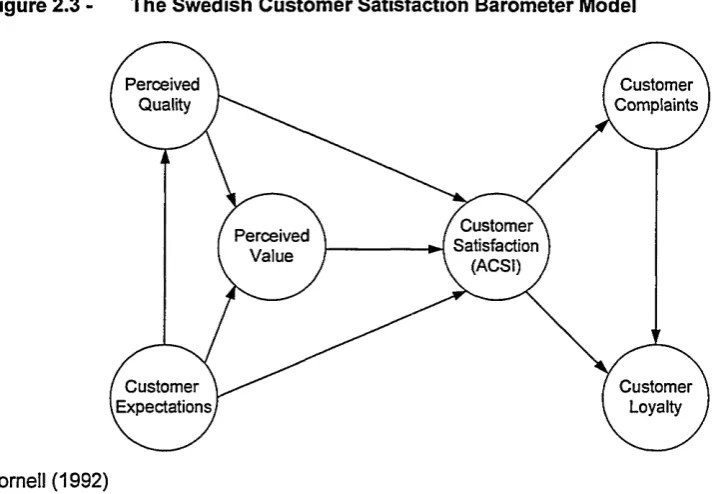
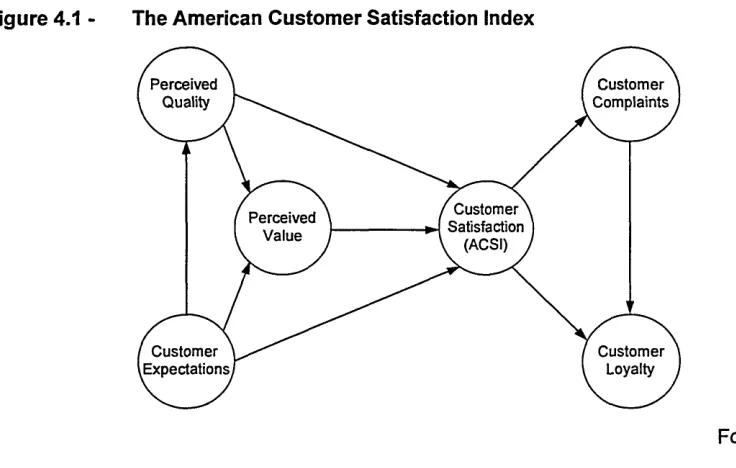
Figure 2.3 -
The Swedish Customer Satisfaction Barometer Model
Perceived
Quality ComplaintsCustomer
Customer Satisfaction
(ACSI) Perceived
Value
Customer
Expectations CustomerLoyalty
Fomell (1992)
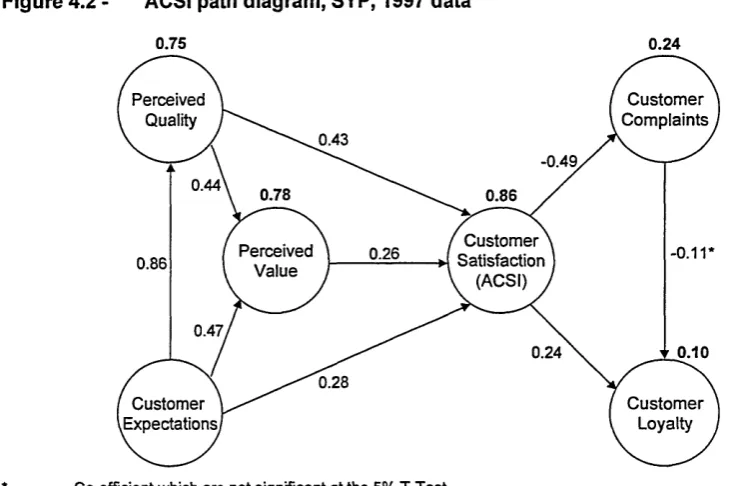
As can be seen from the model (figure 2.3), more than customer satisfaction is measured. By measuring a number of different areas the aim is that the different items that effect customer satisfaction will also be measured and their influence can then be taken into account when calculating the index.
The SCSB carries out its research by using a specially written and developed questionnaire. Completion is carried out by telephone interviews. The questionnaire is asked of customers who have had a recent interaction with a particular company or organisation. Following analysis of the results an index score is produced which will lie between zero and one hundred, with zero being the lowest and one hundred the highest possible score.
The index concentrates exclusively on companies and public sector agencies that supply nationally to household customers, and subscribe to the system.
The Benefits of Using an Index Approach
A benefit of the index is that it allows companies to compare themselves against the different companies who they are competing against, to see which company is providing the best customer satisfaction. This is of particular benefit to companies who are not doing as well as they possibly could, as it will give them an incentive to do something about their failings. Besides being able to compare companies within the same industry, because the index is a single number and is surveyed and calculated using a generic model, it is possible to compare across industries and economic sectors. It is even possible for companies to compare how well they are doing against the national total.
The SCSB acts as a means for consumers to see which companies provide good service before they shop.
“The Index has the potential to raise the public’s perception and understanding of quality, much
in the same way the public has become aware of the consumer price index and other
macroeconomic indicators.”
Jack West, Chairman, American Society for Quality Control
Economic Benefits of measuring customer satisfaction
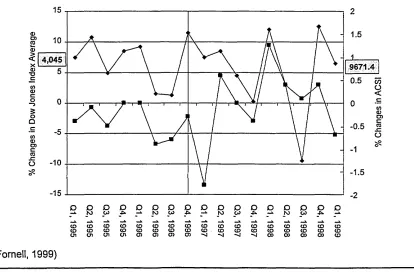
[image:41.616.91.505.450.727.2]Over the past few years a number of people have attempted to show that through improving customer satisfaction, improvements to profitability can be achieved (Anderson et al., 1994).
Figure 2.4 - ACSI and Dow Jones percentage changes
1.5 a> O) £ <D X Q) ■o C 4,045 9671.4 0.5 5 o Q
~ tn -5
0)
O) c
CD 6 -io
-0.5
-1.5
-15
As the graph in figure 2.4 shows, there is a definite link between the American Customer Satisfaction Index and the Dow Jones Index. The relative quarterly changes in ACSI and in the Dow Jones Index seem to be closely linked in through out 1995 and 1996, with a one-quarter lead for ACSI, but eventually these seem to happen concurrently (Eklof et. al., 1999). Eklof et. al. (1999) then go on to explain that is probably due to the increasing awareness of, and focus on, ACSI as an important source of information to evaluate the stock market.
Reasons for measuring customer satisfaction
By tracking customer satisfaction over time, it is possible to work on the long-term goal of creating loyal customers. It has been shown that satisfied customers are very often loyal customers, they tend to buy more, more often, and satisfied customers are often willing to pay premium prices for the company's products (Kristensen & Martensen, 1996).
By considering why organisations lose customers can also bring home the benefits of measuring customer satisfaction with the long-term aim of retaining existing customers. In research carried out by McNealy (1994), he discusses why organisations lose customers. By far the biggest reason for customers moving away was ‘shortcomings in customer service’, (68%). The graph in figure 2.5 shows the reasons why organisations lose customers.
Figure 2.5
Why organisations lose customers
80 n 70 60
50
40 30
20 10
0
O 0)
Long term aims of monitoring customer satisfaction
There should be an ultimate aim in monitoring an organisations level of customer satisfaction. Again in striving for the ultimate aim, there are different stages to go through and different organisations will be at different stages of the journey. Figure 2.6 shows one possible journey that an organisation might choose to follow.
Figure 2.6 - Trends in customer satisfacton, loyalty and value
21st Century Growth Company
Customer Voice Analysis and Voice-of-the-Customer Initiatives
Customer Loyalty • Retaining our Customers • Getting them to recommend us
• Delivering what we promise Conformance Quality
• Meeting standards
• Responding to customer complaints Customer Satisfaction • Providing what the customer wants
Customer Value • Meeting critical needs of targeted customers • Outperforming competitors • Creating new unique benefits
Strategic Insights (1998)
2.3 The Dimensions
The rest of this chapter looks at each dimension individually and looks at the different things that each dimension incorporates. The different dimensions that have been included in the research are:
• Perceived Expectations • Perceived Quality (General) • Perceived Quality (Hardware) • Perceived Quality (Humanware) • Perceived Image
• Perceived Value • Complaints
• Customer Satisfaction • Loyalty
Complaints is included here as it is part of the original Swedish Customer Satisfaction Barometer (SCSB), however, as the model was developed for Europe and the U.K., it was removed (see
‘Chapter 3 - Methodology, A Customer Satisfaction Index’, for more details). Likewise, the
dimension of Quality was split into two different parts as the model developed and the dimension of Image has been added with the advent of the European Model.
The index is constructed using a methodology that maximises the relationship between customer satisfaction and the likelihood of repeat purchase (Anderson et al. 1994).
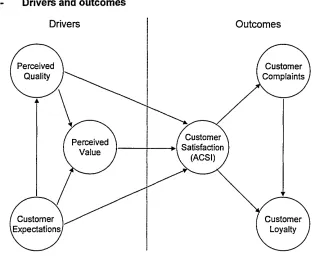
The drivers and outcomes
The model can be seen to split into two separate parts:
• Drivers • Outcomes
Figure 2.7 -
Drivers and outcomes
Drivers Outcomes
Perceived
Quality ComplaintsCustomer
Perceived Value
Customer
Expectationsy CustomerLoyalty
f Customer
+-( Satisfaction
V (ACS|) ,
On the driver’s, side the aim of the ACSI methodology is to ask questions which cover the following areas:
• Fitness for purpose • Customisation • Reliability
By asking questions in each of these areas throughout the driver side of the model, it is hoped that all areas of customer satisfaction measurement are covered. Throughout the development of the methodology for this project, this approach had not always been followed. This has happened to determine whether this approach is beneficial or not.
Each of the three areas are explained below with regard to the World Congress for Total Quality Management study, 1999.
• Fitness for purpose
• Customisation
The driver of customisation is asking how well or poorly a n organisations goods or services are aimed at meeting what the customer wants. For example, in the soft quality example the question asks whether the topics covered were relevant to the delegates needs.
• Reliability
Reliability of an organisation is always important. Do they do what they said they were going to? For example, did the congress cover the topics that it said it would in its advertising literature? Were the respondent’s expectations fulfilled? If they were, to what extent were they fulfilled? These are all areas covered by the driver of reliability.
Some of the questions are asked more than once but from a slightly different angle. The respondent is first asked what they expected to happen, followed by their perceptions of what actually did occur in terms of quality.
2.4 Expectations
What do customers expect?
There are many different attributes that will influence what a particular individual is expecting from a service encounter. If the person has used the service before, then their last visit, especially if recent, will go a long way to forming the expectation. However, if the visit is the first, then what the person is expecting will have been formed by other methods. For example, one or more of the following could have formed a customer’s expectation:
• competitors A service encounter with a rival company will at the least prepare the customer for the process that they will have to go through.
• past experience As has been mentioned above, if a customer has used a company before, they will have an idea as to the level of service that they will receive. However, on the actual service encounter, due to different levels of competency within the organisation, the level of service can vary by quite a margin. If the company is relatively small so that the customer always deals with the same contact person, this is less likely to be a problem. Areas where a staffs training is more likely to be of different standards are in sectors of the economy where employee turnover is high.
If a friend or relative has had good or bad experience with a particular organisation, then they are likely to pass on this information. Research by the TARP organisation has shown that a customer with cause to complain is far more likely to pass this on to friends and relatives than if they have a good experience. But, unfortunately for the organisation involved they are not likely to complain either, meaning that nothing can be done to rectify the bad experience. This is why Stew Leonard is quoted as saying, “A customer who complains is my best friend.”
Consumer programmes and magazines can have an effect on a customers expectations. A lot depends on how much the customer believes the items that appear in the media and how great their belief in the past has been with these particular media products.
2.5 Quality - With regard to customer satisfaction
What is quality?
Quality is the degree of excellence to which a product is made, or a service is carried out. This dimension forms an important part of the model as it is measuring the customer perceptions about the actual encounter, whether it is the purchasing of a product or service.
• reports / documentaries on companies e.g. Which Report etc.
Build in quality - Total Quality Management
If a quality product or service is required, it is important that quality is built in. Traditionally, products would be manufactured and then tested and inspected at the end to try and ensure that they complied with the requirements. However, invariable there would be faulty components or assembly somewhere inside the product which escaped detection. If quality is built in, each individual stage of manufacture is closely monitored by the people c