An analysis of TQM and organisational learning processes
using modelling and simulation.
ABDELMEGUID, Hamdy H.
Available from Sheffield Hallam University Research Archive (SHURA) at:
http://shura.shu.ac.uk/19186/
This document is the author deposited version. You are advised to consult the publisher's version if you wish to cite from it.
Published version
ABDELMEGUID, Hamdy H. (2001). An analysis of TQM and organisational learning processes using modelling and simulation. Doctoral, Sheffield Hallam University (United Kingdom)..
Copyright and re-use policy
See http://shura.shu.ac.uk/information.html
Sheffield Hallam University Research Archive
Fines are charged at 50p per hour
I &MAT ?nn3
< £ . £ ? - •
1 3 MAR 2806
M - 'l S "
S.cnp^
2
U
FEB 2007
9 DEC 2004
"
7
-1 6 MAY 2005
ProQuest Number: 10694066
All rights reserved
INFORMATION TO ALL USERS
The quality of this reproduction is d e p e n d e n t u p on the quality of the co p y subm itted.
In the unlikely e v e n t that the author did not send a c o m p le te m anuscript
and there are missing p a g e s , these will be n o ted . Also, if m aterial had to be rem o v ed , a n o te will in d icate the d eletio n .
uest
ProQ uest 10694066
Published by ProQuest LLC(2017). C opyright of the Dissertation is held by the Author.
All rights reserved.
This work is protected a g a in st unauthorized copying under Title 17, United States C o d e Microform Edition © ProQuest LLC.
ProQuest LLC.
789 East Eisenhower Parkway P.O. Box 1346
AN ANALYSIS OF TQM
AND
ORGANISATIONAL LEARNING PROCESSES
USING
M ODELLING AND SIM ULATION
A thesis submitted in partial fulfilment of the requirements of
Sheffield Hallam University for
the degree of Doctor of Philosophy
Hamdy H. Abdelmeguid
School of Engineering Sheffield Hallam University
United Kingdom
April 2001
ABSTRACT
The aims of this research are to examine the link between Total Quality Management (TQM) and organisational learning, to develop a conceptual framework for a learning organisation, and to model (Skill Pool Model (SKPM), Pipeline Skill Pool Model (PSKPM), Automated Pipeline Skill Pool Model (APSKPM)) learning processes to facilitate simulation of the effects of key parameters on the skill within an organisation.
This thesis presents an analysis of the fundamental factors and mechanisms of TQM. A comparative study of ten quality Gurus is conducted to establish a link between TQM and organisational learning. This has resulted in the development of a conceptual framework for the learning organisation, using TQM as the baseline. The learning organisation conceptual framework consists of twenty-eight elements (enablers) and nineteen dependent outcomes (results).
The learning organisation conceptual framework is utilised in a questionnaire survey to capture a snapshot of European organisations' efforts to become a learning organisation. Survey results show that the main differentiating factors between TQM and organisational learning are the type of learning tools in use and the information system in place. Further analyses reveal that organisations are experiencing great difficulties in translating organisational learning theory into practice.
The research work uses system causal-loop analysis in conceptualising the three waves of quality, which provide a richer picture of the main variables and their relationships in an organisation context. Detailed causal-loop analysis focuses on the organisation’s recruitment, and staff development policy. Adopting the Inventory and Order-Based Production Control System (IOBPCS) model, a SKPM is developed to help understand the dynamics of skill acquisition and retention, particularly during times when an organisation is going through major changes. A PSKPM has shown the significance of the process pipeline policy to improving staff training and the retention rate. By adding a feed-forward path to the PSKPM, an APSKPM shows how new skills can improve the organisation productivity and contribute to the development of new products. The model responds to the training and learning needs as a result of present skill loss rate (feed-forward) as well as skill level and training performance (feedback). The research concludes by identifying learning barriers, describing how knowledge can be created and managed, and analysing how information and knowledge are disseminated over time.
PREFACE
The following thesis is submitted in partial fulfilment of the requirements of the Sheffield Hallam University for the degree of Doctor of Philosophy entitled “AN ANALYSIS OF TQM AND ORGANISATIONAL LEARNING PROCESSES USING MODELLING AND SIMULATION”.
The overall aim of this research work is to construct a conceptual framework of learning organisation to examine the relationship between the Total Quality Management (TQM) and Organisational Learning (OL), and develop dynamic simulation models of the learning process/loops, via system dynamics.
Overview of the thesis
The thesis is structured into eight distinct but interrelated Chapters. What will be found throughout the Chapters is an attempt to marry theory to practice but overall the study represents a thorough analysis of the TQM and organisational learning. The main deliverables from these Chapters are developing the learning organisation conceptual framework, the validation of the framework through implementation in practice, and a family of system dynamic models are developed for anticipating skill gaps to design recruitment and training policies. The Chapters include:
-Chapter one: introduces the three waves of quality. The mutual dependence of total quality management and organisational learning and the purpose of the organisation transformation are described. The significances of learning process evaluation to organisational learning are explained. The main objectives of the research are outlined and methodology proposed which is used for simulation analysis.
identifying the gaps and weakness in the total quality management implementation.
Chapter three:
Chapter four:
Chapter five:
conducts a detailed literature review of learning and organisational learning. The difference between organisational learning and learning organisation is illustrated. This Chapter differentiate between the different levels of learning, and takes into account different organisational learning types. Also, organisational learning processes and creating learning organisation are presented. The link between individual learning and organisational learning is discussed. This Chapter concludes by describing the way forward for the learning organisation.
offers a historical account of the evolution of TQM. It has identified eighteen essential factors contributed to total quality management. The relationships between TQM and organisational learning are developed. The most significant linkage is that of combining systems thinking and total quality management. The main deliverable of this Chapter is the conceptual framework for the learning organisation. The framework consists of twenty-eight elements, which are categorized under
Technologies and tools (T), Organisation and system (O), and People
(P). Nineteen endogenous dependent outcomes have also been identified and grouped under, non-financial and financial performance categories. These elements are enlists, and a description of each factor/variable and potential relationships are provided.
Chapter six:
Chapter seven:
Chapter eight:
discusses the major causal relationships presented in the causal-loop model for the three learning waves. The Skill Pool Model (SKPM) has been used as a datum for the dynamic analysis. Computer simulation was used to find the criteria values for the step input responses of combinations of parameter values for SKPM. This Chapter presents and simulates SKPM, capturing the key elements of skill staff to help understanding the dynamic of skill acquisition and retention, particularly during times when an organisation is going through major changes.
improves the dynamic behaviour of the Skill Pool Model by adding an extra feedback term. However, for a step change in present skill loss rate this introduces a final value offset in the actual skill level. It is shown how the addition of an extra feed-forward path to PSKPM, representing the pipeline skills in process target value, eliminates the actual level of skill pool offset problem.
ACKNOWLEDGEMENTS
I would like to record my appreciation and gratitude to a group of people for their guidance and help provided throughout the duration of this research.
• To Egyptian Higher Minster of Education (Egyptian Cultural and Educational Bureau - London) for providing financial support.
• To Dr. Khalid Hafeez (my Director of Studies) for his guidance, support, friendship, and long commitment in completing this work.
• To Professor Edmund K. Lo (my former Director of Studies) for his guidance and help to bring this to fruition.
• To Professor Terrence Perera (my Supervisor) for his help whenever it was needed. • To Dr. Mike Hubbard for his guidance and help provided to make the amendments
and corrections after the oral examination.
• To my colleagues in the Manufacturing Engineering Research Group who have provided invaluable help on many aspects of the thesis. In particular, I express my appreciation to Mr. Jurgen Hemme for many valuable discussions.
• To my wife and daughters, who have joined with me during my stay in an alien culture and sacrificed many days and nights of family union and social time to support my research work. My sincere thanks are due to my family, especially my mother for her continuing prayers.
LIST OF FIGURES
Chapter 2
Figure 2.1: A summary of quality definitions... 10
Figure 2.2: Dynamic relationships among the seven categories...16
Figure 2.3: European Foundations for Quality Management... 17
Chapter 3 Figure 3.1: Organisation learning levels... 31
Figure 3.2: Senge’s five key disciplines... 35
Chapter 4 Figure 4.1: Evolution of quality ;... 48
Figure 4.2: Correlation between total quality and organisational learning (Learning Flywheel)...54
Figure 4.3: Evolution of learning organisation...56
Figure 4.4: The conceptual framework for a learning organisation ... 57
Chapter 5 Figure 5.1: Respondents by industry/sector...68
Figure 5.2: Implementation period profile of the respondent organisations ...69
Figure 5.3: The continuous improvement strategy profile of the respondent organisations... 69
Figure 5.4: Employee profile of the respondent organisations...69
Figure 5.5: Sales profile of the respondent organisations...70
Figure 5.6: A comparison of self-perception against framework analysis... 71
Figure 5.7: The values of enablers for the first wave case study...74
Figure 5.8: The average values of T, O, and P (enablers) for the first wave case study 75 Figure 5.9: The values of organisational performance (results) for the first wave case study... 75
Figure 5.10: The average values of financial and non-financial performance for the first wave case study...76
Figure 5.12: The average values of the enablers for the first wave organisations...79 Figure 5.13: The average values of organisational performance for the first wave
organisations...80 Figure 5.14: The values of enablers for the second wave case study...81 Figure 5.15: The average values of T, O, and P (enablers) for the second wave case
study... 82
Figure 5.16: The values of organisational performance (results) for the second wave case study... 82 Figure 5.17: The average values of financial and non-financial performance for the
second wave case study... 83 Figure 5.18: The average values of T, O, and P (enablers) and organisational
performance (results) for the second wave organisations...84 Figure 5.19: The average values of enablers for the second wave organisations...87 Figure 5.20: The average values of organisational performance for the second wave
organisations...88 Figure 5.21: The values of enablers for the third wave case study... 89 Figure 5.22: The average values of T, O, and P (enablers) for the third wave
case study... 90 Figure 5.23: The values of organisational performance (results) for the third
wave case study... 90
Figure 5.24: The average values of financial and non-financial performance for
the third wave case study... 91 Figure 5.25: The values of T, O, and P (enablers) and organisational performance
(results) for the third wave organisations...92 Figure 5.26: The average values of enablers for the third wave organisations...93 Figure 5.27: The average values of organisational performance for the third wave
organisations... 93
Figure 5.28: Average score of the twenty-six sample organisations according to
T, O, and P classifications... 96
Figure 5.29: Correlation between the T, O, and P enablers for the twenty-six sample organisations... 97 Figure 5.30: The overall financial and non-financial performance scores for
the twenty-six sample organisations... 98
Chapter 6
Figure 6.1: Influence diagram of the three quality waves... 106
Figure 6.2: A causal-loop diagram of skill and quality improvement... 108
Figure 6.3: Causal-loop diagram of skill level... 108
Figure 6.4: Causal-loop diagram of skill level with skill gap correction...109
Figure 6.5: Causal-loop diagram for skill loss rate...110
Figure 6.6: Causal-loop diagram representing first wave of quality... I l l Figure 6.7: Causal-loop diagram illustrating the relationship between knowledge and new ideas...112
Figure 6.8: Causal-loop diagram representing knowledge and learning relationships... 112
Figure 6.9: Causal-loop diagram representing flow of knowledge within organisation...113
Figure 6.10: Causal-loop diagram representing knowledge acquisition and erosion.... 113
Figure 6.11: Causal-loop diagram of second wave of quality... 114
Figure 6.12: Causal-loop diagram representing the learning and training relationships...115
Figure 6.13: Causal-loop diagram representing knowledge/skill development relationships... 115
Figure 6.14: The effect of competence gap on competence pool...116
Figure 6.15: Causal-loop diagram of competence pool with the effect of the present competence loss...117
Figure 6.16: Causal-loop diagram representing the third wave of quality... 118
Figure 6.17: Influence diagram of SKPM...120
Figure 6.18: A block diagram representation of SKPM... 121
Figure 6.19: Skill level measurements...125
Figure 6.20: Training completion rate measurement...126
Figure 6.21: Step response of SKPM for varying values of T j...129
Figure 6.22: Step response of SKPM for varying values of Ta ...•...130
Figure 6.23: Step response of SKPM for varying values of Tp ...132
Chapter 7 Figure 7.1: Influence diagram of PSKPM... 139
Figure 7.3: Measurement of skill in process criteria... 142
Figure 7.4: Step response of PSKPM for varying values of T j... 145
Figure 7.5: Step response of PSKPM for varying values of Ta ...148
Figure 7.6: Step response of PSKPM for varying values of Tw...150
Figure 7.7: Step response of PSKPM for varying values of Tp ... 153
Figure 7.8: Influence diagram of APSKPM... 156
Figure 7.9: A block diagram representation of APSKPM...157
Figure 7.10: Step response of APSKPM for varying values of T j...160
Figure 7.11: Step response of APSKPM for varying values of Ta ...163
Figure 7.12: Step response of APSKPM for varying values of Tw...166
Figure 7.13: Step response of APSKPM for varying values of Tc ...168
Figure 7.14: Step response of APSKPM for varying values of Tp ... 172
LIST OF TABLES
Chapter 4
Table 4.1: Comparative study of ten Guru’s showing emphasis on various TQM
elements...50 Table 4.2: Comparative study of ten Gurus’ showing emphasis on various learning
organisation elements... 52
Chapter 5
Table 5.1: The correlation between the conceptual framework elements and the
relevant questions presented in the questionnaire...67 Table 5.2: Correlation between the framework elements and the relevant elements
presented analysis...72
Table 5.3: The overall profile and results of the twenty-six sample organisations 100
Chapter 6
Table 6.1: Definitions of learning, knowledge, skill and competence.... Table 6.2: Summary the effect of Ti, Ta, and Tp on the measurement of
performance indices... .
Chapter 7
Table 7.1: Summary the effect of the optimum design parameters and
corresponding performance indices... 177 107
NOMENCLATURE
ALSKP Actual level of skill pool
APSKPM Automatic Pipeline Skill Pool Model
DLSKP Desired level of skill pool
DSKIP Desired skills in process
FSKLR Forecast skill loss rate
PSKLR Present skills loss rate
PSKPM Pipeline Skill Pool Model
SKG Skill gap
SKIP Skills in process
SKIP A Skills in process adjustment
SKPM Skill Pool Model
S Laplace operator
TCRATE Training completion rate
TRATE Training rate
Tj Recovery time
Tp Pipe-line lead-time
Ta Demand average time
Tw Time to adjust skills in process correction rate
Tc Estimated pipeline lead-time
CHAPTER 1
INTRODUCTION
1.1 Introduction
Since the early 1940’s, that is about twenty years after the advent of first production line, studies have revealed that appropriate training and job satisfaction helps to create a productive and effective workforce giving organisations a competitive edge. Results from many recent studies show that in order to improve the working conditions, organisations should adopt a different approach from the Taylorist traditional style of management where workers are seen as cogs, i.e. part of a process towards an end product. They are given little opportunity to take part in any decision-making concerning how to increase the overall productivity of the organisation or how to improve their own working conditions. During the past 50 years, at least within the developed areas of the world, things have moved a long way forward.
This Chapter discusses the significance of the mutual dependence of total quality management and organisational learning through a brief introduction of the concept of the three waves of quality. Also, the significances of learning processes evaluation to organisational learning are explained and the organisation transformation are described. This Chapter presents the research aims and objectives and proposes the research methodologies are used for constructing and developing the conceptual framework and simulation analysis.
1.2 The research background
The purpose of the organisational transformation is to enable the organisation to search for new ideas, new products, and new opportunities for learning from which competitive advantage can be culled in an increasingly competitive world. In other words, organisations must be able to learn and to learn from their learning. Without this ability organisations will not be able to exercise appropriate choice in respect of structure, process, culture, product and, sooner or later, they will fail. A learning organisation cannot be defined in terms of specific structures or cultures, or in terms of normative models of good practice. Processes and values are central. A learning organisation works to create values, practices and procedures in which learning and working are synonymous throughout the organisation. Learning and the learning organisation are frequently mentioned as conducive to successful change. The main characteristics of a learning organisation is how to institutionalise the continual learning process such that it should be manifested in the underlying procedures, practices, code of conducts, routines and even in the products. A learning organisation is defined as “an organisation skilled at creating, acquiring, and transferring knowledge, and modifying its behaviour to reflect new knowledge and insights” (Garvin, 1993). Senge (1994b) describes learning organisation as “a place where people continually expand their capacity to create results they truly desire, where new and expansive patterns of thinking are nurtured, where collective aspiration is set free and where people are continually learning how to learn”.
A learning organisation often seeks to create its own future. It assumes learning is an ongoing and creative process for its members, and it develops, adapts and transforms itself in response to the needs and aspirations of people, both inside and outside itself (Pedler, 1989). Through learning, organisations adapt to change, avoid the repetition of past mistakes, and retain critical knowledge that would otherwise be lost. The amount of learning takes place within an organisation would eventually prove to be a critical factor for its survival and success. In broad terms, a learning organisation can be viewed as a social system whose members have learned conscious, communal processes for continually; generating, retaining and leveraging individual and collective learning to improve the performance of the organisational system in ways important to all stakeholders; and monitoring and improving performance (Drew and Smith, 1995).
Argyris and Schon’s (1981) notion of single-loop and double-loop learning is perhaps most commonly cited, however, other variations include first-order and second-order
learning (Bartunek and Reed, 1992; Watzawick et ol., 1974) Zero learning and Learning
I, II, III and IV (Batestone, 1972; Palmer, 1979), habit formation learning, adaptive organisation learning and creative proactive learning (Burgoyne, 1995). Many commentators on the learning organisation tend to emphasise learning in the context of the organisation transforming itself in relation to its environment and a reciprocal process of individual learning and development.
A central issue, in the context of notions of the learning organisation is the nature of organisational knowledge. If organisational learning is defined as the development of new knowledge or insights that has potential to influence behaviour (Huber, 1991; Sinkula, 1994), what is knowledge and how does it develop as well as what are the conditions for knowledge to develop? These issues have received limited attention in the learning organisational literature. Huber (1991) thinks that learning occurs in an organisation “if through it’s processing of information the range of its potential behaviours is changed”. He considers the following four constructs as integrally linked to organisational learning: knowledge acquisition, information distribution, information interpretation, and organisational memory. He believes that learning need not be conscious or intentional and learning does not always increase the learner's effectiveness or even potential effectiveness. Moreover, learning need not result in observable changes in behaviour.
A learning organisation should be an organisation skilled at creating, acquiring and transforming knowledge, and at reforming the behaviour patterns of decision makers to reflect new knowledge and insights so as to evaluate total quality management in every process. Organisations failing to grasp the basic truth that TQM requires a commitment to learning is the reason why failed programmes far outnumber successes, and success rates remain distressingly low. For TQM to succeed and to achieve the objectives the entire workforce must acquire new knowledge, skills and abilities.
the organisations are now in the second wave of quality. Japanese managers have been given the training to hold regular quality circles with the aim of educating their workers how they all fit in the overall system and objectives of their organisation.
The main concern for learning organisation in this study is to develop a conceptual linkage of TQM and organisational learning to improve organisational and people performance and to speed up, the learning processes within an organisation. By discussing the evolution steps of quality movement, this research is to develop and analyse the building blocks of a learning organisation. System dynamics modelling is used to develop a family of conceptual learning models, which describes the relationships and influences between total quality management and organisational learning.
1.3 Research objectives
The overall aim of this research work is:
-1. To identify the characteristics of TQM and organisational learning.
2. To construct the conceptual relationships between TQM and organisational learning. 3. To develop learning organisation framework to evaluate organisational learning
practices in the European organisations.
4. To introduce system thinking and causal-loop models for the TQM and organisational learning practices.
5. To introduce system dynamic simulation analysis for modelling learning processes as an aid for human resource policy decisions.
1.4 Research methodology
The methodology of this research adopts four main features: literature review, develop a conceptual framework, validation of the conceptual framework through a questionnaire survey, and to provide a dynamic simulation model.
1.4.1 Literature review
of these elements broadly based on the work of at least 20 well-known authors in this
field. The other objective is to study and review the relationships between the total quality
management and the organisational learning.
1.4.2 EFQM model and operations management
The enablers-results mechanism of European Foundation for Quality Management (EFQM) (EFQM, 1999) is adapted to construct the learning organisation framework. Also these enablers and results are grouped and evaluated under the standards operations management framework of Technologies and tools (T), Organisation and
system (O), and People (P).
1.4.3 Questionnaire survey
The questionnaire survey is used to evaluate the conceptual framework for both manufacturing and non-manufacturing organisations. Through analysis of the collected data, some important research findings are summarised and presented. Data from the questionnaire survey is used to validate the three waves of quality.
1.4.4 System thinking and system dynamics
System thinking is used to develop causal-loops (influence diagrams) for the three waves of quality. Causal-loop diagrams display all the major influences and feedback loops that exist between variables; they provide , a qualitative portrayal of the feedback structure of the system. Simulation models are developed to analyse the time-based learning behaviour of an organisation using a system dynamics modelling process. System dynamics is defined as a modelling and simulation methodology used to study the complex dynamics of large, non-linear managerial, socio-economic, human systems (Richardson, 1981). Computer simulation is therefore used to analyse the behaviour of such complex dynamic models. Various software packages exist for system dynamics
modelling; in this case, the ithink software is used.
1.5 Summary
provided. The methodology of this research adopts four main features, literature review, EFQM model and operation management, questionnaire survey, and system thinking and system dynamics.
The literature review has identified essential elements contributed to TQM and learning organisation, to indicate the importance of each of these elements and to study and review the relationships between the total quality management and the organisational learning. EFQM is used to construct the learning organisation framework. To evaluate the conceptual framework for both manufacturing and non-manufacturing organisations the questionnaire survey is developed. System thinking is used to develop causal-loops (influence diagrams) for the three waves of quality. System dynamics is used to develop a simulation model analyse the time-based learning behaviour of an organisation. An overview and more details of these research methodologies are presented in the following Chapters.
1.6 References
Argyris, C. and Schon, D.A. (1981), “Organisational Learning”, Addison-Wesley, Reading, MA
Bartunek, T.M. and Reed, R.D. (1992), “The role of conflict in a second order change attempt”, in Kolb, D.B. and Bartunek, T.M. (Eds), Hidden Conflict in Organisations, Sage, London.
Batestone, G. (1972), “Steps to an Ecology of the Mind”, Ballantine, New York, NY Burgoyne, J.G. (1995), “Feeding minds to grow the business”, People Management, 21
September
Drew, S. and Smith, P. (1995), “The learning organisation: change proofing and strategy”, The Learning Organisation, Vol. 2 No. 1, pp. 4-14.
EFQM, (1999), “The EFQM Excellence Model”, Public and Voluntary Sector, The European Foundation for Quality Management, Brussels
Garvin, D.A. (1993), “Building a learning organisation”, Harvard Business Review, Vol. 71, July/August, pp. 78-91.
Huber, G.P. (1991) “Organisational learning: the contributing processes and the literatures”, Organisation Science, Vol. 2, February, pp. 88-115.
Pedler, M., B'oydell, T. and Burgoyne, J., (1989), “Towards the learning company”, Management Education and Development, Vol. 20 Part 1
Richardson G.P. and A.L. Pugh, (1981), “Introduction to system dynamics modelling with DYNAMO”, MIT Press, Cambridge, MA
Senge, Peter, M., (1994a), “Building learning organisations”, H. Costin, editor, Reading in Total Quality Management (Fort Worth. TX: The Dryden press), pp. 60-67. Senge, Peter, M., (1994b), “The Fifth Discipline: The Art and Practice of the Learning
Organisation”, Doubleday New, York.
Sinkula, F.M. (1994), “Market information processing and organisational learning”, Journal of Marketing, Vol. 58, January, pp. 35-65.
CHAPTER 2
LITERATURE REVIEW: PART I
TOTAL QUALITY MANAGEMENT
2.1 Introduction
The three waves of quality have been highlighted as a critical movement from total quality management to organisational learning in Chapter 1. The purpose of this Chapter is to present an overview of the literature on total quality management (TQM). The literature review gives an appropriate framing for the matters discussed in this thesis.
The overview in this Chapter covers the fundamentals of total quality management with special emphasis on what are described as the essentials of TQM. It is presented in six parts. The first part provides an assessment of the meaning of quality. The second part looks at the definitions and the characteristics on of the TQM. The third and fourth parts review the TQM philosophies by studying the work of ten quality Gurus’ to underpin the fundamental factors and mechanisms of TQM. The fifth part looks at two types of the quality award models, which are the Malcolm Baldrige National Quality Award (MBNQA) and the European Foundation for Quality Management (EFQM). The final part identifies the gaps and weakness in TQM to implemented successfully and concludes by synthesising the information in the literature into a coherent framework in an attempt to portray the key principles and components of TQM.
2.2 Quality definition
time is the skeletal structure of an organisation, finance is the nourishment, and relationships are the soul”. However, the ISO 8402 (1986) offers an alternative systemic definition of quality, “the totality of features and characteristics of a product or service that bear on its ability to satisfy a given need”.
For Garvin (1988) quality can be seen from three views:
-• User-based definition: - Quality is measured by the degree to which the wants and needs of customer are satisfied.
• Product-based definition: - quality refers- to the amount of desired attributes contained in the product.
• Manufacturing-based definition: - Quality is measured by the percentage of scrap or rework required during the production process.
Garvin is of the view that these meaning can co-exist within an organisation. He goes on to suggest that it may become necessary to give quality a different meaning in different industries, and also probably change the approach taken towards quality from user-based to product based, as products move through market research to design; and then from product-based to manufacturing based, as they go from design into manufacture. However, the user-based definition is more appropriate in a service organisation because it denotes that those services, which meet customer preferences and expectations, are the central thrust of high quality.
Feigenbaum (1991) states, “quality is a customer determination, not an engineers determination, not a marketing determination, or a general management determination, it is based upon the customer’s actual experience with the product or service measured against his or her requirements stated or unstated, conscious or merely sensed”. Thus, product and service quality can be defined as: “the total composite product and service characteristics of marketing, engineering, manufacture and maintenance through which the product and service in use will meet the expectations of the customer”.
management is a revolutionary management philosophy characterised by the quality strategic goals”. Taguchi defined quality, as “the quality of product is the minimum loss imparted by the product to the society from the time the product is shipped” (Taguchi, 1996). According to Oakland and Dotchin (1994) the most applicable definitions of quality are: fitness for use, the user perspective, and conformance to specifications (the manufacturing perspective). All are necessary for customer satisfaction.
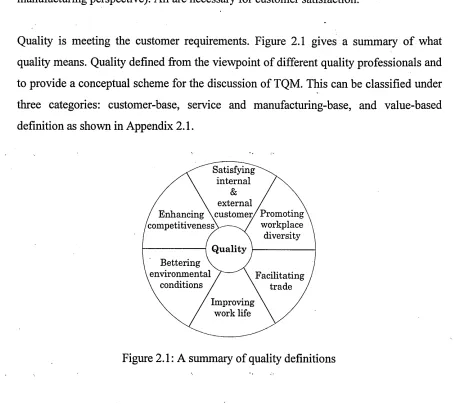
Quality is meeting the customer requirements. Figure 2.1 gives a summary of what quality means. Quality defined from the viewpoint of different quality professionals and to provide a conceptual scheme for the discussion of TQM. This can be classified under three categories: customer-base, service and manufacturing-base, and value-based definition as shown in Appendix 2.1.
Satisfying internal
&
external
customer/ Promoting Enhancing
workplace diversity competitiveness
Quality Bettering
environmental
conditions Facilitatingtrade Improving
[image:26.612.76.533.125.532.2]work life
Figure 2.1: A summary of quality definitions
2.3 Total quality management
In spite of the vast amount of work conducted, a literature review suggests that it is difficult to find a standard definition of TQM. This section conducted for this study aims to provide a few definitions for convenience that incorporates’ the key characteristics and framework of TQM. According to Oakland (1993) “TQM is an approach for improving the competitiveness, effectiveness, and flexibility of an organisation”. Essentially it is a way of planning organising and understanding activities and individuals at each level”. For an organisation to be truly effective each part of it must work together towards the same goals, recognising that each person and each activity has a domino impact on the inter-related system. For Crosby (1979) quality management is a systematic way of guaranteeing that organised activities happen the way they are planned. It is a management discipline concerned with preventing problems from occurring by creating the attitudes and controls that make prevention possible. TQM advocates zero defects in the products and services produced by an organisation. It is about driving quality into all aspects of organisation’s operation.
However, one major premise of TQM is the definition of quality by Juran (1988b) who describes it as “fitness for use” which may be seen a key to business success in the 1990’s against the other established performance indices such as price and delivery. The aim is to have quality built-in rather than inspected-in by quality being the responsibility of all employees, rather than the exclusive presence of a specialist department. This is expected to minimise the overall cost because it brings about a decline in failure rates, warranty costs, returned goods, and reduction in the costs of detection. According to Juran TQM involves a primary focus on the requirements of the external as well as the internal customers within the organisation.
Kanji (1990) notes that the modem concept of quality is defined as conformance to requirements, and requirements are defined as the task to be accomplished in meeting customer needs. According to him quality is to satisfy customer’s requirements continually, total quality is to achieve quality at low cost, and TQM is to obtain total quality by involving everyone’s daily commitment.
In the present author’s view, the essence of quality is do it right first time, and every time satisfy customer requirements by involving everyone in the organisation. TQM is therefore a philosophy of management that strives to make the best use of all available resources and opportunities by continuous improvement. TQM is the key business improvement strategy and the key management issue of the present as well as future because it is essential for improving efficiency and competitiveness.
2.4 TQM philosophies
Constructing a universal definition of TQM is impossible since definitions are affected by a particular managerial situation or problem. W. Edwards Deming, one of the most respected contributors to the quality management movement, claimed he never used the term TQM as it did not carry any meaning (Romano, 1994). Nevertheless, Deming’s 14 points have generated the most impact on the TQM evolution and have been studied
extensively (Tamimi et ol., 1995). Black and Porter (1996) examined the criteria for the
Baldrige Award and the published TQM literature and subsequently identified ten critical factors of TQM. However, they have created considerable confusion when the theoretical aspects of TQM are discussed, or attempts to design and implement TQM programs are made. Harai (.1993) believed this uncertainty of the nomenclature of TQM is a problem in and of itself; “given the fact that there is a multitude of definitions, theories and programs in the public domain, it is difficult to specify exactly what TQM is”. This confusion is. compounded by the proliferation of commercialised TQM training programs offered as a package with no attempt to differentiate between industries or organisations (Caudron, 1993). As a result, many different versions of TQM have been developed, delivered, studied and defended by different professionals (Harai, 1993).
TQM as merely another management fad. However, it would be a mistake to reject TQM at this level, for several important implementation concepts arises directly out of
the more general management philosophy perspective. Grant et al. (1994) addressed in
detail the difference between TQM and conventional management techniques regarding the philosophies and theories that underlie them. For TQM benefits to be fully realised, managers in every level of an organisation need to prepare themselves for change. The philosophical dimension of TQM should also provide a focus for everyone in the organisation by specifying those things that are valued highly by customers, employees, and management.
2.5 TQM Gurus’ principles
The literature review indicates that despite quality, management being considered a matured field of study it is difficult to define the concepts of TQM. A study of the work associated with ten quality Gurus’ (Deming, Juran, Crosby, Ishikawa, Mellor, Kanji, Shingo, Oakland, Feigenbaum and Taguchi) is conducted with the objective to compare and contrast their views, which underpin the fundamental factors and mechanisms of TQM.
Broadly speaking TQM refers to thinking about quality from the perspective of all functions within enterprise. In systems terms it implies thinking about the interaction between all the quality components of the organisation as well as within the components themselves (Oakland, 1993). TQM aims to achieve an overall effectiveness through integrating individual activities in design, planning, production, distribution and customer service (Oakland 1993). It is about changing the mindsets and attitudes of all those involved about the jobs and functions they perform geared towards providing customer satisfaction. TQM advocates zero defects in the products and services through the process of continuous improvement (Crosby, 1979). It is supported by, management by fact, continuous improvement, delight the customer and people based management (Kanji and Asher, 1993).
From the analysis, it could be argued that, the general message is essentially the same: • Management commitment and employee awareness is essential in TQM. Personnel
Crosby, 1979; Juran, 1993). Deming's (1986) 14 points provide an effective starting- point to encourage the necessary attributes.
• Juran (1988b) emphasises the need to plan and prioritise actions with the quality planning road map. Quality costing can be used to prioritise and monitor improvement, and to measure the progress of improvement. Service quality can be measured once qualitative and quantitative research has defined what matters to the customer.
• Teamwork plays an important part in the process of continuous improvement. Indeed, problem solving and improved communication is extremely difficult to achieve without it. Ishikawa (1985) advocated quality circles, which create greater worker involvement and motivation leading to greater commercial awareness and the aim for ever-increasing goals.
• If all employees are to be involved in the improvement process, then simple tools and techniques need to be taught (Crosby, 1989; Deming, 1986). All levels within an organisation can use Ishikawa’s seven tools of quality control (Ishikawa, 1985).
• Taguchi (1996) provide more technical tools to control areas including industrial design and manufacturing. Taguchi’s quality loss function includes the costs to the customer resulting from poor product performance and reliability.
• To achieve quality, management tools should be studied. Feigenbaum’s concept of total quality control stresses the need for top-to-bottom commitment to quality (Feigenbaum, 1991). Ishikawa (1985) also promotes the concept of organisation- wide quality control.
• In today’s competitive markets, “quality as perceived by the customer” has become a key aim for many organisations. Deming’s message to “delight your customers” is seen by many as the way to be competitive in today's markets (Deming, 1986).
2.6 Models of quality awards
There has been a quality management framework as part of the Deming Prize in Japan for over four decades. The Deming Prize was instituted in 1951 by the Japanese Union of Science and Engineering (JUSE) in recognition of Deming’s contribution to the development of industrial quality control in Japan. The Deming Prize is for enterprises or divisions, which achieve the most distinctive improvement in performance through the implementation of organisation-wide quality control based on statistical quality control. The items, particulars, and further information of the Deming Prise can be obtained from the Secretariat of the Deming Prize Committee (Kanji and Asher, 1993). However, it was not until 1987, when the Malcolm Baldrige National Quality Award (MBNQA) was established, that senior managers in the west started looking at quality award criteria as guiding frameworks to plot the approach for effective TQM implementation
2.6.1 The Malcolm Baldrige National Quality Award
The Malcolm Baldrige National Quality Award (MBNQA) promotes three important characteristics, namely, awareness of quality to increase competitiveness, understanding the requirements for excellence in quality, and sharing the information and benefits derived from successful quality strategies that are employed by the organisations (NIST, 1994). It is offered to organisations in three categories, namely, manufacturing, service and small organisations (NIST, 1994). To win the award, organisation must demonstrate a high degree of quality awareness and commitment, together with evidence of quality results. Among the many benefits to an organisation, which applies for the award is the feedback on its quality efforts, which helps to assess the effectiveness of its implementation. It is claimed many organisations apply to take advantage of this benefit.
Furthermore, to help people to understand the Baldrige award criteria, the MBNQA framework expresses values and concepts in seven categories and four key elements as shown in Figure 2.2. Seven categories of criteria are included in evaluating the organisation’s overall strategic and operational strategies employed in implementing quality improvement efforts.
(1989) stated, the award is not given for a specific product or service, nor is it an endorsement of an organisation’s product or service. It is given to those organisations that have world-class systems for managing their people and processes. Each system must ensure continuous improvement in its product or service and provide a way of satisfying and responding to its customers.
Senior executive leadership
1.0
Management of process quality
5.0
Human resource development and
management 4.0
Strategic quality planning
Information and analysis
Customer focus and satisfaction
7.0
Quality and operational
results
,
6.0Customer satisfaction Customer satisfaction relative to competitors Market share
4
*
Product and service quality
Internal quality and productivity Supplier quality
Figure 2.2: Dynamic relationships among the seven categories (NIST, 1994)
Since the introduction of MBNQA, several nations started their own award schemes for similar reasons to those linked to MBNQA. A notable one is the European Quality Award (EQA) established by the European Foundation for Quality Management in
1991.
2.6.2 The European Quality Award
The European Foundation for Quality Management (EFQM) established the European Quality Award (EQA) for the first time in 1992, mainly to accelerate the acceptance of quality as a strategy for global competitive advantage, to stimulate and assess the development of quality improvement activities, and to recognize the organisations in Western Europe that demonstrate excellence in the management of quality as their fundamental process for continuous improvement (EFQM, 1993). The EQA is also supported by the European Committee of the European Organization for Quality. This award consists of nine criteria for evaluation. Figure 2.3 illustrates the EQA framework. The nine elements of the framework, classified as either enablers or results, are seen as influencing one another.
People management
Policy and strategy
Resources
People satisfaction
Customer satisfaction
Impact on society Processes
Leadership Business
results
<--- Enablers Results ►
Figure 2.3: European Foundations for Quality Management (EFQM, 1999)
The two models discussed above give greater attention to defining quality from customer’s perspective and on the measurement of results. The EQA and the revised Baldrige criteria also extend the framework for quality to include public responsibility and corporate citizenship, and measurement of employee satisfaction (EFQM, 1993 and NITS, 1994).
It should be noted that the business results criterion includes financial measures such as profits, cash flows, productivity, market share, and quality cost. The MBNQA, on the other hand, does not include them in the quality and operational results criterion, as the award criteria do not cover the organization’s financial performance.
In addition to the above, Tummala (1996) summaries the comparison between MBNQA and EFQM models which can conclude as the following:
-• Both the MBNQA and EQA are results oriented awards.
• Both awards give maximum weight to customer satisfaction results. Thus, customer focus and satisfaction is the overall goal of both the awards.
• The MBNQA criteria do not include financial performance whereas it is included in the EQA criteria.
• The EQA, by including the impact on society as one of the nine criteria, covers more aspects such as preservation of global resources in a more detailed fashion than the MBNQA.
• The MBNQA and EQA are neither product nor service excellence awards, nor are they corporate management excellence awards. Both are positioned between these two extremes.
• Because of the inclusion of financial performance in the criteria, the EQA is more broad-based than the MBNQA.
individual organizations to assess themselves and look for opportunities to improve their service.
2.7 Pitfalls of TQM
Even in restricting what TQM means to the work of the ten Gurus of quality, there are still important differences in philosophy, approaches, and methods among these. Total quality management can provide significant cost benefits by improving the use of materials, optimising people’s time, reducing the cost of production and employing capital more effectively (Eskildson, 1994). Most organisations emphasise the need for quality, but few can articulate precisely what it is and few organisations have been able to consistently deliver it. The set of gaps/weaknesses in TQM as identified according to Barry (1993) are the following:
-• Consistent, committed support from the top is recognised as crucial for success with total quality management. TQM recognises that this sort of inconsistent behaviour from the top will at least seriously interfere with implementation. TQM itself, as usually practiced, has no methods for dealing with the executive inconsistencies. Argyris and Schon (1978) show that this sort of inconsistent behaviour is very common.
• TQM problem solving tools tend to be reductionist rather than systemic. In particular, TQM lacks both a framework and tools to understand circular causal- loops. System dynamics provides powerful tools for understanding and managing these dynamics. The basic system dynamics framework provides tools for both qualitative analysis and computer simulation of situations where circular causal- loops are important.
• TQM shows how to continuously improve an existing process. What about some totally new product or even a new business or a radical re-structuring of the existing business? TQM does not help the organisation to invent some new and more desirable future for itself.
-o Marginal impr-ovements inv-olve changes (eliminating b-ottlenecks, increasing efficiency, finding a better technique) that leave the basic process untouched.
o Process improvements involve changes to the basic manufacturing or service process, for example, a new kind of machine or a new method for one step in the manufacturing process.
o New technology involves a fundamental rethinking of the given manufacturing or service process. This level of change involves essentially starting over with a new way of producing the given product or service.
Each of these levels of improvements is critically important for long-range success. TQM usually focuses on the first, can be helpful with the second, and offers little help for the third.
• The question of organisational design is important for TQM for a number of reasons. First, TQM emphasises the importance of all parts of the organisation working in harmony because quality for the customer depends on all parts of the business. Second, as process improvements are made or new technology adopted, organisational structures become outmoded. Finally, as customers or their preferences change, the organisational structure needs to adapt as well. TQM, however, is silent on the question of how to design an organisation.
• TQM requires the ability to work together across horizontal and vertical boundaries within the corporation. Unfortunately, many corporations are fraught with dissension and internal conflict. TQM is silent on the question of how to achieve collaboration among divisions and commonality of purpose between managers and workers.
In order to prevent failure in the TQM implementation Liberatore (1993) argues that corporate culture must change in order for new ways of thinking and doing business to evolve. TQM fails because, in most organisations, the culture is so ingrained, it resists change and attempting to change the established culture will not work unless it is disabled.
However, Chattergee and Yilmaz (1993) attribute the pitfalls encountered in the implementation of TQM to what they term the contradictory models of implementation devised by the Gurus i.e. Deming, Juran and Crosby. Whilst Juran advocates setting quality objectives and managing the quality plan according to those objectives, Deming is strongly opposed to management by objectives, as this will as to the use of merit ratings and slogans to achieve objectives. Crosby recommends zero defects as a quality objective, whilst Juran and Deming are against it because they argue that the inherent variability in all processes renders such an objective unrealistic. These assertions by the Gurus, argue Chattergeee and Yilmaz, have created a quality jungle, because managers are obliged to interpret and implement the Gurus ideas as they see fit. Therefore, the bad name TQM is receiving is a matter of execution, but intent (Goodman, 1994).
The challenge of TQM, like any other organisational programme, is to assure that its full systemic outcomes are achieved. Its effects on the organisation at large, organisational stakeholders, and the organisational context are considered. The implementation and application of TQM must fit with participating organisations policies and procedures (the way work is supposed to be done) and with the organisations’ culture (the way works actually accomplished).
2.8 Summary
The literature review of the TQM field shows that none of the quality Guru’s definitions address the management of quality, which encompasses the optimisation of processes that occur within the organisation and beyond. On the other hand the various definitions of TQM in the literature, rely on the hard aspects of quality (production/operations aspects, measurement and control of work.) i.e. tools and techniques, without reference to organisational design and human issues. TQM can be superimposed on existing organisational structures with minimum attention paid to wider issues of organisational structure, worker dignity, process improvement, communication, culture and organisational politics.
TQM embodies a management approach that is committed to satisfying customers by designing, producing, and delivering high quality products. TQM attempts to involve all employees to continuously improve the organisation. TQM is an all-encompassing philosophy about managing a business. Total quality management is concerned with changing attitudes, skills and processes, so that the culture of the organisation becomes one of preventing failure - doing the right things, right first time, every time (Irani and Sharp, 1997). TQM is not just about improving production steps and reducing cycle times, however. It is a thought revolution in management (Ishikawa, 1985).
Two important conclusions are drawn from the TQM literature review. First is that TQM is about changing the mental models of management in order to enhance an organisation’s fundamental capability to determine its own future. This change requires more than a one-time shift in thinking; it means continually re-evaluating the way managers think. Sustaining this thought revolution requires not only engaging in the continual improvement activities already accepted by many organisations, but also changing the conventional wisdom and mental models shared within an organisation.
team, and organizational learning are the subject of discussions in order to test the mutual dependence existing between continuous improvement and continual learning. An overview of this body of the literature is presented in the next Chapter.
2.9 References
Argyris, C., and Sehon, D. A., (1978), “Organisational leaning: A theory of action perspective.” Addison Wesley, Reading
Barry C., (1993), “Total quality management and comprehensive change”, Engineering Management Journal, Vol. 5, No. 1, pp. 6-10.
Black, S.A. and Porter, L.J., (1996), “Identification of the critical factors of TQM”, Decision Sciences, Vol. 27 No. 1, pp. 1-21
«
Caudron, S., (1993), “Keys to starting a TQM program”, Personnel Journal, Vol. 72 No. 2, pp. 28-34
Chattergee, S. and Yilmaz, M., (1993), “Quality confusion: Too many Gurus, not enough disciples”, Business horizons, May-June.
Crosby, P., (1979), “Quality is free”, Me Graw - Hill, New York
Crosby, P., (1989), “Let’s Talk Quality: 96 Questions that you always wanted to ask Phil Crosby”, McGraw-Hill, New York, NY.
Deming, E., (1986), “Out of the crisis”, Cambridge, Massachusetts
Dotchin, J. A. and Oakland, J. S., (1994), “Theories and Concepts in Total Quality Management”, Total Quality Management, Vol. 3, No. 2, pp. 133 -144
EFQM, (1993), Total Quality Management The European Model for Self-appraisal, The European Foundation for Quality Management (EFQM), Brussels
EFQM, (1999), “The EFQM Excellence Model”, Public and Voluntary Sector, The European Foundation for Quality Management, Brussels
Eskildson, L., (1994), “Improving the odds of TQM’s success”, Quality Progress, April Feigenbaum, (1991), “Total Quality Control (3rd edition)”, Me Graw-Hill, New York Garvin, D. H., (1988), “Managing Quality: The Strategic and Competitive Edge”, New
York, The Free Press.
Garvin, D. A., (1993), “Building a learning organisation”, Harvard Business Review, July - August, 71, pp.78-91.
Goodman, J. A., Bargatze, G. F. and Grimm, C., (1994), “The key problem with TQM”, Quality progress, January
Grant, R.M., Shani, R., and Krishnan, R., (1994), “TQM’s challenge to management theory and practice”, Sloan Management Review, Vol. 35 No. 2, pp. 25-35 Harai, O., (1993), “The eleventh reason why TQM doesn’t work”, Management Review,
Vol. 82 No. 5, pp. 31-6
Irani, Z. and Sharp, J.M., (1997), “Integrating continuous improvement and innovation into a corporate culture: a case study”, The International Journal of Technological Innovation and Entrepreneurship (Technovation), Vol. 17 No. 4, pp. 199-206.
Ishikawa K., (1985), “What is Quality Control ? ”, Prentice Hall.
Ishikawa K., (1990), “Introduction to Quality Control”, London, Chapman and Hall. ISO 8402, (1986), “Quality Vocabulary, International Standard Organisation”, Geneva Juran J. M., (1988a), “Juran on Planning for Quality”, New York, The Free Press Juran J. M., (1988b), “Quality Control Hand book”, Me Graw - Hill
Juran, J.M., (1993), “Made in USA: a renaissance in quality”, Harvard Business Review, Vol. 71 No. 4, pp. 42-50.
Kanji, G., (1990), “ Total Quality Management, The second Industrial Revolution”, Total Quality Management, Vol. 1, No. 1, pp. 3-21.
Kanji, G. and Asher (1993), “Total quality management process: a systematic approach”, Journal of Total Quality Management, Vol. 4, Supplement.
Liberatore, R. L., (1993), “The culture factor and quality”, Quality progress, December Mellor C., (1987), “Personal quality”, TMIALS
NIST, (1994), The Malcolm Baldrige National Quality Award, US Department of Commerce, Technology Administration, Gaithersburg, MD.
Oakland, J, S., (1993), “Total quality management - The route to improving performance”, Butterworth - Heinemenn.
Reimann, C.W., “The Baldrige Award: leading the way in quality initiatives”, Quality Progress, July 1989, pp. 35-9.
Romano, C., (1994), “Report card on TQM”, Management Review, Vol. 83 No. 1, pp. 22-5
Tamimi, N., Gershon, M. and Currall, S.C., (1995), “Assessing the psychometric properties of Deming’s 14 principles”, Quality Management Journal, Vol. 2 No. 3, pp. 38-52
CHAPTER 3
LITERATURE REVIEW: PART II
LEARNING ORGANISATION
3.1 Introduction
Recent literature argues that the 1990s and beyond will be a period of major change of organisations and business improvement. The emphasis is to constantly identify learning opportunities for individuals and the organisation (as a collection of individuals), share the learning from these and continuously transform the organisation.
In order to contextualise the work, reported in this Chapter, it is useful to break down and understand the meaning of learning, learning organisation, and organisational learning as described in the earlier section. To identify the conceptual elements and understanding the learning organisation, this Chapter must address the link between the organisational learning and learning organisation, differentiate between the different levels of learning, and takes into account different organisational learning types. Also, organisational learning processes and creating learning organisation are presented in sections 3.8 and 3.9 respectively.
Organisations are comprised of individuals and must ultimately learn via their individual members. Hence, theories of individual learning are crucial for understanding organisational learning. The purpose of section 3.10 is to discuss a theory about the process through which individual learning advances organisational learning. Also, models of organisational learning are developed in some detail in section 3.11.
3.2 Learning
A dictionary definition of the word learning as a noun is “knowledge gained by study; instruction or scholarship, and the act of gaining knowledge” (McLeod, 1982). This implies a rather isolated, mechanistic view of a process, which is essentially integrated and iterative. Fiol and Lyles (1985) define learning as “the process of improving actions through better knowledge and understanding”. Learning itself includes three different activities: thinking, communicating and co-operating. When the organisation capacities to think, communicate and co-operate are enhanced, so is the organisation ability to learn (Fiol and Lyles, 1985).
Learning is as much a task as the production and delivery of goods and services. This doesn’t imply that organisations should sacrifice the speed and quality of production in order to learn, but rather, that production systems be viewed as learning systems. While organisations do not usually regard learning as a function of production, learning becomes more integrated into how we work, where does “work” end and “learning” begin? (Argyris & Schon, 1978). Therefore, a learning organisation is one which fosters and enhances these activities for its members and members of the community in which it exists.
3.3 Learning organisation
West (1979) indicates that the learning organisation concept is embedded in the notion that innovative organisations should be designed as participative learning systems, which place an emphasis on information exchange and being open to enquiry and self- criticism. Pedler (1989) elaborate further on the concept of a learning organisation “a learning organisation is one which facilitates the learning of all its members and continuously transforms itself’. The concept of the learning organisation became popular following the writing of Senge (1990a). According to him “it is a place where: people continually expand their capacity to create the results they truly desire, where new and expansive patterns of thinking are nurtured, where collective aspirations are set free, and where people are continually learning how to learn together” (Senge, 1990a).
organisation that purposefully constructs structures and strategies so as to enhance and maximise organisational learning (Dodgson, 1993). Both of Garvin and Senge definitions imply a new ways of thinking about how people work together and the need of greater emphasis on reviewing current and past experiences.
Hodgetts (1994) similarly indicate that learning organisations are characterised by a strong commitment to generate and transfer new knowledge and that they utilise the external environment as a source of learning. Calvert (1994) maintains that organisations use learning as a means of attaining their goals and create structures and procedures that facilitate and support continuous learning and development. McGill (1994) define the learning organisation as “an organisation that can respond to new information by altering the very programming by which information is processed and evaluated”.
For the purpose of this thesis, a learning organisation is one that seeks to create its own future; that assume learning is an ongoing and creative process for its members and that develops, adapts and transforms itself in response to the needs and aspirations of people, both inside and outside itself. A learning organisation is one in which people at all levels, individually and collectively, are continually increasing their capacity to produce results they really care about. In summary, the learning organisation:
• is customer focused;
• has a high proportion of people leaming-to-learn skills; • continually questions and challenges the norm;
• is creative, prepared to experiment and is action-oriented;
• uses detection and correction activities as a learning experience and as a mechanism to transform the organisation’s accepted values and practices;
• has a vision of how it wants to be, communicates that vision effectively to its people and then works towards a common and shared purpose;
• builds learning opportunities for all into its strategy;
• finds a way of transferring and encoding the individual learning of its people into a cohesive and beneficial whole;
3.4 Organisational learning
Argyris & Schon (1978) two of the early researchers in this field, defined organisational learning as the process of “detection and correction of errors”. In their view “organisations learn through individuals acting as agents for them”. The individuals’ learning activities, in turn, are facilitated or inhibited by an ecological system of factors that may be called an organisational learning system”. Fiol and Lyles (1985) defined the organisational learning as the process of improving actions through better knowledge and understanding. This action is depends both on the situation of the organisation and the way that its members habitually tend to learn.
Organisational learning is more than the sum of the parts of individual learning (Dodgson, 1993). An organisation does lose out on its learning abilities when members leave the organisation. Organisational learning contributes to organisational memory. Thus, learning systems not only influence immediate members but also future members due to the accumulation of histories, experiences, norms, and stories. Kim (1993) notes that “analogous to individual learning, organisational learning is defined as increasing an organisation’s ability to take effective action”. Dodgson (1993) describes organisational learning as “the way organisations build, supplement, and organise knowledge and routines around their activities and within their cultures and adapt and develop organisational efficiency by improving the use of the broad skills of their workforces”.
Organisational learning involves individual learning, and those who make the shift from traditional organisation thinking to learning organisations develop the ability to think critically and creatively. These skills transfer nicely to the values and assumptions inherent in organisation development. Organisational learning is the outcome of three overlapping spheres of individual, team, and system learning as shown in Figure 3.1.