SELENIUM SUPPLEMENTATION MAY DECREASE THE
RATE OF INFLIXIMAB ADRS IN IBD PATIENTS
Manal M.Younus*1, Mohammed A.Taher2, Jasim M. ALMaliki3, Nawal M. AlKhalidi4, Rawa w. Hussein5
1
Ministry of Health, Iraqi Pharmacovigilance Center. Baghdad, Iraq, Master Degree In
Clinical Pharmacy.
Baghdad University, College of Pharmacy, Head of Biochemistry Department, Ass. Prof.
2
Medical City Directorate, Gastroenterology and Hepatology Specialized Hospital,
Consultant Gastroenterologist, Manger of The Hospital.
3
Medical City Directorate, Gastroenterology and Hepatology Specialized Hospital,
Consultant Gastroenterologist.
4
Medical City Directorate, Gastroenterology and Hepatology Specialized Hospital, Clinical
Pharmacy Section, GP Pharmacist.
ABSTRACT
Background: Crohn’s disease (CD) and ulcerative colitis (UC) represent two distinct inflammatory bowel diseases (IBD), yet they
share lots of similarities, both are idiopathic, progressive autoimmune
diseases of unknown etiology, of a remitting and a reviving pattern
with increasing incidence and prevalence all over the world. The
introduction of infliximab in the treatment of both CD and UC patients
had dramatically improves the disease activity and positively affects
the quality of life. Selenium supplementation as antioxidant affect the
inflamed bowel by changing the oxidative stress in the GIT
environment and in this regard the combination of infliximab and
selenium supplementation was studied to look for the effect of
selenium supplementation on ADRs profile in IBD patients treated with infliximab. Patients
and methods: A prospective interventional trial was conducted in the Gastroenterology and Hepatology specialized hospital, a tertiary center in Medical City Directorate in Baghdad,
Iraq and patients were randomly assigned into 2 groups ,one received infliximab and the
other group received infliximab plus selenium supplementation and patients were followed
Volume 4, Issue 9, 193-203. Research Article ISSN 2277– 7105
Article Received on 01 July 2015,
Revised on 24 July 2015, Accepted on 16 Aug 2015
*Correspondence for
Author
Dr. Manal M.Younus
up for 3 consecutive visits every 8 weeks for 24 weeks after the baseline visit. Data were
collected at each visit regarding ADRs in both groups and assessments were made
accordingly. Results: Forty six patients were enrolled in this study divided into two groups
each with twenty three patients, one group of patients were treated with infliximab and the
other with infliximab plus selenium supplementation. The reported ADRs were infection
(28.3%), anemia (6.5%) and skin reactions (6.5%). There was a non significant difference in
the ADRs profile between the infliximab and selenium group, in spite of that anemia was
not reported in the selenium group and there was a decrease in the total reported ADRs in the
selenium group by (13%) when compared to infliximab group. Conclusion: Selenium may have a role in decreasing the number of reported ADRs when supplemented to IBD patients
receiving infliximab
KEYWORDS: (ADRs) adverse drug reactions, (CD) Crohn's disease, (IBD) inflammatory bowel disease, (IFX) infliximab, (TNF) tumor necrosis factor,(UC) ulcerative colitis.
OBJECTIVES OF THE STUDY
1. to investigate the ADRs profile in IBD patients treated with infliximab as compared to
patients receiving selenium supplementation in addition to infliximab.
2. find out the effect of selenium supplementation on ADRs profile in those patients.
INTRODUCTION
Both Crohn's disease and ulcerative colitis as Inflammatory bowel disease affecting the GIT
causing abdominal pain, diarrhea and bloody stool and may even lead to patient
disability[1],therefore, the early introduction of anti-tumor necrosis factor(anti-TNF) agents such as infliximab is applied nowadays to control the progression of the disease.[2,3] Nevertheless, Infliximab(IFX) is a chimeric IgG1 monoclonal antibody to (TNF) that is
composed of 75% human and 25% mouse sequences[4] and because of that there are major
limitations associated with IFX; patients can develop tuberculosis soon after the initiation of
treatment, which is often due to TNF-α neutralization.[5] Delayed hypersensitivity reactions
are also frequently observed following administration of IFX. Its efficacy is frequently lost
because of immunogenicity, and at 1 year, only 25% of patients were responding to
infliximab and off corticosteroids.[5] Adverse side effects include infusion reactions, serum sickness-like reactions, deterioration of congestive heart failure, and central nervous system
infections, including bacterial sepsis, and invasive fungal and other opportunistic
infections.[7]
The use of selenium as an antioxidant in IBD has been tried previously without conclusive
results. Selenium is an essential component of the catalytic part of glutathione peroxidase
enzyme. Selenium deficiency is directly related with complete decrease of glutathione
peroxidase activity in several tissues, which leads to an increase of oxidative stress. In
conditions related with oxidative stress and inflammatory reactions, high selenium efficiency
has been shown to have a positive effect as antioxidant factor.[8] A recent review regarding
selenium and selenoprotien showed that selenium status affects gene expression, signaling
pathways, and cellular functions in the small and large intestine as well as the gut
microbiome composition. This data, specially from animal experiments, give hope that
adequate dietary selenium supply may counteract chronic intestinal inflammation in
humans.[9] In humans, selenium deficiency is commonly observed in patients with Crohn's disease; a study found that the low serum concentrations of zinc, copper and selenium in
patients with CD are “probably a result of inadequate intake, reduced absorption, increased
intestinal loss due to impairment of the absorption as a result of inflammatory process and
may contribute to the continuation of inflammatory process of IBD”.[10]
Selenium toxicity in
humans is not known to be a significant problem except in acute overdose cases. Selenium is
not classified as a human teratogen.[11] Finally Recommended daily allowance for selenium is approximately 55 g/day and selenium can be incorporated into the body by ingesting foods
such as carrots, cabbage, garlic, mushrooms, cheese, meats, and grains and
selenium-containing supplements.[12]
PATIENTS AND METHODS
This was an interventional clinical trial conducted in the Gastroenterology and Hepatology
specialized hospital, a tertiary center in Medical City Directorate in Baghdad. Collection of
data was started in April 2014 and ended in February 2015. Patients were randomly assigned
into two groups; the first group received infliximab (Remicade, Janseen biotech) at a dose of
5 mg per kilogram of body weight, this group consist of both CD and UC patients. The
second group received selenium supplementation 200 mcg per day(Jamieson) plus
intravenous infusions of infliximab (Remicade, Janseen biotech) at a dose of 5 mg per
patients. A bottle of 100 tables was supplied to each patient in the selenium group at 8 weeks
intervals.
Patients were enrolled in this study if : age between 18-60 years, previously diagnosed UC or
CD out patients (using endoscopic, histological and clinical criteria), scheduled to receive at
least 3 doses of infliximab infusion and had received at least 3 doses of infliximab, with or
without concomitant treatment (prednisolone and/or azathioprine or mesalamine), on stable
medication for more than 4 weeks, had no reported ADRs that may be attributed to IFX at the
time of enrollment and have the willingness to participate in the study. Patients were
excluded if : age below 18 years, with the short bowel syndrome, an ostomy (fecal
diversion), a recent history of abdominal surgery (within the previous 6 months), a positive
chest radiograph or tuberculin skin test, active infection with hepatitis B or C. On no
supplementations containing selenium or vitamin A, or other antioxidants.-with a known
hepatic dysfunction and /or renal insufficiency, unwillingness to participate at any time
point.
Patients were followed up for four visits for 24 weeks every 8 weeks and the first visit was
considered as the baseline visit before any intervention was made. Data on disease extent and
duration were extracted from hospital records, Co morbidities, duration of symptoms,
medication history, previous operation history, previous infliximab therapy and number of
infliximab exposures was also recorded. Patients were hospitalized for at least 8 hours at
each visit in order to receive infliximab treatment and the following were assessed for all the
patients at each visit; Measurement of body weight in kilogram (Kg). Diseases activity for
both CD and UC. Laboratory tests measurements of total blood count, was made before
each dose as part of their routine investigation. Questioning about nocturnal symptoms,
features of extraintestinal manifestations involving the mouth, skin, eye, or joints, episodes
of perianal abscess, or anal fissure was made. General examination includes general
wellbeing, pulse rate, blood pressure, temperature, abdominal tenderness or distension,
palpable masses, perianal and oral inspection was also made. Adverse events and
concomitant medications were recorded at each study visit.
STATISTICAL ANALYSIS
Analysis of data was carried out using the available statistical package of SPSS-17. The data
obtained are expressed as means ± SD. A significant P- value was considered when it is less
Descriptive statistics were used to summarize differences in demographic and baseline
characteristics among study groups. Differences between the two groups assessed using
unpaired t- test.
ETHICAL APPROVAL
Ethical approval for the study was obtained from the ethical committee in ministry of health
and college of pharmacy, Baghdad university ethical committee. written consent preceded
data collection from each patient after clarifying the purpose of the study and assuring
confidentiality and anonymity.
RESULTS
The study started with fifty – four (54) IBD patients but only forty –six(46) completed the
follow up for 24 weeks, eight (8) patients went out of the study for different reasons; 2
patients had serious ADRs (fatty liver and seizure ),1 patients had to go through coloctomy,2
patients quit the study after the 1st and 2ed visit and 3 patients quite selenium
supplementation at any points of the study.
Fourteen(14) ulcerative colitis patient and nine (9) Crohn's disease patients with a total of
twenty –three (23) patients received selenium supplementation plus infliximab during the
study period and this group will be referred to as the selenium group, while in the infliximab
group twelve(12) ulcerative colitis and eleven (11) Crohn's disease patients with a total of
twenty three (23) patients were included.
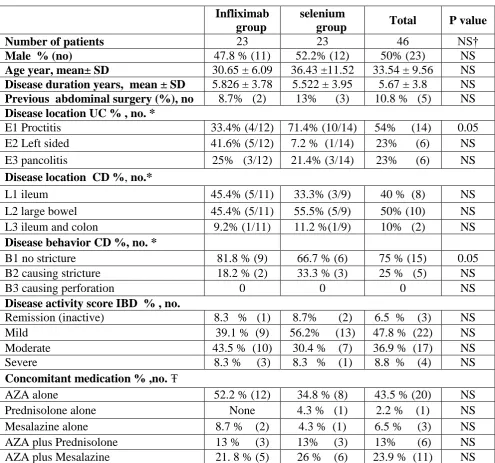
The mean age of the total studied group was 33.54 ± 9.56 years. and there were a non
significant difference between the two study groups (IFX and selenium group) regarding, sex,
age, disease duration and previous abdominal operation.
Significant difference was observed regarding the different sites of ulcerative colitis between
the two studied groups, Proctitis seemed to have a significant p- value (P-Value = 0.05),
while left sided colitis show a non significant results as was the pancolitis as shown in (table
1).
Crohn's disease location L1 results were not significant when statistically tested, L2 was also
not significant and L3 was the same. Regarding the behavior of Crohn's disease, the test
results show that B1 had significant difference (p value = 0.05) , however, B2 shows a non
Disease activity moderate sub scoring represent the most predominant one in the infliximab
group (43.5%), while the mild sub scores was the predominant in the selenium group
(56.2%).There was a non significant differences among the studied disease sub scores
between the two groups (table 1).
The presence of other medications besides IFX and selenium was also tested statistically for
both study groups and all show a non significant results as shown in (table 1).
Mean duration treatment for both group was 20.4 months in the infliximab group and 21.6
[image:6.595.50.546.294.757.2]months in the selenium group, show a non significant differences in both groups (table 1).
Table 1: Baseline clinical and lab. parameters of IBD patients included in the study Infliximab
group
selenium
group Total P value
Number of patients 23 23 46 NS†
Male % (no) 47.8 % (11) 52.2% (12) 50% (23) NS
Age year, mean± SD 30.65 ± 6.09 36.43 ±11.52 33.54 ± 9.56 NS
Disease duration years, mean ± SD 5.826 ± 3.78 5.522 ± 3.95 5.67 ± 3.8 NS Previous abdominal surgery (%), no 8.7% (2) 13% (3) 10.8 % (5) NS Disease location UC % , no. *
E1 Proctitis 33.4% (4/12) 71.4% (10/14) 54% (14) 0.05
E2 Left sided 41.6% (5/12) 7.2 % (1/14) 23% (6) NS
E3 pancolitis 25% (3/12) 21.4% (3/14) 23% (6) NS
Disease location CD %, no.*
L1 ileum 45.4% (5/11) 33.3% (3/9) 40 % (8) NS
L2 large bowel 45.4% (5/11) 55.5% (5/9) 50% (10) NS
L3 ileum and colon 9.2% (1/11) 11.2 %(1/9) 10% (2) NS
Disease behavior CD %, no. *
B1 no stricture 81.8 % (9) 66.7 % (6) 75 % (15) 0.05
B2 causing stricture 18.2 % (2) 33.3 % (3) 25 % (5) NS
B3 causing perforation 0 0 0 NS
Disease activity score IBD % , no.
Remission (inactive) 8.3 % (1) 8.7% (2) 6.5 % (3) NS
Mild 39.1 % (9) 56.2% (13) 47.8 % (22) NS
Moderate 43.5 % (10) 30.4 % (7) 36.9 % (17) NS
Severe 8.3 % (3) 8.3 % (1) 8.8 % (4) NS
Concomitant medication % ,no. Ŧ
AZA alone 52.2 % (12) 34.8 % (8) 43.5 % (20) NS
Prednisolone alone None 4.3 % (1) 2.2 % (1) NS
Mesalazine alone 8.7 % (2) 4.3 % (1) 6.5 % (3) NS
AZA plus Prednisolone 13 % (3) 13% (3) 13% (6) NS
AZA, Mesalazine and prednisolone None 13% (3) 6.5 % (3) NS
Multivitamins 43.5 % (10) 26 % (6) 34.8 % (16) NS
No medication 4.3% (1) 0 2.2 % (1) NS
Duration of IFX treatment mean 20.4 months 21.6 months 21 months NS
* the number of ulcerative colitis and Crohn's disease patients were calculated as per 26 ,20 patient respectively.† NS = non significant, ‡ Total may not equal to 100 since patients might receive multivitamins besides other medication.
There was a non significant difference between the 2 study groups regarding the presence of
ADRs that was attributed to infliximab treatment, where ADR occurs in 47.8% (11/23) of
the IFX group and in 34.8% (8/23) of the selenium group. ADR types felt into three
categories infection, anemia and skin reactions .In addition to that, anemia was detected in
the infliximab group only as shown in (table 2). The total IFX group ADRs was 47.8% compared to 34.8% in the selenium group. As a consequence of ADRs, a temporary delaying
of infliximab dose due to ADRs was required in 30.5% (7/23) of IFX group compared to
26% (6/23) of selenium group. There was no detected ADRs that could be related to selenium
supplementation.
Table 2: ADRs profile during the study period
DISCUSSION
The mean age of the total studied group was 33.54 ± 9.56 years ,the age range between 18
and 54 years. Both sexes were equally distributed in the two groups (IFX and selenium), this
may reflect the wide picture that had been seen generally in many studies.[13, 14]
Regarding UC disease location in this study, proctitis shows 54% while left sided colitis 23%
and pancolitis 23% and it seems to be in the same order that had been found in other
studies.[15,16]
In the current studied CD patients, disease located in the large bowel (L2) was 50%, disease
isolated to ileum (L1) 40% and 10% for disease affecting ileum and colon compared to the
disease location that was reported in European studies where all sites were equally
affected[17], and in Asian were the ileum and colon was the most affected segments.[18] The
ADR type IFX group Selenium group Total P –value
Infection 26% (6/23) 30.4% (7/23) 28.3% (13/46) NS
Anemia 13% (3/23) 0 6.5 % (3/46) NS
behavior of CD in our studied CD patients, was as follows; 75% (B1) as inflammatory,25%
(B2) causing strictures and no perforation was reported compared to other studies where the
same order of behaviour was noticed.[19, 20]
It is well known that TNF- antagonists have improved the care of CD and UC patients but
may lead to primary and secondary therapy failure and increased risk of serious infection.[1,
21]
This study showed a total percentage of 41.3% of ADRs detected during the study period.
ADRs are routinely detected in patients receiving IFX infusion.[22] Comparing the result of ADRs of this study with a recent study in 2014 that followed the ADRs profile of IFX
patients for 2 years, skin rash and eruption were seen in (6%) of patients, infection and
anemia were not reported, with a total adverse events of 28% (6) compared to (28.3% , 6.5%,
6,5%) for infection, anemia and skin reaction in the current study.
All ADRs cases have been reported in patients on concomitant therapy with
immunosuppressive agents and the same notion was found in other previous study (7). Thus
there is increasing interest in attempting to withdraw immunosuppressive agents at a year in
order to reduce the risk of developing some of these serious complications of treatment.[23] On the other hand, the development of antibodies against infliximab is frequently found and
is associated with reduced efficacy and increased numbers of infusion reactions. The
concomitant use of immunosuppressants has been shown to reduce the incidence of antibody
formation[23] therefore continuous patient monitoring is crucial. Finally, the mortality rates and serious infections in IBD patients treated with IFX was studied and found to be similar
to non – IFX treated patients, but there was an increased risk for serious infections that partly
due to disease severity and prednisolone concomitant use[22] and in this study the increased number of ADRs was found in the IFX treated group which show a more severe disease
activity when compared to the selenium group.
In this study although ADRs were statistically not significant when comparing IFX and
selenium groups, there was a total difference of 13% less ADRs in the selenium group, and
this could be attributed to the fact that selenium act to decrease the oxidative stress in IBD
patients[8,24] and this may affect the rate of ADRs. Additionally, one study found that there is an impaired erythrocyte antioxidant defenses in active IBD and a down regulation of
glutathione peroxidase 1(GPX1) caused by anemia[25] thus addition of selenium may have
contributed to an increase in the activity of GPX1 and affect the rate of anemia detection and
the IFX group. Infection is one of the most reported ADRs during IFX therapy[26], and in this study, the incidence of infection in both groups were very close to each other (table 2).
Finally up to our knowledge, this trial is the first to study the effect of selenium
supplementation on ADRs profile of IFX in IBD patients and hope to be a base for further
reproductive studies.
CONCLUSION
The reported ADRs in this study were infection (28.3%) anemia(6.5%) and skin
reactions(6.5%). Selenium supplemented group showed a non significant decrease in the
number of reported ADRs by 13% when added to infliximab treated IBD patients.
Furthermore, no anemia was reported in this group.
ACKNOWLEDGEMENT
We would like to appreciate the time and involvement of all the patients who took part in the
study. Also thank all the specialist doctors in the gastroenterology and Hepatology
specialized hospital in the directorate of medical city in Baghdad who permit us to study their
patients.
REFERENCES
1. Fidder H SF, Ferrante M, Noman M, Katsanos K, Segaert S, et al. Long-term safety of
infliximab for the treatment of inflammatory bowel disease: a single center cohort study.
Gut, 2009; 58(4): 501-8.
2. Travis SP SE, et al for the European Crohn’s and Colitis Organisation (ECCO). European
evidence based consensus on the diagnosis and management of Crohn’s disease :current
management. Gut, 2006; 55((suppl 1)): 11-58.
3. Lee TW FR. Tumor necrosis factor-α monoclonal anti¬bodies in the treatment of
inflammatory bowel disease: clinical practice pharmacology. Gastroenterol Clin North
Am., 2010; 39(3): 543–57.
4. Summers RW. Novel and Future Medical Management of Inflammatory Bowel Disease .
Surg Clin N Am, 2007; 87(3): 727–41.
5. 5. Keane J GS, Wise RP, etal. Tuberculosis associated with inflix¬imab, a tumor
6. Uyanikoglu A EF, Akyuz F, Pinarbasi B, Baran B, Aydogan T, Demir K, Besisik F,
Kaymakoglu S. Infliximab in inflammatory bowel disease: attention to adverse events.
Eur Rev Med Pharmacol Sci., 2014; 18(16): 2337-42.
7. Gary R. Lichtenstein PR, William J. Sandborn ,Bruce E. Sands , Robert H. Diamond
,Marion Blank , Jennifer Montello , Linda Tang , Freddy Cornillie and Jean-Frédéric
Colombel. A Pooled Analysis of Infections, Malignancy, and Mortality in Infliximab- and
Immunomodulator-Treated Adult Patients With Inflammatory Bowel Disease. Am J
Gastroenterol., 2012; 107(7): 1051–63.
8. MP R. The importance of selenium to human health. Lancet, 2000; 356(9225): 233–41.
9. Speckmann B SH. Selenium and selenoproteins in inflammatory bowel diseases and
experimental colitis. Inflamm Bowel Dis., 2014; 20(6): 1110-9.
10.Sturniolo GC MM, Shields R, Turnberg LA. Zinc absorption in Crohn’s disease. Gut,
1980; 5(21): 387–91.
11.Gonzalez S HJ, Fernandez S, et al. Food intake and serum selenium concentration in
elderly people. Ann Nutr Metab., 2006; 50(2): 126-31.
12.Erin E. Battin JL. Antioxidant Activity of Sulfur and Selenium: A Review of Reactive
Oxygen Species Scavenging, Glutathione Peroxidase,and Metal-Binding Antioxidant
Mechanisms. Brumaghim ell Biochem Biophys, 2009; 55(1): 1-23.
13.Jr LE. Clinical epidemiology of inflammatory bowel disease: incidence, prevalence, and
environmental influences. Gastroenterology, 2004; 126(6): 1504-17.
14.Bernstein CN WA, Svenson LW, et al. The epidemiology of inflammatory bowel disease
in Canada: a population-based study. Am J Gastroenterol., 2006; 101(7): 1559-68.
15.Jess T RL, Vind I. Changes in clinical characteristics, course, and prognosis of
inflammatory bowel disease during the last 5 decades: a population-based study from
Copenhagen, Denmark. Inflamm Bowel Dis., 2007; 13: 481–9.
16.Henriksen M JJ, Lygren I et al. Ulcerative colitis and clinical course: results of a 5-year
population-based follow-up study (the IBSEN study). Inflamm Bowel Dis., 2006; 12:
543–50.
17.Jacques Cosnes CGR, Philippe Seksik, Antoine Cortot. Epidemiology and natural history
of inflammatory bowel diseases. Gastroenterology, 2011; 140(6): 1785-94.
18.Lani Prideaux MAK, Peter P De Cruz, Francis K L Chan and Siew C Ng. Inflammatory
bowel disease in Asia: A systematic review. Journal of Gastroenterology and Hepatology,
19.Tarrant KM BM, Frampton CM, Gearry RB. Perianal disease predicts changes in Crohn’s
disease phenotype-results of a population-based study of inflammatory bowel disease
phenotype. Am J Gastroenterol., 2008; 103(12): 3082-93.
20.Sachar DB BC, Goldstein ES et al. . Is perianal Crohn’s disease associated with intestinal
fistulization? . Am J Gastroenterol, 2005; 100(7): 1547-9.
21.Su C SB, Lewis JD, Deren JJ, Kornbluth A, Katzka DA,Stein RB, Adler DR, Lichtenstein
GR. Efficacy of anti-tumor necrosis factor therapy in patients with ulcerative colitis. Am
J Gastroenterol., 2002; 97(10): 2577–84.
22.Gary R. Lichtenstein BGF, Russell D. Cohen, Bruce A. Salzberg, Robert H. Diamond,
and William J. Sandborn. Serious infections and mortality in association with therapies
for Crohn's disease: TREAT Registry. Clin Gastroenterol Hepatol., 2006; 5(4): 621-30.
23.Baert F NM, Vermeire S, Van Assche G, D’ Haens G, Carbonez A, Rutgeerts P.
Influence of immunogenicity on the long-term efficacy of infliximab in Crohn’s disease.
N Engl J Med, 2003; 348(7): 601-8.
24.Geerling BJ B-SA, van Deursen C, van Houwelingen AC, Russel MG, Stockbrugger RW,
Brummer RJ. Nutritional supplementation with n–3 fatty acids and antioxidants in
patients with Crohn’s disease in remission: effects on antioxidant status and fatty acid
profile. Inflamm Bowel Dis, 2000; 6(2): 77–84.
25.Krzystek‐Korpacka M, Neubauer, Katarzyna , Berdowska, Izabela ,Zielinski, Bogdan
,Paradowski, Leszek , Gamian, Andrzej Impaired erythrocyte antioxidant defense in
active inflammatory bowel disease: Impact of anemia and treatment. Inflammatory Bowel
Diseases, 2010; 16(9): 1467–75.
26.Lees C AA, Thompson A, Ho G, Forsythe R, Marquez L, et al. The safety-profile of
anti-tumor necrosis factor therapy in inflammatory bowel disease in clinical practice: analysis