warwick.ac.uk/lib-publications
Original citation:
Moat, Helen Susannah, Olivola, Christopher Y., Chater, Nick and Preis, Tobias. (2016) Searching choices : quantifying decision-making processes using search engine data. Topics in Cognitive Science, 8 . pp. 685-696.
Permanent WRAP URL:
http://wrap.warwick.ac.uk/79612
Copyright and reuse:
The Warwick Research Archive Portal (WRAP) makes this work of researchers of the University of Warwick available open access under the following conditions.
This article is made available under the Creative Commons Attribution 4.0 International license (CC BY 4.0) and may be reused according to the conditions of the license. For more details see: http://creativecommons.org/licenses/by/4.0/
A note on versions:
The version presented in WRAP is the published version, or, version of record, and may be cited as it appears here.
Copyright©2016 The Authors. Topics in Cognitive Science published by Wiley Periodicals, Inc. on behalf of Cognitive Science Society.
ISSN:1756-8757 print / 1756-8765 online DOI: 10.1111/tops.12207
This article is part of the topic “Discovering Psychological Principles by Mining Naturally Occurring Data Sets,” Robert L. Goldstone and Gary Lupyan (Topics Editors). For a full listing of topic papers, see: http://onlinelibrary.wiley.com/doi/10.1111/tops.2016.8.issue-3/issuetoc.
Searching Choices: Quantifying Decision-Making
Processes Using Search Engine Data
Helen Susannah Moat,
aChristopher Y. Olivola,
bNick Chater,
aTobias Preis
aa
Behavioural Science, Warwick Business School, University of Warwick, Coventry, CV4 7AL, UK
b
Tepper School of Business, Carnegie Mellon University, 5000 Forbes Ave., Posner Hall, Pittsburgh, PA 15213, USA
Received 15 October 2013; received in revised form 26 October 2014; accepted 2 November 2014
Abstract
When making a decision, humans consider two types of information: information they have acquired through their prior experience of the world, and further information they gather to support the decision in question. Here, we present evidence that data from search engines such asGooglecan help us model both sources of information. We show that statistics from search engines on the fre-quency of content on the Internet can help us estimate the statistical structure of prior experience; and, specifically, we outline how such statistics can inform psychological theories concerning the valuation of human lives, or choices involving delayed outcomes. Turning to information gathering, we show that search query data might help measure human information gathering, and it may predict subsequent decisions. Such data enable us to compare information gathered across nations, where analyses suggest, for example, a greater focus on the future in countries with a higher per capita GDP. We conclude that search engine data constitute a valuable new resource for cognitive scien-tists, offering a fascinating new tool for understanding the human decision-making process.
Keywords: Search engine data; Google; Wikipedia; Decision making; Behavioral science; Computational social science
Correspondence should be addressed to Helen Susannah Moat, Behavioural Science, Warwick Business School, University of Warwick, Coventry, CV4 7AL, UK. E-mail: [email protected]
1. Introduction
Our increasing interactions with the Internet are creating a digital reflection of modern human life. Events across the world are instantly reported online by ordinary citizens on social media services such as Twitter, and a wealth of further information has been uploaded to the World Wide Web. Search engines such as Google act as a gateway to this vast new information resource. In the process of making this information available to us, Googlelogs both what content exists online and what content people search for.
Cognitive scientists such as Herbert Simon (1955) have long recognized that when faced with a new situation and a need to act, humans can draw on two sources of infor-mation. First, they can consult information they have acquired through their experience of the world to date. Second, at a cost of time and effort, they can gather new informa-tion relevant to the quesinforma-tion in hand.
Here, we argue that search engine data sets offer intriguing insights into how humans make decisions, by providing us with new methods to model and measure both of these information sources. In the first part of this article, we present results suggesting that analyses of content available online can help us model the information that humans may have previously acquired and stored in memory. In the second part, we show that data on queries made to search engines and other online information resources may provide intriguing new measurements of how we gather information before taking actions in the real world, allowing us to map information gathering processes across the globe. We con-clude that search engine data constitute a valuable new resource for investigating the human decision-making process.
2. Using the frequency of content on the Internet to approximate the contents of memory
Human decision making is influenced by memory retrieval and information search pro-cesses that fundamentally depend on, and reflect, the statistical structure of the social and economic environment (Stewart, 2009; Stewart, Chater, & Brown, 2006). Consequently, understanding and modeling decision making requires that we quantify the structure of the environment, to better inform theories of human choice. Fortunately, so-called big data on the Internet, including search engines such as Google, increasingly provide a good proxy for various aspects of this statistical structure. One source of such big data is the frequency of documents on the Internet, which may reflect the frequency with which people observe certain events or values.
distri-bution of event-associated death tolls for natural and industrial disasters. Like many dis-tributions in the natural and social sciences (Chater & Brown, 1999; Gisiger, 2001; Kello et al., 2010; Newman, 2005), the frequency of death toll magnitudes resembles a power-law distribution with a negative exponent, such that small magnitude events (i.e., a few people dying) were much more common than large magnitude events (i.e., large numbers of people dying) (Fig. 1A).
However, the distributions to which people are exposed may not conform to the actual distribution of death tolls. We might expect, for example, an overrepresentation of very large death tolls or the deaths of famous individuals, which could draw disproportionate amounts of media attention.
In an effort to obtain a proxy of the distributions that people might actually observe, Olivola and Sagara (2009) iteratively searched the Google News Archives website1 to quantify attention to event-associated death tolls of various magnitudes in the headlines. Data on media attention to event-associated death tolls were obtained by searching the
[image:4.486.44.430.81.277.2]Google News Archives for news articles whose titles contained keywords related to losses of human life (e.g., “10 people died”), while varying the number of deaths being reported (e.g., “10 people died” vs. “11 people died”). For each search, the number of articles (“hits”) reporting a given death toll was recorded, thus measuring of the total media attention allocated to events associated with a given loss in human lives.
Olivola and Sagara (2009) found that the distribution of Google News Archives hits also approximated a power-law distribution (Fig. 1B), although with a shallower slope. This indicates that very large death tolls receive more coverage in the written media, as one would expect. Nonetheless, small death tolls made up a much larger share of the reporting, even when ignoring celebrity deaths.
The question remains whether the subjective distributions that people hold in memory reflect what they see in the media. To examine this question, Olivola and Sagara (2009) asked a group of participants to spontaneously recall events involving human deaths and estimate, for each one, the number of human fatalities. Once again, the contents of mem-ory seemed to follow a power-law distribution (Fig. 1C), much like the actual distribution and the distribution reflected in the media. In other words, the relative numbers of “hits” returned by Google News Archives when searching for deadly events with given death tolls (e.g., “10 people died” vs. “100 people died”) broadly reflect both the objective dis-tributions of death tolls as they actually occur and the subjective disdis-tributions stored in people’s memory. Olivola and Sagara (2009)’s study illustrates how the contents of the Internet can be used as a proxy for what people observe in their day-to-day environment, as well as what they hold in memory—presumably as a result of their observations.
Beyond finding a proxy for the contents of memory, this study showed that people’s perceptions of, and reactions to, human fatalities are partly governed by the distribution of death toll magnitudes that they are typically exposed to. Specifically, Olivola and Sagara (2009) applied Decision by Sampling theory (Stewart, 2009; Stewart et al., 2006) to the domain of human life valuation. According to this theory, people evaluate the death toll associated with a specific target event by first drawing upon a sample of com-parable events from their memory (e.g., other death tolls they have heard about in the news or from friends) and then comparing the target event-associated death toll with all those in the sampled set. The psychological “shock” (i.e., the perceived negative value) associated with a target event-associated death toll is simply the proportion of pair-wise comparisons in which it is larger than or equal to the comparison death tolls—in other words, its percentile rank among the sampled events.
death tolls (see Study 2 in Olivola & Sagara, 2009); and, unlike the Weber-Fechner Law (which, as its name suggests, refers to a universal human tendency), Decision by Sam-pling correctly predicts that perceptions of death tolls vary across countries according to the distributions of fatalities they experience (see Study 3 in Olivola & Sagara, 2009). Thus, the contents of the Internet can inform theories of human judgment and decision making.
Similarly, data on the frequency distribution of web content allow us to explain and predict people’s time preferences (Stewart et al., 2006)—that is, how they trade-off con-sumption in the present versus future, and their willingness to forgo a smaller immediate (or sooner) reward for a larger, later one. Stewart et al. (2006) looked at the frequency of occurrence of “hits” generated by Google queries for terms related to temporal delays (e.g., “1 day,” “1 year,” etc.; see also Pollmann, 1998; Pollmann & Baayen, 2001). They found that the frequency distribution of duration terms on Google also roughly followed a power-law function. This distribution, when translated through Decision by Sampling theory, predicts that people will exhibit hyperbolic or subhyperbolic delay discounting (i.e., for example, implying that the difference between waiting 1 day vs. 2 days is sub-jectively much larger than the difference between waiting 101 days vs. 102 days), which corresponds well with the typical findings in the literature (Frederick, Loewenstein, & O’donoghue, 2002; Myerson & Green, 1995; Simpson & Vuchinich, 2000).
Other studies have shown that the contents of the Internet can be used to proxy a broad set of variables that reflect various features of human cognition and human experi-ence. For example, Saiz and Simonsohn (2013) demonstrated a close correspondence between the prevalence of corruption in a geographic location and the relative frequency of documents on the Internet that associate that location with corruption.
In sum, a growing body of research suggests that the frequency distribution of content on the Internet may well reflect the distributional properties of the environment that peo-ple are exposed to, and as a result, the contents of human memory. Thus, the Internet offers a useful, powerful, and versatile tool for approximating certain key features of human experience and cognition.
3. Using data from search engine queries to measure information-gathering processes
To address this question, a dataset describing decisions taken in the real world is required. Vast transactional datasets from financial markets provide exactly such data, recording decisions taken by traders in immense detail. Such large datasets from financial markets are particularly important given their economic impact. Preis, Moat, and Stanley (2013) and Moat et al. (2013) investigated whether links could be found between the fre-quency with which Internet users searched for financial terms on Google and Wikipedia
and subsequent actions taken in the financial markets. They examined this relationship by implementing a hypothetical trading strategy, in which they bought or sold the Dow Jones Industrial Average (DJIA), depending on changes in how often Internet users had searched for a given term on Google (Preis et al., 2013) or viewed a given page on Wiki-pedia (Moat et al., 2013). Where they saw decreases in such online activity in a given week, they bought the DJIA at the beginning of the following week. Conversely, where they saw increases in online activity in a given week, they sold the DJIA at the beginning of the following week.
Both analyses by Moat et al. (2013) and Preis et al. (2013) suggested that increases in searches for financially related terms tended to be followed by falls in stock market prices. Preis et al. (2013) further demonstrated that words which were classified as more financially relevant, on the basis of the frequency of their occurrence in the Financial Times normalized by their frequency on the Internet as a whole, were more strongly related to subsequent stock market moves. Similarly, Moat et al. (2013) showed that increases in views of Wikipedia pages relating to companies listed in the DJIA (Fig. 2), or to more general economic concepts, tended to be followed by stock market drops. No such relationship was found between stock market movements and views of Wikipedia
pages relating to actors and filmmakers, a topic with no obvious financial connotations. Together, the results of Moat et al. (2013) and Preis et al. (2013), as well as a further analysis recently reported by Curme, Preis, Stanley, and Moat (2014), suggest that an increase in searches for financially related information online tended to be followed by a fall in stock market prices. What sort of decision-making mechanism might lead to such a pattern? One potential explanation put forward by Moat et al. (2013) is as follows. Many studies in psychology and behavioral economics have suggested that people are loss averse (e.g., Tversky & Kahneman, 1991; although see Erev, Ert, & Yechiam, 2008); that is, they are more concerned about losing $5 than they are about missing an opportu-nity to gain $5. Simon (1955) observed that gathering information to support a decision is not cost-free, incurring at least an expenditure of time and effort. Moat et al. (2013) suggest that humans may be willing to incur higher information gathering costs for deci-sions that they consider to be of greater consequence. If the decision of greatest conse-quence that a trader can make is to sell stock at a price lower than the trader believed it was worth, then more information-seeking efforts may be observed before stock market falls, consistent with Moat et al.’s (2013) and Preis et al.’s (2013) results. Further experi-ments will be needed to investigate the potential role of loss aversion in information search.
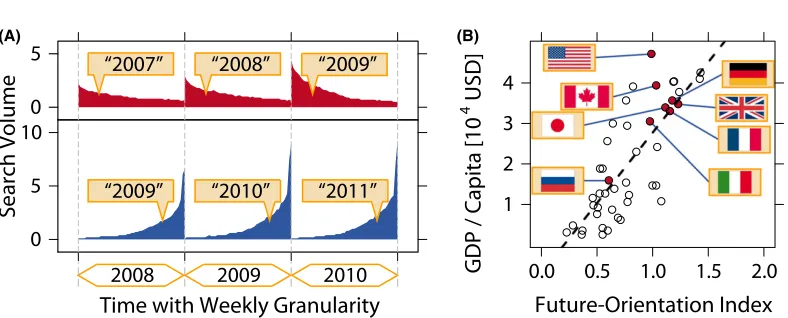
Preis, Moat, Stanley, and Bishop (2012) used data on searches for years expressed in Ara-bic numerals (e.g., “2012”), an almost ubiquitous written representation, to compare search behavior between countries. For the 45 countries with more than 5 million Internet users in 2010, Preis et al. (2012) calculated the ratio of the number of Google searches for the coming year (“2011”) to the number of searches for the previous year (“2009”), a quantity which they called the “future orientation index.” Their analyses demonstrated that the future orientation index was strongly correlated with per capita GDP (Fig. 3). More recently, Noguchi, Stewart, Olivola, Moat, and Preis (2014) extended these analyses to show that per capita GDP was also associated with the rate at which national “atten-tion” shifted from the past to the present. Specifically, countries with a higher per capita GDP were characterized by patterns of Internet search that were not only more future focused but also broader in their retrospective temporal horizon (rather than primarily focused on the present or recent past).
One possible interpretation of these results is that differences in attention to the past, present, and future are linked to economic well-being. A focus on the future and a broader temporal focus may support economic success (Joireman, Sprott, & Spangenberg, 2005; Lynch, Netemeyer, Spiller, & Zammit, 2010; Zimbardo & Boyd, 1999), or con-versely, worse socioeconomic conditions may hinder attention to future events and instead keep it focused on immediate or recent events (Holden, Shiferaw, & Wik, 1998; Lawrance, 1991). For example, a focus on the present (a low future orientation) may favor exploiting immediate opportunities, whereas a focus on the future (a high future ori-entation) may instead favor exploring whether other better options are available
(Carsten-Return [Std. Dev. of Random Strategies]
Density
0.0 0.2 0.4 0.6
−2 0 2
Wikipedia Views
DJIA Companies
Wikipedia Edits
DJIA Companies
[image:8.486.131.351.84.226.2]Random Strategy
Fig. 2. Returns from trading strategies based onWikipediaview and edit logs for articles relating to the com-panies forming the Dow Jones Industrial Average (DJIA) (reproduced from Moat et al., 2013). The distribu-tions of returns from two portfolios of 30 hypothetical strategies, trading weekly on the DJIA, based on changes in how often the 30 Wikipedia articles describing the companies listed in the DJIA were viewed
(blue)and edited(red)during the period from December 2007 to April 2012. The distribution of returns from
sen, Isaacowitz, & Charles, 1999; for mathematical analysis, see, e.g., Gittins, 1979; Git-tins & Jones, 1974). In many environments, there are likely to be substantial long-term benefits to expending a large amount of time and effort on projects focused on explo-ration, with potential benefits in the far future. Types of exploexplo-ration, at the level of indi-viduals and organizations, range from education, to trying out new products, methods, or services, learning new skills, and systematic research and development (e.g., March, 1991). Such exploration tends to lead to long-term benefits, with positive impacts on the economy. But exploration will be chosen only in the context of long-term planning; where immediate needs (e.g., concerning the basic provision of food, water, security, and so on) are pressing, the immediate exploitation of existing knowledge is likely to be the dominant behavior (Banerjee & Duflo, 2007). Although such an interpretation can at this stage only be speculative, overall, Preis et al.’s (2012) and Noguchi et al.’s (2014) analy-ses highlight the opportunities provided by search engine data to measure and compare information gathering at a global scale, a task which was previously near impossible.
A range of studies provide further evidence of links between search engine queries and subsequent decisions (see Moat, Preis, Olivola, Liu, & Chater, 2014, for a summary). For some behaviors, studies demonstrate that search engine data can “predict the present,” measuring real-world decisions before official data are released (Choi & Varian, 2012). Correlations between search engine query data and real-world actions span a range of areas, including motor vehicle sales, incoming tourist numbers, unemployment rates, reports of flu and other diseases, and trading volumes in the U.S. stock markets (Askitas & Zimmermann, 2009; Brownstein, Freifeld, & Madoff, 2009; Choi & Varian, 2012; Ettredge, Gerdes, & Karuga, 2005; Ginsberg et al., 2009; Preis & Moat, 2014; Preis,
Time with Weekly Granularity
Search Volume
0 5 10
2008 2009 2010
0 5
(A) (B)
“2008” “2007”
“2009” “2010” “2011”
“2009”
Future-Orientation Index
GDP / Capita [10
4 USD]
1 2 3 4
[image:9.486.52.446.70.229.2]0.0 0.5 1.0 1.5 2.0
Reith, & Stanley, 2010). In areas where actions may be deliberated for longer, studies show that data on online information gathering can also anticipate future collective behavior. For example, Goel, Hofman, Lahaie, Pennock, and Watts (2010) demonstrated that search query volume predicts the opening weekend box-office revenue for films, first-month sales of video games, and chart rankings of songs. Similarly, Mestyan, Yas-seri, and Kertesz (2013) demonstrate that views and edits of Wikipedia pages relating to movies can anticipate their box-office success on release. This work forms part of a growing literature drawing on data from a range of web services, such as Twitter (e.g., Bollen, Mao, & Zeng, 2011), Flickr (e.g., Preis, Moat, Bishop, Treleaven, & Stanley, 2013), online news (e.g., Alanyali, Moat, & Preis, 2013; Olivola & Sagara, 2009), and the recommendation website digg.com(e.g., Wu & Huberman, 2007) to gain new insights into human behavior (see Bentley, O’Brien, & Brock, 2014, for an overview).
Modern life is now pervaded by massive technological systems, which support our communication, our transport, our retail activities, and much more. Frequent human inter-action with these systems is generating increasing amounts of data on large-scale real-world behavior (Conte et al., 2012) and thereby steadily increasing the possibilities to link online information gathering with decisions taken in the real world. For privacy rea-sons, the publicly available data on information requests provided by services such as
Google Trends and Wikipedia only describe behavior at a collective level, rather than an individual level. Access to sequences of search engine requests submitted by individual users—data which are collected by search engines but not made public—would signifi-cantly advance our ability to study the information gathering process, such as the heuris-tics people use to constrain their search for information, or the rules they use to terminate their searches. Barring access to such data, another approach would be to create a new web search interface, perhaps indexing only a limited set of documents, to experimentally collect data and investigate these processes (e.g., Fu & Pirolli, 2007; Pirolli & Fu, 2003). Nevertheless, we argue that these openly available datasets present an unprecedented opportunity for cognitive science to measure a core process in human decision making, both in a natural environment and at immense scale.
4. Conclusion
or online encyclopedias may give us insight into how people gather information before taking decisions. The results outlined suggest that search engine and online encyclopedia data can contribute to our understanding of how information is gathered before stock market falls, and allow us to compare how information is gathered worldwide, where analyses suggest a greater focus on the future and a broader retrospective temporal hori-zon in countries with a higher per capita GDP. We conclude that data from search engi-nes and other online information resources open up a valuable new avenue for investigating the human decision-making process, and we call these data to the attention of other cognitive scientists.
Acknowledgments
H. S. M., N. C., and T. P. acknowledge the support of the Research Councils UK Grant EP/K039830/1. C. Y. O. and N. C. were partially supported by the Templeton Foundation; N. C. was partially supported by ERC grant 295917-RATIONALITY, the ESRC Network for Integrated Behavioural Science, and the Leverhulme Trust. The authors declare no competing financial interests.
Note
1. Google News Archive was an extension of Google News that offered access to scanned archives of newspapers and links to other newspaper archives on the web (http://news.google.com/archivesearch). In 2011Google News Archives was discon-tinued and instead merged with Google News (http://news.google.com). In 2014, a modified version of Google News Archives was reinstated allowing users to search for articles dating back to 2003.
References
Alanyali, M., Moat, H. S. & Preis, T. (2013). Quantifying the relationship between financial news and the stock market.Scientific Reports,3, 3578.
Askitas, N. & Zimmermann, K. F. (2009). Google econometrics and unemployment forecasting. Applied
Economics Quarterly,55, 107–120.
Banerjee, A. V. & Duflo, E. (2007). The economic lives of the poor. Journal of Economic Perspectives, 21, 141–167.
Bentley, R. A., O’Brien, M. J. & Brock, W. A. (2014). Mapping collective behavior in the big-data era.
Behavioral and Brain Sciences,37, 63–119.
Bollen, J., Mao, H. & Zeng, X.-J. (2011). Twitter mood predicts the stock market. Journal of Computational
Science,2, 1–8.
Carstensen, L. L., Isaacowitz, D. M. & Charles, S. T. (1999). Taking time seriously: A theory of socioemotional selectivity.American Psychologist,54, 165–181.
Chater, N. & Brown, G. D. A. (1999). Scale-invariance as a unifying psychological principle.Cognition,69, B17–B24.
Choi, H. & Varian, H. (2012). Predicting the present with Google Trends.Economic Record,88, 2–9. Conte, R., Gilbert, N., Cioffi-Revilla, C., Deffuant, G., Kertesz, J., Loreto, V., Moat, S., Nadal, J.-P.,
Sanchez, A., Nowak, A., Flache, A., San Miguel, M. & Helbing, D. (2012). Manifesto of computational social science.EPJ Special Topics,214, 325–346.
Curme, C., Preis, T., Stanley, H. E. & Moat, H. S. (2014). Quantifying the semantics of search behavior before stock market moves.Proceedings of the National Academy of Sciences,111, 11600–11605. Erev, I., Ert, E. & Yechiam, E. (2008). Loss aversion, diminishing sensitivity, and the effect of experience on
repeated decisions.Journal of Behavioral Decision Making,21, 575–597.
Ettredge, M., Gerdes, J. & Karuga, G. (2005). Using web-based search data to predict macroeconomic statistics.Communications of the ACM,48, 87–92.
Fetherstonhaugh, D., Slovic, P., Johnson, S. M. & Friedrich, J. (1997). Insensitivity to the value of human life: A study of psychophysical numbing.Journal of Risk and Uncertainty,14, 283–300.
Frederick, S., Loewenstein, G. & O’donoghue, T. (2002). Time discounting and time preference: A critical review.Journal of Economic Literature,40, 351–401.
Friedrich, J., Barnes, P., Chapin, K., Dawson, I., Garst, V. & Kerr, D. (1999). Psychophysical numbing: When lives are valued less as the lives at risk increase.Journal of Consumer Psychology,8, 277–299. Fu, W. T. & Pirolli, P. (2007). SNIF-ACT: A cognitive model of user navigation on the World Wide Web.
Human-Computer Interaction,22, 355–412.
Ginsberg, J., Mohebbi, M. H., Patel, R. S., Brammer, L., Smolinski, M. S. & Brilliant, L. (2009). Detecting influenza epidemics using search engine query data.Nature,457, 1012–1014.
Gisiger, T. (2001). Scale invariance in biology: Coincidence or footprint of a universal mechanism?
Biological Reviews,76, 161–209.
Gittins, J. C. (1979). Bandit processes and dynamic allocation indices. Journal of the Royal Statistical
Society. Series B (Methodological),41, 148–177.
Gittins, J. C. & Jones, D. M. (1974). A dynamic allocation index for the sequential design of experiments. In J. Gans (Ed.),Progress in statistics(pp. 241–266). Amsterdam, The Netherlands: North-Holland.
Goel, S., Hofman, J. M., Lahaie, S., Pennock, D. M. & Watts, D. J. (2010). Predicting consumer behavior with web search.Proceedings of the National Academy of Sciences,107, 17486–17490.
Holden, S. T., Shiferaw, B. & Wik, M. (1998). Poverty, market imperfections and time preferences: Of relevance for environmental policy?Environment and Development Economics,3, 105–130.
Joireman, J., Sprott, D. E. & Spangenberg, E. R. (2005). Fiscal responsibility and the consideration of future consequences.Personality and Individual Differences,39, 1159–1168.
Kahneman, D. & Tversky, A. (1979). Prospect theory.Econometrica,47, 263–292.
Kello, C. T., Brown, G. D. A., Ferrer-i-Cancho, R., Holden, J. G., Linkenkaer-Hansen, K., Rhodes, T. & Van Orden, G. C. (2010). Scaling laws in cognitive sciences.Trends in Cognitive Sciences,14, 223–232. Lawrance, E. C. (1991). Poverty and the rate of time preference: Evidence from panel data. Journal of
Political Economy,99, 54–77.
Lynch, J. G., Jr, Netemeyer, R. G., Spiller, S. A. & Zammit, A. (2010). A generalizable scale of propensity to plan: The long and the short of planning for time and for money.Journal of Consumer Research,37, 108–128. March, J. G. (1991). Exploration and exploitation in organizational learning.Organization Science,2, 71–87. Mestyan, M., Yasseri, T. & Kertesz, J. (2013). Early prediction of movie box office success based on
Wikipedia activity big data.PLoS ONE,8, e71226.
Moat, H. S., Curme, C., Avakian, A., Kenett, D. Y., Stanley, H. E. & Preis, T. (2013). Quantifying Wikipedia usage patterns before stock market moves.Scientific Reports,3, 1801.
Myerson, J. & Green, L. (1995). Discounting of delayed rewards: Models of individual choice.Journal of the
Experimental Analysis of Behavior,64, 263–276.
Newman, M. E. (2005). Power laws, Pareto distributions and Zipf’s law.Contemporary Physics,46, 323–351. Noguchi, T., Stewart, N., Olivola, C. Y., Moat, H. S. & Preis, T. (2014). Characterizing the time-perspective
of nations with search engine query data.PLoS-ONE,9, e95209.
Olivola, C. Y. & Sagara, N. (2009). Distributions of observed death tolls govern sensitivity to human fatalities.Proceedings of the National Academy of Sciences,106, 22151–22156.
Pirolli, P. & Fu, W. T. (2003). SNIF-ACT: A model of information foraging on the World Wide Web. In P. Brusilovsky, A. Corbett, & F. de Rosis (Eds.),User modeling 2003(pp. 45–54). Berlin: Springer.
Pollmann, T. (1998). On forgetting the historical past.Memory & Cognition,26, 320–329.
Pollmann, T., & Baayen, R. H. (2001). Computing historical consciousness. A quantitative inquiry into the presence of the past in newspaper texts.Computers and the Humanities,35, 237–253.
Preis, T. & Moat, H. S. (2014). Adaptive nowcasting of influenza outbreaks using Google searches. Royal
Society Open Science,1, 140095.
Preis, T., Moat, H. S., Bishop, S. R., Treleaven, P. & Stanley, H. E. (2013). Quantifying the digital traces of Hurricane Sandy on Flickr.Scientific Reports,3, 3141.
Preis, T., Moat, H. S. & Stanley, H. E. (2013). Quantifying trading behavior in financial markets using Google Trends.Scientific Reports,3, 1684.
Preis, T., Moat, H. S., Stanley, H. E. & Bishop, S. R. (2012). Quantifying the advantage of looking forward.
Scientific Reports,2, 350.
Preis, T., Reith, D. & Stanley, H. E. (2010). Complex dynamics of our economic life on different scales: Insights from search engine query data. Philosophical Transactions of the Royal Society A, 368, 5707– 5719.
Saiz, A. & Simonsohn, U. (2013). Proxying for unobservable variables with Internet document frequency.
Journal of the European Economic Association,11, 137–165.
Simon, H. A. (1955). A behavioral model of rational choice.Quarterly Journal of Economics,69, 99–118. Simpson, C. A. & Vuchinich, R. E. (2000). Reliability of a measure of temporal discounting. The
Psychological Record,50, 3–16.
Slovic, P. (2007). “If I look at the mass I will never act”: Psychic numbing and genocide. Judgment and
Decision Making,2, 79–95.
Stewart, N. (2009). Decision by sampling: The role of the decision environment in risky choice. Quarterly
Journal of Experimental Psychology,62, 1041–1062.
Stewart, N., Chater, N. & Brown, G. D. A. (2006). Decision by sampling.Cognitive Psychology,53, 1–26. Tversky, A. & Kahneman, D. (1981). The framing of decisions and the psychology of choice.Science,211,
453–458.
Tversky, A. & Kahneman, D. (1991). Loss aversion in riskless choice: A reference-dependent model. The
Quarterly Journal of Economics,106, 1039–1061.
Wu, F. & Huberman, B. A. (2007). Novelty and collective attention. Proceedings of the National Academy of
Sciences,104, 17599–17601.