warwick.ac.uk/lib-publications
Monthly Notices of the Royal Astronomical Society, 465 (1). pp. 1008-1022.
Permanent WRAP URL:
http://wrap.warwick.ac.uk/83207
Copyright and reuse:
The Warwick Research Archive Portal (WRAP) makes this work by researchers of the
University of Warwick available open access under the following conditions. Copyright ©
and all moral rights to the version of the paper presented here belong to the individual
author(s) and/or other copyright owners. To the extent reasonable and practicable the
material made available in WRAP has been checked for eligibility before being made
available.
Copies of full items can be used for personal research or study, educational, or not-for profit
purposes without prior permission or charge. Provided that the authors, title and full
bibliographic details are credited, a hyperlink and/or URL is given for the original metadata
page and the content is not changed in any way.
Publisher’s statement:
This article has been accepted for publication in Monthly Notices of the Royal Astronomical
Society © 2017 The Authors Published by Oxford University Press on behalf of the Royal
Astronomical Society. All rights reserved.
Link to final published version:
http://dx.doi.org/10.1093/mnras/stw2748
A note on versions:
The version presented in WRAP is the published version or, version of record, and may be
cited as it appears here.
Explaining the variability of WD 1145
+
017 with simulations of asteroid
tidal disruption
Dimitri Veras,
1‹Philip J. Carter,
2Zo¨e M. Leinhardt
2and Boris T. G¨ansicke
1 1Department of Physics, University of Warwick, Coventry CV4 7AL, UK2School of Physics, University of Bristol, Bristol BS8 1TL, UK
Accepted 2016 October 21. Received 2016 October 21; in original form 2016 July 20
A B S T R A C T
Post-main-sequence planetary science has been galvanized by the striking variability, depth and shape of the photometric transit curves due to objects orbiting white dwarf WD 1145+017, a star which also hosts a dusty debris disc and circumstellar gas, and displays strong metal atmospheric pollution. However, the physical properties of the likely asteroid which is dis-charging disintegrating fragments remain largely unconstrained from the observations. This process has not yet been modelled numerically. Here, we use theN-body code PKDGRAVto
compute dissipation properties for asteroids of different spins, densities, masses and eccen-tricities. We simulate both homogeneous and differentiated asteroids, for up to 2 yr, and find that the disruption time-scale is strongly dependent on density and eccentricity, but weakly dependent on mass and spin. We find that primarily rocky differentiated bodies with moderate (∼3–4 g cm−3) bulk densities on near-circular (e0.1) orbits can remain intact while oc-casionally shedding mass from their mantles. These results suggest that the asteroid orbiting WD 1145+017 is differentiated, resides just outside of the Roche radius for bulk density but just inside the Roche radius for mantle density, and is more akin physically to an asteroid like Vesta instead of one like Itokawa.
Key words: methods: numerical – minor planets, asteroids: general – planets and satellites: dynamical evolution and stability – planets and satellites: physical evolution – planets and satellites: rings – white dwarfs.
1 I N T R O D U C T I O N
Observations of the fates of planetary systems help constrain their formation and subsequent evolution, and provide unique insights into their bulk composition. Planets, moons and asteroids which survive engulfment from their parent star’s giant branch evolution (Villaver & Livio2009; Kunitomo et al.2011; Mustill & Villaver 2012; Adams & Bloch2013; Nordhaus & Spiegel2013; Villaver et al. 2014; Payne et al. 2016a,b; Staff et al. 2016) represent a sufficient reservoir of material to eventually ‘pollute’ between one-quarter and one-half of all Milky Way white dwarfs with metals (Zuckerman et al.2003,2010; Koester, G¨ansicke & Farihi2014). This fraction is roughly commensurate with that of planet-hosting main-sequence stars (Cassan et al.2012).
The high mass density of white dwarfs (∼105–106g cm−3)
en-sures that their atmospheres stratify chemical elements (Schatz-man 1958), allowing for the relatively easy detection of metals (Zuckerman et al.2007; Klein et al.2010,2011), particularly with high-resolution ultraviolet spectroscopy (Xu et al.2013,2014;
E-mail:[email protected]
son et al.2015,2016). Consequently, trends amongst the chemical diversity and bulk composition of exoasteroids, which are the build-ing blocks of planets, may be inferred and linked to specific families in the Solar system (G¨ansicke et al.2012; Jura & Young2014) or to the compositional evolution during accretion of exoplanets them-selves (Carter et al.2015).
The pollutants are accreted from either or both surrounding de-bris discs and direct impacts. About 40 white dwarf dede-bris discs have now been identified (Zuckerman & Becklin 1987; Becklin et al.2005; G¨ansicke et al.2006,2008; Farihi, Jura & Zuckerman 2009; Barber et al.2012; Wilson et al.2014; Farihi2016; Manser et al.2016), exclusively around white dwarfs which are polluted, strengthening the link between pollution and debris discs. Bod-ies may frequently impact the white dwarf directly (Wyatt et al. 2014, Brown, Veras & G¨ansicke2017), including comets (Alcock, Fristrom & Siegelman1986; Veras, Shannon & G¨ansicke2014b; Stone, Metzger & Loeb2015), moons (Payne et al.2016a,b), aster-oids (Bonsor, Mustill & Wyatt2011; Debes et al.2012; Frewen & Hansen2014; Antoniadou & Veras2016), or small planets (Hamers & Portegies Zwart2016). Alternatively, upon entering the Roche (or disruption) radius, one of these bodies may break up, forming a disc (Graham et al.1990; Jura2003; Debes et al.2012; Bear &
2016 The Authors
at University of Warwick on January 11, 2017
http://mnras.oxfordjournals.org/
tion and multiplanet dynamics over many Gyr (Veras et al.2013a; Mustill, Veras & Villaver2014; Veras2016b) or even over one Hub-ble time (Veras & G¨ansicke2015; Veras et al.2016a,c). Planets are generally required as perturbing agents because self-perturbation into the Roche radius due to radiative effects alone is unlikely (Veras, Eggl & G¨ansicke2015a,c). Amongst the presence of ex-ternal stellar perturbers, planets provide a key pathway for smaller bodies to collide with the white dwarf (Bonsor & Wyatt2012; Bon-sor & Veras2015; Petrovich & Mu˜noz2016).
Before the year 2015, what was missing from the framework detailed above were detections of asteroids breaking up within the Roche radius of a white dwarf. That situation changed with the discovery of photometric transits fromK2light curves of WD 1145+017. These strongly suggest that at least one body around this white dwarf is disintegrating (Vanderburg et al.2015). The transit signatures change shape and depth on a nightly basis (G¨ansicke et al. 2016; Rappaport et al.2016) in a manner which is unique amongst exoplanetary systems, prompting intense follow-up studies (Croll et al.2015; Alonso et al.2016; Gary et al.2016; Redfield et al. 2016; Xu et al.2016; Zhou et al.2016). A plausible interpretation of the observations, exemplified by fig. 7 of Rappaport et al. (2016), is that a single asteroid is disintegrating and producing multiple nearly co-orbital fragments. However, the actual tidal disruption has not yet been modelled numerically, and, with the exception of Gurri, Veras & G¨ansicke (2017), all previous studies on this system have been observationally focused.
In this paper, we perform this task, and utilize both homogeneous and differentiated rubble piles to model the evolution of an object which could create the observational transit signatures. We first, in Section 2, describe the known parameters of the objects orbiting WD 1145+017. Then, in order to begin quantifying disruption, in Section 3, we summarize different simple formulations of the Roche radius which have appeared in the literature and how they relate to our simulations. The setup for these simulations is described in Section 4, and the results are reported in Section 5. We discuss the implications for WD 1145+017 and utility of our study to similar systems in Section 6, and conclude in Section 7.
2 K N OW N PA R A M E T E R S
The known orbital parameters of the WD 1145+017 system are ef-fectively limited to the orbital periods of individual transit features. These periods are obtained directly from the photometric transit curves for features which are observed over multiple nights, and are known to exquisite precision. As suggested by Rappaport et al. (2016), only one periodic signal, at 4.50 h, has been consistently detected over a timespan of about 2 yr (going back to theK2 obser-vations presented by Vanderburg et al.2015) and may be associated with the major disrupting parent body. Other transit features, which could be interpreted as co-orbital disintegrating debris, have or-bital periods ranging from 4.490 to 4.495 h (G¨ansicke et al.2016; Rappaport et al.2016).
These periods, however, do not translate into well-constrained semimajor axes because the stellar mass,MWD, is not well known.
However, under the reasonable assumption (e.g. Tremblay et al.
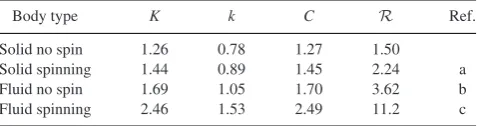
Solid no spin 1.26 0.78 1.27 1.50
Solid spinning 1.44 0.89 1.45 2.24 a
Fluid no spin 1.69 1.05 1.70 3.62 b
Fluid spinning 2.46 1.53 2.49 11.2 c
Notes.
a : see equation 4.131 of Murray & Dermott (1999). b : Sridhar & Tremaine (1992)
c : Roche (1847)
2016) thatMWD=0.5 M–0.7 M, the semimajor axisaof the
dis-rupting asteroid – henceforth denoted as the parent body – lies in the range 0.0051–0.0057 au (assuming a negligible-mass parent body). The typically used fiducial white dwarf mass ofMWD =0.6 M
givesa=0.0054 au.
3 R O C H E R A D I U S
Does this semimajor axis value lie within the white dwarf Roche radius? The answer is not obvious because it depends on how the Roche radius is defined (see equation 9.1 of Veras 2016afor a summary of the different equations in the post-main-sequence lit-erature) and how much internal strength the bodies are assumed to have (Cordes & Shannon2008; Veras et al.2014b; Bear & Soker 2015). We will ignore material strength for the remainder of this paper because for objects larger than about 10 km, the gravitational binding energy is more significant than any material strength (Benz & Asphaug1999; Leinhardt & Stewart2012).
Assume that a Roche radiusrddefines a disruption sphere. Hence
rd∝RWD
ρ
WD
ρ
1/3
∝
M
WD
ρ
1/3
(1)
=KRWD
ρWD ρ 1/3 =k MWD ρ 1/3 (2)
where ρ is the bulk density of the orbiting body, and ρWD and
RWD are the density and radius of the white dwarf. The definition
ambiguity arises with the choice of proportionality constants,Kor k, which are related throughK≈1.61k.
The exact value ofK(ork) depends on the nature of the body; see Table1. A more thorough treatment in the strengthless case (Davidsson1999) reveals thatrdshould also be explicitly
depen-dent on the body’s tensile strength and shear strength, parame-ters which determine when the body will specifically fracture or split.
A useful Roche radius expression which is rescaled for white dwarf systems is (equation 1 of Bear & Soker2013)
rd
R =0.65C M
WD
0.6 M
1/3 ρ
3 g cm−3
−1/3
(3)
which is related to equation (2) through C = 1.63k. Bear & Soker (2013) stated thatC=1.3–2.9, which hence corresponds to k=0.80–1.78 andK=1.29–2.87. Motivated by Chandrasekhar’s
at University of Warwick on January 11, 2017
http://mnras.oxfordjournals.org/
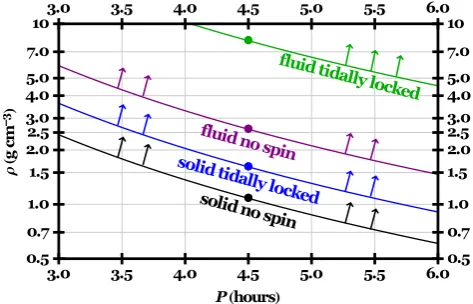
[image:3.595.310.549.113.176.2]Figure 1. The relation between density (ρ) and orbital period (P) of a strengthless spherical homogeneous rubble pile which resides just at the Roche radius (equation 5); tidally locked rubble piles are in synchronous rotation and arrows indicate stable regions. The relation is general, and is independent of the properties of the central object. Dots indicate the orbital period of the likely disintegrating asteroid at WD 1145+017.
seminal work (Chandrasekhar1969), Leinhardt et al. (2012) instead defined a proportionality constantRin their equation 5 as,
R≡ 3
4 ρ ρWD
rd
RWD
3
(4)
which can be shown to be related toKthroughR=0.75K3(see
Table1). Overall,Kvaries only within a factor of 2 for these different scenarios.
Constraining the numerical values of these constants enables one to estimateρfrom knowledge of the orbital periodPalone. If one assumes that the body’s orbit is circular and the body resides just at the Roche radius, then comparing equation (2) with Kepler’s third law cancels out the (unknown) white dwarf mass and leads to the relation
ρ = 4GPπ2k23
=0.72 g cm−3R
P
4.5 h −2
. (5)
Equation (5) provides a useful quick way to estimate the density of a disrupting body if only its orbital period is known. For the bodies orbiting WD 1145+017 (with periods of roughly 4.5 h), this formula givesρ=1.08, 1.62, 2.61, 8.04 g cm−3for the solid no spin,
solid spinning, fluid no spin and fluid spinning, cases, respectively. We plot equation (5) in Fig.1for the purpose of wider use beyond this individual planetary system.
All of the bodies in the figure are strengthless. Incorporating strength would complicate equations (1–4), and the resulting curves would be different. The fluid case is not important for the numerical aspects of our study, but was included in Fig. 1and Table1for
comparison with and clarification of existing literature on Roche radii formulations. In contrast to fluids, granular materials, in gen-eral, can withstand considerable shear stress when they are under pressure (section 4.2 of Mann, Nakamura & Mukai2009).
4 N U M E R I C A L M E T H O D S
The analysis from the last section shows that knowledge of P can provide strong constraints onρ. We explore this possibility in the case of WD 1145+017 with numerical simulations of rub-ble piles, which are aggregates bound together by self-gravity. We used theN-body gravity tree codePKDGRAV(Stadel2001), which has been modified with the ability to detect and resolve collisions amongst individual particles (Leinhardt, Richardson & Quinn2000; Richardson et al.2000).
4.1 Common properties
Our simulations required us to specify a central mass and semi-major axis. We chose values which correspond to P ≈ 4.5 h (M =0.60 Manda=0.0054 au) for all simulations because our focus is on modelling the WD 1145+017 system. We adopted a constant timestep of 50 s for all simulations, a choice which is suf-ficient to resolve the collisions within each rubble pile (see section 5.3 of Veras et al.2014afor details).
4.2 Other parameter choices
Other parameters that we varied amongst different simulations in-clude rubble pile structure, number of particles, bulk densityρ and massM(and hence radiusR), plus eccentricityeand spin. See TableA1for the full list of simulations; three highly referenced sim-ulations are repeated here in Table2for demonstration purposes. The table columns are as follows.
(i)Packing type. We created our rubble piles with two different internal packing structures: (1) hexagonal closest packing (HCP; Leinhardt et al.2000) and (2) random packing. See Fig.2for a visual comparison.
(ii) Differentiated. This column indicates if the rubble pile was homogeneous or differentiated. The differentiated rubble piles all contained a ‘core’ (green particles in Fig.2; image B2) and ‘mantle’ (white particles in Fig. 2; image B2). Each type of particle has different properties: each core particle was four times more massive than each mantle particle although all particles had the same size. For these rubble piles, about 35 per cent of particles were core particles.
[image:4.595.44.549.669.732.2](iii)Number of particles. The vast majority of our simulations contained about 5000 particles, which is a well-justified choice (e.g. Leinhardt et al.2012; Veras et al.2014a) because disruption properties have been shown to be independent of particle number until it becomes smaller than roughly 1000. Some long-duration simulations necessarily featured smaller number of particles due to computational limitations.
Table 2. Details of three simulations which appear throughout the text and in Figs5–10. All simulations performed in this work are detailed in the appendix.
Simulation Packing Differe- Number of Density Mass Radius e Spin Duration Outcome
name type ntiated particles (g cm−3) (kg) (km) (d) (disruption type)
HCP134 Hexagonal No 5003 2.60 1.0×10²² 1000 0.00 0 90 full
RandDiff19 Random Yes 5000 3.50 1.2×10²² 1000 0.00 1 90 mantle
RandDiff32 Random Yes 5000 3.50 1.2×10²² 1000 0.01 1 90 full
at University of Warwick on January 11, 2017
http://mnras.oxfordjournals.org/
Figure 2. (A) A rubble pile with hexagonal closest packing (HCP) of 5003 particles. (B) A randomly packed differentiated rubble pile consisting of 5000 particles. ( B2) A hemispherical cutaway of B to show the structure (not a distinct initial condition).
(iv)Density. Our choices for ρ (1.0−4.6 g cm−3) were
moti-vated by Fig. 1and encompassed the Roche radius regions for solid parent bodies which may be spinning, and a fluid parent body with no spin. This range is reasonable but not exhaustive: the dif-ferentiated bodies limit the density on the upper end because the density of the core would be too high if the bulk density was much above 4.6.
(v)Mass. We have considered different parent body masses, even though theoretically tidal disruption of a strengthless body should be scale-independent for any asteroid size (and therefore be in-dependent of mass for a set density; see Solem1994). We sam-pled seven orders of magnitude in parent body mass (M=1016–
1022kg), a range which is bounded from below by parent bodies
whose mutual co-orbital interactions would produce period vari-ations on the order of tenths of seconds (Gurri et al.2017) and from above based on when instability might set in at a significant level (Veras, Marsh & G¨ansicke2016b). Planet-mass objects are not assumed to frequently enter white dwarf Roche radii (Veras et al. 2013a; Mustill et al.2014; Veras & G¨ansicke 2015; Veras et al. 2016a; Veras 2016b) unless they are smaller than the terrestrial planets and, perhaps, are perturbed by a stellar companion (Hamers & Portegies Zwart2016; Petrovich & Mu˜noz2016).
(vi)Radius. The radius was simply computed from our choices ofMandρ.
(vii)e (eccentricity). Observations so far do not constrain ec-centricity, and in the absence of constraints, circular orbits are the simplest assumption. We sampled eccentricities up to 0.2; see Section 5 for more details.
(viii)Spin. The values of0,1and2indicate no spin, synchronous spin, and twice the synchronous spin rate. A spin value of 0 effec-tively refers to rotation once per orbit in the direction opposite to the motion in the corotating frame. A spin value of 2 instead refers to rotation once per orbit in the orbit direction in the corotating frame.
(ix)Duration. All simulations were run for at least three months (90 d), and some up to 2 yr (730 d). The timespan of 90 d is both computationally feasible and observationally motivated (WD 1145+017 is observed on an almost nightly basis and hence well-sampled over the course of months). This timespan covered nearly 481 orbits. 2 yr corresponds to about 3900 orbits, which represents the overall baseline of observations of the disintegrating asteroid, dating back to theK2observations reported by Vanderburg et al. (2015).
[image:5.595.46.288.57.137.2](x)Outcome. The homogeneous cases result in eitherfullor no disruption (none). The differentiated primary bodies could result in one additional outcome:mantledisruption, where some mantle is lost but the core remains intact.
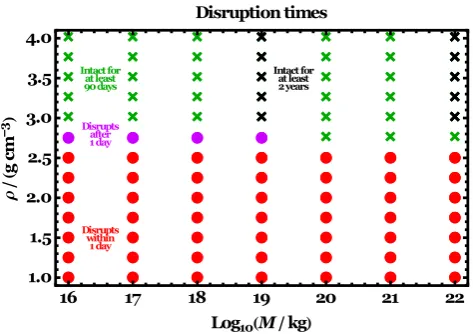
Figure 3. Disruption characteristics for homogeneous HCP progenitors as
a function of parent body mass (M) and density (ρ) for circular orbits. Dots illustrate rubble piles which disrupted (HCP1toHCP53) within one day (red dots) or between one day and one month (purple dots). Crosses represent rubble piles which remained stable throughout their simulations (HCP54to
HCP111), with durations of 90 d (green crosses) or 2 yr (black crosses).
The density boundary between disruption and remaining intact is sharp, and is between 2.5 and 3.0 g cm−3for all masses sampled.
Overall, computational limitations required us to judiciously choose the resolution with which to sample each parameter range, and how to partition our choices amongst different rubble pile con-structions.
5 S I M U L AT I O N R E S U LT S
An observationally relevant question is, can we match the transit observations with a disrupting rubble pile?
5.1 Homogeneous rubble piles
Our first attempt to tackle the answer is to consider the simplest object: a homogeneous one. Also, one of the strictest observational constraints is that the transits are still observed after 2 yr. Therefore, this constraint is the first which we try to replicate. We do so by presenting our results primarily in terms of how quickly the parent body fully disintegrates (Figs3and4). We consider a rubble pile to have disrupted after the mass of the most massive remaining clump is less than one per cent of mass of the original rubble pile. This disruption process for homogeneous rubble piles is illustrated in Fig.5.
5.1.1 Density constraints
Fig.3demonstrates disruption times as a function ofMandρ(for simulation details see TableA1) for rubble piles on circular orbits. The dots consist of all rubble piles which disrupted within 90 d; nearly all of these are red dots, indicating disruption within one day. Alternatively, the crosses signify rubble piles which remained intact throughout the duration of the simulation; green crosses rep-resent our standard numerical resolution 90-d simulations and black crosses represent lower numerical resolution 2-yr simulations. The boundary between the dots and crosses, atρ≈2.5–3.0 g cm−3, is
sharp. The plot illustrates the strong sensitivity of disruption to this density boundary, and the relative insensitivity to mass.
at University of Warwick on January 11, 2017
http://mnras.oxfordjournals.org/
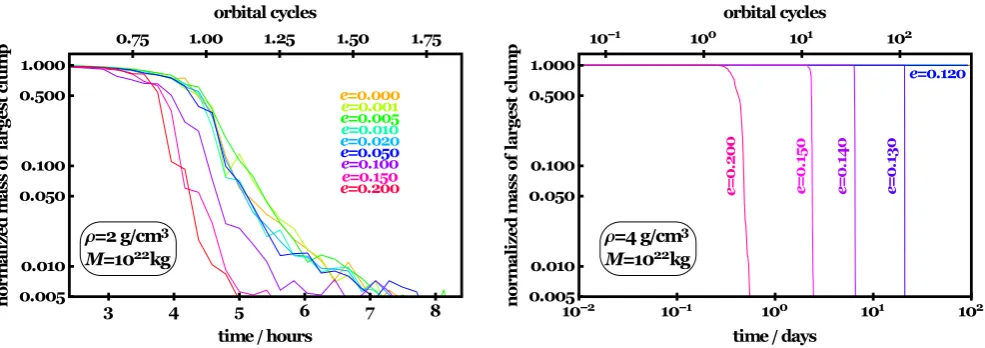
Figure 4. Disruption time-scales forM=1022kg, different eccentricities (shown on plots), and two different parent body densities (2 g cm−3, left-hand panel; 4 g cm−3, right-hand panel). Included on the figure are all simulations labelledHCP112throughHCP133from TableA1(the horizontal curves forHCP120 toHCP129in the right-hand panel all overlap). In the left-hand panel, all parent bodies fully disrupt within two orbits, regardless of eccentricity; generally, the higher the eccentricity, the quicker the dissipation. The right-hand panel demonstrates this correlation clearly (a disruption time-scale of three months occurs for someevalue between 0.12 and 0.13).
Figure 5. The disruption of a homogeneous hexagonal closest packing (HCP) rubble pile from simulationHCP134(ρ=2.6 g cm−3,e=0). The images are
shown in the rotating frame, where left is radially towards the white dwarf and the direction of the orbit is towards the top of the page. The white numbers in the upper part of each panel refer to the number of orbits. An animation accompanying this figure is available online.
5.1.2 Eccentricity constraints
The last section demonstrates that homogeneous primary bodies on circular orbits either disrupt quickly or not at all. These two possibilities do not aid in the interpretation of the observations. Therefore, here we consider non-zero eccentricities. These might allow a rubble pile to dip in-and-out of the Roche radius, shedding some mass during every pericentre passage.
Fig.4displays results for simulations of non-circular rubble piles. The simulations in the figure utilize the same semimajor axis as the zero-eccentricity simulations, so that the variations seen are strongly dependent on the decreasing periapse at increasing eccentricity. The plots suggest that for a sufficiently high bulk density (ρ2.5 g cm−3
from Fig.3), there exists a critical eccentricity below which the parent body will remain intact for at least three months. For ρ=2 g cm−3(left-hand panel) rubble piles disrupt even on circular
orbits, and increasing eccentricity speeds up the disruption (from about 8 h to 5 h). In the right-hand panel, whereρ=4 g cm−3, this
critical eccentricity lay in-between 0.12 and 0.13. Further, the right-hand panel indicates a clearly monotonic trend between increasing eccentricity and disruption time:e=0.20 corresponds to disruption within a day, whereas rubble piles with 0.14 ≤e≤0.15 disrupt within a week, and those withe=0.13 take about a month to break apart.
5.2 Simulation results for differentiated rubble piles
Our results with homogeneous rubble piles could not explain the constant periodic signal or the transient signals over a 2 yr period. Therefore, motivated by Leinhardt et al. (2012), who suggested that a differentiated body might allow for partial disruption, we also adopted a differentiated rubble pile. This assumption is realistic because the primary body could easily be large enough (like the asteroid Vesta; Gurri et al.2017; Rappaport et al.2016) to be dif-ferentiated. For differentiated bodies, the packing type for rubble piles has a more pronounced effect than in the homogeneous case. Therefore, for greater realism, all of our differentiated rubble piles were randomly packed (consequently, because of the lower packing efficiency, these rubble piles will disrupt more easily; see Figs2 and12).
5.2.1 Physics of disruption
The disruption of differentiated rubble piles is more complex than those of homogeneous ones, and has been thoroughly described in Canup (2010) and Leinhardt et al. (2012). We do not repeat their detailed analyses here, but rather just emphasize some of the important points below, and focus instead on the implications for the
at University of Warwick on January 11, 2017
http://mnras.oxfordjournals.org/
Figure 6. Mantle disruption of a differentiated synchronously spinning rubble pile on a circular orbit withρ=3.5 g cm−3(simulationRandDiff19). The white particles are mantle particles, and the green core particles underneath remain hidden. After about half of an orbit, mantle particles start streaming from the L1 and L2 Lagrange points. After about four orbits, the streaming became intermittent. An animation accompanying this figure is available online.
Figure 7. Similar to Fig.6, except for the case of complete disruption withe=0.10 (simulationRandDiff32). Subsequent to mantle stripping, the core is
not dense enough to resist disruption, and both the white mantle particles and green core particles are visible after three orbits. An animation accompanying this figure is available online.
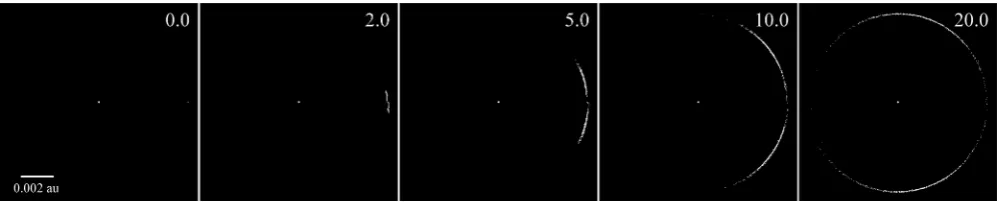
Figure 8. Spreading of stripped particles around the white dwarf (located at the centre) for the mantle disruption in Fig.6(simulationRandDiff19). The
disrupting rubble pile is at the same position in each panel, centre-right. Rubble pile particles have been inflated to enhance their visibility. An animation accompanying this figure is available online.
WD 1145+017 system. Overall, our simulations here are consistent with the behaviour seen in those works.
We characterize the outcome of disrupting a rubble pile with a mantle and core in one of three ways: (i) no disruption, (ii) mantle disruption and (iii) full disruption.
Mantle disruption is shown in Fig.6(simulationRandDiff19) and in the accompanying online animation. In this case, the green core particles remain in place and hidden from view as the white mantle particles are slowly stripped off. The streaming occurs at the L1 and L2 Lagrange points after the rubble pile has been distorted into the shape of a lemon. This process reproduces the schematic in fig. A1 of Rappaport et al. (2016), except for the major difference that in our numerical simulations, particles stream off from both L1 and L2, as opposed to just L1. The streaming is not symmetrical from both ends of the parent body, and up to 20 per cent more of the shorn-off particles emanates from one Lagrangian point than the other (see Section 6). The streaming of particles increases the density of the rubble pile, which allows it to subsequently resist disruption. Therefore, after about four orbits, the mantle stripping
becomes intermittent. The core density is high enough for the core particles to remain protected from escape.
Full disruption occurs when, subsequent to mantle stripping, the remnant core is not dense enough to resist breakup. This situation is visualized in Fig.7(simulationRandDiff32), whose rubble pile is equivalent to that in Fig.6, except placed on ane=0.1 orbit. After three orbits, most of the mantle has already separated and is in the process of forming a ring. After four orbits, the entire pile has catastrophically disrupted.
The trajectory of the stripped off particles forms a ring, just as in the homogeneous case. In Fig. 8, we illustrate this time sequence for the mantle disruption in Fig.6. After about 10 or-bits, the particles have covered an arc halfway around the white dwarf. After about 20 orbits, a full ring has formed, albeit one which contains inhomogeneities. We discuss ring filling times in Section 6.
Because the particles are stripped off from L1 and L2, they orbit at slightly different distances than does the centre of the rubble pile. Consequently, these particles have slightly different (both larger and
at University of Warwick on January 11, 2017
http://mnras.oxfordjournals.org/
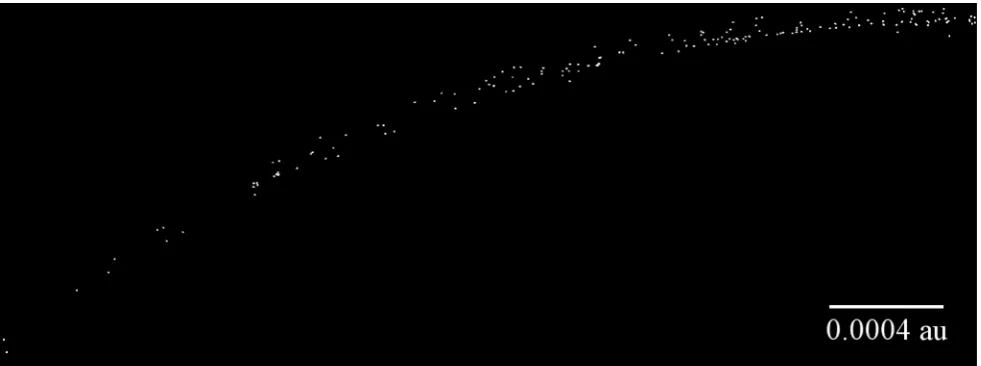
[image:7.595.48.548.365.466.2]Figure 9. Close-up of the rightmost panel of Fig.8(simulationRandDiff19), illustrating annular extent, clumpiness and voids. Particles have been inflated to enhance their visibility.
shorter) orbital periods than the parent body; see Section 6 for more details.
In order to visualize this difference in orbital period from our simulations, in Fig. 9, we have zoomed-in on the top-left arc of the rightmost panel of Fig. 8. This close-up illustrates both the scale of the annulus, and regions of clumpiness and voids. ForM= 1020kg and 1022kg parent bodies, the difference in orbital periods
from particles on each end of the annulus is on the order of, re-spectively, a couple tens of seconds, and about 100 s. In this regard, theM=1020kg case better matches the orbital period differences
[image:8.595.306.543.282.444.2]given by fig. A3 and equation A11 of Rappaport et al. (2016) and table 1 of G¨ansicke et al. (2016). Further, this mass is consistent with the estimates given by Gurri et al. (2017) and Rappaport et al. (2016). The slight excess difference that we see over Rappaport et al.’s (2016) calculation is likely due to collisions in the forming ring.
5.2.2 Transit model
How do these disruption simulations relate to observable photomet-ric transits? WD 1145+017 features some of the most spectacu-lar transit curves of any exoplanetary system, with transit depths reaching 60 per cent, transit features appearing and disappear-ing on a nightly basis, and some appeardisappear-ing over multiple nights. The periods of the individual transits are stable to a few seconds (table 1 of G¨ansicke et al.2016and table 4 of Rappaport et al.2016) even though they differ by up to tens of seconds. In other words, the individual periods are seen to be more stable than their spread among different fragments. Rappaport et al. (2016) suggested that the transit curves in WD 1145+017 may be a result of fragments which break off from a single asteroid. Because we have found that mantle stripping is intermittent, this process could produce frag-ments which occasionally obscure the light from the white dwarf and create detectable dips in photometric light curves.
Our gravity-only simulations are too simplistic to reproduce the detail in these transit curves, particularly because they arise from dust- and gas-streaming off the fragments rather than from geomet-rical blocking of the white dwarf by solid bodies. Nevertheless, we have created a transit model from our simulations by inflating the size of our particles which stream away from the disrupted rubble pile. The flux was calculated by dividing the face of the white dwarf
Figure 10. Illustrative model of photometric transit depths due to mantle
stripping, a process which intermittently streams particles off of a rubble pile. Shown here are two consecutive orbits offset in flux. The rubble pile used here was from simulationRandDiff19(Fig.6), with particles suitably inflated. See the main text for more details.
into about 27 000 pixels, and counting the number which were not obscured by the transiting fragments.
Fig. 10displays the result, in two consecutive orbits offset by flux. Here, we have used only the particles which emanated from the rubble pile (which is shown in Fig.6; simulationRandDiff19) during the previous 50 orbits. The choice of 50 orbits is arbitrary, but represents the idea that fragments are only ‘active’ – i.e. expelling a cloud of gas or dust – for a finite time.1 The time shown is
a few hundred orbits after the start of the run, once the rate of fragment escape has slowed. Following G¨ansicke et al. (2016), we also introduced two scaling factors: (i) the particle sizes were inflated to four times the size of the white dwarf (in order to achieve appropriate durations) and (ii) the transit depths were scaled such that the maximum depth was 0.5. The line-of-sight inclination was assumed to be offset by 2.◦25 from an edge-on orientation, following the assumption in G¨ansicke et al. (2016).
1If we had not implemented a cutoff, then the simulation would have been saturated as fragments were spread into a ring, but not removed.
at University of Warwick on January 11, 2017
http://mnras.oxfordjournals.org/
Figure 11. Disruption time-scales for differentiated rubble piles, where the core particle mass is quadruple that of the mantle particle mass (simulations
RandDiff1toRandDiff22). The rubble piles are on circular orbits and have either no spin (left-hand panel) or synchronous spin, equivalent to being
tidally locked (right-hand panel). The slight decrease in mass at the tens of percent level seen in the curves withρ≥3.2 g cm−3indicate mantle disruption. Full disruption occurs forρ≤3.1 g cm−3. This robust constraint on density, although specific to the rubble pile modelled, is similar to the robustness of the density constraints observed in Figs3and4.
The primary benefit of this simulation is to show that (i) the transit durations over a single orbit are commensurate with those actually observed, and (ii) the non-uniformity of the transit features may be reproduced by mantle stripping. Because the stripping is intermittent, this process may help explain the transience of some of the observed features.
5.2.3 Density constraints
Our simulations suggest that the process of mantle disruption might play an important role in the dynamics of WD 1145+017. A nat-ural accompanying question is, for what values ofρdoes mantle disruption occur? In order to pursue an answer, and informed by the bounds imposed from our homogenous rubble pile results, we have simulated differentiated rubble piles with 11 different bulk core plus mantle densities from 2.5 to 4.0 g cm−3.
We present the results in Fig. 11, which has a similar format to Fig.4and contains the simulations labelled RandDiff1 to
RandDiff22in TableA1. Here, however, mantle disruption is indicated by a slight decrease, at the few to tens of per cent level, in normalized mass of the largest remaining clump, before levelling off. Note that mantle or full disruption occurs in every simulation in the figure. The amount of material lost decreases for higher densities; at the high end (ρ=4.0 g cm−3), in the left- and
right-hand panels, respectively, 2.1 and 3.9 per cent of the total mass was lost. Forρ <3.2 g cm−3, mantle disruption can be observed to
occur for a few hours before full disruption occurs more quickly. Comparison of the two panels in the figure indicates that the initial spin of the rubble pile makes little difference to the outcomes, except at the boundaries of the disruption regimes. For the particular differentiated rubble piles we sampled in this work (with a core four times more massive than the mantle), the transition density between mantle disruption and full disruption occurs atρ=3.1 g cm−3. At
this density, a synchronously spinning rubble pile disrupts an order of magnitude more quickly than a rubble pile with no initial spin.
Although the boundary defined byρ =3.1 g cm−3is strongly
[image:9.595.311.547.301.463.2]linked to the structure of the differentiated rubble pile which we adopted, the clear division between disruption regimes on the figure
Figure 12. Boundaries between the regimes of ‘full disruption’, ‘mantle
disruption’ and ‘no disruption’. The darker hollow symbols refer to simu-lations with randomly packed rubble piles, and the lighter filled symbols to outcomes with hexagonal-closely packed (HCP) rubble piles. The bound-aries are approximated by the dashed lines, and are in good agreement with fig. 2 of Leinhardt et al. (2012).
suggests that other rubble pile constructions will yield similarly robust constraints.
5.2.4 General constraints
Other shape geometries may need to be considered when modelling disruption of parent bodies in other systems. In fact, the results of our simulations might aid in future efforts, a prospect which we consider in this subsection.
Unlike for homogeneous rubble piles, which either disrupt fully or not at all, differentiated rubble piles could undergo no disruption, mantle disruption or full disruption. In order to better quantify the parameter regimes encompassing these ternary outcomes, we present Figs12and13.
Fig. 12 links disruption with Rand ρ through equations (4) and (5). The darker symbols represent simulationsRandDiff2
throughRandDiff11, plusRandDiff23,RandDiff24and
at University of Warwick on January 11, 2017
http://mnras.oxfordjournals.org/
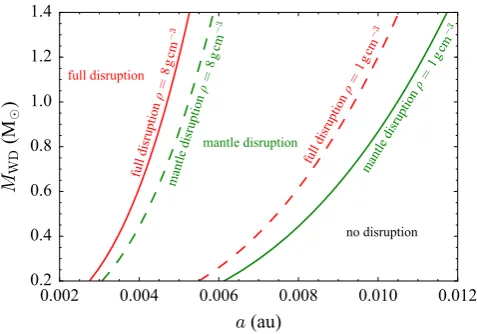
Figure 13. Pinpointing the three regimes where full disruption, mantle disruption and no disruption occur as a function of stellar mass (MWD) and parent body semimajor axis (a). The regions are identified by the horizontal labels. The curves are based on the dashed lines in Fig.12and are applicable only for our randomly packed rubble pile simulations.
RandDiff25. The lighter symbols represent the outcomes for ad-ditional simulations (HCPDiff1toHCPDiff11). The arbitrarily drawn dashed lines then approximate the critical values (4.4 and 6.1) ofRwhich separate the three regimes.
Fig.12can be compared directly to the bottom plot of fig. 2 of Leinhardt et al. (2012), which presents outcomes of tidal disruption simulations of randomly packed differentiated moons. Although they sampled a range of a, and henceP, the agreement with the critical values of 4.4 and 6.1 is good, to within one unit ofRin each case. Any differences could be attributed to the details of the packing geometry, including the bulk radius.
These critical values of 4.4 and 6.1 were then used to create Fig.13, which ignores our knowledge ofP. This figure approxi-mates the boundaries between the disruption regimes (red=full disruption, green=mantle disruption, black=no disruption) in (a,MWD) space, for all possible white dwarf masses, where two
extreme densities (1 g cm−3and 8 g cm−3) are given. The solid
lines provide absolute bounds. In the region to the left of the red solid line, full disruption always occurs. In the region to the right of the green solid line, no disruption ever occurs. In between those two lines, any three possibilities may occur depending on the choice ofρ. If the asteroid is less differentiated or centrally concentrated, then these curves would all shift rightwards.
Both figures represent useful tools for quick identification of a disruption regime for future discoveries of disintegrating bodies around stars. These stars need not be restricted to white dwarfs. In fact, several bodies disintegrating around main-sequence stars are now known (Rappaport et al. 2012,2014; Croll et al.2014; Bochinski et al.2015; Sanchis-Ojeda et al.2015).
6 D I S C U S S I O N
6.1 Roche radius location
We can now return to the question of whether the disrupting asteroid is within the Roche radius of WD 1145+017. Consider that (1) the observational data suggest that the asteroid has not undergone full disruption for over 2 yr, (2) we have shown that an asteroid which remains intact for this long hasρ3.1 g cm−3on a near-circular
orbit, (3) the density which corresponds to the Roche radius for this white dwarf is, for a solid, tidally locked body, 1.6 g cm−3, (4) we
have shown that mantle disruption can qualitatively reproduce the intermittent transit features which are observed.
These statements imply that the parent body isnot within the Roche radius for its bulk density, but rather just outside, and un-dergoing mantle disruption. Some caveats which might negate this conclusion are if the asteroid’s shape is significantly non-spherical, the asteroid is differentiated in a complex manner, or if the aster-oid’s mass contains a significant amount of non-solid matter. These cases all represent viable, interesting and important topics for fu-ture studies. Objects like 67P/Churyumov–Gerasimenko hint at the complexity of small Solar system bodies, and similar bodies could maintain an internal reservoir of volatiles even throughout the giant branch phases of stellar evolution (Jura & Xu2010; Jura et al.2012; Malamud & Perets2016).
The details of the disruption which we have shown here are different than those envisaged by Rappaport et al. (2016). Here, we see mass streaming from both L1 and L2 points. Further, we find that the relative fraction of particles escaping from L1 is slightly greater than those from L2, with the disparity increasing for higher bulk densities. In particular, forρ=3.9 g cm−3, 56 per cent come
from L1, whereas for bothρ=4.0 g cm−3andρ=4.2 g cm−3,
59 per cent originate from L1. These differences are observationally constrained, although only material with shorter orbits is visible (G¨ansicke et al.2016; Rappaport et al.2016). Perhaps the fragments with longer periods are not currently active, or that the imbalance between streaming from L1 and L2 becomes larger with time.K2 data did show some very weak signals at longer periods, but their reality could not be confirmed independently, as those signals are below the sensitivity threshold for ground-based observations.
If the asteroid indeed lies just outside of the Roche radius, then how did it arrive at a nearly circular orbit at that location? One possibility is that sustained gas ejection may be strong enough to appreciably decay the orbit of close minor planets (e.g. equations 32– 33 of Perez-Becker & Chiang2013), although the exact manner of the orbital evolution may be nontrivial (Bou´e et al.2012; Veras et al.2013b; Dosopoulou & Kalogera2016a,b). An alternative (A. Johansen, private communication) is that the asteroid represents a second-generation minor planet which grew out of smaller debris from a disrupted planetesimal which accumulated outside of the Roche radius, an idea previously proposed for Solar system moons (e.g. Crida & Charnoz2012). Charnoz et al. (2011) suggested that the inner mid-sized moons of Saturn (Mimas, Enceladus, Tethys, Dione and Rhea) could all have been formed by a viscously spread-ing massive rspread-ing which was itself the result of a large disruptive impact. Phobos and Deimos (Mars’s moons) could have formed close enough to their parent planet that they have since spiraled in close to Mars due to tidal decay of the orbit (Rosenblatt & Charnoz 2012).
6.2 Ring filling time
We have shown that disrupting rubble piles form rings. How effi-ciently does the debris spread around the white dwarf? We approach this question both analytically and with the numerical output. A key caveat to both approaches is that gas drag is neglected, which may play a significant role in the WD 1145+107 system.2 Also, the
2Gas is likely produced from sublimation and/or collisions of solid particles. The most recent substantial attempt to model this interaction between gas and dust (Metzger et al.2012) indicates a complexity which is beyond the scope of this work.
at University of Warwick on January 11, 2017
http://mnras.oxfordjournals.org/
Then, from equation 25 of Veras et al. (2014a), a breakup event will fill out a complete ring in space in a filling timetfillgiven by
tfill
P =r
3 2
b
r2
b+2aR−rbR
rb−R
3 2
−
r2
b−2a×min(rcrit−rb, R)+rbmin(rcrit−rb, R)
rb+min(rcrit−rb, R)
3 2 −1
,
(6)
where
rcrit=
2arb
1+MM
WD
(2a−rb)
≈ 2arb
2a−rb
(7)
is the distance at which a particle’s orbit becomes parabolic (will escape from the system). For the parent bodies orbiting WD 1145+017, if we suppose they break up at pericentre, then rb=a(1−e) and
tfill
P =(1−e)
3 2
⎡
⎣a(1−e)2+R(1+e)
a(1−e)−R 3
2
−
a(1−e)2−R(1+e)
a(1−e)+R 3 2 ⎤ ⎦ −1 ≈ a
6R(1−e)
2
(8)
=1.3×10³ a
0.00535 au R 100 km
−1
(1−e)2 (9)
corresponding to a filling time of
tfill≈250 d
a
0.00535 au R 100 km
−1
(1−e)2. (10)
Note that the filling time is dependent on radius, and hence mass, for a given density (unlike for disruption). The reason is because the physical separation of the L1 and L2 points depends on the parent body size. Hence, particles leaving from the Lagrangian points will have larger initial orbital period differences for larger parent body sizes.
6.2.2 Numerical filling times
Numerically, one way to determine how quickly particles spread into a ring is to consider the time evolution of the centre of mass of the particles,rCOM. Initially,rCOM≈a≈92RWD,
assum-ingRWD = 8750 km (a fiducial white dwarf radius; Veras et al.
2014a). As the rubble pile disrupts and the particles spread into a ring, this centre of mass will gradually move towards the cen-tre of the white dwarf. Consequently, a uniform ring is formed as rCOM→0. However, asrCOMapproaches zero, it oscillates as ring
[image:11.595.311.548.56.223.2]particles overtake each other, and potentially collide. This move-ment ceases to be monotonic, and inhomogeneities in the ring will show up as non-zero values ofrCOM.
Figure 14. Ring filling times. Plotted is the time evolution ofrCOM, which
is the distance between the centre of mass of the rubble pile particles and the centre of the white dwarf. As the rubble pile disrupts and a ring fills out, this distance decreases. WhenrCOM=0, a uniform ring has been created. Inhomogeneities (clumpiness and voids) in the ring result in the ‘bounces’ along the x-axis. Plotted symbols (stars forM= 1022kg, triangles for M=1021kg, squares forM=1020kg; yellow forρ=1.0 g cm−3and pink forρ=2.5 g cm−3) indicate the analytical predictions for the filling times of asteroids which are assumed to instantaneously disrupt at their orbital pericentres (equations 8 and 10).
6.2.3 Results
In Fig. 14, we plot the time evolution of rCOM for all
homoge-neous HCP rubble piles that are disrupted. Overplotted as stars, triangles and a square are the analytical estimates of the filling time from equation (10). Quantifying the extent of the agreement between the analytics and numerics is not possible unless one de-fines the meaning of a ring which has been ‘filled’: the curves in Fig.14appear to ‘bounce’ on thex-axis several times before settling. Equation (10) best reproduces a point in-between the second and third bounce.
Some trends from the figure are worth noting, particularly be-cause of their potential use for interpreting future observations: (i) the circularization time decreases with increasing mass, (ii) the ‘bounciness’ increases with increasing mass, (iii) rubble piles with M 1020 kg generally spread out into full rings within about
three months and (iv) for a given mass, higher density rubble piles more quickly achieve particle coverage throughout the or-bit, but do not necessarily evenly fill out the ring more quickly or smoothly.
The figure demonstrates that the ring filling times range from 10 to 100 d for 1019 kg M 1022 kg. Although this
time-scale fits within the baseline of observations, the ring is not directly observed. One possible reason is that the ring is collisionally eroded; another is that the newly disrupted pieces of mantle are not active. However, theoretical models which in-clude dust and/or gas might better link observed infrared excess (indicating dust) or circumstellar gas (Xu et al.2016) with ring formation.
7 C O N C L U S I O N
The properties of the asteroid disintegrating around white dwarf WD 1145+017 are poorly constrained observationally. Theoretical work, however, can help remedy this shortfall, and in this case
at University of Warwick on January 11, 2017
http://mnras.oxfordjournals.org/
[image:11.595.47.285.165.291.2]suggests that the disintegrating asteroid orbiting WD 1145+017 appears to reside just outside of the bulk density Roche radius.
In particular, we have modelled the tidal disruption of strength-less rubble piles with an orbital period equal to that of the longest-lasting observed transit signature. We found robust constraints on density (Figs 3and 11) and eccentricity (Fig.4), and weak con-straints on mass (Fig.3) and spin (Fig.11) (but see the last para-graph of Section 5.2.1). By modelling both homogeneous and dif-ferentiated rubble piles, we found thatρ 2.75 g cm−3ensures
disruption within one day, whereasρ 3.10 g cm−3 guarantees
that rubble piles on circular orbits will remain intact for at least 2 yr. Nevertheless, the intact differentiated rubble piles all undergo mantle disruption, which produces intermittent streams of parti-cles which may contribute to the observed photometric transit dips (Fig.10). If the eccentricity of the disrupting object exceeds 0.130, then it is unlikely to remain intact for more than one month unless ρ >4.0 g cm−3.
Useful ancillary results include figures which may be applicable for studies of disruption around other stars. These figures include a mass-free relation between orbital period and density (Fig.1, and equation 5) and parameter-space locations where we can expect to find mantle disruption versus full disruption (Figs12and13).
We must caution that our seemingly robust results for WD 1145+017 rely on several assumptions: (i) the parent body is spher-ical, (ii) the parent body is strengthless and (iii) the parent body or its fragments are not affected by the extant dust or gas in the system. Re-laxing these assumptions (e.g. Metzger, Rafikov & Bochkarev2012; Movshovitz, Asphaug & Korycansky2012; Schwartz, Richardson & Michel2012) as new observations warrant might place stricter physical constraints on the system.
AC K N OW L E D G E M E N T S
We thank the referee for a careful read-through of the manuscript, and valuable comments. DV and BTG have received funding from the European Research Council under the European Union’s Sev-enth Framework Programme (FP/2007-2013)/ERC Grant Agree-ment no. 320964 (WDTracer). PJC and ZML acknowledge support from the Natural Environment Research Council (grant number: NE/K004778/1).
R E F E R E N C E S
Adams F. C., Bloch A. Mx., 2013, ApJ, 777, L30
Alcock C., Fristrom C. C., Siegelman R., 1986, ApJ, 302, 462 Alonso R., Rappaport S., Deeg H. J., Palle E., 2016, A&A, 589, L6 Antoniadou K. I., Veras D., 2016, MNRAS, 463, 4108
Barber S. D., Patterson A. J., Kilic M., Leggett S. K., Dufour P., Bloom J. S., Starr D. L., 2012, ApJ, 760, 26
Bear E., Soker N., 2013, New Astron., 19, 56 Bear E., Soker N., 2015, MNRAS, 450, 4233
Becklin E. E., Farihi J., Jura M., Song I., Weinberger A. J., Zuckerman B., 2005, ApJ, 632, L119
Benz W., Asphaug E., 1999, Icarus, 142, 5
Bochinski J. J., Haswell C. A., Marsh T. R., Dhillon V. S., Littlefair S. P., 2015, ApJ, 800, L21
Bochkarev K. V., Rafikov R. R., 2011, ApJ, 741, 36 Bonsor A., Veras D., 2015, MNRAS, 454, 53 Bonsor A., Wyatt M. C., 2012, MNRAS, 420, 2990
Bonsor A., Mustill A. J., Wyatt M. C., 2011, MNRAS, 414, 930 Bou´e G., Figueira P., Correia A. C. M., Santos N. C., 2012, A&A, 537, L3 Brown J. C., Veras D., G¨ansicke B. T., 2017, in press
Canup R. M., 2010, Nature, 468, 943
Carter P. J., Leinhardt Z. M., Elliott T., Walter M. J., Stewart S. T., 2015, ApJ, 813, 72
Cassan A. et al., 2012, Nature, 481, 167
Chandrasekhar S., 1969, Ellipsoidal Figures of Equilibrium. Yale Univ. Press, New Haven
Charnoz S. et al., 2011, Icarus, 216, 535
Cordes J. M., Shannon R. M., 2008, ApJ, 682, 1152 Crida A., Charnoz S., 2012, Science, 338, 1196 Croll B. et al., 2014, ApJ, 786, 100
Davidsson B. J. R., 1999, Icarus, 142, 525
Debes J. H., Walsh K. J., Stark C., 2012, ApJ, 747, 148 Dosopoulou F., Kalogera V., 2016a, ApJ, 825, 70 Dosopoulou F., Kalogera V., 2016b, ApJ, 825, 71 Farihi J., 2016, New Astron. Rev., 71, 9
Farihi J., Jura M., Zuckerman B., 2009, ApJ, 694, 805 Frewen S. F. N., Hansen B. M. S., 2014, MNRAS, 439, 2442
G¨ansicke B. T., Marsh T. R., Southworth J., Rebassa-Mansergas A., 2006, Science, 314, 1908
G¨ansicke B. T., Koester D., Marsh T. R., Rebassa-Mansergas A., Southworth J., 2008, MNRAS, 391, L103
G¨ansicke B. T., Koester D., Farihi J., Girven J., Parsons S. G., Breedt E., 2012, MNRAS, 424, 333
G¨ansicke B. T. et al., 2016, ApJ, 818, L7
Gary B. L., Rappaport S., Kaye T. G., Alonso R., Hambsch F.-J., 2016, preprint (arXiv:1608.00026)
Graham J. R., Matthews K., Neugebauer G., Soifer B. T., 1990, ApJ, 357, 216
Gurri P., Veras D., G¨ansicke B. T., 2017, MNRAS, 464, 321 Hamers A. S., Portegies Zwart S. F., 2016, MNRAS, 462, L84 Jura M., 2003, ApJ, 584, L91
Jura M., Xu S., 2010, AJ, 140, 1129
Jura M., Young E. D., 2014, Annu. Rev. Earth Planet. Sci., 42, 45 Jura M., Xu S., Klein B., Koester D., Zuckerman B., 2012, ApJ, 750, 69 Klein B., Jura M., Koester D., Zuckerman B., Melis C., 2010, ApJ,
709, 950
Klein B., Jura M., Koester D., Zuckerman B., 2011, ApJ, 741, 64 Koester D., G¨ansicke B. T., Farihi J., 2014, A&A, 566, A34
Kunitomo M., Ikoma M., Sato B., Katsuta Y., Ida S., 2011, ApJ, 737, 66 Leinhardt Z. M., Stewart S. T., 2012, ApJ, 745, 79
Leinhardt Z. M., Richardson D. C., Quinn T., 2000, Icarus, 146, 133 Leinhardt Z. M., Ogilvie G. I., Latter H. N., Kokubo E., 2012, MNRAS,
424, 1419
Malamud U., Perets H. B., 2016, preprint (arXiv:1608.00593)
Mann I., Nakamura A. M., Mukai T., 2009, in Mann I., Nakamura A., Mukai T., eds, Lecture Notes in Physics, Small Bodies in Planetary Systems. Springer-Verlag, Berlin
Manser C. J. et al., 2016, MNRAS, 455, 4467
Metzger B. D., Rafikov R. R., Bochkarev K. V., 2012, MNRAS, 423, 505 Movshovitz N., Asphaug E., Korycansky D., 2012, ApJ, 759, 93
Murray C. D., Dermott S. F., 1999, Solar System Dynamics. Cambridge Univ. Press, Cambridge
Mustill A. J., Villaver E., 2012, ApJ, 761, 121
Mustill A. J., Veras D., Villaver E., 2014, MNRAS, 437, 1404 Nordhaus J., Spiegel D. S., 2013, MNRAS, 432, 500
Payne M. J., Veras D., Holman M. J., G¨ansicke B. T., 2016a, MNRAS, 457, 217
Payne M. J., Veras D., G¨ansicke B. T., Holman M. J., 2016b, MNRAS, preprint (arXiv:1610.01597)
Perez-Becker D., Chiang E., 2013, MNRAS, 433, 2294 Petrovich C., Mu˜noz D. J., 2016, preprint (arXiv:1607.04891) Rafikov R. R., 2011a, MNRAS, 416, L55
Rafikov R. R., 2011b, ApJ, 732, L3
Rafikov R. R., Garmilla J. A., 2012, ApJ, 760, 123 Rappaport S. et al., 2012, ApJ, 752, 1
Rappaport S., Barclay T., DeVore J., Rowe J., Sanchis-Ojeda R., Still M., 2014, ApJ, 784, 40
Rappaport S., Gary B. L., Kaye T., Vanderburg A., Croll B., Benni P., Foote J., 2016, MNRAS, 458, 3904
at University of Warwick on January 11, 2017
http://mnras.oxfordjournals.org/
Solem J. C., 1994, Nature, 370, 349 Sridhar S., Tremaine S., 1992, Icarus, 95, 86 Stadel J. G., 2001, PhD thesis, Univ. Washington
Staff J. E., De Marco O., Wood P., Galaviz P., Passy J.-C., 2016, MNRAS, 458, 832
Stone N., Metzger B. D., Loeb A., 2015, MNRAS, 448, 188
Tremblay P.-E., Cummings J., Kalirai J. S., G¨ansicke B. T., Gentile-Fusillo N., Raddi R., 2016, MNRAS, 461, 2100
Vanderburg A. et al., 2015, Nature, 526, 546 Veras D., 2016a, R. Soc. Open Sci., 3, 150571. Veras D., 2016b, MNRAS, 463, 2958
Veras D., G¨ansicke B. T., 2015, MNRAS, 447, 1049
Veras D., Mustill A. J., Bonsor A., Wyatt M. C., 2013a, MNRAS, 431, 1686 Veras D., Hadjidemetriou J. D., Tout C. A., 2013b, MNRAS, 435, 2416 Veras D., Leinhardt Z. M., Bonsor A., G¨ansicke B. T., 2014a, MNRAS, 445,
2244
Veras D., Shannon A., G¨ansicke B. T., 2014b, MNRAS, 445, 4175 Veras D., Eggl S., G¨ansicke B. T., 2015a, MNRAS, 451, 2814
Veras D., Leinhardt Z. M., Eggl S., G¨ansicke B. T., 2015b, MNRAS, 451, 3453
Veras D., Eggl S., G¨ansicke B. T., 2015c, MNRAS, 452, 1945
Veras D., Mustill A. M., G¨ansicke B. T., Redfield S., Georgakarakos N., Bowler A. B., Lloyd M. J. S., 2016a, MNRAS, 458, 3942
Veras D., Marsh T. R., G¨ansicke B. T., 2016b, MNRAS, 461, 1413 Veras D., Georgakarakos N., Dobbs-Dixon I., Gaensicke B. T., 2016c,
MNRAS, in press
Wyatt M. C., Farihi J., Pringle J. E., Bonsor A., 2014, MNRAS, 439, 3371 Xu S., Jura M., Klein B., Koester D., Zuckerman B., 2013, ApJ, 766, 132 Xu S., Jura M., Koester D., Klein B., Zuckerman B., 2014, ApJ, 783, 79 Xu S., Jura M., Dufour P., Zuckerman B., 2016, ApJ, 816, L22 Zhou G. et al., 2016, MNRAS, 463, 4422
Zuckerman B., Becklin E. E., 1987, Nature, 330, 138
Zuckerman B., Koester D., Reid I. N., H¨unsch M., 2003, ApJ, 596, 477 Zuckerman B., Koester D., Melis C., Hansen B. M., Jura M., 2007, ApJ,
671, 872
Zuckerman B., Melis C., Klein B., Koester D., Jura M., 2010, ApJ, 722, 725
S U P P O RT I N G I N F O R M AT I O N
Supplementary data are available atMNRASonline.
LastMovies.tgz
Please note: Oxford University Press is not responsible for the content or functionality of any supporting materials supplied by the authors. Any queries (other than missing material) should be directed to the corresponding author for the article.
[image:13.595.45.549.480.733.2]A P P E N D I X A : S I M U L AT I O N TA B L E
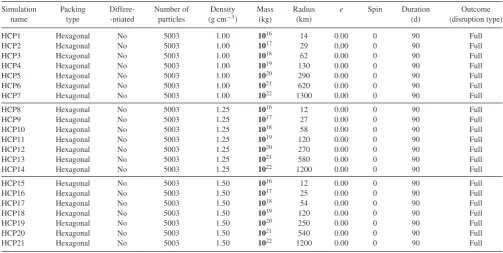
Table A1. Summary of simulations. The radii are rounded to two significant digits. Bold entries indicate important variables which were varied within
each set.
Simulation Packing Differe- Number of Density Mass Radius e Spin Duration Outcome
name type -ntiated particles (g cm−3) (kg) (km) (d) (disruption type)
HCP1 Hexagonal No 5003 1.00 1016 14 0.00 0 90 Full
HCP2 Hexagonal No 5003 1.00 1017 29 0.00 0 90 Full
HCP3 Hexagonal No 5003 1.00 1018 62 0.00 0 90 Full
HCP4 Hexagonal No 5003 1.00 1019 130 0.00 0 90 Full
HCP5 Hexagonal No 5003 1.00 1020 290 0.00 0 90 Full
HCP6 Hexagonal No 5003 1.00 1021 620 0.00 0 90 Full
HCP7 Hexagonal No 5003 1.00 1022 1300 0.00 0 90 Full
HCP8 Hexagonal No 5003 1.25 1016 12 0.00 0 90 Full
HCP9 Hexagonal No 5003 1.25 1017 27 0.00 0 90 Full
HCP10 Hexagonal No 5003 1.25 1018 58 0.00 0 90 Full
HCP11 Hexagonal No 5003 1.25 1019 120 0.00 0 90 Full
HCP12 Hexagonal No 5003 1.25 1020 270 0.00 0 90 Full
HCP13 Hexagonal No 5003 1.25 1021 580 0.00 0 90 Full
HCP14 Hexagonal No 5003 1.25 1022 1200 0.00 0 90 Full
HCP15 Hexagonal No 5003 1.50 1016 12 0.00 0 90 Full
HCP16 Hexagonal No 5003 1.50 1017 25 0.00 0 90 Full
HCP17 Hexagonal No 5003 1.50 1018 54 0.00 0 90 Full
HCP18 Hexagonal No 5003 1.50 1019 120 0.00 0 90 Full
HCP19 Hexagonal No 5003 1.50 1020 250 0.00 0 90 Full
HCP20 Hexagonal No 5003 1.50 1021 540 0.00 0 90 Full
HCP21 Hexagonal No 5003 1.50 1022 1200 0.00 0 90 Full
at University of Warwick on January 11, 2017
http://mnras.oxfordjournals.org/
Table A1 – continued
Simulation Packing Differe- Number of Density Mass Radius e Spin Duration Outcome
name type -ntiated particles (g cm−3) (kg) (km) (d) (disruption type)
HCP22 Hexagonal No 5003 1.75 1016 11 0.00 0 90 Full
HCP23 Hexagonal No 5003 1.75 1017 24 0.00 0 90 Full
HCP24 Hexagonal No 5003 1.75 1018 51 0.00 0 90 Full
HCP25 Hexagonal No 5003 1.75 1019 110 0.00 0 90 Full
HCP26 Hexagonal No 5003 1.75 1020 240 0.00 0 90 Full
HCP27 Hexagonal No 5003 1.75 1021 510 0.00 0 90 Full
HCP28 Hexagonal No 5003 1.75 1022 1100 0.00 0 90 Full
HCP29 Hexagonal No 5003 2.00 1016 11 0.00 0 90 Full
HCP30 Hexagonal No 5003 2.00 1017 23 0.00 0 90 Full
HCP31 Hexagonal No 5003 2.00 1018 49 0.00 0 90 Full
HCP32 Hexagonal No 5003 2.00 1019 110 0.00 0 90 Full
HCP33 Hexagonal No 5003 2.00 1020 230 0.00 0 90 Full
HCP34 Hexagonal No 5003 2.00 1021 490 0.00 0 90 Full
HCP35 Hexagonal No 5003 2.00 1022 1100 0.00 0 90 Full
HCP36 Hexagonal No 5003 2.25 1016 10 0.00 0 90 Full
HCP37 Hexagonal No 5003 2.25 1017 22 0.00 0 90 Full
HCP38 Hexagonal No 5003 2.25 1018 47 0.00 0 90 Full
HCP39 Hexagonal No 5003 2.25 1019 102 0.00 0 90 Full
HCP40 Hexagonal No 5003 2.25 1020 220 0.00 0 90 Full
HCP41 Hexagonal No 5003 2.25 1021 470 0.00 0 90 Full
HCP42 Hexagonal No 5003 2.25 1022 1000 0.00 0 90 Full
HCP43 Hexagonal No 5003 2.50 1016 9.9 0.00 0 90 Full
HCP44 Hexagonal No 5003 2.50 1017 21 0.00 0 90 Full
HCP45 Hexagonal No 5003 2.50 1018 46 0.00 0 90 Full
HCP46 Hexagonal No 5003 2.50 1019 98 0.00 0 90 Full
HCP47 Hexagonal No 5003 2.50 1020 210 0.00 0 90 Full
HCP48 Hexagonal No 5003 2.50 1021 460 0.00 0 90 Full
HCP49 Hexagonal No 5003 2.50 1022 990 0.00 0 90 Full
HCP50 Hexagonal No 5003 2.75 1016 9.5 0.00 0 90 Full
HCP51 Hexagonal No 5003 2.75 1017 21 0.00 0 90 Full
HCP52 Hexagonal No 5003 2.75 1018 44 0.00 0 90 Full
HCP53 Hexagonal No 5003 2.75 1019 95 0.00 0 90 Full
HCP54 Hexagonal No 5003 2.75 1020 210 0.00 0 90 None
HCP55 Hexagonal No 5003 2.75 1021 440 0.00 0 90 None
HCP56 Hexagonal No 5003 2.75 1022 950 0.00 0 90 None
HCP57 Hexagonal No 5003 3.00 1016 9.3 0.00 0 90 None
HCP58 Hexagonal No 5003 3.00 1017 20 0.00 0 90 None
HCP59 Hexagonal No 5003 3.00 1018 43 0.00 0 90 None
HCP60 Hexagonal No 5003 3.00 1019 93 0.00 0 180 None
HCP61 Hexagonal No 3985 3.00 1019 93 0.00 0 365 None
HCP62 Hexagonal No 3011 3.00 1019 93 0.00 0 730 None
HCP63 Hexagonal No 5003 3.00 1020 200 0.00 0 90 None
HCP64 Hexagonal No 5003 3.00 1021 430 0.00 0 90 None
HCP65 Hexagonal No 5003 3.00 1022 930 0.00 0 180 None
HCP66 Hexagonal No 3985 3.00 1022 930 0.00 0 365 None
HCP67 Hexagonal No 3011 3.00 1022 930 0.00 0 730 None
HCP68 Hexagonal No 5003 3.25 1016 9.0 0.00 0 90 None
HCP69 Hexagonal No 5003 3.25 1017 19 0.00 0 90 None
HCP70 Hexagonal No 5003 3.25 1018 42 0.00 0 90 None
HCP71 Hexagonal No 5003 3.25 1019 90 0.00 0 180 None
HCP72 Hexagonal No 3985 3.25 1019 90 0.00 0 365 None
HCP73 Hexagonal No 3011 3.25 1019 90 0.00 0 730 None
HCP74 Hexagonal No 5003 3.25 1020 190 0.00 0 90 None
HCP75 Hexagonal No 5003 3.25 1021 420 0.00 0 90 None
HCP76 Hexagonal No 5003 3.25 1022 900 0.00 0 180 None
HCP77 Hexagonal No 3985 3.25 1022 900 0.00 0 365 None
HCP78 Hexagonal No 3011 3.25 1022 900 0.00 0 730 None
HCP79 Hexagonal No 5003 3.50 1016 8.8 0.00 0 90 None
HCP80 Hexagonal No 5003 3.50 1017 19 0.00 0 90 None
at University of Warwick on January 11, 2017
http://mnras.oxfordjournals.org/