Stability
Abstract. General-elimination harmony articulates Gentzen’s idea that the elimination-rules are justified if they infer from an assertion no more than can already be inferred from the grounds for making it. Dummett described the rules as not only harmonious but stable if the E-rules allow one to infer no more and no less than the I-rules justify. Pfenning and Davies call the rules locally complete if the E-rules are strong enough to allow one to infer the original judgement. A method is given of generating harmonious general-elimination rules from a collection of I-rules. We show that the general-elimination rules satisfy Pfen-ning and Davies’ test for local completeness, but question whether that is enough to show that they are stable. Alternative conditions for stability are considered, including equiva-lence between the introduction- and elimination-meanings of a connective, and recovery of the grounds for assertion, finally generalizing the notion of local completeness to capture Dummett’s notion of stability satisfactorily. We show that the general-elimination rules meet the last of these conditions, and so are indeed not only harmonious but also stable.
Keywords: Harmony, General-elimination rules, Stability, Local completeness, Grounds, Gentzen.
1. Introduction
The concept of general-elimination rules is inspired by Gerhard Gentzen’s famous remark in [11] (translated in [40, p. 80]):
The introductions represent, as it were, the ‘definitions’ of the symbols concerned, and the eliminations are no more, in the final analysis, than the consequences of these definitions.
He was alluding to the introduction- (I-) and elimination- (E-) rules of his natural deduction calculi. Gentzen [40, p. 81] continued:
It should be possible to display the E-inferences as unique functions of their corresponding I-inferences.
The purpose behind general-elimination rules is to exhibit this functional dependency by casting all the E-rules on the model of the familiar ∨E-rule
Presented byHeinrich Wansing;ReceivedOctober 6, 2015
Studia Logica
for disjunction, aka proof by cases. What∨E encapsulates is the idea that whatever follows both from α and from β must follow from α∨β. More generally, a GE-rule states that what follows from a formula is whatever follows from the grounds for assertion of that formula.1
Consider ∨I: it has two cases:
α α∨β ∨I1
β α∨β ∨I2
The meaning conferred onα∨β is that it is assertible just when eitherαor
β are assertible. Moreover, since assertions ofαand β exhaust the grounds for assertion of α∨β, what follows from an assertion of α∨β must either follow from αor fromβ. We thus obtain the single elimination-rule:
α∨β
[α]1
γ
[β]2
γ
γ ∨E(1,2)
We can read this as saying that γ follows from α∨β iff γ follows from α
and γ follows from β.
In general, rules may discharge assumptions.2Even though∨I discharges no assumptions, ∨E discharges the assumptions ofα andβ.
Similar considerations apply to→I:
[α]1
β
α→β →I(1)
The meaning conferred on α → β is that it is assertible just in case β is assertible on the basis of α, with the assumption of α being discharged by the rule.
By the same reasoning that justified ∨E, what follows from the grounds forα→β must follow from an assertion of α→β:
α→β
⎡ ⎢ ⎣
α
.. .
β ⎤ ⎥ ⎦
1
γ
γ →E(1)
1For the notion of general-elimination rule, see [22, esp. Sect. 1.2] and [42].
We can read this as saying thatγfollows from the assumption ofβdependent on α iff γ follows from α → β. The →E-rule allows us to discharge the assumption of β dependent on α. That is, the rule discharges the sequent
α⇒ β. The use of ellipses marks the fact that the assumption is that of a sequent.3 We will see how assumptions of sequents, marked by ellipses, can be replaced by derivations in the discussion of harmony in Section3 below. Note that, even though the sequent α ⇒ β is discharged by →E, the rule does not discharge the assumption αin the minor premise.4
The plan for the rest of the paper is as follows. In Section2, we set out the formal analysis of derivations and rules presupposed in the rest of the paper. In Section3 we describe the procedure by which GE-rules for a con-nective are generated by a set of I-rules for it. The notion of harmony (of E-rules with I-rules) is described and we show that the GE-rules are in har-mony with the I-rules from which they are generated. Section 4 introduces the notion of stability between the I- and E-rules, which requires not only that the E-rules be in harmony with the I-rules, but also that the I-rules be in harmony with the E-rules. The remaining sections are dedicated to: (i) distinguishing formal properties of I- and E-rules which are candidates for capturing the harmony of I-rules with E-rules; and (ii) showing that I- and GE-rules for a connective satisfy all of these properties. Consequently, the I-rules for a connective are in harmony with its GE-rules. Since the GE-rules are harmonious with the I-rules from which they are generated, it follows that the I- and GE-rules of any connective are stable.
2. Formal Analysis
The aim of this section is to present the notion of derivation in systems S
of the sort that will be presupposed in the paper.
3The notion of sequent and the precise use of ellipses employed here are explained formally in Section2.
Definition 1. (Sequent)
• Any wff is a sequent of level 1.
• If Γ is a finite set of wffs, and αis a wff, Γ⇒αis a sequent of level 2.
• If Γ is a finite set of wffs or sequents of level 2, andαis a wff, Γ⇒αis a sequent of level 3.
Notation α, β, γ, . . . are metavariables over wffs. π, πi, πik(i ∈ I, k ∈ K)
are metavariables over sequents, of all levels unless specified otherwise. Γ,Δ,Θ are metavariables over sets of sequents. A sequent Γ ⇒ α where Γ ={π1, . . . , πn} is writtenπ1, . . . , πn ⇒α.5
Definition 2. The antecedent,a(π), and the succedent,s(π), of a sequent
π are defined as follows:
• a(π) =
∅ if π is of level 1
π1, . . . , πn if π =π1, . . . , πn⇒γ
• s(π) =
π if π is of level 1
γ if π=π1, . . . , πn ⇒γ
Definition 3. (Rules of Inference)
• The form of an instance of a rule of inference, J, is an n+ 1-tuple of sequents of level 2 or 3,πi= Γi⇒αi, 1≤i≤n+ 1, asserting thatπn+1 is a consequence of π1, . . . , πn, written
π1 . . . πn
πn+1 J
• In general, Γn+1 = ni=1(Γi−Θi)∪Θn+1. If Θi is non-empty, we say that J discharges the sequents in Θi (wffs, or sequents of level 2).
• – If n= 0, J is a rule of level 0.
– Otherwise, if J discharges no assumptions,J is of level 1, and – if the instances ofJ discharge assumptions of at most leveln, then
J is of level n+ 1.6
5Although the constituents of derivations will be sequents, following Gentzen’s presen-tation in [12, Sect. 5], the systems considered, like his, are natural deduction systems, with I- and E-rules.
Notation Where πi is Γi⇒ αi, 1≤i≤n+ 1, the form of an instance of a
rule J
π1 . . . πn
πn+1 J
may also be written as
π1 . . . πn
αn+1 J
or as
α1 . . . αn
αn+1 J
If Θi is the set of discharged sequents in Γi, then the form may also be
written as
[Θ1]
α1 . . . [Θαnn]
αn+1 J
When π ∈Θj, 1≤j≤nis a sequent of level 2 of the form γ1, . . . , γk⇒ β, π may be written as
γ1, . . . , γk
.. ..
β
Definition 4. (Rules ofS)
Operational Rules The operational rules of S, consisting of I-rules giv-ing the meangiv-ing of the connectives and E-rules generated by the GE-procedure (to be described in Section 3), will vary depending on the system, of, e.g., minimal, intuitionistic or classical logic, considered. The rules∨I1,∨I2,∨E,→I and→E of Section1are written in sequent (aka logistic7) notation as follows:
Γ⇒α
Γ⇒α∨β ∨I1
Γ⇒β
Γ⇒α∨β ∨I2
Γ⇒α∨β Δ, α⇒γ Θ, β⇒γ
Γ,Δ,Θ⇒γ ∨E
Γ, α⇒β
Γ⇒α→β →I
Γ⇒α→β Δ, α⇒β⇒γ
Γ,Δ⇒γ →E
Structural Rules
α⇒α Ass1
Γ,Θ⇒α Θ⇒α,Δ⇒β
Γ,Δ⇒β Slice
Γ⇒α
π,Γ⇒α Thin
Γ1⇒α1 . . . Γn⇒αn
( n1αi)⇒β, n1Γi⇒β Ass2
Ass1is a rule of level 0,Thin,Ass2,∧I,∨I1and∨I2are rules of level 1,∧E1,
∧E2,∨E and→I are rules of level 2, andSlice and →E are rules of level 3. The structural rule Ass2 formalizes the introduction of a higher-level assumption in the course of a derivation, as described in [37, p. 1191]. Sim-ilarly, Slice can be thought of as a higher-level ‘Cut for sequents’: in light of Definition 12 in Section 8 below, we could express Slice as saying that if Θ ⇒ α is derivable from Γ and Δ ⇒ β is derivable from Θ ⇒ α, then Δ⇒β is derivable from Γ.8
Definition 5. (Derivation) A derivation in S is a finite tree of sequents in which every non-initial sequent (that is, any sequent which is not a leaf) is a consequence by a rule of inference of S of the sequents immediately above it, and every leaf is the consequence of a rule of S of level 0.
NotationLetAi,Bi (i∈I) be metavariables over derivations. We now show
how to rewrite derivations given in sequent (or logistic) notation in the perhaps more familiar notation using only wffs.
An application of the rule Ass1may be written simply as
α
IfAis a derivation of the sequentα⇒β,Γ⇒β resulting from the applica-tion of the rule Ass2 to the terminal node Γ⇒αof derivationB, rewritten asB, thenAmay be written as
B
.. ..
β
If Ais a derivation of the sequent Γn+1⇒αn+1resulting from the applica-tion of a ruleJ to the terminal nodes Γi⇒αiof derivations Bi, rewritten
asBi, 1≤i≤n, thenA may be written as
B
1 . . . Bn
αn+1 J
If the application of J discharges the sequents πi1, . . . , πini in Γi, thenA may be written as
B
1 . . . Bn
αn+1 J
where eachBi results fromBi by replacingαby [α] if πij, 1≤j≤ni, is a
formula α, and replacing
αi1, . . . , αik
.. ..
α
by
α
i1, . . . , αik
.. ..
α
ifπij is a sequent of the formαi1, . . . , αik⇒α.
Definition6. (Derivability) We say thatαis derivable from Γ inS, written Γ S α, if there is a derivation in S whose root sequent is Γ ⇒ α, where
Γ⊆Γ.
Proposition 1. The following structural rules are derivable:
1. α⇒α,Γ⇒β
Γ⇒β Refl
2. Γ⇒α α,Δ⇒β
Γ,Δ⇒β Cut
3. Γ⇒α β,Δ⇒γ α⇒β,Γ,Δ⇒γ Trans
Proof. 1.
α⇒α Ass1 α⇒α,Γ⇒β
Γ⇒β Slice
2.
Δ, α⇒β
Γ⇒α
Γ, α⇒β ⇒β Ass2
Γ,Δ⇒β Slice
3. Γ⇒α
α⇒β,Γ⇒β Ass2 β,Δ⇒γ
3. General-Elimination Harmony
Now take an arbitrary connective ∗, forming a wff ∗(α1, . . . , αn), for short
∗α, having m I-rules with 0≤j ≤ni premises, each I-rule ∗Ii (0≤i≤m)
of the form (in logistic notation):9
Γi,1,Θi,1⇒αi,1 . . . Γi,ni,Θi,ni ⇒αi,ni
ni
j=0Γi,j ⇒ ∗α ∗Ii
The set nj=1i Θi,j (1≤j≤ni) is the set of formulae (i.e., sequents of level
1) discharged by the rule. We let Γi,0=∅ unlessni= 0.
For each 0≤l≤ni, we let
gl(∗Ii) = ⎧ ⎪ ⎨ ⎪ ⎩
∅ if l= 0
αi,l if Θi,l=∅
Θi,l⇒αi,l otherwise
The elements ing(∗Ii) = nl=1i gl(∗Ii) are thegroundson which theith I-rule
permits assertion of∗α. For example,αis the ground on which∨I1 permits assertion of α∨β; α⇒ β is the ground on which→I permits assertion of
α→β.
The GE-procedure developed in [32, p. 563] assigns mi=1ni E-rules to
the I-rules for ∗. For each connective, ∗, with m I-rules, let j ∈ ×mi=1ni,
where ×mi=1ni is the set of all functions j with domain {1, . . . , m}, where
1 ≤ j(i) ≤ ni, for all i∈ {1, . . . , m}. Then the jth E-rule has the
general-elimination form:10
Γ⇒ ∗α Δ1, gj(1)(∗I1)⇒γ . . . Δm, gj(m)(∗Im)⇒γ
Γ, mk=1Δk⇒γ ∗
Ej
which we can also write as
∗α
[gj(1)(∗I1)]1
γ . . .
[gj(m)(∗Im)]m γ
γ ∗Ej(1, . . . , m)
9See Definition 3. The format here, requiring∗αto occur as “terminal symbol” [13, p. 80] of the I-rule, excludes “general introduction rules” (see [20,22]), where∗αis also allowed to occur only as a discharged assumption.
Note that each E-rule discharges, in each minor premise, exactly one of the grounds of the corresponding I-rule if it has any grounds, and discharges nothing otherwise.
Dummett’s idea in [4, pp. 396–397] in introducing the notion of “proof-theoretical harmony”, was to articulate Gentzen’s suggestion that the mean-ing of a connective encapsulated in its I-rules should justify the inferences permitted by the E-rules. Harmony requires that the inferences drawn (by the elimination-rules) from an assertion be “consonant” (loc.cit.) with the grounds for that assertion (given in the introduction-rules). That each GE-rule ∗Ej is justified by the collection of I-rules is shown by a kind of
redun-dancy in the role of ∗α, namely, that whatever can be inferred from∗αcan already be inferred from one of the grounds for asserting it. The scheme
[Θi,1]1
A1
αi,1 . . .
[Θi,ni]ni
Ani αi,ni
∗α ∗Ii(1, . . . , ni) . . .
gj(i)(∗Ii)i
Bi
γ . . .
γ ∗Ej(1, . . . , m)
simplifies to
Θi,j(i)
Ai αi,j(i)
Bi γ
However, this glosses over an important distinction as to whether Θi,j(i) is empty or not. Spelling it out in the more explicit logistic notation, to reveal the dependencies more clearly, we observe that we can simplify the scheme
A1
Γi,1,Θi,1⇒αi,1 . . .
Ani
Γi,ni,Θi,ni⇒αi,ni ni
k=1Γi,k⇒ ∗α
∗Ii B1
Δ1, gj(1)(∗I1)⇒γ . . .
Bm
Δm, gj(m)(∗Im)⇒γ
ni k=1Γi,k,
m l=1Δl⇒γ
∗Ej
by taking theith minor premise of the application of∗Ej together with the j(i)th premise of ∗Ii and applying eitherCut orSlice:
Aj(1)
Γi,j(i),Θi,j(i)⇒αi,j(i)
Bi
Δi, gj(i)(∗Ii)⇒γ
Γi,j(i),Δi⇒γ Cut/Slice ni
k=1Γi,k, ml=1Δl⇒γ Thin
• Θi,j(i)=∅, in which casegj(i)(∗Ii) =αi,j(i) and we applyCut, or
• Θi,j(i) = ∅, in which case gj(i)(∗Ii) = Θi,j(i) ⇒ αi,j(i) and we apply
Slice.11
The existence of such a reduction shows that whatever follows from ∗α al-ready follows from what justified its assertion in the first place. The E-rules draw no conclusion not already warranted by the grounds for asserting ∗α. Accordingly, the GE-rules generated by the GE-procedure lie in harmony with the I-rules—they exhibit what in [9] is called “general-elimination har-mony”.12
To take an example, for the harmony of ∨I and ∨E we show that we can close the assumptions of αand of β by the grounds for their assertion, instead of discharging them by the application of ∨E:
A α α∨β ∨I
[α]1
B1 γ
[β]2
B2 γ
γ ∨E(1,2)
reduces to
A α B1
γ
Similarly, we show the harmony of→I and→E by closing the assumption ofα⇒β by replacing it by a derivation ofβ dependent onαwhich justifies the assertion ofα→β, rather than by discharging the assumption ofα⇒β
through→E:
[α]1
A1
β
α→β →I(1) ⎡ ⎢ ⎣
α
.. .
β ⎤ ⎥ ⎦
2
A2
γ
γ →E(2)
reduces to
α A1
β A2
γ
11In general, in the presence of other connectives, we may need to perform so-called permutative reductions to permute the application of∗Ejwith other E-rules to bring∗Ii
and∗Ejinto contact. See, e.g., [5, p. 112], [6, p. 250], [42, Sect. 2] and [34, Sect. 2]. It will, of course, be necessary to show, in any particular logic, that the result of simplification is still a correct derivation, which will depend inter aliaon the conditions on discharge of assumptions and on the satisfaction of side conditions. Note that the GE-procedure is defined only for I-rules whose parametric assumptions have no side conditions. See Sections
8and9below for a discussion of I- and E-rules with side conditions.
In the more explicit logistic notation, it reads:
A1 Γ, α⇒β
Γ⇒α→β →I Δ, α⇒A2β ⇒γ
Γ,Δ⇒γ →E
which reduces to
A1
Γ, α⇒β Δ, α⇒A2β ⇒γ
Γ,Δ⇒γ Slice
Thus an assumption can be closed in two different ways: by discharging it by the application of a rule, or by establishing it by means of a derivation.
In fact,→E is not as unfamiliar as it may seem. Lettingγ=β, we obtain as a special case a derivation of β from α→β and α:
α→β
⎡ ⎢ ⎣
α
.. .
β ⎤ ⎥ ⎦
1
β →E(1)
or more explicitly in the logistic notation:
α→β ⇒α→β Ass1
α⇒α Ass1 α, α⇒β ⇒β Ass2
α, α→β⇒β →E
confirming that the undischarged assumptions are α → β and α.13 This simplifies to the familiar Modus (Ponendo) Ponens:
α→β α
β MPP that is,
Γ⇒α→β Δ⇒α
Γ,Δ⇒β
by two applications ofCut:
Δ⇒α
Γ⇒α→β
. . .
α, α→β ⇒β (as above)
Γ, α⇒β Cut
Γ,Δ⇒β Cut
Thus MPP is a special case of →E.→E tells us that since β follows from α
and α⇒β, then it follows fromαand α→β.
Conversely, MPP justifies →E as follows: given the premises of →E, namely,
α→β and
α
.. .
β A γ
or in the explicit notation
Γ⇒α→β and Δ, α⇒Aβ ⇒γ
we can replace the assumption of α ⇒ β by an actual derivation of β de-pendent on αand α→β by MPP, and proceed to γ:
α→β α
β MPP
A γ
that is,
Γ⇒α→β α⇒α Ass1
Γ, α⇒β MPP Δ, α⇒Aβ ⇒γ
Γ,Δ⇒γ Slice
4. General-Elimination Stability
Dummett [6, p. 287] remarks that:
Harmony is an excessively modest demand . . . It does not show that . . . we are accustomed to draw all those consequences we should be entitled to draw.
E-rules warrant in turn, one returns to the original I-rules; and similarly, if starting with the E-rules, and performing both justification procedures, one arrives back at the original E-rules.14 Consequently, stability ensures that not only do the E-rules allow one to infer no more than is justified by the meaning conferred by the I-rules, they permit one to infer no less than is so justified. Stability ensures the consonance behind the original conception of harmony.15 We will say that the E-rules for a connective are “inversely harmonious” (relative to a set of I-rules) when the I-rules for the connective are harmonious with respect to those E-rules, and so when the I-rules allow one to infer nothing more than is warranted by the E-rules. A collection of I- and E-rules is stable just when the E-rules are both harmonious and inversely harmonious.
Establishing stability lay behind Lorenzen’s inversion principle:
A general formulation of an ‘inversion principle’ would be, e.g.: given a system of rules such that for the derivation of an expressionp0only the rules
p1→p0;. . .;pn→p0
(possibly containing bound variables) are needed, then for every ex-pressionp, in which certain variables do not occur free, the meta-rule
[p1→p;. . .;pn→p]→(p0→p)
is valid.16
14Dyckhoff and Francez [9, p. 614] (see also [10, p. 80]) and Schroeder-Heister [37, p. 1205] interpret Dummett’s remark [6, p. 287], “the demand that such a condition be met goes beyond the requirement of harmony: we may call it ‘stability’,” to refer to the converse of harmony, whereby the I-rules are justified by the meaning conferred by the E-rules. But Dummett applies the term ‘harmony’ to both justification procedures. It is when the procedures bring one back full circle that, for Dummett, we have stability. He writes (loc.cit.): “to verify that stability obtains, we have to appeal toboth justification procedures.”
15See also [44, p. 506], where it is proposed that the E-rules “stabilize or delimitthe meaning of the logical constant concerned, by saying, in effect, of the given I-rules: ‘These are the only ways in which this constant can be introduced’.”
16“Eine allgemeine Formulierung eines ‘Inversionsprinzips’ w¨are etwa: Ist ein System von Regeln vorgegeben, so daß zur Ableitung einer Aussage p0 nur die Regeln p1 → p0;. . .;pn→p0 (evtl. mit gebundenen Variablen) benutzt werden k¨onnen, so gilt f¨ur jede Aussagep, in der gewisse Variable nicht frei vorkommen, die Metaregelp1→p;. . .;pn→
That is, whatever follows from the direct grounds for the assertion of a proposition alone must follow from that proposition. This is a statement of inverse harmony.
Prawitz also formulated an inversion principle. He wrote:
Observe that an elimination rule is, in a sense, the inverse of the corresponding introduction rule: by an application of an elimination rule one essentially only restores what had already been established if the major premiss of the application was inferred by an application of an introduction rule. [26, p. 33]
Thus, according to Prawitz’s inversion principle, whatever follows from an assertion must follow from the direct grounds for that assertion. This is a statement of harmony.
Negri and von Plato claim to follow Gentzen and Prawitz in formulating their “general inversion principle”:
Whatever follows from the direct grounds for deriving a proposition must follow from that proposition. ([22, p. 6]; cf. [23, p. 243])
Moriconi and Tesconi [21, p. 111] comment that Negri and von Plato’s prin-ciple is the very opposite of Prawitz’s inversion prinprin-ciple, and remark that, in point of fact, Negri and von Plato’s “general inversion principle is very akin to Lorenzen’s meta-rule”.
What primarily concerns Lorenzen is the “completeness” of the E-rules. As quoted above, he wrote: “[if] for the derivation of an expression p0 only [such and such] rules . . . are needed, then for everyexpressionp, the meta-rule . . . is valid.” (Our emphases.) Putting Prawitz’s and Lorenzen’s prin-ciples together, we have the demand for stability. As Moriconi and Tesconi put it:
Moreover, considered together with the (‘sufficiency’-)condition sta-ted by Lorenzen’s meta-rule [“the task of generating (the strongest) elimination rule”—p. 108], the above (‘necessity’-condition) [that no more follows fromA than from its grounds] not only justifies but also determines a set of elimination rules. In fact, the two conditions are the same as saying that from a propositionA exactly the same thing follows as follows its immediate grounds. [21, p. 110]
We have already seen that the E-rules generated by the general-elimi-nation procedure are harmonious relative to the I-rules from which they are generated. Our aim is to show what we will call ‘general-elimination stabil-ity’, that the GE-procedure in fact generates a stable set of E-rules from an arbitrary collection of I-rules. The E-rules generated by the procedure allow one to infer everything warranted by the I-rules from which they are generated, and nothing more.
Prawitz [27, p. 246] conjectured that his rules for minimal logic were stable:
Conjecture:The set of inference rules derivable in M is the
maxi-mum set of inference rules which is valid with respect to some justifi-cation J.
We will show that the GE-rules are inversely harmonious (relative to the I-rules from which they are generated) and so, since they are harmonious, they are stable, thus establishing Prawitz’s conjecture forM, indeed, for all the systems S of Section2.
We consider four formal properties of E-rules with the aim of variously capturing the notion of inverse harmony in a formal manner, and show that GE-rules satisfy all the properties considered. The first property, considered in Section5, is called “local completeness” in [25]. Roughly, the E-rules for a connective∗are locally complete just in case there is a proof of each formula
∗α from itself only by applications of all the I-rules and non-vacuous appli-cations of all the E-rules for∗. We consider a different property of E-rules in Section6, based on Schroeder-Heister and Olkhovikov’s idea ([38,39]) of the introduction-meaning and the elimination-meaning of a connective. The I-and E-meanings of a connective are metalinguistic formulae expressing the meaning conferred on a connective by the set of I- and E-rules, respectively. The formal property proposed in Section6to capture inverse harmony is the property that the E-rules for a connective have when its E-meaning implies its I-meaning.
In Section 8 we consider the property of the E-rules for a connective ∗ whereby one can, by application of the E-rules for ∗, derive the grounds for asserting ∗α from ∗α itself, but give reasons to think that this property also fails to capture the notion of inverse harmony successfully. Finally, in Section 9 we introduce the idea of generalized local completeness. As the name indicates, generalized local completeness is a generalization of local completeness. Showing that the GE-rules satisfy generalized local complete-ness, we propose that this property successfully captures the informal notion of inverse harmony. We conclude that the GE-procedure does indeed gen-erate stable rules, thus fulfilling Gentzen’s aim of displaying the E-rules as unique functions of the I-rules, and confirming Prawitz’s Conjecture for all the systems S of Section2.
5. Local Completeness
The requirement that “we can apply the E-rules to a judgment to recover enough knowledge to permit reconstruction of the original judgment” is called “local completeness” by Pfenning and Davies [25, p. 513].17 That way, they say, the E-rules will be “sufficiently strong”.
If taken literally, it is hard to see how this “expansion” can be available in general. The formula α∨β is an obvious counterexample: one cannot in general recover α∨β after applying ∨E to α∨β. However, Pfenning and Davies’ subsequent discussion of α and their argument for the local completeness of their rules for ‘’ [25, p. 518] (see also [3, pp. 561–562]) show that they would accept the following expansion as showing the local completeness of the rules for ‘∨’:18
α∨β
[α]1
α∨β ∨I
[β]2
α∨β ∨I
α∨β ∨E(1,2)
Dyckhoff and Francez [9, p. 623 n.] write:
Conjunction expansion and disjunction expansion . . . exhibit different relative ordering of I-rules and E-rules application.
In fact, a conjunctive expansion can be carried out in either order, I- before E- or E- before I-. But disjunctive expansion, and in general the expansion
17Local completeness is also discussed in [3].
with respect to any formula constructed with a connective with more than one I-rule, can only be achieved by applying the I-rules before, or subordi-nately to, the E-rules.
Let us make this precise:
Definition 7. (Local completeness) We take the E-rules for a connective
∗ to be locally complete just in case, for any α, there is a derivation of
∗α depending solely on ∗α and obtained only by applications of the rule of assumptions (i.e., of the structural rules Ass1 and Ass2 in Section 2), applications of all the I-rules for∗, and applications of all the E-rules for∗, and having ∗α as its only undischarged assumption.19
Local completeness is our first attempt to capture the property of inverse harmony formally. As we now show, any connective with I- and E-rules framed according to the general-elimination procedure admits an expansion of the form previously described.
Theorem 1. (Local Completeness) Let ∗ be an n-ary connective, for any
n ∈ N, governed by a set of introduction- and general-elimination-rules as above. Then there is a derivation of∗α(in any systemSof the sort defined in Sections 2and3containing the I- and GE-rules for∗), for anyα, depending solely on ∗α and obtained only by applications of the rules Ass1, Ass2, all the I-rules for ∗ and all the general-elimination rules for ∗.
The general strategy is to provide a recipe for constructing a deriva-tion of ∗α from undischarged assumptions of ∗α.20 The recipe appeals to a functionPf() from a class ofm-tuples (understood as functions with domain
{1,2, . . . , m}), technically representing the E-rules for∗, to the set of deriva-tions. For each such m-tuple j, Pf(j) outputs a derivation of ∗α from ∗α, and possibly other open assumptions, in which every I-rule for ∗is applied, as well as every E-rule for ∗lexicographically less than or equal to the rule corresponding to j. When j corresponds to the final E-rule for∗,Pf(j) is a derivation of ∗α from ∗αwithout any other open assumptions.
Proof. There are three cases to consider, namely, i) when there are no I-rules; ii) when there is an I-rule with no premises; and iii) when all the
19Of course, there is vacuously an expansion consisting of∗αitself, with no applications of∗I or∗E.
I-rules have at least one premise. If there are no I-rules, then (as noted in footnote 10 above) ∗ is ‘⊥’ and we have the following derivation:
⊥ ⇒ ⊥ Ass1 ⊥ ⇒ ⊥ ⊥E
If there is one I-rule with no assumptions, then (again as noted in footnote
10 above),∗ is ‘’, it has only one I-rule and no GE-rules, and we have the following derivation:
⇒ I
If all the I-rules have at least one premise, assume without loss of gener-ality that ∗hasm I-rules, where each I-rule∗Ii hasnipremises, 1≤i≤m, ni≥1.
Definition 8. Let
• end(A) be the end sequent of derivationA
• Ω =×mi=1ni
• For each j∈Ω, 1≤i≤m:ξij(k) =
j(k) if k=i,
0 if k=i
• Ξ = j∈Ω mi=1{ξij}
• Ω+ = Ω∪Ξ
• For each isuch that 1≤i≤m,δi: Ω→Ω+ such that
δi(j)(k) =
j(k) if k=i j(i)−1 if k=i
• Ωm=n1, . . . , nm.
Each function j ∈ Ω represents the corresponding rule ∗Ej. Moreover,
each function ξij ∈ Ξ represents the rule ∗Ii, as determined as a function
of j. The functionPf() previously mentioned associates with each rule ∗Ej
a derivation Pf(j) whose last step is an application of ∗Ej. The ith minor
premise of this application of ∗Ej is a derivation whose last step is the rule
represented by δi(j). Thus, the role of δ is to determine the rule that is
the last step of the ith premise of the application of ∗Ej in Pf(j). This
will become clearer when we introduce the function Pf() in Definition 10
assumption instead. If i−1 = 0, then δi(j) = ξij, and so δi(j) represents
the rule∗Ii.
Note that, likejitself,δi(j) is also a function with domain{1, . . . , m}, so
on occasion we will writeδi(j) asδij. Them-tuple Ωmis the last function of
Ω according to Ω’s lexicographical ordering, and so Ωm represents the last
of ∗’s E-rules given the ordering of ∗’s E-rules based on the lexicographical ordering of Ω.
Definition 9. Let η be a function mapping sequentsπ of level 1 or 2 to derivations in any system S such that if π is a formula α, then η(π) is the derivation
α⇒α Ass1
and ifπ is a sequentβ1, . . . , βn⇒α, thenη(π) is the derivation
β1⇒β1 Ass1 . . . βn⇒βn Ass1 β1, . . . , βn ⇒α, β1, . . . , βn ⇒α Ass2
The functionη() will be used to generate derivations of sequents suitable for the application of the I-rules of ∗ from the grounds for introducing∗. If a ground gl(∗Ii) is simply a formula α, then η(gl(∗Ii)) is a derivation of α
from itself. And if gl(∗Ii) is the sequent β1, . . . , βn ⇒ α, then η(gl(∗Ii)) is
a derivation of the sequent with succedent α, the succedent of gl(∗Ii), and
antecedents β1, . . . , βn ⇒ α, the ground gl(∗Ii) itself, as well as β1, . . . , βn,
the ground’s antecedents.
Definition 10. For each j∈Ω+, and where l∈Ω, let:
Pf (j) =
⎧ ⎪ ⎪ ⎪ ⎪ ⎨ ⎪ ⎪ ⎪ ⎪ ⎩
η(g1(∗Ii)) . . . η(gni(∗Ii))
ni
k=1gk(∗Ii)⇒ ∗α ∗Ii if j=ξil∈Ξ
∗α⇒ ∗α Ass1 Pf (δ1(j)) . . . Pf (δm(j))
m
i=1 nki=j(i)+1gk(∗Ii),∗α⇒ ∗α
∗Ej if j∈Ω
The function Pf() is used to generate the required derivation of ∗α⇒ ∗α. The function’s role may be understood by considering how to construct a derivation of∗α⇒ ∗α witnessing the claim made in Theorem1. The bottom node,∗α ⇒ ∗α, is obtained by an application of∗EΩm, the last of the E-rules according to the lexicographical ordering on Ω. The ith minor premise of the application of ∗EΩm is a derivation of a sequentπδiΩm whose succedent is ∗α and whose antecedents are ∗α and the ground gΩm(i)(∗Ii), which is
discharged by ∗EΩm.
all of the assumptions discharged by∗EΩm, except that it does not discharge the ground gΩm(i)(∗Ii). Rather, it discharges the ground gΩm(i)−1(∗Ii). We construct the derivation tree in this way, that is, by inserting an application of the E-rule∗Eδij in theith minor premise of the application of the E-rule
∗Ej. The end sequentπδij of the application of∗Eδij has∗α as its succedent and the antecedents of πδij are the antecedents of πj (i.e., the antecedents of the end sequent of the application of ∗Ej), plus the ground gj(i)(∗Ii),
which gets discharged by the application of ∗Ej immediately below in the
derivation.
Constructing the derivation tree in this bottom-up way, inserting an ap-plication of the E-rule ∗Eδij in theith minor premise of the application of the E-rule∗Ej, eventually we reach the case whenj(i)−1 = 0. In this case, δij ∈Ω, and so one cannot place an application of an E-rule for∗as theith
minor premise of ∗Ej, as there is no such rule ∗Eδij. Rather, δij =ξij, and so what gets placed as the ith minor premise of the application of∗Ej is an
application of ∗Ii.
The premises of this application of ∗Ii are η(gk(∗Ii)), 1 ≤ k ≤ ni. The
succedent of the end sequent of the application of ∗Ii is ∗α and the
an-tecedents of the end sequent of the application of∗Iiare the groundsgk(∗Ii),
for allksuch that 1≤k≤ni. These were the assumptions that were getting
discharged by the applications of the E-rules for ∗as we went further up in the construction of the derivation tree, following the ith minor premise of each application of the E-rule below.
To see why the antecedents of the end sequent of the application of ∗Ii
are exactly the grounds gk(∗Ii), for allk such that 1≤k≤ni, note that:
(i) if gk(∗Ii) is a formula, then this formula is the only antecedent of the
end sequent of η(gk(∗Ii)), and so it is the only sequent that is carried
from the antecedent of the end sequent of η(gk(∗Ii)) to the antecedent
of the end sequent of the application of ∗Ii; and
(ii) if gk(∗Ii) is β1, . . . , βn ⇒ α, then the antecedents of the end sequent
of η(gk(∗Ii)) are gk(∗Ii) and β1, . . . , βn. Since an application of ∗Ii
dis-chargesβ1, . . . , βn, the only sequent in the antecedent of the end sequent
of η(gk(∗Ii)) that is carried to the antecedents of the end sequent of the
application of ∗Ii is gk(∗Ii).
So, the antecedents of the end sequent of the application of ∗Ii are exactly
the grounds gk(∗Ii), for all k such that 1≤k≤ni. Thus, starting with an
procedure is captured by the function Pf(). One starts bottom up with Pf(Ωm), and then applies Pf() to the elements in Ω less than or equal to
Ωm.
We establish two general results about the function Pf().
Lemma 1. Pf(j) is a derivation in S, for eachj ∈Ω+ and systemS of the
kind defined in Section 2 containing theI- and GE-rules for ∗.
Proof. (Lemma 1) The proof is by well-founded induction on Ω+. So, consider first the case where j ∈ Ξ = Ω+ −Ω. Let A be the derivation obtained by applying ∗Ii to end(η(g1(∗Ii)), . . . , end(η(gni(∗Ii)). It will be shown that a(end(A)) = a(end(Pf(j))) and s(end(A)) = s(end(Pf(j))), and so that Pf(j) =A.
Since, for each 1 ≤ k ≤ ni, s(end(η(gk(∗Ii)))) = s(gk(∗Ii)), it follows
that s(end(A)) = ∗α = s(end(Pf(j))). Moreover, for each 1 ≤ k ≤ ni: a(end(η(gk(∗Ii)))) =gk(∗Ii) if gk(∗Ii) is a sequent of level 1, and
a(end(η(gk(∗Ii)))) =gk(∗Ii), a(gk(∗Ii))
if gk(∗Ii) is a sequent of level 2. Note that, for each 1≤k ≤ni, a(gk(∗Ii))
is discharged by ∗Ii. So, a(end(A)) = nki=1gk(∗Ii) =a(end(Pf(j))).
There-fore, ifj ∈Ξ, then Pf(j) is a derivation inS.
For the case of j ∈ Ω, assume that Pf(δi(j)) are derivations, for all
1≤i≤m, and let Abe the derivation obtained by applying ∗Ej to
end(Pf(δ1(j))), . . . , end(Pf(δm(j)))
as minor premises. Clearly,s(end(Pf(δi(j)))) =∗α, by the definition ofPf().
So s(end(A)) = ∗α =s(end(Pf(j))) since the last step of A consists in an application of ∗Ej.
If δij ∈Ξ, then j(i) = 1,δij =ξij and soa(end(Pf(δij))) = kn=1i gk(∗Ii)
by the definition of Pf(). Thus,
a(end(Pf(δi(j))))−gj(i)(∗Ii) = ni
k=j(i)+1
gk(∗Ii)
If δij ∈Ω, then
δij =
and so, by the definition of Pf(),
a(end(Pf(δij))) =
l=i nl
k=j(l)+1
gk(∗Il)∪ ni
k=j(i)
gk(∗Ii),∗α
Thus, a(end(Pf(δij)))−gj(i)(∗Ii) = mi=1 nk=ij(i)+1gk(∗Ii). Since the last
step of Aconsists in an application of∗Ej we have that:
a(end(A)) =
m
i=1
(a(end(Pf(δij)))−gj(i)(∗Ii)),∗α
=
m
i=1
ni
k=j(i)+1
gk(∗Ii),∗α
=a(end(Pf(j)))
Hence, if j ∈Ω, then Pf(j) is a derivation inS. Therefore, for all j ∈Ω+, Pf(j) is a derivation in S.
Lemma 2. ∀j, j∈Ω s.t. j≤j: ∗Ej is used in Pf(j).
Proof. (Lemma 2) We prove the result by well-founded induction on Ω. Suppose that ∀j ∈Ω s.t.j < j: ∀f ∈Ω s.t.f ≤j: ∗Ef is used in Pf(j).
We show that ∀j∈Ω s.t. j≤j:∗Ej is used inPf(j).
Take an arbitrary j ∈ Ω s.t. j ≤ j. If j =j, then it is clear that ∗Ej
is used in Pf(j). Suppose instead that j =j. Then, ∃i s.t. 1≤i≤m and
j≤δij. It follows from the I.H. that ∗Ej is used inPf(δi(j)). Hence, ∗Ej
is used inPf(j).
Now, note that Ωm(i) =ni, and so ni
k=Ωm(i)+1
gk(∗Ii) = ni
k=ni+1
gk(∗Ii) =∅
which means that
m
i=1
ni
k=Ωm(i)+1
gk(∗Ii) =∅.
So
Pf(Ωm) =∗α⇒ ∗α
Ass1
Pf(δ1(Ωm)) . . . Pf(δm(Ωm))
∗α⇒ ∗α ∗EΩm
From Lemma 1 it follows thatPf(Ωm) is indeed a derivation. Note that all
if ∗Ii has no premises, and otherwise π1(i) = 1. Note also that, for every
j, j ∈ Ω, if ∗Ej is used in Pf(j) then Pf(j) has Pf(j) as a sub-proof, by
construction of Pf(). Thus, by Lemma2,Pf(π1) is a sub-proof of Pf(Ωm),
since ∀j ∈ Ω: π1 ≤ j, which means that all the I-rules for ∗ are used in Pf(Ωm). From Lemma 2 it follows that every elimination rule for ∗is used
in Pf(Ωm). Therefore, Pf(Ωm) is a proof of ∗α from ∗α obtained only by
applications of the rules Ass1, Ass2, and applications of all the I-rules for
∗ and of all the general-elimination rules for ∗. This completes the proof of Theorem 1.
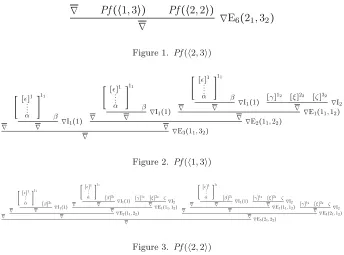
As an example (given in the more familiar notation using only wffs), consider the following 6-place connective ‘∇’, with introduction rules:
[]1
α β
∇(, α, β, γ, ξ, ζ) ∇I1 and
γ ξ ζ
∇(, α, β, γ, ξ, ζ) ∇I2
The I-rules for ‘∇’ generate the following six GE-rules. Recall the formula from Section 3:m = 2, n1 = 2 and n2 = 3, somi=1ni = 6, thus ensuring
that the assumption of one premise from each I-rule is discharged by each E-rule (where ‘∇’ abbreviates ‘∇(, α, β, γ, ξ, ζ)’):
∇ ⎡ ⎢ ⎣ .. . α ⎤ ⎥ ⎦ 1 ψ
[γ]2
ψ
ψ ∇E1(1,2)
∇ ⎡ ⎢ ⎣ .. . α ⎤ ⎥ ⎦ 1 ψ
[ξ]2
ψ
ψ ∇E2(1,2)
∇ ⎡ ⎢ ⎣ .. . α ⎤ ⎥ ⎦ 1 ψ
[ζ]2
ψ
ψ ∇E3(1,2)
∇
[β]1
ψ
[γ]2
ψ
ψ ∇E4(1,2)
∇
[β]1
ψ
[ξ]2
ψ
ψ ∇E5(1,2)
∇
[β]1
ψ
[ζ]2
ψ
ψ ∇E6(1,2)
Figure 1. Pf( 2,3)
Figure 2. Pf( 1,3)
Figure 3. Pf( 2,2)
Pf(2,2) in Figures2and3. Note that each sub-proof ending in the applica-tion of an E-rule discharging premises (l1, r2) corresponds to the derivation Pf(l, r).
Given this result, if local completeness does successfully capture inverse harmony, then the GE-rules for any connective are inversely harmonious, and a fortiori stable, with respect to the I-rules from which they are gener-ated. But we will question this assumption in Section7.
6. Introduction- and Elimination-Meaning
Schroeder-Heister [38] (see also [39]) introduces the idea of the introduction-meaning and the elimination-introduction-meaning of a connective, that is, of formulae which express the meaning conferred on a connective by a set of, respec-tively, I- and E-rules. He proposes an account of stability (which he calls “harmony”: [38, p. 339]), according to which a connective has stable I- and E-rules if and only if its I- and E-meanings are equivalent.
connective to the meaning of the expressions used in the formulation of its I- and E-meanings.
Our project in the present paper is to determine whether the I- and GE-rules for a connective are stable, independently of whether this is achieved by appealing to the meanings of expressions of some language or other. What makes a real distinction between our projects is (as noted in [38, p. 330]) that we are interested in the stability of I- and E-rules where the latter are gen-erated from the former via the GE-procedure, whereas Schroeder-Heister’s interest is in the relationship between I- and E-rules in general. Schroeder-Heister’s specific formulation of I- and E-meanings concerns (second-order) intuitionistic logic. However, it readily generalizes to other logics and their higher-order counterparts.
These (meta-)formulae belong to a basic vocabulary expressing the cen-tral idea of alternative, jointly sufficient and possibly conditional grounds. In the case of ‘∧’, ‘∨’, ‘→’ and ‘⊥’, for example, the I-meaning is simply expressed by the (metalinguistic) formulae α∧β, α∨β, α → β and ⊥, respectively.
Now consider the connective ‘◦’ discussed in [44, p. 506] and [38, p. 345], with I-rules:
[α]1
β
◦(α, β, γ) ◦I1(1) and
γ
◦(α, β, γ) ◦I2
Then ◦(α, β, γ) can be asserted either ifα implies β or if γ obtains, so the I-meaning of◦(α, β, γ) is given by the meta-formula (α→β)∨γ. In general, the I-meaning of∗ given by the schematic I-rules in Section3 is
m
i=1
ni
l=0
cgl(∗Ii)
where
c(gl(∗Ii)) =
gl(∗Ii) if gl(∗Ii) is a level 1 sequent and
a(gl(∗Ii))→s(gl(∗Ii)) if gl(∗Ii) is a level 2 sequent.21
What of the E-meaning of ∗? First, recall the application of the general-elimination procedure to the case of implication, ‘→’, given in Sections 1
and 3 above:
α→β ⎡ ⎢ ⎣
α
.. .
β ⎤ ⎥ ⎦
1
γ
γ →E(1)
The E-meaning is given not by the grounds for assertion of α→β (that is,
α ⇒ β), but in terms of what can be inferred from those grounds, which is anything which follows from the sequent α⇒ β. Thus the E-meaning of
α→β is represented by the second-order formula:
(∀ζ)(α→β)→ζ→ζ
,
that is, if αimplies β only ifζ, then ζ, for anyζ.
Now consider◦(α, β, γ) again. Since in its I-rule,m= 2 andn1=n2= 1, it follows that mi=1ni= 1, and so the rules ◦I1 and ◦I2 generate one GE-rule:
◦(α, β, γ)
⎡ ⎢ ⎣
α
.. .
β ⎤ ⎥ ⎦
1
ζ
[γ]2
ζ
ζ ◦E(1,2)
Once again, the E-meaning is given in terms of what can be inferred from the grounds for asserting ◦(α, β, γ), that is, whatever follows both from the sequentα⇒β and fromγ. Thus the E-meaning of◦(α, β, γ) is represented by the second-order formula:
(∀ζ) (α→β)→ζ∧(γ→ζ)→ζ
,
that is, if α implies β only if ζ, and moreover γ holds only if ζ, then ζ, for any ζ. More generally, the E-meaning of ∗ as given by the ∗E-rules of Section 3is:
j∈Ω (∀ζ)(
m
i=1
(c(gj(i)(∗Ii))→ζ)→ζ)
where, as in Section 5, Ω =×mi=1ni, that is, the set ofm-tuples j whoseith
memberj(i)≤ni.22
22When there is no I-rule (i.e., m= 0), 0
i=1ni = 1 and∗α=⊥(see footnote10).
The property that the E-rules for a connective∗have when the E-meaning for ∗ implies the I-meaning for ∗ provides an alternative way of formally capturing the notion of inverse harmony. For example, (∀ζ)(((α→ζ)∧(β → ζ))→ζ), the E-meaning of ‘∨’, impliesα∨β, the I-meaning of ‘∨’, and the E-meaning of ‘◦’, (∀ζ)((((α→β)→ζ)∧(γ→ζ))→ζ), implies (α→β)∨γ, the I-meaning of ‘◦’.
In fact, the I- and E-meanings of both ‘∨’ and ‘◦’ are equivalent. In gen-eral, we can show that the E-meanings given by the GE-rules are equivalent to the I-meanings of the set of I-rules from which they are generated:
Theorem 2. (Equivalence of I- and E-meanings) The E-meanings given by
the GE-rules are equivalent to the I-meanings of the sets of I-rules which generate them.
Proof. we show that
m i=1 ni l=0 c
gl(∗Ii)
↔
j∈Ω (∀ζ)
m
i=1
cgj(i)(∗Ii)→ζ →ζ Left-to-right: Clearly, c
gl(∗Ii) → m i=1
cgj(i)(∗Ii)→ζ
→ζ
for any ζ, where j(i) =l≤ni, and so ni
l=0
c
gl(∗Ii)
→(∀ζ)
m
i=1
c(gj(i)(∗Ii))→ζ
→ζ
for every j∈Ω. Hence
ni
l=0
c(gl(∗Ii))→
j∈Ω (∀ζ)
m
i=1
c(gj(i)(∗Ii))→ζ
→ζ
for every i. The result follows by∨E.
Right-to-left: Suppose j∈Ω(∀ζ)(mi=1(c(gj(i)(∗Ii)) → ζ) → ζ). Then,
by ∧E and ∀E,
m
i=1
cgj(i)(∗Ii)→ m
i=1
cgj(i)(∗Ii)
→
m
i=1
cgj(i)(∗Ii)
Footnote 22 continued
for every j∈Ω. Clearly,c(gj(i)(∗Ii))→mi=1c(gj(i)(∗Ii)) for everyi, by
∨I. Hence, by →E,mi=1c(gj(i)(∗Ii)) for every j∈Ω. Thus,
j∈Ω
m
i=1
cgj(i)(∗Ii)
by ∧I, and so
m
i=1
j∈Ω
cgj(i)(∗Ii)
by distributivity, which is equivalent to
m
i=1
ni
l=0
c(gl(∗Ii))
Corollary 1. (Local Completeness—aliter proof ) ∗α follows from the
E-meaning of ∗.
Proof. Clearly,mi =1
ni
l=0c(gl(∗Ii))→ ∗α, by∧E,∗Iiand ∨E. So by The-orem2 we have that
j∈Ω (∀ζ)
m
i=1
cgj(i)(∗Ii)→ζ
→ζ
→ ∗α
Equivalence of I- and E-meanings generalizes from the propositional case above to cases such as that of ‘∃’, to be discussed in Section 8. The E-meaning expressed by ∃E is (∀ζ)((∀u)(α(u/x)→ζ)→ζ) for ‘u’ not free in
ζ, which is intuitionistically and classically equivalent to (∃x)α.
Higher-level rules were simplified in [7] to a form also found in [31, p. 135], [42, p. 545], [22, p. 8] and [9, p. 619] in which only formulae are discharged.23 In [33], this simplification is called “flattening” of the higher-level rules. The flattened E-rule for ‘→’ reads:
α→β α [β]
1
γ
γ →E(1)
It was shown in [33] that only in the context of classical reductio can we be sure that the flattened rules will be equivalent to the higher-level rules.
Intuitionistically, the flattened GE-rules, such as those given in [9], are often weaker than the I-rule warrants, and so are not stable.
Schroeder-Heister and Olkhovikov [39] demonstrate the weakness of flat-tened E-rules for certain intuitionistic connectives, such as ‘◦’. Suppose we flatten the GE-rule for ‘◦’ so that only formulae are discharged in the minor premises:
◦(α, β, γ) α
[β]1
ζ
[γ]2
ζ
ζ ◦E
(1,2)
The E-meaning of ‘◦’ given by◦E is (∀ζ)(α∧(β →ζ)∧(γ→ζ))→ζ. It is easy to see that this is classically equivalent to (∀ζ)(((α→β)→ζ)∧(γ→ ζ))→ ζ). But it is not intuitionistically equivalent to it. The latter implies the former, but not vice versa. Thus ◦E is in harmony with ◦I1 and ◦I2, but the rules are not (intuitionistically) stable.◦Eis too weak and does not allow one to infer everything that the I-meaning of ‘◦’ warrants.24
7. Problems with Quantum Disjunction
We have shown in Sections 5–6 that the GE-rules of Section 3 are locally complete and that their E-meanings entail (and indeed, are equivalent to) their I-meanings. However, there is reason to doubt that local completeness and implication of the I-meaning of a connective by its E-meaning really succeed in formally capturing inverse harmony.
Consider the elimination-rule for ‘∨’ in quantum logic, which does not allow parametric assumptions in the minor premises:25
α∨β [α]
1
γ [β]
2
γ
γ ∨EQ(1,2)
This rule appears to be locally complete by Pfenning and Davies’ test, since one can recover α∨β despite the restriction:26
α∨β
[α]1
α∨β ∨I1
[β]2
α∨β ∨I2
α∨β ∨EQ(1,2)
24It had already been noted in [44, p. 506] that there “does not seem to be a suitable set of E-rules” (that is, flattened rules) for ‘◦’.
But though ∨EQ is in harmony with∨I (it does not allow one to infer more than∨I warrants), it is clearly incomplete, since it is weaker than∨E (which is also in harmony with ∨I) in that it does not permit one to establish the distribution of ‘∧’ over ‘∨’, as ∨E in conjunction with the ∧-rules and ∨I does.
Furthermore, the I- and E-meanings of ‘∨Q’ are equivalent. The I-meaning
of ‘∨Q’ is α∨β, and its E-meaning is (∀ζ)(((α→ζ)∧(β → ζ))→ ζ), and
these formulae are equivalent in classical, intuitionistic and quantum logic. Thus, local completeness and implication of I-meanings by E-meanings do not seem to capture the notion of inverse harmony successfully.
The example involving quantum disjunction is contentious. It is unclear whether the ban on parametric assumptions is acceptable in a schematic rule (as opposed, say, to requiring all parametric assumptions to have a certain form, as in the normal ∀I-rule). For example, Humberstone [16, p. 587] criticizes ∨EQ for not respecting his demand of Generality in respect of side formulas (p. 521). But Humberstone confesses that he has given no argument for his Generality demands, other than to exclude the counterex-amples. Francez [10, p. 115] rehearses an argument for the constraint from [17, p. 720], but admits that he finds the argument unconvincing. Indeed, the constraint seems to be violated by standard rules for the quantifiers and for modality. In the same vein, Prawitz [28, p. 35] noted that his modal rules do not satisfy his requirement that the rules be fully schematic.27 Absent a clear and persuasive formulation of the constraint, the example of quantum disjunction invites further reflection on means to establish inverse harmony and, a fortiori, stability, to which we now turn.
8. Grounds for Assertion
Perhaps it was a mistake to respond to the objection that one cannot use∨I to recover α∨β from the application of ∨E to it by allowing the I-rules to precede the minor premises of the application of the E-rule. Rather, what we should require is that one derive the grounds for assertion of α∨β, or in general, derive the grounds for assertion of ∗αfrom ∗α after application of ∗E.
For example, we can do this with ‘→’. Suppose we apply →E to derive
β from α→β and α, as in Section 3:
α→β
⎡ ⎣α....
β ⎤ ⎦
1
β →E(1)
or in the lo-gistic nota-tion
Γ⇒α→β
α⇒α Ass1 α, α⇒β⇒β Ass2
Γ, α⇒β →E
Note that, as we remarked in Section 3, while the sequent α ⇒ β is dis-charged by →E, the assumption of αremains so far undischarged.
We have now obtained, through an application of →E, the grounds for an assertion ofα→β, namely, an assertion ofβ on the basis ofα:g1(→I) =
α⇒β. From here, we can proceed to apply→I to discharge the assumption of αand infer α→β:
α→β
⎡ ⎣[α]
2 .. ..
β ⎤ ⎦
1
β →E(1)
α→β →I(2)
that is, Γ⇒α→β
α⇒α Ass1 α, α⇒β ⇒β Ass2
Γ, α⇒β →E
Γ⇒α→β →I
This may seem little different from the derivation of α∨ β from α∨β
in Section 5. But that derivation did not derive either of the grounds for assertion of α∨β from α∨β. As remarked in Section 5, that is clearly impossible, since those grounds are an assertion either of α or of β, and neither αnorβ follows from α∨β.
However, in a multiple-conclusion environment, such as is available in classical logic, one can infer bothαandβ(disjunctively) fromα∨β; and one can mimic a multiple-conclusion environment in single-conclusion natural deduction by use of the negation rules. First, note that in a single-conclusion calculus, we can show that if one of the grounds for assertion ofα∨β is not available, the other must be, that is, given ¬β, one can inferα from α∨β; and given ¬α, one can infer β from it. First, we need ex falso quodlibet as
¬E:
¬α α
β ¬E that is,
Γ⇒ ¬α Δ⇒α
Γ,Δ⇒β ¬E
Then we can argue:
α∨β [α]1
[β]2 ¬β
α ¬E