eScholarship provides open access, scholarly publishing services to the University of California and delivers a dynamic research platform to scholars worldwide.
Peer Reviewed Title:
Double Time: Facing The Future in Migration’s Past Journal Issue:
California Italian Studies, 2(1)
Author:
Duncan, Derek, University of Bristol Publication Date:
2011
Publication Info:
California Italian Studies, Italian Studies Multicampus Research Group, UC Office of the President Permalink:
http://escholarship.org/uc/item/38q389mk
Author Bio:
Derek Duncan is Professor of Italian Cultural Studies at the University of Bristol. He has published extensively on modern Italian literature, and film with a particular emphasis on issues of sexuality, gender, and migration. He is author of Reading and Writing Italian Homosexuality: a case of possible difference (2006), and has edited a number of publications on Italian colonial and postcolonial culture, including National Belongings (2010). He is editor of the Cultural Studies issue of the long-established journal Italian Studies. His current research project looks at the intersection of sexual and racial identities in contemporary Italian culture.
Keywords:
migration, contemporary Italian cinema, visibility Local Identifier:
ismrg_cisj_8958 Abstract:
eScholarship provides open access, scholarly publishing services to the University of California and delivers a dynamic research platform to scholars worldwide.
Double Time: Facing The Future in Migration’s Past
Derek Duncan
By picturing our wishes as fulfilled, dreams are after all leading us into the future. But this future, which the dreamer pictures as the present, has been moulded by his indestructible wish into a perfect likeness of the past.
--Sigmund Freud, Interpretation of Dreams
Trauma is not necessarily a single event, but a series of events that affects the imaginary and the symbolic.
--Maureen Turim, Flashbacks in Film
In La mia casa è dove sono, Igiaba Scego explores the imaginary and real geographies of memory and belonging as she maps the contours of her identity as an Italian woman of Somali origin. Scego paints a vivid picture of her native city’s new materiality: “Una Roma dove la globalizzazione si è fatta carne” (2010, 157). She recounts the astonishment of her brother on his first visit from England when he sees a group of Italian boys playing cricket with some Sri Lankan friends. Scego is quite happy with the new diversity reflecting that “[l]e mazze di cricket e i sari non sono altro che i segni di un futuro che non solo verrà, ma che è già qui da discreto tempo” (157). In the gendered symbolism of the cricket bats and the saris, Scego foresees a multicultural future that has already become past. In a gesture that is characteristic of many attempts to envisage what the nation will become, she then immediately returns to more distant times: “Qui ci sono passati tutti, arabi, normanni, francesi, austriaci. C’è passato Annibale, condottiero africano, con i suoi elefanti” (157-58), a historical fact, she reminds the reader, recalled relatively recently by the Neapolitan hip-hop band Almamegretta. “Essere italiani,” she concludes, “significa far parte di una frittura mista. Una frittura fatta di mescolanze e contaminazioni” (158). Scego’s return to history as a way of making sense of Italy’s multicultural present is one instance of the dominant mode of interpreting recent migration to Italy as a socio-economic and cultural phenomenon.1 Nostalgia for a monocultural homogeneity that arguably never existed vies with the cultural memory of a nation whose history has been marked by multiple demographic displacements: emigration, internal migration, and colonial expansion. While the first perspective is most commonly, but not exclusively, associated with the xenophobic politics of the nationalistic right and its press, the second belongs more frequently to commentators on the centre-left eager to establish, through the labour of empathy, some degree of identification with the plight of today’s migrants. What both perspectives share, I would
1 A recent, elegantly crafted instance of this tendency is Norma Bouchard’s essay (on multiculturalism in
suggest, is the desire to see Italy transformed into some kind of reflection of the past, or to interpret its future, which may be our present, as a direct emanation of that past. What I propose to do in this essay is examine a group of recent Italian films that feature migrants, but in which the sense of temporal continuity intimated by hegemonic interpretations of the national past and their future projections is called into question.2 Derrida’s suggestion that “haunting belongs to the structure of every hegemony” (2006, 46) is fundamental to a project that never seeks to deny the weight of history but that wonders exactly which of its stories calls on the present. The past proves intrusive, but is also unpredictable in its manifestations, and the futures that emerge from it may be marked by its fraught energies, but are not quite determinable by them.
Films about migration have rarely been explicit in making connections with Italy’s own colonial or emigrant past.3 Perhaps the most resonant example of this indirection and the hermeneutic challenge it throws up is Mohsen Melliti’s Io, l’altro (2006) where two trawlermen dredge up the body of a black African woman in their net from the waters of the Mediterranean. Tentatively, it is suggested that she is Somali, creating for the informed spectator a link with Italy’s colonial history in East Africa. The crescent-shaped medallion identifies her as Muslim. The complexity of the sequence lends itself to multiple possible interpretations, but Áine O’Healy’s reading of the episode is particularly relevant and convincing as she interprets it through the Derridian notion of “spectrality” that has had wide resonance in postcolonial thought. The West continues to be haunted by a past that interrupts unpredictably the present, expressing an ongoing sense of injustice that decolonisation has done little to assuage. The woman’s body functions as an uncomfortable revenant, whose presence provokes an inexplicable and unresolvable rupture in the texture of the present: she is not a reminder of the past as such for she comes from a past time that is as yet unavailable to conscious recall. As O’Healy argues, the woman’s body is “uncanny,” signalling, but not quite articulating, the “return of the repressed memory of Italian colonialism” (2009, 177).4 It is in the shadow of this
2 To this end I work with Graziella Parati’s contention: “academic discourses and popular culture…work
together in talking back to the fiction of Italian homogeneity and to the norms that dominant narratives create about origins. The goal is not to construct a privileged position for otherness, but to reveal an internal asymmetry and the artificiality of homogeneity” (2005, 28).
3 Angelo del Boca (2002) popularised the idea that Italy’s colonial memory had been “repressed” and much
scholarly work in this area has been directed precisely to excavating what most Italians had needed, or preferred, to forget. Yet Italy’s ongoing ambivalence towards its colonial past and the “repression” of that memory means that only rarely has it been available for direct recollection. Its status as what Ruth Ben-Ghiat and Mia Fuller refer to as “the still-desired lost object” (2005, 2) goes some way to illuminating the scant presence it occupies in post-war Italian cultural production and the difficulty of finding a secure place for it in the national story. Gianni Amelio’s film Lamerica (1994) is unusual inmaking explicit parallels between the very different demographic phenomena mentioned above. The story of an unscrupulous Italian entrepreneur who discovers connections between Albania of the early 1990s and war-time Italy that make him revise his sense of personal and national identity functions as an extended metaphor for the amnesia that besets Italy’s multiple histories of mobility and displacement. Amelio attempts to align contemporary and earlier experiences of migration and of Italy’s colonial presence in Albania that has been vividly remembered there if not in the peninsula itself. The film has been criticised for the way in which it figures Albania as a kind of throw-back to Southern Italy of the 1940s, yet Amelio’s conflation of history and geography does nevertheless initiate a historical narrative that sites Italy in a transnational, rather than solely national, frame.
4 In this essay O’Healy also makes the point that simultaneously the body “obliquely draws attention to the
dual temporality, and dual history of representation, that the body is returned to the Mediterranean suggesting symbolically a resistance to what she might represent. Yet her brief presence escalates the level of tension between the two men confined to the enclosed space of the boat. The longstanding friendship between the two has turned to media-fuelled paranoia as the Italian-Catholic Giuseppe comes to believe that his Tunisian-Muslim friend Yousef is a terrorist. What had started as a relatively benign exploration of cross-cultural friendship and harmony turns into an overwrought male melodrama in which the homosocial relationship between two close friends articulates deep feelings of cultural unease. The claustrophobic space of the boat shot from the subjective perspectives of both men intensifies the murderous feelings of panic and terror. The gentle blurring of their identities, even through their names (Giuseppe/Yousef), turns into fratricidal animosity. This swift reversal shifts the geopolitical and historical coordinates of the film.5 The timeless fantasy of a common Mediterranean identity is made resolutely contemporary as Yousef’s nationality and religion turn him into the object of fear and suspicion. The wholly inconclusive nature of the film’s ending, where the two men are cast adrift with little hope of rescue, anticipates a future of radical uncertainty. The body of the dead Muslim woman and that of the suspected Muslim terrorist sit in uneasy alignment in terms of the various historical precedents of Italian migration.
While I find persuasive O’Healy’s argument that the Somali woman can be read as a reminder of the repressed memory of Italian colonial history, I do have concerns that the various histories of Italian migration are being called on too readily as the prism through which contemporary responses to migrants are interpreted. Part of the power of O’Healy’s analysis lies in her sense that the past and the present are not conjoined in predictable, linear fashion. In Io l’altro, a forgotten, or disavowed, past may have returned, but it is hastily consigned to where it came from. In this instance, the story of that particular past remains untold, if what is wanted from the telling is the whole story. If, however, it is precisely in the history of its repression that the truth of this story lies, then what the spectator glimpses, incarnated in the chance finding of the corpse, is enough.
The narrative caesura at the heart of Melliti’s film marks a move away from the conventions of a socially engaged Italian realist tradition that characterise earlier films
production. Her alertness to the oblique is particularly relevant given that most Italian films about migration have adopted a primarily realist mode of representation. Arguably, this body of cinematic work has leant itself to a symptomatic reading precisely because of an adherence to the conventions of realism in a socio-political context that renders problematic the hegemonic acceptance of the norms that these conventions imply. This is especially pertinent in the field of postcolonial representation where the “realistic” can often pass as the real, reflecting “actual conditions of existence, thus giving rise to prejudicial effects” (O’Healy 2010, 4). Subsequently, in this later article, O’Healy draws attention to the fact that Vittorio De Seta’s almost excessive deployment of the tropes of realism in Lettere dal Sahara (2006) misrepresents migrants’ current situation in Italy (12).
5 Gennaro Nunzinate’s Che bella giornata (2011) starring Checco Zalone (Luca Medici) is a comedy about
about migration.6 These films gesture emphatically towards contemporary reality and simultaneously attempt to counter hostile media treatment of migrants through a benign, although rarely unproblematic, representation of them.7 I will suggest that in turning away from realism, Io l’altro heralds a body of work on the figure of the migrant that owes more to an alternative tradition of Italian film-making that is also politically motivated but that draws on a different set of stylistic resources to express a different set of concerns.8 The prevalence of subjective camera angles and the narrow framing of space in Melliti’s film recall the conventions and thematic concerns of what might be loosely called Italian film noir.
I.
Film noir is a contested category. There is no consensus over its formal features, and the noir canon is a malleable entity.9 It is most commonly associated with a retrospectively noticed tendency in filmmaking in the United States in the post-war period, and attendant anxieties about social order and gender identity. Anxiety is perhaps noir’s key defining term. Disruptions to conventions of narrative structure, techniques of lighting and sound that intensify feelings of fear or suspense, and stories of sexual perdition are not unique to films considered noir but create the defining mood of crisis which probably is. While some critics consider the noir to be specific to post-war America, others have identified a more diffuse historical and cultural legacy. The authors of a recent study point to the fact that it has very successfully travelled to a wide range of
6 I offer no precise definition of realism here, but rather take my cue from a recent article by Laura
Rascaroli in which she elegantly and succinctly dissects the various and changing aesthetic and political valences that pertain to the term. Rascaroli sets out the idea that realism might most usefully be seen as “an ongoing process rather than a fixed outcome, as a series of interrelated operations instead of a static product” (2010, 346). Millicent Marcus has been a great exponent of the socio-political and aesthetic values associated with the neorealist tradition, articulating its historical and literary antecedents with exemplary clarity (1984) and its ongoing value in an age of degraded screen production (2002). Her work and the value she attributes to realism and to what is perceived to be realist continue to generate debate and polemic in Italian Film Studies. O’Leary and O’Rawe (2011) make a compelling case for the reconsideration of Italian film history in the light of the range of cinematic production which this emphasis on the realist tradition has necessarily excluded.
7 The debate on the political uses of realism needs to be extended beyond the boundaries of the national.
Alex Lykidis (2009) notes the formative influence of Italian neo-realism on the representation of migrants in European cinema more generally. He also identifies a broader turning away from its conventions in a survey of recent European film production on this topic that operate in tandem with the features I go on to identify here.
8 In discussing the work of the Black Audio Film Collective, Jean Fisher comments incisively on the turn
from realism in their work to create “a poetics of affect beyond the scope of documentary media that could penetrate beneath surface symptoms to the deeply buried psychic economy of race and belonging” (2007, 18). While the films I discuss here have little in common with those produced by the Collective, I would nevertheless contend that the departure from realism in both instances opens up spaces in which unresolved conflicts might be perceived without leading onto the compensatory resolutions invited by realist narrative. In a different vein, Marcus notes the apparent irony that “[f]ilmmakers working in the realist tradition known for its courage in facing socio-political injustices past and present, show a surprising reluctance to confront Mussolini’s racial laws and the ensuing genocidal campaign” (2007, 24).
different national contexts. They argue that this success is due to the fact that noir “has repeatedly been connected to anxieties about the boundaries of national culture – about the fixities or integrity of national culture in a world of more fluid identities and economies in which national boundaries are increasingly irrelevant” (Fay and Nieland 2010, x). The claimed irrelevance of national boundaries is certainly debatable, but the more general point that noir is suited to expressing anxieties about nationhood suggests its availability for the exploration of responses to migration in Italy, and its conflicted pasts. Indeed, this would seem entirely congruent with Italy’s own noir tradition. Mary Wood’s comprehensive review of Italian noir notes a convergence between stylistic, structural, and thematic features that cut across a broad range of films over quite a considerable time-frame “to indicate dissatisfaction with official versions of events, and/or to evoke a dysfunctional world” (2007, 238). The features she identifies do not constitute a genre as such, but function more as a potent, aesthetic resource. “Disruptions, disturbance, anxieties, mysteries [that] typically have a visual counterpart in intense lighting contrasts, dark atmospheres, visual disorder and asymmetry, and visual excess” (ibid., 263) are deployed creatively as a way of indicating the menacing opaqueness of a given reality, and have proved flexible tools for the depiction of the murky politics of post-war Italy. Wood is particularly attentive to how techniques for the shooting of cinematic space (composition, lighting, mise-en-scène) contribute to the expression of a sense of unease in a climate of political and social instability. Yet perhaps more tellingly for what I will argue here, she refers, albeit briefly, to Trauma Theory as a means of interpreting noir’s often wayward temporality and the crisis of referentiality resulting from it. As will become evident in the films I analyse, this crisis in linear unfolding may be articulated thematically or structurally. The tension between noir’s visual and narrative excess are indicators of “the psychic investment in the engagement with contemporary reality” (238; emphasis added).
If noir is seen as a highly subjective mode, expressive of periods of social uncertainty and disquiet, it is perhaps unsurprising that its affective chronologies seem to imitate those identified by research in the field of Trauma Theory. Dominick LaCapra, one of its most influential voices, notes the existence of parallel structures in certain art forms and in real-life experience where “hallucination, flashback, dream, and retraumatizing breakdown triggered by incidents that more or less obliquely recall the past” (1998, 10) predominate. What might be called the “continuity editing” that creates the realist historical narrative is fractured by temporal interruptions to the unfolding of plot that pose serious hermeneutic challenges to spectator and character alike. This obliqueness that replaces straightforward linear time with a more subjective articulation of it is perhaps ill-suited to a national cinema dominated by a realist aesthetic and the imperious claims of the pro-filmic. Yet realism itself seems ill-suited to giving expression to modes of historical experience that remain unavailable to conscious recollection and the structures through which memory produces a coherent narrative text. Thomas Elsaesser has argued that film has a particular relation to trauma in that it is able to go beyond the recording of the historical event to instantiate ways of apprehending obliquely histories that can’t be told, but whose traces might be felt.10 His suggestion that trauma
10 His position seems close to that of Joshua Hirsch in his study of cinema and the trauma of the Holocaust,
can be read as “the name for a referentiality that can no longer be placed (that need no longer be placed) in a particular time or place, but whose time-space-place referentiality is nonetheless posited, in fact, doubled and displaced in relation to an ‘event’” (2001, 200) offers itself to a symptomatic reading of futures that will continue to be invaded by potentially unknown pasts.11 This contention does not obliterate the question of historical referentiality, but makes the confident identification of a precise referent a suspect procedure, and the tracing of its affect in the present and in possible futures a self-consciously hazardous enterprise.12 Noir explores the anxieties and uncertainties of a disturbing socio-political reality through a set of cinematic features that intensify rather than resolve the underlying sense of crisis that the films symptomatically document. It also introduces a sense of temporality that does not foresee a seamless fit of past with present and future. As a mode of representation, noir does not foster the sense that sound historical understanding leads onto a better future, but rather that the future always risks being tormented by an unruly past that refuses to go away. This unruliness is due in no small measure to the fact that we can never tell in advance which particular past will make its energies felt.
II.
The four films I will deal with in detail are Giuseppe Tornatore’s La sconosciuta (2006), Carlo Mazzacurati’s La giusta distanza (2007), Giuseppe Capotondi’s La doppia ora (2009), and Alessandro Angelini’s Alza la testa (2010). As will become apparent, these films share a number of stylistic and narrative features that both trade on, and depart from, the realist tradition. Their spatial dimensions map multi-ethnic Italy in ways that are perhaps surprising. What differentiates them from classic noir, usually seen as a quintessentially urban genre, are their small town settings, scattered across the north of Italy. The transposition to an apparently more familiar and less threatening environment can be read immediately as a symptom of profound unease with the heimlich. This
11 A very different path towards Italy’s multicultural future has been articulated with great commitment and
optimism by Armando Gnisci through both his published work and his wide range of cultural activities. The future he envisages is very different to the one(s) that I work with in this body of texts. For instance, while many would share his call for the creation of a “discorso interculturale, pacifico e amorevole” (2006, 28), it would be intemperate to embrace this call without a steady sense, at the very least, of the vicissitudes and discontents of desire, our best intentions notwithstanding.
12 In his interrogation of the “post” in postcolonial, Homi Bhabha expresses a temporality which might well
transposition accentuates the temporal structures characteristic of noir that are reminiscent of those of the “unhomely” referred to by O’Healy, in that the boundaries between past, present, and future are no longer securely in place. Each is susceptible to the unpredictable invasion of elements believed to be proper to the others.13 Like much cinematic production about migration, these films are centred round the relationship between a migrant and an Italian. However, unusually with respect to earlier films about migration, children and other forms of self-reproduction are critical elements (Duncan 2008). The focus on reproduction inevitably anticipates a future which necessarily invites an interpretation of the migrant story that depends less on the multiplicity of possible pasts.14 By considering these films together almost as a continuous body of work, my aim is to draw attention to a particular cultural discourse that exceeds the intentions of any single director working through in different, but complementary directions, a series of concerns about the national body. More specifically, I will argue that their attempts to relate the past and present of multicultural Italy express, above all, an uncertainty about how to envisage the nation’s future. Indirectly, these four films raise a series of inter-related questions about the past and about how it might extend into the future: What is the explanatory power of the past? And what certainties does it bring as a hermeneutic resource for interpreting the present? Whose past is actually in question? And is the only future one that has already been experienced in the past?
Alza la testa is the least innovative of these films, in that its narrative structure is relatively conventional. It contains none of the menace or uncertainty generated by the formal testing of realist boundaries characteristic of the other films I discuss. The main character is Mero, a middle-aged shipyard worker who brings up his teenage son, Lorenzo alone. The return of his Albanian mother, who raises the possibility that the bi-national Lorenzo might move back to Albania with her, threatens to rob Mero of his son. He is also the boy’s boxing coach. The intensity of their relationship is gradually eroded as it becomes clear that in order to progress in the sport Lorenzo needs to be trained more professionally. After Lorenzo meets a Rumanian girl, Ana, the relationship with his father becomes even more fractious. The first half of the film, therefore, comprises an exploration of the father-son bond and its possible dissolution that is a familiar topos in Italian cinema. The unexpected death of Lorenzo in a traffic accident takes the film into very different territory.
13 Contemporary noir fiction in Italy, conversely, is primarily an urban genre, and not all versions of
multicultural Rome are positive as Scego’s. In a subtle and closely-argued analysis of Melania Mazzucco’s contemporary noir novel, Un giorno perfetto (2005), Nicoletta Di Ciolla notes how it “describes the new Rome: a recipient of mass immigration struggling to find a new definition of itself as a multicultural environment, a victim of negligent urban planning schemes which have overhauled its social fabric in an attempt to restore some kind of equilibrium; a witness to profound changes in reactional dynamics, particularly within the family, and seeking a suitable urbi consistam to reconcile old and new mores” (2007, 300).
14 In Specters of Marx, Derrida is concerned also about the vicissitudes of reproduction: “ghosts,
The unsettling of Mero’s sense of patriarchal masculinity is what the first half of the film is about.15 The film’s second half reinscribes this sense of identity through an initially traumatic encounter that forces Mero to cross new boundaries of gender and national difference. This identity is also acquired through the work of mourning his son. After Lorenzo’s death, Mero gives permission for his son’s heart to be used in a transplant. The doctor attending Lorenzo is unsure what this means. Firstly, he tells Mero that “il cuore da solo non significa niente—è solo un muscolo”’ playing on its sheer materiality as an organic object. Subsequently, Lorenzo’s “gift” assumes a metaphysical dimension: “un meraviglioso gesto di amore.” Against the rules governing such donations, Mero manages to track down the recipient, Ivan Canepa who lives in north east Italy close to the Slovenian border. Mero’s attempts to find Ivan are hopelessly confused until he grasps the fact that Ivan is now Sonia. Overcoming his initial hostility, Mero befriends the transgendered Sonia who had become forcibly involved in human trafficking to pay off a debt.16 A key scene in Mero’s confrontation with the other occurs in a restaurant where he reflects on what he interprets in retrospect as his joyless relationship with Lorenzo.17 Asking Mero if Lorenzo had short hair, Sonia playfully and disconcertingly pulls hers up in order to resemble, but effectively to underline her physical difference from, the dead boy. She takes a mirror from her bag and applies lipstick. In the foreground of this scene, the spectator sees Sonia’s reflection in the mirror, but the camera’s focus is on Mero looking at Sonia in the middle distance.18 His comment, “sei carina,” acknowledges a femininity he had been reluctant to concede. It is difficult to see this episode in terms of doubling, or specularity, and might be more appropriately understood as a recognition of, and respect for, difference beyond the certainties of biological gender and nationality.
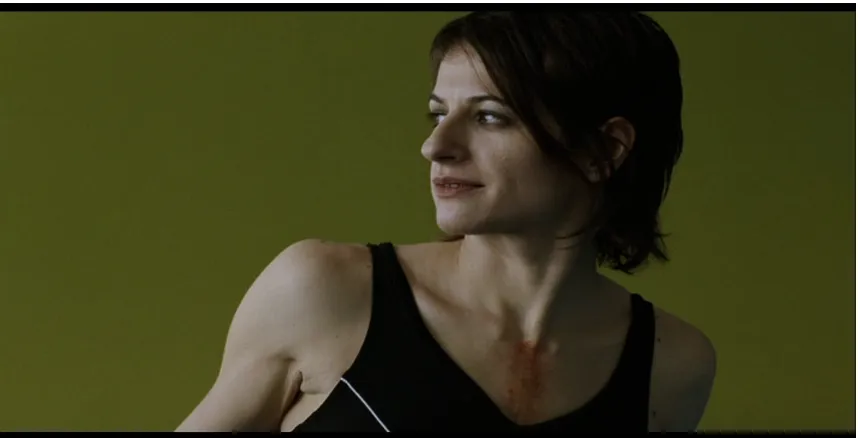
Shortly afterwards when we see Sonia in the swimming pool, the operation scar on her chest is clearly visible as a corporeal reminder that Lorenzo has in some sense been reproduced in her body across gendered and national boundaries of differentiation. Earlier in the film, Mero had tried to pull open Sonia’s shirt in order to see the scar as proof of her identity, the true recipient of Lorenzo’s heart. Sonia’s marked body is a defining signifier of altered identity. Her transition from male to female as well as her heart transplant and move from Slovenia to Italy intimate a narrative trajectory that defies hegemonic expectation as Mero learns to embrace her difference. Organ donation from
15 All of these films contain a kind of femme fatale in different guises who calls into question the
masculinity of the male protagonist. Mary Wood (2007) notes that Italian noir echoes the crisis in masculinity characteristic of noir in its classic Hollywood form, where it was often precipitated by the presence of a femme fatale whose function was to destabilise and call into crisis the parameters of the man’s world and sense of reality. See also Neale (2000, 160-64).
16 Even in films like Alza la testa which appear to espouse a manifest tolerance of multiculturalism, the
association of migrants with forms of criminality endures.
17 In Freudian terms, Mero might be regarded as a melancholic rather than a mourner given the
distinguishing intensity of his self-reproach. That aside, it is the temporality of mourning that counts here. Mourning-work in the present is trained on the past, but harbours the (unconscious) aim of taking the mourner into an as yet inconceivable future.
18 Lesley Sharp’s study of the social relations that accrue around organ transplants is useful here. Her
an Italian to an East European is the motor of the narrative and as such the intervention of medical science to alter the boundaries of national difference is a critical factor. The film is an extraordinary rejoinder to the British and French films studied by Elizabeth Ezra and Terry Rowden in which organ transplants and transgender identity function as the critical nexus through which the migrant subject is embodied as irrevocably other and inferior.19 While in films such as Stephen Frear’s Dirty Pretty Things (2002), the migrant worker is the donor of a trafficked organ, Sonia is the recipient. Her transgender status infers the fluidity of gender identity, not an inevitable and undesirable alterity. She embodies transformative potentiality rather than dismal inbetweenness. The damage visible on her body suggests her integration (albeit traumatic) into the Italian body politic rather than her exclusion from it. The film’s final sequence occurs after Mero takes over Sonia’s role in guiding a group of undocumented migrants across the border allowing her to escape. As the group of migrants flees into Italy, Mero notices a pregnant woman unconscious in the back of the truck. He carries her along the road flagging down a car to transport her to hospital. There, the medical staff inform him that while the baby is fine, the mother’s health is poor. Mero takes the baby from its cot, placing it on the chest of the mother who, predictably, is roused from her coma by the baby’s cries [Figure 1]. The
Figure 1 – Mother and child
camera lingers in medium close-up on the brown face of the mother insisting on the difference within universality. Her maternal instinct is beyond race. An exultant Mero is
19 Ezra and Rowden contend that “[l]ike immigration, alternative sexualities and gender identities represent
led away by security guards, yet the film ends on this note of a rediscovered paternity. He has provided fatherly care to both Sonia and the unconscious woman and her baby, so in a sense the crisis of masculinity that subtended the first section of the film finds resolution through the migrant body. The film ends with the image of hope expressed through the trope of the child. Here, however, it is the baby of the migrant woman and its adoptive Italian father who project the spectator into a possibly different future.20 The baby and mother are not saved simply by medical science, but rather through Mero’s humanitarian intervention.21 Ultimately, it is Mero who crosses the borders of gender and nation, although this crossing is articulated through the marked bodies of the migrant subjects he encounters.
Alza la testa’s central focus is on identity and its reconfiguration across differences of nationality, gender, and life and death, and bodies are subject to some kind of medical or technological intervention that forces a reconsideration of what has been called “somatized nationality.”22 National and natural boundaries are stretched, not always visibly, but certainly palpably, by these interventions. The “gift” of Lorenzo’s heart erodes both physiological and bureaucratic identities that would see him and Sonia as other. Yet curiously Lorenzo was already figured as a transplanted subject.23 Within the film’s diegetic logic, the relationship between his parents must have started in the early-mid 1990s. From the demographic perspective of contemporary Italy, bi-national couples with children are entirely commonplace, yet this has not been the case in Italian cinema where heterosexual relationships have been used systematically to signify the incompatibility of Italy and its foreign others (Duncan 2008). Lorenzo then functions, within the logic of cinema, if not that of the pro-filmic world, as an uncanny reminder of a reality that eludes the hegemonic narrative of national difference. He is, of course, dead.
20 Lee Edelman has studied the symbolic function of the Child from the perspective of Queer Theory which
is deeply embedded in conceptualisations of future time. He argues: “The Child…marks the fetishistic fixation of heteronormativity: an erotically charged investment in the rigid sameness of identity that is central to the compulsory narrative of reproductive futurism” (2004, 21). José Muñoz offers a trenchant critique of Edelman’s failure to account for issues of race. He concludes: “Theories of queer temporality that fail to factor in the relational relevance of race or class merely reproduce a crypto-universal white gay subject that is weirdly atemporal – which is to say a subject whose time is a restricted hollowed-out present free of the need for the challenge of imagining a futurity that exists beyond the self or the here and now” (2009, 94). I would suggest that with respect to Alza la testa, the future is queered by the fact that the closing sequence dislodges the continuity implied by sexual reproduction from a pre-scripted national story to anticipate a more racially and sexually diverse nation.
21 With reference to children born in Italy to non-Italian parents, Jacqueline Andall notes: “Their legal
status is that of ‘foreigner’...as current Italian citizenship law dictates that they retain their parents’ foreign nationality until at least the age of eighteen. From a socio-legal perspective, until they acquire Italian citizenship, their residence in Italy is ultimately precarious” (2010, 172). Andall offers an insightful examination of how the so-called G2 or “second generation” have responded culturally and politically to the precarious nature of their situation, proposing amongst other things, amendments to their current legal right of residence.
22 Ryan Prout’s article that reads organ transplant in two films by Almodovar as a metaphor for the working
through of the boundaries of Spanish national identity offers a useful introduction to how it functions in Alza la testa. I take the term “somatized nationality” from there (2004, 51).
23 Sharp argues that “[d]onors are peculiarly liminal beings, caught somewhere between patient and cadaver
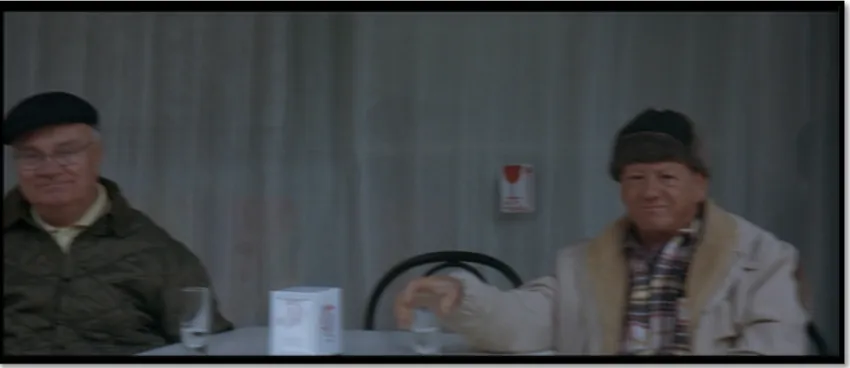
Carlo Mazzacurati’s La giusta distanza has been described as “both a love story and a noir” (Luciano and Scarparo 2010, 173). Set in a village in the Po valley, the film deals with the intersecting relationships of three characters who are extraneous to, and at odds with, the claustrophobic environment in which they find themselves: Giovanni, the aspiring journalist who becomes the film’s narrator in the final section, Mara, the newly-arrived Tuscan school-teacher planning to set off for Brazil, and Hassan, a Tunisian car mechanic, teased because of his desire to assimilate so totally into Italian culture. The film’s title refers to the perceived need to maintain traditional social and ethnic boundaries. Surveillance of these boundaries is a key element of the film, yet it proves to be a mode of social control that fails. When Mara first arrives in the village, a brief middle-distance shot of old men staring at her as she walks from the bus points to the logic of the gaze that will dominate the film. As she walks down the deserted main street, she is the object of the hostile looks of men and women alike who stare at her from a series of enclosed interiors [Figure 2]. Mara eventually enters into a relationship with Hassan, but only after she has caught him spying on her outside her house in the dark. The spectator had already seen Giovanni watching Hassan watch Mara, an activity that compounds his own electronic surveillance of Mara after he succeeds in intercepting
Figure 2 - Watching Mara
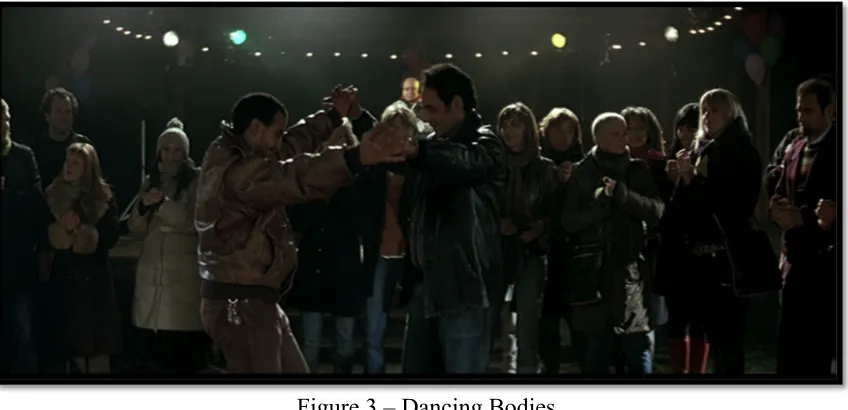
her email. Giovanni also sends articles about events in the village to the local newspaper which are published anonymously, fuelling speculation that there is some kind of local informer. In a scene without any other diegetic function than to reiterate the logic of enforced visibility familiar from many Italian films about migration, Hassan and his brother-in-law dance at a local festa [Figure 3]. The other dancers have moved to the edge of the dance floor to watch the spectacle of their exotic, bodily performance. The camera reiterates this fascination by alternating between close-ups of the men and of Mara and Jamila, Hassan’s sister, who wears a head-scarf that marks her difference from the other women present. This spectacularisation of gender and ethnic or religious difference presents in nuce what the film is about.
brutal killings of their dogs whose bodies litter the countryside. The school-teacher whom Mara replaced has gone mad. Giovanni witnesses the liberation of a group of undocumented Chinese workers held in inhumane conditions. The desolate, foggy landscapes of the Po valley are both stunningly beautiful and alienating as long-distance tracking shots of individual figures suggest the extent of human desolation and isolation. These exterior long shots contrast visually with the tight middle-distance framing of the village residents in enclosed spaces: in shops, cars, the workplace, or at home. The society in which the love story unfolds is not simply traditional, but profoundly disordered.
Figure 3 – Dancing Bodies
Having rejected Hassan’s proposal of marriage, Mara is murdered. While the catastrophic end to the relationship between Mara and Hassan is familiar from other films about migrants in Italy, this is not a conventional representation of migrant criminality (Duncan 2007). Although a homicide stands at the heart of La giusta distanza, it is a domestic crime rather than the fall-out of some form of organised activity. Framed as a murder-mystery rather than a thriller, the narrative explores questions of identity common to the detective genre. Hassan is soon arrested and convicted despite protesting his innocence. Traces of his semen found on the body and of Mara’s blood in his car serve to indict him. He commits suicide in prison. At this point Giovanni turns detective/investigative journalist and increasingly becomes the focaliser of the film and his voice-over (a classic noir feature) narrates the concluding section.24 He tracks down the real culprit who turns out to have been the friendly local bus-driver, taking the crime back to a decidedly unhomely small town Italy. The traces of bodily fluids that serve to condemn Hassan prove unreliable indicators of culpability. Giovanni finds the actual murderer by checking Mara’s phone records: the bus-driver is identified not by his DNA, but by his mobile phone.25 The technological turn evident in La giusta distanza suggests
24 In fact Mara and Hassan are rarely granted point-of-view shots underlining their status as objects of
surveillance.
25 Paul Gilroy has acutely analysed the consequences of advances in medical science and technology for the
a revision of how bodies need to be read. Giovanni demonstrates that the police’s hasty ascription of a homicidal impulse to Hassan’s semen points to an outdated and, in turn, deadly, racialised mode of thinking that plots a causal link between body and identity. Technology functions almost as a redemptive mechanism through which the dead Hassan is perversely vindicated. The transgressive behaviour of Mara and Hassan has been soundly punished, but the end of the film sees the optimistic restoration of an order of sorts as Giovanni leaves the village, again by bus, to take up a job with a newspaper in Milan, shunned however by his fellow villagers. Yet as Luciano and Scarparo astutely note, the apparent movement towards the future is effectively a return to a particular cinematic, national past: “the film adheres to the mainstream cinematic convention dating back to neorealism whereby it is only the young Italian male protagonist who provides the spectator with the hope for a more enlightened national future” (2010, 176).26 While La giusta distanza may well be read as an indictment of small-town Italy’s resistance to social change, it nevertheless reiterates a familiar, but by now hopelessly out-of-date and profoundly conservative vision of the future which in reality is a memory of a wished-for, but unrealised, future past.
III.
This manifest, albeit flawed, optimism of Alza la testa and La giusta distanza is countered by the second pair of films I look at. Their investment in medical science and technology is remarkably similar, yet results in less positively transformative outcomes. Russian-born Ksenia Rappaport is featured in both La sconosciuta and in La doppia ora. In each film, she plays a woman whose past intrudes in unpredictable and not easily interpretable ways on the present. La sconosciuta opens with a scene in which a line of semi-clothed, masked women are brought out for the perusal of a man who watches through a peep-hole, hidden from the women. Inevitably, the audience shares this voyeuristic performance until one unidentifiable woman is selected from the pack. The film cuts to a shot of a woman travelling through the north of Italy in a coach. The blue-grey palette that will be used throughout the film contrasts with the garish colours of the opening sequence.27 This visual contrast will be maintained throughout the film as the
very much in biological terms, Gilroy is aware that a metaphysics of racial difference persists. In light of the failure of the bodies to reveal a compelling diversity at the micro-level, Gilroy affords greater power to the mediation of its larger-scale representations: “Screens rather than lenses now mediate the pursuit of bodily truths. This is a potent sign that ‘race’ should be approached as an afterimage - a lingering effect of looking too casually into the damaging glare emanating from colonial conflicts at home and abroad” (2000, 37). La giusta distanza, like the other films I look at, plays with visual and narrative regimes of bodily identity. As Gilroy concludes: “The history of racism is a narrative in which the congruency of micro- and macrocosm has been disrupted at the point of the analogical intersection: the human body” (53).
26 For a discussion of the image of the child in post-neorealist Italian cinema see Small (1998).
27 In an essay on the use of colour in neo-noir filmmaking, Kathrina Glitre analyses how, in a range of
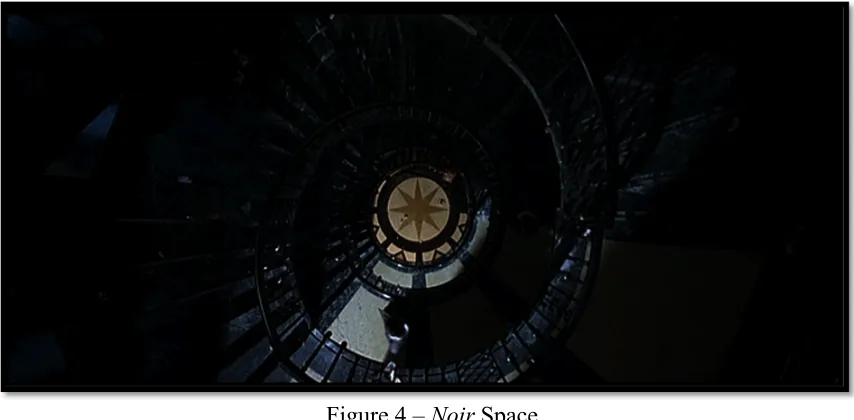
narrative is punctuated by a series of flashbacks that interrupt the story-line without conveying any kind of clear explanatory account to link past and present.28 These flashbacks are either scenes of violence and brutalisation that reveal Irena’s involvement in prostitution, or soft-focus shots of a romantic relationship with an Italian man whose body, in one hallucinatory and traumatic memory sequence, Irena exhumes from a rubbish dump. These returns of the past add another layer of disquiet to what is a disturbing narrative in formal and thematic terms.29 Irena secures employment in a block of flats as a cleaner and gradually infiltrates the apartment of the Adacher family in whom she has an obsessive interest. The family comprises a married couple and their young daughter, Tea, with whom Irena soon builds up an intense emotional bond, filling the void left by the emotionally distant mother. The nature of Irena’s interest is unclear. The family has a goldsmith’s business and is relatively well-off, yet Irena’s constant searching through their belongings appears to have no financial motive. Subjective camera shots encourage the spectator to identify with her as she rummages through the apartment, and this tension between audience sympathy for and disapproval of Irena’s objectively reprehensible behaviour is maintained throughout. Her attempts to cure Tea of a syndrome that inhibits her natural defence mechanisms appear sadistic. To get the job with the family, she had to befriend their previous maid before causing her to trip and plunge down the central staircase of the block. The staircase, a typical feature of classic noir, is shot through a range of framing techniques that induce a sense of claustrophobia and vertigo in the spectator [Figure 4].30
28 In a careful and detailed analysis of the film, Paolo Russo (2010) identifies twenty-seven instances of
interruptive returns to the past. Yet he rightly points out that twenty-four of these are better considered as “memory flashes” in that they are triggered by an event or action in the present that prompts some kind of recollection in Irena. They are mostly very brief and yield little information to the spectator. As Russo points out, they appear in no particular chronological order, and the viewer struggles to piece together their sequence and significance until the final section of the film provides a fuller explanation for Irena’s behaviour throughout the film. For the greater part of the film, this very partial and fragmented return of the past has no explanatory force. Russo’s paper is part of an ongoing project on migration and genre in cinema.
29 In her extensive study of flashback, Maureen Turim compares its use in film noir and psychological
melodrama, male and female-centred genres respectively. While she initially posits the idea that in the psychological drama, the flashback functions as part of a restorative narrative in which the damage done to the psyche is overcome, she moves towards the sense that in both there is a fascination with “the psyche as an agent of evil causing the destruction of self and of others” (1989, 143-44). While this offers, at first glance, a convincing insight into the function of the flashback in La sconosciuta, Turim’s comments on its use in Modernist cinema are ultimately more valuable: “The modernist difference is that the mode of filmic narration seeks mimetically to represent mental processes, to show the memory flashes and brief disjointed or distorted images which come to a character’s mind” (190). From this perspective, Turim avoids Deleuze’s too singular condemnation of the flashback as a conservative narrative device that serves simply as a heuristic key to explain the present. Turim is much closer to Elsaesser’s sense of the relationship between trauma and film in that, in the modernist flashback at least, the return of the past may be seen, even as it resists narrative resolution. For a positive assessment of Deleuze’ contribution see Martin-Jones (2006).
30 Mary Wood suggests that in noir the visual metaphor of the staircase represents a “boundary zone”
Figure 4 – Noir Space
The forging of the badly-injured maid’s signature to take money from her bank account point to criminal traits that are at odds with an otherwise sympathetic characterisation. The sense of paranoia and anxiety around the figure of Irena is illustrated early on when an alarm goes off as she leaves a supermarket. Clearly ill-at-ease, she is searched by the guards who in the end apologise as it becomes clear that the alarm had sounded because of a fault in the system. The sense of tension and ambiguity is intensified by chiaroscuro/contrastive lighting, the menace of Morricone’s classic noir soundtrack, and framing techniques that see Irena dominated by a cold and hostile environment. Towards the conclusion of the film’s middle section, the spectator shares the suspicious gaze of Valeria, Tea’s mother, as she spies on an unaware Irena trying to fathom out something about her that her body never quite betrays [Figures 5 and 6].31
The final third of the film sees the feeling of underlying menace erupt into episodes of violence centred on Irena. Muffa, her former pimp, appears. He is seeking revenge because Irena had stabbed and robbed him to escape his abusive hold.32 The level of violence escalates leading to the death of Valeria in a car accident. Muffa had tampered with the brakes but Irena is accused of the murder. An earlier close-up of a single red stiletto shoe assumes retrospective significance as its pair is discovered in the wreckage indicting Irena. Yet what is interpreted as a clue to Irena’s culpability is a misleading
thither of the stairwell, the temporal movement and passage that it allows, prevents identities at either end of it from settling into primordial polarities” (1994, 4). As such, the stairwell might be seen to represent the space of migrant/maternal identity that the film explores.
31 Valeria expects Irena’s body to yield some kind of truth. Gilroy’s notion of “diaspora” that breaks the
link between territory and identity can be usefully deployed here: “As an alternative to the metaphysics of ‘race,’ nation, and bounded culture coded into the body, diaspora is a concept that problematizes the cultural and historical mechanics of belonging. It disrupts the fundamental power of territory to determine identity by breaking the simple sequence of explanatory links between place, location, and consciousness” (2000, 123). It is instructive that in the sequence in which Irena is watched so attentively by Valeria, she is up to absolutely nothing at all. Even though Valeria sees her visit her former maid in the care home, this conveys nothing untoward to her. The redundancy of her surveillance opens up a critical gap in the narrative leading to Irena’s guilt (or innocence).
signifier, a sign used by Muffa in order to lie. The police over-invest in the historical narrative Muffa sets up.33 Their misreading does however lead to Irena’s confession that allows the spectator finally to make sense of the fragments of the past that had intruded on the main narrative, and of Irena’s peculiar obsession with the Adacher family. Irena believes Tea to be her own daughter: the thick curly hair of both Tea and Irena and the girl’s lack of physical similarity to either parent seem to bolster this claim. It emerges that
(Figures 5 and 6 – Valeria watches)
over a period of twelve years she had given birth to nine children whom Muffa then sold.34 The film’s initial scene loses its charge of perverse eroticism to become one of enforced reproduction. In response to Irena’s insistent pleas to know the name of the family that would adopt her last-born child, the midwife had said “Adacher.” This name, however, was simply taken from a gold medallion that Muffa wore round his neck, presumably made by the Adachers, setting up a completely false relationship between
33 The stiletto functions in a similar way to the traces of Hassan’s semen. Their metonymic value is to
create a social identity for the migrant through a signifier of hyper-sexualisation.
34 This horrific detail also feeds fears of the migrant woman’s exorbitant reproductive potential. Ezra and
Irena and the family, and DNA tests ultimately confirm that Tea and Irena are not related. Although innocent of any involvement in Valeria’s death, Irena does go to prison for the other crimes she committed. La sconosciuta’s final scene, however, sees Irena being released from prison to be met by a now-adult Tea bearing a striking resemblance to the woman who is not her mother. The ontological status of this scene remains ill-defined as it takes place in an indeterminate future.
La sconosciuta is fuelled by the affective energy of what turns out to be Irena’s erroneous version of the past. This damaging over-investment in the past draws her into a destructive relationship with the present as she struggles to re-invent a future. The transformative impulse is apparent throughout all four films, but also has a wider cultural resonance. It is implicit in Michael Haneke’s Caché,one of the most critically discussed postcolonial films of recent years, that explores the deferred trauma of the Franco-Algerian War. Caché has been described as “part thriller, part mystery, part ghost story” (Ezra and Sillars 2007, 211), and it is precisely this hybrid mix that challenges the establishment of any clear causal link between colonial past and postcolonial present.35 Set in Turin, Giuseppe Capotondi’s La doppia ora displays a similar generic mix but is primarily a love story between an ex-policeman Guido now working as a security guard in a private villa, and half-Slovenian Sonia who is employed as chambermaid in a hotel. Like the other films I discuss, La doppia ora has none of Caché’s historical specificity, yet shares many of its formal characteristics. The film is striated with instances of odd slippages and convergences of time.36 Its title refers to the supposedly lucky, yet uncanny, temporal coincidence of hour and minute (such as twenty three twenty three) and, as such, destabilises notions of progressive historical time. The film is structured in three roughly equal parts, and is prefaced by an apparently unmotivated scene at the hotel where Sonia works. She enters the room of a young woman and starts cleaning the bathroom. The woman comments on how nice Sonia’s hair looks when she wears it loose. Sonia hears a window slam, goes into the bedroom and peering out of the window sees the young woman dead in a pool of blood on the pavement. There is no sense in which Sonia is responsible for the death, yet the scene sets up a feeling of foreboding and uncertainty over narrative causality that extends throughout the film.
35 Haneke’s film has been the subject of much critical debate, primarily in relation to the way in which it
tackles (or fails to tackle) the ongoing effects of France’s colonial past. The plot depends tangentially on the relationship between the main character and the Paris massacre of October 17, 1961 when some two hundred North Africans were murdered, many driven into the Seine, by French police. The power of the film, however one views it, depends on how the historical tangent is interpreted. In a convincing analysis of the film, Mireille Rosello defines it as follows: “Fake thriller, fake detective story, fake whodunit, Caché insists on the absence of a narrative and on the traces and clues that denounce a character’s reluctance to testify” (2010, 129). Similarly, I would suggest that La doppia ora raises many of the same questions as Caché about how a particular past intrudes on its future, yet with the added complication that it never offers the spectator the lure of a precise historical referent. As such, it keeps in play the structure of trauma as a heuristic challenge to a narrative without a fixed object.
36 In many respects, all these films, but particularly, La doppia ora bear comparison to recent international
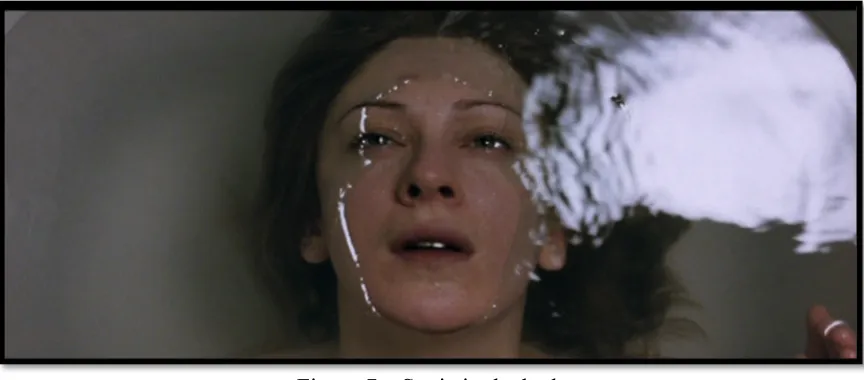
The film cuts to the speed-dating event at which Sonia and Guido meet. The spectator learns that Guido regularly attends these evenings in search of easy, yet potentially destructive, sexual encounters. Sonia is there for the first time. Their relationship quickly develops even though they appear to know little of each other. Guido had been widowed three years before, and there is perhaps the suggestion that this bereavement has somehow led to the loss of his job in the police-force. (Like Alza la testa and La sconosciuta, this is also a film about mourning.) One day while Sonia is visiting the villa, there is an armed robbery, and the section concludes with a gunshot leaving the spectator unsure about what has happened to the couple. Whereas the opening section unfolds in conventional narrative sequence, the second is disruptive and unsettling exhibiting many of the features characteristic of trauma’s disturbance of chronological time outlined above. An emotionally fragile Sonia is back at work, and a shot of Guido’s grave alerts the spectator to how the robbery must have ended. The emotional realism of the narrative is gradually eroded. Sonia is disturbed to receive a photograph of Guido and her in Buenos Aires, a city they had never visited. Subjective camera shots from Sonia’s perspective intensify her growing anxiety. She thinks she has seen Guido on the hotel’s CCTV system, but is unable to find any recording of it. The yellow palette used for the scene in which she returns to the hotel to check this is out emphasises the film’s shift to the detective genre. She is haunted by the sound of the Cure’s suggestively titled “Inbetween Days,” a song Guido had played in his car. In what is almost a pastiche of a classic horror bath scene, Sonia immerses herself in the water only to be roused by a phone call from the supposedly dead Guido [Figure 7].
Figure 7 – Sonia in the bath
(Figure 8 – Guido’s spectral return)
In what is fast becoming a ghost story, Sonia appears to be increasingly out of touch with reality. Actors appear in dual roles intensifying the sense of her paranoia. Dante, a former colleague of Guido, seems to be pursuing her. Shorter than Sonia, he is always shot towering over her, adding to her sense of oppression. At one point, in her own role as investigator, she drives to a lorry park. She pulls open the door of a truck, slaps and then kisses its driver who looks like one of the robbers. After a night out, Sonia’s friend, Margherita comments that Sonia’s hair looks better down. She goes home and commits suicide, throwing herself from a window in an uncanny reiteration of the young woman in the opening scene. At the funeral Sonia hears her own name read out as the priest commits her friend’s body to the grave. Led away by a client from the hotel who drugs and tries to assault her, Sonia struggles for breath as he winds her in plastic sheeting and attempts to bury her alive. Forcing her eyes open, Guido’s face appears in close-up.
The film’s delirious second section turns out to have been Sonia’s dream, or rather nightmare. Only three days have elapsed since the robbery as a result of which she ended up in a shock-induced coma in hospital. Guido was left unscathed. Subsequently, flashbacks to the dream, however, complicate any straightforward return to narrative order. Sonia is still haunted by the version of the past that was in a sense a hallucination, a symptom of the traumatic event itself. Her memory flashes of the dream contain anticipations of what will turn out to be the future. Yet it cannot be said that the dream was a complete fiction or fabrication. While elements such as Guido’s death prove factually incorrect, intimations of a truer, but as yet unknown, past emerge.
Sonia to a car park where she meets Riccardo, her actual boyfriend and the main actor in the robbery. As they leave, Sonia sees Guido watching them. He telephones Dante, but doesn’t speak thus allowing the two to escape. Sonia boards a flight for Argentina using a dead woman’s identity. The film concludes with shots of Guido working as a security guard in a supermarket and Sonia and Riccardo in Buenos Aires posing for a photograph in front of the bridge. The image recreates the dream picture of Sonia and Guido that now assumes the status of an unrealised future memory. In La doppia ora, the conscious falsification of the body and its location through digital imagery generates a labyrinthine plot to defraud the film’s Italian investigator hero. The “diasporic” body of Sonia in this film, is quite different than that of the character of the same name in Alza la testa. Here, the wilful disruption of the link between national territory, belonging, and corporeality is framed as criminal deceit rather than evidence of a putative cosmopolitanism. Yet both bodies depend on technological interventions to secure a functional identity and place in the world. While one Sonia makes a new life for herself in Argentina (a favoured destination for Italian migrants at one time), the other Sonia just flees into the night and into a new invisibility. While neither woman has children, they both are in possession of bodies that have been reproduced in such a way that natural difference becomes blurred.
IV.
Figure 9 – Sonia’s migrant body
history, but rather they reiterate a familiar logic of racial difference inscribed on the body’s surface. Effectively, they return the spectator to a scene which the film’s manifest narrative appears to disallow, but their insistent and diegetically unmotivated reappearance expresses the failure to resolve fully the somatisations that they appear to have worked though. The anxieties instigated by reproductive narratives involving white European migrants are reminiscent of what Jackie Stacey, in her reading of the figure of the clone in Alien Resurrection, calls“the relations of ‘excessive sameness’” (2000, 252). Stacey’s exploration of the “performance of passing” (252) in science fiction offers a useful entry into films in which the physical proximity and physiological similarity of the migrant to Italians is the source of narrative anxiety. Cloning, she points out, draws on science fiction’s generic interest in the double, the unhomely specular relation between the self and its other. But as I noted above, the double is also a genre feature of the noir. The films in what is admittedly a limited, but possibly growing, sample act out the anxieties generated by new technologies of reproduction in a social context where, to reprise the terms used by Ben-Ghiat and Fuller, “the still-desired object” still needs to be different.