doi:10.4236/cn.2009.12010 Published Online November 2009 (http://www.scirp.org/journal/cn).
Study on Value Chain of Telecom VAS under
Transformation Background
Yanming TAN, Jianqiu ZENG
School of Economics and Management, Beijing University of Posts & Telecommunications Beijing, China
E-mail: tanyanming@126.com, [email protected] Received July 15, 2009; accepted July 30, 2009
Abstract
Driven by both technology and market, telecom industry is becoming a part of several converged industries in information society gradually from an independent industry which provides telecom products like voice or data. Under such background, this paper introduces a new value chain model of telecom value-added ser-vices in the new environment, providing theoretic support for transformation of telecom operators.
Keywords:Telecom Transformation, Telecom VAS, Value Chain, Service-Oriented
1. Introduction
With the dual-driving of technology and market, the de-veloping environment of globe telecom industry is un-dergoing profound changes. (Ma, 2006) In terms of in-dustrial external environment, firstly, regulatory focus has transferred gradually from controlling of corporate be-havior to improving market effects, and telecom industry regulation is shifting to be user-centric; Secondly, the continually advancing technology is driving the conver-gence of the networks like telecom network and internet etc., so the traditional definition of industry boundaries no longer exists, and “digital integration” represented by network integration, business integration and terminal integration has become inevitable developing trend of information and communication industry (Shu, 2007), and traditional telecom business revenue is diverting con-tinually; thirdly, the traditional telecom market in devel-oped countries are becoming more and more saturated, while the market growth scale of telecom industry in the emerging markets exceeds developed countries for the first time, and the telecom industry will be confronted with global competitions under the frameworks of “WTO basic telecom agreements”. In terms of industrial internal environment, firstly, the business developing trend changes, for example, the number of mobile users ex-ceeds the one of fixed users in nearly 20 years; Secondly, the industry becomes increasingly competitive, and more and more enterprises participate in the competition with lower entering barriers, and it makes the global telecom industry has to face the problem of surplus capacity; thirdly, the requirements of users become diversiform and
personalized gradually, and with the driving of buyer’s market users will require not only more telecom products with better quality and lower price, but also require more convenient and practical services. With comprehensive analysis of industrial internal and external environment changes, it is no doubt that telecom industry will enter a new phase, and transformation will be corporate strategic choice to achieve sustained growth in the new phase for telecom carriers.
Nowadays, the global mainstream telecom operators have decided to implement strategic transformation, and most of them choose integrated information service pro-viders as their future industrial roles. As embryonic form of future integrated information services, today’s telecom value-added services are gradually becoming important sources of revenue for carriers. How to effectively nurture them and make them grow to be integrated information services will become the focus of attention for telecom operators in recent years.
Under such background, this paper will study the growth of telecom value-added services from the point of view of value chain, analyzing and find out the shortages of the existing value chain of telecom value-added ser-vices in the developing process, and proposing a new value chain model of telecom value-added services to adapt the new developing environment, which can be take as theoretic support for carriers’ transformation.
2. The Developing Trend of Telecom
Industry is Service-Oriented
64 Y. M. TAN ET AL.
industry has experienced more than 100 years developing process, and in the meantime, the continually advancing technology brought people increasingly high-quality communication experience. However, with the develop-ing of technology and deregulatdevelop-ing, the continuous influx of new investment makes an increasingly competitive telecom industry, and telecom market is becoming a buyer’s market, and pure voice services and simple data services are difficult to fulfill customers’ growing diver-siform and personalized requirements. At the same time, the quick developments of digital technology and com-munication technology make the convergence of indus-tries to be possible and it gradually becomes a new de-veloping trend, and media, entertainment, internet and telecom industries began to converge not only at technical layer but also at business layer. In such converging envi-ronment, users can acquire not only high-quality voice services and data access services, but also more informa-tion and entertainment services, and even experience in some forward-looking studies.
In the past hundred years, telecom companies con-nected different users through wired or wireless way, and transmitted voice or data for them through different communication technologies, while in the new converg-ing environment, telecom operators can help users achieve greater functionality and provide users with a wider range of services based on the connections between them. At this point, the connections built by telecom companies become infrastructures for users’ enjoying rich services. In this vein, the transformation of telecom in-dustry is not a general sense of business transformation, but strategic choice in the information revolution of lead-ing human society from industrial society into informa-tion society.
People produce and use information and knowledge on a large scale in information society, which is a knowl-edge-based economy-driven society. According to the ITU’s description of information society, information society is composed with two major parts for socio-eco-nomic and industrial. Socio-ecosocio-eco-nomic part includes set-ting up new lifestyles (such as online shopping, virtual reality, etc.), creating new arts and culture methods (such as multimedia books, remote music appreciation, etc.), constituting laws, rules and regulations (such as medical law in remote-medicine etc.). Industrial part includes cre-ating new applications and services (such as e-commerce, video services, etc.), building information networks (such as telecom networks, cable networks, satellite networks, etc.), manufacturing equipments (such as terminals, transmission systems and servers, etc.).
As part of industrial part, the focus of telecom indus-try’s transformation must be “Applications/Services” and “network/infrastructure” in Figure 1. That is to say, be-sides continuing to upgrade and maintain the network infrastructures, the more important tasks for telecom op-erators will be developing and providing rich applications and services based on the requirements in people’s social and economic life.
It is clear that in the future evolution of information society, the focus of telecom operators will change from the network-centric communications service providing to the application $/service-centric information service providing. In other words, telecom operators will no longer provide users with simple products limited by ex-isting functions that network supports, but fulfill users’ diversified demands in information society through re-lated network upgrading and value chain cooperation.
Culture/Life style
Globe common understanding of
culture
Law/Statute
Constitute law/statute for globe
economy
Applications /Service
Develop globe applications/services
Network/Infr astructure
Constitute international
standard
Socio-economic part
Industrial part
National affairs
WTO and others
Standard organization
[image:2.595.135.462.471.705.2]/Internation al group
In a word, the future operating model of telecom in-dustry will be service-oriented converted and trans-formed.
3. The Shortages of Existing Value Chain of
Telecom VAS
In the past ten years, with the sustained and rapid de-veloping of networks and computer technology, a large number of new features and business appeared in addi-tion to the tradiaddi-tional voice business in telecom indus-try, and they are so-called telecom VAS. In recent years, the voice revenue declined because of increas-ingly competition, while VAS became important measures for operators to maintain stability and growth of total revenue.
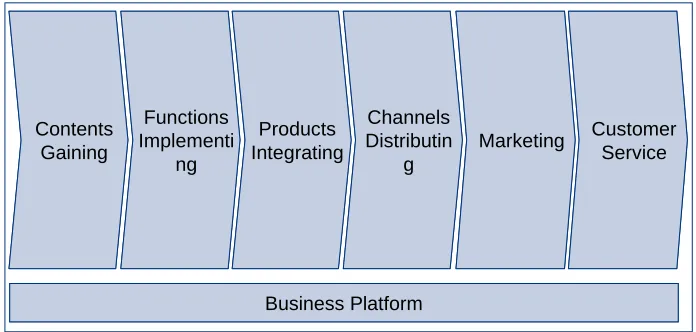
Telecom VAS plays a important role for telecom op-erators’ growth at this stage. The current operating modes of telecom VAS can be partitioned to three types in ac-cordance with the participating degree of operators, which are independently providing, cooperatively operating and fully outsourcing. The three main operating modes are fundamentally based on common value chain, as shown below.
In current network-functions-based developing envi-ronment, this value chain mode in accordance with divi-sion of functional expertise contributes much for growth of telecom value-added services. However, when facing the requirements with telecom industry in future informa-tion society, the limitainforma-tions of current value chain mode are fully exposed as followed:
First of all, the limited telecom VAS based on currently existing network functions will not be able to fully fulfill people’s rich demands of informationization; Secondly, a single business platform in the value chain mode limits the business expansion, making the involving scope of telecom VAS have been confined in a small framework, and we can not fully mobilize and make use of a wide
range of social resources, what’s more, it also limits the applying scope of basic resources of telecom industry; Thirdly, which is the core problem, the users’ demands are difficult to be reflected in this value chain mode, while in future service-oriented operating mode, the user’s demands in information society are the sources of information services.
In summary, the current value chain mode of tele-com VAS is clearly unable to adapt the new require-ments of telecom industry in future service-oriented operating environment, and it must be redefined and transformed to effectively support transformation of telecom industry.
4. A new Vale Chain Mode of Telecom VAS
As mentioned above, in the service-oriented operating mode of telecom industry, the developing and providing of telecom business will be based on users’ practical de-mands in information society rather than existing network features, and this new operating idea will make new de-mands to value chain of telecom VAS as follows:
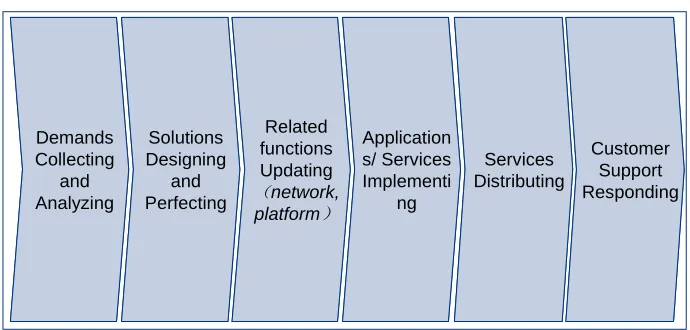
First, business will start from user’s demands and end with users’ fulfillments; Second, implementing network functions will become an important part among value chain activities, rather than limitation of infrastructure in the current value chain; Third, a wide range of social resources will be effectively integrated into the new value chain of telecom VAS, to fully maximize the level of participation to build telecom VAS, if possible, to make the telecom VAS to fully fulfill the people’s various aspects of demands in the Information Society; Based on these new requirements of value chain of telecom VAS, combined with the optimization of original value chain mode, this paper proposes a new service-oriented value chain mode of telecom VAS, as shown below.
Products
Integrating Marketing Functions
Implementi ng
Channels Distributin
g Contents
Gaining
Customer Service
Business Platform Products
Integrating Marketing Functions
Implementi ng
Channels Distributin
g Contents
Gaining
Customer Service
[image:3.595.123.471.536.702.2]Business Platform
66 Y. M. TAN ET AL.
Related functions Updating
(network, platform)
Services Distributing Solutions
Designing and Perfecting
Application s/ Services Implementi
ng Demands
Collecting and Analyzing
Customer Support Responding Related
functions Updating
(network, platform)
Services Distributing Solutions
Designing and Perfecting
Application s/ Services Implementi
ng Demands
Collecting and Analyzing
[image:4.595.125.470.73.238.2]Customer Support Responding
Figure 3. New service-oriented value chain mode of telecom VAS
The new value chain mode of telecom VAS not only integrates the original value chain, but also expands the value chain to include some new aspects like users’ de-mands researching, solution designing, etc. What’s more, it removes the original limitations of infrastructures through requesting the separation of network and busi-ness, and it also requests flexibility of network and plat-form and upgrading or adjusting them based on the dif-ferent business solutions.
Overall, the new value chain mode of telecom VAS has gone beyond the range of telecom industry, and it combines possible demands for support of telecom net-work and services in information society with imple-mentation and distribution of telecom services, creating effective support with networks and applications for in-formation society.
5. Conclusions
In the new environment, telecom industry is becoming a part of several converged industries in information soci-ety gradually from an independent industry which pro-vides telecom products like voice or data. Judging from the industry status quo, the construction of flexible tele-com networks still need more time, and the degree of information society also needs to be further upgraded, and applying conditions of the new value chain mode of telecom VAS may be not sophisticated enough. However, it will be necessary to implement gradual transition to-wards future goals for telecom operators, and the study of this paper will offer certain theoretic guide to opera-tors.
6. References
[1] L. Bossidy and R. Charan, Confronting Reality [M], CITIC Press, Beijing, 2005.
[2] W. B. Rouse, “A Theory of Enterprise Transformation, Systems, Man and Cybernetics [J],” IEEE International
Conference, Vol. 1, October 10–12, 2005.
[3] W. B. Rouse, “Enterprises as systems: Essential challenges and approaches to transformation [J],” Engineering Ma- nagement Review, IEEE, Vol. 33, No. 3.
[4] W. B. Rouse, “Introduction to dynamic systems: Theory, models and application [J],” Proceedings of the IEEE, Vol. 68, No. 9, September 1980.
[5] W. B. Rouse, J. A. Cannon-Bowers, and E. Salas, “The role of mental models in team performance in complex systems, Systems, Man and Cybernetics [J],” IEEE Transactions, Vol. 22, No. 6, November–December 1992.
[6] M. R. Halley and C. Bashioum, “Enterprise transfor- mation to a service oriented architecture: Successful patterns, web services [J],” ICWS, Proceedings, IEEE International Conference, July 11–15, 2005.
[7] D. Paper, “Development and initial testing of a theoretical model of transformation [J],” Proceedings of the 33rd Hawaii International Conference on System Sciences, 2000.
[8] Benoit Montreuil. Strategic Enterprise Realization and Transformation Processes in the Virtual Organization Era[J]. Engineering and Technology Management, 1996. IEMC 96. Proceedings. International Conference, August 18–20, 1996.
[9] R. J. Adensamer, “A process-centric approach to enterprise transformation [J],” Network Operations and Management Symposium, IEEE, Vol. 3, pp. 15–19, April 1996.
[10] M. E. Porter, Competitive Advantage [M], Free Press, 1988.
[11] H. Mintzberg, The Rise and Fall of Strategic Planning [M], Free Press, 1999.
[12] J. L. Salvaggio, Te1ecomunication Issue and Choice for Society [M], Longman, 1983.
[13] E. Hsu, Guide to Comercia1 Te1ecomunications Services [M], Prentice Hall, 1989.
[14] A. K. Shaw, Strategic Management in Te1ecomunications [M], PPTP, Beijing 2003.
[15] T. Durand, “Strategizing for innovation: Competence analysis in assessing strategic change [M],” John Wiley, ChiChester, pp. 127–150, 1997.
Information Age: From Monopoly to Competition [M], Harvard University Press, 1998.
[17] G. Pogorel, Global Telecommunications Strategies and Technologica1Changes [M], North Holland Press, 1994.
[18] K. Strouse, Strategies for Success in the New Telecom- munications Marketplace [M], Artech House, 2001.
[19] O. Jong-Geun, “Global strategic alliances in the telecom- munications industry [J],” Telecommunications Policy, Vo1. 20, No. 9, 1996.
[20] W. S. Baer, “Telecommunications infrastructure compe-
tition: The costs of delay [J],” Telecommunications Policy, Vol. 19, No. 5, 1995.
[21] J. van Cuilenburg and P. Slaa, “Competition and inno- vation in telecommunications: An empirical analysis of innovative telecommunications in the public interest [J],” Telecommunications Policy, Vol. 19, No.8.
[22] A. Payne, The Essence of Service Marketing [M], Prentice Hall, 1993.