Heuristic Spectrum Assignment Algorithm
in Distributed Cognitive Networks
Li Yu, Cong Liu, Zuhao Liu, Wenyu Hu
Huazhong University of Science and Technology, Department of Electronic Information Engineering, Wuhan National Laboratory for Optoelectronics, Div Commun and Intelligent Networks, Wuhan, China
E-mail: [email protected],{liuconggg, liuzuhao, babywinnerhu}@gmail.com Received December 14,2009; revised February 5,2010; accepted February 10,2010
Abstract
Cognitive radio is an exciting emerging technology that has the potential of dealing with the urgent require-ment and scarcity of the radio spectrum. Although having multiple radio interfaces and available spectrum bands can generally increase the effective throughput, a problem arises as to what the best strategy to dy-namically assign available bands to secondary users for maximizing throughput by minimizing the interfer-ence, and what the best scheme to allocate the spectrum holes to unlicensed users to maximize the fairness. This paper presents a distributed and heuristic spectrum assignment algorithm for multi-radio wireless cogni-tive networks in a cognicogni-tive network environment. The proposed algorithm (Fairness Bargaining with Max-imum throughput, FBMT) considers the problems including system throughput and the fairness. Extensive simulation studies in 802.11 based multi-radio cognitive networks have been performed. The results indicate that the proposed algorithm can facilitate a large increase in network throughput and acquire a good fairness performance in comparison with a common spectrum assignment mechanism that is used as a benchmark in the literature.
Keywords:Cognitive Network, Distributed Spectrum Assignment, Throughput, Fairness, FBMT
1. Introduction
As wireless technologies continue to grow, more and more spectrum resources will be needed. Within the cur-rent spectrum regulatory framework, however, all of the frequency bands are exclusively allocated to specific services, and no violation from unlicensed users is al-lowed. A recent survey of spectrum utilization made by the Federal Communications Commission (FCC) has indicated that the actual licensed spectrum is largely un-derutilized in vast temporal and geographic dimensions [1]. For instance, a field spectrum measurement taken in New York City has shown that the maximum total spec-trum occupancy is only 13.1% from 30 MHz to 3 GHz [2,3]. Similar results, obtained in the most crowded area of downtown Washington, D.C., indicated occupancy of less than 35% of the radio spectrum below 3 GHz. More- over, the spectrum usage varies significantly in various time, frequency, and geographic locations.
1.1. Spectrum Opportunity
Spectrum segments in a licensed band that are currently
unused by its primary users (PU) are referred to as the spectrum opportunity/holes. Spectrum holes appear as useable spectrum bands to a secondary user (SU) with respect to the licensed band in question. For a secondary user, given its locations, a set of spectrum holes can be available at a given time. Such a set of available bands are referred to as the spectrum opportunity of the secon-dary user.
Spectrum utilization can be improved significantly by allowing a secondary user to utilize this spectrum oppor-tunity when the primary user is absent. Cognitive radio (CR), as an agile radio technology, has been proposed to promote the efficient use of the spectrum [4]. By sensing and adapting to the environment, a CR is able to fill in spectrum holes and serve its users without causing harmful interference to the licensed user.
alloca-412 L. YU ET AL. tion policies are needed.
1.2. Related Work
Dynamic spectrum allocation strategies enable secondary user to sense local usable bands (including the bands without license), and to use them by some certain rules/ algorithms without interference to primary users. Ac-cording to the difference of structures of networks, the algorithms can be divided into two categories: the cen-tralized and the distributed. In cencen-tralized spectrum allo-cation algorithms, due to higher computing complexity, the centralized control devices become a bottle-neck be-cause they are not competent for such complex comput-ing work. So the distributed algorithms are much better than the centralized algorithm in spectrum assignment. Most distributed algorithms adopt heuristic assignment methods, in which algorithm’s astringency is a very im-portant target, and the higher the astringency of algo-rithms is, the better the algorithm can adapt to the time- varying systems. Beside astringency, in [5-7], Zheng et al. put forward other two basic targets, Max-Sum- Bandwidth (MSB) and Max-Min-Bandwidth (MMB), these targets are used to describe the improvement of throughput that the algorithm brings to system. In [8], Cao et al. proposed a FBFP (fairness bargaining with feed poverty) algorithm to Ad Hoc networks, in this algorithm, secondary users are divided into different groups based on their regions. Simulation result present that this algorithm can decrease the computing complex-ity effectively but increase the system cost because it needs extra packet to set up and maintain the groups. In [9,10], Wang and Liu proposed several algorithms which based on the max-spectrum-employ rate and max- fair-ness, but the throughput of system is absent in their con-sideration. In [11], by using the time-continuous Markov
chain to model the spectrum access, Xing et al. proposed a random spectrum access algorithm, but this algorithm is only applicable in simple systems which consist of fewer primary users and secondary users.
Motivated by this, considering both the fairness and throughput, we bring forward a heuristic algorithm called Fairness Bargaining with Maximum Throughput (FBMT). The simulation will demonstrate that FBMT not only contribute to promote the systems fairness, but also im-prove the system throughput.
The rest of this paper is organized as follows. In Sec-tion 2, a completely distributed system model will be briefly reviewed, and a mathematic model will be de-signed for the spectrum assignment and coordination process. In Section 3, we give the detailed description of FBMT. We evaluate the performance of FBMT by our simulation in Section 4. Finally, we conclude the paper.
2. Preliminary
2.1. Wireless Cognitive Network Architecture
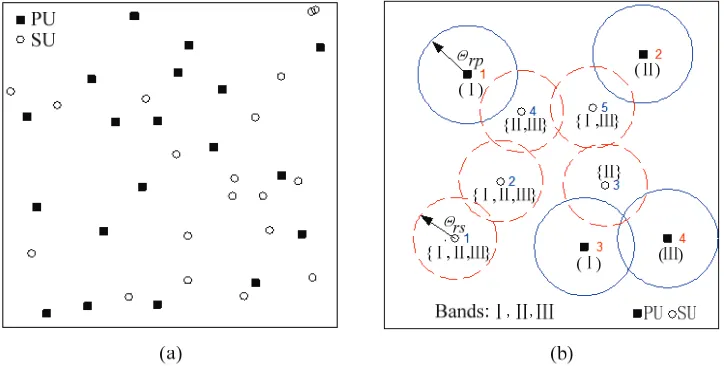
First, we characterize a distributed system model: M primary users and secondary users are randomly distributed in an
N
X Y area (Figure 1(a)), secondary can using a certain signal detection techniques such as matched filter detection, energy detection or cyclosta-tionary detection to get the usable spectrum opportunity. In the system, available spectrums are divided into K completely orthogonal bands. We assume that these bands are symmetric, which means that these bands have the same bandwidth, meanwhile, have the same spectrum quality and the spectrum availability. We also assume that the interference between two nodes only rest with the relative distance of theirs, all of the primary users and
[image:2.595.117.479.521.704.2]secondary users utilize the omni-antenna, we define the transmission radius of primary users and secondary users are rp( , )i k and rs( , )j k respectively, where and denote the serial number of the primary user, secondary user and spectrum bands respectively. If the distance between the primary user and secondary user is greater than
,
i j k
( , )i k rs( , )
rp j k
, the secondary user will not conflict with primary user when they se-lect the same band to propagate data simultaneously. In order to analyze simply, we assume that all of the pri-mary users have the same transmission range (express as rp), and all of the secondary users have the same transmission range (express as rs). Moreover, we define that the node and are neighbours if their transmission coverage area is overlapped with each other.
i j
Figure 1(b) depicts generic wireless cognitive net-work architecture. The netnet-work consists of four primary users and five secondary users; there are three orthogonal wireless bands which are denoted by Ⅰ, Ⅱ and Ⅲ. From the figure we can see that the transmission range of SU3 conflicts with the transmission of PU3 and PU4,
which occupy the band Ⅰand Ⅲ respectively. Definitely, SU3 can only utilize the spectrum Ⅱto transmit data. As
for SU1, it can use the spectrum , Ⅰ Ⅱ and Ⅲ without
interference to any PUs; As for SU2, it also can use the
spectrum Ⅰ, and , meanwhile, SUⅡ Ⅲ 2 and SU1 is
neighbour node mutually, in order to avoid the conflict between them, they cannot use the same spectrum to propagate data simultaneously. We need to establish some rules to assign the available spectrums to each secondary user. In this paper, we aim to maximize the system throughput by maximize the total spectrum utili-zation rate.
2.2. Definitions
1) In a network waiting for spectrum assignment, there are secondary users indexed from 1 to compet-ing for
N N
K spectrum bands indexed 1 to K.
2) S
s ii k, 1,..., ;N k1,...,K
characterize theper user available spectrum, i.e., spectrum band is available for user if
k i si k, 1. Due to differences in
user locations, technology employed in different spec-trums and user requirements, different users will per-ceive different available spectrum. In Figure 1(b), we can obtain
1 1 0 0 1 1 1 1 1 1 1 1 0 1 1
T
S
3) We also consider that the throughput achieved by different bands is different, depending on the user’s en-vironment and the attribute of spectrums. Let
i k, 1,..., ; 1,...,
B b i N k Kdescribe the reward that a user gets by successfully acquiring available spectrum band , i.e., repres- ents the maximum throughput that can be acquired (as-suming no interference from other neighbours). Let
i
k bi k,
, ,
B i k i k N K
S s b
denote the bandwidth weighted available spectrum. 4) We characterize interference between two compet-ing users by a constraint set. Let
, , , , 0,1
i j k i j k
N M K
C c c
represent the constraint, where if , users and can cause interference if they use the spectrum band simultaneously.
, , 1
i j k
c i
j
k
5) We define a valid spectrum assignment
i k, i k, 0,1
N KA a a
where ai k, 1 denotes that spectrum band is
as-signed to user ,
k
i A satisfies all the constraints defined by C, that is:
, , 0, 1; ,, , ;
i k j k i j k
a a if c i jN kK (1)
Finally, we use N K, to denote the set of valid spec-trum assignments for a given set of N users and K
spectrum bands.
6) We must pay attention that different secondary us-ers have different neighbors in different bands, which means that different secondary users have various influ-ence to system throughput if they are assigned to identi-cal band. We must take this heterogeneity into consid-eration in spectrum allocation process, we define the gain matrix
i k, 1,..., ; 1,...,
R r i N k K
to describe this impact, where ri k, bi k, /i k, , i k, is the neighbor numbers of user in spectrum band . i k
2.3. Optimization Problems
The objective of a general resource allocation problem can be defined in terms of a utility function. In spectrum related resource allocation problems, we usually need to solve the optimization problem expressed as follows:
maxi-414 L. YU ET AL. mize the total spectrum utilization in the system. The
optimization problem is expressed as:
, 1 1 , ,
max N K
N K
i k i k
A
i k s b (2) 2)Max-Min-Bandwidth (MMB): This aims to maxi- mize the bottleneck user’s spectrum utilization. The op-timization problem can be expressed by:, 1 , ,
max min N K
K
i k i k
i N
A
k s b (3)2.4. Color-Sensitive Graph Coloring Problem
By mapping each spectrum into a color, the spectrum allocation problem can be simplified as a GMC (Graph Multi-Coloring) problem. First, we define a bidirectional graph , where is a set of nodes de-noting the users that share the spectrums,
, C, BG V E S
VB
S
k c
c
k
represents the bandwidth weighted available spectrum as defined in Section 2.2, or the color list at each node, and is a set of undirected edges between nodes representing in-terference constraints between two nodes defined by . For any two distinct nodes , an edge between and , is in if and only if 1. Hence, any two distinct nodes can have multiple colored edges between them. We define the color specific degree of a node , i.e.,
C
E
olor
, ,
=
i j k
C
,
i j
C
,
i k
V
i j
i
E
to represent the number of neighbours that are color mutually constrained with (those who can not use if i uses color ). It is also a relatively good measure of the impact (to neighbours) when assigning a color to a node. The equivalent graph coloring problem is to color each node using a number of colors from its color list, such that if a color edge ex-ists between any two distinct nodes, they can’t be colored with simultaneously. We name this the Color Sensi-tive Graph Coloring (CSGC) problem.
k i
k k
k
k
3. Proposed Spectrum Assignment
Algorithm
The optimal coloring problem is known to be NP-hard. In this section, we discuss a set of heuristic based approaches that produce good coloring solutions. In particularly, we extend some of the well-known graph coloring solutions toward our problem settings and optimization goals.
3.1. The Analysis of Existing Algorithms
3.1.1. Collaborative-Max-Sum-Bandwidth Rule
This rule aims to maximize the sum of bandwidth weig- hted color usage, corresponding to MSB optimization
defined in (2). When a node is assigned with a color , his contribution to the sum bandwidth in a local neighborhood can be computed as
i k
, / ,
i k i k
b since his neighbors can not use the color. Here i k, represents the
number of color constrained neighbour of a node in the current graph. We propose to label the node ac-cording to
k i
,
max /
i
i i k
k s
label b
i k,
(4)
,
arg max / i
i k s i k
color b
i k,
(5)
where represents the color list available at node i at this stage. This rule considers the tradeoff between spec-trum utilization (in terms of selecting the color with the largest bandwidth) and interference to neighbours. This rule enables collaboration by taking into account the im-pact to neighbours. If two nodes have the same label, then the node with lower assigned bandwidth weighted colors will get a higher label.
i
s
3.1.2. Random (RAND) Rule
Each node generates a random label which is between , where denote the threshold of the node i. At the beginning of the allocation, all of the nodes have the same threshold. In an allocation process, if node i get a color, , else
[0,windowi]
i
window wi
i
window
win
2 i
/ 2 i
dow windowi ndow
. In each stage, each node labels itself according to the above labeling rules, and broad-casts the label to his neighbors. A node with the maxi-mum label within his neighborhood gets to grab the color associated with his label and broadcasts the color as-signment to his neighbors. After collecting asas-signment information from surrounding neighbors, each node up-dates his color list and recalculates the label. This proc-ess is repeated until the color list at each node is ex-hausted or all the nodes are satisfied.
Although RAND can optimize fairness performance in spectrum allocation process, however, it cannot guaran-tee the network throughput. This will be demonstrated in next section.
3.2. Fairness Bargaining with Maximum Throughput (FBMT)
In this section, we describe the Fairness Bargaining with Maximum Throughput algorithm-a distributed heuristic spectrum assignment strategy.
The algorithm is based on the following assumptions: 1) Distributed wireless network architectures. 2) All the primary users have the same transmission range, the same to secondary users.
,
of the spectrum holes.
4) Primary users have the preferential right of spec-trum bands.
5) Users can communicate with each other by using some mechanism.
In FBMT algorithm, we aim to maximize the sum of bandwidth, corresponding to MSB optimization defined in (2). When a node is assigned with a color , its contribution to the sum bandwidth in a local neighbour-hood can be computed as
i k
, , /
i k i k i k
r b . We also search for the fairness in spectrum distribution, defined a fair-ness factor, which can be expressed by
,
1 , , 1 1 2 ( ) . ( 1) Ni j rs
j
i k K
i k k d f t s t
(6)where denotes current allocation times, numerator denotes the neighbour numbers of node in spectrum band , denominator means the number of bands which is assigned to node before the assignment, d denotes the distance between the node and node . We define
t
k
i
i t th- i j,
j i
, ,
1
( ) N1 2
i k i j rs
j
f t d
(7)if , .
1
( 1) 0 K i k k s t
In FBMT, We propose to label the node according to
, ,
max ( )
i
i k s i k i k
label r f t
(8)
, ,
arg max ( )
i
i k s i k
color r f t
i k
K
(9)
where . This rule not only consid-ers the tradeoff between spectrum utilization and inter-ference to neighbours, but also considers the fairness in spectrum allocation by introduction of the fairness factor.
1,..., , 1,...,
i N k
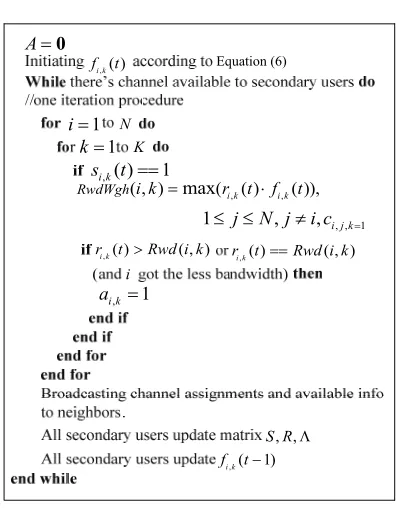
The Pseudo code of HBTM algorithm is shown in Fig-ure 2.
4. Performance
4.1. Performance Index
We often evaluate an algorithm by the throughput and fairness it can achieve in spectrum allocation. The throu- ghput, as defined herein, is the sum of bands each user is assigned, which can be expressed by
, , ,
1 1
( ) N K ,
Throughput i k i k N K
i k
A a b A
(10)A0
, ( ) i k
f t
1
i N
1
k K
, ( ) 1
i k
s t
, ,
, , 1
( , ) max( ( ) ( )),
1 , , i k i k
i j k
RwdWghi k r t f t
j N j i c
, ( ) ( , ) i k
r t Rwd i k
, ( ) ( , )
i k
r t Rwd i k i
, 1
i k
a
, ,
S R , ( 1) i k
f t
[image:5.595.324.524.67.321.2]Equation (6)
Figure 2. Pseudo code of HBTM algorithm.
In order to analysis the fairness of each spectrum algo-rithms, we also define the fairness
2 , , 1 1 2 , , 1 1 ( ) , N K
i k i k
i k
fairness N K
N K
i k i k
i k
a b
A A
N a b
(11)In (11), we can conclude that , the more closely the
[0,1]
fairness fairness
approach to 1, the more im-partial the process of spectrum allocation has. We also define
2
, ,
1 1
( ) N K ,
fairness i k i k N K
i k
A a b A
(12)if 2 , 1 1 , 0 N K i k i k i k a b
. 4.2. Simulations4.2.1. Simulation Parameters
In this section we evaluate the performance of FBMT, We design and implement a prototype system which consists of some primary users and some secondary users, these users are deployed at random in our simulation. Our experiments apply following evaluation metrics:
416 L. YU ET AL. We compared FBMT with a recent CMSB algorithm
[image:6.595.312.537.92.199.2]and RAND algorithm, CMSB represents the Max-band- width-based spectrum allocation algorithm, and RAND algorithm is the Max-fairness-based.
Table 1. The simulation circumstance.
Parameter
Value
Area 1.0 × 1.0
Transmission range of Pus
0.25 Transmission range of Sus
0.15 The number of Pus 10, 15, 20, 25, 30, 35 The number of Sus 10, 15, 20, 25, 30, 35
The number of spectrums 10, 12, 14, 16, 18, 20, 25, 30
The simulation time
600 s
In our simulations, we have considered values of N and M ranging from 10 to 35. The values of K ranging from 10 to 30, for each situation, we have assigned with different value (constant or variable). The parame-ters of simulation circumstance are shown in Table 1 in detail.
,
i k
b
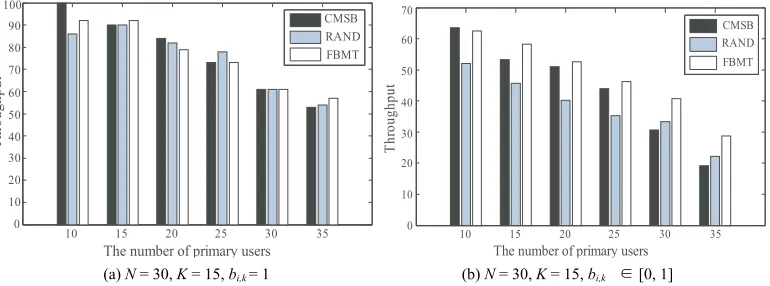
4.2.2. Numerical Result like = 1, the three algorithms almost have the same
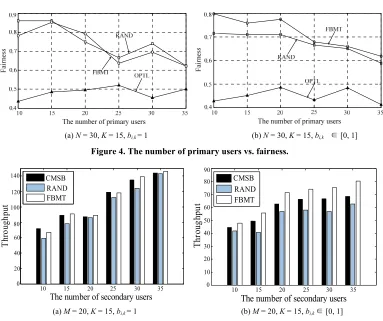
throughput, while if random, the throughput of FBMT is maximum, CMSB less if primary users are less than 30, and RAND least. Figure 4 shows the fairness of PUs with three algorithms. We can find that CMSB has much lower performance compared with FBMT and RAND. Moreover, if = 1, FBMT has the best fairness per-formance.
,
i k
b
,
i k
b Figures 3, 5 and 7 depict the throughput of three
algo-rithms on condition of the various numbers of primary users, secondary users and spectrums, the same with
Figures 4, 6 and 8 with the fairness. All the comparisons have different . In (a), is a constant, while in (b)
the value of is a random distributed in [0, 1]. In
Figures 3, 5 and 7, we can find out if is identical, the throughput of FBMT is almost equal to CMSB, but larger than RAND; if b is a random number, the throughput of FBMT has 10% gain compared with CMSB, and has a more gain compared with RAND. In
Figures 4, 6 and 8, we can find the FBMT is all square to RAND but better than CMSB in fairness, but the for-mer has the lower throughput relatively.
,
i k
b
,
i k
b
,
i k
b
,
i k
,
i k
b
Figures 5 and 6 depict the throughput and fairness of secondary users. When there are 20 primary users and 15 channels for secondary users, when is a random number, the FBMT present the most preferable per-formance, CMSB less and RAND least. However when bi,k is set 1, CMSB has better throughput gain. But
whether bi, k is confirmed or not, CMSB has the lowest
fairness performance.
,
i k
b
The simulation result shows that the CMSB, although has a high throughput, but with a low fairness perform-ance; the RAND, has an agreeable fairness performance, but not well in enhancing the throughput. The FBMT, not only succeeds in throughput achieving, but also makes a good fairness performance in spectrum assign-ment. Relatively FBMT is the best spectrum allocation algorithm in these algorithms.
Figures 7 and 8 show the results in which the channel number is fixed. If is a constant, we can find that RAND has the lowest throughput and FBMT the highest. However if is not fixed, the throughput of three algorithms is almost the same. Also we can find that CMSB still has the lowest fairness performance.
,
i k
b
,
i k
b
[image:6.595.109.494.555.698.2]The simulation result reflects that although CMSB has a high throughput, the fairness performance is not satis-fying. RAND has an agreeable fairness characteristic but not much well in throughput. However, FBMT can achieve both performances of throughput and fairness.
Figure 3 shows the system throughput of different primary users with CMSB, RAND and FBMT algo-rithms respectively on the premise of 30 SUs competing 15 channels. We can find that if bi k, is identical such
T
hr
oughp
ut
The number of primary users
CMSB RAND FBMT
0 70 60 50 40 30 20 10
30 25 20 15
10 35
90 100
80
T
hr
ough
put
The number of primary users
CMSB RAND FBMT
0 70
60
50
40
30
20
10
30 25 20 15
10 35
(a) N = 30, K = 15, bi,k = 1 (b) N = 30, K = 15, bi,k ∈ [0, 1]
(a) N = 30, K = 15, bi,k = 1 (b) N = 30, K = 15, bi,k ∈ [0, 1]
Figure 4. The number of primary users vs. fairness.
T
hro
ugh
put
The number of secondary users
CMSB RAND FBMT
0 120
100
80
60
40
20
30 25 20 15
10 35
140
T
hr
oug
hpu
t
The number of secondary users
CMSB RAND FBMT
0 70
60
50
40
30
20
10
30 25 20 15
10 35
90 80
(a) M = 20, K = 15, bi,k = 1 (b) M = 20, K = 15, bi,k ∈ [0, 1]
Figure 5. The number of secondary users vs. system throughput.
(a) M = 20, K = 15, bi,k = 1 (b) M = 20, K = 15, bi,k ∈ [0, 1]
Figure 6. The number of secondary users vs. fairness.
10 250
200
150
100
50
0
30 25 20 18 16 14 12 CMSB
FBMT RAND
The number of channels
T
hro
ugh
put
10 100
80
60
40 20
0
30 25 20 18 16 14 12 CMSB
FBMT RAND
The number of channels
Th
ro
ug
hpu
t
120
(a) M = 15, K = 20, bi,k = 1 (b) M = 15, K = 20, bi,k ∈ [0, 1]
[image:7.595.108.491.69.390.2] [image:7.595.120.481.417.545.2]418 L. YU ET AL.
(a) M = 15, K = 20, bi,k = 1 (b) M = 15, K = 20, bi,k ∈ [0, 1]
Figure8.The number of spectrums vs. fairness.
5. Conclusions
[4] J. Mitola and G. Q. Maguire, “Cognitive Radio: MakingSoftware Radios More Personal,” IEEE Personal Com-munications, Vol. 8, No. 6, 1999, pp. 13-18.
In this paper, we explore the tradeoff in spectrum utiliza-tion and interference mitigautiliza-tion in open spectrum system. We develop a new graph-theoretical model to character-ize the spectrum access problem under a number of dif-ferent optimization functions, taking into account het-erogeneity in both spectrum availability, reward and in-terference constraint.
[5] H. Zheng and C. Peng, “Collaboration and Fairness in Opportunistic Spectrum Access,” Proceedings of the 2005 IEEE International Conference on Communications (ICC’05), Seoul, Korea, 2005, pp. 3132-3136.
[6] C. Peng, H. Zheng and B. Y. Zhao, “Utilization and Fairness in Spectrum Assignment for Opportunistic Spec- trum Access,” Mobile Networks and Applications, Vol. 11, No. 4, 2006, pp. 555-576.
We then propose an algorithm where each user can opportunistically utilize its available spectrum. Experi-mental results confirm that our algorithm significant benefits most in system throughput and also have a good performance in fairness.
[7] J. Zhao, H. Zheng and G. Yang, “Distributed Coordina-tion in Dynamic Spectrum AllocaCoordina-tion Networks,” Pro-ceedings of the 2005 1st IEEE International Symposium on New Frontiers in Dynamic Spectrum Access Networks (DySPAN’05), Baltimore, 2005, pp. 259-268.
6. Acknowledgements
[8] L. Cao and H. Zheng, “Distributed Spectrum Allocation Via Local Bargaining,” Proceedings of the 2nd Annual IEEE Communications Society Conference on Sensor and Ad Hoc Communications and Networks, Santa Clara, 2005, pp. 475-486.This work was supported in part by National 863 Pro-jects of China (2009AA01Z205), Fund of National Labo- ratory (P080010) and Program for New Century
Excel-lent TaExcel-lents in University (NCET070339). [9] X. Liu and W. Wang, “On the Characteristics of Spec-trum-Agile Communication Networks,” Proceedings of the 2005 1st IEEE International Symposium on New Frontiers in Dynamic Spectrum Access Networks (DySP- AN’05), Baltimore, 2005, pp. 214-223.
7. References
[1] S. W. Ellingson, “Spectrum Occupancy at VHF: Implica-tions for Frequency-Agile Cognitive Radios,” Proceed-ings of IEEE Vehicle Technologies Conference, Vol. 9, No. 2, 2005, pp. 1379-1382.
[10] W. Wang and X. Liu, “List-Coloring Based Spectrum Allocation for Open-Spectrum Wireless Networks,” Pro-ceedings of the IEEE International Symposium on Ve-hicular Technology (VTC’05-Fall), Dallas, 2005, pp. 690-694.
[2] M. A. McHenry, “NSF Spectrum Occupancy Measure-ments Project Summary,” Shared Spectrum Company
Report, Vienna, 2005. [11] Y. Xing, R. Chandramouli, S. Mangold and S. N. Shan-kar, “Analysis and Performance Evaluation of a Fair Spectrum Access Protocol for Open Spectrum Wireless Networks,” Proceedings of the 2005 IEEE International Symposium on Communications (ICC’05), Seoul, Korea, 2005, pp. 1179-1183.