APPLICATIONS
ERIC BUDISH, YEON-KOO CHE, FUHITO KOJIMA, AND PAUL MILGROM
Abstract. Randomization is an important feature of resource allocation when the
resources assigned are indivisible and monetary transfers are limited. We expand the theory of efficient random assignment to accommodate multi-unit demand and supply, and certain real-world features such as group-specific quotas (“controlled choice”) and endogenous capacities in school choice and house allocation, and scheduling and curriculum constraints in course allocation. We develop new mechanisms that are ex ante fair and efficient in these respective problems. Our method can also be applied to certain two-sided matching problems to produce fair matchups in interleague games and speed dating.
Keywords: Market Design, Random Assignment, Birkhoff-von Neumann Theorem,
Prob-abilistic Serial, Pseudo-Market, Utility Guarantee, Assignment Messages.
Date: February 17, 2011.
Budish: University of Chicago Booth School of Business, 5807 S Woodlawn Ave, Chicago IL 60637, [email protected]. Che: Department of Economics, Columbia University, 420 West 118th Street, 1016 IAB New York, NY 10027, and YERI, Yonsei University, [email protected]. Kojima: Department of Economics, Stanford University, CA 94305, [email protected]. Milgrom: Department of Eco-nomics, Stanford University, CA 94305, [email protected]. We are grateful to Emir Kamenica, Sebastien Lahaie, Mihai Manea, Herve Moulin, Tayfun S¨onmez, Al Roth, Utku ¨Unver, and seminar participants at Boston College, Gakushuin, Johns Hopkins, Princeton, Tokyo, UC San Diego, Waseda, Yahoo! Research, and Yale for helpful comments. We especially thank Tomomi Matsui, Akihisa Tamura, Jay Sethuraman, and Rakesh Vohra. Yeon-Koo Che is grateful to Korea Research Foundation for World Class University Grant, R32-2008-000-10056-0. Paul Milgrom’s research was supported by NSF grant SES-0648293.
Randomization is commonplace in everyday resource allocation. It is used to break ties among students applying for overdemanded public schools and for popular after-school pro-grams, to ration offices, parking spaces, and tasks among employees, to allocate courses and university dormitories among college students, and to assign jury and military duties among citizens.1
The ubiquitous “first-come first-served” method, or “queuing,” is often only a less apparent way to include random elements in setting a priority order. Randomization is sensible in these examples and many others because the objects to be assigned are in-divisible and monetary transfers are limited or unavailable.2
In these circumstances, any non-random assignment of resources is likely to be asymmetric and, without compensating monetary transfers, “unfair.” Randomization can sometimes restore ex ante symmetry and the perception that the mechanism is fair.
To find a desirable random allocation, it is often helpful to view agents as consuming lotteries over objects, subject to a joint production constraint and to evaluate incentives and welfare on that basis.3
Since a random assignment— the lotteries over objects received by agents—is “divisible” in probability units, one can then apply the classical frameworks developed for divisible objects. Hylland and Zeckhauser (1979) (“HZ”) were the first to apply this perspective to market design. Their pseudo-market mechanism endows agents with equal fixed budgets in a fictitious currency, allows them to use the currency to “buy” probability shares of alternative objects, and finds a competitive equilibrium by solving for prices (per unit probability of obtaining each object) that clear the market. The resulting allocation is then ex ante efficient and envy-free. Bogomolnaia and Moulin (2001) (“BM”) also adopted the random assignment approach to find an allocation that is efficient in an ordinal sense and envy-free.
1Lotteries played historical roles in assigning public lands to homesteaders (Oklahoma Land Lottery of
1901), and radio spectra to broadcasting companies (FCC assignment of radio frequencies during 1981-1993). Lotteries are also used annually to select 50,000 winners of the US permanent residency visas (“green cards”) from those qualified in the DoJ’s immigration diversity program.
2The limitation of monetary transfers arises from moral objection to “commoditizing” objects such as human
organs and from fairness consideration (cf. Roth(2007)). Assignment of resources based on prices often favor those best endowed with money rather than those most deserving, and can be regarded as unfair for many goods and services. SeeChe and Gale(2008) for an argument making this point based on utilitarian efficiency.
3An more common alternative perspective evaluates the efficiency of agents’ ex post assignment of objects,
rather than of the ex ante lotteries they receive. In that view, a mechanism identifies ex post desirable allo-cations and uses randomization only to ensure ex ante fairness. For example, the random serial dictatorship (RSD), widely used in practice, is often analyzed that way. In RSD, the agents are randomly ordered and, following that order, each agent is assigned his/her most preferred object not yet assigned. The resulting pure assignment is ex post efficient and ex ante envy-free, but may entail ex ante inefficiencies even in an ordinal sense (seeBogomolnaia and Moulin (2001)). Extensions of other well known mechanisms, such as Gale and Shapley’s deferred acceptance and Gale’s top trading cycles, suffer similar ex ante inefficiencies when priorities are set randomly and used to break ties.
The purpose of the current paper is to broaden the random assignment methodology (including HZ and BM) to enhance its practical applicability. To be applied to problems in-cluding school choice and course allocation, the random assignment model must be extended in two ways. First, the model needs to account for various policy constraints. A case in point is the so-called “controlled-choice” in school assignment. Schools often seek to balance their student bodies in terms of gender, ethnicity, race, test scores, and the geographic location of students’ residence. For instance, public schools in Massachusetts are discouraged by the Racial Imbalance Law from having student enrollments that are more than 50% minority. Miami-Dade County Public Schools control for the socioeconomic status of students in order to diminish concentrations of low-income students at certain schools. In New York City, “Ed-ucational Option” (EdOpt) schools must balance their student bodies in terms of students’ test scores.4
Public schools in Seoul restrict the number of seats for those students residing in distant school districts, in order to alleviate morning commutes. In a course allocation problem, a student may wish to enroll in no more than a certain number of courses in a given subject (curriculum constraints) or in a given time slot (scheduling constraints). The preceding examples are ones in which we add constraints to the ones already present in the HZ and BM models, but some applications also involve removing or relaxing the traditional constraints. For instance, when schools assign their students to different foreign language programs, the exact composition may be adjustable to a degree determined by the available staff and resource.
Second, in order to accommodate applications like course allocation, in which a single course may accept multiple students and a single student may take multiple courses, we need to drop the one-to-one restriction. We do that by using the matrix ofexpected assignments to generalize the random assignment matrix of one-to-one matching. This expected assignment formulation is most useful when the agents’ and mechanism designer’s parties’ payoffs are at least approximately linear functions of the pure assignment over the support of the relevant lottery. Part of our analysis below will focus on implementing using lotteries with supports for which this restriction might reasonably apply.
Even for one-to-one matching, describing the individual agent’s consumption outcome in terms of their individual random assignments poses a technical challenge. For even if each agent is assigned just one item in expectation and each item is assigned just once in expec-tation, implementation still requires finding a joint lottery over feasible pure assignments with the right marginal distributions for each agent. For HZ and BM, the only feasibility constraints on the pure assignments are those of one-to-one matching: each agent is assigned
4In particular, 16 percent of students that attend an EdOpt school must score above grade level on the
standardized English Language Arts test, 68 percent must score at grade level, and the remaining 16 percent must score below grade level (Abdulkadiroglu, Pathak, and Roth, 2005).
exactly one item and each item is assigned exactly once. Those papers were then able to solve their technical challenge by appealing to the celebrated celebrated Birkhoff-von Neumann theorem (Birkhoff, 1946;von Neumann,1953), which asserts that every random assignment matrix, that is, every non-negative matrix with all the row sums and column sums equal to one, is a convex combination of pure assignment matrices. Consequently, every random assignment matrix can be implemented by some lottery over pure assignments.
Is there an extension of the BvN theorem available when there are additional constraints, such as the ones described above? Does the extension apply as well to many-to-many match-ing problems? The first part of the paper answers these questions by identifymatch-ing a maximal generalization of the Birkhoff-von Neumann theorem. Appealing to results in the combina-torial optimization literature, we show that a certain underlying structure of constraints is sufficient for an expected assignment to be always implementable by a lottery over feasible pure assignments. Then we demonstrate that the same condition is not only sufficient but also necessary in canonical two-sided environments.
The second part of the paper applies the expected assignment methodology to specific market design contexts. One application is a generalization of BM’s Probabilistic Serial mechanism that accommodates new kinds of supply-side constraints, which may arise in unit-demand applications such as school choice and dormitory assignment. We show how to modify BM’s algorithm to accommodate constraints such as controlled choice and adjustable capacities and prove that the attractive properties of BM’s algorithm extend to this more general environment.
Our second application is a generalization of HZ’s pseudo-market mechanism, to accom-modate new kinds of demand-side constraints that may express important aspects of partic-ipants’ preferences in multi-unit demand applications such as course allocation and assign-ment of shifts to interchangeable workers.
In this section, we also relax the assumption of additive preferences. We adapt the “as-signment messages” developed by Milgrom (2009), to accommodate some scheduling and curricular constraints (“I want just one course in finance and at most one course before noon”) arising in course allocation, and to express nonlinear preferences such as diminishing marginal utilities for an item or category (“the second finance course is worth less to me than the first”). We then utilize these enriched messages to develop a generalized multi-unit pseudo-market mechanism, establish existence of competitive equilibrium prices in the pseudo-market, and invoke our earlier sufficiency result to ensure implementability of the expected assignment that results from this competitive equilibrium. We finally show that this generalized mechanism inherits the attractive efficiency and fairness properties of the
original one-to-one mechanism. This extended mechanism may be useful for practice, espe-cially because several multi-unit assignment mechanisms currently in use have been shown to allow outcomes that are inefficient and ex post quite unfair (S¨onmez and ¨Unver, 2008;
Budish and Cantillon, 2009).
Finally, our implementation result has an unexpected application for promoting ex post fairness in multi-unit resource allocation. When agents demand multiple objects, there can be many ways to implement a given expected assignment. For instance, suppose there are two agents, 1 and 2, dividing four objects,a, b, c,andd, which they prefer in the order listed. An ex ante fair expected assignment may assign each object to each agent with probability 0.5. One way to implement this expected assignment is to assigna andb to 1 andcanddto 2 with probability one half anda andb to 2 and cand d to 1 with the remaining probability one half. If utility is additive over objects, then this allocation may be ex ante efficient and fair, but ex post unfair, since one agent always gets the two best and the other gets the two worst. There is another implementation of the same expected assignment that is more fair ex post: whenever one agent gets one of the two best objects, he must also get one of the two worst objects. It turns out our implementation result can be utilized to avoid the former unfair implementation, and more generally to ensure that pure assignments used in the implementing lottery have a small variation in utility. The method also ensures that every pure assignment approximates the original expected assignment in terms of expected utilities. This procedure can be applied in the context of course allocation, for instance in conjunction with our generalization of HZ, or in other multi-unit demand environments such as task assignment and fair division of estates.
This utility guarantee method can also be adapted to a two-sided matching problem, in which both sides of the market are agents. Starting with any expected matching, we can introduce ex post utility guarantees on both sides, ensuring ex post utility levels that are close to the promised ex ante levels. This method can be used, for example, to design a fair schedule of inter-league sports matchups or a fair speed-dating mechanism.
The rest of the paper is organized as follows. Section 1 presents the model. Section 2 presents the sufficiency and necessity results for implementing expected assignments. Sec-tion 3 presents the generalizaSec-tion of Bogomolnaia and Moulin’s (2001) Probabilistic Serial mechanism, for applications such as school choice. Section 4 presents the generalization of Hylland and Zeckhauser’s (1979) Pseudo-market mechanism, for applications such as course allocation. Section 5 presents the utility guarantee results, including the application to two-sided matching. Section 6 collects some negative results for non-bilateral matching environments. Section 7 concludes.
1. Setup
Consider a problem in which a finite set N of agents are assigned to a finite set O of objects (as will be clear, our framework works with no loss ifN are objects orO are agents). A (pure) assignment is described as a matrixX = [xia] indexed by all agents and objects,
where each entry xia is the integer quantity of object a that agent i receives. Note that
we allow for assigning more than one unit of an object and even for assigning negative quantities. Negative quantities can be interpreted as supply obligations. The requirement that the matrix be integer-valued captures the indivisibility of the assignment.
We introduce a general class of constraints. A constraint structure H is a collection of subsets of N ×O (that is, H ⊂ 2N×O) that includes all singletons (i.e., sets of the form
{(i, a)}). That is, each elementS ∈ H, called aconstraint set, is a set of agent-object pairs. A vector q = (q
S, qS)S∈H of integers are the quotas associated with each set in H, where
integers q
S and qS are the floor and the ceiling constraints on the total amount assigned in
S, respectively. The constraint structureHand the quotas qrestrict the set of assignments. We say that a pure assignment X isfeasible under q if
(1.1) q
S ≤
X
(i,a)∈S
xia ≤qS for each S∈ H.
For instance, the constraint structureHof the simple one-to-one matching setting consists of all singleton sets, “all rows” ({(i, a)|a ∈O}for eachi∈N), and “all columns” ({(i, a)|i∈N}
for each a ∈ O), and the quotas satisfy q
S = qS = 1 for every non-singleton constraint set
S ∈ H. The constraints say that each agent is assigned one object and each object is assigned to one agent.
Given a constraint structure H and associated quotas q, a random allocation can be described as a lottery over pure assignments each of which is feasible under quotas q. As with HZ and BM, however, our approach is to focus directly on an expected assignment— namely, the expected numbers of each item assigned to each agent—as a basic unit of analysis. Formally, an expected assignment is a matrix X = [xia] indexed by agents and objects
where xia ∈(−∞,∞) for every i∈ N and a ∈O. In contrast to pure assignment matrices,
an expected assignment allows for fractional allocations of objects. A natural question is: when can an expected assignment be implemented by some lottery over pure assignments?
Definition 1. Given a constraint structureH, an expected assignmentX isimplementable
(as a lottery over feasible pure assignments) under quotas q if there exist positive numbers
{λk}K
k=1 that sum up to one and (pure) assignments {X
k
}K
q, such that (1.2) X= K X k=1 λkXk.
In words, given quotas, an expected assignment is implementable if it can be expressed as a lottery over feasible assignments each of which satisfies the quotas.
If an expected assignment X is implementable under quotas q, then the expected assign-ment will trivially satisfy the quotas q:
(1.3) q
S ≤
X
(i,a)∈S
xia ≤qS for each S∈ H.
The more challenging question is the reverse: when is an expected assignment imple-mentable? More specifically, our interest is to identify the constraint structures for which any quotas are implementable. Our characterization will be provided in terms of the con-straint structure, so the following definition will prove useful.
Definition 2. Constraint structure H is universally implementable if, for any quotas
q= (q
S, qS)S∈H, every expected assignment satisfying q is implementable under q.
If a constraint structure H is universally implementable, then every expected assignment satisfying any quotas defined on H can be expressed as a convex combination of pure as-signments that are feasible under the given quotas. In other words, for any given quotas, any expected assignment satisfying (1.3) can be implemented as a lottery over feasible pure assignments.
Universal implementability aims to capture the sort of information that is likely available to a planner when the mechanism is being designed. For example, in a school choice prob-lem, the planner may consider whether to apply certain principled geographic and ethnic composition constraints — that is, what the constraint structure will be — before knowing the exact numbers of spaces in each school or the precise preferences of the students. By studying universal implementability, we characterize the kinds of constraint structures that are robust to these numerical details and certain to be implementable.
2. Implementing Expected Assignments
This section provides a condition which guarantees that a constraint structure is univer-sally implementable. To do so, we introduce concepts that will be useful for our character-ization. A constraint structure H is a hierarchy if, for every pair of elements S and S0 in
H, we have S ⊂ S0 or S0 ⊂ S or S ∩S0 = ∅.5 That is, H is a hierarchy if, for any two of
its elements, one of them is a subset of the other or they are disjoint. The following concept proves to be central throughout the paper.
Definition 3. A constraint structure H is a bihierarchy if there exist hierarchies H1 and
H2 such that H =H1∪ H2 and H1∩ H2 =∅.
A bihierarchy is a constraint structure that can be expressed as a union of two disjoint hierarchies. Note that the partition ofH into H1 and H2 need not be unique. For instance,
singleton sets can be put into the two families in any arbitrary fashion. The result offered below follows readily from the combinatorial optimization literature, establishing that the bihierarchy condition is sufficient for universal implementability.
Theorem 1. (Sufficiency) If a contraint structure is a bihierarchy, then it is universally
implementable.
Proof. Suppose that constraint structure H is a bihierarchy. Consider any expected assign-ment X that satisfies qgiven constraint structure H. Since q
S and qS are integers for each
S ∈ H, we must have q
S ≤ bxSc ≤ xS ≤ dxSe ≤ qS, where xS :=
P
(i,a)∈Sxia, bxSc is the
largest integer no greater than xS, and dxSe is the smallest integer no less than xS. Hence,
X must belong to the set X0 = [x0ia] bxSc ≤ X (i,a)∈S x0ia≤ dxSe,∀S ∈ H . (2.1)
The set (2.1) forms a bounded polytope. Hence, any point of it, including X, can be written as a convex combination of its vertices. To prove the result, therefore, it suffices to show that the vertices of (2.1) are integer-valued. Hoffman and Kruskal (1956) show that the vertices of (2.1) are integer-valued if and only if the incidence matrix M = [m(i,a),S],
(i, a)∈N ×O, S ∈ H, where m(i,a),S = 1 if (i, a)∈S and m(i,a),S = 0 if (i, a)6∈S, is totally
unimodular.6 The total unimodularity of matrix M in turn follows from Edmonds (1970).
A fuller self-contained proof is available in Web Appendix C.
As is clear from the proof, the pure assignments used in the implementing lottery in Theorem 1 are not just feasible under the given quotas; rather, the implementation ensures that each of the resulting pure assignments is rounded up or down to the nearest integer for each constraint set, which is a stronger property.
5Hierarchies are usually called laminar families in the combinatorial optimization literature.
For practical purposes, knowing simply that an expected assignment is implementable is not satisfactory; implementation must be computable, preferably by a fast algorithm. Fortunately, there exists an algorithm, formally described in Web Appendix D with an illustrative example, that implements expected assignments in polynomial time.7 At each step of the algorithm, an expected assignment X satisfying given quotas is decomposed into a convex combination γX0 + (1− γ)X00 of two expected assignments, each of which satisfies the quotas and has at least one more integer-valued constraint set than X. Then, a random number is generated and with probability γ the algorithm continues by similarly decomposing X0, while with probability 1−γ the algorithm continues by decomposing X00. The algorithm stops when it reaches a pure assignment. As argued more formally in the appendix, this process has a run time polynomial in |H|.
2.1. Examples of Bihierarchy. We show here that a number of constraints illustrated in the Introduction satisfy the bihierarchy condition.
2.1.1. One-to-one assignment and the Birkhoff-von Neumann theorem. Supposenagents are to be assigned tonobjects, one for each. Notice that any assignment is described as ann×n
permutation matrix; namely, each entry is zero or one, each row sums to one, and each column sums to one. Any expected assignment is in turn represented as ann×nbistochastic matrix, i.e., a matrix with entries in [0,1], satisfying the same row-sum and column-sum constraints. The Birkhoff-von Neumann theorem states that any bistochastic matrix can be expressed as a convex combination of permutation matrices. Clearly, this result follows from Theorem1; all rows are disjoint and thus form a hierarchy, and all columns form another. (Singletons can be added arbitrarily to either hierarchy).
Corollary 1. (Birkhoff, 1946; von Neumann, 1953) Any bistochastic matrix can be written as a convex combination of permutation matrices.
2.1.2. Endogenous Capacities. Consider a school choice problem in which the school author-ity wishes to run several education programs within one school building. An assignment in such an environment can be described as a matrix in which rows correspond to students and columns correspond to education programs (rather than school buildings). With this representation, a school building corresponds to multiple columns. Formally, we can let H1
include all rows, which correspond to students, while H2 includes sets of the form N ×O0
where O0 is a subset of educational programs: A singleton set O0 represents an individual
7We thank Tomomi Matsui and Akihisa Tamura for suggesting the algorithm. An earlier draft of this
paper included an alternative algorithm generalizing the stepping-stones algorithm described by Hylland and Zeckhauser(1979).
educational program while a larger setO0 corresponds to a school building with multiple pro-grams. The ceiling qN×O0 then describes the total number of students who can be admitted withinO0, which may apply to a single program or a set of programs in the same building. If the sum of ceilingsP
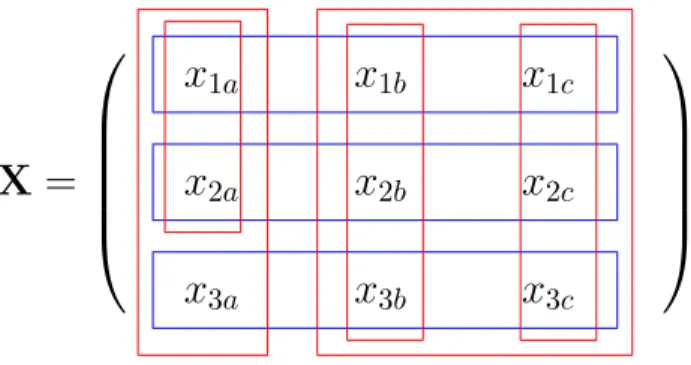
a∈O0qN×{a}is larger than the ceiling qN×O0, then that means the sizes of programs within the same school buildingO0 can be adjusted, subject to the (say physical) capacity of the school building. For instance, in Figure 1, columns b and c represent two programs (within a school) each of which is subject to a quota, and there is a school wide quota impinging onb and c, together. Note that a constraint structure composed ofH1 and
H2 described above is a bihierarchy, thus it is universally implementable. Notice also that
the hierarchical structure H2 allows for nested constraints on program sizes.
Figure 1 about here
2.1.3. Group-specific Quotas. Affirmative action policies are sometimes implemented as quo-tas on students fitting specific gender, racial, or economic profiles.8 A similar mathematical
structure results from New York City’s Educational Option programs, which achieve a mix of students by imposing quotas on students with test scores (Abdulkadiro˘glu, Pathak and Roth, 2005). Quotas may be based on the residence of applicants as well: The school choice program of Seoul, Korea, limits the percentage of seats allocated to applicants from outside the district.9 A number of school choice programs in Japan have similar quotas based on residential areas as well.
Again constraints pertaining to individual students (i.e., “rows”) can be organized as a hierarchy H1. All constraints pertaining to schools’ capacities are organized as a separate
hierarchy H2. Group-specific quotas can be handled by including sets of the form N0× {a}
for a∈O and N0 $N in the second hierarchy H2. The ceiling qN0×{a} then determines the maximum number of agents school a can admit from group N0. Quotas on multiple groups can be imposed for each a without violating the hierarchy structure as long as they do not overlap with each other.10 Moreover, a nested series of constraints can be accommodated.
8 Abdulkadiro˘glu and S¨onmez (2003b) and Abdulkadiro˘glu (2005) analyze assignment mechanisms under
affirmative action constraints.
9See “Students’ High School Choice in Seoul Outlined,” Digital Chosun Ilbo, October 16, 2008
(http://english.chosun.com/w21data/html/news/200810/200810160016.html).
10In fact, an overlap of constraint sets can be accommodated with a small error. Suppose a school has
maximal quotas for white and male at 60 and 55, respectively. Suppose an expected assignment assigns 40.5 white male, 14.5 black male, and 19.5 white female students to that school. Notice both ceilings are binding at this expected assignment. This expected assignment can be implemented recognizing only white and male, white and female, and male as the constraint sets, which then forms a hierarchy. Implementing with this modified constraint structure may violate the maximal quota for whites, since the constraint set for “white” is not included in the structure; for instance, the school may get 41 white male, 14 black male and 20 white female students. However, the violation is by only one student. In fact, the degree of violation is at most one when there is only one overlap of constraint sets. Such a small violation can often be tolerated in realistic
For instance, a school system can require that a school admit at most 50 students from district one, at most 50 students from district two, and at most 80 students from either district one or two.
It is also possible to accommodate both flexible-capacity constraints and group-specific quota constraints within the same hierarchy H2. Flexible-capacity constraints are defined
on multiple columns of an expected assignment matrix X, whereas group-specific quota constraints are defined on subsets of single columns ofX. Any subset of a single column will be a subset of or disjoint from any set of multiple columns.
2.1.4. Course Allocation. In course allocation, each student may enroll in multiple courses, but cannot receive more than one seat in any single course. Moreover, each student may have preference or feasibility constraints that limit the number of courses taken from certain sets. For example, scheduling constraints prohibit any student from taking two courses that meet during the same time slot. Or, a student might prefer to take at most two courses on finance, at most three on marketing, and at most four on finance or marketing in total.
Many such restrictions can be modeled using a bihierarchy, with H1 including all rows
and H2 including all columns. Setting q{(i,a)} = 1 and q{i}×O > 1 for each i ∈ N and
a∈O ensures that each student i can enroll in multiple courses but be assigned to at most one seat in each course. Letting F and M be the sets of finance courses and marketing courses, respectively, if H1 contains {i} × F,{i} ×M and {i} ×(F ∪M), then we can
express the constraints “studenti can take at mostq{i}×F courses in finance,q{i}×M courses in marketing, and q{i}×(F∪M) in finance and marketing combined.” Scheduling constraints are handled similarly; for instance, F and M are sets of classes offered at different times (e.g., Friday morning and Monday morning). It may be impossible, however, to express both subject and scheduling constraints while still maintaining a bihierarchy constraint structure. Note that the flexible production and group-specific quota constraints described in Sections
2.1.2-2.1.3 can also be incorporated into the course allocation problem without jeopardizing the bihierarchical structure. These constraints can be included in H2, while the preference
and scheduling constraints described above can be included in H1. So long as H1 and H2
are both hierarchies, H=H1∪ H2 is a bihierarchy.
2.1.5. Interleague Play Matchup Design. Some professional sports associations, including Major League Baseball (MLB) and the National Football League (NFL), have two separate leagues. In MLB, teams in the American League (AL) and National League (NL) had traditionally played against teams only within their own league during the regular season, controlled-choice environments. In case the quotas are rigid, the quota can be set more conservatively; for instance in the above example, the quota for whites can be set at 59 instead of 60.
but play across the AL and NL, called interleague play, was introduced in 1997.11 Unlike the
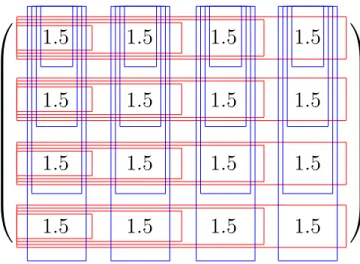
intraleague games, the number of interleague games is relatively small, and this can make the indivisibility problem particularly difficult to deal with in designing the matchups. For example, suppose there are two leagues, N and O, each with 9 teams. Suppose each team must play 15 games against teams in the other league. Ignoring indivisibility, a fair matchup will require each team in a league to play every team in the other league the same number of times, that is, 15/9≈ 1.67 times. Of course, this fractional matchup itself is infeasible, but one can implement this expected matchup as a convex combination of feasible matchups. In doing so, one can also specify additional constraints: e.g., each team in N has a geographic rival inO, and they must play twice; teams in each league must face opponents in the other league of similar difficulty. Specifically, one could require each team to play at least 4 games with the top 3 teams, 4 games with the middle 3 teams and 4 games with the bottom 3 teams of the other league. It is not difficult to see that the resulting constraint structure forms a bihierarchy. Our approach can produce a feasible matchup that implements the uniform expected assignment satisfying these additional constraints.
2.2. Necessity of a bihierarchical constraint structure. Theorem 1 shows that bihier-archy is sufficient for universal implementability. This section identifies a sense in which it is also necessary. Doing so also provides an intuition about the role bihierarchy plays for implementation of expected assignments. We begin with an example of a non-bihierarchical constraint structure that is not universally implementable.
Example 1. Consider the following environment with two objects a, b and two agents 1,2, and the constraint structure H that consists of the “first row” {(1, a),(1, b)}, the “first col-umn” {(1, a),(2, a)}, and a “diagonal set” {(1, b),(2, a)} (in addition to all singleton sets). Clearly, this constraint structure is not a bihierarchy as there is no way to partition it into
two hierarchies. Suppose each constraint set in H has a common floor and ceiling quota of
one. The following expected assignment
X = 0.5 0.5 0.5 0.5
!
cannot be implemented as a lottery over feasible pure assignments.12 To see this, first observe
that the lottery implementing X must choose with positive probability a pure assignment X
in which x1a = 1. Since the first row has a quota of one, it follows that x1b = 0. Since the 11See “Interleague play”, Wikipedia (http://en.wikipedia.org/wiki/Interleagueplay).
12Notationally, the convention throughout the paper is that theith row of the expected assignment matrix
from the top corresponds to agentiwhile the first column from the left corresponds to objecta, the second column corresponds to objectb, and so on.
diagonal set has a quota of one, it follows that x2a = 1. This is a contradiction because the
quota for the first column is violated at X since x{(1,a),(2,a)} =x1a+x2a = 2.
Example 1suggests that the failure of implementability is caused by a “cycle” formed by an odd number of constraint sets. In the above example, for instance, a cycle formed by three constraint sets (the first row, the first column, and the diagonal set {(1, b),(2, a)}) leads to a situation where at least one of the constraints is violated. Generalizing this idea, we say that a sequence of constraint sets (S1, . . . , Sl) in H is an odd cycle if l is odd and there
exists a sequence of agent-object pairs (s1, . . . , sl) inN ×O such that for each i= 1, . . . , l,
we have si ∈Si∩Si+1 and xi ∈/ Sj for any j 6=i, i+ 1, where subscript l+ 1 is understood
to be 1. An argument generalizing the above example yields the following (a formal proof is in the Appendix).
Lemma 1. (Odd Cycles) If a constraint structure contains an odd cycle, then it is not
universally implementable.
An important role of the bihierarchy is to rule out odd cycles. To see this, suppose for contradiction that a bihierarchy H = H1 ∪ H2 contains an odd cycle (S1, . . . , Sl). Assume
S1 ∈ H1 without loss of generality. Then, S2 must belong to H2 since S1 ∩S2 6= ∅ and
neither is a subset of the other (since s1 ∈S1∩S2, s2 ∈S2\S1 and sl ∈ S1 \S2). Arguing
in the same fashion, S3 must be in H1,S4 inH2, . . . , and Sl must be in H1 sincel is an odd
number. But Sl∩S1 6=∅ and neither is a subset of the other. So H1 cannot be a hierarchy,
and H cannot be a bihierarchy, a contradiction.
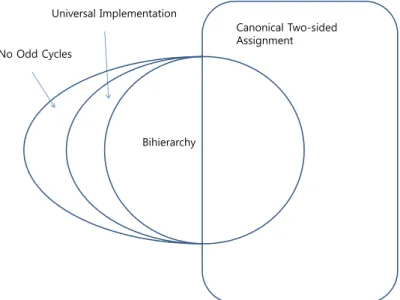
Is bihierarchy necessary for universal implementation? It turns out this is not the case; nor is it the case that ruling out odd cycles is sufficient for universal implementation.13 Figure 2 depicts how the sets of constraint structures satisfying different properties relate to
13To see that bihierarchy is not necessary, consider an environment with 2 objects and 2 agents as before,
but let
H={{(1, a),(1, b)},{(1, a),(2, a)},{(1, a),(2, b)}},
and the floor and ceiling quotas for each constraint set be one. NoteHis not a bihierachy. Yet, any expected assignment X = s t t t ,
withs+t= 1, can be decomposed by a convex combination of pure assignments as
X= s t t t =s 1 0 0 0 +t 0 1 1 1 .
Next, we show that an absence of odd cycles is not sufficient for universal implementability. ConsiderH=
{{(1, a),(1, b)},{(1, a),(2, a)},{(1, a),(2, b)},{(1, a),(1, b),(2, a),(2, b)}}. This structure does not contain an odd cycle (and it is not a bihierarchy). Assume the quota for each of the first three sets is one and the quota for the last set is two. Now consider the expected assignmentX of Example1. Even thoughX satisfies the quotas, it is not implementable.
each other. In particular, there are gaps between the set of constraint structures containing no odd cycles, the set of those universally implementable, and the set of those that are bihierarchical. No Odd Cycles Universal Implementation Bihierarchy Canonical Two-sided Assignment
Figure 2: Constraint structures satisfying different properties
We now show that these gaps disappear for an important class of constraint structures (depicted on the right side of Figure 2). In a two-sided assignment problem, there are often quotas for each individual agent and quotas for each object. We say that H is a
canonical two-sided constraint structureif H contains all “rows” (i.e., sets of the form
{(i, a)|a ∈ O} for each i ∈ N) and all “columns” (i.e., sets of the form {(i, a)|i ∈ N}
for each a ∈ O). The next result demonstrates that bihierarchy is necessary for universal implementability for such constraint structures.14
Theorem 2. (Necessity) If a canonical two-sided constraint structure is not a bihierarchy, then it is not universally implementable.
The formal proof of Theorem 2 is in the Appendix. The basic strategy of the proof is to show that there exists an odd cycle whenever a canonical two-sided constraint structure is not a bihierarchy.
14One may wonder if the restriction to canonical two-sided constraint structures has any real bite in light of
the fact that one can seemingly convert anyHinto one containing each row and column simply by imposing non-binding quotas, e.g.,q
S =−∞andqS =∞. This cosmetic conversion does not alter the fact that no
constraint is ever binding for the added set, however. Recall that the notion of universal implementability requires the ability to implement an expected assignment subject to the tightest possible constraints on each set in H. Hence, the sets with non-binding constraints cannot be added to a constraint structure in this manner.
Thus, in the context of typical two-sided assignment and matching problems, bihierarchy is both necessary and sufficient for universal implementation. We now turn to applications.
3. A Generalization of The Probabilistic Serial Mechanism for Assignment with Single-unit Demand
In this section, we consider a problem of assigning indivisible objects to agents who can consume at most one object each. Examples include university housing allocation, public housing allocation, office assignment, and student placement in public schools.
A common method for allocating objects in such a setting is therandom priority mech-anism. In this mechanism, every agent reports preference rankings of the objects. The mechanism designer then randomly orders the agents with equal probability. The first agent in the realized order receives her stated favorite (the most preferred) object, the next agent receives his stated favorite object among the remaining ones, and so on. Random priority is strategy-proof, that is, reporting ordinal preferences truthfully is a weakly dominant strategy for every agent. Moreover, random priority is ex-post efficient, that is, every pure assignment that occurs with positive probability under the mechanism is Pareto efficient.
Despite its many advantages, the random priority mechanism may entail unambiguous efficiency loss ex ante. Adapting an example by Bogomolnaia and Moulin (2001), suppose that there are two types of objects a and b with one copy each and the “null object” ∅
representing the outside option. There are four agents 1,2,3 and 4, where agents 1 and 2 prefer atobto∅while agents 3 and 4 preferb toato∅. By calculation, the random priority mechanism results in the expected assignment
X = 5/12 1/12 1/2 5/12 1/12 1/2 1/12 5/12 1/2 1/12 5/12 1/2 .
This assignment entails an unambiguous efficiency loss. Notice first that every agent con-sumes the less preferred of the two proper objects with positive probability. This happens since two agents of the same preference (e.g., agents 1 and 2) are chosen with positive prob-ability to the be first two in the serial order, in which case the second agent will claim the less preferred of the two proper objects. Clearly, it will benefit all if agents 1 and 2 can trade off 1/12 share of b for the same share of a with agents 3 and 4. In other words, every agent
prefers an alternative expected assignment, X0 = 1/2 0 1/2 1/2 0 1/2 0 1/2 1/2 0 1/2 1/2 .
An expected assignment is said to beordinally efficientif it is not first-order stochastically dominated for all agents by some other expected assignment. The example implies that random priority may result in an ordinally inefficient expected assignment.
Theprobabilistic serial mechanism, introduced byBogomolnaia and Moulin(2001) in the simple one-to-one assignment setting, eliminates this form of inefficiency. Imagine that each indivisible object is a divisible object of probability shares: If an agent receives fraction
p of an object, we interpret that she receives the object with probability p. Given reported preferences, consider the following “eating algorithm.” Time runs continuously from 0 to 1. At every point in time, each agent “eats” her reported favorite object with speed one among
those that have not been completely eaten up. At time t = 1, each agent is endowed with
probability shares of objects. The probabilistic serial assignment is defined as the resulting probability shares.
In the above example, agents 1 and 2 start eating a and agents 3 and 4 start eating b
at t = 0 in the eating algorithm. Since two agents are consuming one unit of each object, botha and b are eaten away at time t= 12. As no (proper) object remains, agents consume the null object between t = 12 and t = 1. Thus the resulting probabilistic serial assignment is given by X0 defined above. In particular, the probabilistic serial mechanism eliminates the inefficiency that was present under random priority. More generally, Bogomolnaia and Moulin(2001) show that the probabilistic serial random assignment is ordinally efficient with respect to any reported preferences.15
The main goal of this section is to generalize the probabilistic serial mechanism to accom-modate constraints absent in the simple setting. To begin, we consider our basic setup with
15The contribution of Bogomolnaia and Moulin has led to much subsequent work on random assignment
mechanisms for single-unit assignment problems. The probabilistic serial mechanism is generalized to allow for weak preferences and existing property rights byKatta and Sethuraman(2006) andYilmaz(2009). Kesten
(2007) defines two random assignment mechanisms and shows that these mechanisms are equivalent to the probabilistic serial mechanism. Ordinal efficiency is characterized by Abdulkadiro˘glu and S¨onmez(2003a),
McLennan(2002) andManea(2006). Behavior of the random priority and probabilistic serial mechanisms in large markets is studied by Kojima and Manea (2008), Manea (2009) and Che and Kojima (2008). In the scheduling problem (a special case of the current environment),Cr`es and Moulin(2001) show that the probabilistic serial mechanism is group strategy-proof and first-order stochastically dominates the random priority mechanism, andBogomolnaia and Moulin(2002) give two characterizations of the probabilistic serial mechanism.
agents N and objects O, where O now contains a “null” object ∅ with unlimited supply.16
We then consider a bihierarchy constraint structure H = H1 ∪ H2 such that H1 is
com-posed of all rows while H2 includes (but is not restricted to) all columns. We assume that
q
{i}×O =q{i}×O = 1 for alli∈N, that is, each agent obtains exactly one object, rather than
at most one. This is without loss of generality since O contains ∅. We assume that q
S = 0
for any S ∈ H that is not a row, that is, there are no other floor constraints. The ceiling quota for each object a, qN×{a}, can be an arbitrary nonnegative integer. Recall that an expected assignment X is said to satisfy quotas qif q
S ≤
P
(i,a)∈Sxia ≤ qS for each S ∈ H.
Each agent i has a strict preference i over the set of objects. We write a i b if either
ai b ora=b holds. We write for (i)i∈N and −i for (j)j∈N\{i}.
As mentioned earlier, the bihierarchy structure in this section accommodates a range of practical situations faced by a mechanism designer. First, the objects may be produced endogenously based on the reported preferences of the agents, as in the case of school choice with flexible capacity (Section 2.1.2). Second, a mechanism designer may need to treat different groups of agents differently, as in the case of school choice with group-specific quotas (Section2.1.3).
Now we introduce the generalized probabilistic serial mechanism. As in BM, the basic idea is to regard each indivisible object as a divisible object of “probability shares.” More specifically, the algorithm is described as follows: Time runs continuously from 0 to 1. At every point in time, each agent “eats” her reported favorite object with speed one among those that are “available” at that instance, and the probabilistic serial assignment is defined as the probability shares eaten by each agent by time 1. In order to obtain an implementable expected assignment in the presence of additional constraints, however, we modify the definition of the algorithm. More specifically, we say that object a is “available” to agent i if and only if, for every constraint set S such that (i, a)∈S, the total amount of probability shares eaten away within S (the sum, over every agent-object pair (j, b) ∈S, of shares of b eaten by j) is less than its ceiling quota qS. This algorithm is formally defined in Appendix A. Given reported preferences , the generalized probabilistic serial assignment is denoted P S().
Note that a few modifications are made in the definition of the algorithm from the version of Bogomolnaia and Moulin (2001). First, we specify availability of objects with respect to both agents and objects in order to accommodate complex constraints such as affirmative action. Second, we need to keep track of multiple constraints for each agent-object pair (i, a)
16Formally, we assume that q
S = +∞ for each constraint set S that is not a row and has a nonempty
during the algorithm, since there are potentially multiple constraints that would make the consumption of the object a by the agent i no longer feasible.
Recall that the constraint structure in this section is a bihierarchy. Building on this observation and our analysis from the previous section, we point out that any expected assignment produced by the generalized probabilistic serial mechanism is implementable.
Corollary 2. For any preference profile , the generalized probabilistic serial assignment
P S() is implementable.
Proof. The result follows immediately from Theorem 1, because the constraint structure
under consideration forms a bihierarchy and P S() satisfies all quotas associated with that
constraint structure by construction.
In this sense, the mechanism is well-defined as a random assignment mechanism in the current setting.
3.1. Properties of The Generalized Probabilistic Serial Mechanism. We introduce the ordinal efficiency concept in our setup. A lottery xi = [xia]a∈O for an agent (first-order)
stochastically dominates another lottery x0i = [xia0 ]a∈O at i if
X bia xib ≥ X bia x0ib,
for every objecta∈O, andxi strictly stochastically dominates x0i if the former
stochas-tically dominates the latter and xi 6=x0i.
An expected assignmentX = [xi]i∈N ordinally dominatesanother expected assignment
X0 = [x0i]i∈N at if X0 =6 X, and, for each i, xi stochastically dominates x0i at i. If X
ordinally dominates X0 at , then every agent i prefers xi tox0i according to any expected
utility function with utility index consistent with i. An expected assignment that satisfies
q is ordinally efficient at if it is not ordinally dominated at by any other expected assignment that satisfies q. Note that our model allows for a variety of constraints, so the current notion has the flavor of “constrained efficiency” in that the efficiency is defined within the set of expected assignments satisfying the quota constraints.
Bogomolnaia and Moulin (2001) show that the probabilistic serial mechanism results in an ordinally efficient expected assignment in their setting. Their result can be generalized to our setting although its proof requires new arguments.17
17In BM’s environment, ordinal efficiency is equivalent to the nonexistence of a Pareto-improving trade in
probability shares among agents (in the sense of leading to a ordinally dominating expected assignment). This enables a characterization of ordinal efficiency in terms of a certain binary relation over objects, which is crucial in BM’s proof of their mechanism’s ordinal efficiency. There are two main difficulties for generalizing
Theorem 3. For any preference profile , the generalized probabilistic serial expected as-signment P S() is ordinally efficient at .
Bogomolnaia and Moulin (2001) also show that the probabilistic serial mechanism is fair in a specific sense in their setting. Formally, an expected assignment X = [xi]i∈N is
envy-free at if xi stochastically dominates xj at i for every i, j ∈ N. It turns out that the
generalized probabilistic serial assignment is not necessarily envy-free in our environment. To see this point, consider the following environment: there are three agents 1,2, and 3, and two units of objectaplus a null object∅. Even though there are two copies ofa, only one of them can be assigned to to 1 or 2. Suppose all agents preferaover the null object. Then, by a simple calculation the generalized probabilistic serial expected assignment P S() is given by P S() = 0.5 0.5 0.5 0.5 1 0 .
Note that P S() is not envy-free since P S3() is not stochastically dominated by P S1()
with respect to 1 (indeed, P S3() strictly stochastically dominates P S1() in this
ex-ample). However, there is a sense in which the above expected assignment should not be considered unfair despite the existence of envy. To see this point, note that it is infeasible to assign object a to agent 1 with higher probability simply by moving some probability share ofa from agent 3 to agent 1, because such a change would violate the ceiling quota on
{1,2} × {a}. In that sense the envy is based on a desire of agent 1 that cannot be feasibly accommodated.
Motivated by the above example, we introduce the following concept. Expected assignment
X entails no feasible envy atif, wheneverxi does not stochastically dominatexj ati,
it is impossible to feasibly reassign agent ito xj while keeping intact expected assignments
of all agents except possibly of agent j; i.e., if no expected assignmentY defined byyi =xj
and yk = xk for all k 6= i, j, satisfies q.18 Thus the above definition requires that either i
does not envyj, or an alternative expected assignment in whichireceivesj’s lottery violates the result to our setting. First, not all trades in probability shares are feasible because the new expected assignment may violate constraints such as group-specific quotas. Second, the nonexistence of a Pareto-improving trade does not imply ordinal efficiency because, thanks to flexible capacity, a different aggregate supply of objects may exist that makes every agent better off. These differences make it impossible to directly apply BM’s technique. We address these complications by defining a new binary relation over agent-object pairs. See AppendixFfor details.
18Note we do not put any restriction on agentj’s lottery in considering feasible reassignment. Not putting
any restriction onj’s lottery can only weaken the condition for a feasible reassignment, and thus can only strengthen the notion of envy-freeness, in comparison with imposing restrictions such as assigningxito agent j in the new assignment.
quotas. In the above example, P S() entails no feasible envy. This property turns out to hold generally, as stated below.
Theorem 4. For any preference profile , the generalized probabilistic serial expected as-signment P S() entails no feasible envy at .
Neither ordinal efficiency nor no feasible envy is satisfied by random priority even in the simplest setting of one-to-one matching (Bogomolnaia and Moulin,2001).
Unfortunately the probabilistic serial mechanism is not strategy-proof, that is, there are situations in which an agent is made better off by misreporting her preferences. However,
Bogomolnaia and Moulin (2001) show that the probabilistic serial mechanism is weakly strategy-proof in their setting, that is, an agent cannot misstate his preferences and obtain an expected assignment that strictly stochastically dominates the one obtained under truth-telling. Formally, we claim that the generalized probabilistic serial mechanism is weakly strategy-proof, that is, there exist no , i ∈ N and 0
i such that P Si(0i,−i) strictly
stochastically dominates P Si() at in our more general environment.19
Theorem 5. The generalized probabilistic serial mechanism is weakly strategy-proof.
Proof. The proof is an adaptation of Proposition 1 of Bogomolnaia and Moulin (2001) and
we omit the proof.
One limitation of our generalization is that the algorithm is defined only for cases with
maximum quotas: The minimum quota for each group must be zero. In the context of
school choice, this precludes the administrator from requiring that at least a certain number of students from a group attend a particular school. Despite this limitation, administrative goals can often be sufficiently represented using maximum quotas alone. For instance, if there are two groups of students, “rich” and “poor”, a requirement that at least a certain number of poor students attend some highly desirable school might be adequately replaced by a maximum quota on the number of rich students who attend.
4. A Generalization of The Pseudo-market Mechanism for Assignment with Multi-Unit Demand
In a seminal paper,Hylland and Zeckhauser(1979) propose an ex-ante efficient mechanism for the problem of assigning n objects amongst n agents with single-unit demand. Based
19Kojima and Manea (2008) show that truthtelling becomes a dominant strategy for a sufficiently large
market under the probabilistic serial mechanism in a simpler environment than the current one. Showing a similar claim in our environment is beyond the scope of this paper, but we conjecture that the argument can be extended.
on the old idea of a competitive equilibrium from equal incomes, the mechanism can be de-scribed as follows. Agents report their von Neumann-Morgenstern preferences over individual objects. Each agent is allocated an equal budget of an artificial currency. The mechanism then computes a competitive equilibrium of this market, where the objects being priced and allocated are probability shares of objects. As the allocations are based on a competitive equilibrium, each agent is allocated a probability share profile that maximizes her expected utility subject to her budget constraint at the competitive equilibrium prices. This expected assignment is ex ante efficient by a version of the first welfare theorem. It is also envy-free in the sense that each agent weakly prefers her lottery over anyone else’s according to her expected utility, because all agents have identical budget constraints. The resulting expected assignment can be implemented by appeal to the Birkhoff-von Neumann theorem.
By contrast, designing desirable mechanisms has been challenging in problems where agents have multi-unit demand, as in the assignment of course schedules to students or assignment of athletes to sports teams.20 For instance, axiomatic results on the problem are mostly negative,21 and the mechanisms used in practice suffer from inefficiency and fairness problems.22 In this section, we consider a generalization of a pseudo-market mechanism that is ex-ante efficient and interim envy-free like HZ’s to cases in which agents have multi-unit demand.23
Initially, we assume that the agent’s preferences are additive subject to a set of constraints (we illustrate how to extend the framework to more general preferences in Section 4.2.) Specifically, for each agenti, there exists a cardinal valuevia ∈Rfor eacha∈O, a collection
Hi of hierarchical sets of the form Si ={i} ×O0,O0 ⊂O, and ceiling quotas qSi ≥0 for each
Si ∈ Hi, such that the agent’s utility from pure consumption bundle xi = [xia]∈Z|O| is
ui(xi) = P a∈Oxiavia if 0≤ P (i,a)∈Sixia≤qSi,∀Si ∈ Hi −∞ otherwise. (4.1)
20Similar problems include the assignment of tasks within an organization, the division of heirlooms and
estates among heirs, and the allocation of access to jointly-owned scientific resources.
21Papai (2001) shows that sequential dictatorships are the only deterministic mechanisms that are
non-bossy, strategy-proof, and Pareto optimal; dictatorships are unattractive for many applications because they are highly unfair ex post. Ehlers and Klaus(2003), Hatfield (2008), and Kojima (2008) provide similarly pessimistic results.
22SeeS¨onmez and ¨Unver(2008) andBudish and Cantillon(2009).
23Budish(2009) proposes a mechanism that accommodates arbitrary ordinal preferences over schedules, but
which is only approximately ex-post efficient. It too is based on the idea of CEEI, but use the framework to find an ex post sure assignment; by contrast, we use CEEI framework to find an “expected” assignment. Additional discussion on the tradeoffs between these two approaches can be found in Section 8.2 ofBudish
In course allocation, the constraints may capture a student’s desire to avoid taking more than a certain number of courses in a given subject area or during a given time slot. We set all floor constraints equal to zero; this will play a role in our proof that equilibrium prices exist. For technical convenience we also require that each agent has a unique bliss point.
This form of utility function can easily be extended to “expected consumption bundles.” Given linearity of preferences, an agent’s expected utility from any expected consumption bundle xi ∈R|O| can be expressed by the same formula as in (4.1).
We now define the generalized pseudo-market mechanism.
The Generalized Pseudo-Market Mechanism:
(1) Each agent i reports her cardinal object values and her consumption constraints, as described above.
(2) Let b∗ be a positive number, which we interpret as the equal budget endowment of each agent in artificial currency. The mechanism computes a vector of nonnegative item prices p∗ = (pa)a∈O and an expected assignment X∗ = [x∗i]i∈N which clears the
market in the sense below:
• Each agent i is allocated a (possibly fractional) consumption bundle x∗i which maximizes her (reported) utility subject to the budget constraint, that is,
x∗i ∈arg max xi ui(xi) subject to X a∈O p∗axia≤b∗.
• The probability-shares market clears in the sense that X
i∈N
x∗ia ≤ qa for all a∈O (object constraints)
< qa only if p∗a= 0 (complementary slackness)
(3) The expected assignmentX∗ is implemented.
Given our interpretation that the mechanism simulates a competitive market, we refer to a price vector p∗ above as competitive equilibrium prices. To show that the mechanism is well defined we need the following results. The first result is that a competitive equilibrium exists in this problem.
Theorem 6. There exist competitive equilibrium prices p∗ and expected assignment X∗ in the sense defined in Step (2) of the generalized pseudo-market mechanism.
Standard competitive equilibrium existence results cannot be applied here due to the failure of local non-satiation; for instance, a student may have a most-preferred schedule of courses that constitutes a bliss point where the student is satiated.24
The next result shows that the expected assignment produced by the mechanism can be implemented.
Corollary 3. The expected assignment X∗ produced in Step (3) of the generalized pseudo-market mechanism is implementable. Moreover, there exists a lottery over pure assignments implementing X∗ such that the expected utility of each agent i is ui(x∗i).
Proof. Follows immediately from Theorem 1, because the agents’ constraints form one
hier-archy, while the objects’ capacity constraints form a second hierarchy.
4.1. Properties of the Generalized Pseudo-Market Mechanism. The original HZ mechanism is attractive for single-unit assignment because it is ex-ante efficient and interim envy free. We show that these properties carry over to this more general environment.
Theorem 7. The expected assignment X∗ is ex-ante Pareto efficient, and every realization of the lottery is ex-post Pareto efficient.
Proof. Suppose there exists an expected assignment ˜X = [˜xi]i∈N that Pareto improves upon
X∗. If ui(˜xi) > ui(x∗i) then revealed preference implies that p
∗ ·x˜
i > p∗ · x∗i. Suppose
ui(˜xi) = ui(x∗i). We claim that p
∗ ·x˜
i ≥ p∗ ·x∗i. Towards a contradiction, suppose that
p∗ ·x˜i < p∗ ·x∗i. Let ˆxi denote i’s bliss point. From our assumption that bliss points are
unique it follows that ui(ˆxi) > ui(˜xi) = ui(x∗i). Since p
∗ ·x˜
i < p∗ ·x∗i ≤ b
∗ there exists λ∈(0,1) such thatp∗·(λxˆi+ (1−λ)˜xi)≤b∗. By concavity ofuand uniqueness of the bliss
point, ui(λxˆi+ (1−λ)˜xi)> ui(˜xi) = ui(x∗i), which contradicts x
∗
i being a utility maximizer
for i in Step (2) of the generalized pseudo-market mechanism. Hence p∗·x˜i ≥p∗·x∗i.
From the above and from the assumption that ˜X is a Pareto improvement onX∗, we have established thatp∗·x˜i ≥p∗·x∗i for alliwith at least one strict. Thus
P
ip
∗·˜x
i >Pip∗·x∗i.
It then follows that there exists a ∈ O such that p∗a > 0 and P
ix˜ia >
P
ix
∗
ia. But this
contradicts the complementary slackness condition of the pseudo market defined earlier, which implies that P
ix
∗
ia =qa. We thus conclude thatX∗ is (ex-ante) Pareto efficient. 24The bliss point can be in the interior of the agent’s budget set if the prices of the objects in his bliss point
are sufficiently low. Hylland and Zeckhauser (1979) discuss the failure of standard existence proof techniques in their footnote 14. By endowing agents with budgets in a fictitious currency, and by assuming all floor constraints to be zero, we avoid some of the difficulties that the failure of nonsatistion may pose. Hylland and Zeckhauser (1979) assume strictly positive floor constraints – in HZ, each agent requires exactly one object – and for this reason their method of proof is more involved and does not readily generalize to our environment.
Ex-ante efficiency immediately implies ex-post efficiency; if some realization of a lottery were ex-post inefficient, then by executing Pareto improvements for that realization we could
generate an ex-ante Pareto improvement.
Theorem 8. The expected assignment X∗ is interim envy free. That is, for any agents
i6=j, ui(xi∗)≥ui(x∗j).
Proof. Follows immediately from the definition of the mechanism given that all agents have
the same budget.
Theorem8concerns interim fairness. The main result of Section 6 can be used to enhance ex-post fairness in cases where agents’ bids take a simple additive-separable form without additional constraints.
Aside from accommodating multi-unit demand, our generalization of the pseudo-market mechanism allows agents to express several kinds of constraints that may be useful for practice. To fix ideas we focus on constraints specific to the problem of course allocation.
• Scheduling Constraints: Scheduling constraints can often be expressed by means of a
hierarchy. One example is students at Harvard Business School, who require 10 courses per school year, of which 5 should be in each of the two semesters, and of which no more than one should meet at any given time. More generally, if there is a set of time slots, constraints of the form “no more than one course at any time slot” form a simple kind of hierarchy.
• Curricular Constraints: Students often seek variety in their schedules due to diminishing returns. Our language can accommodate constraints of the form “at most 2 courses in Finance,” and it can also accommodate more elaborate constraints like “at most 2 courses in Finance, at most 2 courses in Marketing, and at most 3 courses in Finance or Marketing.” A limitation of our formulation is that we may not be able to simultaneously accommodate multiple kinds of the constraints described above. While ruling out some practical applica-tions, this restriction is necessitated by implementability. For instance, if there is a Finance course and a Marketing course that meet at time slot 1 (f1, m1), and another Finance course
and another Marketing course that meet at time slot 2 (f2, m2), then scheduling constraints
on{f1, m1}and{f2, m2}and curricular constraints on {f1, f2}and {m1, m2}cannot coexist
in the same hierarchy.
4.2. Accommodating nonlinear preferences. So far, we have assumed that agents’ pref-erence are linear (additive) on a domain specified by certain constraints. This restriction is necessitated by the methodology that focuses on “expected” assignments as a primitive de-sign variable. Focusing on expected asde-signments is without loss when the agents have linear
preferences, but not if their preferences are nonlinear. For instance, if an agent values the first unit of a good at $12, the second unit at $8, and the third at $4, consuming 1.5 units of the good in expectation can mean different expected utility levels, depending on the precise distribution.25 Yet, certain nonlinear preferences seem quite relevant in real applications. In course allocation, for instance, diminishing marginal utilities for similar courses may be natural; an MBA student may value a course in finance more when he takes fewer other finance courses. Other kinds of non-additivity may also prove useful in some applications (as described below).
Fortunately, we can accommodate certain substitutable preferences, using the idea of Milgrom (2009)’s integer assignment messages. The idea is to encode nonlinear preferences into linear objectives by enriching the agents’ message spaces. To illustrate, suppose an agent has two finance coursesf andf0, and she values each course more when it is the only finance course taken. For concreteness, her values of takingf andf0 as the sole finance course are 10 and 8, respectively, and her value of taking both courses is 15. Our method involves defining two separate “roles” for a given course, sayf, based on how it is used— whether it is used as the first or second finance course taken. Let f1 and f2 denote these two “usages” of course
f, and let f10 denote simply her use of f0 as the first course. With this expanded language, the agent can encode her (nonlinear) preferences by assigning appropriate “additive” values to the separate usages of the courses, together with an appropriate set of constraints. For concreteness, the agent in this example can submit valuesvf1 = 10, vf2 = 15−8 = 7, vf10 = 8,
along with constraints that she can take at most one out off1 and f10 and at most one out of
f1 and f2, ensuring that whenever she takes two courses, she consumes only bundle (f10, f2)
for which she assigns the right value of 15.26
Formally, for each objecta, we allow each agent ito define roler for which she will use a, and to submit associated utility valuevira, interpreted as her value of usingain roler. With
this enriched language, we must also extend the expected assignment matrix as well. We do so by associating each pair (i, r) with a separate row, and associating each good a, just as before, with a column. Intuitively, we have each agent “own” several rows of the expected
25If one implements 1.5 units via lottery 1 2·1 +
1
2·2, her expected utility will be $16, but if it is implemented
via lottery 34·1 + 14·3, her expected utility will be $15.
26Observe that this language does not allow the agent to ensure that whenever she consumes only one
course, it must be eitherf1 orf10. That is, she cannot exclude consuming f2 alone using constraints (that are bihierarchical, as will be seen below). In the case of diminishing utility, however, this is not a problem since she assigned higher value tof1 thanf2; so utility maximization in our equilibrium will ensure thatf2
cannot be consumed alone (i.e., without consuming f10). But the inability to exclude consuming f2 alone presents a problem for encoding “complementary” or increasing marginal utility. Suppose instead that the agent derives a value of 20 from taking the two finance courses. If she submitsvf2 = 20−8 = 12, our pseudo-market mechanism may return an assignment where the agent consumesf2alone, supposedly realizing value of 12, although if she takes onlyf, her value is 10 and not 12. Complementary preferences may also present difficulties with guaranteeing existence of the pseudo-market equilibrium.