http://wrap.warwick.ac.uk
Original citation:
Yu, Andy C., Park, Heechan and Martin, Graham R. (2006) Fast mesh-based motion
estimation employing an embedded block model. In: IEEE International Symposium on
Circuits and Systems, Kos Isl, Greece, 21-24 May 2006. Published in: 2006 IEEE
International Symposium on Circuits and Systems Proceedings, Volume 1-11 pp.
4703-4706.
Permanent WRAP url:
http://wrap.warwick.ac.uk/31042
Copyright and reuse:
The Warwick Research Archive Portal (WRAP) makes this work by researchers of the
University of Warwick available open access under the following conditions. Copyright ©
and all moral rights to the version of the paper presented here belong to the individual
author(s) and/or other copyright owners. To the extent reasonable and practicable the
material made available in WRAP has been checked for eligibility before being made
available.
Copies of full items can be used for personal research or study, educational, or not-for
profit purposes without prior permission or charge. Provided that the authors, title and
full bibliographic details are credited, a hyperlink and/or URL is given for the original
metadata page and the content is not changed in any way.
Publisher’s statement:
“© 2006 IEEE. Personal use of this material is permitted. Permission from IEEE must be
obtained for all other uses, in any current or future media, including reprinting
/republishing this material for advertising or promotional purposes, creating new
collective works, for resale or redistribution to servers or lists, or reuse of any
copyrighted component of this work in other works.”
A note on versions:
The version presented here may differ from the published version or, version of record, if
you wish to cite this item you are advised to consult the publisher’s version. Please see
the ‘permanent WRAP url’ above for details on accessing the published version and note
that access may require a subscription.
FAST MESH-BASED MOTION ESTIMATION EMPLOYING AN EMBEDDED BLOCK
MODEL
Andy C. Yu, Heechan Park, and Graham R. Martin
Department of Computer Science
University of Warwick, Coventry CV4 7AL, United Kingdom
email:
{
andycyu, heechan, grm
}
@dcs.warwick.ac.uk
ABSTRACT
A fast algorithm for mesh-based motion estimation employ-ing uniform triangular patches is proposed. The technique utilises an embedded block model to estimate the motion of the mesh grid points. Without the need for time-consuming evaluation, the algorithm reduces the number of search iter-ations according to the inherent motion. A block-wise cod-ing approach is taken for the motion information, permittcod-ing any picture degradation caused by the fast algorithm to be successfully compensated by the residue coding. Simula-tions on three classes of test sequence show that the pro-posed algorithm results in a better PSNR-rate performance than the hexagonal matching algorithm. Moreover, a reduc-tion of up to 91% in mesh iterareduc-tions is obtained.
1. INTRODUCTION
The use of mesh-based triangular patches provides an alter-native approach to the estimation of motion. The procedure is to divide the current frame into a number of triangular patches, and to find the best matching corresponding patch in the reference frame when deformed by affine transforma-tion. The mean absolute difference is commonly used as the matching criterion, and the motion is defined by the change in position of the corresponding vertices [1][2]. Compared to the conventional block-matching algorithm (BMA), mesh-based motion models provide more visually acceptable re-sults in the predicted frame. This is credited to the fact that connectivity of the triangular patches is maintained, com-pared with a disjointed collection of blocks in the BMA. Furthermore, motion is estimated more accurately due to the utilisation of an affine transformation, which supports var-ious spatial deformations such as translation, rotation and zoom [3]. The deformed triangular patches are described by the motion displacement of the grid points (the points shared by the vertices of the triangles) for motion coding purposes.
In mesh-based motion estimation, the computation of the motion vector for a grid point is affected by its
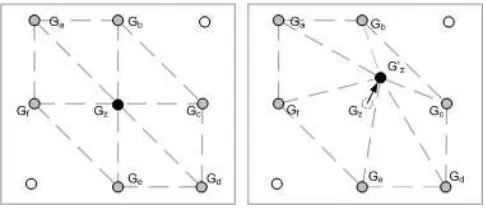
neigh-Fig. 1. Search scheme for the hexagon matching algorithm: (1) Fix the position of the six vertices,GatoGf; (2) Search
for the best position ofGz.
bours. The interdependence requires a costly computation, performed in a recursive manner. A scheme based on a hexagonal matching algorithm was proposed by [4] to re-duce the number of computational iterations. It basically relies on a hexagon formed by seven grid points as shown in Fig. 1. By fixing the position of the six peripheral ver-tices, the central grid point,Gz, is allowed to acquire an
op-timal motion displacement within the hexagon. Estimation of the motion for the other vertices forming the hexagon is performed in a similar manner. Subsequently, a refinement process is activated for the central grid point if the displace-ment of any grid point in the hexagon has been modified. The iterative refinement process is applied to all grid points until convergence to local or global minima.
[image:2.595.307.550.232.336.2]2. MESH-BASED MOTION ESTIMATION INCORPORATING AN EMBEDDED BLOCK
MODEL
The popularity of block-based motion compensation is evi-denced by the MPEG-x and H.26x video coding standards. The reasons are that (a) a significant proportion of the mo-tion trajectories found in natural video can be described with a rigid translational motion model; (b) fewer bits are required to describe simple translational motion; (c) im-plementation is relatively straightforward and amenable to hardware solutions. However, in spite of its relatively low computational requirement, the block-matching algorithm can provide visually unacceptable results when motion tra-jectories exhibit non-translational motion. The difficulties stem from the fact that the connectivity of vertices of adja-cent blocks is not preserved [5].
In contrast, mesh-based motion models deform inter-connected triangular patches by computing the displacement of the grid points. These have been shown to be a good alternative to block-based models when coping with non-rigid translational motion. As mentioned above, one method of evaluating motion displacement is to use the hexagonal matching algorithm which recursively computes each grid point. We propose an embedded block model to reduce the computational requirement.
It is observed in mesh-based models that a significant proportion of the grid points do not change from frame to frame. This is normally attributed to a stationary intensity field that exists in consecutive frames. This is particularly prevelant in scenes comprising a static background. It is natural to ask whether it is possible to detect the location of these areas and to know in advance that estimation of new grid point locations is not required. Richardson and Zhao [6] advocate an error metric based on mean absolute differ-ence (MAD) to detect skipped macroblocks (macroblocks that are directly copied from the previous frame at the corre-sponding location). The MAD evaluation for a block-based model is defined as:
M ADB(i,j)= 1
M ×N
X
M
X
N
|B(i, j, t)−B(i, j, t−1)|
(1) where M×N is the size of the block.B(i, j, t)andB(i, j, t−
1) represent corresponding blocks at location of (i, j) in framestandt−1respectively.
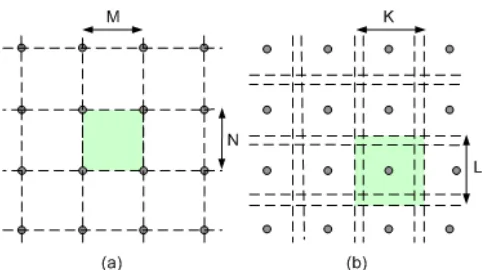
The question arises whether (1) can be applied to a mesh-based model. In a block-mesh-based model the vertices of a block are the four adjacent grid points as shown in Fig.2(a), and the individual grid points have little influence on the MAD evaluation for a block. However in a mesh-based scheme, the displacement of each grid point is dependent on its ad-jacent neighbours. This is particularly true at the bound-aries of a static intensity field. Thus, a modification to (1) is
Fig. 2. (a) Conventional representation of a block (size M×N) containing four grid points; (b)Embedded blocks (of size K×L) centred at each grid point.
necessary. A MAD evaluation incorporating an embedded block model can solve the above problem. In Fig.2(b), an embedded block is formed at the centre of each individual grid point, and a MAD is calculated from the effective area within the embedded block. Note that the size and geome-try of the embedded blocks can affect the evaluation. In this paper, we discuss only rectangular embedded blocks which are allowed to overlap each other. The MAD evaluation for an embedded block of size K×L is then defined as
M ADBe(G(i,j))= 1 K×L
X
K
X
L
|Be(G(i, j), t)−
e
B(G(i, j), t−1)|
(2) whereBe(G(i, j), t) andBe(G(i, j), t−1) are the embed-ded blocks centred at grid pointG(i, j)in frames t and t-1, respectively.
A decision process is then used to decide whether the current grid point is to be exempt from motion estimation. The process contains a threshold,∆T h, to provide a boolean
outcome:
DecisionG(i,j)= (
true ifM ADBe(G(i,j))≤∆T h,
f alse otherwise.
(3) A positive outcome in (3) results in the exemption of motion estimation for the current grid point,G(i, j). Eventually, all the grid points are assigned a boolean value. In the decision making process, the algorithm ensures that motion is esti-mated for those grid points located at static intensity field boundaries.
3. BLOCK-WISE APPROACH FOR MOTION INFORMATION CODING
[image:3.595.306.547.70.205.2]group-Fig. 3. The motion information coding process. (a) Con-ventional approach using raster scan; (b) the proposed ap-proach incorporating indicator bits and a block-wise scan that results in fewer bits to encode the same amount of mo-tion informamo-tion.
ing grid points with zero displacement. A block-wise ap-proach is proposed to achieve this, without specifying the location of the groups. Fig. 3 illustrates an example of two different schemes utilising an Exp-Golomb lookup table for motion information coding. In Fig. 3(a) motion information is encoded in the conventional raster manner without con-sidering the correlation of adjacent motion displacements. In contrast, the proposed algorithm employs a block-wise scan considering groups of four grid points at a time, as shown in Fig. 3(b). An indicator is assigned to each group to indicate whether all four grid points have zero motion (in-dicator = ’0’). For a group in which there is at least one grid point with non-zero motion the indicator is set to ’1’ and is followed by the motion vector difference (MVD) code for each member of the group. The proposed motion coding algorithms for encoder and decoder are summarised as fol-lows:
Encoder:
1. Consider a group of four grid points and check for consistency of zero motion displacement.
2. If motion is consistently zero, assign indicator bit ’0’ and proceed to the next group.
3. Otherwise, assign indicator bit ’1’ and code individ-ual members. Proceed to the next group.
Decoder:
1. Examine the indicator bit (the first bit of the bitstream)
2. If the indicator bit is ’0’, assign all members of the group as having zero motion displacement. Return to 1.
3. Otherwise, decode the next four codewords for indi-vidual members of the group, and return to 1.
Table 1 lists simulation results of employing the conven-tional and proposed approaches for motion information cod-ing. It is observed that reductions of up to 78% are achieved.
Sequences Exp-Golomb Proposed Diff.
Carphone 343.3 305.2 11.1%
Miss A 299.2 49.0 78.6%
Silent 227.8 86.5 62.0%
[image:4.595.47.291.70.191.2]Table Tennis 276.9 186.6 32.6%
Table 1. Reduction in motion coding (average bits per frame) achieved by the proposed block-wise approach
Sequences HMA Proposed Diff. Carphone 32.44 32.41 -0.03dB
Miss A 42.55 42.53 -0.02dB
Silent 37.31 37.31 0.00dB
Suzie 38.49 38.49 0.00dB
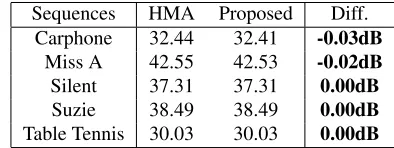
[image:4.595.317.538.71.135.2]Table Tennis 30.03 30.03 0.00dB
Table 2. Average PSNR performance of the hexagon al-gorithm and the proposed alal-gorithm prior to residue coding with JPEG2000
4. SIMULATION RESULTS
This section discusses the performance of the proposed al-gorithm in a complete codec. Results are presented as im-provements over the hexagon matching algorithm (HMA) employing 16×16 triangular meshes. The selected video se-quences were of QCIF resolution (176×144) and 30 frames of each sequence were processed. Except for the first frame, all the frames are encoded with mesh-based coding. The search range of the motion estimation is set to±8 pixels. Finally, the motion information was encoded using the Exp-Golomb method and the residue data using JPEG2000 at fixed bit rates.
Table 2 shows the average picture degradation for the two motion estimation algorithms. The PSNR measure-ments are made prior to residue coding with JPEG2000. Significantly, the sequences employing the proposed algo-rithm achieve almost the same PSNR values as those by the hexagon matching algorithm. A maximum of 0.03dB in picture degradation is observed in the Carphone sequence (Class C) which demands a detailed motion search.
Table 3 shows the reduction in number of mesh-based grid point iterations. Generally, the reduction is dependent on the amount of motion within the sequence. For the class C sequences, Carphone and Table Tennis, an average speedup of 30% is obtained, and a speedup of over 40 % is achieved for the other classes.
[image:4.595.326.523.169.243.2]infor-Sequences HMA Proposed Speed up Carphone 263.2 185.7 29.4%
Miss A 195.8 17.4 91.1%
Silent 141.3 42.2 70.1%
Suzie 149.6 84.5 43.5%
[image:5.595.68.269.71.145.2]Table Tennis 186.9 124.6 33.3%
Table 3. Reduction in mesh grid point iterations over the hexagon matching algorithm
mation coding allows more bits to be employed for residue coding. However Class C sequences do not reflect the same advantage as the bit reduction is less significant.
5. CONCLUSION
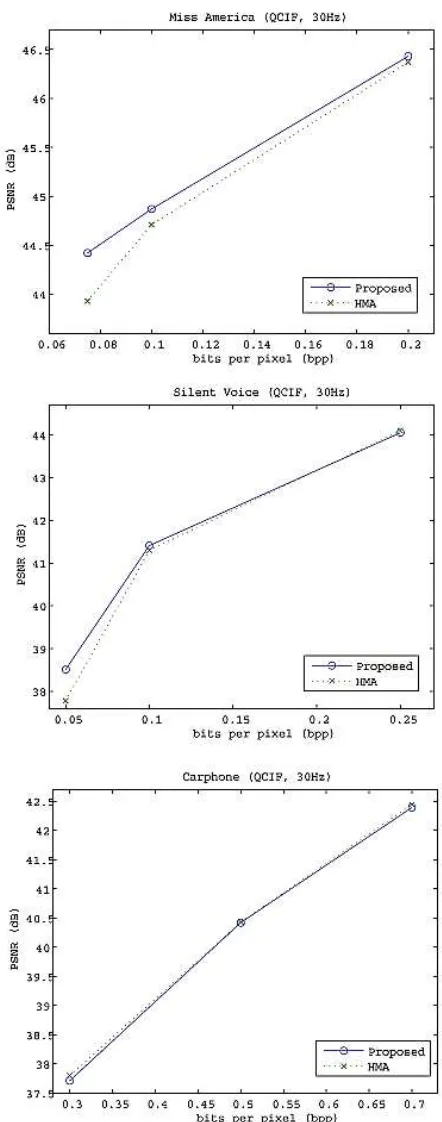
In this paper, we present a fast algorithm based on an em-bedded block model for mesh-based motion estimation. It is decided whether grid points should undergo further motion searches depending on a MAD evaluation of the embedded blocks. Based on the similar concept of assessing whether motion is present, a block-wise approach for motion infor-mation coding is proposed. Simulation results show that the proposed algorithm achieves a better PSNR-rate perfor-mance than the hexagon matching algorithm. Furthermore, a reduction of up to 91% in the number of mesh grid-point iterations is obtained.
6. REFERENCES
[1] A. Nosratinia, “New kernels for fast mesh-based motion es-timation,” IEEE trans. on Circuit and System for Video Tech-nology,, vol. 11, no. 1, pp. 40–51, Jan. 2001.
[2] H. Park, A. Yu, and G. Martin, “Progressive mesh-based mo-tion estimamo-tion using partial refinement,” inProc. of Inter-national Workshop on Very Low Bit-rate Video (VLBV) 2005, Sep. 2005, p. 4 pp.
[3] Y. Altunbasak and M. Tekalp, “A hybrid video codec with block-based and mesh-based motion compensation modes,”
Special Issue of Int. Journal of Imaging System and Techol-ogy,, vol. 9, no. 4, pp. 248–256, Aug. 1998.
[4] Y. Nakaya and H. Harashima, “Motion compensation based on spatial transformations,”IEEE trans. on Circuit and System for Video Technology,, vol. 4, no. 3, pp. 339–367, Jun. 1994. [5] N. Bo˘zinovi´c, J. Konrad, T. Andr´e, M. Antonini, and M.
Bar-laud, “Motion-compensated lifted wavelet video coding: to-ward optimal motion/transform configuration,” in Proc. of European Signal Process Conference (EUSIPCO) 2004, Sep. 2004, pp. 1975–1978.
[6] I. Richardson and Y. Zhao, “Video encoder complexity reduc-tion by estimating skip mode distorreduc-tion,” inProc. of Inter-national Conference on Image Processing (ICIP) 2005, Sep. 2004, pp. 103–106.
[image:5.595.310.531.77.638.2]