EXPLORING THE VARIABLES WITHIN
OPPORTUNITY EVALUATION
THIJS SLOT
I
Title page
Author
Name Thijs Slot
Student number S0196789
Thesis Master Thesis MSc in Business Administration Track Innovation & Entrepreneurship
University
University University of Twente, School of Management and Governance (SMG) First supervisor Kasia Zalewska-Kurek PhD
Second supervisor drs. Patrick Bliek
Company
Company Ingenion
Supervisor Niek Stoker
II
Preface
Before you lies the thesis ‘Exploring the variables within opportunity evaluation’. The research on this thesis is conducted on several serial entrepreneur located in different areas of The Netherlands and acting within different industries. This thesis is written to graduate the master business administration, track innovation & entrepreneurship on the University of Twente. The internship corresponding to the thesis was done at Ingenion.
Together with my supervisor, Dr. Kasia Zalewska-Kurek, we came up with the idea to investigate the variables influencing the opportunity evaluation process of (serial) entrepreneurs. This meant conducting a literature study and testing it against serial entrepreneurs. This quantitative study eventually enabled me to come to conclusions about these variables.
The interviews with the entrepreneurs, coupled with my desire to once start my own company led to the establishment of my own business. As this was great, it interfered with finishing the thesis, it is safe to say starting my own company definitely did not facilitate graduation. But despite my lack of time spent on the thesis, my supervisors, Dr. Kasia Zalewska-Kurek and drs Patrick Bliek stayed with me.
That is why I would like to thank my supervisors, Dr. Kasia Zalewska-Kurek and drs Patrick Bliek, for their patience, constructive feedback and flexibility they showed on this research. Secondly I would like to thank Ingenion for letting me do the research at this company and giving me an insight in the ambidextrous organization Ingenion is while also contributing to the entrepreneurial field of study. Besides Ingenion I would like to thank the respondents for taking some time on their busy schedule to help me graduate. Last but certainly no least I would like to thank my parents, girlfriend and other loved ones for their support, believe and encouragement they have always showed during the time it took me to finish my Master’s degree, thank you!
I hope you enjoy reading this thesis. Thijs Slot
III
Abstract
This research focusses on the entrepreneurial process, with the emphasis on opportunity evaluation. Within the entrepreneurial process, three concepts are identified: the opportunity recognition, the opportunity exploitation and the concept in between the two, the opportunity evaluation. Current research on the field of opportunity evaluation lacks the components between the opportunity recognition and the actual exploitation of an opportunity. Thus lacking the evaluation of an idea which turns this idea into an business opportunity.
This research creates a model which incorporates the variables which are considered when evaluating an idea. Through an explorative research on the literature written about opportunity evaluation a preliminary model is created about the variables entrepreneurs take in consideration when evaluating a possible business opportunity. In order to test and complement the model an empirical research is added to the study. Serial entrepreneurs are interviewed to enable the researcher to not only test and complement the model but also find the most important variables within this particular model. The literature review led to a model consisting out of fourteen variables divided into four components which are all in their extend an element or variable influencing the opportunity evaluation of a specific business opportunity:
Opportunity evaluation
Cognitive framework
Possible gains
Resources & Network
Innovation adoption
This model and its underlying variables were tested through structured interviews with serial entrepreneurs and was altered on a few minor points in order to produce a tested model on opportunity evaluation.
IV
Report
Figures
Figure 1: The entrepreneurial process ... 2
Figure 2: Research funnel ... 3
Figure 3: Opportunity recognition model (R. A. Baron, 2006) ... 4
Figure 4: Opportunity evaluation model (Keh et al., 2002, p. 128) ... 7
Figure 5: Diffusion of Innovation curve (Rogers, 2010) ... 9
Figure 6: Opportunity evaluation variables through literature review ... 11
Figure 7: Concise representation of the entrepreneurial process ... 12
Figure 8: Opportunity evaluation variables: the cognitive framework... 16
Figure 9: Opportunity evaluation variables: possible gains ... 19
Figure 10: Feedback on perceived personal gains ... 21
Figure 11: Opportunity evaluation variables: resources & network ... 22
Figure 12: Opportunity evaluation variables: innovation adoption ... 24
Figure 13: Feedback on ‘what makes an opportunity?’ ... 26
Figure 14: Tested and improved opportunity evaluation model ... 29
V
Table of content
1. Introduction ... 1
1.1. Research objective and research questions ... 2
Research goal ... 2
Central question ... 3
Research questions ... 3
2. Literature review ... 4
2.1. The entrepreneur ... 4
2.2. Opportunity recognition ... 4
2.3. Opportunity evaluation ... 5
Internal factors ... 6
Internal & external factors ... 8
External factors ... 9
Synthesis ... 11
2.4. Opportunity exploitation ... 11
2.5. The entrepreneurial process ... 12
3. Method ... 13
3.1. Literature review ... 13
3.2. Interviews ... 13
Data collection method ... 13
Subject of the study ... 13
Measurement ... 14
4. Results ... 16
4.1. The entrepreneur’s personality – The cognitive framework ... 16
Personality ... 16
Risk perception ... 16
Optimism ... 17
Experience ... 18
The cognitive framework ... 19
4.2. Perceived personal gains ... 19
The perceived personal gains ... 21
4.3. Resources, and gaining them through the network ... 21
Resources, and gaining them through the network ... 23
4.4. Readiness: the customers, market, product and investors ... 24
VI
4.5. Retrospect: What makes an idea an opportunity? ... 26
5. Conclusion and implications ... 28
5.1. Conclusion opportunity evaluation ... 28
5.2. Theoretical implications / Academic relevance ... 30
5.3. Practical implications / Practical relevance ... 30
5.4. Discussion ... 31
6. Bibliography ... 33
7. Appendix ... 38
7.1. Appendix A: Interview ... 38
7.2. Appendix B: The interviews ... 41
Interview entrepreneur 1... 41
Interview entrepreneur 2... 44
Interview entrepreneur 3... 47
Interview entrepreneur 4... 50
Interview entrepreneur 5... 53
Interview entrepreneur 6... 56
Interview entrepreneur 7... 60
7.3. Appendix C: The feedback ... 64
The data ... 64
1
1.
Introduction
Entrepreneurship literature has been up and coming in the last decades. Since the early 1980’s a lot of different components within entrepreneurship research have been analyzed. Due to the novelty of the research, the analysis of these different components lead to an overall diverged field of study (Gregoire & Noel, 2006, p. 336). The field of study shows a convergence-divergence cycle throughout the past 30 years, where the overall convergence is apparent. Convergence leads to common ground on concepts within entrepreneurship research (Gregoire & Noel, 2006, p. 359). This common ground has not been met with all components of entrepreneurship research though.
According to Shane & Venkataraman (2000, p. 220) The field of entrepreneurship research focusses on: ‘how, by whom, and with what consequence opportunities to produce future goods and services are discovered, evaluated, and exploited’. Different parts of this definition of the entrepreneurship field of research have been analysed extensively.
The entrepreneurial process, which is identified by Bygrave & Hofer (1991, p. 14) as: ‘The entrepreneurial process involves all the functions, activities, and actions associated with the perceiving of opportunities and the creation of organizations to pursue them’. Within this process, opportunity recognition is commonly accepted to be the first and most important step (R. A. Baron, 2006, p. 104; Douglas & Shepherd, 2000; Kaish & Gilad, 1991; Kizner, 1978). Because this is considered to be the most important step, the field of opportunity recognition has been subject to much research. Also opportunity exploitation has been subject to much research, with the actual interpretation of the opportunity to a business and thus the effective venture creation process as the main research fields. Besides these concepts, also opportunity evaluation is identifiable for the entrepreneurial process, this concept has not been subject to the extensive research the other concepts have received, leading to a research gap in the field of entrepreneurial opportunity evaluation and thus opportunity management (Haynie, Shepherd, & McMullen, 2009, p. 338; Keh, Foo, & Lim, 2002, p. 125). Krueger (1993, p. 7) defined an opportunity as: ’a future situation that the decision makers deem personally desirable and feasible (i.e., within their control and competence). The state of being “desirable” and “feasible” is subjective to the individual’. Most entrepreneurs do not find it difficult to get to ideas, but through the evaluation of this idea it can distinguish ideas from possibilities (Hills & Shrader, 1998). The “black box” between the decision maker and the startup of a new company by purseuing a specific opportunity is opportunity evaluation.
This paper focusses on this entrepreneurial process, especially on the underdeveloped field of opportunity evaluation. This concept is about selecting which opportunity to pursue or as Haynie et al. (2009, p. 338) defined it: ‘envisioning the future – specifically the wealth generating resource combinations to be controlled by the entrepreneur post- exploitation’. Through the identification of the factors about what entrepreneurs value in an opportunity a model is created. With the help of this model opportunities could be analyzed in a constructive manner and processes benefiting from this (attracting investors for example) are eased.
2
opportunities and innovative products, the ambidextrous nature of companies has led to many new businesses or project oriented spin-offs.
The problem which is to be identified is why some of these intends to be ambidextrous make it to commercialization while others do not, how to distinguish good and profitable business ideas from the ones which do not go well with current business or are not profitable enough? The decision making of the entrepreneur as to exploit an opportunity or not has to be made evident. In other words: why do entrepreneurs exploit idea A while letting idea B go? What makes a business idea an business opportunity? What do the entrepreneurs take into account when evaluating an opportunity?
Thus evaluating opportunities could prove to be difficult. With the help of the framework created in this paper entrepreneurs can value opportunities in a more constructive and objective manner. Through the narrowing of the existing research gap within the venture creation process, being opportunity evaluation, both practical and academic relevance is present in the study.
Opportunity evaluation
Opportunity recognition
[image:9.595.75.486.285.370.2]Opportunity exploitation
Figure 1: The entrepreneurial process
1.1.
Research objective and research questions
Heerkens & Van Winden (2012) describe two different types of problems, the knowledge and the action problems (Heerkens & Van Winden, 2012, p. 22). An action problem has the characteristic that there is a discrepancy between the desired and the real situation. A knowledge problem is characterized by a lack of knowledge about one certain domain of the study and can be solved by conducting a research on that particular domain. Since the lack of understanding and lack of research on opportunity evaluation, this research is typified as an knowledge problem, where the acquisition of the knowledge should solve the problem at hand. The procedure to solve a knowledge problem consists out of eight steps which should all be taken in order to solve the problem. The steps are: set a goal, the problem description, the central question (including the research questions), the design of the research, the methodology, the data, processing the data and last the answering of the problem description or the drawing of conclusions (Heerkens & Van Winden, 2012, p. 25). These will all be attended to in the coming chapters.
Research goal
3
Entrepreneurship field of research
Entrepreneurial process
[image:10.595.82.502.82.155.2]Opportunity evaluation
Figure 2: Research funnel
Central question
When an entrepreneurs has an idea he/she evaluates this idea according to several criteria before acting upon it. This is the process of opportunity evaluation. The question however remains which criteria the entrepreneurs value when evaluating such an idea. This study aims to create a model which incorporates these criteria, coming to the central question of this thesis:
Which components of an opportunity do entrepreneurs evaluate when considering venture creation?
Research questions
o Who is an entrepreneur? o What is opportunity evaluation?
o Which components are present within opportunity evaluation?
o How important are different components within opportunity evaluation?
These sub questions are important in order to get to the answer of the central question. In order to create a model for opportunity evaluation the entrepreneurial process needs to be understood and the relevance of the role of opportunity evaluation needs to be apparent. After the recognition of the importance of opportunity evaluation the components of opportunity evaluation are identified, with this identification a model can be constructed.
4
2.
Literature review
In order to get to the answer of the research question, a literature study is conducted to set the basis of the study. The first part will elaborate on research already done on the entrepreneur. The entrepreneurial process is due in the next chapters, first the opportunity recognition, the second part will elaborate on opportunity evaluation and the third paragraph discusses opportunity exploitation.
2.1.
The entrepreneur
Before the entrepreneurial process can be elaborated upon, some background on an ‘entrepreneur’ is needed. Gartner (1988) tried for ten years to identify a typical entrepreneur but never succeeded in the way that the definition deemed satisfactory by the academic society. The definition Gartner (1988, p. 26) suggested was: ‘Entrepreneurship is the creation of new organizations’. This definition has been used and also criticized in many studies. Gartner (1988) did focus on the traits which make an entrepreneur. Using these traits the entrepreneur personality is created. These personality traits, discussed in various articles (Brandstätter, 2011; Chapman, 2000; Goldberg, 1990; Marcati, Guido, & Peluso, 2008; Rauch & Frese, 2007; Seibert & Lumpkin, 2009; Zhao & Seibert, 2006), form the cognitive framework (the process through which the entrepreneur identifies an opportunity) (R. A. Baron, 2006).
2.2.
Opportunity recognition
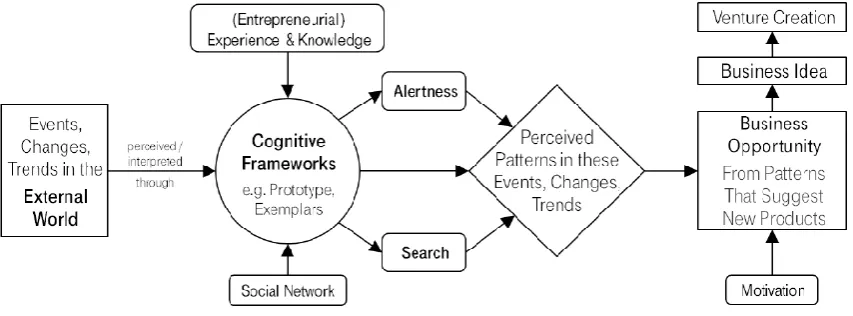
[image:11.595.85.512.530.688.2]As stated in the introduction, opportunity recognition is regarded as the most important step in the entrepreneurial process (R. A. Baron, 2006, p. 104; Douglas & Shepherd, 2000; Kaish & Gilad, 1991; Kizner, 1978; Shane & Venkataraman, 2000). This has the consequence that opportunity recognition has been the subject of many studies (e.g. Baron, 2006; Bhave, 1994; Gaglio & Katz, 2001; Shane & Venkataraman, 2000). With the identification of many factors driving the opportunity recognition, three factors have come up regularly in the studies. Baron (2006) identified these three major components in opportunity recognition as: the engagement in active search towards opportunities; alertness towards possible opportunities and the prior knowledge about the external market, being the technology, markets, industry, demographics (customers) and other events that could be relevant to the business. Baron (2006, p. 112) constructed a model incorporating these variables:
Figure 3: Opportunity recognition model (R. A. Baron, 2006)
5
the external market. Through this external world, opportunities are recognized using the three components: active search, alertness to opportunities and experience and prior knowledge (Ardichvili, Cardozo, & Ray, 2003; R. A. Baron, 2006). The events and changes happening in the outside world could be seemingly unrelated but the entrepreneur connects the dots and applies interrelated connections, thereby identifying patterns which could be useful the business of the entrepreneur. The opportunities which are identified using this model could eventually turn out to be business opportunities and therefore the venture creation process is started (R. A. Baron, 2006).
2.3.
Opportunity evaluation
Before the venture creation process could be started, more has to be known about the reception of patterns by the entrepreneur. This is done using the understudied field of opportunity evaluation. Although it has been subject to less research than opportunity recognition, not all researchers shy the research field of opportunity evaluation. The opportunity attractiveness in the study of Haynie et al. (2009) is about the possible gains the opportunity is able to generate. If the opportunity is able to generate a competitive advantage the opportunity attractiveness increases. The second insight about opportunity evaluation identified by Haynie et al. (2009) is the focus on the future, which is targeted towards the possible gains for the company given the opportunity is being exploited. The last insight is about the first-person view of the opportunity. The opportunity should not be evaluated as ‘attractive to someone’ but rather as ‘attractive to me’, the entrepreneur. This takes the existing state of the company in mind, with the inclusion of the available skillset, abilities, knowledge and resources. These three insights together lead to a cognitive process of opportunity evaluation, it’s all about what the entrepreneur’s conception of the idea is. This future-oriented process takes the point of view as if the opportunity were to be pursued and then focusses on the possible gains of the opportunity. The study also identified the fact that entrepreneurs tend to pursue opportunities which are in line with existing or related knowledge (Haynie et al., 2009, p. 341). Besides the possible attractiveness of the opportunity other components about evaluating an idea are covered in studies as well.
6 Characteristics of the entrepreneur Product/service characteristics Market characteristics Financial characteristics Other Management skills and experience Product attributes
Market size Cash-out method References
Venture team Product differentiation
Market growth Expected ROI Venture
investment stage Management
stake in the firm
Proprietary Barriers to entry Expected risk Venture capitalist criteria
Personal motivation
Growth potential Competitive threat Percentage of equity Entrepreneurs personality Market acceptance Venture creates new markets Investors provisions
Prototype Size of
[image:13.595.72.523.70.326.2]investment Liquidity Table 1: Venture capitalist evaluation criteria (Boocock & Woods, 1997; Hudson, 2005)
Although these models have not been fully able to identify the key decision making variables according to Hudson (2005, p. 1), these models do turn out to be more successful in predicting successful outcomes than the judgment of the venture capitalists (Khan, 1987, p. 194). Since these models are also dealing with the evaluation of opportunities, they will be taken into account in the creation of the theoretical framework about possible factors driving the opportunity evaluation process of the entrepreneur.
The factors influencing the opportunity evaluation process indicated in the research on opportunity evaluation by entrepreneurs and venture capitalists will be discussed in the following paragraphs using internal and external factors driving the opportunity evaluation .
Internal factors
The cognitive framework
The following factors have been identified by literature to influence the decision making on whether to pursue an opportunity or not. This paragraphs focusses only on the factors stemming from the cognitive framework of the entrepreneur.
7 Figure 4: Opportunity evaluation model (Keh et al., 2002, p. 128)
8
Perceived personal gains
With possible gains by starting a company one could think of monetary gains, also non-monetary gains or intangibles are present in the reasons people pursue ideas and start businesses. Gatewood, Shaver, & Gartner (1995) conducted a longitudinal study of the cognitive factors influencing both the start-up behaviour as the success of the new venture.
Monetary motives were identified, such as the identification of a market need of which they could make money off or the fact that they could make more money by starting a (new) business are mentioned often (together almost 50% of the time) (Gatewood et al., 1995, p. 377). Opportunities which carry a high expected value are pursued more often that the ones with a relative low value. The costs of creating a business is weighted against the uncertainty the entrepreneur holds (Kizner, 1978; Shane & Venkataraman, 2000).
During the lifetime of a venture new opportunities can arise to leverage the competencies of the firm (Penrose, 1995). This opportunities can be used for continuity of the firm, identifying another reason to start with a new product or service, for example through a spin-off. Through simultaneously exploiting the current business and exploring future possibilities (ambidexterity) the viability of the company is guaranteed.
The non-monetary reasons however are apparent in the study too. Gaining knowledge, autonomy, independence, experience and the sense of achievement are some intangible reasons for starting a new venture. These intangibles are related to the cognitive framework of the entrepreneur and the reasons as to why to start a new business.
Internal & external factors
Resources, and gaining them through the network
In addition to the three insights about opportunity evaluation, Haynie et al. (2009) also used the resource-based view to measure opportunities. If the resources needed for a particular opportunity could be obtained and are labeled valuable and rare a competitive advantage on the market could be gained, when these specific opportunities could also be labelled as inimitable and non-substitutable, the competitive advantage could also be sustained (Barney, 1991; Haynie et al., 2009, p. 343). While taking the resources at hand and the resources which should be summoned into account, a decision about which opportunity to chase and which to let go is made. These resources could be obtained using the internal resources, but also while looking at the resources which are possibly apparent in the network of the company, these gains of resources due to the network could be included in the decision making process about whether to pursue an idea or not. In the study of Baum, Calabrese, & Silverman (2000) they suggested that a network could be a good resource in setting up new ventures. The networks can be used to establish alliances, get information and be efficient among other advantages.
9
resources could be available when directing to the network of the entrepreneur. These resources could be obtained cheaper or could not be available at all when looking outside of the network of the entrepreneur (Witt, Schroeter, & Merz, 2008). The advantages of using the network while starting a new venture are apparent through these conducted studies.
Carolis, Litzky, & Eddleston (2009) also studied the influence of the network on new venture creation. They made the connection between the cognitive framework of the entrepreneur and the influence of the network on the new venture success. The type of entrepreneur, with his/her social network, also influences the venture creation. There results suggest that the illusion of control is enhanced through these social networks.
External factors
Readiness: the market, product and investors
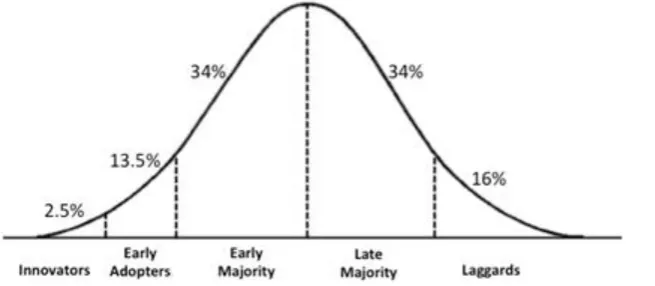
[image:16.595.75.403.544.687.2]Companies are started in order to deliver a (new) product or service to their respective customers. This customer has a big influence on the possible profitability of the new business. If customers do not purchase the product or service, the viability of the business is threatened. This is the reason the customer readiness, or market readiness (Douglas & Shepherd, 2002), has to be taken into account when launching a new venture. In their paper, Douglas & Shepherd (2002) took various components of the market readiness into account in order to identify and test the demand of the target market. The readiness of the market could also be measured using the diffusion process (Beal & Bohlen, 1957; Rogers, 2010). The diffusion process concerns the adoption of innovations or as Rogers (2002) defined it: “Innovativeness is the degree to which an individual or other unit of adoption is relatively earlier in adopting new ideas than other members of a social system”. With the innovation adoption curve a model is created about the adoption of the ideas (new products or services) of the customers (members of a social system). Depending on the target market and the number of sales, the company has an indication about the readiness of the market concerning the adoption of the product. The innovation adoption curve is categorized into five groups of customers. These five classifications are: innovators, early adopters, early majority, late majority and the laggards. The categories are divided based on a normal curve and classified according to standard deviations from the mean of the population as a whole, resulting in the following illustration:
Figure 5: Diffusion of Innovation curve (Rogers, 2010)
10
development, the launch, growth, maturity and the decline (Dean, 1950). These five steps indicate the readiness of the product or service as to where it stands on the market.
Besides the readiness of the market and the product the founders of the business idea generally need money in order to pursue the idea. This particular part is addressed through the investor readiness which measures the willingness of the investors to provide resources to the venture. Douglas & Shepherd (2002) investigated the investor readiness of a start-up. As investors will only invest in businesses they deem viable and profitable in the foreseeable future this is an important variable which has to be taken into account when evaluating an idea. Investors hold almost the same criteria as entrepreneurs do when evaluating a business idea (the management team, the product, the market, financial returns (Boocock & Woods, 1997; Hudson, 2005)). These evaluation components are also depicted in Table 1: Venture capitalist evaluation criteria (Boocock & Woods, 1997; Hudson, 2005). Investor readiness generally includes technology readiness, market readiness and management readiness (Douglas & Shepherd, 2002). The latter two elements (the market and management readiness) are described in the previous chapters, where the management readiness is depicted in the cognitive framework of the entrepreneur and the market readiness is explained in the previous paragraph. The technology readiness is the extent to which the technology is ready for commercialization. This is not used in this particular study since new businesses could also incorporate services instead of products, rendering the technology aspect redundant for services.
11
Synthesis
In the paragraphs discussed above the variables identified in the literature on opportunity evaluation is discussed, leading to an overview of variables influencing the opportunity evaluation process. Each topic is represented in the same manner as the paragraphs, the overview on the variables is illustrated in the figure:
Possible gains The cognitive framework
Resources & Network
Innovation adoption
Profitability
Continuity
Impoving cognitive framework
Internal resources
Gaining status
Gaining customers
Opportunity evaluation
Product readiness
Investor readiness Customer readiness Internal
External
Possible partnerships Personality
Risk perception
Optimism
[image:18.595.72.520.161.498.2]Experience
Figure 6: Opportunity evaluation variables through literature review
2.4.
Opportunity exploitation
Opportunity exploitation is the next and final step in the entrepreneurial process and is closely linked to the opportunity evaluation variables. The cognitive framework for example has a big impact on the exploitation of the opportunities. When an opportunity is exploited that is closely linked to the cognitive framework and the environment (with the available resources) a positive link between the viability of the new venture is identified in the research of Hmieleski & Baron (2008). The influence of the cognitive framework on opportunity exploitation is also proved in the research of Choi & Shepherd (2004), who identified a positive relationship between the perception of knowledge of customer demand, managerial capabilities and stakeholder support and the likeliness and willingness to exploit an opportunity.
12
of failed businesses relative to the numbers of owned businesses. Leading to the believe that more experience positively correlates with successful businesses.
Besides experience, optimism is also showed to have a negative impact on the exploitation of opportunities (Hmieleski & Baron, 2009). In most industries, newcomers fail to suppress the established firms, often leading to failed businesses (Dunne, Roberts, & Samuelson, 1988). The failure to identify the changes of a succeeding business and supress the optimism by first analysing instead of acting is elaborated upon by Choi, Lévesque, & Shepherd (2008).
The tipping point between exploring a potential business opportunity and the exploitation of that particular opportunity is also studied. The tipping point, also called the “ignorance threshold”, indicates the trade-off between the time needed to increase legitimacy and the necessity to act now in order to minimize competition. The timing of the “ignorance threshold” is crucial, as it impacts the performance of the opportunity exploitation (Choi et al., 2008). In the case of business opportunities with a high level of novelty, being innovative, more time should be based on exploring the opportunity and making the knowledge about the opportunity explicit, helping to set up a framework in order to convince stakeholders for example. If the opportunity can be identified by a low degree of innovativeness the market demand and competitors must be properly investigated. When a competitor can assimilate knowledge about your opportunity just as, or more, easily as you, the exploitation of the opportunity should be hasted (Choi et al., 2008).
Besides the cognitive framework and the degree of innovativeness of the new venture, the possible gains also influence the exploitation of an opportunity. As stated in the previous chapter (Perceived personal gains), an entrepreneur is more likely to exploit an opportunity which has a higher potential upside or expected value (Shane & Venkataraman, 2000).
2.5.
The entrepreneurial process
In this chapter the entrepreneurial process is covered, by stating the most important findings on each component of the entrepreneurial process elaborated upon in the literature review. To give an overview on the basic concepts of the three components of the entrepreneurial process a model is depicted below.
Opportunity evaluation Opportunity
recognition
Opportunity exploitation
Cognitive framework
Possible gains
Resources
Network
Innovation adoption
Active search
Alertness
Prior knowledge
Pattern recognition
Cognitive framework
Innovativeness
[image:19.595.74.479.533.744.2] Perceived possible gains
13
3.
Method
In order to study the opportunity evaluation variables, data were collected. The data collection methods which were used for the gathering of this data are discussed in this chapter. Two different kinds of data collection methods were applied in this study. The first method is the collection of information through the existing literature and knowledge about opportunity evaluation. This was done in the previous chapter, the literature review. In this chapter a preliminary model was created about the variables of opportunity evaluation. The second method used in the study were interviews with (serial) entrepreneurs to test and supplement the model created with the use of the literature review. Through the creation of an opportunity evaluation model by an exploratory research and an empirical research by conducting the interviews, the model gains legitimacy through real life experiences of the interviewees.
3.1.
Literature review
Although a literature study is needed for every scientific paper, it was particularly applicable in this study. Since the field of opportunity evaluation and the entrepreneurial process is diverged, the studies are not tied together and the papers are not connected to each other. In this literature study the different papers on opportunity evaluation were aggregated into one new model.
3.2.
Interviews
Data collection method
The literature review was tested against interviews with entrepreneurs, serial entrepreneurs were preferred for conducting these interviews with. The interviews were conducted using the semi-structured format. Doing this enabled the entrepreneur to elaborate upon his/her experiences in evaluating business opportunities and eventually setting up businesses, while still maintaining a structure in the interview (Barriball & While, 1994; Cohen & Crabtree, 2006; Wengraf, 2001). During the interviews the businesses the entrepreneur started were discussed and the perceived reason why they were/are a success or failure were elaborated upon, getting insight into possible new variables about opportunity evaluation. Also elaborating upon the reason as to why the entrepreneur acted upon a certain idea while letting another one slip by. By mentioning the same variables the entrepreneurs strengthened the model. Due to the empirical research on the literature review the model was tested through the interviews.
To ensure no data was lost while conducting the interviews, the interviews were recorded and a transcript was created. The transcripts can be found in Appendix B: The interview.
Subject of the study
14
In order to give the study a wide applicability and not focus on one sector, industry or geographical location, entrepreneurs acting in different industries and different parts of the Netherlands were interviewed.
Measurement
The interviews with the entrepreneurs were aimed on identifying variables on opportunity evaluation and testing the variables of the opportunity evaluation model (Figure 6: Opportunity evaluation variables through literature review) created in the previous chapter. Together with the interviews (Appendix A: Interview), the model founded on existing studies was tested and supplemented and provided a checklist of variables which were taken into account when evaluating an idea.
In order to operationalize the components of the opportunity evaluation model, the components had to be made measurable. To do this the importance or influence of the variable was asked, depending on the variable. The feedback from the entrepreneurs provided indications as to how important or influential they think that particular variable was. With the use of the recordings and transcript the feedback was scored on a 5 point scale with 5 being very influential, very important and 1 having not much influence/importance to the entrepreneur. By doing this the qualitative study was made measurable (see also 7.3.2 The combined interviews).
The purpose of the interview was not to identify the personality traits that influenced the opportunity evaluation process but mainly that the personality traits influenced the decision making at all, since it was indicated in the research that the cognitive framework, and thus the personality of the entrepreneur, influences the decision making. It is only necessary for the model to have the indication that personality and other variables influence the opportunity evaluation, while there is no need, in this study, to elaborate upon the variables within the variables (for example: the variables within the personality (personality traits) of the entrepreneur influencing the personality of the entrepreneur, which in turn influences the opportunity evaluation). Since there was no need to identify the specific personality traits there was no reason to elaborate on the specifics any further.
Within the cognitive framework, which was identified using the interview, the risk perception was a part which cannot have been asked straight forward. A question on risk perception needs to contain four specific aspects: it should indicate who is at risk, what the hazard is, what the time period is and the behaviour of the interviewee (Brewer, Weinstein, & Cuite, 2004). For example: “If you don’t change any Lyme related behaviours, what is your chance of getting Lyme disease in the next year?” (Brewer et al., 2004). This question was rephrased into questions applicable to the venture creation process: Assuming that the market remains the same, what is your chance of making the company profitable within a year? (see also Appendix A: Interview).
15
16
4.
Results
The theoretical framework and the method for collecting and analyzing the gathered data has been described in the previous two chapters, this chapter provides the results gathered by conducting the interviews. These results are presented in the sequence as the discussed in Figure 6: Opportunity evaluation variables through literature review. All the raw data can be found in Appendix C: The feedback, where the concise answers can be found (7.3.1 The data), as well as the combined answers (7.3.2 The combined interviews).
4.1.
The entrepreneur’s personality – The cognitive framework
The first part of the opportunity evaluation model is the cognitive framework, which in its turn is divided into four separate variables, the personality, risk perception, optimism and experience:
Possible gains The cognitive framework
Resources & Network
[image:23.595.81.299.253.330.2]Innovation adoption Profitability Continuity Impoving cognitive framework Internal resources Gaining status Gaining customers Opportunity evaluation Product readiness Investor readiness Customer readiness Internal External Possible partnerships Personality Risk perception Optimism Experience
Figure 8: Opportunity evaluation variables: the cognitive framework
Personality
The personality is deemed very important and influential to the respondents. Five out of seven stated that their personality was very important when it comes to the decisions that are made, whereas the other two rated it extremely influential. Entrepreneur 1 for example on the influence of his personality: “It is very influential, I am creative, goal oriented and decisively. This is reflected in the way I do business, but also in the evaluation of opportunities. I see opportunities everywhere and want to exploit them all. This enthusiasm has proven to be difficult sometimes because every idea is an opportunity” (7.2.1 Interview entrepreneur 1, Cognitive framework). This shows that besides the positive influence on opportunity evaluation it can also effect the evaluation in a negative way, typifying every idea as an opportunity, which later on turned out to be not entirely true.
As stated before, it is not the intention to pinpoint which characteristics influence the decision making, but more if the personality of the entrepreneur has any influence on the opportunity evaluation at all. Despite this all the entrepreneurs provided feedback about their personality traits which they think influence their decision making process. “I am open to new ideas, I think this is important for the judgement of opportunities. Besides that I have got passion for my ideas and am therefore very motivated to let this become a success. Perseverance also comes into play. As an entrepreneur, this is very important” (7.2.4 Interview entrepreneur 4, Cognitive framework).
Openness, perseverance and passion was not only mentioned by entrepreneur 4. Oppenness and perseverance was mentioned by four entrepreneurs, while passion and creativity was mentioned two out of seven times among other which were mentioned only once (e.g. drive, enthusiasm, focussed, impatient). The importance and influence of the entrepreneurs personality therefore has a great effect on opportunity evaluation.
Risk perception
17
all went so fast that I did not even had the time to judge it properly. From one day to the other I decided to relaunch the company and had to resume business that evening” (7.2.5 Interview entrepreneur 5, Cognitive framework). Another example is given by entrepreneur 1: “No, since 1999 I started the company but only after three years we had real growth. In-between I had to relaunch the company since it was declared technically bankrupt” (7.2.1 Interview entrepreneur 1, Cognitive framework).
This is to some extend indicative for the feedback on the risk perception. Five out of seven interviewees thought they did not estimate the risks involved well enough, so with an overall low score on risk perception but a large number of successful companies this part can be seen as not that important. The entrepreneurs started an average of 4,4 companies and indicated that they gained risk perception through the years and was also subject to the type of company, with the respondents indicating that the appropriate estimation of risk varies with different companies.
The entrepreneurs also tend to analyze the financial risks involved: “I think you want to estimate the risks, especially the financial risks, seeing that they have the biggest impact. You should balance your risks, I do not care if it takes up a lot of time, I do not consider time to be a risk, money however, is a risk. So no, you do not have a 100% clear image of the risk, you will just have to do it instead of talking about it and doing nothing. If the idea work you can adjust along the way, it is important to have a learning organization which is open to criticism and adjustments” (7.2.6 Interview entrepreneur 6, Cognitive framework). Also entrepreneur 2 has the same approach: “Sometimes the costs are higher than expected. This is the case with a company is France, but I have not stopped it yet. I do not give up and persevere despite it has costs me money for one and a half years already. I have never ceased any activity due to a poor assessment of the risk, I have adjusted expectations but never stopped” (7.2.2 Interview entrepreneur 2, Cognitive framework7.2.6).
As to why they did start the companies despite the risks involved the feedback of the entrepreneurs matched:
“Because the analysis supported my gut feeling. Through analyzing the financial implications the risks are mapped out, then you only have to weigh the risks” (7.2.4 Interview entrepreneur 4, Cognitive framework). So this decision was made on gut feeling supported by analysis. Other entrepreneurs also weigh in: “The risks outweigh the believe in the service” (7.2.6 Interview entrepreneur 6, Cognitive framework). “Because of the believe, and perhaps enthusiasm, about the idea you act on it. You believe in the idea and want to prove this” (7.2.1 Interview entrepreneur 1, Cognitive framework). The passion I have with the product, if I believe in the product I want to convince the market of this product” (7.2.3 Interview entrepreneur 3, Cognitive framework).
The risks, however, did not stop the entrepreneurs from starting a business. They all started their businesses despite the risks involved because of optimism, believe and the desire to prove themselves:
Optimism
In the previous paragraph it can already be seen that optimism is deemed important: “There are always risks involved when starting a company, but as an optimist you see the risks coming at you and respond to them. An optimist sticks his neck out before an pessimist does, they stay put in a pitfall and only see problems and risks” entrepreneur 2 weighs in (7.2.2 Interview entrepreneur 2, Cognitive framework7.2.6).
18
Interview entrepreneur 5, Cognitive framework). Entrepreneur 7: “I am an optimist, there should be more pessimism sometimes” (7.2.7 Interview entrepreneur 7, Cognitive framework). “I am a huge optimist, I think you have to as an entrepreneur. 70-75% of the decisions to start a new company is ascribed to optimism” (7.2.1 Interview entrepreneur 1, Cognitive framework). “The gut feeling and the believe in the product account for 60-70% of the persuasion I need for starting a new company” (7.2.3 Interview entrepreneur 3, Cognitive framework).
When asked if they base decisions on gut feeling or on analysis all entrepreneurs indicated that they base their decisions on gut feeling, for example entrepreneur 1: “Gut feeling, absolutely” (7.2.1 Interview entrepreneur 1, Cognitive framework). This is supported by an analysis in four cases, where two other respondents also indicate that the analysis is becoming more important in the process. “Feeling is very important, I almost always act on basis of the gut feeling. In later companies this distribution between gut feeling and analysis shifts somewhat towards the rational side” (7.2.1 Interview entrepreneur 1, Cognitive framework). “Gut feeling is important to me, but analysis has always been a part of the decision whether to start a new company. This has eliminated plans in the past but if I have got the feeling and believe in the product and it added value I often go with this feeling” (7.2.3 Interview entrepreneur 3, Cognitive framework). “The gut feeling is important, it is a matter of doing, an analysis is made for the bigger risks. Time isn’t a problem, money is” (7.2.6 Interview entrepreneur 6, Cognitive framework). Entrepreneur 7 also indicated that gut feeling is important, and that decisions are based on gut feeling which is supported by analysis: “At first instant it is based on gut feeling. The first company was solely based on gut feeling, no analysis whatsoever. In later companies there was more analysis present, also because of the support I got. But I act on gut feeling, that has to be present, if that is present an analysis can be made. It is a combination of analysis and gut feeling, both have to be there but I think I act on my gut feeling which is formed by the outcome of the analysis” (7.2.7 Interview entrepreneur 7, Cognitive framework).
Experience
With almost 100 years (95 to be exact) of experience between the entrepreneurs, they average a little over 13 years being an entrepreneur per person (13,57 years). During that time span the entrepreneurs have set up a total of 31 companies, leading to an average of 4,4 per person.
The entrepreneurs (six out of seven) indicated that the experience they gained is very influential in setting up later businesses. In particular the experiences of financing (n=4) the establishment and preservation of companies proved to be useful as for example stated by entrepreneur 5: “The experience is important, especially the financial part of a company has helped me a great deal. What is needed to set up a business and what to spend your money on. To distinguish the cases that can be postponed and which have to be done immediately. Besides that also the weekly and the monthly costs that are involved with running a company. These are things I learned during the period of the first company which I can apply in the later company” (7.2.5 Interview entrepreneur 5, Cognitive framework).
The analytical power (n=3) is also believed to increase as the experience grows. This is illustrated by entrepreneur 4: “As your experience grows in setting up a company you will learn to analyze the case faster. You are able to get a better and faster image about the new company. You kind of see it with a bird eye view, you are able to oversee everything better” (7.2.4 Interview entrepreneur 4, Cognitive framework).
19
analyzing promising or hopeless situations. You can more easily weigh the pros and the cons. You get to know what is working and what is not. You will still make mistakes but no blunders. From making blunders you will go to making mistakes and from making mistakes you will reduces those mistakes. Besides that, nine out of ten times it comes down to just doing it. When you believe in it (the opportunity), and when the gut feeling is there, you just have to give yourself the period where you will prove yourself right, or in the contrary; prove yourself wrong.” Entrepreneur 6 stated (7.2.6 Interview entrepreneur 6, Cognitive framework).
The cognitive framework
The cognitive framework proved to be very important for the entrepreneurs. All four indicated variables which could influence the cognitive framework, which in turn influences the opportunity evaluation, have been addressed by the entrepreneurs. This indicates that all variables have some role in the decision making process. Not all variables are of equal importance to the entrepreneurs. Their personality, optimism and experience are believed to have a large impact on the opportunity evaluation process, whereas the risk perception tends to be seen as something that comes with experience, therefore not seen as that important as the other three variables. The greatest influence, within the cognitive framework, on the opportunity evaluation process is being an optimist. This part of the survey was almost answered unanimously by the respondents. All answers (one missing) indicating that they are in fact an optimist and that being an optimist is extremely influential on the evaluation of opportunities. Also experience is seen as important by the entrepreneurs, not only because they rated this to be very influential, but also the traits entrepreneurs gain through the acquiring of the experience. Getting better in the financial and analytical affairs concerning the business.
All in all the above mentioned variables within the cognitive framework are all important in the opportunity evaluation process, therefore the cognitive framework can be typified as an influential and important part of the decision whether to start setting up a new business.
4.2.
Perceived personal gains
The next part of the interview concerned the perceived personal goals, which was divided into three separate variables: profitability, continuity and improving the cognitive framework:
Possible gains The cognitive framework
Resources & Network
[image:26.595.76.293.520.589.2]Innovation adoption Profitability Continuity Impoving cognitive framework Internal resources Gaining status Gaining customers Opportunity evaluation Product readiness Investor readiness Customer readiness Internal External Possible partnerships Personality Risk perception Optimism Experience
Figure 9: Opportunity evaluation variables: possible gains
In order to get a grasp on the perceived personal gains the motives of the entrepreneurs were asked as to why they started a company, why they would start another one and the expectations surrounding the establishment of the company.
20
myself and can be seen as a success. This makes you develop yourself as a person” (7.2.3 Interview entrepreneur 3, Possible gains).
Besides this drive for freedom and success other reasons were provided as well: the desire to prove themselves, dreaming, believe in the idea, owning a business, drive, idealism and a learning curve can all be ascribed to the improvement of the cognitive framework. Entrepreneur 7: “The first company was to help people, so idealism. The second company as a learning process. A better education than doing it yourself basically does not exists. And of course, the perspective to gain a salary out of the business is nice” (7.2.7 Interview entrepreneur 7, Possible gains).
Only ‘necessity’ cannot be attributed to this incentive as to why to start a business, this reason can be attributed to continuity, since the entrepreneur felt he had no choice in order to provide income to his family. Entrepreneur 5: “I started out of necessity, besides that I have always had the drive to work hard. This can be done as an employer” (7.2.5 Interview entrepreneur 5, Possible gains)
Confronted with the question as to why the entrepreneurs would start another company the answers are mostly towards the improvement of the cognitive framework again. “I feel the need for tension in my life. I cannot really quietly enjoy my life. I am easily bored and feel the urge for challenges which bring along pleasurable stress and tension. This tension is fun, something I like doing”. Entrepreneur 3: “I am currently occupied with a new chance because I see it as a challenge. The progress in the current company stagnates and continues the way it goes now, without new developments ready to be implemented in the market. The new challenge lies within the current industry but is a totally different challenge I like to face” entrepreneur 2 stated (7.2.2 Interview entrepreneur 2, Possible gains).
Besides the challenge and the “pleasurable stress” that comes with it, other reasons as to why the entrepreneurs started another company are provided as well:
o Improving cognitive framework (total n=11)
o Challenge (n=4), Boredom (n=2), Proving yourself, frustrations about the market, the need for tension, new experiences and freedom.
o Continuity (total n=3)
o Growth, diversification of risk and continuity o Profitability (total n=2)
o Supporting family, growth
It can be seen in the overview that the improvement of the cognitive framework is deemed the most important by the entrepreneurs when contemplating about setting up a new business. Profitability and continuity however are also represented in the feedback of the entrepreneurs: “The second company I ran concerned a merger, which enabled the company to accelerate the growth. Besides that the risks are spread between the companies” Entrepreneur 6 (7.2.6 Interview entrepreneur 6, Possible gains). Growth is classified with both continuity and profitability, since growth has an effect on the lifespan of the company as well as the revenue and profits the company makes.
21
build a professional organization with a large customer base in which continuity is paramount” (7.2.7 Interview entrepreneur 7, Possible gains). As can be seen in the quotes from the entrepreneurs they do not value one specific part (for example improving the cognitive framework) the answers are complex and include components which can be placed in multiple variables:
o Improving cognitive framework (total n=8)
o Proving yourself (n=2), realizing enthusiasm, building a successful company, personal growth, hiring good personal and satisfying them, working hard, building a professional organization
o Continuity (total n=6)
o Good result for the company, building a successful company, adding value to current business, building a professional organization, continuity, evading problems.
o Profitability (total n=5)
o Good result for the company, building a successful company, adding value to current business, providing for my family, building a professional organization.
The perceived personal gains
[image:28.595.74.522.373.553.2]The answers of the questions surrounding the perceived personal gains and goals are merged into one table:
Figure 10: Feedback on perceived personal gains
It is apparent that the improvement of the cognitive framework is perceived as the most important part of the personal goals with setting up a business. Besides that no other variables were mentioned besides the three (improving cognitive framework, continuity and profitability), thus can be stated that the model is complete on this part of the variables possibly influencing the opportunity evaluation process. A note can be added that all variables are important for the entrepreneurs but that some variables are more important than others: improving the cognitive framework is the most important, the profitability is less important over continuity.
4.3.
Resources, and gaining them through the network
The third concept of the opportunity evaluation model concerns the resources and the network used by the entrepreneur when contemplating about setting up a new business. It contains the following variables:
Why become an entrepreneur? Why start another company Expectations about the company 0
2 4 6 8 10 12
Perceived personal goals
22
Possible gains The cognitive framework
Resources & Network
[image:29.595.77.293.75.157.2]Innovation adoption Profitability Continuity Impoving cognitive framework Internal resources Gaining status Gaining customers Opportunity evaluation Product readiness Investor readiness Customer readiness Internal External Possible partnerships Optimism Experience
Figure 11: Opportunity evaluation variables: resources & network
The resources deemed necessary for starting a company have been answered more diverse than the previous two categories. The resources deemed most important are internal resources: the
entrepreneur him/herself (n=6) and the passion of the entrepreneur (n=2). As entrepreneur 2 explains: “The most important part is you. You can start a company with nothing. In most cases some financial needs are necessary but you can start a company with minimal resources. You have to have knowledge of the market, the way you place your product into the market, how to arrange the service and how to arrange everything commercially, both on the purchase as the selling side of the business. You have to realize this, this knowledge and experience is essential” (7.2.2 Interview entrepreneur 2, Resources & Network).
Entrepreneur 1 also attaches great importance to the entrepreneur himself: “The company itself is perhaps the most important, the intangible side. The passion, focus and talent of the entrepreneur and perhaps the employees. The goal and vision of the company is also very important. Besides the network also is an important part. Money always plays a part, this is needed with every start-up” (7.2.1 Interview entrepreneur 1, Resources & Network).
Another important resource is believed to be the financial resources (n=5) surrounding your idea, this variable however was not incorporated into the model. Entrepreneur 5: “Financial resources are always necessary, it does not have to be a lot but it is always necessary to do investments” (7.2.5 Interview entrepreneur 5, Resources & Network). Entrepreneur 4 has a similar understanding: “A good idea is necessary, besides that it always is advantage to have money. These financial resources will always prove necessary for the realization of the idea” (7.2.4 Interview entrepreneur 4,
Resources & Network).
Regarding the importance and the use of the network, the entrepreneurs showed a distinct distribution: not at all influential (n=2), slightly influential (n=2) and extremely influential (n=3).
o Entrepreneur 3: “Did not use it. I went from the car industry to another, since these industries are miles apart with little common ground, they did not share networks either” (7.2.3 Interview entrepreneur 3, Resources & Network)
o Entrepreneur 2: “Not that important. It helps but is not extremely critical. You do have to make sure you have good support from a good accountant and legal counsel but can arrange yourself. I cannot say nothing I would not have achieved anything without a network, you can build that yourself” (7.2.2 Interview entrepreneur 2, Resources & Network).
o Entrepreneur 4: “You use some regular contacts but concerning customers or clients my network has not been important” (7.2.4 Interview entrepreneur 4, Resources & Network).
23
appointments with the decision makers. Without the use of the network the company would not have grown to be what it is now. I think that the network has probably proven to be the most important of all” (7.2.7 Interview entrepreneur 7, Resources & Network). Entrepreneur 6 shares the same believes: “Often a company becomes a success, or not, because of Vitamin R, relations. I met my companion via a networking club. If you know people from your network this creates opportunity to detect opportunities. You can start a company without the use of a network but you will eventually need the network for customers” (7.2.6 Interview entrepreneur 6, Resources & Network).
So while five entrepreneur did use their network in order to establish their business(es), they used it in a different manner. The five entrepreneurs, mainly used the same accountants or marketing techniques/businesses. Although clientele and follow up orders from customers were also mentioned. This indicated that the customer is of some importance in the expansion of the business within the network of the entrepreneur as can be seen in the previous quote of entrepreneur 6. Entrepreneur 1 also thinks his network is important for clientele: “There has been a lot of word of mouth advertising within the network. This really helped us a lot, also it forces you to deliver good results. Besides that follow up orders from our clients is a very large proportion of the revenue” (7.2.1 Interview entrepreneur 1, Resources & Network).
Although the network seemed to have a different effect and importance for start-up of companies it tends to have an great influence on the existing business: slightly influential (n=1), very influential (n=2) and extremely influential (n=4). The reasons for being influential were mainly attributed to the clientele (expanding and bonding with the clientele) of the companies which is also reflected in the business of entrepreneur 1: “The network accounts for 80-95% of the revenue” (7.2.1 Interview entrepreneur 1, Resources & Network). Although entrepreneur 5 did not use the network when starting the companies, it has proven to be important in existing business: “Now the network is very important. There is a regular clientele which you have built, they will continue to buy from your company” (7.2.5 Interview entrepreneur 5, Resources & Network). Also for entrepreneurs which have used their network when starting a company continue to use this network in current business, for example entrepreneur 6: “Without network you do not have relations which deliver you work. It is very important to us to expand our clientele through our satisfied customers. The network is the most important thing, if you do not have a network you do not have goodwill” (7.2.6 Interview entrepreneur 6, Resources & Network).
Resources, and gaining them through the network
As stated above the feedback given in the interviews is more diverse than in the previous two paragraphs. Also the feedback was less in line with the model which was made with the use of the literature. The resources & network should, according to the literature, have been represented in four categories. With the use of the interviews these categories can now be confirmed, altered, removed and added.
The internal resources has proven to be a part of the decision making process of an entrepreneurs when evaluating a business idea. This is confirmed by the feedback about the importance of ‘yourself’ and the ‘passion’ which is deemed essential by the entrepreneurs.
The category which is to be altered is the gaining of the customers. It was indicated that the customer is important in many aspects, not only attracting the customer but also the satisfaction of the customer and bonding with the customer.
24
missing resource in the model are the financial resources. According to the entrepreneurs they are essential for setting up a business, therefore they should be added to this particular category. The resources and gaining these resources through the network is seen as an important part of the opportunity evaluation process and eventually the venture creation process. This is illustrated by the importance the entrepreneur hold against the use of the network in their current business.
4.4.
Readiness: the customers, market, product and investors
The last component due in the interview was about the readiness of the product, the customers, the investors and the market. Leading to the innovation adoption:
Possible gains The cognitive framework
Resources & Network
[image:31.595.75.293.221.290.2]Innovation adoption Profitability Continuity Impoving cognitive framework Internal resources Gaining status Gaining customers Opportunity evaluation Product readiness Investor readiness Customer readiness Internal External Possible partnerships Optimism Experience
Figure 12: Opportunity evaluation variables: innovation adoption
When asked about the customer readiness, the opinions were scattered: too little (n=1), somewhat (n=2), much (n=2) and a great deal (n=2) were all mentioned, although five out of seven indicated that the opinion of the customer is of utmost importance. Although the customer readiness was not always up to the point the entrepreneurs would have wanted, is it perceived as very important (with five entrepreneurs indicating that the customer feedback is of utmost importance). Entrepreneur 3 on customer readiness: “your clientele is very important, they are the ones who can make or break your company” (7.2.3 Interview entrepreneur 3, Innovation adoption). Entrepreneur 6 also stated that they had extensive contact with different groups of people before starting the business: “I talked a lot, you talk with friend, your parents, bankers, insurers, potential clients, competing colleagues and competitors to gain as much as information as possible and to gain the sense of what is needed and desired. You can think of something but when the need is not there it is pointless. You look at it market oriented instead of thinking of something and trying to enforce it” (7.2.6 Interview entrepreneur 6, Innovation adoption).
Since the customer feedback is important to the entrepreneurs they made sure the product readiness was high once it hit the market. Entrepreneur 1: “Through pilots we tested the product on our clients, from here on we adapted and launched the product” (7.2.1 Interview entrepreneur 1, Innovation adoption). Entrepreneur 7 also elaborated upon the product readiness: “Through the incorporation of a preliminary stage we encountered all sorts of problems. The feedback from the customers was used to improve the process. We took the perception and wishes of the client about how to offer out service” (7.2.7 Interview entrepreneur 7, Innovation adoption).
Through the incorporation of customer feedback platforms and pilots the product readiness is rated very high. Since the customer is perceived as important the product is adjusted and fine-tuned to the customers wishes. The entrepreneurs’ feedback on the product readiness is quite unanimously: much (n=3), a great deal (n=4).