University of Warwick institutional repository: http://go.warwick.ac.uk/wrap
This paper is made available online in accordance with publisher policies. Please scroll down to view the document itself. Please refer to the repository record for this item and our policy information available from the repository home page for further information.
To see the final version of this paper please visit the publisher’s website. Access to the published version may require a subscription.
Author(s): Louise Gracia
Article Title: Accounting Students' Expectations and Transition Experiences of Supervised Work Experience
Year of publication: 2009 Link to published version:
http://dx.doi.org/10.1080/09639280902886033
Publisher statement: ‘This is an electronic version of an article published in Gracia, L. (2009). Accounting Students' Expectations and Transition Experiences of Supervised Work Experience . Accounting Education, Vol. 1, pp. 1-14. Accounting Education iis available online at:
AE GS 15
Accepted Version
Accounting Students’ Expectations and Transition Experiences of
Supervised Work Experience.
LOUISE GRACIA*
University of Warwick
Received: November, 2007;
Revised: June, 2008; October 2008; Accepted: December 2008
*Correspondence address:
Dr Louise Gracia, Warwick Business School, University of Warwick,
Gibbett Hill Road,
Abstract
Political and economic discourses position employability as a responsibility of higher education, which utilise mechanisms such as supervised work experience (SWE) to embed employability into the undergraduate curriculum. However, sparse
investigation of students’ contextualised experiences of SWE results in little being known about the mechanisms through which students derive employability benefits from SWE. The aim of this study is to examine the impact of students’ expectation and conception of workplace learning on their transition into SWE. Analysis of accounting students’ experiences reveal two broad conceptions of workplace learning, the differing impacts of which on transition experience are explored using existing learning transfer perspectives.
Students displaying the more common ‘technical’ conception construct SWE as an opportunity to develop technical, knowledge-based expertise and abilities that prioritise product-based or cognitive learning transfer. Students with an
‘experiential’ conception were found to construct SWE primarily as an experience through which the development of personal skills and abilities beyond technical expertise are prioritised using process-based or socio-cultural learning transfer. Further data analysis suggests that these two learning transfer approaches have differing impacts on students’ employability development which may indicate a need for universities to consider how to develop appropriate student expectations of and approaches to SWE and meaningful support for students’ SWE transition.
Introduction
Enhancing employability has, since the Dearing Report (1997), become a significant
aim of undergraduate programmes within UK higher education institutions (HEIs).
Increasingly, political and economic agendas link the global competitive strength of
UK industry and commerce to UK HEI’s ability to produce skilled and employable
graduates. Hence employability, despite having ‘an elusive quality…[with] no
precise definition’ (Cranmer 2006, p. 169), lies at the centre of contemporary UK
higher education.
Supervised work experience (SWE) is one widespread attempt by HEI’s to address
employability and embed workplace learning into the curriculum. Widely recognised
within the UK, much of Europe, and internationally, including the USA ( Dykxhoorn
and Sinning, 1999), Canada (Ryder and Wilson, 1987), New Zealand (Ahmed, Alam
and Alam, 1997), and Australia (Gillen, 1993) as being a desirable component of
higher education courses, it usually takes the form of a one-year placement between
the second and final years of academic study (typical in the UK, New Zealand and
Australia), or shorter periods of three to six months (common in the USA) spread
throughout a degree programme.
In contemporary higher education, SWE figures prominently - especially within ‘new’
(post 1992) universities in the UK, which have a stronger vocational tradition and,
particularly, but not confined to, professional courses such as medicine, pharmacy,
civil engineering and accountancy. Proponents argue that SWE lends a practical and
understanding to classroom-based learning. However, beyond this generalised view,
there is little understanding of the mechanisms through which students derive benefit
from SWE or how their preconceptions of it impact on their transition into it. Beck
and Halim (2008, p. 3) identify a ‘paucity of research’ into the impact of workplace
learning on students and Schaafsma (1996, p. 5) too is critical of the failure to include
students’ experiences of SWE into understandings of it, such that SWE is ‘seldom
critically examined – particularly by those who espouse their achievements’. This is
problematic since universities, through SWE, routinely despatch large numbers of
students into the workplace, yet relatively little is known about the impact of students’
conceptions of workplace learning on their transition or subsequent experience of it,
nor of its ability to enhance students’ employability skills. Moreover, sector
massification and the knowledge economy further increase the pressures which higher
education (HE) is under to deliver adequate employability development opportunities
to students. In this light the need to develop a fuller understanding of the factors that
influence SWE’s ability to deliver employability development is heightened. This
study aims to respond to this by examining students’ expectations and transition
experiences of SWE within the wider context of developing employability. The key
question of this research paper is therefore: How do students’ conceptions of SWE
influence their transition into and early experiences of SWE as an employability
development mechanism within higher education? It follows that the contribution of
this study lies in developing a fuller understanding of the ability of SWE to develop
students’ employability skills, specifically through identifying how students’ prior
construction of SWE can be more or less effective in enhancing students’
employability by influencing their approaches to and subsequent experiences of SWE.
students for SWE; and students themselves who play an active role in the success or
otherwise of SWE.
This paper firstly examines the existing literature on SWE to reveal some of the
tensions inherent in understanding its nature and role in developing employability.
Student data relating to their expectations, transition and experience of placement
learning are subsequently collected via interviews. Two broad student constructions
of SWE emerge from the data analysis, the impact of which on students’ transition
Literature Review
Within HE, the practice of SWE is widespread (Wallace and Murray, 1999).
Furthermore, a National Centre for Work Experience discussion document suggests
that, in periods of change (typical of the current knowledge economy which prioritises
softer, transferable skills, over technical knowledge), work experience becomes an
essential ingredient of undergraduate programmes assisting students to ‘take
responsibility for their own learning and thus improve their performance in the market
place’ (1999, p. 2). Employability is increasingly viewed as a fundamental graduate
characteristic (QAA, 2001) which, together with the dynamic demands placed on
employees by the knowledge economy and increasing numbers of students entering
higher education, intensifies competition within the graduate employment market.
Therefore graduates, more than ever, need to develop employability skills as a means
of deriving a competitive employment edge, causing the demands placed on SWE in
delivering employability within HE to be heightened (Harvey et al., 1997, p. 3).
Most research in the area attempts to identify the personal and professional skills
developed through work experience (National Centre for Work Experience, 1999, p.
2). The employability benefits of SWE, including the application of knowledge,
self-development, an understanding of the language and culture of organisations and
increased self-confidence (Hawkins, Butcher and Jackson, 1999, p. 4) are well-
documented within the literature. Other studies include the views of SWE employers
who identify ‘the ability to seek out information; problem-solving ability; and ability
formal presentation skills [and] team-working skills’ (Mason, Williams, Cranmer and
Guile, 2003, p. 2) as being key employability features.
Despite having some understanding of the characteristics of employability Harvey
(2001) identifies a number of difficulties concerning the measurement of such
outcomes centering on the evaluation criteria used. Auburn (2007, p. 118) also
questions the findings of such studies in that ‘one of the main difficulties for
evaluating SWE has been the lack of an accepted model of it as part of the
undergraduate curriculum’.
In this work Auburn is critical of existing models – the ‘magic ingredient model’
(where SWE is the magic input ingredient for the output of employable graduates)
and the ‘role transition model’ (where SWE is viewed as one input element of a
developmental process the output of which is employable graduates). The former is
criticised for its simplistic view of the role of SWE, what Auburn (2007, p. 118)
describes as its inability to address ‘how supervised work experience engages with
other components of the student’s programme of study…[and] tends towards a
rhetoric of unalloyed goodness relating to supervised work experience’.
Similarly, criticisms of the role transition model centre around its failure to consider
the management of students’ role transitions from learning to work leading to a
‘mechanistic understanding of placement learning’ (Auburn 2007, p. 120). As such
neither model focuses on how students construct their understanding of the
experiential process of SWE in a meaning-making process. Indeed, within the
(2006, p. 291) provides an extensive list including: ‘knowledge production in action,
the interrelation of contexts and knowledge, the dynamics of continual change,
politics and power relations, subjectivity and ethics and knowledge processes in work
and organizations’. It is perhaps unsurprising therefore that there are no reported
studies of the impact of students’ prior construction of SWE on their subsequent
experiences of it per se. A few studies do consider issues of transition into
employment, but from the perspective of school-leavers or graduates. Moreover, such
studies ignore personal or experiential factors, and focus instead on a range of issues
including the reporting of first destination employment statistics, the influence of
work patterns on employment transition (Try, 2004), the impact of demographic
factors on employment choices and employability (Tomlinson, 2007), and the
development of efficient employer induction programmes (Pare and Le Maistre,
2006). Furthermore, such studies have been criticised for considering SWE after the
event (Knight, 2001) and therefore ignoring transition, or for ignoring students within
discussions of employment and employability linked to SWE (Morley, 2001).
Brown (2002) argues that the lack of consideration of young people’s experiences of
transition into employment results in a positive skew within the reporting of studies of
SWE, where weak evidence is used to support it with considerable downplay of the
negative experiences of it (Duignan, 2003). This problematic position has resulted in
calls for a meaningful consideration of students’ experiences of SWE (Auburn, 2007)
that creates a ‘richer conceptualisation of young people’s transition into work’
Therefore a need for studies that include the influence of students’ conceptions of
work place learning on subsequent transition experiences of SWE is identified within
the literature. This research responds to this need by exploring students’ construction
of SWE and examining how these different constructions frame and influence their
transition into and early experiences of SWE. This approach therefore offers a
broader understanding of students’ SWE transition and experience beyond simplistic
outcome-based and static based models. This is considered important since, in
common with any change experience, the transition phase is identified as key to
expediting successful learning transfer (Mann, 2001). This initial transition into SWE
is therefore likely to be pivotal in stimulating the potentially positive outcomes of
SWE thereby influencing the access to opportunities for students to integrate
theoretical learning from the academic environment to the practical experience of
workplace learning. The effectiveness of this transition will depend upon the students
themselves as well as upon institutions and their representatives responsible for
facilitating students’ transfer, hence the transition phase of students’ placement
learning, although under-researched, may be important in contributing to our
understanding of employability development.
Methodology
This research takes place within a UK Business School and is based on second year
students (n=30) enrolled on the BA (Hons.) degree in Accounting and Finance who
undertook an optional 48 week period of SWE between their second and final (third)
This study is concerned with understanding the impact of students’ prior expectations
and learning conceptions on their SWE transition and subsequent employability
development. Students’ SWE experiences do not take place within a workplace
vacuum but are influenced by pre-existing dispositions and attitudes including their
learning conceptions, and data is required that facilitates deep insights into students’
experiences from within their own frame of reference. Through the analysis of such
data, I seek to offer explanations or accounts of students’ workplace learning that
focuses on the meaning within, rather than the measurement of, their SWE
experiences. This lends itself to a qualitative, or phenomenological research approach
in order to capture the complexity and intricacy of the subjective and personal
meanings within students’ experiences, and draws on the techniques of grounded
theory (Glaser and Strauss, 1967) where theory emerges from the data analysis.
Student data concerning their expectations of and transition into SWE were collected
via semi-structured interviews, which Easterby-Smith, Thorpe and Lowe (1991)
suggest are useful in revealing interviewees’ subjective reality or perceptions of a
social phenomenon. Exponents of semi-structured interviewing place emphasis on
their exploratory ability through open discovery (Hussey and Hussey, 1997) that
facilitates the exploration of human experiences, feelings and attitudes at a deep level
(Easterby-Smith et al., 1991). Within the interviews, respondents were encouraged to
tell their story (Reinharz, 1992) creating oral, personal narratives or accounts of their
learning conception and SWE experiences. Gubrium and Holstein (1997) find
personal narratives effective in eliciting personal experiences and, for this reason,
questions to participants were specifically designed to elicit narratives of their
semi-structured nature of the encounter to provide a loose framework. The intention was
to pursue ‘thick descriptions’ (Patton, 1987) of how participants saw the issues around
SWE. Open-ended questions were used to probe aspects of the students’ narratives to
maximise discovery and description and allow the participants to shape the flow and
structure of their account. Infrequently used within accounting research, Haynes
(2008) argues for the use of narratives within accounting research with participants
who are frequently voiceless – such as SWE students (see Brown, 2002).
Mason et al. (2003) suggest that measuring the transfer of employability skills should
focus on students’ early experience of SWE to avoid the impact of the workplace
itself on the transition experience. To allow for this students were interviewed
immediately prior to the commencement of their period of SWE (to collect
expectations data) and again six weeks into placement (to collect transition data).
Interviews varied in length from approximately 45 to 90 minutes.
An interview schedule was drawn up, designed to explore the issues of expectations,
transition and experience. Each interview was recorded and transcribed verbatim, the
transcripts being read through several times to gain initial familiarity with the data.
The data was subsequently analysed using a series of coding steps beginning with
open coding where the data was broken down and initial categories ascribed to the
data. Links between categories were then explored through axial coding allowing the
identification of the conditions under which categories occur and the impact of these
to be recorded. Finally, selective coding was used where key or main categories
emerged to capture the meaning from the data analysis.
The analytical process uses an inductive ‘method of difference’ approach – where,
other things being equal, different effects (transition into and experiences of SWE) are
considered to arise from different causes (different student learning constructions).
This has some significant limitations, not least of which being that human behaviour
is so complex it undermines simplistic cause and effect relationships. However, this
study is not concerned with testing particular hypotheses but rather sets out to explore
how patterns of expectation and construction influence students’ transition
experiences and how these experiences subsequently impact issues of employability.
Therefore, this approach is useful in exploring the potential existence and implications
of any linkages between students’ prior learning construction and SWE transition
experiences rather than seek to prove that one event is the cause of another.
Data were collected from a sample of 30 students within one institution whose main
subject of study was accounting. These characteristics potentially limit the general
applicability of the findings of this study. However, as noted above, this study is
based in grounded theory as opposed to a positivist framework and aims to explore
and interpret the personal employment experiences of students. Accordingly,
participants were selected to exemplify different facets of student conception and
subsequent experience rather than to form a representative group or sample of a
specific population. The selection of participants was therefore made on the basis of
theoretical interest rather than random sampling. As a consequence, limitations
surrounding students being drawn from a single cohort within one program of study
from one Business School are mitigated. Notwithstanding this, the phenomenological
approach does not preclude generalisations being made from the data. Norman
other settings, if the analysis captures the interactions and characteristics of the
phenomena under study. As a result it may be possible to generalise the results of this
study to SWE students across other HEI’s or to inform understanding generally of the
issues surrounding students’ SWE transition and subsequent employability skills
development.
The data analysis that follows initially explores students’ expectations of placement
learning and conception of workplace learning. It progresses to consider how
differing conceptions impact upon students’ SWE transition experiences and
employability development.
Results and Discussion of Findings
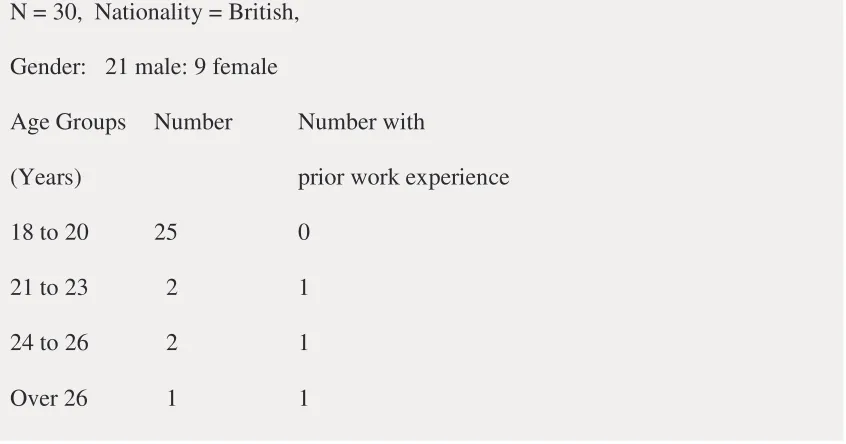
Approximately 85% of the student group were aged 20 years, commencing their
degree studies directly after ‘A’ levels (or equivalent university entry qualifications)
with no prior work experience. Students’ SWE took place in a variety of business
organisations, ranging from small accounting practices to public sector organisations
and large accounting firms, thus data are drawn from students with a wide exposure of
accounting SWE that itself offers a first introduction to the world of work, but more
importantly presents what may be the only opportunity which many students have to
develop work-based skills prior to graduating and seeking full-time employment.
The age, gender and prior work experience profiles of the students interviewed are
given in Table 1 below. In addition the grade point average (GPA scale of 0 to 6) for
an average GPA of 4.4. This compared to an average of 4.3 for the remainder of the
cohort.
Insert Table 1 here
Expectations and Construction of SWE
To assist the understanding of the reader, the number of students identifying each of
the key themes discussed below is indicated as a rating out of a maximum of 30
(x/30). In addition, the frequency of each key theme across all and within individual
students’ accounts is summarised in Appendix 1.
The analysis of students’ expectations of SWE reveals a number of commonalities,
the most frequent being that of ‘making myself more employable’ (27/30), followed
by an opportunity to ‘help me decide if I want a full time career in accounting’
(22/30) as a means of testing out career choices. That students had enrolled on a
vocationally-based degree may imply the intention to pursue an accountancy career.
However, research evidence suggests that students decide on a course of study for a
variety of reasons many of which use ‘vague or negatively focused reasoning’ (Gracia
and Jenkins 2002, p. 104) including pressure from family and friends, a failure to
achieve the grades for other programmes of study or merely drifting into courses. It is
evident that the subject of undergraduate study and career interests do not necessarily
coincide. Findings here support this and provide some insight into the career
A further common theme within students’ expectations is the lack of certainty about
the experience (28/30): ‘I don’t really know what to expect’; ‘I’ve never had a job
before, so the whole thing feels like a step into the unknown’. Analysis reveals that
these uncertainties give rise to a number of anxieties: ‘I feel very nervous about
it…I’m not sure I’ll fit in (17/30) or be able to cope (13/30)’. Students are also
concerned about being accepted into this new environment: ‘I don’t want to feel on
the outside of things’ (16/30), or not enjoying the experience: ‘I’m worried I won’t
like it’ (11/30), or of failing to be successful within it: ‘I’m anxious that I won’t be
any good at the job, be useless and just feel like a failure’ (24/30). Richardson and
Blakeney (1998) conclude that SWE is frequently a ‘painful’ experience for students.
The identification of students’ anxieties within this study supports and supplements
this finding, providing an indication of the nature of the ‘pain’ experienced in relation
to fitting in, being able to cope, unfamiliarity with employers’ expectations, feeling
accepted, not enjoying the experience and of feeling a failure.
Students’ accounts of their expectations of SWE are littered with emotional language,
descriptions of feelings and anxieties concerning their transition into SWE, indicating
a strong affective or emotional dimension to SWE transition. Frequently, HEI’s SWE
support for students focuses on the provision of factual information and guidance
which treats SWE transition as a cognitive or intellectual process. However, students’
accounts are inconsistent with this, demonstrating that it is a much broader, whole
person experience including the affective as well as cognitive realms. If HEI’s are
concerned about providing meaningful SWE support to students (in terms of
extent of their uncertainty, concerns and anxieties in order to better understand the
type of support that is required.
Beyond these commonalities, exploring students’ accounts of their expectations reveal
some prominent differences in terms of workplace learning conception - the students’
views or construction of their learning. Dahlgren and Marton (1978) identified two
broad categories of learning conception, each having a different orientation, which
were developed by others, most notably Marton, Dall’alba and Beaty (1993). The
polarisation of students into two types of learning approach, conception or mode is a
well-established practice within the education literature, mirrored in the work of
amongst others, Fromm (1982) who identified two modes of learning termed ‘having’
and ‘being’; Ramsden (1987) who identified two main approaches to learning
(namely deep and surface); and Mann (2001) who formulated two alternative
approaches to learning (namely alienated and engaged).
Within this study, the classification of students into two categories of learning
conception (termed ‘technical’ and ‘experiential’), followed the principles suggested
by Saljo (1979) that students should be categorised on the basis of their own personal
descriptions of their learning, by identifying dominant strands of description.
Moreover, students’ positioning within a particular category (at least in the short- to
medium-term) is relatively, though not entirely, fixed (Flood and Wilson, 2002). The
potential for movement does exist, but requires a degree of personal change and
self-development occurring over time.
Analysis of students’ accounts reveal that most (21/30) fall within this category,
typified by the following characteristics:
• Prioritise practical skills: ‘I think it’s important to focus on developing my
technical expertise…to get some practice of doing accounting’ (15/21).
• View SWE as providing knowledge - a product to be received: ‘I’m hoping to
learn things that I can take away and use at other times when I might need
them’ (16/21).
• Describe their contribution to the experience of SWE as restricted to an ability
to ‘remember and apply what I already know so that I can be useful’ (17/21).
• Consider SWE in terms of its potential to ‘increase my technical accountancy
knowledge’, and ‘improve my degree results’ (19/21).
• Hold a relatively simplistic understanding of the role of work experience in
developing employability: ‘I don’t think employers are that bothered about
what skills you have…what they are looking for is that you have worked and
you can work’ (12/21).
Experiential Conception (n=9)
Fewer students fell within this category (9/30), characterised by:
• Prioritise the process of learning: ‘I think the whole experience is more
important than the day-to-day things I’ll be doing’ (8/9).
• Recognise SWE as an experience: ‘I want to learn about the whole experience
• Position employment as fluid and dynamic: ‘Work these days is changing all
the time so it’s important to be able to adapt and change quickly, to respond to
what is going on around you’ (5/9).
• View themselves as active participants in their SWE: ‘I want to show my
employer how useful I am…make a difference within the organisation, really
make a contribution’ (8/9).
• Demonstrate awareness of the workplace context: ‘It’s important to be aware
of the nature of the business you work in, and what the organisation is trying
to achieve…otherwise you won’t be as effective as you should be’ (5/9).
• Understand the importance of soft or transferable skills development:
‘Working should help me to become better organised…maybe get better at
time management’ (6/9).
• Recognise SWE as an opportunity to engage in self-development beyond
technical skills: ‘It may transform me and the way I think…not just about
accounting but also about myself’ (8/9).
The next stage of the analysis explores the impact that the two identified conceptions
of workplace learning have on students’ SWE transition experiences.
Transition Experiences
For all students, regardless of their learning conception, the expectation that SWE has
the potential to be a ‘painful’ experience is evident within their transition experiences:
I’m supposed to be doing a lot of the time’ (26/30). Some describe the impact of this
on their self-confidence; ‘I’m normally quite a confident person, but I feel a bit out of
my depth and I tend to keep myself to myself’ (19/30). Students understood that
some of these early difficulties stem from their lack of understanding of what is
expected of them within SWE: ‘I don’t really feel like I know what is going on or
what I should be doing’: ‘It’s a bit like being dumped in a foreign land and not being
able to speak the language or understand what is going on around you’ (23/30). This
suggests that HEI’s and employers may need to be more explicit and inclusive about
the expectations of SWE they hold for students. A more collaborative, partnership
approach based on shared objectives may enhance students’ understanding of what is
required of them, reducing transition ‘pain’ and promoting more effective skills
development.
Students’ isolation is further exacerbated by the poor levels of support they report
from their HEI supervisors: ‘I haven’t seen my supervisor yet…I feel a bit abandoned
here…like the university have just forgotten about me’; ‘I had a meeting with my
supervisor yesterday, but he wasn’t very helpful…I’m finding it hard to settle in here
but he just ignored what I was saying…he wasn’t interested in talking about how I
was feeling’ (20/30). HEI’s need to more effectively support students during their
SWE perhaps in terms of moving away from individual learning transfer towards a
more integrated approach between students, employers and universities. Such a shift
would create different knowledges and practices based on shared objectives – what
Konkola, Tuomi-Grohn, Lambert and Ludvigsen (2007, p. 2) describe as ‘a collective
conceptualisation of transfer’, prioritising integration of theory and practice across
Turning the analysis to the comparison of the transition experiences of students with
differing experiential and technical conceptions of SWE reveals a number of
differences, explored through current understandings of learning transfer within
education theory. Learning transfer is essentially concerned with the application and
development of knowledge, skills, ability and practice across sector boundaries such
as exist between higher education and the workplace.
Findings suggest that students with a technical construction lean towards a cognitive
learning transfer approach. Here learning transfer occurs through the application or
adaptation of relevant and known relational patterns from prior academic learning
(either theoretical or practical) in order to solve current problems or issues: ‘At work I
try to remember what I have learnt and look at how I could apply that to the current
situation’; ‘I tend to rely on what I already know and draw on it to help me’ (17/21).
Students within this conception are reluctant to use more creative, flexible or intuitive
approaches to workplace learning: ‘I don’t think it is appropriate for me to think too
much for myself here…it’s more about using what I know to be useful’ (12/21).
‘Technical’ students thus favour cognitive learning transfer that relies on the
recognition and recall of pre-existing patterns of understanding or knowledge (mental
schemas) and their modification.
Criticisms or limitations of such cognitive learning transfer centre around its static
quality, ‘taking a given item and applying it somewhere else’ Konkola et al. (2007, p.
212) largely in isolation from the socio-cultural context of the situation (Hatano and
which the socio-cultural context of their SWE presents, in terms of developing
valuable employability skills such as communication and personal skills: ‘I don’t
think it matters where you do your placement…you can learn accountancy skills
wherever you are’: ‘Accountancy is really about being good with numbers and
understanding the rules so I don’t focus so much on the people around me or the
organisation too much’. This approach has implications for employability
development which the literature suggests is not focused on technical knowledge but
encompasses wider softer or transferable skills, highly regarded by employers
(HEFCE, 2003). Consequently, students with a technical conception may not be
positioned to fully exploit SWE’s usefulness in developing employability skills. In
contrast ‘experiential’ students who recognise the importance of soft skills may be
better placed to use SWE to develop employability skills.
The majority of students (21/30) within this study are categorised with a technical
conception of SWE, which is perhaps unsurprising given the finding of Konkola et al.
(2007) that higher education itself prioritises cognitive transfer as its dominant
learning approach, placing emphasis on individuals’ acquisition of knowledge rather
than situated learning. This may warrant consideration by HEI’s of the impact of its
learning transfer approach on employability development indirectly, through its
engagement with and shaping of students’ learning approaches. The impact of higher
education’s dominant approach to learning on students’ learning conceptions is an
area requiring further research.
In contrast, learning transfer for experiential students is more consistent with a
different activity contexts, such as higher education and the workplace; ‘The best
thing about being here is that I am learning about how the nature of a particular
business type impacts on the way accountancy is done’; ‘The way we learn things in
class is totally different to how things are really done in practice…it’s good to be able
to experience new ways of doing things’ (7/9).
Students with an experiential construct recognise that learning transfer is an active
and engaged phenomenon; ‘You have to just get stuck in and not worry too much
about not knowing enough’ (5/9). Students here understand learning transfer as
including personal development: ‘I’m learning more about myself and how I need to
be to be successful as I am about accounting’ (8/9). Such comments are characteristic
of a socio-cultural approach to learning transfer which Konkola et al (2007, p. 214)
describe as being ‘multi-dimensional and reciprocal…[where] it is not only the
knowledge that moves, but the entire human being, including his or her identity and
social participation, changes as well’. Such an approach positions SWE beyond
knowledge transfer to include engaged personal development which may enable such
students to more readily develop employability skills.
Drawing on the work of Mann (2001) provides a further opportunity to consider the
impact of different students’ conceptions on SWE transition. Mann (2001) identifies
two arguably rational responses by students to their transition into higher education –
namely alienated and engaged: ‘Most students entering the new world of the
academy are in an equivalent position to those crossing the borders of a new
country…they may have limited knowledge of the local language, and are alone…the
potential to impose their particular ways of perceiving and understanding the world’
(2001, p. 11). Extending this, it is arguable that students’ transition into SWE– where
they have to negotiate a ‘new world’ of employment with limited knowledge of the
language, procedures, and rules that exist, finding themselves in a strange place
surrounded by employers and workmates whose power relations and cultural
understandings impose unspoken ways of being on them - may be just as engaging or
alienating, the latter having the capacity to compromise the value of SWE to students.
Moreover, findings of this study suggest that students with different conceptions of
SWE display differing general patterns of SWE transition experience. This is
significant since Mann op cit. suggests that students who respond positively to
transition, engaging with it, are better able to derive benefit from the experience than
those who do not assimilate their new environment as readily and become alienated
from it.
Within this study, students with an experiential construction of SWE demonstrate
greater flexibility and creativity during their transition; ‘I have adapted really quickly
to the way they do things here…you have to be responsive’; ‘I learned really quickly
that I had to think on my feet and be able to be flexible to what was going on around
me’; ‘The best bit has been being able to think outside of what I know…use my
initiative to make decisions’ (8/9). An experiential disposition may enable students to
more readily respond to their workplace environments, rapidly adapting to the new
experience. They also indicate a general openness to change: ‘I’ve realised that what
I have learnt in university so far is not the whole picture…things are different in the
real world and you have to be able to accept that difference and work with it not
transition as being a more engaged experience: ‘I’m really enjoying it’; ‘Working here
gives me a good feeling…I feel like I’m really coming into my own now’ (7/9).
By contrast, students with a technical conception are more likely to describe their
workplace transition using language that indicates an alienated experience. They
express more resistance (in comparison to their experiential peers) to the changes that
placement learning brings, with a tendency to oppose this change and struggle with
assimilating the new environment or activities that contradict or challenge their
existing understanding: ‘Its difficult to get used to things here. They do things
differently to what we have learned and I find that confusing’; ‘I struggle with
reconciling what I have learnt with how things are really done in practice. It would be
a lot easier if they had just taught us how things really are in the first place’ (14/21).
Students’ response to change is less positive and indicates some resistance to it: ‘I
don’t like the way they do things here…I wish they did things the way I know how
to…I don’t want to have to relearn what I already know!’ (10/21) This may suggest
inadequate consideration of the context of their SWE and its impact on practices,
creating difficulty in negotiating the boundary between higher education and
workplace learning for these students.
It is evident that a technical construction may encourage a level of dissatisfaction with
SWE that leads to a more alienated experience and compromises students’ ability to
maximise the potential to be drawn from SWE: ‘I’m not very happy with the whole
thing really…its difficult to fit in and I’m not sure it’s the best use of my
Conclusion
Findings of this study suggest that students commonly anticipate SWE with some
degree of uncertainty of what is expected of them together with a range of emotional
anxieties (e.g. a fear of failure) which contribute towards the ‘pain’ of transition. This
suggests that SWE transition is as much an emotional process as it is an intellectual
one, which has implications for the type of support (including affective as well as
cognitive dimensions) and timing of it, that is required of HEI’s, particularly given
that many students identify current HEI support during their early SWE as being
inadequate.
Using existing patterns of students’ learning conceptions, student data was analysed to
classify students into two distinct categories - ‘technical’ and ‘experiential’. Students
with an experiential conception were found to frame SWE as a dynamic,
context-specific experience with which they actively engage, to prioritise the development of
soft, transferable skills in a process of personal development. In contrast, findings
indicate that students with a technical conception frame SWE as a practical,
knowledge-producing event within which they are largely passive recipients of
packages of knowledge.
Analysis indicates that students with a technical conception favour a cognitive
approach to learning transfer. In contrast, students with an experiential conception
tend towards a socio-cultural learning transfer that recognises the relationship
situated learning as an active and engaged process. The cognitive approach to
learning transfer is linked, within the literature, to restricted levels of creativity and
flexibility and this is supported by the findings of this study which also indicate that
such ‘technical’ students experience a more alienated SWE transition experience in
comparison to ‘experiential’ students, which may subsequently distance ‘technical’
students from SWE’s employability-enhancing potential.
In addition, this study finds that students with a technical disposition are not as
explorative as their experiential counterparts. It seems likely that, drawing on the
work of Barnett (2004), technically-focussed students arguably engage with SWE on
an epistemological basis that prioritises knowledge acquisition, whereas experiential
narratives suggest an affinity with SWE that uses an ontological basis that priorities
self-development. This is significant, since although research evidence suggests that
work experience develops both hard and soft skills, the current knowledge economy
(and employers) prioritise the latter, as knowledge becomes rapidly outdated.
Therefore, ‘technical’ students who view and engage with work experience to
improve their (hard) practical and technical accountancy skills may miss the
opportunity to improve desirable soft skills and hence fail to maximise the
‘value-added’ potential of SWE in terms of developing employability skills. Unlike their
experiential peers, they may find it more difficult to ‘make sense’ of SWE in a way
that enhances personal development and hence employability. Given this finding,
HEI’s may need to consider how best to collaboratively engage with their students to
encourage an experiential, process-based conception of workplace learning amongst
integrated. This would support students in being responsive to the current diverse and
Appendix 1 - Analysis of Key Themes
Key Theme Number of Students
Identifying Theme Theme Identified Within Total Number of Times All Accounts EXPECTATION
Enhance employability 27 127
Test out career choice 22 121
Fitting in 17 109
Ability to cope 13 88
Being accepted 16 119
Enjoying SWE 11 57
Uncertain of employer expectations
21 129
Failure 24 113
TRANSITION
Feelings of ‘newness’ 26 131
Self-confidence 19 114
Lack of understanding of
role 23 128
Inadequate mentor support 20 116
SWE as a process 8 66
SWE as an experience 7 69
Need to adapt and be responsive
5 71
Active participation 8 94
Awareness of context 5 53
Soft/transferable skills 6 72
Flexibility and creativity 8 86
Openness to change 7 77
Technical expertise 19 109
Practice of accounting 16 101
SWE as knowledge 16 94
Application/adaptation of existing knowledge
17 122
Experience new ways of learning/doing
7 85
Engaged process 5 49
SWE as self-development 8 92
Struggling with change 14 102
References
Ahmed, K., Alam, K.F. and Alam, M. (1997) An empirical study of factors affecting accounting students’ career choice in New Zealand, Accounting Education: an international journal, 6 (4), pp. 325-339.
Auburn, T. (2007) Identity and placement learning: student accounts of the transition back to university following a placement year, Studies in Higher Education, 32 (1), pp. 117-133.
Barnett, R. (2004) Learning for an unknown future, Higher Education Research and Development, 23 (3), pp. 247-260.
Beck, J. E. and Halim, H. (2008) Undergraduate Internships in Accounting: What and How do Singapore Interns Learn from Experience?, Accounting Education: an
international journal, 17 (2), pp. 151-172.
Brown, M. (2002) Feeling like a fully fledged psychologist, The Psychologist, 15 (12), pp. 629-630.
Cranmer, S. (2006) Enhancing graduate employability: best intentions and mixed outcomes, Studies in Higher Education, 31 (2), pp. 169-184.
Dahlgren, L. and Marton, F. (1978) Students’ conceptions of subject matter: an aspect of learning and teaching in higher education, Studies in Higher Education, 3 (1), pp. 25-35.
Dearing, R. (1997) Higher Education in the Learning Society – report of the National Committee of Inquiry into Higher Education. (London: National Committee of
Inquiry into Higher Education).
Dykxhoorn, H. J. and Sinning, K. E. (1999) Perceptions of master of accountancy graduates concerning their job search and employment experiences with public accounting firms, Journal of Accounting Education, 14 (4), pp. 415-434.
Duignan, J. (2003) Placement and adding value to the academic performance of undergraduates; reconfiguring the architecture – an empirical investigation, Journal of Vocational Education and Training, 55, pp. 335-350.
Easterby-Smith M., Thorpe R. and Lowe A. (1991) Management Research: An Introduction, (London: Sage).
Flood, B. and Wilson, R. M. S. (2002) Conceptions of Learning of Prospective Professional Accountants, Paper presented at the British Accounting Association Annual Conference, April 2002, Jersey.
Gillen, M. (1993) New models of co-operative education in Australia. Proceedings of the 8th World Conference on Co-operative Education, Dublin City University, pp. 43-44.
Glaser, B. J. and Strauss, A. (1967) The Discovery of Grounded Theory. (Chicago: Aldine).
Gracia, L. and Jenkins, E. (2002) An exploration of students’ failure on an undergraduate accounting programme of study, Accounting Education: an international journal, 11 (1), pp. 93-107.
Gubrium J. F. and Holstein J. A. (1997) The new language of qualitative method, (Oxford: Oxford University Press).
Harvey, L. (2001) Defining and measuring employability, Quality in Higher Education, 7, pp. 99-109.
Harvey, L., Moon, S. and Gaell, V. (1997) Graduates Work: Organisational Change and Students Attribute, (Centre for Research & Quality, Birmingham: University of Central England).
Hawkins, P., Butcher, V. and Jackson, P. (1999) Making the most of Work Experience, (London: The National Centre for Work Experience).
Haynes, K. (2008) Transforming identities: Accounting professionals and the transition to motherhood, Critical Perspectives on Accounting, 19(5), pp. 620-642.
HEFCE (2003) Widening Participation Initiative 2000-02. The Graduate Employability Project: enhancing employability of non-traditional students. www.londonmet.as.uk/gem accessed 15 October 2006.
Hussey, J. and Hussey, R. (1997) Business Research: A practical guide for undergraduate and postgraduate students, (Basingstoke: Macmillan).
Konkola, R., Tuomi-Grohn, T., Lambert, P. and Ludvigsen, S. (2007) Promoting learning and transfer between school and workplace, Journal of Education and Work, 20 (3), pp. 211-228.
Knight, P. T. (2001) Employability and quality, Quality in Higher Education, 7 (2), pp. 93-95.
Mann, S. (2001) Alternative perspectives on the student experience: alienation and engagement, Studies in Higher Education, 26, pp. 7-19.
Marton, F., Dall’alba, G. and Beaty, E. (1993) Conceptions of learning, International Journal of Educational Research, 19, pp. 277-300.
Morley, L. (2001) Producing new workers: quality, equality and employability in higher education, Quality in Higher Education 7 (2), pp. 131-138.
National Centre for Work Experience (1999) The Value of Work Experience for Undergraduates – a discussion paper for higher education institutions, (London: The National Centre for Work Experience).
Pare, A. and Le Maistre, C. (2006) Active learning in the workplace: transforming individual and institutions, Journal of Education and Work, 19 (4), pp. 363-381.
Patton, M. Q. (1987) How to use qualitative methods in evaluation, (Newbury Park, California: Sage).
Quality Assurance Agency (2001) The Framework for Higher Education in England, Wales and Northern Ireland. http://qaa.ac.uk/crnwork/nqf/ewni2001.html
Ramsden, P. (1987) Improving teaching and learning in higher education: the case for a relational perspective, Studies in Higher Education, 12, pp. 275-286.
Reinharz, S. (1992) Feminist methods in social research, (Oxford: Oxford University Press).
Richardson, S. and Blakeney, C. (1998) The Undergraduate Placement System: an empirical study, Accounting Education: an international journal, 7 (2), pp. 101-121.
Ryder, K. G. and Wilson, J. W. (1987) Cooperative Education in a New Era.
Understanding and Strengthening the Links between College and the Workplace, (San Francisco: Jossey Bass).
Saljo, D. (1979) Learning in the learner’s perspective, Reports from the Department of Education, Goteborg University, No. 76.
Schaafsma, H. (1996) Back to the real world: work placements revisited, Education and Training, 38 (1), pp. 5-13.
Tomlinson, M. (2007) Graduate employability and student attributes and orientations to the labour market, Journal of Education and Work, 20 (4), pp. 285-304.
Try, S. (2004) The role of flexible work in the transition from higher education into the labour market, Journal of Education and Work, 17(1), pp. 27-43.
Vaughan, K. and Roberts, J. (2007) Developing a ‘productive’ account of young people’s transition perspectives, Journal of Education and Work, 20 (2), pp. 91-105.
Wallace, R. and Murray, B. (1999) Good Practice in Industrial Work Placement, (Nottingham: Nottingham Trent University).
http://science.ntu.ac.uk/chph/improve/gpiwp.html.
Table 1: Student Profiles
N = 30, Nationality = British,
Gender: 21 male: 9 female
Age Groups Number Number with
(Years) prior work experience
18 to 20 25 0
21 to 23 2 1
24 to 26 2 1