Creativity, intelligence, and executive functions: Explaining the creativity-intelligence relationship through the involvement of executive functions
Raphael Kübler June 25th, 2018
University of Twente
Human Factors and Engineering Department of Psychology
Supervisors:
We examined whether executive functions were involved in creativity and intelligence and thereby could explain the creativity-intelligence relationship through directing the access, management, and retrieval of ideas. Twenty-four university students from the Netherlands were assessed on the Raven’s Advanced Progressive Matrices, the Remote Associates Test, a modified version of the Alternate Uses Task, the Stroop Task, the n-back Task, the Wisconsin Card Sorting Test, and the Category Fluency Task. A correlational design was applied to the variables fluid intelligence, convergent thinking, divergent thinking speed and creativity, processing speed, inhibition, shifting, and associative fluency. Based on the results of the Pearson Correlation analysis, three different standard regression analyses were conducted to examine the relationship between shifting and fluid intelligence, fluid intelligence and divergent thinking speed, and the relationship between processing speed and divergent thinking speed. Results showed that associative fluency was not correlated with divergent or convergent thinking. Furthermore were the executive functions not commonly involved in creativity or intelligence. However, processing speed and fluid intelligence were able to respectively explain a significant amount of variance in the divergent thinking speed. It was concluded that neither the numbers of associations nor the executive functions were beneficial to creativity or the creativity-intelligence relationship. The hypothesized model of the
1. Introduction...5
1.1. The creative thought processes...7
1.1.1. Divergent and convergent thinking ...7
1.1.2. Associative Fluency ...8
1.2. Executive functions ...8
1.2.1. Updating ...9
1.2.2. Inhibition ...9
1.2.3. Shifting ... 10
1.3. Fluid intelligence ... 12
1.3.1. Processing Speed ... 12
1.4. Models of the creativity-intelligence relationship ... 13
1.5. The present study... 14
2. Method ... 15
2.1. Overview ... 15
2.2. Participants ... 15
2.3. Materials ... 15
2.3.1. Fluid intelligence ... 16
2.3.2. Convergent thinking ... 16
2.3.3. Divergent thinking ... 17
2.3.4. Inhibition and processing speed ... 17
2.3.5. Updating ... 18
2.3.6. Shifting ... 18
2.3.7. Associative fluency ... 19
2.4. Procedure ... 19
2.5. Data analysis ... 20
reliability analysis ... 20
3.1.1. Raven’s Advanced Progressive Matrices ... 20
3.1.2. Remote Associates Test ... 21
3.1.3. Alternate Uses Task ... 21
3.1.4. Reaction time indicator ... 21
3.1.5. Stroop Task ... 22
3.1.6. n-back Task ... 22
3.1.7. Wisconsin Card Sorting Test ... 22
3.1.8. Category Fluency Task ... 23
3.2. Correlational analysis of the variables ... 23
3.3. Ravens’s Advanced Progressive Matrices and Wisconsin Card Sorting Test .. 24
3.4. Alternate Uses Task, Raven’s Progressive Matrices, and the reaction-time indicator ... 25
3.5. Summary of results ... 27
4. Discussion ... 27
4.1. Executive functions in the creativity-intelligence relationship ... 27
4.1.1. Executive functions and creativity ... 27
4.1.2. The relationship between executive functions and intelligence ... 29
4.2. The role of processing capacities in divergent thinking and fluid intelligence . 30 4.3. Limitations to the study ... 31
4.4. Summary and concluding remarks ... 31
1. Introduction
Creative problem-solving is characterised by generating ideas (divergent thinking) and evaluating these ideas (convergent thinking; Beaty et al., 2018). This process of idea production greatly relies on associative fluency since it is “the ability to activate, retrieve and combine associations” from memory (p. 316; Lee & Therriault, 2013). Contemporary creativity research investigates these divergent, convergent, and associative (e.g., Benedek, Fanz, Heene, & Neubauer, 2012; Lee & Therriault, 2013) thinking processes as the underlying cognitive structure of creativity. Recent studies found that the associative process of accessing, managing and controlling knowledge and ideas is directed by executive functions (e.g., Gilhooly, Fioratou, Anthony, & Wynn, 2007; Nusbaum & Silvia, 2011; Silvia, 2015). Executive functions influence lower-level cognitive processes and thereby drive the cognition of thought (e.g., Friedman et al., 2006; Lee & Therriault, 2013; Benedek et al., 2014). This has led back to the re-examination of the relationships between higher-order thinking processes creativity and intelligence1 (e.g., Nusbaum & Silvia, 2010; Lee & Therriault, 2013; Avitia & Kaufman, 2014). This debate dates back to the beginnings of creativity research which examined the creativity-intelligence relationship (e.g., Wallach & Kogan, 1965; Guilford & Hoepfner, 1966). Guilford’s Structure of Intellect model, for instance, theorized the creative processes convergent and divergent thinking to be part of intelligence. In contrast, currently, executive functions are investigated as the linkage between creativity and intelligence (e.g., Benedek et al., 2014; Silvia, 2015). The reason for this is that executive functions are also closely related to crystallized and fluid intelligence (Friedman et al., 2006). Particularly the executive functions updating, shifting, and inhibition2 are examined in the intelligence-creativity relationship. Since fluid intelligence is also linked to associative fluency (Lee & Therriault, 2013) and the speed with which individuals come up with creative ideas (Silvia, 2015), it is plausible, that the three executive functions account for the long-theorized linkage between creativity and intelligence. Furthermore, processing speed3 is a cognitive ability part of fluid intelligence (Papadopoulos, Georgiou, Deng, & Das, in press) which might also be beneficial for the speed of retrieving
1 Creativity here refers to the creative thought dichotomy of divergent and convergent thinking, involving associative fluency. Intelligence refers to crystallized and fluid intelligence. Fluid intelligence is the concept used
in this paper, which refers to the ability of reasoning and logical thought.
2 Updating is the ability to monitor and revise working memory content. Shifting is the ability to switch between mental sets. Inhibition is the ability to control response tendencies.
ideas as is shown in Silvia’s (2015) study. However, neither was the role of processing speed in one of the creative thought processes examined until now, nor was it not studied whether the executive functions updating, shifting, and inhibition relate to convergent thinking or associative fluency.
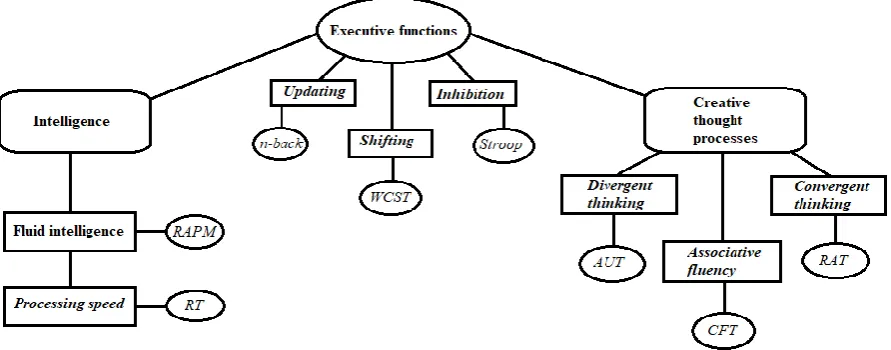
Taken together, new approaches emerged to investigate the creativity-intelligence relationship. However, the full spectrum of interrelations between the underlying cognitive processes of intelligence and creativity was not studied yet, making it the main aim of the present study. The emerging main research question, therefore, was whether executive functions are an explanatory factor in the creativity-intelligence relationship through their involvement in both, creativity and intelligence. In this study, we, therefore, first focused on the higher-order abilities characterising creative thinking. Afterwards, the executive abilities are explained and how they relate to creative thought. Intelligence and its underlying structure are examined and followingly, on basis of theories and theoretical models, the current study’s proposed view of the creativity-intelligence relationship is explained within a model. Figure 1 illustrates this view. The Raven’s Advanced Progressive Matrices was used as an assessment of fluid intelligence, the Remote Associates Test as measure of convergent thinking, and a modified version of the Alternate Uses Task as measure of divergent thinking. To assess the executive functions, the Stroop Task was used as a measure of inhibition and processing speed, the n-back Task as a measure of updating, and the Wisconsin Card Sorting Test as a measure of shifting. The Category Fluency Task was used to assess associative fluency.
Figure 1. Conceptual model of the theorized relationships between fluid intelligence, executive functions, and creative thought processes as based on literature. Constructs are given with the respective measurement. RAPM – Raven’s Advanced Progressive Matrices, RT – Reaction time indicator, WCST – Wisconsin Card Sorting Test, AUT – Alternate Uses Task, RAT – Remote Associates Test, CFT –
[image:6.595.76.522.499.674.2]1.1. The creative thought processes
1.1.1. Divergent and convergent thinking
In current research of higher-order creative cognition, the two mental abilities divergent thinking and convergent thinking form the dichotomy of creative thought (Benedek et al., 2012;
Lee & Therriault, 2013; Beaty et al., 2018). Divergent thinking is characterized by ideational processes that generate multiple, possible conclusions (Nusbaum & Silvia, 2011; Lee & Therriault, 2013). According to Guilford, divergent thinking is the basis for creative thought because it is defined by non-directional search for ideation without boundaries (Gibson, Folly, & Park, 2009). A standard assessment of divergent thinking is the Alternate Uses Task, which asks the participant to come up with unusual or alternative uses of a daily object such as a brick. It, therefore, involves the ability to generate ideas (e.g., what a brick can be used for).
Contrasting, creative convergent thinking encompasses cognitive processes narrowing thought and leading to single correct conclusions (Nusbaum & Silvia, 2011; Silvia, 2015). It is furthermore associated with the executive processes necessary for combining ideas (Lee & Therriault, 2013), and the evaluation of created ideas (Nusbaum & Silvia, 2011; Beaty et al. 2018). When applying this ability to the example of the generated usages of a brick, the question can be how a brick can be used to solve a problem. The participant then is asked to evaluate the generated idea on its usefulness. A more specific example of how convergent thinking is assessed is the Remote Associates Task. This task requires the participant to find the one fitting solution to a word triad. If the word triad is ‘strong, man, and lime’, then the participant needs to narrow down the generated solution by evaluating them. This process leads to the one fitting solution (i.e., ‘super’).
& Neubauer, 2012; Kenett et al., 2018). Specifically, Lee and Therriault (2013) found that associative fluency is an underlying cognitive structure related to divergent and convergent thinking. The present study, therefore, adopts Mednick’s view of associative abilities being the key factor for creative problem-solving.
1.1.2. Associative Fluency
Associative fluency is equivalent to the number of associations a person retrieves in
regard towards a priming concept (Benedek & Neubauer, 2013). Associative fluency, therefore, reasonably is related to creative idea production. The importance of this role can be recognized in Mednick’s conceptualization of creativity. Mednick (1962) defined “the creative thinking process as the forming of associative elements into new combinations which either meet specified requirements or are in some way useful. The more mutually remote the elements of the new combination, the more creative the process or solution” (p.221). Thus, the organization of associations is central in Mednick’s theory. Evidence for the structure of knowledge is found within contemporary semantic network research (Kenett, Anaki, & Faust, 2014; Jung & Vartanian, 2018).
A standard task of assessing associative fluency is the Category Fluency Task. Here, the participant is asked to come up with as many ideas as possible in regard to two categories. For example, one category can be animals. The participant thus is required to retrieve all ideas associated with animals within a set timeframe. A greater number of associations retrieved indicates a greater network of associations which is shown to be beneficial in divergent and convergent thinking (Lee & Therriault, 2013). However, even though several studies show the importance of the amount and organization of knowledge in creative ideation, Silvia (2015) points out that “how people access, manage, and control their knowledge has been overlooked” (p. 15). That is, to generate ideas, the existing associations must be accessed. In contrast to the view of the individual’s knowledge structure being central to creativity, the present study, therefore, focuses on the view that higher creativity is also connected to more effectively managing knowledge and its contents (Beaty & Silvia, 2012; Benedek & Neubauer, 2013). 1.2. Executive functions
functions. In general terms, executive functions are essentially involved in higher-order cognition (Benedek et al., 2014). Characteristic of executive functions is their influence on lower-level cognitive processes, enabling individuals the regulation of thoughts and actions during goal-directed behavior (Miyake & Friedman, 2012; Friedman & Miyake, 2017). It is thus reasonable that executive functions are involved in creativity, whose involvement is also focus of current creativity research. Commonly assessed executive functions include updating, inhibition, and shifting (Miyake & Friedman, 2012; Benedek et al., 2014; Friedman, 2016; Friedman & Miyake, 2017).
1.2.1. Updating
Updating refers to the constant monitoring and revision of working memory contents (Miyake & Friedman, 2012). A validated and reliable task indicating the executive function updating is the n-back Task. It requires the participant to continuously update the content of working memory in order to maintain the last n presented elements as well as it asks to monitor whether the given stimulus matches with the one n back (Miyake & Friedman, 2012). Benedek et al. (2014) reported that updating is closely related to divergent thinking. The generation of ideas thus seems to be dependent on the ability to activate and retrieve memory contents, but also to monitor them in relation to a specific goal. Benedek et al. (2014) further suggest that, in order for creative responses to be retrieved, inhibition is necessary to inhibit dominant responses that are generic and not creative. It should be noted that they only used a divergent thinking task as an indicator of creative thought, whereas dual-process theories suggest both, convergent and divergent thinking as important contributors to creativity (Beaty et al., 2018). Furthermore, since associative fluency is involved in both, convergent and divergent thinking, the present study proposes that updating is necessary to access the associative structures and thereby exerts influence on creativity. Even more, it can be argued that the ability to monitor the working memory content is necessary to evaluate the generated ideas and thereby supports the process of convergent thinking.
1.2.2. Inhibition
(2014) found that inhibition was directly related to divergent thinking. Furthermore, Benedek et al. (2012) found that inhibition was positively related to ideational fluency and divergent thinking. This evidence lends hand to the interpretation that higher inhibition enhances the ability to access the individual’s knowledge structures as well as the production of ideas. More specifically, it is proposed that through this influence a better ability to inhibit dominant responses is generally beneficial to divergent and convergent thinking by enabling the access to more remote ideas and the access to ideas in a goal-directed manner. However, the way inhibition relates to convergent thinking was not studied yet. Through the nature of inhibition, it can be assumed that the ability to suppress goal-unrelated ideas is particularly beneficial to narrow down the generated ideas in a goal-directed manner (Beaty & Silvia, 2012). This would particularly be necessary in the Remote Associates Task to find the one fitting solution and suppress the responses that do not fit (Lee & Therriault, 2013). For this to work, updating is necessary in order to enable the evaluation of the generated ideas in regard to how they fit the problem.
1.2.3. Shifting
Shifting is the ability to switch between tasks or mental sets (Miyake & Friedman, 2012). This includes reaction to changes in conditions, requiring the thinker to adapt different rules and responses that are more appropriate to the situation (Benedek et al., 2014). Gabora proposed that spontaneous shifts between analytic and associative thinking modes are necessary for creative ideation (Jung & Vartanian, 2018). In this case, problem-solving then involves applying different strategies flexible in relation to task demands. Moreover, the shifting between different modes of attention was also proposed to be necessary as the ability to see the large picture and its details (Jung & Vartanian, 2018). Such an interpretation of the shifting ability places importance on its role within creative processes, because it would link convergent and divergent thinking.
flexibility is related to divergent thinking. Zabelina, Colzato, Beeman, and Hommel (2016) also reported cognitive flexibility to be related to divergent thinking, and discovered that the link for this is dopaminergic polymorphisms. Cognitive flexibility involves not only shifting ability but also inhibition as a constituting part of it (Zabelina & Robinson, 2010; Ropovik, 2014). Particularly, the flexibility in perspective should allow the access to more remote and uncommon ideas, and thereby benefit creative thinking (Benedek et al., 2014). For instance, shifting could enable the flexible shift between numerous associations and thereby enabling the ability to create uncommon ways of thinking about a problem. We will further refer to it as shifting since all executive functions are particularly constituted by inhibition (Friedman & Miyake, 2017). A task that assesses cognitive flexibility is the Wisconsin Card Sorting Test (Nyhus & Barceló, 2009; Ropovik, 2014). The Wisconsin Card Sorting Test thus might be a good opportunity to assess the ability to flexibly shift between analytic and associative modes that are important in divergent thinking. Furthermore, it could provide more insight into the executive nature of convergent thinking, and how the creative thought dichotomy can be explained.
1.3. Fluid intelligence
Fluid intelligence is the ability to solve novel problems by using reasoning, analytic capacities, and abstract thought (Chuderski & Nęcka, 2010; Shipstead et al., 2016). Fluid intelligence is typically measured by Raven’s Progressive Matrices (Roca et al., 2009). In Raven’s Progressive Matrices, the participant is required to analyze geometrical problems and reach the solution through reasoning with new and abstract material. Raven’s Progressive Matrices thus measures fluid intelligence as the ability to solve unfamiliar problems by applying a variety of mental abilities, problems that do not require past learning or experience (Avitia & Kaufman, 2014).
Executive functions that support the process of novel problem-solving are particularly updating and inhibition (Friedman et al., 2006). It is theorized that updating is closely connected to fluid intelligence because of their relation to working memory capacity. Inhibition then enables attentional control which is necessary for controlled information processing or revision of working memory content. This can be conceived by citing Binet’s definition of intelligence: ‘‘[It] consists of two chief processes: First to perceive the external world, and then to reinstate the perceptions in memory, to rework them, and to think about them’’ (translation by Carroll, 1993, p. 35 cited in Friedman et al., 2006). It thus becomes clear that the linkage between fluid intelligence and associative, convergent, and divergent thinking processes is within the executive functions updating and inhibition. These could enable the access and management of ideas and thereby enable higher-order thought in analytic and creative form. It then also becomes evident that the ability to access and manage knowledge is dependent on the individual’s capacity of information processing. This ability is also inherent to fluid intelligence.
1.3.1. Processing Speed
Processing speed refers to the cognitive processing of information, as assessed by simple reaction time. Processing of information is closely associated with working memory and updating. Within working memory, information processing takes time, there is thus a capacity with which an individual encodes, transforms, or retrieves information (Conway et al., 2002). Thus, the amount of information which an individual is able to process within one unit of time increases with a faster rate of processing (Conway et al., 2002).
processing speed to be a sub-trait of fluid intelligence. A faster processing speed is often found to predict better performance on intelligence tests. Fink and Neubauer (2005), for example, found that processing speed is highly correlated with fluid intelligence (r = -.50). The fluid intelligence of an individual thus is strongly related to the individual’s capacity of information processing. Beaty’s and Silvia’s (2012) study showed that higher fluid intelligence is related to faster creative thinking. Participants that were more creative and high in fluid intelligence would come up with more creative ideas within a set timeframe. The relation here could be processing speed, enabling a creative person with higher fluid intelligence to handle a greater number of associations and ideas and to retrieve these.
1.4. Models of the creativity-intelligence relationship
To converge the painted picture of the interplay between the cognitive abilities underlying creativity and intelligence, a model of the proposed creativity-intelligence relationship is explained on the basis of foregoing theories, studies, and Carroll’s three-stratum model (Carroll, 1993). Carrol’s three-stratum model theorizes a relationship between intelligence and creativity. This model separates general intelligence into general crystallized intelligence and general fluid intelligence and these again into more narrow abilities. In contrast
to fluid intelligence, crystallized intelligence refers to an individual’s accumulated knowledge and the ability to use that knowledge in problem-solving. This form of intelligence is thus more static and represents what a person knows from experience, culture, learning, and education (e.g., vocabulary and general knowledge). Although the form of this knowledge is static, it is accumulated over a lifetime and, therefore, changes during life. To access the gained knowledge, crystallized intelligence entails the ability to retrieve information from long-term storage (Glr; Avitia & Kaufman, 2014).
intelligence, it is furthermore proposed that another linkage between both types of intelligence are the executive functions updating, shifting, and inhibition. This then represents the creativity-intelligence relationship.
Benedek et al. (2014) reported that updating is the most important executive function in the linkage between fluid intelligence and divergent thinking. Even more, Lee and Therriault (2013) reported that fluid intelligence predicts divergent and convergent thinking through associative fluency. The present study, therefore, assumes that the reason for this link is the executive function updating. Since Benedek et al. (2012) found that inhibition is related to ideational fluency, divergent thinking, and fluid intelligence, inhibition is also proposed to depict a link between fluid intelligence and divergent thinking. Shifting was only found to be related to divergent thinking. However, studies suggest that not all shifting measures correlate with intelligence measures (Friedman, 2016). It is still to be explored whether using the Wisconsin Card Sorting Test as indicator of shifting can make a link between the measures of fluid intelligence and associative, convergent, and divergent thinking visible.
Furthermore, there is incongruency in findings to what extent inhibition, shifting, and updating really contribute in a differential or common manner to fluid intelligence or associative fluency, or divergent and convergent thinking. For example, Benedek et al. (2014) reported a linkage between inhibition and divergent thinking, but not between inhibition and fluid intelligence. Miyake et al. (2006) contrasted this and only found that updating contributes to fluid intelligence, but not to crystallized intelligence. In addition, this is the first study to examine to what extent the executive functions updating and shifting contribute to convergent thinking and associative fluency. Inhibition, too, was never assessed regarding convergent thinking. The study on how executive functions thus indeed contribute to the creativity-intelligence relationship by being involved in their underlying cognitive structures is still an open question. The explained proposed model is illustrated in Figure 1.
1.5. The present study
It is plausible that the functional involvement of the executive functions updating, shifting, and inhibition in associative fluency are responsible for this relationship. However, there are no recent studies that directly investigated such relationship more thoroughly, requiring it to be experimentally tested. The present study, hence, aimed at answering the research question whether the creativity-intelligence relationship can be explained by the involvement of executive functions in creativity and intelligence. The hypothesis, therefore, was that individual differences in executive abilities can explain the relationship between the creative thought processes and intelligence. To this end, we used measures of fluid intelligence, associative fluency, convergent thinking, and divergent thinking. Furthermore, we used indicators of the executive function facets updating, shifting, and inhibition. The relationships between the results were analyzed within a correlational framework.
2. Method
2.1. Overview
In the experiment reported here, a correlational design was applied. In the first session, participants were given the Advanced form of Raven’s intelligence test and the Dutch version of the Remote Associates Test. In the second session participants carried out the Alternate Uses Task, the Stroop test, the n-back Task, the Wisconsin Card Sorting Task, and the Category Fluency Task.
2.2. Participants
Twenty-four (5 female, 19 male) undergraduate student volunteers from the University of Twente (UT) participated in this study. Ages ranged from 18 to 29 years (M = 21.04, SD = 2.90). Participants applied through an online system provided by the UT (SONA-System) through which they were rewarded three and a half SONA study-points for participation. Because of the Dutch version of the Alternate Uses Task, only subjects with Dutch as first language. Furthermore, no colorblind subjects were included. Informed consent was obtained from all participants. No data was excluded. The procedure was in line with the Declaration of Helsinki as approved by the BMS (Behavioural, Management and Social sciences) Ethics Committee of the UT.
2.3. Materials
Stroop test, the n-back Task, and the Wisconsin Card Sorting Task were administered on PC either using Presentation or PEBL (Psychological Experiment Building Language) software. A 24-in. color monitor with 140 hertz display rate was used to display the stimuli.
2.3.1. Fluid intelligence
Fluid intelligence was measured by using Raven’s Advanced Progressive Matrices. It consisted of one set of 36 multiple choice items. Each item presented a 3 x 3 matrix of black and white geometric figures with one section of the matric missing. The participant was asked to identify the correct figure missing out of eight possible answer options. Each correct response was scored as one point with a maximal score of 36. The Raven’s Advanced Progressive Matrices measures fluid intelligence in form of the raw total score. Psychometric properties are satisfactory. COTAN rated the norms as insufficient because they were too old. Literature reports internal consistency (split-half reliabilities r = .8 to r = .9) and test-retest reliability (r = .83) to be high, as well as high correlations with the full-scale Wechsler Adult Intelligence Scale (r = .74; Bors & Stokes, 1998).
2.3.2. Convergent thinking
2.3.3. Divergent thinking
Divergent thinking was assessed with a modified version of the Alternate Uses Task in Dutch. The task consisted of three blocks each consisting of 52 word pairs the participant was asked to evaluate. Participants were randomly distributed over six possible block conditions. Word pairs represented the common, creative, and impossible uses of objects which should be evaluated according to how (un)usable and (un)common they seemed. Two scales were used as an indicator of commonness and usability. Keys ‘M’ and ‘Z’ (common and uncommon) were used to evaluate the commonness and keys ‘M’, ‘N’, ‘X’, and ‘Z’ were used to evaluate the usability (usable, a bit usable, a bit unusable, and unusable). Two versions of the task existed which differed in sequence of keys (left and right counterbalanced across participants). For the right-handedness condition, the given sequence of keys as indicators was used whereas for the left-handedness condition the sequence of keys was reversed. Subjects were also distributed randomly over handedness condition. Participants conducted a practice block with 15 word pairs beforehand, which was evaluated to see whether they grasped the instructions right or not. A threshold of 80 percent correct responses was applied. The modified version of the Alternate Uses Task is thought to involve cognitive processes necessary for evaluation and semantic processing creative ideas necessary for creativity (Rataj, Nazareth, & van der Velde, 2017). Proportion of correct and incorrect responses as accuracy measure indicated creativity of responses. Reaction-times for correct responses on the two questions were used as a general indicator of the participant’s semantic processing capacities involved in evaluating creative ideas.
2.3.4. Inhibition and processing speed
A computer-based Dutch version of the Stroop Task was used as an indicator of inhibition ability and processing speed. Participants were shown the words ‘rood’ (red), ‘geel’
indicator of inhibition (i.e., the smaller the interference in reaction time, the higher the inhibition ability). The Stroop effect emerges during interference of conflicting information (i.e., when the color does not match the word). The reaction time during the interference trials thus is slowed down through information that is task-irrelevant or counterproductive. Neutral trials, in contrast, are used to control whether this effect is related to the task demands. Thus, the Stroop interference effect is indicated by calculating the difference in mean reaction time between all incongruent and neutral trials. The Stroop task was obtained from PEBL’s experimental task battery (Mueller, 2014).
2.3.5. Updating
A computer-based n-back Task was used as an indicator of the subject’s updating ability. It presented a total of 50 color blocks on white background at a pace of 1 s per color block. The task was to indicate whether the current shown color block was identical with the one shown two stimuli back by clicking the left mouse button. Three blocks were assessed differing in whether the target was located zero, one, or two back. Miyake and Friedman (2012) found that the n-back Task is a valid measurement of the executive function updating. Generally speaking, n-back tasks are often used as prevalent measure of updating ability (Benedek et al., 2014; Friedman and Miyake, 2017). The task was obtained from the Neurobehavioral Systems inventory of experimental tasks.
2.3.6. Shifting
ability. The Wisconsin Card Sorting Test was obtained from PEBL’s experimental task battery (Mueller, 2011). A cut-off score of 25% was handled, speaking that a participant above this threshold did not pay attention during the task.
2.3.7. Associative fluency
A common measure of associative fluency is the Category Fluency Task. The Category Fluency Task is a free-association task in which the participant was asked to generate as many associations as possible to the presented concept ‘animal’ and ‘job’. For each category the participant had two minutes time to write down all associated ideas. The total number of appropriate responses was used as the total score and can be considered as an indicator of associative fluency.
2.4. Procedure
Each participant was seated in a small room, 60 cm in front of a 24-in. PC computer monitor in a quiet laboratory of the University of Twente. Chair heights were not adjustable. In advance, Ishihara’s colorblindness test was conducted in online form to assess whether the participant had problems with color vision. An online laterality questionnaire was also completed at the facility’s apparatus. Participants signed up for both parts of the study with a maximum of seven days in-between. Distribution of participants was counterweighed by allocating them evenly in conditions of block order and left- or right-response condition (see section on Alternate Uses Task). Six different block order conditions for the Alternate Uses Task were established with even distribution of all participants (four participants for each of the six block orders).
2.5. Data analysis
The data was analyzed for normal distribution, outliers, and reliability of measurements. After this step, descriptive statistics were calculated. Then, the correlations between all variables by executing a two-tailed bivariate Pearson Correlation were examined. To examine the hypothesized relations that were found to be significant, simple linear regression analyses including the constant, with 95-% confidence intervals, and testing for collinearity were executed.
3. Results
3.1. Data distribution, outlier analysis, descriptive statistics, and results of reliability analysis
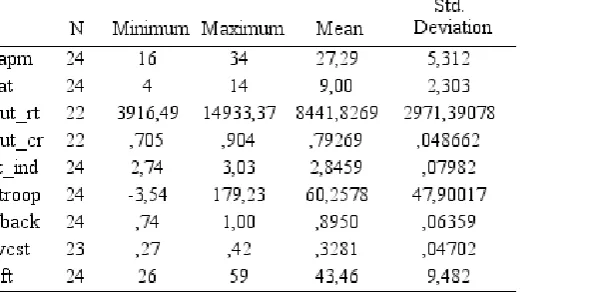
[image:20.595.84.387.543.689.2]It was analyzed whether the data was approximately normally distributed. For each variable, a Shapiro-Wilk’s test (p > .05) and a visual inspection of their histograms, normal Q-Q plots and box plots was executed. Outliers were checked for through inspection of box plots and handling a cutoff z value of 2.5 for standardized values of the data. Reliability analysis was conducted for the modified Alternate Uses Task, the Stroop Task, the n-back Task, and the Category Fluency Task. Reliability analysis of the Wisconsin Card Sorting Test was not conducted due to missing data input for this analysis. Afterwards, the scores of the participants were analyzed by using SPSS, for results see also Table 1. Only correct responses were used as indicators.
Table 1
Summary of Minimum, Maximum, Means, and Standard Deviations for Scores of Key Study Variables.
Note. rapm = Raven’s Advanced Progressive Matrices (raw scores); rat = Remote Associates Test (raw scores); aut_rt
= Alternate Uses Task reaction-times (in milliseconds); aut_cr = Alternate Uses Task response accuracy; rt_ind =
neural trials Stroop Task (in milliseconds); stroop = Stroop Task (Stroop effect); n-back = n-back Task (response
accuracy); wcst = Wisconsin Card Sorting Test (proportion perseverative errors); cft = Category Fluency Task (raw
3.1.1. Raven’s Advanced Progressive Matrices
Indicator of fluid intelligence were the total scores of each participant on the Raven’s Advanced Progressive Matrices. Scores were normally distributed. No outliers were detected.
3.1.2. Remote Associates Test
The indicator of convergent thinking was the total score on the Remote Associates Test. Scores were also normally distributed. No outliers were detected.
3.1.3. Alternate Uses Task
For semantic processing capacities, the mean reaction-times (RT) in milliseconds (ms) of correct trials on the three task blocks of the modified Alternate Uses Task was extracted. The RTs for responses on both questions were extracted to function as a general indicator of semantic processing capacities. For creativity of responses, proportion of correct responses were taken as separate indicators. Mean accuracy of responses on block one was 77.8%, on block two 78.2%, and on block three 81.6%. The data distribution analysis showed that reaction-time (RT) scores of the modified Alternate Uses Task were not normally distributed, with a skewness of 2.59 (SD = .481) and a kurtosis of 8.62 (SD = .935). Using the cutoff z score, two outliers were identified (z = 2.5 and z = 3.64). These two outliers were also detected when visually inspecting the box plots. Both outliers were removed from the Alternate Uses Task dataset. The first one, because the participant had fewer than 70% correct responses (69% responses correct), suggesting that this participant did not comprehend the goal of the task or was not paying attention. The second one was eliminated, because a mean RT three- to fourfold as high compared to the RT mean of the dataset suggest a technical error during the measurement. This participant could not have completed the task within the set time limit of the second part of the study (80 minutes). The outliers were eliminated from the further analysis. After eliminating the outliers, the data was normally distributed. Internal consistency of RT scores across the three blocks was good (Cronbach’s α = .88). Internal consistency of correct response proportions across the three blocks was also good (Cronbach’s α = .84).
3.1.4. Reaction time indicator
the interpretation of this value being an outlier (z = 2.32). In addition, there was no reason to assume technical errors. The outlier, therefore, was considered to be an extreme value of the sample but was not eliminated from the further analysis. The internal consistency of the three measured conditions on the Stroop Task was acceptable (Cronbach’s α = .71). A logarithmic transformation was executed with this variable. After this transformation, the data was normally distributed, and no outliers were detected.
3.1.5. Stroop Task
The indicator of inhibition was the RT in milliseconds on neutral trials subtracted from RT on incongruent trials. The data was normally distributed. A paired samples t-test with incongruent and neutral trials showed that the incongruent condition caused larger response delay than the neutral condition (t(23) = 5.04, p < .001, CI [39.02, 93.29]). The Stroop Task used in this experiment thus can be used to assess inhibition. For reliability of the Stroop Task see also the section on processing speed.
3.1.6. n-back Task
Updating was indicated by the proportion of correct responses on the n-back Task. The data was normally distributed. A split-half reliability analysis of even and uneven numbered trials was carried out to determine internal consistency. The correlation coefficient for the two halves was r = .652.
3.1.7. Wisconsin Card Sorting Test
3.1.8. Category Fluency Task
Associative fluency was indicated by total scores on the Category Fluency Task. The data was normally distributed. Internal consistency of correct responses across the two categories was excellent (Cronbach’s α = .90).
3.2. Correlational analysis of the variables
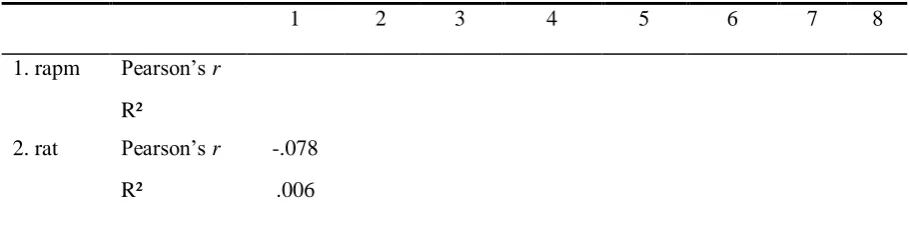
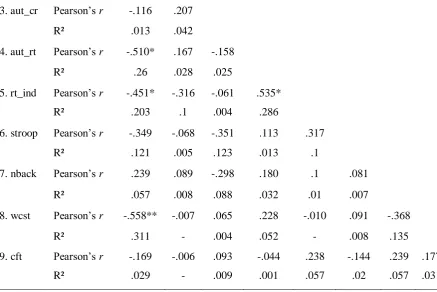
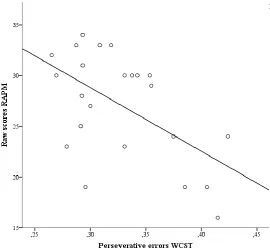
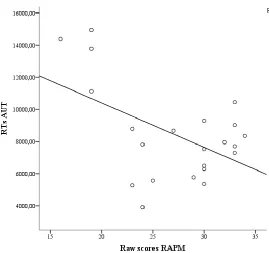
[image:23.595.70.525.634.747.2]Table 2 shows the correlation matrix. Unexpectedly, raw scores on the associative fluency measure were neither statistically significant correlated with results of the divergent thinking measure, nor with raw scores on the convergent thinking measure. Neither were associative fluency scores, divergent thinking response accuracy and response times, or convergent thinking scores significantly correlated with preservative errors on the shifting measure, differences in the Stroop effect, or accuracy on the n-back measure. Only preservative errors on the shifting measure were significant negatively correlated with raw scores on the fluid intelligence measure, Pearson’s r(23) = -.558, p = .006. Participants making less perseverative errors on the Wisconsin Card Sorting Test thus scored higher in Raven’s Advanced Progressive Matrices. As expected, however, response times on the divergent thinking measure were statistically significant negatively correlated with raw fluid intelligence scores, Pearson’s r(22) = -.510, p = .015. Participants that scored higher in Raven’s Advanced Progressive Matrices thus were faster in reacting during the modified Alternate Uses Task. RTs on the divergent thinking task also showed a significant positive correlation with RTs on the processing speed measure, Pearson’s r(22) = .535, p = .010. Participants that reacted faster during the neutral trials on the Stroop Task thus also reacted faster on the modified Alternate Uses Task. Lastly, and as expected, a statistically significant negative correlation between response times on the processing speed measure and raw fluid intelligence scores was found, Pearson’s r(24) = -.451, p = .027.
Table 2
Pearson Correlations and R² Among and Descriptive Statistics for Key Study Variables.
1 2 3 4 5 6 7 8
1. rapm Pearson’s r
R²
2. rat Pearson’s r -.078
Table 2 (continued)
Pearson Correlations and R² Among and Descriptive Statistics for Key Study Variables.
3. aut_cr Pearson’s r -.116 .207
R² .013 .042
4. aut_rt Pearson’s r -.510* .167 -.158
R² .26 .028 .025
5. rt_ind Pearson’s r -.451* -.316 -.061 .535*
R² .203 .1 .004 .286
6. stroop Pearson’s r -.349 -.068 -.351 .113 .317
R² .121 .005 .123 .013 .1
7. nback Pearson’s r .239 .089 -.298 .180 .1 .081
R² .057 .008 .088 .032 .01 .007
8. wcst Pearson’s r -.558** -.007 .065 .228 -.010 .091 -.368
R² .311 - .004 .052 - .008 .135
9. cft Pearson’s r -.169 -.006 .093 -.044 .238 -.144 .239 .177
R² .029 - .009 .001 .057 .02 .057 .031
Notes. n’s range from 21 to 24 due to occasional excluded data. rapm = Raven’s Advanced Progressive Matrices.
rat = Remote Associates Test; aut_cr = Alternate Uses Task accuracy; aut_rt = Alternate Uses Task RTs; rt_ind =
neural trials Stroop Task; stroop = Stroop Task; nback = n-back Task; wcst = Wisconsin Card Sorting Test; cft =
Category Fluency Task.
* p < .05.
** p < .01.
3.3. Ravens’s Advanced Progressive Matrices and Wisconsin Card Sorting Test
[image:24.595.77.515.105.397.2]The relationship between the raw scores on the fluid intelligence measure and perseverative errors on the shifting measure was further examined in a simple linear regression analysis. Less perseverative errors on the shifting task predicted higher raw scores on the fluid Table 3
Model summarya of a regression analysis where raw scores on Raven’s Advanced Progressive Matrices
were predicted by perseverative errors on the Wisconsin Card Sorting Test (wcst; after logarithmic
[image:24.595.68.515.699.747.2]intelligence task and accounted for 28% of the variance in fluid intelligence scores (Table 3), Beta = -558, t(23) = -3.08, p =.006, CI [-105.06, -20.36]. Figure 2 illustrates this relationship.
3.4. Alternate Uses Task, Raven’s Progressive Matrices, and the reaction-time indicator
Based on the correlations, two simple linear regression analyses including the constant with 95-% confidence intervals were calculated. The first predicted RTs on the divergent thinking measure through raw scores on the fluid intelligence task. Fluid intelligence scores were found to explain a significant amount of the variance in individual differences in RTs on the divergent thinking measure, F(1,20) = 7.03, p = .015, R² = .26, R2Adjusted = .223. Figure 2
illustrates this relationship, Beta = .535, t(20) = -3.08, p = .010, CI [5318.358, 34974.32]. The second simple regression analysis predicted RTs on the divergent thinking measure through RTs on the processing speed measure. The model was found to be significant. RTs on the processing speed measure could explain 26% of the variance in individual differences of RTs on the divergent thinking measure, F(1,20) = 8.03, p = .015, R² = .287, R2Adjusted = .251. Figure
[image:25.595.74.345.127.377.2]3 illustrates the relationship in a scatterplot.
[image:26.595.74.344.71.324.2]
Figure 3. The linear relationship between raw scores on Raven’s Advanced Progressive Matrices predicting RTs on the modified Alternate Uses Task (AUT; after logarithmic transformation) in a scatterplot.
[image:26.595.78.378.429.672.2]3.5. Summary of results
The reported findings can be summarized as not anticipated, contradicting the hypothesized model. Raw scores on the associative fluency measure neither correlated with raw scores on the convergent thinking measure, nor with RTs or accuracy on the divergent thinking measure. Most important of all then was that neither the results of the inhibition measure, the accuracy of responses on the n-back Task, nor preservative errors on the Wisconsin Card Sorting Test were significantly correlated with these variables. This contradicts the assumed model. Only the results of the shifting measure were significantly correlated with the results of the fluid intelligence measure. However, RTs on the processing speed indicator and raw scores on the fluid intelligence task were both significant predictors of RTs on the divergent thinking measure.
4. Discussion
4.1. Executive functions in the creativity-intelligence relationship
The purpose of this study was to investigate the functional relationship between creative thought processes and intelligence. It was proposed that the creativity-intelligence relationship emerges through the common connection of both concepts with executive functions. The assumed model was that the executive functions updating, shifting, and inhibition are related to associative fluency to retrieve ideas, manage them, and thereby support divergent and convergent thinking. At the same time, it was proposed that at least the executive functions updating, and inhibition are involved in fluid intelligence, which then could explain the creativity-intelligence relationship. We first discuss the involvement of executive functions in creativity and intelligence and what it means in regard to the assumed model. Then we discuss the involvement of intelligence and processing speed in creativity.
4.1.1. Executive functions and creativity
We examined whether executive functions are related to creativity. To this end, we used a n-back Task to assess updating, the Wisconsin Card Sorting Test to measure shifting, and a Dutch Stroop Task as indicator of inhibition. To assess creativity, we used a modified version of the Alternate Uses Task to assess divergent thinking, the Remote Associates Task as convergent thinking measure, and the Category Fluency Task as a measure of associative fluency. We discuss the meaning of our results for the links between each executive function facet and creative thought process.
ability to revise the memory content and thereby enabling the retrieval of information (Miyake & Friedman, 2012). Our study was the first to examine this link, but the findings suggest that the hypothesized link is contradicted. A possible explanation might be that updating, as part of the working memory system (Baddeley, 2012), is only indirectly related to associative fluency through working memory. Working memory, in turn, is directly related to associative fluency (Lee & Therriault, 2013). On the other hand, Benedek et al. (2014) found that updating is directly related to divergent thinking, which is also discrepant with what our findings suggest. We used a modified version of the Alternate Uses Task which could account for this discrepancy with our finding. In this version, the focus was less on generating ideas than on evaluating given word-pairs on their uncommonness/commonness and usability. Yet, during this process of evaluating ideas, updating was proposed to be necessarily involved, because it enables the monitoring of ideas. Seemingly, the ability to monitor or revise working memory content is also not directly related to the evaluative process of creative thinking. This is also reflected in our findings that measures of updating did not correlate with measures of convergent thinking. Though the executive function updating is thought to be involved in directing higher-order thought (i.e., intelligence or creativity; Bendek et al., 2014), our results show that this is not the case.
Our findings, furthermore, indicate that the ability to inhibit dominant response tendencies or task-irrelevant information is not related to the ability of accessing, retrieving, and managing ideas, although a greater cognitive control was shown to benefit higher associative fluency (Gilhooly et al., 2007). This finding contrasts the idea that suppressing goal-unrelated ideas would be beneficial for accessing memory (Beaty & Silvia, 2012). However, one explanation can be that the words ‘jobs’ and ‘animals’ had such a strong priming effect on activating the associative structures that task-irrelevant information would not come up within the set time frame to begin with. This idea is consistent with the proposed view that inhibition rather emerges from neural competition instead of being a function specific to frontal lobe areas (Friedman & Miyake, 2017). Furthermore, Zabelina and Robinson (2010) proposed that creative ideation is dependent on the flexibility of shifting between different modes of inhibition.
2010; Nusbaum & Silvia, 2011) was thus not asked. However, our findings cannot support the idea that cognitive flexibility is beneficial for creative ideation (i.e., divergent thinking) or the evaluation of created ideas (i.e., convergent thinking). Yet, we thereby partly replicate the findings of Benedek et al. (2014) where results on shifting measures were not correlated with results on divergent thinking measures. Seemingly, executive switching is neither involved in accessing associative structures more effectively or to access more remote ideas that would contribute to more creative ideas, nor is it necessary for the evaluation of these.
Concluding, our findings can be interpreted as that executive functions (i.e., inhibition, shifting, and updating) are not related to creativity (i.e., divergent and convergent thinking, and associative fluency). Although executive functions are thought to direct higher-order thought, such as creativity, by enabling the effective access to associative or knowledge structures, our study cannot support this view. We will further discuss the meaning of these findings regarding our hypothesized model in relation to the involvement of executive functions in intelligence.
4.1.2. The relationship between executive functions and intelligence
Regarding the finding that the results of the inhibition measure were not significantly correlated with the results of the fluid intelligence measure is also reflected in earlier findings (Friedman et al., 2006; Benedek et al., 2014). This, however, does not support the assumption that inhibition is an important supervising function in fluid intelligence to support solving novel problems by directing goal-related behavior (Friedman et al., 2006). The notion here then must be that, although Raven’s Advanced Progressive Matrices is thought to be a valid measure of fluid intelligence, it seems to miss important supervisory functions. This is also reflected in the study by Benedek et al. (2014) and Friedman et al. (2006) who used the same measures of fluid intelligence and inhibition as we did.
Updating was the second executive function we proposed to be involved in fluid intelligence. However, contrary to the results of the study by Benedek et al. (2014), we found no correlation between the scores on the updating measure and the scores on the fluid intelligence measure. Thus, the ability to monitor and revise memory content is also not related to fluid intelligence.
2014). The authors of these studies concluded that not all intelligence measures assess the full spectrum of executive functions. Contrary, and in a more conceptual sense, as Jung and Vartanian (2018) put it, problem-solving can be characterized by flexibly applying different strategies that are asked within a task. For instance, Raven’s Progressive Matrices consists of several figurative problems that increase in complexity and task demands, each matrix confronting the individual with a new problem that asks for a different approach than the problem before. Thus, here, fluid intelligence as the ability to solve new problems could be the function of the ability to shift in thinking modes and apply different strategies.
Concluding, our findings can be interpreted as that not all executive functions are involved in intelligence. Only shifting is related to fluid intelligence. In combination with the findings that no executive function is related to creativity, this then also means that executive functions cannot account for the creativity-intelligence relationship, contradicting our hypothesized model which was based on Carroll’s three-stratum model (1993). A different explanation is needed, which we will discuss below in regard to processing speed.
4.2. The roles of processing capacities and fluid intelligence in divergent thinking
4.3. Limitations of the study
A potential limitation of the present study was that the reliability of the Wisconsin Card Sorting Test could not be assessed due to missing data input, letting the question open whether the data produced through this measurement is reliable. This could influence the links between the variables. A second limitation might be the population-specificity of our sample. Only university students from less creativity demanding disciplines were examined. Particularly when considering a study on creativity, it might be a good idea to include participants from both, creativity demanding and not creativity demanding disciplines. This could increase the spectrum of individual differences within gathered data. A third limitation, but also opportunity for future research, is that we did not include a measurement of working memory. Working memory was shown to be of major contributing value in the creativity-intelligence relationship, and it might even account for the relationship between the executive process updating and divergent thinking (Benedek et al., 2014).
4.4. Summary and concluding remarks
References
Avitia, M. J., & Kaufman, J. C. (2014). Beyond g and c: The relationship of rated creativity to long-term storage and retrieval (Glr). Psychology of Aesthetics, Creativity, and the Arts, 8(3), 293.
Baddeley, Alan. "Working memory: theories, models, and controversies." Annual review of psychology 63 (2012): 1-29.
Beaty, R. E., Kenett, Y. N., Christensen, A. P., Rosenberg, M. D., Benedek, M., Chen, Q., ... & Silvia, P. J. (2018). Robust prediction of individual creative ability from brain functional connectivity. Proceedings of the National Academy of Sciences, 201713532.
Beaty, R. E., & Silvia, P. J. (2012). Why do ideas get more creative across time? An executive interpretation of the serial order effect in divergent thinking tasks. Psychology of Aesthetics, Creativity, and the Arts, 6(4), 309.
Benedek, M., Franz, F., Heene, M., & Neubauer, A. C. (2012). Differential effects of cognitive inhibition and intelligence
Benedek, M., Jauk, E., Sommer, M., Arendasy, M., & Neubauer, A. C. (2014). Intelligence, creativity, and cognitive control: The common and differential involvement of executive functions in intelligence and creativity. Intelligence, 46, 73-83.
Benedek, M., Könen, T., & Neubauer, A. C. (2012b). Associative abilities underlying creativity. Psychology of Aesthetics, Creativity, and the Arts, 6(3), 273.
Benedek, M., & Neubauer, A. C. (2013). Revisiting Mednick's model on creativity‐related differences in associative hierarchies. Evidence for a common path to uncommon thought. The Journal of creative behavior, 47(4), 273-289.
Bors, D. A., & Stokes, T. L. (1998). Raven's Advanced Progressive Matrices: Norms for first-year university students and the development of a short form. Educational and Psychological Measurement, 58(3), 382-398.
Carroll, J. B. (1993). Human cognitive abilities: A survey of factor-analytic studies. Cambridge University Press.
Chermahini, S. A., Hickendorff, M., & Hommel, B. (2012). Development and validity of a Dutch version of the Remote Associates Task: An item-response theory approach. Thinking Skills and Creativity, 7(3), 177-186.
Conway, A. R., Cowan, N., Bunting, M. F., Therriault, D. J., & Minkoff, S. R. (2002). A latent variable analysis of working memory capacity, short-term memory capacity, processing speed, and general fluid intelligence. Intelligence, 30(2), 163-183.
Friedman, N. P. (2016). Research on individual differences in executive functions. Linguistic approaches to bilingualism, 6(5), 535-548.
Friedman, N. P., & Miyake, A. (2017). Unity and diversity of executive functions: Individual differences as a window on cognitive structure. Cortex, 86, 186-204.
Friedman, N. P., Miyake, A., Corley, R. P., Young, S. E., DeFries, J. C., & Hewitt, J. K. (2006). Not all executive functions are related to intelligence. Psychological science, 17(2), 172-179.
Friedman, N. P., Miyake, A., Young, S. E., DeFries, J. C., Corley, R. P., & Hewitt, J. K. (2008). Individual differences in executive functions are almost entirely genetic in origin. Journal of Experimental Psychology: General, 137(2), 201.
Gibson, C., Folley, B. S., & Park, S. (2009). Enhanced divergent thinking and creativity in musicians: A behavioral and near-infrared spectroscopy study. Brain and cognition, 69(1), 162-169.
Gilhooly, K. J., Fioratou, E., Anthony, S. H., & Wynn, V. (2007). Divergent thinking:
Strategies and executive involvement in generating novel uses for familiar objects. British Journal of Psychology, 98(4), 611-625.
Guilford, J. P., & Hoepfner, R. (1966). STRUCTURE-OF-INTELLECT FACTORS AND THEIR TESTS, 1966. STUDIES OF APTITUDES OF HIGH-LEVEL PERSONNEL
(No. 36). UNIVERSITY OF SOUTHERN CALIFORNIA LOS ANGELES PSYCHOLOGICAL LAB.
Chermahini, S. A., Hickendorff, M., & Hommel, B. (2012). Development and validity of a Dutch version of the Remote Associates Task: An item-response theory approach. Thinking Skills and Creativity, 7(3), 177-186.
Jung, R. E., & Vartanian, O. (Eds.). (2018). The Cambridge handbook of the neuroscience of creativity. Cambridge University Press.
Kenett, Y. N., Anaki, D., & Faust, M. (2014). Investigating the structure of semantic networks in low and high creative persons. Frontiers in Human Neuroscience, 8, 407.
Kenett, Y. N., Levy, O., Kenett, D. Y., Stanley, H. E., Faust, M., & Havlin, S. (2018).
Lee, C. S., & Therriault, D. J. (2013). The cognitive underpinnings of creative thought: A latent variable analysis exploring the roles of intelligence and working memory in three creative thinking processes. Intelligence, 41(5), 306-320.
Mednick, S. A. (1962). The associative basis of the creative process. Psychological Review, 69, 220–232.
Miyake, A., & Friedman, N. P. (2012). The nature and organization of individual differences in executive functions: Four general conclusions. Current directions in psychological science, 21(1), 8-14.
Mueller, S. T. (2011). PEBL’s Berg Card Sorting Test (PBCST). Computer software retrieved from http://pebl.sf.net/battery.html
Mueller, S. T., & Piper, B. J. (2014). The Psychology Experiment Building Language (PEBL) and PEBL Test Battery. Journal of neuroscience methods (222), 250–259.
Nusbaum, E. C., & Silvia, P. J. (2011). Are intelligence and creativity really so different?: Fluid intelligence, executive processes, and strategy use in divergent thinking.
Intelligence, 39(1), 36-45.
Nyhus, E., & Barceló, F. (2009). The Wisconsin Card Sorting Test and the cognitive assessment of prefrontal executive functions: a critical update. Brain and cognition, 71(3), 437-451.
Papadopoulos, T., Georgiou, G., Deng, C., & Das, J. P. (in press). The Structure of Speed of Processing Across Cultures. Advances in Cognitive Psychology.
Rataj, K., Nazareth, D., & van der Velde, F. (2017). Evaluating creative ideas: Insights from erps and changes in the upper alpha bank. Psychophysiology, 54, S143-S143. DOI: 10.1111/psyp.12950
Raven, J. C. (1998).Raven's progressive matrices. Oxford: Oxford Psychologists Press. Roca, M., Parr, A., Thompson, R., Woolgar, A., Torralva, T., Antoun, N., ... & Duncan, J.
(2009). Executive function and fluid intelligence after frontal lobe lesions. Brain, 133(1), 234-247.
Ropovik, I. (2014). Do executive functions predict the ability to learn problem-solving principles?. Intelligence, 44, 64-74.
Silvia, P. J. (2015). Intelligence and creativity are pretty similar after all. Educational Psychology Review, 27(4), 599-606.
Zabelina, D. L., & Robinson, M. D. (2010). Creativity as flexible cognitive control. Psychology of Aesthetics, Creativity, and the Arts, 4(3), 136.
Zabelina, D. L., Colzato, L., Beeman, M., & Hommel, B. (2016). Dopamine and the creative