manufacturer
Master’s Thesis
Author T.J.G. Bijen
Master Programme Industrial Engineering and Management
Specialisation Track Production and Logistics Management
Student number s0210692
Date of submission March 16th 2015
Supervisors University of Twente Supervisor TKF
Dr. Ir. J.M.J Schutten R. Kienhuis
I This research report is a result of my graduation research for my study of Industrial Engineering and Management at the University of Twente. The research is performed at the production department of the Twentsche Kabelfabriek B.V. located in Haaksbergen, the Netherlands. To have the
opportunity to perform my graduation research in such an interesting, practical, and unpredictable production facility is something I am very thankful for. Even though the duration of the research was longer than anticipated, it was a very inspiring and valuable learning experience for me. The initial goal of this research was to improve the service level towards customers and to improve the flow of production orders. This goal perfectly suits to my interests and range of study. The philosophy of TKF, my interests, and the theoretical background of my studies are a perfect match, which resulted in an opportunity to work for this fascinating company. I realise I could not have written this research report without the help of many friends and colleagues. Many ideas, practical requirements and limitations, and motivation emerged during one of the many formal and informal conversations. I want to express my gratitude to all who were involved in this research. Some I would like to thank separately.
First of all, I thank my supervisor from TKF, Rik Kienhuis, who provided the opportunity to perform my graduation research. Rik, your help and support during my research period are much appreciated. Furthermore I thank Thijs Ten Have and Stijn Koppelmans for their help, their insight and knowledge on production and production planning. Finally I thank my current colleagues for the opportunity to work on my research during my period of employment at TKF.
I thank my supervisors of the University of Twente, Dr. Ir. J.M.J Schutten and Dr. P.C Schuur for their contribution to the results of this research. Their critical feedback, knowledge, guidance, and constructive advises helped significantly to overcome some of the problems I encountered and are experienced as very valuable.
Last, but certainly not least, I thank my family and friends for their unconditional support during this research. Many thanks to my parents in particular. Your support, ongoing encouragement, and patience have been important to me for successfully completing my education.
II This research assesses the current methodology of production and production planning and scheduling of one of the production departments of TKF, the Installation department, with the goal to improve these processes. TKF wants to be a reliable partner that delivers high-quality custom cable solutions and focusses on innovative products. Offering custom and innovative solutions result in a higher diversity of production orders and therefore in more changeover trade-offs. To even further differentiate from its competitors, TKFs relatively short lead time is a key selling point. Currently, the production planner manually creates a production schedule for 24 hours in advance. This schedule is based on experience, intuition, and priorities based on product lead times, provided by the ERP system. TKF expects that the planning and scheduling approach can be improved, since the scheduling horizon is only 24 hours. Furthermore, the importance of a standardised and structured scheduling approach increases as the number of customer orders increases. To solve these problems we formulated the following research goal: ‘’Develop a standardised and structured scheduling approach to facilitate the scheduling process such that the service level and throughput of the Installation department increase and the product lead time decreases’’. We define scheduling as assigning the jobs in a certain sequence over the available machines within the capacity restrictions. A structured and standardised scheduling approach is what is currently missing at TKF to make the production department reliable towards the customer. To achieve the research goal, we stated the research problem as: “How can TKF improve its production scheduling approach such that it results in an increase of service level and throughput and a decrease of product lead times at the Installation department?”.
Based on the literature review and analysis of the current situation, we proposed three scheduling alternatives to improve the planning and scheduling processes. Every process has a bottleneck: a critical process whose performance or capacity limits the performance or capacity of the entire production facility. Production planners consider the machine with the highest workload often as the bottleneck machine and they are aware that the bottleneck determines the capacity and flow of the production facility. The first two scheduling alternatives focus on optimising the production schedule of the bottleneck machine. We consider the machine with the highest lateness to be the bottleneck machine, which is obviously influenced by the workload of this machine. The third scheduling alternative uses a technique that is used for many combinatorial optimization problems due to its proven performance and (relative) simplicity. Besides formulating scheduling alternatives, we formulated a different production strategy as well. Each of the three alternatives is adapted to the one piece flow manufacturing principle. We introduced one piece flow manufacturing in order to reduce the lead time, work in progress, and waste and to increase the flexibility of the production department. This resulted in the following three production scheduling alternatives:
1) Shifting bottleneck heuristic – Extended Jackson Rule
The SBH-EDD approach uses the shifting bottleneck heuristic (SBH) to solve the scheduling problem. To solve the single and parallel machine scheduling problems it uses the Extended Jackson Rule and has as objective function to minimise the maximum lateness.
2) Shifting bottleneck heuristic – Simulated annealing
III
3) Simulated annealing algorithm
The SA approach uses the SA algorithm to solve the scheduling problem. The SA algorithm requires an initial solution, for which we use the Extended Jackson rule. The objective functions are identical as for Alternative 2.
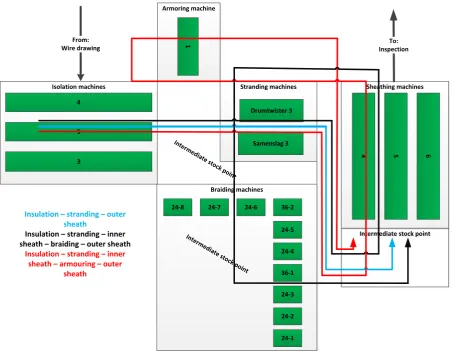
To formulate the production scheduling alternatives we excluded the insulation processes from the model. The insulation processes are designed for long production runs. Consequently, the one piece flow manufacturing principle results in an unacceptable inefficient production schedule in terms of waste due to changeovers. To ensure an efficient and effective production schedule, we recommend TKF to decouple the insulating processes from the scheduling problem and schedule the insulation process with, for example, a Kanban system. To comply with one piece flow, production orders need to meet several requirements. First, a production order may not consist of more than one reel after the stranding process. Furthermore, the processing time at the bottleneck machines, which are in general the braiding machines, should be around 24 hours. The most important prerequisites to implement one piece flow: a stable process and processing times that are, on average, significantly larger than the required changeover times. A stable process implies reliable processing times and a reliable process (few erroneous products).
The alternative approaches are evaluated on the number of backorders, service level, total changeover time, and lead time. We evaluate both the number of backorders as well as the service level because, due to the introduction of one piece flow manufacturing, even though the number of backorders may increase, the service level may increase as well. We create two variants of each alternative. The first variant, called ‘’normal’’, uses data as they are used currently. The second variant, called “OPF’’, uses data adjusted to the one piece flow manufacturing principle. Table 1 depicts the results of the assessment.
Service level (%) Backorders (#) Lead time (days) Changeover time (h)
SBH-DR - normal 81,9% 10,0 6,4 235,4
SBH-DR - OPF 90,9% 10,0 5,9 242,1
SBH-SA - normal 82,9% 11,3 6,4 222,6
SBH-SA - OPF 91,2% 9,8 5,8 243,3
SA - normal 91,2% 5,8 6,8 211,1
SA - OPF 92,8% 7,8 6,4 224,0
Table 1: Performance alternative scheduling approaches
Based on the analysis of the performance assessment we select the most suitable scheduling approach for TKF. The analysis shows which alternative is the best performing, and whether one piece flow manufacturing yields an improvement.
IV level of 93%, with limited variation over the experiments, while the other alternatives only achieved 82% to 91% with high variation over the experiments. For all time periods, alternatives incorporating the one piece flow manufacturing principle outperform the alternatives that do not incorporate the one piece flow manufacturing principle, even though in some occasions the number of backorders is higher.
Besides being a reliable supplier, TKF wants to differentiate from its customers by offering customers a short lead time on production orders. The one piece flow approach divides large production orders into several small production orders, reducing the maximum production time per production order from 142 hours to around 24 hours. The implementation of one piece flow reduces the average lead time with 7% with respect to their normal counterpart. The increasing numbers of production orders result in a significant increase of total
changeover time as well. Compared with the normal production strategy, the one piece flow approaches require on average 6% more changeover time. The impact of the production sequence is the highest at the sheathing processes due to the different materials that are used. Looking at the sheathing processes, the SBH-SA and SA approaches reduce the number of large changeovers significantly compared to their dispatching rule counterparts. Even though the total changeover time required is higher with one piece flow compared to the normal approach, the overall performance improves.
V
TKF Twentsche KabelFabriek
TKH Twentsche KabelHolding
ERP Enterprise resource planning system
LSS Lean Six Sigma
OEE Overall Equipment Efficiency
KPI Key performance indicator
WIP Work in Progress
JSSP Job shop scheduling problem
MTO Make to order
MTS Make to stock
LMAX Maximum lateness
SA Simulated Annealing
SBH Shifting Bottleneck Heuristic
DR Dispatching Rules
EDD Earliest due date rule. This research uses the Extended Jackson rule
OPF One piece flow manufacturing
Scheduling Assigning jobs in a certain sequence over the available machines within the capacity restrictions
Bottleneck machine A critical process whose performance or capacity limits the performance or capacity of the entire production facility
Wire drawing The first step to making a cable. Raw materials are drawn to the required diameter
Insulation A plastic layer is applied to protect the copper core Stranding Multiple insulated cores are combined
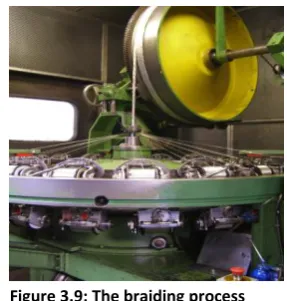
Braiding Wire or steel braiding is applied to protect the cable from external forces
Armouring Steel tape or wire is applied to protect the cable from external forces
Inner sheath To protect the cable from armouring or braiding, an inner sheath is applied
VI
1 Introduction ... - 1 -
1.1 Introduction to the Twentsche kabelfabriek ... - 1 -
1.2 Problem identification ... - 3 -
1.2.1 Causes & effects ... - 5 -
1.2.2 Project demarcation ... - 7 -
1.2.3 Research objectives ... - 7 -
1.2.4 Research questions ... - 8 -
1.3 Research design ... - 9 -
2 Literature review ... - 11 -
2.1 Positioning ... - 11 -
2.2 Manufacturing designs ... - 13 -
2.3 Production planning and scheduling approaches ... - 15 -
2.3.1 Job shop production ... - 16 -
2.3.2 Disjunctive graph representation ... - 17 -
2.3.3 Scheduling approaches ... - 18 -
2.3.4 Generic combinatorial optimization methods ... - 20 -
2.4 Lean six sigma ... - 22 -
2.4.1 Heijunka ... - 23 -
2.4.2 One Piece Flow ... - 24 -
2.5 Key performance indicators ... - 24 -
Conclusion ... - 26 -
3 Analysis of the current situation ... - 28 -
3.1 The production processes ... - 28 -
3.1.1 Cables ... - 28 -
3.1.2 Production departments ... - 29 -
3.1.3 Production processes ... - 30 -
3.2 The production-planning and -scheduling processes ... - 34 -
3.2.1 Production-planning and -scheduling at TKF ... - 34 -
3.3 Performance assessment current situation ... - 36 -
Conclusion ... - 41 -
4 Developing the scheduling approach ... - 42 -
VII
4.1.3 Alternative 3: Simulated annealing ... - 46 -
4.2 Practical extensions, restrictions and assumptions ... - 46 -
4.3 Detailed model description ... - 51 -
4.3.1 Dispatching rules ... - 51 -
4.3.2 Shifting bottleneck heuristic ... - 51 -
4.3.3 Simulated annealing ... - 53 -
5 Results ... - 56 -
5.1 Performance evaluation ... - 56 -
5.2 Sensitivity analysis ... - 61 -
5.3 Conclusion ... - 62 -
6 Conclusions and recommendations ... - 64 -
6.1 Conclusions ... - 64 -
6.2 Recommendations... - 65 -
6.3 Limitations and further research ... - 66 -
References ... - 68 -
Appendices ... - 71 -
Appendix A: Example shifting bottleneck heuristic ... - 71 -
Appendix B: Single machine scheduling algorithm ... - 73 -
Appendix C: Parallel machine scheduling algorithm ... - 74 -
Appendix D: Changeover time calculation ... - 75 -
Appendix E: Parameter settings SA ... - 77 -
Appendix F: Example production schedule ... - 78 -
Appendix G: Idle times ... - 79 -
Appendix H: Changeover times - One piece flow vs current approach ... - 80 -
- 1 -
1
Introduction
The Twentsche Kabelfabriek (TKF) is a company that provides innovative and custom cable solutions for customers worldwide. The innovativeness of products changed the ratio between make to stock and make to order products. Now make to order (MTO) products become increasingly important, TKF faces difficulties delivering these products on time to their customers. This research aims to improve the production planning and scheduling approach such that the service level increases and additionally the lead times decrease. This rapport also serves as a graduation thesis for the education Industrial Engineering and Management with Production and Logistics Management as specialisation track.
Currently, the planner manually creates a production schedule for 24 hours in advanced. This schedule is based on experience and a buffer ratio which indicates the ratio between the time until the delivery date and the number of remaining operations of a job. The planner schedules the MTO products, after which he decides which make to stock (MTS) products he includes. Again, these decisions made are based on intuition. TKF expects that the planning and scheduling approach can be improved, since the scheduling horizon is only 24 hours. Also, the importance of a decent scheduling approach increases as the number of customer orders increases.
Due to a lack of sales that lasted several years, TKF had a reorganisation to save the company from bankruptcy. The locations Lochem and Haaksbergen merged to one factory in Haaksbergen. After this reorganisation, the decision was made to implement the lean philosophy to reduce costs and increase efficiency even more. Many projects have been (and still are) executed to implement lean management within the organisation. By providing a production planning and scheduling approach that results in an efficient production plan, this report complies with the philosophy the company pursues.
This chapter proceeds with introducing TKF and analysing the problems TKF currently encounters. Section 1.1 provides a general description of TKF and in Section 1.2 we define the problem situation. The problem situation contains the analysis of the current situation, research demarcation, and formulation of the research objectives and research questions. Section 1.3 provides the research approach we use to answer the research questions and finally meet the research objectives.
1.1
Introduction to the Twentsche kabelfabriek
- 2 - manager, quality engineer, capacity planner, process engineer, and shift-leaders). The ambitions and aspirations are captured nicely in its mission statement (TKF, 2013);
‘’Our inspiration comes from developing, selling and manufacturing innovative, high-quality cable concepts. In situations of defiant requirements for functionality and reliability of cable connections, we are the partner’’
As the mission statement implies, the main goal of TKF (as any producing company) is to sell products. To be able to differentiate from competitors, it develops and produces innovative and qualitative solutions. Another aspect that distinguishes TKF from other companies is that customer intimacy is a priority; TKF helps creating a solution when a customer has a problem. The markets it targets can be divided into 5 segments: infrastructure & construction,
telecom, energy, marine & offshore, and industry. To give an impression of the variety of products, we give some examples:
Medium and high voltage cables Low voltage distribution cables
Fibre optic cables Telephone cables and wires
CATV coaxial cables Data cables
Signal and telecommunication cables and wires Installation cables and wires Lead sheathing data and energy cables EMC motor cables
In 1980, the Twentsche kabel holding (from now on abbreviated to TKH) was established as a result of the acquisitions of several Dutch and German companies. The main office of the TKH-group is located next to TKF in Haaksbergen,
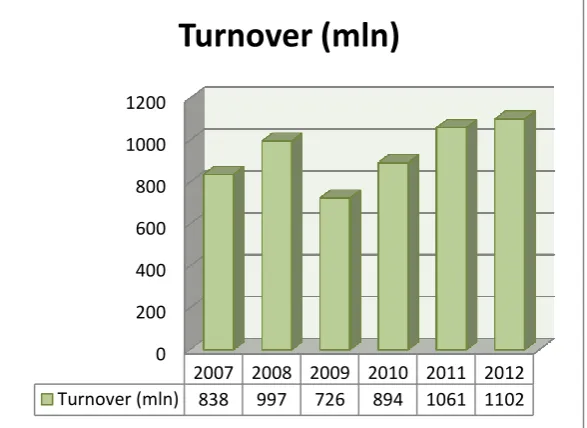
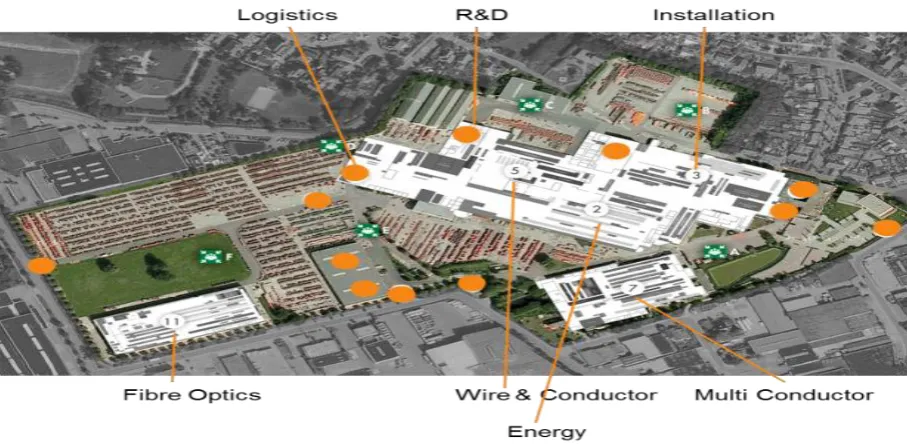
the Netherlands. Currently, it consists of over 70 independent subsidiaries, which are located in more than 20 countries, and had in 2012 a little over 4700 employees. Figure 1.2 shows that the annual turnover is steadily increasing since 2009 and was 1.1 billion euro in 2012. The biggest portions of the companies within TKH are research and development related, thus their contribution to the total turnover is limited.
0 200 400 600 800 1000 1200
2007 2008 2009 2010 2011 2012 Turnover (mln) 838 997 726 894 1061 1102
[image:11.595.354.544.114.285.2]Turnover (mln)
[image:11.595.250.544.484.698.2]Figure 1.1: The first cable factory
- 3 -
1.2
Problem identification
TKF wants to be a reliable partner that delivers high-quality custom cable solutions and focusses on innovative products. To even further differentiate from its competitors, a relatively short lead time is a key selling point. Due to these custom and innovative solutions, the production environment shifted from high volume & low variety to low volume & high variety. Producing according to a low volume & high variety strategy means a high diversity of production orders resulting in more changeovers / setups and other trade-offs. Consequently the complexity of production planning and scheduling increases. TKF expects an increase in demand for MTO products, causing the planning and scheduling processes become increasingly important. TKF realises that it does not fully utilise the production processes’ capabilities and it expects that the production planning and scheduling approach can be improved whereas the service level, utilisation of machines, products´ lead time, and output of the production department do not meet the set standards. TKF recently started implementing lean six sigma (LSS) projects concerning continuous improvement of business processes. In order to improve the production planning and scheduling approach, the decision was made to initiate this research.
By means of interviews with the materials control manager, production planner, machine operators, and time spent at the production department, we identified recurring problems regarding the planning and scheduling processes. The most frequently mentioned recurring problems are:
- The absence of a structured scheduling approach - The absence of a standardised scheduling approach - The manual scheduling approach
- The short term planning horizon
- 4 - Besides Navision, there are no mechanisms, procedures, or rules available to perform these tasks. This makes that the scheduling process heavily relies on the intuition and experience of the production planner, resulting in a dependency of the production planner. It is difficult to find a replacement for a process that is unstructured and non-standardised. Due to the fact that TKF is an innovative company, new products are not an exception. The value of the intuition and experience when scheduling these products is limited and thus the desire to obtain a more standardised approach arises.
Alongside with the manual scheduling approach, a production plan for a longer horizon is lacking. Due to the manual scheduling approach it is hard to take future orders into consideration, resulting in that most decisions are based on daily information and problems are solved ad-hoc without considering any long term effects. Considering that the horizon of the schedule is only 24 hours, it occurs that rush or rework orders are inconvenient. Due to complexity and the required flexibility, it is difficult to ensure a profitable production schedule without any optimisation support (Harjunkoski et al., 2013). Clustering orders with similar characteristics can result in a better flow in the production department, as it reduces the number of changeovers during a period and results in longer production runs of production orders with similar characteristics. Currently, clustering of production orders only happens when orders within the 24 hour scheduling horizon can be combined.
Essentially, there are 2 different types of production orders: orders consisting of make to order (MTO) products and make to stock (MTS) products. In the remainder of this report we refer to orders consisting of MTO or MTS products as MTO orders and MTS orders. MTO orders are orders that arise when a customer places an order, so when a customer order is accepted the production process has yet to begin. MTS orders are orders to replenish the stock, so not directly related to a customer order. From this stock, customer orders are fulfilled. The priority of the production planner is scheduling the MTO orders because these contain a delivery date that is agreed upon with the customer. The production planner attempts to allocate capacity as efficiently as possible so he adds, if possible, MTS orders of products whose inventory level is below their minimum stock level. In terms of efficiency this is beneficial, but in terms of service level and backorders, it can have rather adverse consequences. To make a schedule, the planner has to assess the orders scheduled at each individual machine to make the trade-off which order to start, which is difficult to do by heart. The production planner has to take the flow within the production department into account and ensure that all machines have work available for processing. This flow is disturbed by rework orders which require reprocessing. Some production orders, regular or rework, are critical in terms of due date. In situations when the production order is critical, the production planner has a last trump to overrule the rules in terms of an urgency card. A production order with an urgency card gets the highest priority and takes precedency at all processes.
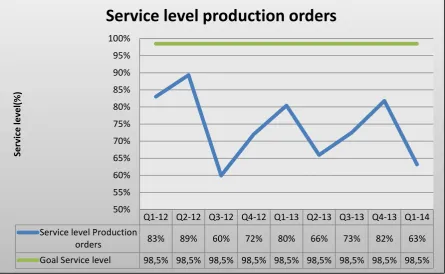
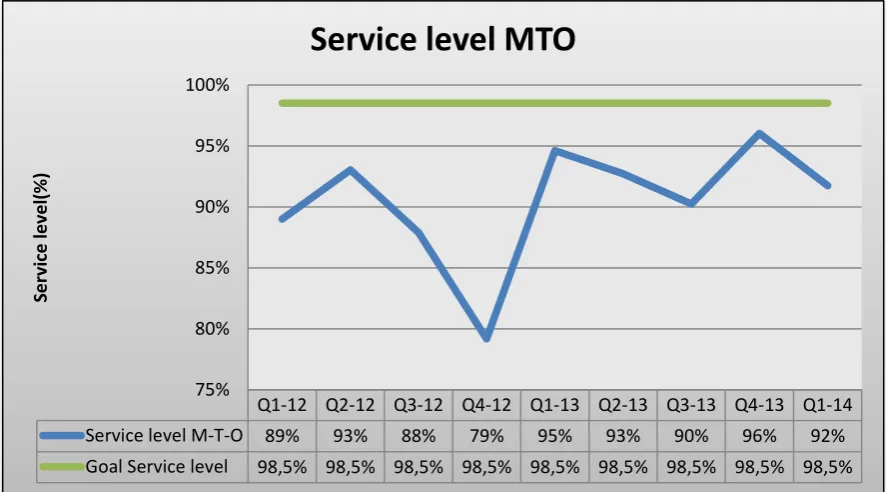
- 5 - similar products. These problems will become more urgent since production management expects an increase in demand. The production planner uses a manual approach and a 24 hour scheduling horizon. The priority of production orders to schedule is first rework orders, then MTO, and finally MTS in case there is production capacity remaining. The planner aims to maximise the service level while taking the continuous flow of products within the factory into account by minimising the number of changeovers and by ensuring that each machine has work available. The main consequences of the current scheduling approach are an unacceptable service level, a poor utilization of machines, long lead times, and an insufficient throughput of the production department. Summarising this section results in the following main research question:
“How can TKF improve its production scheduling approach such that it results in an increase of service level and throughput and a decrease of product lead times at the Installation production department?”
1.2.1 Causes & effects
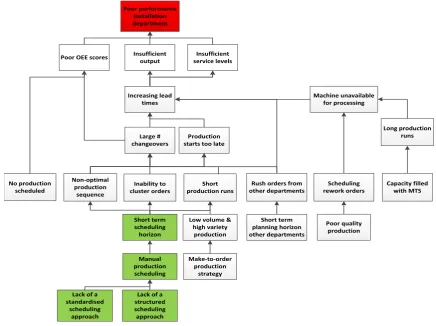
This section provides a summary of the most occurring and influential problems of Section 1.2 and visualises the relationships between problems in a causal diagram. As mentioned before, the motivation for this research is the expectation of management that the planning and scheduling process can be improved. The central problem is: ‘’poor delivery performance of the Installation department’’. After analysing the current production planning and scheduling approach, the most important (core) problems that can be influenced are:
- The absence of a structured scheduling approach - The absence of a standardised scheduling approach - The manual scheduling approach
- The short term planning horizon
Not all problems and causes of problems have been mentioned or explained in the problem analysis because they are either less relevant, fall outside the scope of this research, or are not suggestible. For the understanding and completeness of this analysis however, it is necessary to elucidate these problems.
Make-to-order production: To reduce the amount of stock and to be able to produce custom cables with a competitive lead time, TKF decided to increase the proportion make-to-order. We do not take this cause into consideration because it is a marketing strategy decision made by the management. Strategic decisions fall outside the scope of this research.
Low volume & high variety: To satisfy customers’ needs, TKF produces innovative and custom made cable solutions instead of cables for the ’big market’. This strategy results in wider variety of different production orders. The objective of this research is to propose a scheduling approach that is able to cope with this. Therefore, we do not take this problem into consideration. We let these decisions outside the scope of this research.
- 6 - set of production orders is not providing sufficient work for a certain machine. When there is no work available for a machine, the utilisation of this machine decreases. As stated in the research question, the focus of this research is to increase the throughput and the service level of the Installation department, making machine utilisation a secondary objective. For this research, we assume that either the machine utilisation increases when producing with an (near) optimal schedule or the idle time is caused by a lack of demand for these machines.
Short term scheduling horizon other departments: Besides the Installation department, other departments have a manual scheduling approach and use a short scheduling horizon approach. When other departments have rush orders that need processing at the Installation department, it causes scheduling problems at the Installation department. We do not take this problem into consideration because this research focusses on the scheduling approach of the Installation department.
Delivery date set too optimistic: It occurs that the sales department does not take the workload of the production department into account, therefore accepting a workload that cannot be processed in time. Another aspect is that due to the competitive lead times, there is little room for errors which eventually increases the impact of such errors.
Poor quality of production: The quality of the production determines the number of rework orders. The focus of this research is improving the scheduling process and not the production process. Even though the number of rework orders influences the performance of a schedule, we leave this problem outside the scope of this research. Figure 1.3 visualises the relationship between problems causing a poor performance of the Installation department.
Poor performance Installation department
Poor OEE scores service levelsInsufficient
Large # changeovers Insufficient output Short term scheduling horizon Short production runs Make-to-order production strategy Manual production scheduling Capacity filled with MTS No production scheduled
Rush orders from other departments Increasing lead times Inability to cluster orders Scheduling rework orders
Lack of a structured scheduling approach Non-optimal production sequence Machine unavailable for processing Production starts too late
Poor quality production Short term
planning horizon other departments Low volume &
high variety production
Lack of a standardised
scheduling approach
[image:15.595.78.515.425.751.2]Long production runs
- 7 -
1.2.2 Project demarcation
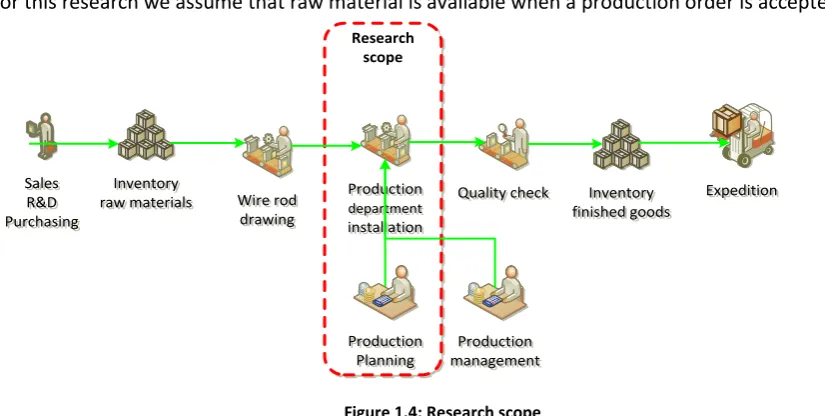
We restrict the scope of this research to short term production scheduling. As mentioned in Section 1.2, the production activities at TKF are divided in 4 separate production departments namely Installation, Energy, Multi-Conductor, and Fibre-optic. This research focusses on the production scheduling of the Installation department only. The Installation production department mainly produces cables for the marine & offshore, building, and utility industry. As mentioned, this research focusses on production scheduling for the Installation department and not processes prior or subsequent to this department. The sales, purchasing, R&D, quality control, production management (i.e. personnel scheduling), and inventory management activities are outside the focus of this research as Figure 1.4 shows. With the focus on customer service level, product lead time, and machine utilization of the Installation department, we restrict this research to their production processes. Therefore, we exclude wire rod drawing, the purchase of raw materials, inventory handling, quality checks, and the delivery of finished goods towards the customer from this research. For this research we assume that raw material is available when a production order is accepted.
Research scope Expedition Expedition Inventory raw materials Inventory
raw materials Production department
[image:16.595.76.489.289.497.2]installation Production department installation Sales R&D Purchasing Sales R&D Purchasing Inventory finished goods Inventory finished goods Quality check Quality check Production management Production management Wire rod drawing Wire rod drawing Production Planning Production Planning
Figure 1.4: Research scope
We decide to leave several activities outside the scope of this research, but we expect that some of these activities need to be addressed as well. To create a production schedule, input from several departments is required. The exchange of information, cooperation between several departments, and the alignment of strategies are critical for a successful scheduling process. After all, production scheduling has not only a close relation with the production process, but is also influenced by the availability of raw materials, the number of sales, product development, and the delivery date promises from production towards sales and from sales towards the customers.
1.2.3 Research objectives
- 8 - proper scheduling approach as stated in Pinedo (2009). The research objectives are captured in the following research objective:
‘’Develop a standardised and structured scheduling approach to facilitate the scheduling process such that the service level and throughput of the Installation department increase and the product lead time decreases’’
To meet these research objectives, we provide a set of deliverables. The deliverables of this research are:
- A tool that results in a feasible production schedule
- A tool that assists the production planner in making more efficient production schedules - A tool that visualises the effect of scheduling decisions
- A structured and standardised approach to create a production schedule - A scheduling approach that is aligned with the LSS philosophy
- Key performance indicators for decision making and future monitoring
The first deliverable of this research is a tool that provides a production schedule. This tool has to assist the production planner in making more efficient production schedules by using a longer scheduling horizon. As mentioned in Section 1.2.1 the production planner lacks a clear overview of the schedule he created. By providing a visual overview, the planner is able to see effects of scheduling decisions and facilitates the decision of which MTS order to include. By scheduling with a tool, the scheduling process becomes more structured and standardised, reducing the impact of intuition and experience. Since this research is one of many business improvement projects, it is important to align this report as well as the approach with this philosophy. Finally, this research provides a set of key performance indicators (KPIs) to assess the current and future scheduling approaches. KPIs assist with decision making and enable monitoring of the future situation.
1.2.4 Research questions
In Section 1.2 we provided a brief explanation of the problem, together with the main research question: “How can TKF improve its production scheduling approach such that it results in an increase of service level and throughput and a decrease of product lead times at the Installation production department?”. To answer the main research question, we formulate several research questions in order to make this comprehensive question manageable. Aggregating the answers to these research questions provide the required data and knowledge to answer the main research question. These research questions ensure a structured and organised research approach.
First we want to know what literature is available about planning and scheduling approaches and how to improve the latter. Furthermore, we need to know what the required parameters and variables are for a planning approach for the development of alternative approach. By performing a literature study we identify alternative solution approaches, identify relevant key performance indicators, and get more familiar with the terminology and other relevant aspects of scheduling processes.
- 9 - 1.2. How to classify the planning and scheduling processes?
1.3. What scheduling approaches are available in literature?
1.4. What are the key performance indicators of a scheduling approach?
The next step is to get familiar with the production processes in order to identify and understand the practical restrictions and preferences we need to take in to account when developing a scheduling approach. To find improvement opportunities we discuss the current scheduling approach, after which we assess the current scheduling approach in order to assess the proposed solution approaches.
2. What is the current situation of the production and scheduling processes? 2.1. What are the current production processes?
2.2. What are the current scheduling processes?
2.3. What is the performance of the current scheduling approach?
After understanding the current production and scheduling processes and the practical restrictions and preferences, we develop alternative scheduling approaches. Research question 3 leads to alternative scheduling approaches, after which we determine which is best suitable for TKF (research question 4).
3. Which of the developed planning approaches suits best to the situation of TKF? 3.1. What are the practical restrictions?
3.2. What is the performance of the solution approaches?
3.3. Which of the solution approaches is the best suitable scheduling approach for TKF?
After research question 4, we identified which alternative provides the most beneficial results. The final research question remaining is:
4. What is the best method to implement the selected solution approach at TKF?
4.1. What is the impact of the selected solution approach to other business processes?
Ultimately, the answers to the research questions and finally the answer to the main research question leads to the fulfilment of the objective of this research:
‘’A standardised and structured scheduling approach to facilitate the scheduling process such that the service level and throughput of the Installation department increase and the product lead time decreases’’
1.3
Research design
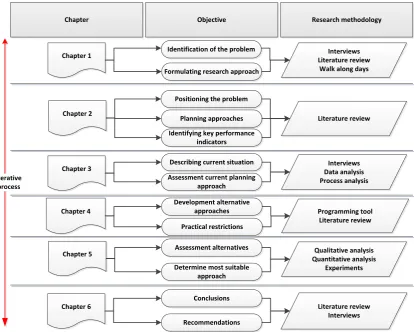
In this section we provide the structure of this research report. Figure 1.5 shows the project design we use for this report, together with the goals we want to achieve in each chapter and the method used to achieve this goal. This research design is a result of the research questions defined in Section 1.2.4. Each chapter answers at least one of the research questions. As the red arrow indicates, this is an iterative approach.
- 10 - of the research problem, identification of alternative planning and scheduling approaches, background information on lean six sigma, and the key performance indicators that are used to evaluate the current and alternative planning and scheduling approaches. Chapter 3 provides a description of the current production and scheduling processes, and we perform measurements in order to assess the current scheduling approach. In Chapter 4 we develop the alternative scheduling approaches and Chapter 5 provides the results of the assessment of the formulated alternatives. After the assessment we are able to make a decision on which of these planning and scheduling alternatives is best suitable for the problem situation at TKF. In Chapter 6 we formulate conclusions and recommendations regarding implementation.
Chapter Objective Research methodology
Chapter 1
Chapter 2
Chapter 3
Chapter 4
Chapter 5
Identification of the problem Formulating research approach
Interviews Literature review
Walk along days
Positioning the problem Planning approaches Identifying key performance
indicators Describing current situation Assessment current planning
approach
Assessment alternatives Determine most suitable
approach
Chapter 6
Literature review
Interviews Data analysis Process analysis
Programming tool Literature review
Qualitative analysis Quantitative analysis
Experiments
Literature review Interviews Conclusions
Recommendations Iterative
process
[image:19.595.106.521.213.545.2]Development alternative approaches Practical restrictions
- 11 -
2
Literature review
This chapter describes and elucidates the literature required for this research in order to answer
“What literature is available regarding improved scheduling approaches?”. First, Section 2.1 identifies the hierarchical levels of planning and scheduling and aim to answer research question 1.1: “How to position the planning and scheduling processes?” Answering this research question enables us to find appropriate literature. To ensure the literature review provides relevant information we classify the production department in Section 2.2. In Section 2.3 we answer research question 1.2: ‘’What scheduling approaches are available in literature?’’. We perform a literature research to identify relevant scheduling methodologies and approaches. Section 2.4 provides background information on lean six sigma. This research is a result of the implementation of the lean philosophy within TKF, and to understand the motivation, it is important to be familiar with this philosophy. Section 2.5 provides an overview of key performance indicators and answers research question 1.3: “What are the key performance indicators of a scheduling approach?”.
2.1
Positioning
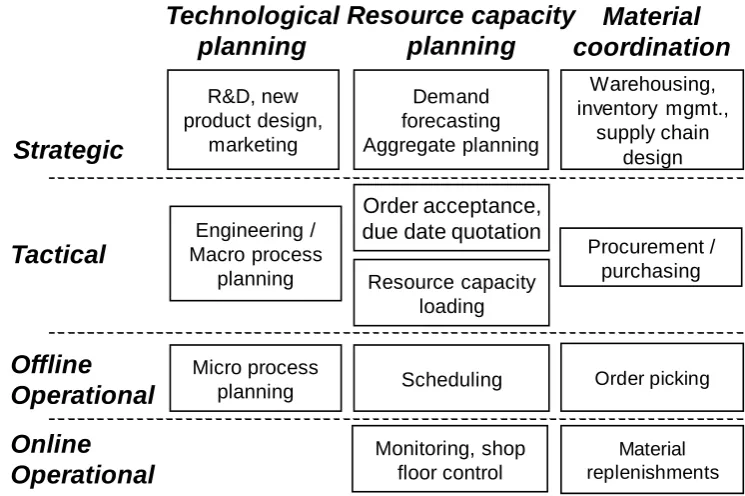
With the help of the hierarchical planning framework we answer the research question “how to position the scheduling processes?”. Planning and scheduling is relevant on various levels within a company. By positioning the problem we define the research area by restricting to the most relevant aspect of planning and scheduling. Figure 2.1 displays the hierarchical planning framework developed by Zijm (2000). For the Y-axis, Anthony (1965) proposed three hierarchical levels of planning and scheduling activities: the long term (strategic), the medium term (tactical) and the short term (online and offline operational) activities. For the x-axis, Zijm (2000) distinguishes three different management aspects: technological planning, resource capacity planning, and material coordination.
Technological
planning
Resource capacity
planning
Offline
Operational
Strategic
Tactical
Demand forecasting Aggregate planning Resource capacity loading Scheduling Engineering / Macro process planning Micro process planning Order acceptance, due date quotationMaterial
coordination
Warehousing, inventory mgmt.,
[image:20.595.112.485.480.728.2]supply chain design Procurement / purchasing R&D, new product design, marketing Order picking
Online
Operational
Monitoring, shop floor control Material replenishments- 12 - For this research we limit ourselves to the resource capacity planning because this focusses on production planning. Concerning resource capacity planning Zijm (2000) distinguishes 4 different planning levels. First we describe each of the hierarchical levels before we identify which category this research covers.
The strategic level concerns the long term decisions, generally made by high level management. Resource capacity planning addresses problems relating product mix planning and general workforce planning. Strategic planning does not assume any information about customer specific orders, but uses aggregated or forecasted data as input for, for example, LP (linear programming) models. This model contains a considerable amount of uncertainty and is on general used as an estimator for the future. At this stage, management defines the capacity available for production, decides whether to make or buy a part, and produces a rough workforce planning (Hans, 2001). The tactical level planning aims to allocate resources as efficiently as possible. Resource allocation starts with the order acceptance process which consists of dividing orders in jobs, determining precedence relations, estimated processing times, and calculating a reliable external due date for customer orders (Hans, 2001). Next, resource loading is executed to determine the internal due dates and the capacity required to process these orders. Tactical planning is used at a medium term when usually only aggregated data, such as a rough capacity or workload estimation, is available and therefore subject to a considerably large uncertainties. The strategic level provides the capacity available, i.e., it determines the regular capacity. Despite the capacity boundary, in a manufacturing environment capacity is often flexible because capacity can be expanded by adding irregular capacity or by outsourcing production orders. Irregular capacity often invokes additional costs (overtime or hiring personnel) and is not desirable. At this stage we determine the amount of regular and irregular capacity available for scheduling (Hans, 2001). Detailed information about the customer orders is still unavailable, which generally is acquired after order acceptance. The operational level planning focusses on short term decisions to produce a production schedule that fits within the restrictions provided in the previous stages. The production capacity (regular and irregular) is determined on the strategic and tactical levels and is considered as fixed at the operational level (Wullink et al., 2004). We define scheduling as assigning the jobs in a certain sequence over the available machines within the capacity restrictions. At this stage, the objective usually is to meet the internal due dates, set at a higher hierarchical level, with the help of a scheduling heuristic or an optimisation model (Zijm, 2000). At this stage, the degree of uncertainty is still significant due to machine break downs or other disruptions in the process as a result using deterministic data as input for the scheduling model (Wullink et al., 2004).
- 13 -
2.2
Manufacturing designs
Besides the positioning within the hierarchical framework, it is important to classify the production process in order to find suitable planning and scheduling literature. This section answers research question 2.2: ‘’How to classify the planning and scheduling processes?’’. The production strategy of TKF is to have a mix of MTS and MTO products. Several products are produced according to the make-to-stock strategy because they are fast movers (products with a high and predictable demand). However, an increasing amount of products is produced with the MTO strategy. TKF increases its amount of MTO products because the product variety increases due to the unique solutions it offers. To offer a competitive lead time and to cope with the increasing demand for these products, it is important to use a suitable scheduling method. The advantage of producing fast moving products using the MTS strategy is the reduction of the lead time to customers. Regarding the innovative solutions, the customers of TKF rarely request instant availability of products. Therefore, a short, competitive lead time suffices. Aslan et al. (2012) state that it is decisive that the selected scheduling approach is suitable for the type of production facility otherwise it will not yield the expected results. To find a suitable scheduling approach, we classify the current production facility. Pinedo (2009) distinguishes 4 different manufacturing models namely:
Single machine Parallel machines Flow shop Job shop
In single and parallel machines models, a job consists of operations that can be processed on either of the available machines. In job and flow shops, a job usually consists of a number of operations that have to be processed on several different machines. Each job has a predetermined route throughout the factory. In a flow shop, all jobs have the same route, i.e., all jobs visit the same machines in the same sequence. In a job shop however, the routes of jobs may differ for each job as shown in Figure 2.2. Job shop models are successful in environments with a high diversity of products that have specific parameters and routing (Aslan et al., 2012). Extensions to the general flow and job shop models are flexible flow and job shop models. In a flexible flow and job shop environment, processing steps can consist of multiple machines in parallel and jobs may be processed at any of these machines. These models often have the objective to minimise the makespan, the number of jobs that are completed too late, or minimising the maximum lateness.
- 14 - Project planning and scheduling models
Project planning and scheduling are used whenever a large project, such as the construction of an airplane or a building, has to be carried out. A job consists of a number of operations that may or may not have precedence relations. Some jobs have to wait until others are finished, while other jobs can start any time. Often, for project planning and scheduling, the assumption is made that resources are unlimited, so that a job can start when its predecessors are completed. More difficult projects contain workforce constraints, meaning that for a particular operation, multiple operators are required with specific skills. The result of workforce constraint is that it occurs that a certain job is allowed to start, but is not able to due to the unavailability of an operator. When creating a project plan or schedule, the objective is to minimise the makespan (Pinedo, 2009).
Automated material handling models
Automated material handling models are used when an automated system, such as a conveyor belt or AGV, controls the movement of jobs. The system also controls when and where jobs are processed. Besides the regular release and completion times of jobs at certain machines, the automated systems impose constraints as well. For example, when the AGV is occupied or the buffer of the subsequent machine is full, an available job that needs processing at that machine cannot be transported (blocking). This type of manufacturing model is used in industries where flexible or paced assembly lines are used. Examples are the assembly of cars and electronics (Pinedo, 2009).
Lot scheduling models
Lot scheduling models encompass decisions made for long and medium term scheduling. First, these models determine the size of a production order, and second, it determines the sequence for production. These models are widely used in the oil industry, where changeover and inventory costs are relatively high. Another application is the regular retail industry. In this case, the setup costs are equal to the ordering costs. The objective is to make a trade-off between holding costs and changeover / ordering costs (Pinedo, 2009).
Supply chain planning and scheduling models
- 15 - products in order to minimise the changeover costs. At this stage, the sequence dependent changeover times, demand, release date, and delivery date are determined (Pinedo, 2009).
After analysing the production process at TKF, we conclude that the manufacturing process corresponds best to the job shop model because not all jobs have the same sequence of operations, jobs have to be processed fully before it can be transferred to the next machine, and each machine can only process one job simultaneously. Consequently, we classify our scheduling problem as a job shop scheduling problem (JSSP).
2.3
Production planning and scheduling approaches
In this section we collect and review information on the available production planning and scheduling approaches in order to answer research question 1.3: “What scheduling approaches are available in literature?”. In Section 2.2 we classified the production facility at TKF as a job shop and concluded that the scheduling problem is a JSSP.
Jain & Meeran (1999), Blazewicz et al. (1996), and Tan & Khoshnevis (2000) discuss multiple approaches to solve the job shop scheduling problem. Some of the proposed approaches have been tested on several problems to test the quality of the generated solution and the required computational time. We discuss frequently mentioned methods that we encountered during our literature study. Solution approaches to solve the JSSP, or any combinatorial optimisation problem, can be divided in 2 categories: exact and approximation approaches. Exact approaches provide optimal solutions, but their running time can often not be bounded by a polynomial function of the problem size. The running time of a solution approach is measured by the upper bound of the number of mathematical operations it has to perform. Therefore, the running time increases when the problem size increases. Approximation approaches provide feasible, not necessarily optimal or even near optimal, solutions in relatively short running time. Practical problems, with hundreds of jobs, are extremely large and hard to solve to optimality. To overcome this problem, approximation heuristics became more attractive regardless the fact that these do not necessarily provide an optimal solution. Practice shows that an optimal solution is not always required. A near optimal, or ‘’good’’, solution often suffices.
Exact approaches
- 16 -
Approximation approaches
To be able to solve larger problem instances, approximation approaches are a viable alternative. Jain & Meeran (1999) distinguish two types of approximation heuristics namely the constructive and improvement (local search) algorithms. Constructive algorithms, such as greedy randomized adaptive search and dispatching rules, start without an initial solution and construct (build) towards a solution. Simulated annealing, iterative improvement, and tabu search are examples of improvement algorithms. Simulated annealing is evaluated by Van Laarhoven et al. (1992), He et al. (1996), and Naderi et al. (2010) and they claim that simulated annealing provides near optimal solutions within very little computational time. Vaessens et al. (1996) conclude that local search algorithms (such as simulated annealing) outperform all other techniques. The results of the experiment performed by Jain & Meeran (1999) show that tabu search and the shifting bottleneck heuristic provide for most experimental settings the best solution. Hybrid approaches use a combination of multiple approaches and are able to provide a better solution than the individual methods would provide (Jain & Meeran, 1999). The shifting bottleneck heuristic for example, is a combination of schedule construction and schedule improvement. Van Laarhoven et al. (1992) compared the shifting bottleneck heuristic with the simulated annealing heuristic and came to the conclusion that simulated annealing has the potential of finding a better solution than possible with the shifting bottleneck heuristic. The difference in makespan, however were small. The running time of simulated annealing however, is significantly longer (Jain & Meeran, 1999).
2.3.1 Job shop production
Job shop models describe production facilities with a certain number of machines, jobs and routes, and therefore applicable to the situation of this research. The description of the job shop model this research uses is the following: A job shop consists of a set of m machines on which a set of n jobs have to be processed. If job j requires processing on machine i, it is referred to as operation Oij. The processing time of job j on machine i is denoted by pij (Pinedo, 2009). All machines are available at time t=0, each machine can process at most one job simultaneously, and each job has to be fully processed before it can be transferred to the next machine.
- 17 -
2.3.2 Disjunctive graph representation
The literature study revealed that inter alia the shifting bottleneck heuristic, simulated annealing, and tabu search algorithm heavily rely on the lengths of the longest paths in the disjunctive graph. Each instance of the job shop scheduling problem can be represented by a disjunctive graph G. Graph G consists of a set of nodes (N), a set of arcs (A and B). Jobs consist of several operations (Oij), and each operation is represented by a node with weight pij (processing time). Besides all operations, the set of nodes contains two dummy nodes, s and t. The nodes s and t are respectively the source and the sink of the graph. The conjunctive arcs (A) between two nodes represent the route of each job. The arc Oij Okj indicates that job j has to be processed on machine i, before it can be processed on machine k. The disjunctive arcs (B) link two operations that belong to different jobs that have to be performed on the same machine. Initially, disjunctive arcs do not indicate the sequence of jobs, but show what operations a machine has to process. Based on the conjunctive and disjunctive arcs, the longest path in graph G is calculated. The disjunctive arcs indicate the sequence. A feasible schedule corresponds to a set of disjunctive arcs that result in an acyclic graph.
To explain the functionality of the disjunctive graph we use the same problem instance consisting of two jobs and two machines. The characteristics of the jobs are depicted in Table 2.1. The machine sequence indicates the sequence of operations, job 1 and 2 both have to be processed on machine 1, before they are allowed to be processed on machine 2. The sequence of machine M1 is O11 – O12 and the sequence of machine M2 is O22 – O21. Figure 2.3 displays a feasible solution of this instance.
Jobs
Machine sequence
Processing times
1 1,2 = 2 = 6
2 1,2 = 3 = 6
Table 2.1: Data used in the example
1,1
1,2
2,1
2,2
s t
0
2
2 6
3 6
5 11
2
5 11
17
Cmax = 17
Figure 2.3: Disjunctive graph example
- 18 - the sequence yet and is the makespan equal to the maximum cumulative of the processing times of each job.
2.3.3 Scheduling approaches
First, we discuss solution approaches designed for job scheduling. The first approach we discuss is using dispatching rules due to their simplicity to use and implement. Second, we discuss the shifting bottleneck heuristic because it is designed for the minimization of the makespan in a job shop.
Dispatching rules
Dispatching rules, or priority rules, provide good approximation solutions for the JSSP (Pinedo, 2009), depending on the objective function. With the help of some sort of rule, jobs are sorted and scheduled in a specific order. Dispatching rules are used to determine which task to allocate to a resource, when that resource becomes available. Dispatching rules are ideal when many scheduling decisions need to be made quickly, as is the case with a low volume & high variety product mix. Many dispatching rules are available. To avoid a long enumeration of dispatching rules, we briefly mention the most common ones.
One of the simplest dispatching rules is first come - first serve where orders are sorted and scheduled in the order they arrive. Hopp & Spearman (2008) state that this rule does not work well in complex job shop environments. Earliest due date, shortest processing time, longest processing time, and total work are just a few of the alternative dispatching rules. Which rule to choose depends on the objective function the scheduler aims to minimise or maximise. Two types of dispatching rules can be distinguished: dynamic and static dispatching rule. With static dispatching rules, the priorities of operations do not change over time in contrast to dynamic dispatching rules.
Shifting bottleneck heuristic
The shifting bottleneck heuristic, as proposed by Adams et al. (1988), is a heuristic to solve job shop scheduling problems. The shifting bottleneck heuristic is an iterative improvement algorithm and provides a good approximation for the JSSP. The shifting bottleneck heuristic decomposes the JSSP in to single machine problems, schedules the single machines by minimising a certain objective function, and selects the bottleneck machine. This algorithm heavily relies on the disjunctive graph G, which we explained in the previous section.
- 19 - machine scheduling problems and the bottleneck optimisation. Examples of approaches to solve the single machine scheduling problems are the dispatching rules, Carlier’s algorithm (Carlier, 1982), Schrage’s algorithm, or one of aforementioned the iterative heuristics.
Algorithm 1: General SBH
Step 1 (Initialisation): - M0 = {Ø}
- Calculate objective function for the entire job shop.
Step 2 (Analysis job shop):
- Determine rij, pij, and dij for each machine
- Solve the single machine problem for all machines M \ M0
- Calculate objective function for each machine
Step 3 (Bottleneck selection): - Determine the bottleneck machine k
- Schedule bottleneck according to the schedule provided in step 2 - Add machine k to M0
- Calculate new objective function for the entire job shop.
Step 4 (Bottleneck optimisation): - Do for all machines h ϵ (M0 \ k)
- Remove the arcs from machine h from graph G - Determine rij, pij, and dij for machine h
- Reschedule and optimise machine h Step 5 (Stop criterion):
If M = M0 then STOP; else, go to STEP 2
Practical Extensions for the shifting bottleneck heuristic
The basic shifting bottleneck heuristic does not provide a good enough representation of the practical situation. To incorporate practical restrictions, to increase the practical applicability, Schutten (1996) proposes practical extensions for the shifting bottleneck heuristic. In this section we discuss the practical extensions that are applicable to the scheduling problem this research addresses.
Release and due dates
- 20 - 1996). By assigning the weights rj and dj in the disjunctive graph, the longest path of the graph changes from CMAX to LMAX.
Setup times
Between two jobs it may be necessary to set up the machine before it can process the next job. A setup may take a substantial amount of time, and therefore it is necessary to incorporate this time in order to provide a representative schedule. When setting up a machine, the machine is unavailable for processing. The time required to setup a machine depends on the production sequence. Between two identical production orders, the setup will be short because only a minor changeover is required. When, for example, the type of insulation material required and the diameter of the core differ, changeovers takes up to 60 minutes. To incorporate the sequence dependent setup times, sih,ij is introduced (Schutten, 1998). Sih,ij denotes the setup time required between operation Oih and operation Oij. To include the setup time in our model, we assign weight sih,ij to the arc between node Oih and node Oij. The incorporation of setup times requires an algorithm since setup time depends on the sequence of jobs.
Parallel machine scheduling
The original job shop problem assumes that each operation requires a specific machine. In practice, an operation may be performed on any of a series of parallel machines. Parallel machine scheduling assigns operations to machines and sequences the assigned operations for each machine. In case the machines are identical, the weights of the nodes do not change during the execution of SBH. The group of parallel machines are seen as one machine when determining the bottleneck. The maximum lateness of the group of parallel machines is the maximum of the maximum lateness of the individual machines. The incorporation of parallel machine scheduling requires an algorithm to solve the parallel machine scheduling problems.
Diverging job routing
The original job shop problem assumes that each job consists of a chain of operations meaning that jobs are processed as a whole at each operation. In practice however, it occurs that parts of jobs have to undergo different processes or in different order. To model this, diverging job routing is introduced. After a certain operation, jobs are divided in several sub jobs with different routes. These sub jobs are scheduled individually with as goal to minimise the maximum lateness of all jobs.
2.3.4 Generic combinatorial optimization methods
Besides scheduling methods dedicated to job shop scheduling problems, several meta-heuristics have proven to be successful when applied to the JSSP. We discuss simulated annealing (SA), tabu search (TS), and greedy randomized adaptive search (GRASP). Literature shows that these algorithms are promising algorithms to solve the JSSP. SA and TS are both improvement algorithms indicating they need to be combined with a construction algorithm such as adaptive search. GRASP is a combination of a construction heuristic and a local search algorithm to improve the latter.
Simulated Annealing
- 21 - The SA algorithm creates alternative solutions by making small changes to a feasible solution in order to find feasible alternative solutions with an improved objective value (Jain & Meeran, 1999). The neighbourhood is the set of all feasible alternative solutions that can be considered within an iteration. A feasible solution after a change is called a ‘’neighbour solution’’ but is not necessarily a better solution. In the case the neighbour solution improves the current objective value, this neighbour solution is accepted (Van Laarhoven et al., 1992).However, when the objective value is worse, the neighbour solution is accepted with probability ( ). ‘’c’’ denotes the control
parameter, or temperature. When a neighbour solution is accepted, it becomes the current solution. The SA algorithm starts with a predetermined value for the control parameter, CStart. For each temperature the algorithm performs k iterations. After these iterations, the control parameter is multiplied with a cooling parameter α. The SA algorithm terminates when the temperature reaches a predetermined value denoted by CStop. The acceptance probability, in case of a minimisation problem, is calculated with formula 3.1. The acceptance of worse neighbour solutions allows the heuristic to escape from local optima in order to find the global optima (Aarts & Korst, 1989). A denotes the current solution value, and B denotes the neighbour solution value. The initialisation of the parameters determines the quality and computational time of this heuristic (Artiba & Elmaghraby, 1997).
( ) {
(3.1)
Greedy randomized Adaptive Search
GRASP finds its origin in adaptive search, so to understand GRASP we start with discussing adaptive search. Adaptive search is a generic randomised constructing heuristic proposed by Kolish and Drexl (1996) and is able to provide good initial solutions for combinatorial optimization problems. Adaptive search combines a priority rule and a random search method. When applied to the JSSP, a priority rule provides each operation a priority ϕj. For example, when we choose the earliest due date priority rule, the priority is higher when the due date is closer to the start. Adaptive search uses the priority ϕj to calculate the regret factor rj for each operation. The regret factor (rj) is the absolute difference between priority ϕj and the worst priority of all available operations. Whether the worst priority is the minimum or maximum of all priorities depends on the priority rule that is used. The formula to calculate the regret factor, if a higher implies a higher priority, is give below in formula 3.2 (Kolisch & Drexl, 1996). ‘’I’’ denotes the decision set, i.e. all jobs that are scheduled.
|
(
)|
(3.2)
The higher the regret value implies that not selecting this operation will have a more negative result. Adaptive search does not use the priorities to select an operation, it uses the regret values to calculate the probability Pj that an operation is selected. The higher the probability, the higher the likelihood an operation is scheduled. The probability an operation is selected is calculated with formula 3.3 (Kolisch & Drexl, 1996).