1
Faculty of Electrical Engineering,
Mathematics and Computer Science
Creating an IT Risk
Maturity Model for
Distributed Ledger Applications
Jaap Vermeij
M.Sc. Thesis
14 December 2018
Business Information Technology
IT Management and Innovation
Supervisors: Dr.ir J. M. Moonen Dr. L. Ferreira Pires
(University of Twente)
M.Sc. M. Sch¨afer
Acknowledgements
During this research I have been supported by many people which have helped me succeed. There are a number of people which I would like to thank in particular for their contributing to this research, to my development or to my overall well-being.
I would like to thank everyone within the CI/DAA1 department within Bosch and especially Michael Sch¨afer in supporting me during the course of writing my thesis. Within the department I got all the freedom to shape my research in the way I wanted and was supported at moments where I needed more guidance.
Hans and Luis have always had their metaphorical door open, even though I was out of the country and we only sat together in person on a few occasions. The collaboration from a distance worked out great and I would like to thank both for their guidance during our effective Skype meetings.
Throughout the course of the research I’ve had contact with many people from different compa-nies which have helped me out in the research by joining the Delphi panel or assisting me in any other way. Thank you to all of you since without you joining the research, it would not have been possible to complete it in its current form.
Finally I would like to thank my family and my girlfriend who have helped to support me mentally and put in quite some hours reviewing all of my work.
Summary
Distributed ledger technology (DLT) has been gaining in popularity for businesses and academics alike in the previous years. The promise of DLT is that it ensures shared control over data without a central party to control these data. With DLT, businesses no longer need to base their trust in the integrity of the data on this central party since DLT systems can potentially guarantee this integrity. Distributed ledger technology is still a young technology and there are only a limited number of organization which are using applications with DLT. One of the reasons that it’s not widely used yet is due to the risks involved with the technology. Identifying risks specific to DLT is difficult with current risk assessment models. This research proposes a new IT Risk DLT Application Maturity Model which can be used by businesses to asses risks of DLT and enhance their development processes.
In this research, a multi-method approach was applied to develop a maturity model. We started by identifying IT risks of DLT applications through a literature study. The risks identified in literature were presented to a panel of 15 experts from various companies and academic institutions in a two round Delphi study. The panel proposed a large number of additional risks that have been consolidated into a total of 48 risks divided over 5 risk areas and 14 sub-risk areas. We found that there were many risks that are not mentioned in literature which are considered important to businesses. The combination of both fields provide valuable insights for both academics and practice.
The risks that were collected were further verified within five different case studies. Within these case studies, it was found that the identified risks are not generalizable to every DLT application. There are aspects, such as DLT performance, which differ per use case. In order to define these restrictions of the model, criteria have been drafted which the use case should adhere to before the maturity model can be applied.
For each of the 14 risk areas, five maturity level descriptions were defined based on the definitions of the CMMI levels in combination with the identified risks. These level descriptions were checked once more by a panel of experts through a survey. In this survey, we found that a number of areas, such as the Data Management area and the Endpoint Security area, are still in discord. Not all experts agree with the descriptions, but have given feedback on how to improve them. The feedback has been incorporated in the final level descriptions.
The created maturity model can be applied to a DLT application through a number of drafted assessment questions based on the level descriptions for each level. The results of the assessment are visualized through a dashboard to improve the comprehensibility of the results and to quickly identify possible areas of improvement for the applications. Both the assessment questions and the dashboard have been verified with one of the case studies used earlier in the research.
The created IT Risk DLT Application Maturity Model and the collection of IT risks are the most important contributions of this research. The model includes a number of risk areas which can be improved upon in future research. The combination of academics and practice within this research allowed us to create a comprehensive list of IT Risks for DLT applications which can be used both in academics and in practice as a basis for future research.
Contents
Acknowledgements iii
Summary v
List of Figures xi
List of Tables xiii
Abbreviations xv
I Spark
1
1 Introduction 3
1.1 Organization Background . . . 4
1.2 Research Goal . . . 5
1.3 Research Methodology . . . 5
1.4 Structure of the Thesis . . . 7
2 State of the Art 9 2.1 Distributed Ledger Technology . . . 9
2.2 Internet of Things . . . 12
2.3 Maturity Models and IT Risks . . . 15
3 Maturity Models for DLT risk evaluation 17 3.1 Overview of Maturity Models . . . 18
3.2 Evaluation of Maturity Models . . . 19
3.3 Conclusion . . . 21
II Design
23
4 IT Risks Described in Literature 25 4.1 Literature Study . . . 254.2 Extracting and classifying risks . . . 27
5 IT Risks Described by Field Experts 29 5.1 Study Design . . . 29
5.2 Selection of Experts . . . 30
5.3 Conducting the study . . . 31
VIII CONTENTS
5.4 Delphi Round 1 . . . 31
5.5 Delphi Round 2 . . . 33
5.6 Preliminary model . . . 35
6 Case Studies verifying Risks 37 6.1 Introduction . . . 37
6.2 Case Study Design . . . 37
6.3 Supply Chain Management . . . 38
6.4 GS1 Palettenschein - Pallet deposit . . . 40
6.5 Share&Charge - EV charging . . . 41
6.6 Odometer fraud . . . 43
6.7 Groningse Kredietbank - Debt relief . . . 44
6.8 Conclusion . . . 46
7 Forming the maturity model 47 7.1 Focus of the model . . . 47
7.2 Level descriptions . . . 47
III Evaluation
61
8 Model Verification and Validation 63 8.1 Verification through Survey . . . 638.2 Extending the Model . . . 68
8.3 Evaluating the assessment questions and Dashboard . . . 70
9 Discussion 73 9.1 Conclusions . . . 73
9.2 Limitations . . . 75
9.3 Practical relevance of the research . . . 76
9.4 Scientific relevance of the research . . . 77
9.5 Future work . . . 78
References 81 A Evaluations of maturity models 87 A.1 CMMI Development v1.3 . . . 87
A.2 Risk Maturity Model . . . 89
A.3 IT Capability Maturity Framework Risk Management . . . 91
A.4 Maturity Model for Blockchain Adoption . . . 93
A.5 KPMG Blockchain Maturity Model . . . 95
B Literature study results 99 B.1 Included papers . . . 99
B.2 Consolidated risks from literature . . . 102
C Delphi Study Surveys 107 C.1 Survey 1 . . . 107
CONTENTS IX
D Final Model Elements 123
D.1 Criteria for usage . . . 123 D.2 Level Descriptions and Assessment statements . . . 123
E Back-end Dashboard Files 139
List of Figures
1.1 Overview of different chapters in this thesis . . . 7
2.1 Difference of centralized and distributed ledger (Santander Innoventures, Oliver Wyman, & Anthemis Group, 2015) . . . 10
2.2 Schematic of a blockchain (de Kruijff & Weigand, 2017) . . . 11
2.3 Schematic of a Directed Acyclic Graph (DAG) (Churyumov, 2016) . . . 12
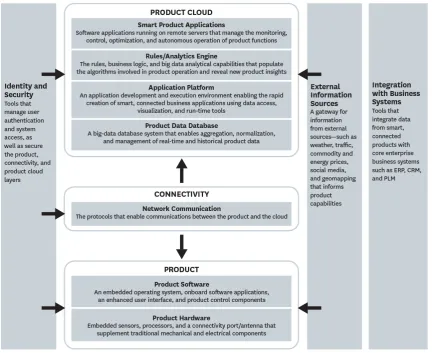
2.4 Technology stack of Internet of Things (IoT) (Porter & Heppelmann, 2014) . . . 13
2.5 IT Risks as part all risks areas . . . 15
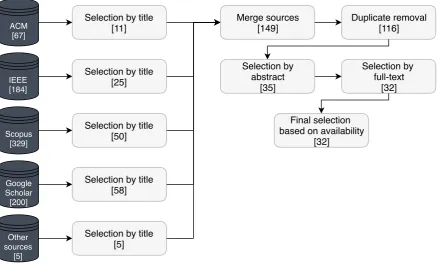
4.1 Diagram of papers collected through systematic review . . . 26
4.2 Year of publishing . . . 27
4.3 Overview of the different steps of collecting the risks . . . 28
5.1 Study design of the Delphi study . . . 30
5.2 Redefined two layer model after round 1 . . . 33
5.3 Preliminary Risk Area model . . . 35
6.1 Share&Charge architecture (Garcia, 2018) . . . 42
8.1 Database Schema . . . 69
8.2 Main screen of Maturity Dashboard . . . 70
8.3 Detailed screen of Maturity Dashboard . . . 71
9.1 Maturity model development and application cycle (Mettler, 2011) . . . 79
C.1 Redefined two layer model with high- and low-level risk areas . . . 111
List of Tables
1.1 Decision parameters per design phase . . . 6
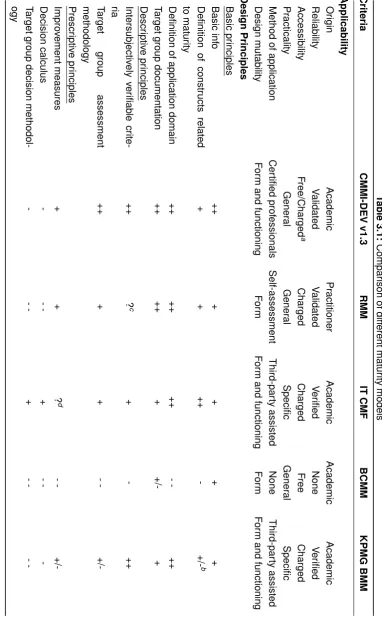
3.1 Comparison of different maturity models . . . 22
4.1 Keywords utilized in the literature study . . . 26
5.1 Sector of participants . . . 31
5.2 Function of participants . . . 31
5.3 Results of risk area satisfaction rating . . . 34
8.1 Results of the survey . . . 64
8.2 Example of statements for DLT Platform Choice risk area . . . 68
C.1 Risks of Strategic risk area . . . 115
C.2 Risks of Operational risk area . . . 117
C.3 Risks of Security risk area . . . 118
C.4 Risks of Legal risk area . . . 119
C.5 Risks of Development risk area . . . 120
C.6 Risks of DLT platform risk area . . . 121
LIST OF TABLES XV
Abbreviations
AML Anti Money Laundering BMM Blockchain Maturity Model CPO Charge Point Operator DAG Directed Acyclic Graph DLT Distributed Ledger Technology ERM Enterprise Risk Management EV Electric Vehicle
GDPR General Data Protection Regulation IoT Internet of Things
IT CMF IT Capability Maturity Framework KYC Know Your Customer
MSP Mobility Service Provider MVP Minimal Viable Product PoC Proof of Concept PoS Proof of Stake PoW Proof of Work
Part I
Spark
Chapter 1
Introduction
Distributed Ledger Technology (DLT) has been gaining popularity in the previous years. Many compa-nies are looking for opportunities to use DLT within their business but there are not many instances where a company moves onto using a DLT application in their regular business processes. Often times after a proof of concept is created the decision is made to not further develop the applica-tion since DLT is simply not yet mature enough to perform a vital role within the company. There is currently no method to easily analyze a DLT application that gives an overview of its associated technology and business risks.
The promise of DLT is that it enables shared control over data without a central party to control these data (Hileman & Rauchs, 2017). With DLT, businesses no longer need to base their trust in the integrity of the data on this central party since DLT systems can potentially guarantee this integrity. This opens up new opportunities for businesses for collaborations where previously no central trusted party was available. However, it is still proving difficult to find these new uses and integrate them within their organization. Start-ups have sprouted up around new and improved applications of the technology, and research and development departments at larger enterprises are creating proof of concept applications to be used within their organization.
Bosch is currently in the process of identifying use cases and producing proof of concept appli-cations using distributed ledger technology. Working together with a multitude of partners in different consortia they are producing use cases mainly in the field of IoT and mobility. One of the strategic ob-jective of Bosch is to become an IoT company with many of it’s products being interconnected. This idea of an IoT company is leaking through all the different industries in which Bosch is active, from connected industry to smart homes and connected mobility, to only name a few. Simply connecting devices to the Internet is not enough to create an effective IoT network, devices need to be properly secured and methods to manage the devices should be set up. DLT can help to support this network of secured inter-connected devices and create trusted data connections between IoT devices from various organizations.
Distributed ledger technology is a young technology and there are only a limited number of or-ganization which are using applications with DLT. Some oror-ganizations have introduced applications using DLT but each application has limitations, such as scalability, security, a centralized governance and others. Popular DLT networks such as Ethereum and Blockchain are not optimized to run to-gether with IoT devices since they require too much power, storage or require the device to be online all the time.
Identifying the limitations and risks of the created applictions can often prove difficult for managers since there is no reference system to compare them to. Existing IT risk assessment frameworks are not suitable for DLT applications since they lack the ability to easily identify DLT related risks such as
4 CHAPTER1. INTRODUCTION
the immutability of data and shared governance issues.
Maturity models are often used in larger companies as an informed approach to continuous im-provement or as a means of benchmarking and self-assessment. These models often look at larger processes such as the development process of an application, but they can also be applied to assess the maturity of processes surrounding a specific technology. This type of object-specific models can serve as a developmental aid in organizations wanting to develop or implement DLT applications. Using maturity models to assess DLT applications offers managers a structure they are familiar with and it can show different types of risks in a common format.
This thesis will focus on evaluating current methods of IT risk identification using maturity models. After this, a new maturity model is presented which focuses on evaluating the IT risks of DLT applica-tions in connection with IoT. This model is verified through a number of case studies evaluating proof of concept applications.
1.1 Organization Background
This research is being carried out with the cooperation of Robert Bosch GmbH. Bosch is a multi-national engineering and electronics company with over 400.000 employees spread out over 60 countries. The company is headquartered in Gerlingen, Germany, close to Stuttgart where it was founded in 1886. In 2017 they had 78.1 billion euros in sales with their mobility solutions business sector producing 61 percent of the sales. Other business sectors they are active in are industrial technology, energy, building technology and consumer goods.
Research and development is a key focus of the company which is always looking to expand and improve their product range. Their objective is to develop innovative, useful, and exciting products and solutions to enhance quality of life. They have around 59,000 researchers and developers working on research at 120 location worldwide. In the past six years they have invested around 27 billion euros in research and development.
1.1.1 Central IT - Advanced Development
Central IT (CI) at Bosch consists of about 5000 employees of which most are located in Feuerbach, Germany, again close to Stuttgart. The Advanced Development department within CI focuses on analyzing IT trends and supporting the operative business units in the pre-development phase. The department is consulting other business units, scouting new technologies, prototyping and creating contacts with universities and other technology leaders. It aims to be the connection between the Corporate Research (CR) division and CI. The department is spread out over multiple locations; Feuerbach, Palo Alto, Pittsburg and Singapore. Within the departments these departments there are teams focusing on different emerging IT technologies ranging from AI to Edge computing.
1.2. RESEARCHGOAL 5
1.2 Research Goal
The goal of this research is to create a method to evaluate risks of DLT applications to be used by organizations within their development process. This method should help to identify risks and show in what aspects an application can be improved to reduce these risks. Currently, much of the development of DLT applications does not take risks into account in early development since they are either not well known or difficult to evaluate.
This research aims to create a systematic means to evaluate the risks and rate an application based on standardized levels. These standardized levels will form a maturity model which is easily understood by organizations already familiar with maturity modeling. The model will look specifically into risks of the combined usage of IoT and DLT while also being applicable to DLT applications in general. Applying DLT to the IoT presents an interesting opportunity but the are currently still many risks involved in applications harnassing both technologies. The created maturity model can be used for risk assurance of DLT related projects. This can be useful in a multitude of different stages of DLT application development.
1.2.1 Research Questions
In order to achieve our research goal, the following main research question has been defined: Research Question:What constitutes a usable maturity model for IT risk assessment of distributed ledger applications in connection with the Internet of Things?
In order to answer the main research question we have defined a number of sub questions which help guide the research to the answer.
Sub Question 1: What is Distributed Ledger Technology in connection with the Internet of Things?
Sub Question 2:What maturity models are currently available to evaluate IT risk maturity of software applications?
Sub Question 3: What is the state of the art of maturity models with respect to risks of DLT applications in the IoT domain?
Sub Question 4:What are the IT risks and corresponding risk domains for DLT applica-tions in general and specific to IoT?
Sub Question 5:How can the maturity levels be defined for each risk domain?
Sub Question 6: How can the IT risk maturity of a DLT application be assessed using the created model?
1.3 Research Methodology
In order to create a method to evaluate the risks of DLT applications a maturity model is designed. This type of model is chosen because it is well known within many organizations and can provide a good overview of risks and how well these risks are mitigated.
6 CHAPTER1. INTRODUCTION
Winter, 2010). During our research, the design science methodology for maturity models as pro-posed by Mettler (2011) is followed. He has compared and combined elements from the mentioned research methodologies with his expertise of creating maturity models to create a methodology which includes essential decision parameters from both a developers and a users perspective.
During this research the following four phases of the development cycle are followed: 1. Define scope
2. Design model 3. Evaluate design 4. Reflect evolution
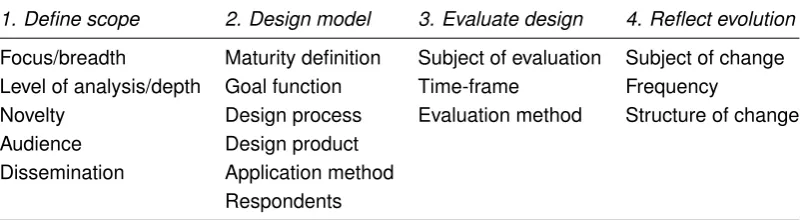
For each of these phases, Mettler (2011) has created decision parameters to help guide the development of the maturity model. The decision parameters for each of the phases are shown in table 1.1.
Before the development cycle starts, the need for a model is established and a review on existing maturity models is completed. An evaluation will be performed to identify if there is a need for a new or adapted maturity model and the first phase of the development cycle is started by defining the scope of the model.
The second phase is focused on designing the model. In this research this phase is divided up into a number of different parts in order to build up the model. The first elements of the model are gathered through a literature review and a two round Delphi study with industry experts. These steps ensure that risks from both literature and practice are covered in the model. The collected risks are further evaluated through a number of case studies. After gathering all the information about the risks maturity levels are created that represent the identified risks.
The third phase, evaluating the design, is done by presenting the design to the the experts which helped to identify the risks in the Delphi study. Furthermore the created model is applied to one of the case studies which has been researched to evaluate its design.
[image:22.595.65.469.656.766.2]After a final model is presented, the fourth and last phase is the ‘reflect evolution phase’. Here, the evolution of the model will be further investigated since the topic of Distributed Ledger Technology is far from mature and changes may take place in the definition of maturity in the field. A guideline should be in place to adapt the model to the changing environment.
Table 1.1:Decision parameters per design phase
1. Define scope 2. Design model 3. Evaluate design 4. Reflect evolution
Focus/breadth Maturity definition Subject of evaluation Subject of change Level of analysis/depth Goal function Time-frame Frequency
Novelty Design process Evaluation method Structure of change
Audience Design product
1.4. STRUCTURE OF THETHESIS 7
1.4 Structure of the Thesis
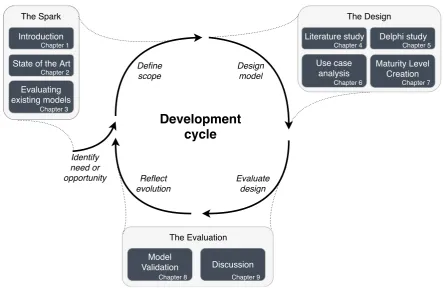
This thesis will follow the development cycle as defined by (Mettler, 2011). The structure of this thesis is build around the different phases of this development cycle. Figure 1.1 illustrates the organization of this research mapped onto the development cycle.
Chapter 2 will define the various concepts relevant to this research and present the state of the art for each topic. At first, the basic concepts behind Distributed Ledger Technology are explained. Second, the concept of Internet of Things will be explained. Third and last, IT risks are defined and the basic concepts behind maturity models are explained.
Chapters 4, 5, 6 and 7 include the design phase of the model. In chapter 4 the risks of DLT as described by literature are collected through a literature study. Chapter 5 gathers additional risks from field experts through a Delphi study. The collected risks are evaluated with a number of case studies in chapter 6. Chapter 7 includes the design of the maturity model with level descriptions based on the identified risks.
Chapter 8 evaluates the created maturity model using a survey and presents a number of assess-ment questions accompanied by a dashboard to visualize the model. Finally, in chapter 9 the results of this research will be discussed and directions for future research are proposed.
Introduction
State of the Art
The Spark
Evaluating existing models
The Design
Identify need or opportunity
Define scope
Design model
Evaluate design Reflect
evolution Chapter 1
Chapter 2
Chapter 3
Literature study
Chapter 4
Delphi study
Chapter 5
Use case analysis
Chapter 6
Model Validation
Chapter 8
The Evaluation
Development
cycle
Discussion
Chapter 9
Maturity Level Creation
[image:23.595.90.538.333.623.2]Chapter 7
Chapter 2
State of the Art
This research touches upon a number of topics, some already well established and some which are still developing. This chapter will introduce the different topics on which this research is built and present the state of the art for each topic. First, an introduction to the focus of this research, Distributed Ledger Technology, is given. Second, the Internet of Things is explained together with its close connection to Distributed Ledger Technology. Third, maturity models and their connection with DLT is presented.
2.1 Distributed Ledger Technology
In order to explain what DLT is and how it works, we first have to establish a definition of DLT. The definition of DLT is disputed within literature, it is often used interchangeably with blockchain tech-nology (Hileman & Rauchs, 2017; Maull, Godsiff, Mulligan, Brown, & Kewell, 2017; Walport, 2016). Blockchain technology is a subset of DLT that uses a data structure of chained blocks (Ellervee, Mat-ulevicius, & Mayer, 2017; Hileman & Rauchs, 2017). In order to create a clear definition, throughout this paper the term Distributed Ledger Technology (DLT) will be used when referring to the overall technology instead of the more common, but more restrictive, term blockchain technology.
This research uses an approach by Platt (2017) and adapted by Hileman and Rauchs (2017) to define DLT as a number of layers to distinguish the various components of a DLT system. The three ’layers’ that are proposed are: protocol, network, and application.
Protocol layer- The backbone on which network and applications are build, the in-frastructure.
Network layer- The network that connects participants within a specific protocol. Application layer - Provides products and services on a specific network, the user interface of a DLT.
Although these layers are not as clear cut as explained above, they do help to understand the different elements of DLTs. In this research the focus will be on evaluating IT risks in the applica-tion layer of DLT systems. Inherently this also includes risks in the layers above on which these applications are built.
Blockchain and DLT represent different part of this layered definition. Blockchain can be seen as only one type of DLT. There are new technologies being introduced in the DLT landscape which do not fall under the blockchain definition but do conform to the definition of a DLT. In this research, the following definitions are used, which are further explained in the sections below:
10 CHAPTER2. STATE OF THEART
Distributed Ledger Technology (DLT)-“. . . all initiatives and projects that are build-ing systems to enable the shared control over the evolution of data without a central party, with individual systems referred to as distributed ledgers” (Hileman & Rauchs, 2017, p. 24)
Blockchain based protocol- A subset of Distributed Ledger Technology which has
“. . . global data diffusion and/or uses a data structure of chained blocks” (Hileman & Rauchs, 2017, p. 24)
Directed Acyclic Graph (DAG) based protocol - A subset of Distributed Ledger Technology which has“. . . a directed graph data structure that uses a topological ordering”
(Lee, 2018)
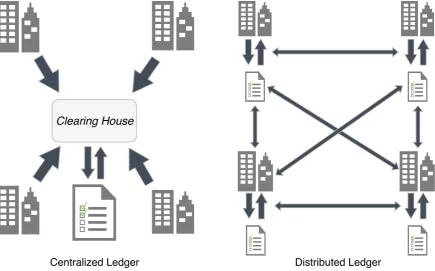
Distributed Ledger Technology is the overarching technology that encompasses technologies like the blockchain. It can be characterized as a shared database without a central validation system and it builds on the assumption that some nodes in a distributed network are malicious (Hileman & Rauchs, 2017; Pinna & Ruttenberg, 2016). Validation of the data often happens by multiple nodes in the network which removes the need of a trusted third party to validate correctness of data. The data of a DLT is distributed across multiple nodes in the network which means there is no single point of failure within the system (Maull et al., 2017). Figure 2.1 visually represents the differences of a centralized ledger with a trusted third party and a distributed ledger. Within the centralized ledger a trusted third party, the clearing house, is needed to perform transactions between parties which do not necessary trust each other. A decentralized ledger removes the need of the clearing house, generating trust between parties which do not trust each other so they can perform transactions directly with each other.
Clearing House
[image:26.595.68.504.441.712.2]Centralized Ledger Distributed Ledger
2.1. DISTRIBUTEDLEDGERTECHNOLOGY 11
There are a number of different variations of the DLTs which can be useful in different applications depending on the trust of nodes in the network and the anonymity that is needed. In principle, a DLT can be open (public), meaning any participant can read data, or closed (private), meaning only a spe-cific set of participants are able to read data based on certain requirements. Within these categories, there are different sets of permissions for writing and committing to a DLT. In permissioned systems only authorized participants can write and commit, and in permissionless systems any participant can write and commit.
2.1.1 Blockchain
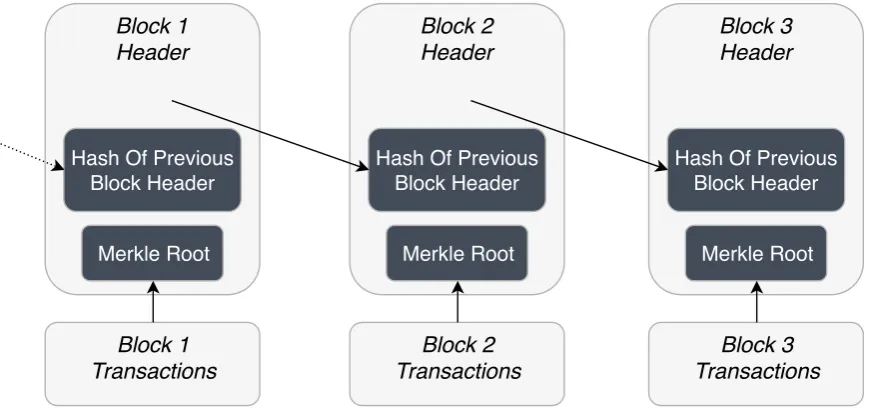
The blockchain is arguably the most well known subsidiary of DLT. It is the technology on which the first public cryptocurrency Bitcoin is built (Iansiti & Lakhani, 2017; Nakamoto, 2008). As mentioned in the definition at the beginning of this chapter, it is built up of blocks that are linked together in a single chain. Multiple transactions are combined into blocks, each with a unique block header. This block header contains the contents of the block, a timestamp and the header of the previous block, thus creating a chain of blocks. Next to this, the block also contains the Merkle root in order to verify the validity of the whole chain without needing to download it all (de Kruijff & Weigand, 2017). This is graphically represented in figure 2.2.
Block 1
Header
Hash Of Previous Block Header
Merkle Root
Block 1
Transactions
Block 2
Header
Hash Of Previous Block Header
Merkle Root
Block 2
Transactions
Block 3
Header
Hash Of Previous Block Header
Merkle Root
[image:27.595.100.535.366.572.2]Block 3
Transactions
Figure 2.2:Schematic of a blockchain (de Kruijff & Weigand, 2017)
12 CHAPTER2. STATE OF THEART
2.1.2 DAG
Recently, new types of DLT protocols that are based on Directed Acyclic Graphs (DAGs) have been gaining traction. These protocols differ from blockchain based protocols in the way that transactions are linked to each other. Within blockchain based protocols there is one single chain of transactions or blocks while in DAG based protocols there can be a multitude of chains.
A DAG is a directed graph data structure in which the sequence can only go from earlier to later (Lee, 2018). Multiple transactions can take place simultaneously and depending on the protocol, the validation of transactions is done by the transactions themselves and not by separate miners. These differences are essential changes from the blockchain where there is one single ‘chain’ on which transactions are kept and blocks of transactions can only be created sequentially. Figure 2.3 is a graphical representation of a such a DAG, in which the G is the genesis node; the first node created in a DAG. The genesis node is the only node which does not refer to any other nodes but to which all nodes eventually refer back to.
[image:28.595.69.505.292.396.2]G
Figure 2.3:Schematic of a DAG (Churyumov, 2016)
Depending on the implementation, validation on a DAG can work differently than within a blockchain. When a node communicates with the network to submit a transaction, it also confirms multiple other transactions at the same time. This can be done using the same protocols as explained in the previ-ous section. This method eliminates the need for separate ‘miners’ in the network.
There are currently a number of protocols that use this technology; some are fully based on this technology and others use it in combination with other blockchain technologies (Churyumov, 2016; IoT Chain, 2017; LeMahieu, 2014; Lewenberg, Sompolinsky, & Zohar, 2015; Popov, 2017).
2.2 Internet of Things
This section will focus on introducing Internet of Things (IoT) in order to better understand why DLT can play a large role in its future. While exploration in the combination of these two technologies has only just begun, it shows great promise for future applications.
The Internet of Things is a topic that has been gaining interest in the past years. Defined simply, it’s a network of interconnected ’things’ which were previously not connected. A simple example of a smart home device is a smart lamp, providing consumers with the opportunity to control the lamp from their smartphone or other device instead of a simple light switch. The actual application of IoT devices goes much further than this example, extending to connecting manufacturing plants and even entire cities.
2.2. INTERNET OFTHINGS 13
even to improve their manufacturing processes. In order to do so, organizations need to change their way of offering products to their customers. What was once merely the manufacturing of products, transforms into long time support of these products and offering services on top of these physical products.
[image:29.595.98.531.300.653.2]In order to support IoT products, an organization needs to support a new technology infrastructure around their products. Figure 2.4 presents all the elements that are needed for successful IoT prod-ucts according to Porter and Heppelmann (2014). From this technology stack, it is clear that there are many more elements involved than simply the product hardware and software. An organization needs to create a cloud platform with multiple functionalities and create a method of connecting their products to this cloud platform. All of these systems need to work together with their existing business systems and be able to accept information from external sources. Furthermore, customers need to be able to access all the systems through an authentication system. While all these elements do not need to be provided by a single organization, they do need to be in place in order to provide customers with IoT products.
14 CHAPTER2. STATE OF THEART
2.2.1 Challenges of IoT
Current IoT systems have evolved around a centralized model using centralized product clouds to register devices. While this may work for smaller IoT ecosystems, the operating costs and security concerns around this infrastructure increase when the IoT ecosystem grows. The centralized nature of current IoT systems causes them to be expensive due to the high infrastructure and maintenance costs of the centralized cloud solutions (Banafa, 2017). Scaling the systems will cause these cloud solutions to grow even larger and become more expensive. Furthermore, when one of the centralized systems is not available, the entire network can be disrupted as all the communication goes through these centralized systems.
There are currently a number of challenges regarding IoT devices, mostly regarding security of the devices and the information handled by these devices. Securing IoT devices and the surrounding ecosystem create a large challenge for organizations. Currently there are many IoT devices that lack both extensive security measures and life cycle management, creating possibilities for attacks on these devices. Furthermore, in home automation IoT devices, there is a large privacy concern regarding the safety of personal information being saved on the devices or a poorly secured cloud platform. Due to the immature nature of IoT devices, there is currently a lack of security or authenti-cation standards shared by a large number of IoT devices.
A good example of the lack of security in existing IoT devices is a large Distributed Denial of Service attack carried out on October 21st of 2016 targeting Domain Name Systems. This attack was carried out by a botnet largely consisting of poorly secured IoT devices (Symantec, 2016). The botnet used for the attack used weaknesses in the security of IoT devices and default credentials in order to gain access to devices. The attackers were able to shut down or reduce traffic to a number of popular websites for up to a couple of hours. While this attack has awoken customers and organizations about the risks of IoT devices, the situation around poorly secured devices is not resolved yet.
2.2.2 IoT and DLT
Distributed Ledger Technology is presented as a solution for many of the challenges that the IoT ecosystem currently faces. DLT can be seen as a solution to settle privacy and reliability concerns in the Internet of Things (Banafa, 2017). It acts as an enabler for IoT by providing a robust mechanism to support decentralized networks. This decentralized network reduces the single points of failure and the cryptographic algorithms of many DLT networks protect consumer data. Furthermore, it reduces the costs of maintaining a single centralized cloud to support the IoT devices.
The security of IoT devices can be improved by using DLT to perform a number of essential func-tions. These functions include controlling access, checking and performing software updates, and providing transparency and anonymity for IoT devices. It also opens up the possibility for new busi-ness cases using IoT devices. It might for example open up the possibility of using micro-payments between multiple machines or between a machine and a customer without a centralized third party.
2.3. MATURITYMODELS ANDIT RISKS 15
2.3 Maturity Models and IT Risks
When deciding if and how to implement applications within an organization, one aspect that must be carefully considered are the risks associated with the application. With the rapid expansion of Distributed Ledger Technology come many risks as well. These risks associated with the application can be defined as IT risks. There are not many large scale implementations of DLT since many of the applications or networks are not mature enough yet. The development and improvement of applications is rapidly taking place but deciding if an application is ready for large scale roll-outs can prove difficult.
Within literature there are multiple interpretations of the term IT Risks (ISACA, 2009; ISO, 2011; NIST, 2012), but there is no commonly accepted term. Some enterprises put IT risks only as an operational risk while we believe IT risks touch many aspects of different risks. IT has penetrated many aspects of enterprises and therefor the risks related to IT should also be considered throughout these different risk areas. It should not be seen as separate risk, rather as a part of existing risk areas as illustrated by figure 2.5.
IT-related Risk
Enterprise Risk
[image:31.595.93.535.307.421.2]Strategic Risk Operational Risk Legal Risk Technology Risk Security Risk
Figure 2.5:IT Risks as part all risks areas
This idea that IT risks are part of multiple risk areas will be used to classify risks associated with DLT applications. In order to aid this classification, the following definition by ISACA (2009) is used:
“The business risk associated with the use, ownership, operation, involvement, influence and adoption of IT within an enterprise.”
Assessing these IT risks of a specific application like a DLT application is part of IT risk man-agement. This assessment and managing of risks can be aided with maturity models. Maturity models provide organizations with a method to assess the maturity of a selected domain based on a comprehensive set of criteria (De Bruin et al., 2005).
2.3.1 Defining maturity models
16 CHAPTER2. STATE OF THEART
The idea of maturity models has its roots in models by R. Nolan (1979); R. L. Nolan (1973), where he described a stage model on the progression of IT through organizations. This stage hypothesis has been criticized by multiple scholars (Benbasat, Dexter, Drury, & Goldstein, 1984; King & Kraemer, 1984) but it remains the basis of much research in the IS field due in part to its simplicity. Maturity models became popular in practice with the development of the Capability Maturity Model (CMM) (Paulk, Curtis, Chrissis, & Weber, 1993). This model, developed by the US Department of Defense Software Engineering Institute, has been further developed and adapted into new models over the years (P¨oppelbuß & R¨oglinger, 2011).
The many maturity models that have been created can be used by businesses for multiple pur-poses depending on the need of the organization. P¨oppelbuß and R¨oglinger (2011) defines three different types of maturity models based on how they are applied in an organization:
• Descriptive - Maturity model applied as an as-is assessment of current capabilities of an entity. • Prescriptive - Maturity model which indicates how to identify desirable maturity levels and
pro-vides specific guidelines on improvement measures.
• Comparative - Maturity model that can be applied for internal or external benchmarking in order to compare maturity levels of similar business units and organizations.
Chapter 3
Maturity Models for DLT risk
evaluation
To evaluate if current models fit the need for evaluating DLT applications this chapter creates an overview of current relevant models. As presented in the previous chapter, over the years many different maturity models have been developed all with different purposes. Through this landscape of different maturity models it is easy to lose track of what is available and relevant. There are many maturity models of varying quality and varying fields of applicability. This chapter evaluates a selection of models based on quality and relevance to identify the need for a different model.
In order to identify relevant models a literature search for specific maturity models aimed at IT risk maturity of DLT applications has been carried out. The search engines Google Scholar and Scopus are used in addition to the databases of IEEE and ACM. This led to two relevant results based on the title and/or abstract. One of these sources is academic while the other is non academic but upon further research also has an academic basis. This will be explained further in the next section. The models found in the initial search are the following:
• Maturity Model for Blockchain Adoption (Wang, Chen, & Xu, 2016) • KPMG Blockchain Maturity Model (KPMG, 2017)
In order to gather more models which might be relevant to the research we broadened the search to also include general and/or IT specific risk management maturity models not directly related to DLT. A selection of well known maturity models with risk management aspects have been included in this analysis:
• CMMI for Development v1.3 (CMMI Product Team, 2010) • Risk Maturity Model (RIMS, 2006)
• IT Capability Maturity Framework Risk Management (Carcary, 2013)
These models have been chosen because these models all have a different degree of generaliz-ability in business contexts. CMMI for Development (CMMI-Dev) has a high level of generalizgeneraliz-ability as it can be applied to many different processes within an organization. On the other side of the spectrum is the KPMG model which is very specific as it can only be applied to analyzing IT risks of blockchain applications. In the following sections each model will be explained in more detail. The order of models will be from general maturity models to more specific maturity models.
18 CHAPTER3. MATURITYMODELS FORDLTRISK EVALUATION
3.1 Overview of Maturity Models
3.1.1 CMMI for Development 1.3
The CMMI-DEV model is aimed to guide process improvement across a project, division or an entire organization (CMMI Product Team, 2010). The model aims at covering multiple processes within an entire organization. Some of the areas on which the CMMI focuses can therefor be very abstract in order to cover a large number of practices.
The CMMI model is most well known in the industry, it is used as a basis for multiple other models as well (Becker et al., 2009). It is developed at the Software Engineering Institute of the Carnegie Mellon University and its development traces back to 1987. Through the years multiple models have been released improving on the previous versions.
The CMMI-DEV model is divided into 22 process areas, each area contains a cluster of related practices that when implemented collectively, satisfies a set of goals considered important for making improvement in that area (CMMI Product Team, 2010). For the purpose of this research we will focus on one of the process areas namely Risk Management (RKSM).
It should be noted that at the time of writing the CMMI-DEV 2.0 has been released. This model is the first update after 8 years but for the first time it is not available for free. Even though changes to this model are significant, for the purpose of this research it is expected to not be of influence. Because of this reason, along with the costs associated with using the new model, the 1.3 version of the model will be used for this research.
3.1.2 Risk Maturity Model
The Risk Maturity Model (RMM) is a model which combines elements from different models and standards into one model. It is aimed at Enterprise Risk Management (ERM) practitioners and aims to offer a method to evaluate and set goals in terms of risk performance (RIMS, 2006). It is focused only on risk management and mainly on an enterprise level.
The model is created in 2006 by LogicManager in collaboration with the Risk and Insurance Management Society (Risk Management Society, 2018). It is based on the methodology of the CMM model and has therefor the same levels as the CMM model.
The RMM consists of seven attributes which fit in existing frameworks like COSO ERM, and COBIT. Attributes consist of subjects like ‘ERM process management’, ‘Uncovering risks’ and ‘Root cause discipline’, among others. In order to further specify risk management within these attributes there are 25 competency drivers consisting of a total of 68 key readiness indicators to measure these competencies.
3.1.3 IT Capability Maturity Framework Risk Management
Managing IT specific risks is well discussed in literature but there exist relatively few maturity mod-els aimed specifically at IT risk management. Most literature is in the form identifying IT risks or best practice frameworks like the IT risk management framework Risk IT by ISACA (2009). These frameworks do however not provided the added benefits of a maturity model like providing a path for improvement.
3.2. EVALUATION OFMATURITYMODELS 19
management capability consists of ten capability building blocks which consist in turn of multiple dedicated maturity questions.
3.1.4 Maturity Model for Blockchain Adoption
Wang et al. (2016) have created a maturity model for blockchain adoption. While this is a blockchain specific maturity model, it is not very extensive. It identifies the current maturity of blockchain pro-tocols in general. It states that the maturity of the blockchain is currently not high enough yet and provides some recommendations to organizations choosing to adopt blockchain applications.
3.1.5 KPMG Blockchain Maturity Model (BMM)
KPMG has created a maturity model for analyzing risks of blockchain application adoption. This model can be used to assess the state of a DLT implementation and how well certain DLT-specific IT risks are under control (Spenkelink, 2017). The exact content of the model is not available to the public, however, through contact with KPMG more details about the model have been collected. An adaption of the paper on which the model is based is published in (van der Voort & Spenkelink, 2018). Using this model and an interview held with one of the authors of the model this maturity model is further evaluated.
While there has been research about risks of blockchain and implementing blockchain technology in businesses, this has been relatively scattered or only applies to a small niche in the market. The model by KPMG has created a comprehensive overview of the IT risks involved in implementing private DLTs and is created for and verified within the financial services industry (Spenkelink, 2017). A literature review has been carried out to identify current IT risks and these have been categorized into eight risk areas. Each of these risk areas is divided into multiple sub risks which are in turn measured using maturity self assessment questions. Each self assessment question relates to an IT risk area and is assigned to a specific maturity level. These questions and corresponding levels have been created in collaboration with experts within KPMG and the financial services industry.
3.2 Evaluation of Maturity Models
To evaluate the maturity models that are mentioned in the previous section we will look at two different aspects of the models, the applicability and the quality of the models. Quality of models is a heavily debated issue within IS research (De Bruin et al., 2005; Mettler et al., 2010; P¨oppelbuß, Niehaves, Simons, & Becker, 2011), many authors argue that research rigor is often times not carried out successfully. A method to create maturity models by rigorously executed design science research has been proposed by (Becker et al., 2009). In order to evaluate the quality of maturity models P¨oppelbuß and R¨oglinger (2011) has proposed a number of design principles that can be used to develop and evaluate maturity models.
The applicability of maturity models on specific applications is less discussed in literature. While there is a consensus that there are many different models available and some are very similar, a comprehensive method to choose a specific model has not been proposed yet. Mettler (2011) has made suggestions as to criteria for maturity model selection. These can be used to evaluate the applicability of the selected maturity models to the identified problem area.
20 CHAPTER3. MATURITYMODELS FORDLTRISK EVALUATION
• Applicability
– Origin of the model – Reliability
– Accessibility
– Practicality of recommendations – Method of application
– Design mutability • Design principles
– Basic
* Basic information
* Definition of central constructs related to maturity and maturation * Definition of central constructs related to the application domain * Target group-oriented documentation
– Descriptive
* Intersubjectively verifiable criteria for each maturity level and level of granularity * Target-group oriented assessment methodology
– Prescriptive
* Improvement measures for each maturity level and level of granularity * Decision calculus for selecting improvement measures
* Target group-oriented decision methodology
For each model presented in the previous section these criteria will be used for evaluation. The complete notes of the evaluation can be found in appendix A. In table 3.1 an overview of the results of the evaluation are presented. CMMI-Dev v1.3 is qualitatively a very good model that is in use within many different companies and is freely accessible. Appraisals take place by professionals according to Appraisal Requirements for CMMI which includes general recommendations of process improvement. All basic and descriptive design principles are included in the model, not all prescriptive principles are included but these principles might be included in appraisals of the CMMI model.
The Risk Maturity Model (RMM) is based in practice created by Logicmanager. It has been verified at a large number of organisations and validated in a single research paper. The model itself is not available for free, a small self assessment is available for free. The recommendations are general on processes of risk management. From the information that was freely available it can be deduced that all basic and descriptive principles are included in the model. Only the inter subjectively verifiable criteria are unknown based on the information available. The prescriptive principles are not all included, missing a decision calculus and a target group decision methodology.
The IT CMF model is based in academics and further developed in practice. The model is verified in practice but not validated and it is not available for free. Only academic papers can be found with parts on the model. The recommendations by the model are problem specific and assessments are carried out by third parties. All the design principles are included in the IT CMF model.
3.3. CONCLUSION 21
The KPMG Blockchain Maturity model is based in academic research into the IT risks of blockchain of which the full research is not available to the public. It is verified through case studies but the step from individual risks to maturity levels is not clear from the available literature. Assessment is done in collaboration with KPMG after filling in an assessment. The recommendations from this assessment are very specific to the problems identified. The model includes many of the basic and descriptive design principles, although not all elements are clear from the available research. The prescriptive design principles are not included in this model but it might be possible that these elements are included in the consulting services of KPMG.
3.3 Conclusion
The current landscape of maturity models is very broad with models operating on different levels of analysis. In this research a solution is being sought for evaluating specific DLT applications using a maturity model. While some of the identified maturity models that have been evaluated are of good enough quality, only the KPMG Blockchain Maturity model fits the purpose of evaluating a single DLT application. Other models are either too broad or do not offer enough guidance in evaluating the risks related to DLT applications.
Part II
Design
Chapter 4
IT Risks Described in Literature
With the need of a new model established, we start to identify what is needed to design the model. In this chapter the IT risks related to Distributed Ledger Technology are identified through a literature study which is complimentary to a study already executed by van der Voort and Spenkelink (2018). This study is brought up to date and an additional search for risks specific to IoT has been executed. This resulted in a collection of 29 individual risks divided over five areas.
4.1 Literature Study
This literature study followed a semi-structured approach. It attempts to cover all relevant papers in order to collect IT risks of DLTs. The literature review is carried out according to the Preferred Reporting Items for Systematic Reviews and Meta-Analysess (PRISMAs) approach (Moher, Liberati, Tetzlaff, & Altman, 2009). This is a method to carry out a thorough systematic literature review. In this research not all steps of the PRISMA approach are completed, the qualitative synthesis and meta-analysis are excluded. Instead of these last steps we are analyzing the primary papers and extracting only IT risks from these papers. A systematic literature review approach is chosen in order to include as many as possible papers about IT risks of Distributed Ledger Technology.
A literature review close to the topic of this review has already been carried out by van der Voort and Spenkelink (2018), this review covered risks of DLT but did not cover IT risks of DLT in the IoT field. The full results of the literature review form van der Voort and Spenkelink (2018) are also not available. The keywords from this study are adapted in order to also cover IoT risks. Furthermore, a search has been carried out in Elsevier Scopus in order to obtain more papers. The main keywords are related to the three main themes of this research: Distributed Ledgers, Internet of Things and Risks. From these main keywords a number of similar keywords were identified which are used to formulate a search string. The keywords used for the search are listed in table 4.1.
IT risks of DLT applications in general are inherently also risks which are applicable to DLT appli-cations in the IoT domain. Therefore in this literature review two search terms will be used to collect relevant articles. While the only difference of the search query is the addition of IoT keywords, this produced different results than searching for IoT keywords within the results of the general query. This is likely due to the way the search engines for specific databases are set up.
The search engines Scopus and Google Scholar and the databases of IEEE and ACM are used to find relevant articles. The Science Direct database is excluded from this search since these articles are also included in the Scopus search engine. The results from the initial search query are narrowed down first by title and the remaining papers by relevance of the abstract. Because of the large amount of results in the Google Scholar search engine, only the first 10 pages (100 results) of the results
26 CHAPTER4. IT RISKSDESCRIBED INLITERATURE
Table 4.1:Keywords utilized in the literature study Distributed Ledger Internet of Things Risks
DLT IoT IT risks
Distributed Ledger Technology Embedded Systems Disadvantage
Blockchain Risk management
Block chain Threat
Weakness Vulnerabilities Challenge
will be included. Additional papers from forward/backwards citing and recommendation engines from Mendeley are also included.
In figure 4.1 the result from each stage in the literature study is visualized. Each number in the diagram represents the number of papers included in the step. In the selection of titles a relatively broad selection of papers has been made. This is because in an initial search it has been found that there are many articles that cover some detail on risks or challenges of DLTs but do not have it as their main focus. Therefor the title may not reflect some of the relevant information in this research. The titles that were included relate to challenges and risks with different types of DLT or to the connection between IoT and DLT.
The selection on abstracts looked at the abstract or introduction and headers of different sections of the paper or article. Papers were included in the selection when they showed they had connection with risks of DLTs or challenges related to them.
ACM [67]
IEEE [184]
Scopus [329]
Google Scholar [200]
Selection by title [11]
Selection by title [25]
Selection by title [50]
Selection by title [58]
Merge sources [149]
Duplicate removal [116]
Selection by full-text
[32] Selection by
abstract [35]
Final selection based on availability
[32]
Other sources
[5]
Selection by title [5]
[image:42.595.67.508.436.701.2]4.2. EXTRACTING AND CLASSIFYING RISKS 27
[image:43.595.109.522.254.503.2]In appendix B.1 the primary list of papers which are included in the literature review is presented. From the results of the literature study it becomes clear that the research in this area has only recently gathered the interest of researchers. Figure 4.2 presents the years in which the selected papers have been published. It is interesting to see that no papers older than 2016 have been included and that the amount of papers almost tripled in the year 2017. Even though the literature search has been performed in may 2018, the amount of relevant papers is already as high as in 2016. One reason for the recent increase in interest might be because of a shift in focus on the topic. In the past, research has been focused on creating use cases and evaluating and improving the technology itself. Recently, there has been a shift towards implementing these systems within companies which in turn increases the need to look into the related IT risks.
Figure 4.2:Year of publishing
4.2 Extracting and classifying risks
The goal of the literature study is to identify the different IT risks related to DLT for IoT within literature. At first a list of all the risks mentioned in the papers are extracted, from each risk it is noted from which papers they have been deduced. This total list of risks consists of 57 individual risks of which some are related but not duplicate.
28 CHAPTER4. IT RISKSDESCRIBED INLITERATURE
• Strategic Risks • Operational Risks • Security Risks • Legal Risks • Technology risks
The different risks within the risk categories have been consolidated to further group together similar risks. This resulted in a final collection of 29 different risks. Figure 4.3 presents the different steps of the identification process and the number of risks that were carried on from each step. The list of consolidated risks derived from literature including from which papers they stem can be found in appendix B.2.
Initial list of risks [57]
Consolidated risks
[29] Categorized into
risk areas [57]
Strategic Risks [6]
Operational Risks
[10]
Security Risks [4]
Legal Risks [3]
Technology Risks [6] Technology Risks
[image:44.595.68.506.278.444.2][6]
Chapter 5
IT Risks Described by Field Experts
In order the create a more complete collection of risks, a number of field experts have been consulted to verify and adapt the identified risks from the literature study. A two round Delhpi study has been performed which resulted in a preliminary risk model for further evaluation during a number of case studies.
5.1 Study Design
In order to identify IT risks of DLT applications according to field experts, a Delhpi study has been set up. According to Okoli and Pawlowski (2004) the Delphi method leans itself for concept/framework development study following a two-step process namely: identification and elaboration of a set of concepts, and classification and taxonomy development. This approach fits well with the creation of a maturity model as exemplified by a number of maturity model creation studies (De Bruin et al., 2005; Mettler, 2011; Rosemann & Bruin, 2005; Smits & Van Hillegersberg, 2015; Van Dijk, Willem, Van Hillegersberg, & Daneva, 2017). According to Hasson, Keeney, and Mckenna (2000), the Delphi technique is particularly useful in areas of limited research; as is the case for DLT related research. Furthermore it is suited to explore areas where controversy, debate or a lack of clarity exist. This fits perfectly with the current landscape of DLT research, as there are many different opinions on the design and risks relating to DLT applications.
There are a number of different ways to conduct a Delphi study but the techniques all aim for the same goal as characterized by Linstone and Turoff (1975):‘“Delphi may be characterized as a method for structuring a group communication process so that the process is effective in allowing a group of individuals, as a whole, to deal with a complex problem.” The traditional Delphi method was developed by Norman Dalkey of the RAND corporation in the 1950’s (Dalkey & Helmer, 1963). Rowe and Wright (1999) note that a classical Delphi study should consist of four key features: anonymity of Delphi participants, iteration, controlled feedback, and statistical aggregation of group response. The traditional way of conducting a Delphi study is by collecting a number of experts in the same room for a day and having them reach consensus during a number of rounds. However, in order to meet the requirements of a given study, Linstone and Turoff (1975) argue that a Delphi method can also be adapted. For this research the approach of Skulmoski, Francis Hartman, and Krahn (2007) will be used to conduct the study, using questionnaires for a geographically dispersed group of experts.
A two round design has been chosen based on the design used by Rosemann and Bruin (2005). We have excluded ranking the different risks and creating level descriptions which are the third and fourth round of the Delphi study by (Rosemann & Bruin, 2005). This approach has been chosen because of the difficulty of generalizing level descriptions for a number of the identified risk areas
30 CHAPTER5. IT RISKSDESCRIBED BYFIELDEXPERTS
Survey to experts
Preparation
Add additional IT risks Rate satisfaction with risk areas and provide comments
Round 1
Consolidate and revise list of IT risks
Consolidate and revise risk areas
Round 2
Rate list of risks for measurement by model Rate satisfaction with proposed risk areas and provide comments
Round 2
Round 1
Propose list of initial IT risks for DLT
Propose initial risk areas for DLT
[image:46.595.138.431.87.391.2]Propose definitions for risk areas
Figure 5.1:Study design of the Delphi study
during the first rounds of the Delphi study.
During the two rounds, IT risks that are identified in the literature study are adapted and further classified. Figure 5.1 illustrates the design of the two rounds of the study where in the left column the work by the researcher is explained and the left the task for the experts. The first round of the study focuses on brainstorming around the risks and risk areas that have been identified in the literature study. The second round verifies the adapted lists and rates the satisfaction with the newly proposed risks and risk areas.
5.2 Selection of Experts
5.3. CONDUCTING THE STUDY 31
Sector of focus # IT Consulting 3
Automotive 2
Logistics 4
Energy 2
Manufacturing 4 Cyber security 1
[image:47.595.135.230.85.214.2]Academics 2
Table 5.1:Sector of participants
Function #
Academic researcher 2
Software Architect 2
R&D and Strategy Manager 3
IT Consultant 3
Business partner manager 1
[image:47.595.322.527.93.204.2]Researcher in DLT-related research unit 4 Table 5.2:Function of participants
1. Knowledge and experience with the issues under investigation 2. Capacity and willingness to participate
3. Sufficient time to participate 4. Effective communication skills
Based on these criteria a list of potential experts have been identified. The potential experts have mostly been collected through contacts in the Netherlands and Germany and snowballing further to reach other candidates. A list of 30 potential candidates have been contacted and 15 candidates have agreed to participate in the study. The other potential candidates either did not respond or stated that they did not have the time to participate. The experts that have agreed to participate in the study are distributed across multiple countries, multiple companies, multiple disciplines and have different relations with the topic. This distribution is important since it increases the possibility of different opinions on the topic. In table 5.1 and 5.2 the number of experts is shown according to their expertise, the IT consultants have been divided further based on their sector of expertise.
5.3 Conducting the study
The Delphi study technique using surveys can be conducted in a multitude of ways. Traditionally the experimental studies have relied on paper based surveys sent out to participants, later this trans-formed into to electronic based surveys through email or online surveying tools (Hasson et al., 2000). However, with these methods it is difficult for participants to respond to each other during a survey round, which is one of the advantages of performing a Delphi study in-person.
In order to reproduce the behavior of a local condensed group of experts in a geographically dispersed group of experts through an electronic way, a Group Decision Support System, Spilter, is used (Spilter, n.d.). This online tool provides the possibility of viewing anonymous answers from other participants in the study while the survey is being conducted.
5.4 Delphi Round 1
32 CHAPTER5. IT RISKSDESCRIBED BYFIELDEXPERTS
The focus of this round is to identify additional risks to the ones that have already been identified in the literature study. The survey of round one was divided into three parts and had a combined total of 11 questions. The first part focused on gaining some more demographic information about the participants. Part two included five questions, one for every risk area as defined in the literature study. Participants got the opportunity to add their own risks and note if they don’t agree with any of the proposed risks in each risk area. Part three of the survey offers the opportunity to comment on the identified risk areas. For each risk area the participant was able to note on a five point Likert scale if they agree with the definition or not. When they do not agree with a definition of a risk area they had the opportunity to propose one themselves. The last question of the survey asks the participant to note on a five point Likert scale if they agree that the list of risk areas is complete or not. The full survey can be found in appendix C, section C.1.
5.4.1 Redefining Risk areas
The participants were asked if they agreed with the defined risk areas and if the proposed risk areas were complete. While half of the participants agreed that the list was complete (7 out of 14), the remaining participants either disagreed or neither disagreed or agreed with the completeness. The comments given with the scores provide some insights as to why participants scored the question low:
“Some risks may overlap, for example: ‘a low number of nodes in a network’ can be classified as a Technology and Security risks.”
“In general they are OK, but I question if this provides any insights based on a lot of the answers as filled in before.”
Based on these comments and other suggestions, the risk areas have been redefined to create less overlap and to be able to provide more insights. In order to achieve this, a new layer has been added to the model. This new layer provides more insights in the topics covered by the different high level risk areas and provide a method to further categorize risks. Furthermore this layer aims to create a more clear divide between the high-level risk areas.
The high-level risk areas have been redefined based on the feedback from the participants. The lowest scoring and most controversial risk area, technology risks, has been replaced by two new risk areas: ‘Development’ and ‘DLT platform selection’. These areas in part cover some of the risks previously categorized in the ‘Technology’ risk area. In figure 5.2 the redefined risk area model is presented with it’s 6 high-level risk areas and 23 newly defined low-level risk areas. These risk areas are proposed to the participants in the second round of the study.
5.4.2 Redefining IT Risks
During the second part of the first round the participants were presented the list of 26 risks as identified in the literature study. They were asked if they agreed with the list of risks and if they had any additional risks which were not mentioned. While the participants did not disagree with the risks already identified, they provided an additional 110 risks bringing the total up to 136. This large increase may partly be explained by the varying abstraction level of the identified risks.