University of Warwick institutional repository: http://go.warwick.ac.uk/wrap
A Thesis Submitted for the Degree of PhD at the University of Warwick
http://go.warwick.ac.uk/wrap/40520
This thesis is made available online and is protected by original copyright.
Please scroll down to view the document itself.
Current Issues in Trade Policy
by
Terence Huw Edwards
Submitted to the Department of Economics
in partial ful…llment of the requirements for the degree of
Doctor of Philosophy
at the
UNIVERSITY OF WARWICK
December 2007
c University of Warwick 2007
Current Issues in Trade Policy by
Terence Huw Edwards
Submitted to the Department of Economics on __ January, 2007., in partial ful…llment of the
requirements for the degree of Doctor of Philosophy
Abstract
The articles in this thesis re‡ect my work at the Centre for Study of Globalisation and Regionalisation in Warwick, centred around two EU-funded projects: one relating global-isation to social exclusion, and the second looking at the re-integration of the Central and Eastern European transition economies into the main European economy. The papers in this thesis are seen as new contributions. Chapter 1 is introductory, consisting of a brief literature survey outlining a number of important debates. This is followed by a summary of the contributions of the papers in subsequent chapters. Chapter 2, written with John Whalley, is a general equilibrium decomposition of the widening wage gap in the United Kingdom, utilising novel techniques of double calibration. The underlying question is the degree to which widening inequality re‡ects a change in world traded prices follow-ing liberalisation. Chapters 3 and 4 refer to regional integration. In Chapter 3 I look speci…cally at the likely e¤ ects of admitting several new Central and Eastern European countries to the European Single Market, using a general equilibrium model combining the new trade theory and the gravity model approach. Chapter 4 is more theoretical, examining the perceived misuse of regulatory protection in determining national product standards - in this case, in a cross-hauling duopoly. It is shown that several conclusions of the recent literature regarding the trade volume e¤ ects of regulation and the welfare e¤ ects of mutual recognition agreements, may be misleading. In Chapter 5 I delve into a new issue in trade theory: namely the implications of imperfect information, match-ing, search and networking. This chapter indicates a possible direction in which trade theory needs to move to better understand the growing outsourcing trade, and also draws important theoretical and policy implications. Chapter 6 draws brief conclusions.
0.1
Contents
Title Page, p. 1. Abstract, p. 2. Contents, p. 3.
Acknowledgements p. 4. Declarations, p. 5. Abbreviations, p. 6.
Chapter 1: Introduction p. 7.
Chapter 2: Short- and long-run wage inequality decompositions. With John Whalley, p. 29.
Appendix 2.1: Elasticity sensitivity of model based decompositions Chapter 3: An economic assessment of EU single market enlargement, p. 61.
Appendix 3.1: Derivation of border and comparative production costs. Appendix 3.2: General equilibrium model of European Enlargement. Chapter 4: Trade and strategic regulatory bias, p.108.
Appendix 4.1: Welfare and pure, horizontal trade barriers.
Appendix 4.2: Properties of the Cournot-Nash model with constant elasticity demand.
Appendix 4.3: The e¤ects of mutual recognition in a cross-hauling duopoly in the presence of a nonnegative pro…t constraint.
Chapter 5: Search and the path-dependency of trade, p. 231. Chapter 6: Conclusions/Afterword, p. 271.
0.2
Acknowledgements
0.3
Declarations
The work in this thesis is my own, excepting Chapter 2 which was co-authored with
John Whalley. The broad idea of this chapter, and some of the …nal drafting, were Prof
Whalley’s, while the modelling work and most of the text are primarily my responsibility.
The paper in Chapter 2 was presented at the Royal Economic Society conference in
Warwick in April 2003, and was published as an NBER discussion paper. A revised
version is currently forthcoming in the Bulletin of Economic Research. Chapters
3-5 have appeared as working papers. A revised version of chapter 3 is forthcoming in
Applied Economics. Chapters 4 and 5 will shortly be submitted to journals.
0.4
Abbreviations used in this thesis
CEEC Central and Eastern European Countries CES Constant Elasticity of Substitution CGE Computable General Equilibrium
CU Customs Union
GDP Gross Domestic Product
GEMEE General Equilibrium Model of European Enlargement GM Genetically Modi…ed
GTAP Global Trade Analysis Project H-O Heckscher-Ohlin
HOS Heckscher-Ohlin-Samuelson IMP International Monetary Fund NTB Non-Tari¤ Barrier
OECD Organisation for Economic Co-operation and Development TBT Technical Barrier to Trade
UK United Kingdom US United States
WTO World Trade Organisation
Chapter 1
Introduction
The world is becoming increasingly integrated economically. Between 1965 and 2001, international trade grew faster than World GDP in all but three years. Global trade’s share of World GDP rose from 13 percent in 1970 to 21 percent in 1995 (World Bank, 1998).1 Successive rounds of trade agreements have cut tari¤ and non-tari¤ barriers, while policymakers’ opinions, under the in‡uence of the Washington Consensus of the World Bank, IMF and US Treasury,2 have generally shifted in favour of freer trade, compared to the general support for protectionism and managed trade (especially in developing countries) during the immediate postwar years.
The economic arguments in this debate can be divided into a number of categories:
1.0.1 Standard arguments for greater global integration
The arguments in favour of reducing trade barriers are well-rehearsed. Not only does freer trade allow countries to make specialisation gains, as indicated by classical and neoclassical trade theory, but the advocates of newer trade theories (see, e.g. Baldwin and Venables, 1995) would argue it also produces further gains in terms of increased competition (driving down prices), increased variety of goods available to consumers and increased capital ‡ows into regions opening themselves up to increased trade. Em-pirical evidence has increasingly supported the idea that more open economies tend to outperform relatively closed economies.3 In neoclassical theory, countries as a whole
would expect to make specialisation gains from liberalising their own trade, unless there is some other form of distortion present.4 In the new trade theory, integration on a world scale also allows for increased technology ‡ows and for countries to reap bene…ts of economies of scale in developing new products (see e.g. Grossman and Helpman, 1993) - consequently new trade theory approaches to estimating the gains from trade generally yield greater potential global welfare gains from trade than standard theory, although individual countries and groups within countries may lose.
3
See e.g. Winters, 2004.
4
1.0.2 Arguments for a deeper integration at the global or regional level
It is increasingly argued that removing formal trade barriers alone is not enough to achieve economic optimality. A major source for this view is the empirical evidence that trade between most countries - even within close trading areas such as the European Union - falls well short of that within any single country. This conclusion stems primar-ily from gravity analysis of trade patterns (see McCallum, 1995, Tre‡er, 1995), which suggests that even within a free trade area, country dummies are strong and signi…cant and indicate powerful ‘border e¤ects’impeding trade.5
To a growing school of thought the logical explanation for these observed border e¤ects is that they must re‡ect some form of transactions costs on businesses wishing to operate across national boundaries. However, despite attempts to explain the observed patterns (see, e.g. Obstfeld and Rogo¤, 2000) the precise reason why trade between countries seems to fall short of that within countries is still far from satisfactorily ex-plained. For example, Obstfeld and Rogo¤ emphasise the importance of transport costs - yet gravity models already implicitly proxy for transport costs with a distance variable, and replacement of distance with more direct estimates of average trade costs does not greatly a¤ect the conclusions regarding border e¤ects.6 There is evidence that freight and insurance rates for di¤erent commodities vary, as do rates for sea as against land transport, but again it is hard to build up a conclusive case that these di¤erences can explain the estimated border e¤ects when these are present both for countries with land and sea borders.7
5
Though McCallum’s analysis has been challenged, e.g. by Hillberry (1999) or Anderson and van Wincoop (2003).
6
In Chapter 2, below, I calibrate a variety goods model for European trade with explicit estimates of transport costs, and …nd results broadly in line with previous gravity simulations.
7
The alternative is to look at the e¤ects on trade of policies other than simply tari¤s and formal non-tari¤ trade barriers. Obstfeld and Rogo¤ mention currency conversion costs in this regard - and the argument that eliminating these would boost trade is frequently cited as a motivation for the European common currency. However, many forms of national policies may potentially a¤ect international trade ‡ows. The costs of certi…cation and testing of goods to meet di¤erent health and safety standards, di¤erent labelling or warranty requirements in di¤erent countries can be quite signi…cant, though varying between goods and commodities (see e.g. Harrison et al, 1996).8
Not only is estimation of the trade costs imposed by national policy regimes a tricky empirical task, but the interpretation of such costs is also di¢ cult. While, on the one hand, national policies on product standards may act as impediments to trade, and may even be systematically manipulated to form ‘regulatory protection’, particularly when other forms of protection are ruled out (see e.g. Wallner, 1998, Baldwin, 2001),9 on the other hand such policies may also serve important purposes of consumer protection, and so the ‘regulatory protection’ classi…cation may be over-simplistic in many cases. The degree to which such an interpretation applies in practice to policy di¤erences between countries has important implications for policy (see Chapters 3 and 4 for more detail). The belief that such di¤erences primarily re‡ect protectionist motives has led to the policy conclusion that internal product regulation policies are a legitimate …eld of concern to international trade negotiators, and has, in particular, encouraged the development of regional agreements to reduce such barriers (notably the European Single Market). This
some possible validity in Hillberry’s (1999) suggestion that estimated border e¤ects may in fact re‡ect the propensity of some footloose industries to move closer to their main potential customers.
8
Zahariadis, 2002, using …gures derived from Harrison et al (1996), suggests costs on Turkish imports into the EU of 1.3 to 3.1 per cent for frictional/border costs, 1 to 2 per cent for testing/certi…cation costs and 1 to 2.5 per cent for standardisation costs.
9A classic example of regulatory protection in practice was the policy of the …rst Mitterand government
school of thought underlies much of the economic case for deeper regional integration. In support of this view, it should be noted that advanced countries - such as those which, until recently, dominated the European Union - are likely to share a high degree of preference for reliability, safety and the like, so that mutual recognition of each other’s standards (or harmonisation on a shared standard) is more likely to be bene…cial in that context, though Chapter 4 shows there may still be strategic reasons why countries may distort their choice of standards in the presence of trade. Where countries greatly di¤er in income levels or consumer attitudes, this may not be the case - a matter which makes the extension of the European Single Market to the poorer, new members relatively more debatable.
To traditional trade theorists, regionalism - in the form of Free Trade Areas or Cus-toms Unions - has a distinctly ambiguous nature, with o¤setting trade creation and trade diversion e¤ects. There is also a more recent literature on whether regional trade areas form a lasting barrier or a stepping stone to global trade liberalisation. The optimistic interpretation stems particularly from Kemp and Wan (1976), who showed that, on not particularly restrictive assumptions, when a country joins a Customs Union (CU), it is always possible, by adjusting tari¤s (adopting the Vanek compensating tari¤10) and, if necessary, by internal side-payments, to ensure that no country, inside or outside the CU loses. In these circumstances, a Customs Union or Free Trade Area might be expected to eventually expand to incorporate the whole World. It is not di¢ cult to show that this result implies that members of a CU will gain if the CU sets optimum tari¤s vis-a-vis the rest of the World, and nonmember states do not adjust their tari¤s.11 However, it does
1 0The Vanek compensating tari¤ is the tari¤ which maintains the level of trade with the rest of the
World at pre-CU levels.
1 1
not necessarily hold if non-member countries alter their tari¤s in an optimum fashion (Richardson, 1995).
A more critical view (Krugman, 1991b) is based on an imperfectly competitive model where countries form a series of rival customs union blocs, which expand mainly in order to increase their ability to impose higher tari¤s on the rest of the World. Recent studies12
seek to investigate empirically the circumstances in which trade blocs lead to greater protectionism or greater trade.
Regardless of this debate, there is strong reason to believe the removal of regulatory barriers between member states of a regional bloc is more likely to bene…t third party countries than the removal of internal tari¤s within the bloc. The argument is that di¤erent regulatory standards e¤ectively impose a real resource cost on companies trading between two nations, often modelled as an iceberg cost13: while removing regulatory di¤erences between country A and country B may increase A and B’s shares of each other’s market at the expense of a third country C, the key di¤erence is that if the regulatory cost is real and signi…cant, overall incomes in both A and B will rise, and this will potentially produce an o¤setting income e¤ect on C’s exports. Under these circumstances a regional agreement betweenAandB may well actually be of net bene…t to C. Assuming this is the case, there is less con‡ict between regionalism and the promotion of global trade.
The two major methods by which an agreement of this sort can be implemented are, …rst, the application of a central harmonisation of standards and, secondly, the use of mutual recognition agreements, under which country A will accept for sale any
1 2See, e.g. Abrego et al (forthcoming). 1 3
goods from country B which meet the latter country’s own regulations, as long as this is reciprocated. The latter, which e¤ectively devolve more decision-power to individual nations, have tended to be favoured in the literature.14 In practice, the European Single Market Initiative has used a combination of the two approaches, though mostly applying mutual recognition where possible (see Brenton et al, 2001).
Mutual recognition has a further attraction: whereas harmonisation of product stan-dards requires a harmonising body - usually a regional body, such as the European Commission - to implement, mutual recognition agreements can be agreed between any pair of governments or trade blocs. Mutual recognition agreements are increasingly appearing on the trade agenda, forming the basis of agreements between the EU and Asia-Paci…c countries, for example.
1.0.3 Distributional arguments for protection
While the case both for trade liberalisation and for the removal of other types of barriers (as discussed above) has been in‡uential in furthering global and regional integration in recent years, there are also powerful counter-arguments. Let us start with the standard arguments on freer trade and globalisation: while trade theory generally suggests freer trade should bene…t output and welfare globally, it has always been recognised that cer-tain groups will lose out. Following Stolper and Samuelson (1941), the argument has been generally accepted that trade will tend to bring about a movement towards equalisation of factor prices worldwide.15 For any given country, trade can serve to remedy relative factor shortages by allowing the country to import goods intensive in the factors more
1 4Again, see Wallner (1998), or Lutz (1996 (1) and (2)). 1 5
abundant elsewhere. Trade liberalisation between the developed world and less developed countries (LDCs) should therefore result in the richer countries, which are assumed to be more abundant in skilled relative to unskilled labour, exporting skill-intensive goods and importing less skill-intensive goods. This has the consequence (unfortunate in terms of income distribution) that unskilled labour demand in wealthy countries should fall, leading either to a fall in wages or (in more rigid labour markets) unemployment.
In this context, it is worth bearing in mind that, during the trade liberalisations of the past 2 or 3 decades, wealthy countries have indeed seen falls in unskilled labour demand (see, e.g. Slaughter, 1999 or Leamer, 1998), taking the form of rising wage di¤erentials in the USA and UK, and of rising unemployment elsewhere. However, correlation does not necessarily imply causality, and there has been a vigorous debate among economists as to whether the observed labour demand changes really re‡ect trade e¤ects, or whether the more important factor is simply technological change, for example with computers displacing unskilled workers. Most studies using aggregate data have concluded the latter, technology e¤ect is probably the more important (see the survey in Abrego and Edwards, 2003), although some authors have argued this may re‡ect a failure to disaggregate su¢ ciently industries in which outsourcing is taking place.16
1.0.4 The clash between regional governance and national sovereignty
While the case for deeper regional integration, going beyond simply the removal of formal trade barriers, as outlined above, has been cited in support of the European Single Market and the Euro currency - classic cases of governance on a regional level - the economic analysis underlying this is still relatively novel and, on a theoretical level,
1 6
under-developed. The currency debate - the choice between potentially trade-promoting stable exchange rates or more ‡exible rates to suit di¤erent national macroeconomic conditions - is well-rehearsed and beyond the scope of this thesis.
Less familiar is the parallel debate over regulatory standards. For example, in the instance of product standards, the case for regional or even global governance, either in the form of agreed harmonisation or mutual recognition, is based upon the perceived threat of ‘regulatory protection’. However, there is no common economic textbook treat-ment of such protectionism to compare with the chapters on tari¤s and quotas found in any standard trade text. Rather, work to date either consists of empirical studies characterised by sweeping assumptions, special case studies of individual industries (e.g. Gandal, 2001) or a few rather abstract theoretical pieces.17 The claim that increased
regulation hampers trade has rarely been investigated empirically, and what evidence there is (e.g. Swann et al, 1996) rather points in the opposite direction.
The problem is the dual nature of regulatory policy - whether implemented on a national or international level. Regulatory policies can be justi…ed from the point-of-view of protecting consumer health, safety and providing insurance against substandard goods (c.f. Akerlof’s ‘lemons’) in the presence of externalities or costs of information acquisition. Regulations of this type can be classi…ed as ‘vertical’standards regulation, in the sense that they tangibly improve some aspect of quality as experienced by consumers. Alternatively, regulations of a ‘horizontal’nature (e.g. in telecommunications) can often be justi…ed on the grounds of the need for di¤erent users to use compatible technology, which produces network externalities.18
1 7See Lutz, 1996 (1) and (2) or Wallner (1998). 1 8
The potential clash comes because on the one hand, regulation can be used potentially for protectionist reasons - hence providing a case for international intervention to avoid this - yet, on the other hand, di¤erences in national regulations may well re‡ect a rational response to national di¤erences in consumer preferences. For example, one would expect a poor country to be less willing to raise costs to consumers in order to improve, say, product safety than a rich country would be. The danger, from a policy point-of-view, is that if national regulations are weakened by harmonisation or by mutual recognition, there may be an undermining of quality, safety or reliability of goods, and this may reduce consumer utility in those countries where the preference is for higher quality or safety standards19. The rather bold conclusion of several studies that mutual recognition is necessarily welfare-improving are based upon rather speci…c assumptions about the nature of regulatory protection: studies either tend to concentrate upon the speci…c case of pure horizontal protection (Wallner, 1998) or to assume zero demand elasticity in response to vertical quality changes (Lutz, 1996 (1) and (2)).
In practical terms, the danger is that, unless analysis of quality regulation takes account of the vertical quality/utility e¤ects as well as potential trade e¤ects, there may be a tendency to over-prescribe either international harmonisation or mutual recognition, to the extent where the ability to vary national policy in response to national variations in preferences is undermined.
1 9This is essentially an adverse selection argument: consumers, arguably, lack information on di¤erent
1.0.5 Incomplete information, trade and national border e¤ects
As an alternative to viewing border e¤ects as re‡ective simply of protectionist barriers, a recent development in the trade literature has been to relax the assumption of per-fect information. Where goods quality, or the reliability of a supplier, is important, or even more where the success of business connections depends upon a variety of factors, summarised as ‘match quality’between two agents, then the quality of information one agent holds about potential partners in various parts of the globe will play a key part in determining where (s)he seeks to trade. This information, in turn, may depend upon his-torical and ethnic connections between countries, including cross-border migration ‡ows, as well as geographical proximity, and such factors have been shown to be signi…cant in gravity studies, especially in products which are qualitatively less standardised.20 Search for such information is likely to be important,21 as well as that of networks such as trade associations or common intermediaries in spreading information about potential match partners.22
It follows that trade patterns may well re‡ect historical, cultural and sociological factors, as well as current trade policy. The literature to date has not really taken much account of the policy implications of this (the …eld of informational barriers to trade is, admittedly, fairly novel). There is a distinct possibility that, in the presence of informational imperfections, while the scale of existing regulatory barriers may be exaggerated by gravity studies of border e¤ects, the e¤ects of relatively modest trade or regulatory barriers may be greater than estimated by standard models, and that past barriers may continue to in‡uence trade long after they are removed. My paper in
2 0
Rauch, 1999.
Chapter 5 is probably one of the …rst serious attempts to investigate the implications of search theory for trade policy.
Going beyond the material in Chapter 5 and speculating, a model where information about trading possibilities is spread by networking and informational spillovers from one agent to another is also likely to have important welfare properties. In particular, if some of the bene…ts of search for trading partners are external to the agent doing the searching (i.e. there is free-riding on others’ search activities),23 then we might expect the acquisition of trade information to be suboptimal. This provides a new potential explanation for the apparent correlation between openness to trade and economic growth, as well as scope for much further investigation, not only of the links between trade policy or regulatory policy and the growth of international trade, capital and knowledge ‡ows, but also on the signi…cance of di¤erent models of industrial organisation and interaction between …rms, trade associations, ministries and other bodies.
1.1
Organisation of this thesis and chapter summary
The thesis comprises four articles investigating a selection of topics relevant to the above debates.
1.1.1 Short- and long-run wage inequality decompositions
Chapter 2, written jointly with John Whalley, explores the issue of trade and wages in the advanced countries - in particular the question of whether trade liberalisation with LDCs can explain the relative fall in unskilled wages in the UK (and perhaps by analogy
the United States) since the 1970s. It forms part of a series of such papers24 investigat-ing the implications of variations in the speci…cation of the standard Heckscher-Ohlin-Samuelson trade model for the quantitative relationship between the traded prices of unskilled-intensive versus skill-intensive goods upon relative wages. Most of these mod-els use fairly simple assumptions (2 sectors, 2 factors both …xed in total volume within a nation, and treating the UK as a small, open economy). The justi…cation for using a computable general equilibrium approach to decomposing observed changes is that stan-dard econometric studies, which use a single equation, mandated wage approach, su¤er from a number of ‡aws: speci…cally, the putative causal relationship between trade prices and/or technology and relative wages implied by trade theory works through changes in relative trade volumes, industry outputs and factor intensities. While it is possible to bypass any analysis of these stages, and derive and estimate a single-equation mandated wage model simply relating trade to either computerisation or prices, many such models are, in fact, inconsistent with the observed changes in industry outputs and employment. In particular, most Heckscher-Ohlin applications imply a far greater change in industrial structure than has actually occurred.
General equilibrium decompositions are, in theory, a means around this problem. The procedure adopted in various papers by Abrego and Whalley, as well as in the paper in Chapter 2 here, is decomposition by double calibration. The structure of the model and various key behavioural parameters are speci…ed, and the model is then …tted to two years’ data - one before, the other after the World price change. Estimates are then obtained for the shifts in various technology parameters, which are e¤ectively derived as implicit residuals of the model, and a series of counterfactual model simulations is
then carried out, changing each technology parameter, or relative prices, individually. In the paper in Chapter 2 this is done by means of a series of chained steps to reduce the inevitable index number problems inherent in this type of decomposition.
The problem is that decomposition results for the United Kingdom turn out to be highly sensitive to variations in the speci…cation of the model concerned. In our paper in Chapter 2, the speci…cation variation under investigation is factor …xity. The Heckscher-Ohlin-Samuelson (HOS) framework generally assumes that all factors are mobile between sectors (though not between countries). In fact this has very important implications for the e¤ects of traded prices upon wage inequality - a …nding …rst derived with regard to the labour/capital di¤erential in papers by Mayer and Mussa (both 1974) and Neary (1978). In the HOS framework, most of the e¤ect of traded prices or technology upon wages comes from the magni…cation e¤ect. This is the result, associated with Jones (1965), that a shift in relative traded prices causes a larger change in relative factor rewards. On certain model parameterisations,25 a relatively modest change in goods prices can produce a large shift in relative factor demands. However, the magni…cation result critically assumes factors are fully mobile between sectors. Any factor immobility which hampers that structural change will reduce the e¤ects of trade prices upon wages. In our paper, two forms of immobility are investigated: …rst, a partial mobility assumption for unskilled labour. We assume that unskilled labour will only move from a declining to an expanding sector if the wage di¤erential exceeds a certain iceberg mobility cost. The second speci…cation is a three-factor model with capital as well as two kinds of labour, but where capital is sectorally immobile in the short-run.
2 5The scale of the magni…cation e¤ect upon relative industry size and the scale of the consequent
Numerical simulations show that even relatively modest mobility costs or modest endowments of a sectorally-immobile factor reduce the e¤ect of trade prices upon wages, and this reduction can be large on plausible model parameterisations. In turn, this will greatly a¤ect the residual technology parameter changes required for the model to be able to …t observed output and employment data in both start and end years. In fact, a fully factors-mobile model is shown to be quite implausible, since trade prices would produce a far larger shift in output towards skill-intensive industries than has been observed, and the model could only …t the data if there were strong sector-biased technological progress in the opposite direction (something inconsistent with Haskel and Slaughter’s 1998 observations on computerisation).
In general, if we assume that factors are more mobile in the long- than in the short-run, then explaining the observed changes in wage inequality between 1979 and 1995 will depend to a large extent upon whether we consider this time-period to be more ‘long-run’or ‘short-run’in terms of factor mobility. If the latter, then it is likely that the full e¤ects of trade price changes between 1979 and 1995, which favoured skilled labour, will be much less than the long-run e¤ects implied by HOS. Consequently, it is likely that a higher proportion of the factor price changes which occurred are, in fact, attributable to technological change within the UK - while we would expect in future further increases in inequality as the longer-run e¤ects of the trade price shift work through.
1.1.2 An economic assessment of EU single market enlargement
EU’s Single Market to incorporate a number of Central and Eastern European Countries (CEECs). This analysis is done upon the assumption, common to previous studies by Baldwin et al (1995) and LeJour et al (2001), that di¤erent national regulations im-pose an iceberg cost upon …rms trading across borders, while any other e¤ects upon consumer utility are assumed to be negligible (i.e. we are talking about pure horizontal regulations). This assumption is examined more critically in Chapter 4.
The analysis in Chapter 3 utilises a 10 region, 8 commodity static general equilibrium model, where trade is based upon a ‘love of variety’ (Dixit-Stiglitz) formulation. The speci…cation of the model used (‘GEMEE’) is laid out in detail in an appendix to the chapter. The ‘love of variety’ framework was chosen partly because it has properties akin to the empirical gravity model frequently used in analysing trade patterns,26 partly
because it implies (at least in the short- to medium-term) trade patterns which are not totally price-elastic (and hence has implications in terms of optimal tari¤ and customs union theory), and partly because it incorporates some of the scale, variety and capital stock e¤ects which Baldwin and Venables (1995) show to be important aspects of regional trade agreements. This approach is consistent with the recent literature on trade costs, as surveyed by Anderson and van Wincoop (2004).27
The model is calibrated upon the assumption that, once transport costs and country size/variety a¤ects have been corrected for, di¤erences in shares of CEECs in the EU market in our base year (1997) compared to those attained by existing EU states in other EU markets (which we could call the implicit EU border e¤ect) re‡ect extra trading costs - a combination of tari¤s and NTBs (though these were almost entirely phased out even
2 6
See Bergstrand (1989). However, Deardor¤, 1998, has shown that on some assumptions gravity properties can also be derived from more traditional Heckscher-Ohlin-type models.
2 7
by 1997, except in agriculture) and the costs of regulatory di¤erences. The residual border costs implied by this model (which correspond to EU membership dummies in more traditional gravity models) vary between 7 and 15 per cent of total cost of goods traded - which suggest they are roughly twice as large as implied by ‘bottom-up’estimates such as those by Harrison et al (1996) or Zahariadis, 2002. When converted to gravity dummy equivalents, the costs are, however, broadly similar to those estimated by gravity models, such as by LeJour et al (2001).
Simulations show that accession to the Single Market is potentially much more im-portant than reform of the existing tari¤ structure (this is hardly surprising, given that the Europe Agreements of the 1990s removed all bar agricultural tari¤s between the EU and the accession states). The estimated welfare gains to the accession states from EU entry could be of the order of 11-20 per cent of GDP, slightly larger than the estimates by LeJour et al (2001). This perhaps re‡ects the di¤erence between trade gains in a monopolistically competitive market compared to perfectly competitive national mar-kets. Since the CEEC economies are small relative to the pre-2004 EU, their accession does not greatly a¤ect welfare in existing EU states, but, on the assumption that Single Market enlargement consists of the removal of resource costs on trade, all member states gain, as do the states of the former Soviet Union.
1.1.3 Trade and strategic regulatory bias
hauling duopoly.
If it costs more to produce goods of higher quality, then one would expect a monop-olist (or oligopoly) to choose lower-than-optimal quality standards, for much the same reason as he will produce a smaller volume than optimal. I set up a model based on fairly simple homotheticity assumptions, where consumer utility depends on an aggregate of quantity consumed and quality (=‘quality adjusted output’). I assume that national regulators have power to set minimum quality standards, but not to regulate prices. Consider …rst a simple monopoly: if a regulator sets a minimum quality standard higher than the producer would choose, pro…ts are lower, but consumer welfare is higher. For the socially optimal standard (assuming price regulation is infeasible), the regulator will set a standard at the point where the marginal loss of pro…t to the monopolist exactly o¤sets the marginal gains to consumers from higher quality (unless this causes pro…ts to fall below zero28) . However, if the monopolistic producer is foreign, the regulator will set a higher standard than this, to the point where pro…ts fall to zero.29
The approach is extended to a cross-hauling duopoly with identical consumers, pro-ducers and countries. However, in this case, the strategic game is more complicated. If national regulators do not cooperate, then in a Cournot-Nash equilibrium they will again set product standards which are higher than socially optimal, since each regula-tor does not take account of the e¤ect of higher regularegula-tory standards upon the foreign producer’s pro…ts. Consequently, there are potential welfare gains from cooperation in standard setting. However, in the absence of cooperation, trade (at least in terms of
2 8This is a feature which almost certainly depends upon the functional form selected. On the form
investigated in Chapter 4, the non-negative pro…t constraint does not intervene in the monopoly case, so that the regulator in an importing country will always set a higher standard than that in a producing country.
2 9This result might potentially be modi…ed if regulators were to engage in strategic games of retaliating
quality-adjusted units) will be higher, not lower than socially optimal. The nonnegative pro…t constraint generally limits the degree of overregulation, but does not eliminate it. Also, if …rms are identical, there is no discrimination in favour of the domestic against the foreign …rm: in other words, this is an over-regulation bias, rather than regulatory protection. Against this, it is worth noting that mutual recognition also produces non-optimal results, though whether over- or under-regulation is not always clear: if each country’s regulator knows that it can allow its domestic producer to cut quality and sell goods abroad at greater pro…t (but at a loss to foreign consumers), then there could po-tentially be a bias under mutual recognition to under-regulation and suboptimal trade. In other circumstances, raising regulatory standards at home may increase the …rm’s export share (causing a pro…t shift). Which e¤ect dominates depends upon model pa-rameterisations and the assumed setup of the regulatory game. However, in numerical simulations based upon the chosen functional form, I …nd that the pro…t-shifting motive outweighs the quality-cutting motive, so that mutual recognition consistently leads to standards above the global optimum for a wide range of parameter values. In some of these cases, the nonnegative pro…t constraint intervenes (so that the standards set, in practice, both with mutual recognition and with noncooperation are the zero pro…t standards). In these cases, mutual recognition will not alter standards or trade. In other cases, mutual recognition leads to a reduction in overregulation, which will almost certainly be welfare-improving, even if it is trade-reducing.
pro…ts have to be signi…cant.
A pure horizontal barrier, which raises the costs for the foreign …rm, without raising the quality experienced by consumers, is unattractive when the option of tari¤ protec-tion is also available. If tari¤s are ruled out, there is a potential pro…t-shifting motive. However, to be attractive to a regulator, the pro…t-shift has to outweigh the loss to con-sumers: in the case of the Cobb-Douglas/linear functional form investigated in Chapter 4, this is not the case.
1.1.4 Search and the path-dependency of trade
The paper in Chapter 5 is a contribution to a relatively new area of trade theory: namely the application of searching and matching theory to trade. The theoretical model is partly derived from Rauch and Casella’s (2003) matching model of inter…rm trade -however, it di¤ers in that Rauch and Casella assume …rms have only one opportunity to match with a foreign partner, and that if it is unsuccessful they can return to their previous domestic partner. By contrast, I postulate the development of trade as the outcome of a match-searching process, where …rms search for information on potential partners (domestic or foreign) by undertaking a series of potential matches, until a match which exceeds their reservation match quality is achieved.
This model can be seen as rather schematic - in practice there may be plenty of ways in which …rms can shorten the search process, by sharing information and the like. However, the key feature which comes across from the match-searching schema, which is perhaps overlooked in previous matching models of trade, is the importance of trade history as a determinant of the information which in turn in‡uences current trade decisions. Consequently, trade would be expected to have strongly path-dependent properties, and perceived home bias in today’s trade may be, at least in part, the legacy of a past where trade and international contact were more costly to undertake than today.
Chapter 2
Short- and long-run wage inequality decompositions.
2.1
Introduction
We examine two cases of factor immobility: a two-factor model where one factor is subject to mobility costs, and a Ricardo-Viner model with a third factor, immobile in the model run. In both cases, relatively small departures from the fully mobile Hecksher-Ohlin model noticeably change the decomposition results.
2.2
Long- and short-run models for trade and wages
analy-sis
We use trade-based models to decompose the observed change in skilled-unskilled wage inequality in the UK between 1979 and 1995 to evaluate the relative importance of world prices (trade changes) and technological progress (whether sector- or factor-biased) in generating wage change. We compare results from short-run models in which some factors are either immobile or face adjustment costs moving between sectors, to those from a longer-run Heckscher-Ohlin type model where all factors are fully mobile between industries.
Models where not all factors can move easily between sectors (Mayer, Mussa, 1974, and Neary, 1978) have been used to investigate the implications of this feature for relative incomes in a two-factor model (such as whether the Stolper-Samuleson theorem still holds) and are the starting point for this paper. In these papers, the factor inputs are labour and capital, with capital immobile between sectors.
the expanding sector and fall more steeply than the goods price in the declining sector. The wage of S will fall in the short run, though by less than the fall in the price of theU-intensive good. In the longer run, as factor U becomes free to move towards the S-intensive sector where its wage is higher, the output of this sector will expand. Given
the shift towards the S-intensive sector, S’s wages will rise, while U’s wage will fall further in both sectors. This relative wage e¤ect re‡ecting the shift over time in factors can be more marked than the initial impact e¤ect of the price shock, and is the main factor behind the long-run Stolper-Samuelson in‡uences on relative wages (a fall in the U-intensive good price will reduceU’s wage and raiseS’s wage).
AlthoughU’s income will fall sharply in theU-intensive sector when the goods price falls, it will actually fall further, rather than be mitigated, onceU becomes free to move to the other sector, as S’s share of income gets bid up by the shift of output to the S-intensive sector. This suggests that some of the conclusions of the short-run model may di¤er from those predicted by the longer-run H-O model, in that much of the impact of trade on relative factor rewards (the ‘magni…cation’e¤ect2) requires factor rewards to be equated across sectors (which, in turn, will lead to changes in output): something which requires factor movement except in the polar case of Leontief production technologies. Also factor price insensitivity to endowments does not apply when not all factors are able to move, so any ‘short-run’study of the causes of changing wage inequality needs to take account of changing endowments, not simply world prices and technology.
This conclusion is supported by our alternative, Ricardo-Viner case, where both types
2Jones (1965) identi…ed the ‘magni…cation’ e¤ect of product prices on factor prices, whereby if the
of labour are mobile, but capital is immobile. Again, the capital immobility reduces the shift in output between sectors in response to a price change, with the e¤ects depending, among other things, on relative factor intensities. On the simulations carried out for the UK, this has a damping e¤ect on changes in labour demand and wages, which becomes signi…cant even with relatively small amounts of the …xed factor present. Sector output movement and changes in factor demand are noticeably reduced even when only 2% to 5% of value added comprises a …xed factor.
We consider the possibility that the changes in relative wages observed in a small open economy re‡ect the short-run response of the economy to a combination of world price, technological and demographic shocks. The procedures we employ are to calibrate a numerical general equilibrium model to the UK economy using data for 1979 and 1995, and then to make computations to decompose the observed change into component parts by considering the e¤ects of changes separately. We use a Heckscher-Ohlin model, which assumes that factors can freely move between sectors, a short-term model which incorporates adjustment costs for unskilled labour and a Ricardo-Viner model.
2.2.1 A long-run trade and wages model
For our long-run model, we use a 2-factor, 2-sector Heckscher-Ohlin type formulation of a small, open economy.3 Of the two sectors, sector E (exportables) is assumed to be intensive in the use of skilled factor S relative to sector M (importables): ie UE=SE < UM=SM. This holds for any pair of wage rates Wu and Ws (i.e. there are no factor intensity reversals). The factor input-output ratios forEandM, which we denote
3
auE,asE,auM and asM;are all functions ofWu and Ws.
We assume both labour markets are perfectly competitive. In equilibrium, these markets will clear, and factor prices and the associated input-output ratios will all adjust to clear the two factor markets. These equilibrium conditions imply that
auEfWu; WsgYE+auMfWu; WsgYM = U ; (2.1)
asEfWu; WsgYE +asMfWu; WsgYM = S;
where YE and YM are outputs of the two goods and U and S are the economy-wide endowments of unskilled and skilled labour.
Competition ensures prices equal unit costs in both sectors, ie
auEfWu; WsgWU+asEfWu; WsgWS = PE; (2.2)
auMfWu; WsgWU+asMfWu; WsgWS = PM;
wherePE and PM are the two goods prices set on the world market.
In order to capture the separate e¤ects of factor- and sector-biased technical progress, we use a CES production function for each sector of the form
Yi=Ai h
i( uUi)(( i 1)= i)+ (1 i) ( sSi)(( i 1)= i)
i( i=( i 1))
; (2.3)
to-tal factor productivity in sector i, which is purely sector-biased in its e¤ects. Changes in u and s represent technical progress which increases the productivity of one fac-tor across both secfac-tors (facfac-tor-biased technological change), or, alternatively, changes in factor quality over time. Henceforth, we assume u and s are the same across sec-tors: the di¤erent factor shares in output between the sectors are determined by the i parameters.
For simplicity, we assume the elasticity of substitution between factors, i, is the same in both sectors. We can therefore amend (2.3) to read:
Yi =Ai h
i( uUi)( 1)= )+ (1 i) ( sSi)(( 1)= )
i( =( 1))
: (2.3a)
In the calibrations and simulations summarised below, a central case value is assumed for the elasticity of substitution, = 1:25, with sensitivity cases of 0:5 and 2.
In a perfectly competitive industry, relative factor rewards will be equated to the value of marginal product. Consequently, for any level of output Yi; Wu and Ws can be derived by di¤erentiating (2.3a) with respect to Ui and Si respectively, setting the marginal products of Ui and Si equal to the respective wages divided by the product price, and then rearranging. Hence we derive
Wu = PiAi(Yi=AiUi)1= i( u)( 1)= ; (2.4)
Ws = PiAi(Yi=AiSi)1= (1 i) ( s)( 1)= :
Rewrite (2.3a) as
Yi =AiZi( =( 1));
where
Zi= i( uUi)( 1)= + (1 i) ( sSi)( 1)= :
Hence, by the chain rule of di¤erentiation
dYi=dUi= ( =( 1))AiZi(1=( 1))(dZi=dUi);
where
dZi=dUi = (( 1)= ) i (u 1)= U 1= i ;
and
Zi= (Yi=Ai)( 1)= :
By substitution we can write
dYi=dUi = ( =( 1))Ai(Yi=Ai)1= (( 1)= ) i (u 1)= U 1= i ;
= Ai(Yi=AiUi)1= i (u 1)= :
We then equate this to the real product wageWu=Pi. The derivation for factor S can be derived analogously.
Si=Yi =Ai 1(Ws=((1 i)Pi)) s 1:
Noting that the zero pro…t conditions for each sector imply Pi = Wu(Ui=Yi) + Ws(Si=Yi), we can substitute in for (Ui=Yi) and (Si=Yi) to obtain prices for the two sectors, which are equated by competition to unit costs,
Pi=Ai 1fWu 1 i u 1+Ws1 (1 i) s 1g1=(1 ): (2.5)
... Derivation of Equation (2.5):
Pi = Wu(Ui=Yi) +Ws(Si=Yi);
= Wu(Ai 1(Wu=( iPi)) u 1) +Ws(Ai 1(Ws=((1 i)Pi)) s 1);
Pi1 = Ai 1[Wu1 i u 1+Ws1 (1 i) s 1];
Pi = Ai 1[Wu1 i u 1+Ws1 (1 i) s 1]1=(1 ):
... De…ning
si = (1 i) = 1s ;
ui = i = 1u ;
i = fE; Mg; (2.6)
we can write
and cross-multiplying these equations for industriesE and M gives us:
(PEAE)1 ( U MWu1 + SMWs1 ) = (PMAM)1 ( U EWu1 + SEWs1 );(2.7)
Wu1 [(PEAE)1 U M (PMAM)1 U E] = Ws1 [(PMAM)1 SE (PEAE)1 SM]:
Hence we can derive the ratioWS=WU.
(Ws=Wu)1 = [(PEAE)1 U M (PMAM)1 U E]=[(PMAM)1 SE (PEAE)1 SM];
= [ um(PEAE=PMAM)1 uE]=[ SE SM(PEAE=PMAM)1 ];
Ws=Wu =f[ um(PEAE=PMAM)1 uE]=[ SE SM(PEAE=PMAM)1 ]g1=1 :
(2.8)
In this formulation, Ws=Wu is higher the larger is PE or AE, and the smaller isPM or AM. An increase in u= s will reduceWs=Wu (this is the same result as in Davis (1997) and Haskel and Slaughter (2002)). Changes in the CES share parameters, , however, have ambiguous e¤ects on relative wages.
ment of consumer demand or utility. In this framework, prices of all goods are set on the world markets, and consumer demand at home does not a¤ect prices or output if we assume the economy is small and open. This means that the production and con-sumption sides of the economy are separable; and given our focus on the determination of relative wage change we can concentrate on modelling the production side alone. The same argument applies for the short run model to which we turn next.
2.2.2 A short-run adjustment model of trade and wages
We formulate a short-run trade and wages model similar to the long-run model above, but in which labour cannot move costlessly between sectors due to adjustment costs. These may be search costs, transportation or removal costs, transactions costs in housing markets, or even psychological costs and preference for location.
In the model, we assume these transactions costs create a wedge between the wage o¤ered in the sector where labour is currently employed and the wage needed to be o¤ered in another sector in order for a worker to move. Wage rates in sectors which are expanding following an international price shock to the economy are thus higher than those in contracting sectors where labour shedding occurs.
sector, where the wage is lower, but adjustment costs are lower or (iii) it can be a static sector. In this latter case, the sector concerned will pay wages high enough that its labour force does not …nd it attractive to move to another sector once adjustment costs are taken into account, but not so high that it attracts labour from the other sector.
In expanding sectors (denoted sector i, a member of set eof all expanding sectors), we de…ne the wage gross of adjustment costs asWue. The wage net of adjustment costs isg thenWuen =Wue=g (1+ U). In declining sectors (iis a member of setd, the set of declining sectors) the wage rate Wud will be the same as the wage in expanding sectorsWue net of adjustment costs, which in turn equals Wue=g (1 + U):Potentially, there may also be some sectors whose output may fetch a declining price, but where workers will take a lower wage rather than become unemployed: these will have unchanged employment if the wage lies betweenWueg and Wue=g (1 + U).
To capture these features we modify equation (2.4) to apply di¤erent wages to di¤er-ent sectors, expressing wages in all sectors in relation to the gross wage in the expanding sectors, Wue. We will call this the reference wage, and label it asg WuR. As we consider a two sector model, there are, in theory, two possible outcomes - …rst, one sector may be expanding and the other contracting, or alternatively both sectors may be static. In this latter case, one of the static sectors (call it the ‘static, advantaged’sector) may well be paying a higher wage than the other ‘static, disadvantaged’sector, but the di¤erence in wages is not su¢ cient to tempt the unskilled factor to move.5
For each sector, we express the proportional di¤erence between the wage received by labour in the unskilled intensive sector WR
u, and the (gross of adjustment cost) wage paid by employers, Wug as lui. This allows us to characterise the di¤erence in sectoral
wage rates as follows:
In expanding sectors (i e) :lui = 0; (2.9a)
In declining sectors(i d) :lui = u; (b)
In static, advantaged sectors (i e) :lui = 0; (c)
In static, disadvantaged sectors (i e) : 0< lui < u: (d)
In other words, the wage discount cannot exceed u, since otherwise labour would move, reducing the discount back to this level.
We de…ne the benchmark (pre-shock) levels of employment ofU andS in each sector asUiandSi; the levels of employment if nobody leaves the sector. In a declining sector i(i d;)adjustment costs mean that the wage discount factor luj equals the maximum permitted, u, and labour can move (ie the sector is ‘declining’).
The adjustment costs borne by those factors which move (which may be in the form of either temporary unemployment or a loss of productive e¢ ciency) are given by:
u = WuR X
i
lui(Ui Ui) ; (2.10)
s = WsR X
i
lsi(Si Si):
economy-wide endowments
X
i
Ui = U ui=WuR; (2.11)
X
i
Si = S si=WsR:
The e¤ects of introducing adjustment costs into the model are thus: i) the wage of each factor will now di¤er between sectors by a proportion u for U and s for S. (ii) Factors are now less mobile in response to a price or other shock. In particular, there is a range of traded goods prices over which factors will not move, and this is wider the larger are u and s. (iii) Following Neary (1998), reduced mobility reduces the e¤ects of product price changes on relative wage changes in both sectors. (iv) Because of the e¤ects of the adjustment costs on factor movements and relative wages, the specialisation e¤ects in a classical Heckscher-Ohlin model are less likely to occur. The modi…ed model is easier to reconcile with observed data, where extreme changes to specialisation are not observed. (v) If we assume that in the long run u and s are zero, a price change will have larger e¤ects on output, employment and wages in the long run than over the short-run. (vi) the long-run model is simply the short-run model with the parameters
u and s set to zero.
2.2.3 A Ricardo-Viner …xed factor model of trade and wages
ci…c, set at a level Ki. A CES nesting structure is used in which the two types of labour are used in each sector iare combined to form aggregate labour Li using a CES aggregation. This is then combined with capital in a Cobb-Douglas function to yield total sectoral output,Yi.
The CES aggregation function for the sectoral labour aggregate, Li, is of the same form as equation (2.3)
Li =Ai h
i( uUi) ( 1)=
+ (1 i) ( sSi)( 1)=
i =( 1)
; (i=u; s): (2.12)
If we de…ne an aggregate labour wage, Wi, as a CES aggregation of skilled and un-skilled wages for each sector, then the …rst order conditions for employment of each type of labour in a competitive market can be written as dLi=dUi = Wu=Wi and dLi=dSi =Ws=Wi. We can obtain dLi=dUi and dLi=dSi by di¤erentiating (2.12). Con-sequently we can rearrange this to express the two wages Wu and Ws in terms of Wi; Li; Ui and Si:
Wu = WiAi(Li=AiUi)1= i u=( 1); (i=u; s); (2.13)
Ws = WiAi(Li=AiSi)1= (1 i) u=( 1); (i=u; s);
which implies that
Ui=Li=Ai 1(Wu=( iWi)) u 1; (2.13a)
Si=Li=Ai 1(Ws=((1 i)Wi)) i si 1;
or
{Derivation of 2.13 follows that for 2.5}
The aggregate labour wage, Wi can be normalised to equal the average of skilled and unskilled wages in the sector :
Wi= (WuUi+WsSi)=Li: (2.14)
The Cobb-Douglas aggregation ofLiandKito formYiis given by: Yi = iKiiL 1 i
i ;
where0< i<1:
i is the capital share coe¢ cient for industryI, i is a scale coe¢ cient and from the …rst order conditions
Li = (1 i)PiYi=Wi; (2.15)
Ri = iPiYi;
whereRi is the rental return to capital.
2.3
Calibration and data
partial mobility) we reallocate capital income from our database to the other two factors proportionately by sector, so the simpli…ed model just has two factors. The H-O model di¤ers from the partial mobility one in that uand sare set to zero: calibration based on this assumption means assuming a long-run equilibrium in the economy (ie the standard H-O model), whereas with u set at a non-zero level we are assuming the economy is at a short-run equilibrium only. This latter treatment means that the adjustment process for the unskilled factor re‡ects an outcome in‡uenced by short-run adjustment costs.
In all three models calibrated here, both goods are fully tradable and perfect substi-tutes for foreign goods. Consequently, if we assume the UK is a small, open economy, prices of the two goods are determined on global markets and can be taken as exogenous (although there is a downward shift in the price of the unskilled-intensive good over time, re‡ecting the opening up of new supply sources in Asia and elsewhere6). A consequence of these assumptions is that the production and factor demand side of the economy can be treated as separable from the goods demand side: we can simply treat World prices as given, with no need to model domestic goods demand, import and export volumes.
One potential problem with the above trade formulations (indeed with all neoclassi-cal trade models) is the di¢ culty of reconciling the model with observed two-way trade. This is frequently used as a justi…cation for the use of new trade theory models based upon a ‘love of variety’ approach (see chapter 3). However, while we acknowledge the importance of two-way trade between advanced countries in the skill-intensive sectors, arguably trade between the rich countries and the developing World is driven more by specialisation, with the rich countries as a group exporting skill-intensive goods and ser-vices and importing less skill-intensive goods. In this context, it may well be appropriate
6
to use more factor-driven models of trade, such as in this paper.7 Consequently, we have used data for net imports/exports in this model.
To calibrate either the H-O or partial mobility models to the start- and end-years, we solve the model for parameter values given data for the two years, 1979 and 1995 with prices, wages, output and employment set at their observed values. We assume a value for the elasticity of substitution between factors in production (we assume the same elasticity for both sectors, to rule out the possibility of factor intensity reversals), and we assume values for the di¤erential between skilled and unskilled wages in the expanding and declining sectors E and M.
Note that, for our central case we assume an elasticity of substitution between factors in production, = 1:25:In the Appendix, we investigate sensitivity cases where = 0:5
and = 2:The unknowns at this stage are the model parameters for each sector and each time period( uit; sit; it and Ait).
We use the eight …rst-order conditions for cost-minimising behaviour (equations for 2 factors for 2 sectors for 2 years, (1979 and 1995)).
Wuit = PtiAit(Yit=AitUit)1= it
( 1)=
uit (2.16)
Wst = PitAit(Yit=AitSit)1= (1 it)
( 1)= sit
We assume a value for the elasticity of substitution between factors in production, which we also assume to be constant across sectors (we carry out the calibration and
7
simulations for a central case = 1:25 with sensitivity values of = 0:5 and = 2:0). Using this, it is possible to calibrate the model, i.e. to generate values of the technical coe¢ cients ( u, s; , and A) for each sector. The other constraint we assume is that there is no decline in industry-speci…c technology in either sector (i.e. Ai cannot decline from period0to period1), based on the assumptions that technological innovations will not be unlearnt once developed.
For the Ricardo-Viner model, we calibrate capital share coe¢ cients i from income shares. The calibrated values of the unskilled share parameters, i, and the labour quality coe¢ cients, ui and si;are unchanged compared to the calibrated H-O model, while the Ai scale parameters for labour income are smaller.
Having determined parameter values in each of the models using the calibration procedures described above (which we use for the long-run model where u; s = 0and the short-run model where u >0), we then compute counterfactual equilibria with each model. Using the 1979 UK price, technology and endowment data as inputs, we compute equilibria for the UK economy if endowments, prices and/or technological parameters are separately changed to their 1995 model values. We then compare these computed model equilibria to the actual 1995 data in which all these changes jointly appear.
of the total change in technology, then repeating the cycle): the smaller the steps, the less the order matters.8
2.3.1 Data
We use data for the UK for 1979 and 1995 for our model analyses, similar to those used by Abrego and Whalley (1999b). They used data on skilled and unskilled employment and wages for two broad categories of industry, taken from the UK Labour Force Survey. We use an estimate of a 7.9 per cent fall in the relative price of unskilled imports between 1979 and 1995 based on an estimate derived by Abrego and Whalley (1999) from Neven and Wyplosz (1999).9
As two of our models have only two factors, against the three in Abrego and Whalley (1999a), we reallocate income accruing to the …xed factor in each sector between skilled and unskilled labour in the proportions used in that sector. Following Abrego and Whalley, value added is rounded to equal gross output.
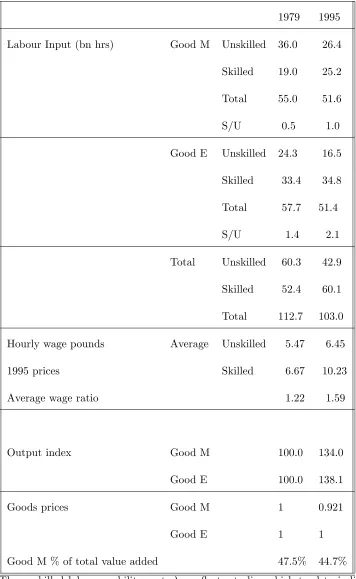
The 1979 and 1995 UK data we use are shown in Table 2.1 below. Price and wage data are in real terms. An important feature of the data used is the marked di¤erence in skilled/unskilled labour usage between the two sectors: the ratio of skilled to unskilled workers is more than twice as great in sectorE as in sector M in both years.
The rise in the average real wage of unskilled labour was approximately 23 per cent between 1979 and 1995,10 re‡ecting an increase in the premium for skilled over unskilled
8
This was con…rmed by carrying out decompositions in di¤erent orders with progressively smaller steps. As the steps grow smaller, the decompositions converge.
9
wage rates from 22% in 1979 to over 59% in 1995. This occurs despite the ratio of skilled/unskilled labour inputs rising in both sectors. While there is an increase in the share of skilled intensive exportables in total production, both sectors show rising output. The change in industrial structure in the data is therefore a relatively minor factor compared with what a Heckscher-Ohlin model would usually be expected to produce in response to the assumed 7.9% fall in the relative goods prices.11
1 1
Table 2.1: 1979 and 1995 UK data used in calibrating short-run models
1979 1995 Labour Input (bn hrs) Good M Unskilled 36.0 26.4 Skilled 19.0 25.2
Total 55.0 51.6
S/U 0.5 1.0
Good E Unskilled 24.3 16.5 Skilled 33.4 34.8
Total 57.7 51.4
S/U 1.4 2.1
Total Unskilled 60.3 42.9 Skilled 52.4 60.1 Total 112.7 103.0 Hourly wage pounds Average Unskilled 5.47 6.45
1995 prices Skilled 6.67 10.23
Average wage ratio 1.22 1.59
Output index Good M 100.0 134.0
Good E 100.0 138.1
Goods prices Good M 1 0.921
Good E 1 1
Good M % of total value added 47.5% 44.7%
unemployment periods in the US are generally longer for unskilled rather than skilled workers, which, in terms of our model, might suggest a higher threshold wage di¤eren-tial for the unskilled before they start to move between sectors. This is borne out by Haynes, Upward and Wright’s (2000) UK study, which suggest that those with lower skills experience longer unemployment duration.
We have chosen, for simplicity, to assume that only unskilled labour, factor U, is a¤ected by mobility costs (ie s = 0; u 0) and we use a …gure of 13.7 % for 1995,12 an ‘upper end’estimate of mobility costs. In later sensitivity analysis, we also evaluate models with lower values.
2.4
Model results
We use three calibrations to the 1979 and 1995 data: one involving the long-run two-factor model in which all two-factors are able to move freely in response to price and technol-ogy shocks; a second short-run model in which unskilled labour is only partially mobile, if intersectoral wage di¤erentials exceed a threshold, assumed to be 13.7% of wages; and a third using a three-factor Ricardo-Viner model with sectorally …xed capital. We concentrate initially on the case where the elasticity of substitution between factors of production is 1.25 in both sectors.
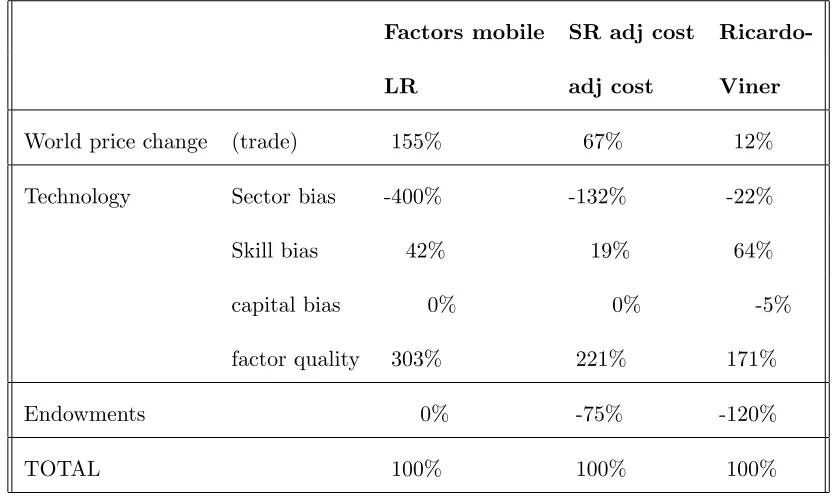
Table 2.2 outlines our decomposition results for observed changes in relative wages of skilled and unskilled labour between 1979 and 1995 using these three calibrated models. The contribution of various causal factors to the observed change in the average skilled to
1 2This assumes that the 7 3
4 % di¤erence in wages between sectors reported by Greenaway et al.
(1999) for the UK in 1990 is explained entirely by lower unskilled wages in the declining sectors, in turn re‡ecting an unwillingness to move due to mobility costs. We assume the 7 3
4 % di¤erence in average
unskilled wage ratio, whichTable 2.1 indicates increased from 1.22 to 1.59, is expressed by the contribution of each causal factor as a percentage of the total change.
Table 2.2: Model decomposition of wage inequality
Central case changes Long run Short run
Ricardo-Component factors: factors mobile adjustment cost Viner
World price change 152% 83% 19%
Technology:
-sector bias -491% -228% -43%
-skill bias 184% 187% 256%
-capital bias 0% 0% -8%
-factor quality 255% 151% 67%
Endowments 0% -92% -191%
Total 100% 100% 100%
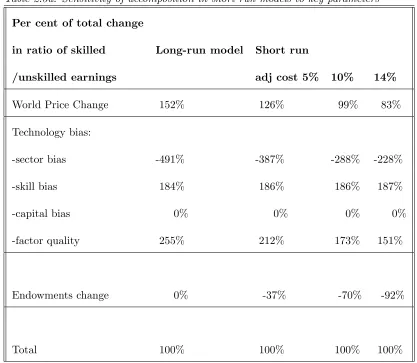
Table 2.3a: Sensitivity of decomposition in short run models to key parameters
Per cent of total change
in ratio of skilled Long-run model Short run
/unskilled earnings adj cost 5% 10% 14%
World Price Change 152% 126% 99% 83%
Technology bias:
-sector bias -491% -387% -288% -228%
-skill bias 184% 186% 186% 187%
-capital bias 0% 0% 0% 0%
-factor quality 255% 212% 173% 151%
Endowments change 0% -37% -70% -92%
Total 100% 100% 100% 100%
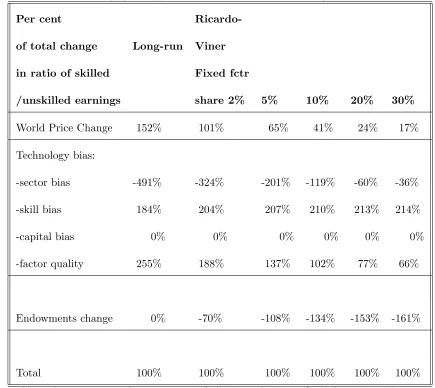
Table 2.3b: Sensitivity of decomposition in short run models to key parameters
Per cent
Ricardo-of total change Long-run Viner
in ratio of skilled Fixed fctr
/unskilled earnings share 2% 5% 10% 20% 30%
World Price Change 152% 101% 65% 41% 24% 17%
Technology bias:
-sector bias -491% -324% -201% -119% -60% -36%
-skill bias 184% 204% 207% 210% 213% 214%
-capital bias 0% 0% 0% 0% 0% 0%
-factor quality 255% 188% 137% 102% 77% 66%
Endowments change 0% -70% -108% -134% -153% -161%
Total 100% 100% 100% 100% 100% 100%
…xed, and 65% with a 5% …xed factor share.13
The tables in the Appendix explore the sensitivity of our decomposition results in the three models to the elasticity of substitution between unskilled and skilled labour in production, which we set at 0.5 and 2 instead of our central case value of 1.25.
Comparing estimates of the contribution of various factors when the assumed elastic-ity of substitution between skilled and unskilled labour is changed shows that the rela-tionship between elasticity and decomposition estimates is neither simple nor monotonic. In most cases the e¤ects of skill bias (positive) and endowments change (negative) on rel-ative wages are higher when the elasticity of substitution between factors is lower. Factor quality is more important in explaining relative wage changes with higher substitution elasticities. The relationship to price changes and sector bias seems to be non-monotonic.
1 3
2.5
Conclusions
In this paper, we compare the use of short-run and long-run trade models to decompose changes in observed wage inequalities between skilled and unskilled labour over the period 1979-95 for the UK into trade and technology, and endowment change components. Results of these decompositions are very di¤erent depending upon whether a short-run model, with limited mobility of unskilled labour, or a long-short-run model is used to explain the observed changes. This emphasises that di¤erent assumed model structures applied to the same data in decomposition will substantially a¤ect the perception of the role of trade in wage inequality change. The main contribution of this paper is to demonstrate the degree to which factor mobility assumptions are likely to a¤ect the response of factor prices to traded goods prices in an advanced economy such as the United Kingdom. A clear conclusion is that modellers need to be explicit about the factor mobility assumptions they are making when carrying out decompositions of wage inequality changes. Since factors are generally believed to be more mobile in the long-run than the short-run, the time scale over which the decomposition is being carried out is also important.