Simulation Particle Swarm Optimisation for
Stochastic Permutation Flow Shop Scheduling
Problem under Different Disruptions
Mohanad AL-Behadili, Djamila Ouelhadj and Dylan Jones
Abstract—This paper considers the permutation flow shop scheduling problem (PFSP) under stochastic processing time and in the presence of different types of real-time events. A multi-objective optimisation model and a novel predictive-reactive approach based Simulation-Particle Swarm Optimi-sation algorithm is designed and adapted for this problem. This algorithm hybridised the Monte-Carol Simulation (MCS) technique with the Particle Swarm Optimaisation algorithm to deal with the the stochastic behavior of the problem. Also, a deterministic version of the benchmark set proposed by [1] is adapted and used to test the aforementioned problem and solution method. Furthermore, the survival analysis based on the Kaplan-Meier estimator is used to analyse the behaviour of stochastic and dynamic solutions.
Index Terms—Permutation Flow Shop Scheduling; Multi-objective Optimisation Model; Predictive-Reactive Approach; Simulation-Particle Swarm Optimisation Algorithm
I. INTRODUCTION
The scheduling in a manufacturing environment has re-ceived a special attention for its wide real applications. In real-world scheduling systems, there are two main sources of uncertainties that lead to different scheduling environments, which are; dynamic and stochastic. When there are some variables that are considered as unknown and follow a probability distribution, the scheduling in this case is named as stochastic scheduling [2]. The PFSP problems in stochastic environment (SPFSP) have received increasing interesting in the literature of scheduling, due to the nature of most real problems where the data and information cannot be known in advanced. However, the stochastic and dynamic scheduling problems have less consideration comparing to the deterministic PFSP. Stochastic scheduling models have been mainly introduced since the 1980s where researches have traditionally concentrated on non-anticipative policies which intent to minimise the criteria in expectation. [3] showed that for the scheduling problem of m immediately available jobs with random variable service times. It is certain that such problems can be reduced to equivalent deterministic problems. [4] investigated the analytic prop-erties in scheduling of various classes of policies, also for special cases the optimal policies were determined. [5]
Manuscript received April 17, 2019; revised April 17, 2019.
M. AL-Behadili is with the Department of Mathematics, Col-lege of Science, University of Basrah, Basrah, Iraq, e-mail: ([email protected]).
D. Ouelhadj is with the School of Mathematics and Physics, University of Portsmouth, Lion Gate Building, Lion Terrace, Portsmouth PO1 3HF UK, e-mail: ([email protected]).
D. Jones is with the School of Mathematics and Physics, University of Portsmouth, Lion Gate Building, Lion Terrace, Portsmouth PO1 3HF UK, e-mail: ([email protected]).
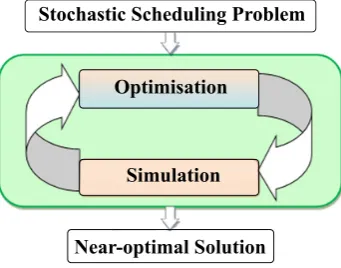
Fig. 1. Overview scheme of the Sim-Opt approach
scheme of the Sim-Opt approach. Recently, in stochastic scheduling, the Sim-Opt is used where heuristics or meta-heuristics are applied for the optimisation part. The concept of Simulated Annealing (SA) algorithm has been developed into an algorithm that can be used to solve a variety of optimisation problems. This is shown in work by [20], where SA was used to optimise parameters for an automated man-ufacturing system simulation. [21] presented the Simulation-Iterated Local Search approach that extends the Simulation-Iterated Local Search algorithm by combining simulation to provide the algorithm with the ability of dealing with stochastic COPs in a natural way. [22] presented a Sim-heuristic approach for solving the PFSP under uncertain processing times. [23] integrated routing metaheuristics with MCS for solving the VRP with stochastic demands; [24] presented a review of Sim-heuristics by extending metaheuristics to deal with stochastic COPs. In this paper, the PFSP under stochastic processing time and different dynamic disruptions including; machine breakdowns and new job arrivals is considered, where a multi-objective model is used to preserve the prob-lem stability and robustness. The reminder of this paper is as follows, Section II concentrates on the multi-objective model that used for the proposed problem. Section III shows the hybridisation of the MCS approach and PSO algorithm, which lead to the Sim-PSO approach. The experimental results are given in section IV. Finally, the conclusions and future works are listed in section V.
II. AMULTI-OBJECTIVE OPTIMISATION MODEL FOR ROBUST DYNAMICPFSP
In this paper, a multi-objective optimisation model pro-posed by [25] is presented. This model is designed for the PFSP of size n×m (jobs×machines) in the presence of different real-time events. The model considers very important performance measures including utility, stability, and robustness. The proposed multi-objective optimisation model (M SR) is given as follows:
M in M SR=αUn(S∗) +βIn(S∗) +γRn(S∗) (1)
whereα, β andγ are the objective weights andα+β+
γ= 1,Un(S∗)is the real makespan,In(S∗)is the stability objective andRn(S∗)is the robustness objective.
The first measure, utility, is defined as a classical makespan measure, which is used to indicate the degree of optimisation
of the problem. It is required to define two makspans in this model, which are; the real and predictive makespans. To define these makespanes, for given processing timespiπj for
jobs j = 1,2, ..., n on machines i = 1,2, ..., m, and a job permutationπ=π1, π2, ..., πnthat sequencednjobs through mmachines using the same permutation, theCijdenotes the completion time of jobπj on machinei. The calculation of completion time for jobsjon machinesiis given as follows:
C11=P11
C1j=C1,j−1+P1j
Ci1=Ci−1,1+Pi1
Cij =max{Ci,j−1, Ci−1,j}+Pij ∀i= 2, .., m, j= 2, .., n Where Pij = piπj. Then the makespan of the PFSP is
defined as follows:
X
j
Cmj≤Cmn,∀π
Hence, the first objective is defined as follows:
Un(S∗) =
X
j0
CRmj0 (2)
WhereP
jCRmj0 is the makespan in the real schedule. mis total number of machines.
n0 is the number of the jobs sequence that have not been processed yet and the job in progress on the first machine, including the newly arrived job at the disruption timetD. j0={1,2, ..., n0} the index ofn0 jobs.
S∗ refers to the new schedule for the partial subsequnce of jobs that have not been processed yet on the first machine at the time of disruptiontD. It should be noted that theS∗has n0 number of jobs and n0 depends on the disruption type,
e.g., if there is new job arrived to the system thenn0will be
the number of not processed jobs, the job in process on the first machine and the new arrived job.
The stability measure is defined as the deviation of the completion time of each job in the baseline sequence and the new schedule. The stability performance is defined as follows:
In(S∗) =
X
i
X
j
|CRij0−CPij0| (3)
whereCRij0 refers to the real completion time in the real
schedule, and CPij0 represents the predicted completion
time of a job j0 on machine i according to the planned baseline solution.
The third performance measure is robustness, which is defined as the difference of the total completion time between the new schedule and the baseline one and it is given by the following equation:
Rn(S∗) =|
X
j0
CRmj0−
X
j0
CPmj0| (4)
where P
j0CPmj0 is the predicted value of makespan
according to the planned baseline solution.
N M SR=αN Un(S∗) +βN In(S∗) +γN Rn(S∗) (5)
Where N Un(S∗), N In(S∗) and N Rn(S∗) are the nor-malised objectives of makespan, stability and robustness respectively. The normalised makespan is giving by the following equation:
N Un(S∗) =
Un(S∗)−M in(Un) M ax(Un)−M in(Un)
WhereM ax(Un)andM in(Un)are the upper and lower bounds respectively for the makespan at the moment of disruption tD. The calculation of M in(Un), M ax(Un) and N In(S∗) are given in details in [25]. The objective N Rn(S∗)is calculated as follows:
N Rn(S∗) =
Rn(S∗)−M in(Rn) M ax(Rn)−M in(Rn)
(6)
Where Rn(S∗) represents the robustness measure after the disruption time tD, M ax(Rn) is the robustness upper bound and M in(Rn)is the robustness lower bound [25].
III. THESIMULATION-PSOFRAMEWORK
Following an analysis, we propose that the processing times follow the Log-Normal distribution. In this case, a random variable pij (of processing time) follows a Log Normal probability distribution where µ and σ are param-eters if log(pij) follows a Normal distribution N(µ, σ). To transform the stochastic problem into dynamic version of deterministic processing times, we assume that the deter-ministic processing time of job i is the expected value of the probability distribution which characterised the unknown processing time of the same job. After this, the expected values of makespan for the PFSP is estimated by employing the MCS technique. The MCS phase will be repeated running as many times as we require to obtain an enough reliable estimation. Thus, the steps of the Sim-PSO approach can be given as follows:
1) For stochastic FSP in a permutation scheduling, let us first consider stochastic processing timesPij of jobs i and on machinesjwhere the jobs number arenand the machines number are m. Each stochastic processing time Pij follows the Log Normal distribution with known meanE[Pij].
2) In the dynamic PFSP scheduling where the processing times are constant values, we consider the processing timespij as constant values given bypij=E[Pij]. 3) For the dynamic PFSP under different real-time events,
we generate an initial scheduling sequence (solution) by using the predictive-reactive based PSO algorithm with the MSR model.
4) Improve the initial generated schedule by applying a classical Local Search (LS) algorithm, then the new improved solution is consider as a new initial solution for the dynamic problem.
5) Apply a simulation for short runs (for example 250 iterations), to obtain the estimated expected stochastic solution of the dynamic PFSP.
6) Employ the ILS technique [26] to improve the best of dynamic and stochastic solutions obtained so far.
7) Employ a simulation with long runs (e.g. 1000000 runs) to obtain good expected stochastic makespans related to the best dynamic and stochastic solutions.
The LS algorithm has been applied in different steps in the Sim-PSO approach, the proposed LS algorithm used in this research has been used by [27] among others.
The MCS is employed to estimate the expected makespan value that related to the given solution. The approach steps are given in the following points:
a. Generate a random variate for all jobs processing times using the Log Normal distribution.
b. The random variates obtained from the proposed probability distribution are employed to generate a random stochastic makespan observations.
c. These steps are iteratively repeated and the obtained observations are employed to estimate the expected makespan, variance or quartiles.
d. An efficient operator of the perturbation process, which is the enhanced swap operator and the accep-tance criterion of Demon-like procedure are used in the Sim-PSO approach. For more details about the acceptance criterion and the perturbation process we refer to [28] and [29].
Moreover,
IV. EXPERIMENTRESULTS
In this section, the experimental results and statisti-cal study for the approach are given and discussed. The predictive-reactive based PSO is hybridised with the MCS approach and the MSR model are used to solve the SPFSP under different real-time events. Java eclipse is used to imple-ment all the experiimple-ments on a PC of Intel Cori5 2.6 GHz with 6GB of memory RAM. The proposed Sim-PSO approach starts with solving the dynamic part of the problem (PFSP under machine breakdown and new job arrivals disruptions) using the predictive-reactive based PSO algorithm with the MSR model, then, the MCS is applied to calculate the stochastic makespan. Since we apply a multi-objective opti-misation model, different weights are used, these weights are assumed to be; (0.333,0.333,0.333), (0.498,0.498,0.002)
and (0.166,0.166,0.666). For the instances introduced by [1] (PFSP under machine breakdown and new job arrivals disruptions), we suppose the processing timespij as the ex-pected processing timePij =E[pij]follow the Log-Normal distribution. In this paper, we consider small, medium and large Taillard benchmark [30] of size 20×5,50×10 and
200×20 (jobs×machines). Each instances from the same size consists of 10 different problems. [1] have reported the PFSP with different real-time disruptions including machine breakdown and new job arrivals. In this experiment, each problem has been run for five independent times. Also, we consider the limittmax=n×m×0.03in seconds to stop the approach. The Log-Normal distribution has two parameters, namely;µij andσij parameters. These parameters are given in the equations below from the Log-Normal distribution properties.
µij =ln(E[Pij])−0.5×ln
1 + V[Pij]
E[Pij]2
TABLE I
THE AVERAGE DYNAMIC AND STOCHASTICRPDFOR WEIGHTSW1-W3 ANDk= 0.1
n×m DRPD SRPD W1 20×5 25.762 25.76 50×10 29.287 29.2 200×20 19.863 19.86 W2 20×5 25.684 25.21 50×10 30.122 28.76 200×20 19.697 19.43 W3 20×5 21.114 20.353
50×10 23.903 23.888 200×20 14.976 14.517
σij =
s
ln
1 + V[Pij]
E[Pij]2
We will consider the scenario where the variance are rela-tively low particularlyk= 0.1[22]. Once the best solution is found, the average relative percentage deviation of dynamic solution (DRPD) and the average relative percentage devia-tion of stochastic soludevia-tion (SRPD) are calculated over 10 of Taillard problems from the same size(n×m). The average relative percentage deviation is given as follows:
RP D=M −BestSol
BestSol
×100 (7) Where the valueM represents the acquired solution using the proposed model and solution methods. BestSol is the average of lower bound solution of 10’s Taillard’s instances that have the same number of jobs and machines. Table 1 show the results obtained in this experiment, for the SPFSP under different real-time events. Table 1 includes the results corresponding to one of the three weightsWi,i= 1,2,3. It shows the solutions corresponding to the variance where k is equal to 0.1 and both of the DRPD and SRPD are taken as average of 10 Taillard’s instances from same size (20×5,
50×10 and 200×20). Finally, the Table has the relative percentage deviations for dynamic and stochastic solutions. From Table 1, we can conclude the following two points:
• The SRPDs corresponding to the best solution obtained from MCS are generally lower than the dynamic RPDs. Also, the difference between the DRPD and SRPD rises even for low level of uncertainty k= 0.1.
• The DRPD and SRPD are variants typical to different weights, hence, the SRPD corresponding to weight W3 = (0.166,0.166,0.666) are generally lower than other SRPD of other weights. For this, we select the the weightW3= (0.166,0.166,0.666)for the next analysis study.
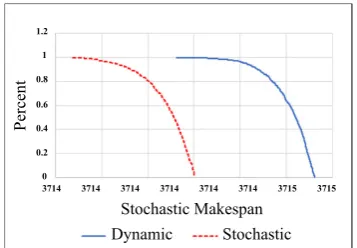
[image:4.595.338.515.52.179.2]Figures 2, 3 and 4 show the survival functions for different size instances selected previously withk= 0.1. The selected instances are of size 20 × 5, 50 × 10 and 200 × 20, respectively. The survival functions are related for both of the best dynamic and the best stochastic solutions, respectively. The survival function produced from the observed stochastic makespans when employing the stochastic solution. This function corresponds to the stochastic solution and is gener-ally under the survival function corresponding to the dynamic solution. The dynamic solution is constructed from the observed stochastic makespans when the dynamic solution is used. It means in job schedule terms that the probability of keeping the job under operation will be generally lower when using the stochastic solution.
Fig. 2. Survival plot with intersecting solutions for problem20×5with k= 0.1and weightW3
Fig. 3. Survival plot with intersecting solutions for problem50×10with k= 0.1and weightW3
Fig. 4. Survival plot with intersecting solutions for problem200×20with k= 0.1and weightW3
V. CONCLUSION
[image:4.595.104.233.71.219.2] [image:4.595.337.516.225.349.2]the experiment, so providing incomplete or censored obser-vations. This statistical study shows that the the probability of ongoing jobs corresponding to the stochastic solution is generally lower than the dynamic one. In summary, this paper clarifies some of the advantages which can be gained when hybridising the PSO algorithm with the MCS technique in solving the SPFSP under different uncertainties. For future work, the proposed approach could compare with other methods to solve the SPFSP under different real-time events. Also, applying the Sim-PSO approach for other stochastic scheduling problems.
REFERENCES
[1] K. Katragjini, E. Vallada, and R. Ruiz, “Flow shop rescheduling under different types of disruption,” International Journal of Production Research, vol. 51, no. 3, pp. 780–797, 2013.
[2] M. L. Pinedo,Scheduling: Theory, Algorithms, and Systems. Springer Publishing Company, Incorporated, 2016.
[3] M. H. Rothkopf, “Scheduling with random service times,” Manage-ment Science, vol. 12, no. 9, pp. 707–713, 1966.
[4] R. H. M¨ohring, F. J. Radermacher, and G. Weiss, “Stochastic schedul-ing problems i — general strategies,” Zeitschrift f¨ur Operations Research, vol. 28, no. 7, pp. 193–260, Nov 1984.
[5] G. Weiss, “Approximation results in parallel machines stochastic scheduling,”Ann. Oper. Res., vol. 26, no. 1-4, pp. 195–242, Jan. 1991. [6] J. Kamburowski, “On three-machine flow shops with random job processing times,”European Journal of Operational Research, vol. 125, no. 2, pp. 440 – 448, 2000.
[7] D. Alcaide, A. Rodriguez-Gonzalez, and J. Sicilia, “An approach to solve the minimum expected makespan flow-shop problem subject to breakdowns,”European Journal of Operational Research, vol. 140, no. 2, pp. 384 – 398, 2002.
[8] L. Wang, L. Zhang, and D.-Z. Zheng, “A class of hypothesis-test-based genetic algorithms for flow shop scheduling with stochastic processing time,”The International Journal of Advanced Manufacturing Technol-ogy, vol. 25, no. 11, pp. 1157–1163, Jun 2005.
[9] P. V. Hentenryck and R. Bent,Online Stochastic Combinatorial Opti-mization. London, England: Massachusetts Institute of Technology, 2006.
[10] P. J. Kalczynski and J. Kamburowski, “A heuristic for minimizing the expected makespan in two-machine flow shops with consistent coefficients of variation,”European Journal of Operational Research, vol. 169, no. 3, pp. 742 – 750, 2006.
[11] B. Liu, L. Wang, B. Qian, and Y. Jin, “Hybrid particle swarm opti-mization for stochastic flow shop scheduling with no-wait constraint,”
IFAC Proceedings Volumes, vol. 41, no. 2, pp. 15 855 – 15 860, 2008, 17th IFAC World Congress.
[12] K. R. Baker and D. Altheimer, “Heuristic solution methods for the stochastic flow shop problem,” European Journal of Operational Research, vol. 216, no. 1, pp. 172 – 177, 2012.
[13] C. Almeder and R. F. Hartl, “A metaheuristic optimization approach for a real-world stochastic flexible flow shop problem with limited buffer,” International Journal of Production Economics, vol. 145, no. 1, pp. 88 – 95, 2013.
[14] K. R. Baker, “Minimizing earliness and tardiness costs in stochastic scheduling,” European Journal of Operational Research, vol. 236, no. 2, pp. 445 – 452, 2014.
[15] A. Aydilek, H. Aydilek, and A. Allahverdi, “Production in a two-machine flowshop scheduling environment with uncertain processing and setup times to minimize makespan,” International Journal of Production Research, vol. 53, no. 9, pp. 2803–2819, 2015.
[16] J. M. Framinan and P. Perez-Gonzalez, “On heuristic solutions for the stochastic flowshop scheduling problem,” European Journal of Operational Research, vol. 246, no. 2, pp. 413 – 420, 2015. [17] S. Amaran, N. V. Sahinidis, B. Sharda, and S. J. Bury, “Simulation
optimization: A review of algorithms and applications,”ArXiv e-prints, Jun. 2017.
[18] M. C. Fu, “Optimization via simulation A review,”Annals of Opera-tions Research, vol. 53, pp. 199–247, 1994.
[19] S. Andrad´ottir, “A review of simulation optimization techniques,” in
Proceedings of the 1998 Mnrer Siinularion Conference, 1998, pp. 151– 158.
[20] E. Manz, J. Haddock, and J. Mittenthal, “Optimization Of An Au-tomated Manufacturing System Simulation Model Using Simulated Annealing,”1989 Winter Simulation Conference Proceedings, pp. 390– 395, 1989.
[21] A. Grasas, A. A. Juan, and H. R. Lourenc¸o, “Simils: a simulation-based extension of the iterated local search metaheuristic for stochastic combinatorial optimization,”Journal of Simulation, vol. 10, no. 1, pp. 69–77, Feb 2016.
[22] A. a. Juan, B. B. Barrios, E. Vallada, D. Riera, and J. Jorba, “A simheuristic algorithm for solving the permutation flow shop problem with stochastic processing times,”Simulation Modelling Practice and Theory, vol. 46, no. Supplement C, pp. 101 – 117, 2014, simulation-Optimization of Complex Systems: Methods and Applications. [23] A. Juan, J. Faulin, S. Grasman, D. Riera, J. Marull, and C. Mendez,
“Using safety stocks and simulation to solve the vehicle routing problem with stochastic demands,”Transportation Research Part C: Emerging Technologies, vol. 19, no. 5, pp. 751 – 765, 2011, freight Transportation and Logistics (selected papers from ODYSSEUS 2009 - the 4th International Workshop on Freight Transportation and Logis-tics).
[24] A. A. Juan, J. Faulin, S. E. Grasman, M. Rabe, and G. Figueira, “A review of simheuristics: Extending metaheuristics to deal with stochastic combinatorial optimization problems,”Operations Research Perspectives, vol. 2, no. Supplement C, pp. 62 – 72, 2015.
[25] M. Al-Behadili, D. Ouelhadj, and D. Jones,Multi-objective Particle Swarm Optimisation for Robust Dynamic Scheduling in a Permutation Flow Shop. Springer International Publishing, 2017, pp. 498–507. [26] H. R. Lourenc¸o, O. C. Martin, and T. St¨utzle,Iterated Local Search:
Framework and Applications. Boston, MA: Springer US, 2010, pp. 363–397.
[27] R. Ruiz and T. St¨utzle, “A simple and effective iterated greedy algo-rithm for the permutation flowshop scheduling problem,” European Journal of Operational Research, vol. 177, no. 3, pp. 2033–2049, 2007.
[28] E.-G. Talbi,Metaheuristics: From Design to Implementation. Hobo-ken, New Jersey Published simultaneously in Canada: JohnWiley & Sons, Inc. All, 2009.
[29] A. A. Juan, H. R. Lourenc¸o, M. Mateo, R. Luo, and Q. Castella, “Using iterated local search for solving the flow-shop problem: Parallelization, parametrization, and randomization issues,”International Transactions in Operational Research, vol. 21, no. 1, pp. 103–126, 2014. [30] E. Taillard, “Benchmarks for basic scheduling problems,”European