Abstract— Cyber physical systems offer a vast variety of new possibilities in the context of the fourth industrial revolution, ‘Industrie 4.0’. Due to an increasing amount of more complex requirements for companies and the necessity of an implementation guideline of Industrie 4.0 technologies, a new approach for supporting small and medium sized enterprises (SMEs) was developed: the 'Generic Procedure Model to Introduce Industrie 4.0' (GPMI4.0). Fields of action, adapted to their own enterprise, are identified to reach a higher level of Industrie 4.0. GPMI4.0s core method is the Industrie 4.0 toolbox which is divided in five phases: preparation, analysis, idea generation, validation and implementation. Toolboxes for the domain product, production, intralogistics, IT security and assembly are already published. However, in order to use technologies of Industrie 4.0 in more stages of the product life cycle, GPMI4.0 has to be applied to the not yet considered domain of engineering. This paper focuses on the development of a Toolbox for the domain of engineering regarding Industrie 4.0, analysing the product development process from the product idea to the manufacturing process. Using the Toolbox, the enterprises are able to analyse their engineering in the context of Industrie 4.0 and develop solutions to reach a higher level. The purpose of the engineering Toolbox is to generate an engineering competence profile by classifying the development state of every application level of an enterprise. Based on the profile the engineering Toolbox is used to advance the enterprise engineering competence regarding Industrie 4.0. The benefits are optimized inputs for the production field that can be used for the digital supply chain and for generating new business models. Finally, the suitability of the engineering Toolbox is validated by different companies and projects.
Index Terms— Industrie 4.0, Engineering 4.0, Project Teams, Small and Medium Sized Enterprises
Manuscript received January 8th, 2018; revised February 11th, 202018. Mr. Yübo Wang is with the Department of Computer Integrated Design of the TU Darmstadt, Otto-Berdt-Str. 2, 64287 Darmstadt, Germany (phone: +49 (0) 6151-16-21845; email: [email protected]).
Mr. Andreas Faath is with the Mechanical Engineering Industry Association (Verband Deutscher Maschinen- und Anlagenbau – VDMA), Frankfurt, Germany (phone: +49 (0) 69 6603 1495; e-mail: [email protected]).
Mr. Timon Görne is with the Lear Corporation GmbH, Freising, Germany (email: [email protected]).
Prof. Dr.-Ing. Reiner Anderl is Head of the Department of Computer Integrated Design of the Technische Universität Darmstadt, Otto-Berdt-Str.°2, 64287 Darmstadt, Germany.
I. INTRODUCTION
HE term “Industrie 4.0” was coined for the first time in 2011 at the Hannover Trade Show. It describes the immense potential for engineering processes that lies amongst other things in enhanced communication of cyber physical systems in companies. [1].
However, companies do not conceive the potentials of Industrie 4.0 as such. From their point of view, Industrie 4.0 represents another challenge to face, beginning with the lack of necessary knowledge to implement Industrie 4.0. To support companies in implementing Industrie 4.0 concepts, several approaches have been developed.
The Guideline Industrie 4.0 (Guiding principles for the implementation of Industrie 4.0 in small and medium sized enterprises) set by the VDMA can be seen as the basis of all efforts [2]. It deals with a procedure model and shows the structure and procedure of workshops to implement business models and concepts of Industrie 4.0.
Requirements are an increased production with a higher degree of automation, an increased product quality or flexibility for individual customization, while time is an important factor as well. In a dynamic world companies have to react faster on global market requirements or reduce time to market, which necessitates enhanced engineering workflows and optimized logistical systems [3]. Additionally, shorter product and innovation cycles cause pressure to innovation. Finally, the increasing product piracy and cyber criminality intensifies by digitalization. A higher efficiency in every domain is needed [4].
Industrie 4.0 offers potentials for time and cost savings in the underexposed field of engineering. Engineering potentials are particularly evident in the areas of product creation process. Relevant fields of actions are mainly “politics and networks”, “production and business models” research and innovation”, “norms and standards”, IT security and legal affairs” and finally “people and work” [2]. The idea of essential conditions agreeing with political and societal representatives to become a leading market and leading supplier of Industrie 4.0 is part of “Politics and networks”. In the field of “production and business models”, the communication between products, components and equipment has to be facilitated to enable customer-specific production processes. The aim of “research and innovation” is the quick transfer of research findings to
Development of a Toolbox for Engineering in
Project Teams for Industrie 4.0
Yübo Wang, Andreas Faath, Timon Goerne, Reiner Anderl
industrial operations, which is a major factor of success in international competition. “Norms and standards” are fundamental to enable interoperability and collaboration. Industrie 4.0 paves the way for various value –added networks and cross-company networking and requires defined rules for cooperation und information exchange. “IT security and legal affairs” is gaining relevance as cross-company processes and automated data exchange of connected systems has to be secured and reliable. In addition, SMEs have to deal with changing legal affairs. In the field “people and work” the work and processes will be changed fundamentally as Industrie 4.0 requires enhanced technological, organisational and interdisciplinary competences. Employees are more responsible in taking autonomous decisions, coordinating processes and communication.
A new, more general approach for Industrie 4.0 implementation has been developed: The Generic Procedure Model for the Implementation of Industrie 4.0 in small and medium sized companies (GPMI4.0). The key elements in this approach are Toolboxes which have to be generated for the whole life cycle of products. Up to date, toolboxes for the topics intralogistics, products and production, IT security and assembly have already been developed. Due to inattentiveness of the topic of engineering, a toolbox for engineering was developed in project teams. It is the focus of this paper.
II.ROLE OF THE TOOLBOX IN GPMI4.0
Using the Generic Procedure Model to introduce Industrie 4.0, small and medium sized enterprises are able to identify fields of action, adapted to their own enterprise, which paves the way to reach a higher level of Industrie 4.0. The GPMI4.0 is divided in five phases: preparation, analysis, idea generation, validation and implementation.
The first phase is the preparation phase in which employees of the company gain knowledge about Industrie 4.0 concepts and terms. It aims at a uniform understanding of the concepts and potentials. In the second phase, the employees analyse the companies’ external perception e.g. of external partners and clients, and its internal capabilities. As a result, the actual state is determined and further improvement goals can be outlined. The following creativity phase uses these findings in order to generate innovative ideas for new products or improvements to develop advanced concepts of business models based on Industrie 4.0. Based on the generated ideas, the next phase contains the evaluation of the developed concepts. A cost-benefit analysis helps in clustering and ranking the ideas. Afterwards they can be selected and put on a road map for implementation, which makes up the final phase. Meanwhile, the management has to decide and introduce the chosen Industrie 4.0 solutions in a company-wide strategy [5].
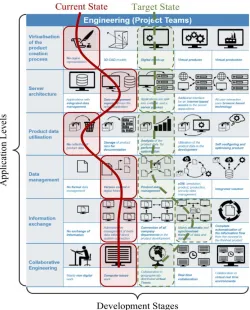
As an important method for the analysis phase and basis for the creativity phase, the toolbox embodies a key element in the Guideline Industrie 4.0. Each toolbox consists of six
application levels (AL), each split up into five development stages. It expands over the states where no Industrie 4.0 potential is used up to a large extend of usage. With this method, the status quo of a company and the target state for all application levels can be illustrated by marking the current and target state of each application level. Therefore, the toolbox can be take into account in the evaluation phase. It should also be noted that the highest development stage cannot be reached on every application level, depending on the company. A schema of the toolbox is given in Fig 1.
[image:2.612.322.572.284.594.2]During the development of new toolboxes, several requirements have to be taken into account. First, the standard structure of a toolbox has to be used to enable a rapid and familiar start. In addition, a questionnaire has to be evaluated by the company to determine the current state. Finally, an information model is used to link all information.
Figure 1: Overview of functionalities of the toolbox
III. REQUIREMENTS FOR SMALL AND MEDIUM SIZED ENTERPRISES
1. Vertical and horizontal integration
2. Consistent digital engineering along the value chain 3. De-/centralized intelligent control
In the following section, the first and second aspect will be described, the third aspect is out of focus of this paper.
A. Vertical and horizontal integration
Vertical integration is the integration and networking of IT systems within the enterprise from the field level to the enterprise level. The goal is to get and control process data and information from sensors and actuators of the production in the company level as far as possible, and, if necessary, to return appropriate control information. The communication takes place without human intervention and allows, e.g. an efficient adjustment of the production to change order inventories or adjustments to the operative planning [7]. A key challenge is overcoming language barrier within IT and control systems. While PLC languages have been used in automation technology, the world of business IT is dominated by high-level language, which severely restricts direct interoperability [10]. The prerequisite for consistent vertical integration in SME is thus the internal definition and application of common, open standards, which ensure unrestricted, cross-vendor communication.
Networking of IT systems and production facilities across the enterprise’s boundaries is called horizontal integration. Along the value chain it allows a flow of data and information between geographically distributed locations of a company as well as the participants in the value-added network from the supplier to the end customer and thus enabling a new level of collaboration between the stakeholders in the network [8]. The development of completely new business models is also possible, e.g., to offer individualized products to customers or to be aware of impending delivery bottlenecks directly by suppliers’ due to a machine failure. Services such as automatic re-ordering and delivery of raw materials and supplies are another possibility. An analytical evaluation of the data can also reveal optimization potentials. Horizontal integration requires open information and communication technologies as well as appropriate platforms that enable networking [13].
B. Consistent digital engineering along the value chain The complete digital representation of the product as well as the means of production over its entire life cycle is called continuous digital engineering. It includes all digital explanatory and planning models, such as CAx models, which are created during the lifecycle and used as a basement for decision-making. The aim is to digitally represent the physical product as accurately as possible. This result in the digital twin which is bi-directionally coupled to its physical image, meaning that, on the one hand, changes in the virtual world are
taken over into the physical world and, on the other hand, data from the physical world, such as sensor data, are transmitted to the virtual world for wear and tear. This concept is not limited to the products, but also includes the enterprise production resources. Machines and conveyor systems can be digitized and used as a basement for simulation, planning and optimization processes [15]. The central element is a product data management system, in which all data converge are available to users along the entire life cycle.
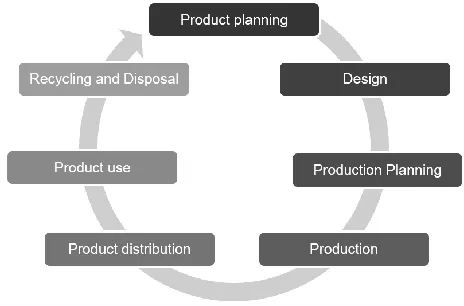
[image:3.612.333.565.339.492.2]IV. RELEVANCE OF ENGINEERING IN INDUSTRIE 4.0 To understand the relevance of engineering in Industrie 4.0, an analysis of the term and function of engineering is necessary. Engineering includes all activities of an engineer in an enterprise. It influences and is influenced by all phases of the product lifecycle (visualised in Figure 2) [9]. After the products planning and designing, the production itself needs to be planned and executed. Once the product is distributed it can be used. The last phase deals with recycling and disposal of the product which is already taken into account during the product planning phase and the design phase.
Figure 2: Product life cycle
The most important potentials for engineering in the context of Industrie 4.0 are the production planning and design phases. Nevertheless, requirements and data of all phases have to be considered during the engineering.
In addition, workflows and data management have to be mentioned as important factors for engineering regarding Industrie 4.0.
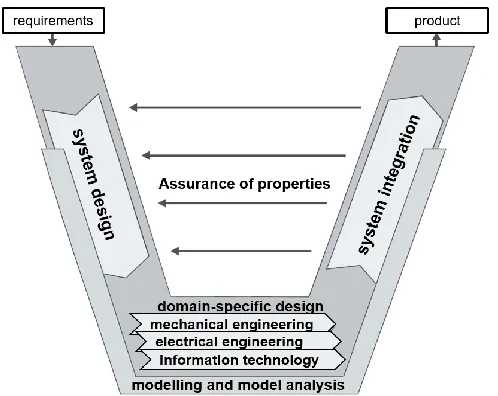
into the subsystem requirements and the part requirements. The second stream embodies the system integration processes. The right steam consists of the same levels as the first stream and implements and validates the different requirements, but in an inverted order. First, the parts are implemented, then the subsystems and then the entire system. In addition, on each level the model requires a check to determine if the level fulfils the requirements gathered in the left stream [11].
Figure 3: V model
V.DEVELOPING TOOLBOXES FOR ENGINEERING
The development of toolboxes for engineering follows the Guideline Industrie 4.0 set by the VDMA [2]. To meet the guidelines, applications levels are firstly defined and divided in development stages. Almost 30 relevant application levels are identified based on the defined engineering tasks and potentials. Furthermore, the application levels are classified respecting the categories of engineering potentials. Due to the high amount of application levels, similarities have to be analysed and replaced by new defined application levels. The six most important application levels have to be selected and used in the toolbox. During the selection, different problems occur. Application levels are not suitable for any types of enterprises. For example, the integration of the supply chain offers potentials for a large company with many suppliers. Smaller enterprises with a limited number of suppliers would not benefit of the same improvements. Therefore, different company types are distinguished. The classification for SMEs follows the supply chain classification in the automotive sector [12]. In this case, the company type defines companies from the same production stage. The supply chain classification divides the supply chain in four company types. They are called original equipment manufacturer (OEM), Tier 1, Tier 2 and
Tier 3. The OEM in this example embodies the automobile manufacturer and is supplied by every Tier. The OEM sells the final product to the final customer. Tier 3 is a supplier of raw materials and semi-finished products. It supplies Tier 2 that is a component supplier, while Tier 1 is supplied by Tier 2 representing a module supplier. Every company type has its own composition of application levels that have to be considered. Consequently, for each company type an engineering toolbox has to be developed. Figure 4 shows the supply chain classification in the automotive sector [12].
Figure 4: Supply chain classification in the automotive sector
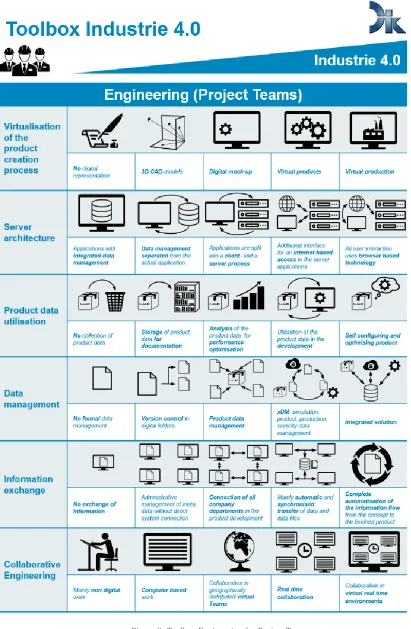
Supplementary, a fifth toolbox especially for companies in project business is developed. The toolbox covers the most relevant application levels for project teams, small enterprises specialized in working on complex technical projects. Characteristics are having a small available budget and a large number of strong suppliers. The most potential lies in the digital collaboration, while data management and workflows are also very significant.
VI. ENGINEERING FOR PROJECT TEAMS
To demonstrate and validate the detailed development, the toolbox “Engineering (Project Teams)” as shown in Figure 9 is used. A reason for choosing project teams is that they are more comparable to the emphasized small and medium enterprises. Additionally, the validation of the engineering toolbox with a project team is more understandable than with an enterprise.
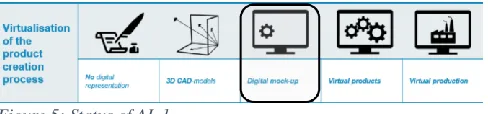
[image:4.612.323.550.204.362.2]3D models and works as a basis for further simulations, which can be reached by simulating some of the products functions using a digital mock-up, for example, for assembly simulations. A virtual product can be created by validating all of the products functions and behaviour in the model. In this fourth development stage, the entire product behaviour can be simulated. A virtual product allows the entire product development process to be computerized and improved. The need for prototypes is vastly reduced. If the virtual product is employed in a completely modelled virtual production environment, the fifth and last development stage will be achieved. In this state, the entire product creation process is digitally simulated. In context of Industrie 4.0, virtual products and production enable the use of the digital twin, representing the physical product and including any information and data, which occurs during the whole product lifecycle. It allows to use the data during the product development process which paves the way for continuous improvement of products and processes [14].
The second application level analyses the server architecture. The focus lies on the calculations that are carried out to servers. Enterprises in the first development stage do not use a server for data management. All applications manage their files locally on a PC. When the data management is separated from the actual application and is relocated to a central server the second development stage is reached. This improves sharing data and allows an efficient data backup. In the third development stage, the server carries out some of the calculations. The applications are split into a client and a server process. It speeds up complex simulations and reduces the workload for the client PCs. In order to facilitate flexible work, some of the applications on the server can be made accessible from the internet. This represents the fourth development stage. If the server runs all applications and a location independent access using an online browser portal is implemented, the fifth development stage will be attained. This allows users all over the world to use the data and applications in real time without the need of any special software except a browser, which enables for example continuous monitoring, an improved collaboration and a quick reaction when necessary.
The utilisation of product data is the next application level. The collected product data is used during the product development process. Product data of the entire life cycle has to be transmitted and stored for documentation purposes to make the step from the first to the second development stage. Because of the inefficiency of the processing of raw, the next step is data analysis in which the results are processed to improve the products performance. The fourth development stage is reached by using the collected data in the product development process. For example, stresses can be measured during the product use in order to optimize dimensions of the product or to validate simulation results. The fifth development
stage can be obtained by making parts of the product self-configuring and optimized. By implementing an algorithm that defines the best parameters for the part, it can be automatically improved.
The mass of collected data must also be managed to ensure its efficient use. Companies on the first development stage of the application level data management, use no data management approaches, but rather store the data unmanaged in a folder structure. Difficult for employees is to find the desired information and is prone to information loss. If a documented revised, the previous version could be lost. To prevent a loss, a version control can be implemented, which represents the second development stage. A version control tracks the changes of document. This allows the user to access previous versions. The third development stage is achieved by using a PDM system.
The software connects the data with the product and enables more intuitive and transparent data management. For the fourth development stage, further data management systems have to be implemented. For example, a SDM (system design and management) system manages the simulation data, a production management system manages the production data and a security data management system manages the IT-security data. If all of the data can be managed distributed using federal systems, the fifth development stage will be reached. Federation means the loose coupling of information tools with a maximum degree of freedom and flexibility. It aims at standardized communication between the tools to ensure data consistence.
The fifth application level examines how employees exchange information. A company on the first development stage shows a lack of information exchange. On the second development stage, Meta data is managed on administration site, but the systems are not connected to exchange information. Therefore, the third development stage demonstrates a companywide connection of all the involved users in the product creation process. If the exchange of information is automatic and synchronized, the fourth development stage will be attained. The fifth development stage is reached by having a completely automated information flow from the product concept to the finished product. This enables in the context of Industrie 4.0, that all information will be used during the whole product development process. Suggestions and workflows can be made by the system itself to support the engineer and will be integrated to the virtual product and production.
application level, increasingly more steps of the product creation process can be virtualized. Based on that, a geographically distributed work in virtual teams can be implemented to achieve the third development stage. Further improvements can be made by permitting the virtual team to collaborate in real time on digital documents. Virtual environments characterize the fifth development stage, where teams can collaborate in real time and in the same virtual environment using the Virtual Reality.
VII.VALIDATION OF TOOLBOX ENGINEERING
In order to validate the toolboxes, two different sets of interviews were conducted. The first one used computer assisted personal expert interviews. Expert interviews are a method that dictate the asked questions in the interview, but extend the freedom for the interviewer to pose further questions to explore more other certain topics [16]. They are also called semi-structured interviews. Personal in this context means face-to-face in contrast to telephone based or online. The interviews were assisted by a user interface that was programmed in Visual Basics for Applications in combination with Microsoft Excel. The program displays the questions and allows the answers to be input. It permits to display the results of the interview, which give immediate feedback to the interviewed person.
Using this approach, two university groups were interviewed. The first one was the Darmstadt Racing Team (DART) which is a team consisting of over 40 students. They aim to develop a race car and participate with it in Formula Student racing events. The second group was a project of a department of the Technical University Darmstadt, the DiK (Department of Computer Integrated Design). The evaluated team aims to create a complete vehicle simulation based on the DART vehicle. Different students simulate parts of the vehicle for it as section of their thesis. As a result of both interviews, the use of the engineering toolbox for project teams was possible. Consequently, improvement suggestions for further use of Industrie 4.0 potentials were devised.
A second interview was conducted for validation. It was part of a workshop in the Industrie 4.0 competence center from the DiK. Small and medium sized companies were invited to learn about Industrie 4.0 with the purpose of enabling them to implement the concepts themselves. In one part of the workshop, the above-mentioned program was presented on tablet PCs. The company representatives had the opportunity to complete a standardized questionnaire on their company type. The representatives received immediate feedback about the results, which allowed a group discussion.
Due to the focus on the toolbox for project teams, the subsequent will expand on the use of the engineering toolbox for one questioned group. It will be the vehicle simulation group of the DiK. The team has already created a complete
[image:6.612.321.565.145.202.2]vehicle model and is constantly improving it. At present, it does not have a complete virtual product, but soon probably will. Therefore, the group is on the third development stage on the application level ‘virtualization of the product creation process’.
Figure 5: Status of AL 1
[image:6.612.320.565.304.357.2]The members of the university group from the DiK usually work in the university building in a computer pool. There, they have access to high performance computers that are connected to a central data server. The server does not run any applications at the moment. Hence, the team is on the second development stage of the application level ‘server architecture’.
Figure 6: Status of AL 2
[image:6.612.320.564.463.520.2]Further on, the data server of the university group of the DiK and the DART, which provides the data, are not connected. All information is transferred manually between both groups. Therefore, the DiK cannot use the product data that DART is collecting and only reach the first development stage of the application level ‘product data utilization.
Figure 7: Status of AL 3
[image:6.612.319.563.607.660.2]The central data server in the DiK does not implement any kind of data management. All of the data is stored in files in a folder structure without version control. This means, the team is on the first development stage of the application level ‘data management’.
Figure 10: Status of AL 5
In the application level ‘information exchange’, the team is on the fourth development stage, if the students work in the computer pool. As long as they work there, all files are automatically synchronized with the central server and are available to every student at every computer in the department.
If a student decides to work from home or on his private computer, he is no longer connected to the server. He has to download all necessary files to his machine and reload them later, when he is in the computer pool.
[image:8.595.49.291.50.105.2]Due to this, the team is currently on the second development stage of the application level ‘collaborative engineering’.
Figure 11: Status of AL 6
VIII.IMPROVEMENT SUGGESTIONS
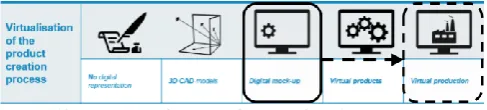
After the actual state is analysed and determined, the target state can be achieved by improvement suggestions. Specifically, several ideas for the workflow potential were generated. In the application level ‘virtualization of the product creation process’, shown in Figure 12, the target of the group is to develop from the third development stage ‘digital mock-up’ to fifth development stage ‘virtual production’. The group already has a comprehensive simulation knowledge of a virtual product and is constantly working on improving it. The topic of simulating the production has not been addressed so far. The accomplishment of the production simulation would give the group a clearer view of the product creation process.
Figure 12: Current and improved status of AL 1
[image:8.595.48.291.295.350.2]In the application level ‘server architecture’, a higher level of development can be achieved by calculating complex simulations on the server. The target of the group is to develop from the second development stage ‘Data management separated from the actual application’ to fifth development stage ‘All user interaction uses browser based technology’. As a result, local terminals are relieved and simulations are accelerated by using the server's computing power. Since access to the server is possible via the internet, there will be no location-based working any more.
Figure 13: Current and improved status of AL 2
[image:8.595.301.550.319.377.2]In the application level ‘product data utilization’, the target of the group is to develop from the first development stage ‘no collection of product data’ to fourth development stage ‘utilization of the product data in the development’. The vehicle data transmitted to DART during performance tests and races could be used to validate digital models and to improve the simulations. The fourth development stage is achieved as shown in Figure 14 and data will be saved and analysed. During the product development process the data usage, paves the way for an enhanced lightweight construction. Forces and stresses can be calculated more precisely and compared to real conditions. This allows reducing safety factors and enabling a better insight into the product usage. It might be possible to use the data to create self-improving vehicle parts.
Figure 14: Current and improved status of AL 3
In the application level ‘data management’ the target of the group is to develop from the first development stage ‘no formal data management’ to fourth development stage ‘xDM, simulation, product, production, security data management’ as shown in Figure 15. The group currently does not have formal data management. By storing on the server, everyone can access all files, but there is no linking of the data and no version management. The product development process and simulations will be improved by implementing a better synchronization between the DiK and the DART. If a SDM and PDM or PLM system were implemented, it would be beneficial to both groups. The DART would have less work giving information to members and the DiK could use the data. In addition, a redundant creation of the vehicle model is omitted. While reducing the workload for both teams, all simulations done by the DiK are automatically applicable to DART.
Figure 15: Current and improved status of AL 4
[image:8.595.47.291.570.625.2] [image:8.595.304.550.612.665.2]connection on the server. This can only help if the members have access to the required software. Software licenses could be made available on the server for all members.
Figure 16: Current and improved status of AL 5
In the application level ‘collaborative engineering’ the target of the group, as shown in Figure 17, is to develop from the second development stage ‘computer based work’ to third development stage ‘Collaboration in geographically distributed virtual teams’. One problem in the workflow that could occur by this change is that monitoring of the current work progress is more difficult. If the members work in the computer pool, a quick conversation can confirm the status. If they work from different locations, the communication is more complex. One solution is the continuous documentation of the current process status. All the members could be required to use a document to track their progress. This document could be implemented in a software that allows a large number of users to access all the information and change it simultaneously in real time.
By using this kind of product data management regarding the functionalities in data-, privilege- and workflow-management the collaboration between the members is facilitated. Since everybody can see what everybody else has already done, they will be able to coordinate the work more easily.
Figure 17: Current and improved status of AL 6
IX. CONCLUSION AND OUTLOOK
Based on the identified potentials of engineering regarding Industrie 4.0, five toolboxes for different needs of different company types were generated. Especially, the engineering toolbox for project teams is described and validated in this paper.
In general, the method of the toolbox can easily be applied to analyse the current state of a company and their capabilities and visualize the potential state. After the analysis phase, the toolbox is being used further. The application occurs as basis for generating ideas or during the evaluation phase, the ideas become more transparent by visualization which improvements can be made to reach a higher development state.
The toolbox gains more benefits the more they are employed. Therefore, companies and university groups as project teams were interviewed. From every interview, additional information could be collected that can be used for other evaluations. Consequently, with the collection of information a database can be formed, that can ensure a better analysis of the state of art.
has been pointed out, by the interviews. According the interviews of the two university groups, their work could be evaluated and compared to each other. The comparison and findings from the literature have been provided guidance to suggest improvement for a higher development stage in the toolbox and fulfil their potentials. As a result, comparisons can act as a possibility to enhance the toolbox for a simply implementation and to form improvement suggestions.
Finally, with an increasing development and use of such toolboxes, including toolboxes with other topics, companies can advance more efficient in a short time and minimal costs. Concerning GPMI4.0 the toolboxes ‘people and work’ is not existing which will complete the considering of Industrie 4.0 potentials.
Moreover, IT security was ignored during the creation of the toolbox engineering. However, IT security is an important issue. The more a company relies on digital technologies, the more they become vulnerable to crashes and data theft. Consequently, every development stage has characteristic threats to IT security. Against this lack, an investigation of every development stages has to take place. Due to the investigation, specific countermeasures are enabled. Companies can ultimately guarantee that they do not expose themselves to danger by implementing Industrie 4.0 technologies.
REFERENCES
[1] Kagermann, H., Lukas, W.-D. and Wahlster, W., Industrie 4.0: Mit dem Internet der Dinge auf dem Weg zur 4. industriellen Revolution [Internet], VDI Nachrichten 13, 2011 [cited 2017 May 2]. Available from: http://www.ingenieur.de/Themen/Produktion/Industrie-40-Mit-Internet-Dinge-Weg-4-industriellen-Revolution.
[2] R. Anderl, A. Picard, Y. Wang, J. Fleischer, S. Dosch, B. Klee, and J. Bauer, “Guideline Industrie 4.0 - Guiding principles for the implementation of Industrie 4.0 in small and medium sized businesses,” in VDMA Forum Industrie 4.0 2015.
[3] Schröder, C., Herausforderungen von Industrie 4.0 für den Mittelstand. Gute Gesellschaft - soziale Demokratie #2017plus, Friedrich-Ebert-Stiftung, Abteilung Wirtschafts- und Sozialpolitik, Bonn 2016.
[4] Bundesministeriums für Wirtschaft und Energie, Erschließen der Potenziale der Anwendung von "Industrie 4.0" im Mittelstand: Studie im Auftrag des Bundesministeriums für Wirtschaft und Energie 2015. [5] Y. Wang, G. Wang, and R. Anderl, “Generic Procedure Model to Introduce Industrie 4.0 in Small and Medium-sized Enterprises,” in
Lecture Notes in Engineering and Computer Science: Proceedings of
The World Congress on Engineering and Computer Science 2016, pp.
971-976.
[6] IHK, Industrie 4.0 – Chancen und Perspektiven für Unternehmen der Metropolregion Rhein-Neckar. Studie im Auftrag der Industrie- und Handelskammern Rhein-Neckar, Pfalz und Darmstadt Rhein Main Neckar erstellt durch das Fraunhofer-Institut für Produktionstechnik und Automatisierung IPA 2015.
[7] Plattform Industrie 4.0 (Ed.), Umsetzungsstrategie Industrie 4.0.: Ergebnisbericht der Plattform Industrie 4.0., Berlin and Frankfurt am Main 2015.
[8] Anderl, R., “Industrie 4.0 – technological approaches, use cases, and implementation,” Automatisierungstechnik, vol. 63, pp. 753-765, 2015.
[9] VDI 2221, Systematic approach to the development and design of technical systems and products [Internet], 1993 [cited 2017 May 2]. Available from: http://www.beuth.de/de/technische-regel/vdi-2221/973992?websource=vdin.
[image:9.595.48.292.447.497.2]2004 [cited 2017 May 2]. Available from: http://www.beuth.de/de/technische-regel/vdi-2206/73296956. [12] Handfield, R. B., Nichols, E. L., Supply chain redesign:
Transforming supply chains into integrated value systems, Financial Times Prentice Hall, Upper Saddle River NJ 2002.
[13] Diemer, J., Sichere Industrie 4.0-Plattformen auf Basis von Community-Clouds, in: Bauernhansl, T., Hompel, M. ten, Vogel-Heuser, B. (Eds.), Industrie 4.0 in Produktion, Automatisierung und Logistik: Anwendung, Technologien, Migration. SpringerLink, Springer Vieweg, Wiesbaden 2014, pp. 369–396.
[14] Rosen, R., Wichert, G. von, Lo, G., Bettenhausen, K. D., About The Importance of Autonomy and Digital Twins for the Future of Manufacturing. IFAC-PapersOnLine 2015, 48, 567–572.
[15] Stark, R., Damerau, T., Lindow, K., Industrie 4.0 – Digitale Neugestaltung der Produktentstehung und Produktion am Standort Berlin, in: Sendler, U. (Ed.), Industrie 4.0 grenzenlos. Xpert.press, Springer Vieweg, Berlin, Heidelberg 2016, pp. 169–184.