Abstract— Many types of research were done in the past few decades, trying to construct a bio-Mathematical model of cellular bone-implant interaction. One of the major aspects of bone metal interaction is stress shielding. Stress shielding is one of the important design constraints in biomedical implants, which cause the mobility of implant after a period. In this paper, non-parametric optimization was performed to design stress-free implant. The method that used is topology optimization. Topology optimization where performed with two methodologies first is conformal lattice structure and SIMP method function. SIMP method showed superior results. In order to increase life expectancy of the 3D printed model, it needs to have good surface finished. In this work, electrochemical polishing by precipitation was studied. Electrochemical polishing simulation has been performed using ALE method in the finite element. It showed good smoothing using this method of polishing.
Index Terms— Femoral implant, Stress shielding, Topology optimization, Conformal lattice structure, Electrochemical polishing.
I. INTRODUCTION
designing artificial body parts to help to heal or replace permanently damage organs is a challenge for physician and engineers. The way of approaching the problem will vary with the designer experience and the way of thinking. Mostly there are two ways of thinking on the matter of scaffold design; the strictly Engineering aspects, like manufacturing aspects, compliance and mechanical failure approaches, and simplified models. The other is the strictly biological way, post and pre-observation of the problem in hand, before and after surgical intervenes on the other hand. Bone replacements in some cases considered the best treatment. Metal implants are one of the good choices in such matter. Such treatment traced to the ancient Egyptian 4000 years ago[1]. Bone is a connective tissue composed of cells, fibers, and ground substance supported by an extracellular matrix. For mechanical point of view, this matrix aids the major mechanical response for external – internal fields. About 70% of the matrix is inorganic matter. Mostly hydroxyapatite [Ca10 (PO4)6(OH) 2] and calcium Carbonate [Ca CO3]. As a composite, bone density will vary around 1.7 gm/cm3.
Rajaa S. Abass is a lecturer at Al Mamon University College, 14 Ramadan St., Baghdad, Iraq (corresponding author; e-mail: [email protected]).
Musaddiq Al Ali is a 3rd year PhD student at Hiroshima University, graduate school of engineering1-3-2 Kagamiyama, Higashi-Hiroshima City, 739-8511, Japan (e-mail: [email protected]).
Amjad Y. Sahib, is a lecturer at University of Wasit, collage of engineering, Wasit Province, Hay Al Rabee, Kut, Iraq ([email protected]).
The degree of brittleness varies due to age, gender, and conditions. Due to age factor, and traumas. The bone may suffer a fracture. In order to treat a bone fracture, several types been introducing as classification, such that best treatment course can easily be selected. One of the classifications is a Stress fracture, which happened due to abnormal trauma to the bone, usually caused by external intense stress field acting on trauma’s area[2]. Fracture hematoma, initiate fracture healing process by promoting blood capillaries sprouting in clot while fibroblasts, macrophage, osteoclasts, and osteogenic cells interstitial migrating from periosteal and medullary fracture sides. In order to make this process happened, bone sides should be aligned to gather in bone fragments are manipulated to aligned in natural order and been guarded against external fields. Several works were done to study femoral stem effect in terms of stress distribution of femoral stem [3, 4]. The stem design takes two major tendencies, first one is mechanical design aspects based on size optimization aspects, and the second view is material bone interaction point of view. The optimal size of femoral stem been studied by many researchers for the past few decades. Abdellah Ait Moussa et al [5] studied stress shielding and femoral stem diameter. Von Mises stress was the main characteristic stress that was studied. M Reimeringer et al [6] studied the mechanical immobility improvement in terms of stem length. MY Shishani et al [7] studied the length factor of the stem in the bone. The second design point view gained increasing attention in the recent decades. D R Sumner et al [8], studied material tissue interaction, the recommendation of porous coating of matching material was introduced. van Rietbergen et al [4] studied material selection option by introducing bone-friendly material coating to the stem surface. F schmidutz et al [9] introduced ceramic outer shell as stem design. Considering mechanical structure biocompatibilities, Stress shielding is an important topic which can be controlled by mechanical properties matching. The desired mechanical properties can be achieved by structural design aspects such as introducing pore within the desired artificial structure. Optimization was defined by Snyman [10] as the set of scientific methodologies to find the best solution. Generally, optimization model consists of variables, constraints (if any), and the objective function. Variables define the objective function shape, optimization methodology, and even the constraints. Constraints have been introduced to the optimization process, guide the solution to what so-called feasibility area of the solution. Constraints state whether it is equality of non-equality types will affect the choice of optimization set such as finding the necessary and satisfying set of equations to get global optima. The objective function (presuming the smoothness
Rajaa S. Abbas, Musaddiq Al Ali, Amjad Y. Sahib
Designing Femoral Implant Using Stress Based
Topology Optimization
of the design period) is the one who took the extremum process, which designed and, in some cases, rectify extensively according to the desired output. Objective function ideally should be convex. The stronger the convexity, the more global optimization solution could be found. In case of structural optimization, the objective function can be constraint such as weight minimization with maximizing stiffness. Weight minimization is the condition which will lead to feasible design. Stress-based function does does not necessitate volume condition. Topology optimization (TO) be a mathematical scheme to give a suggestion of material representation in design domain conditioned by certain constraint and move to reach targeted extrema. TO is considered as fast-growing subject nowadays. The classical Mechanical design has a general view in designer mind which is starting with the objective, moving through apply theory, analysis, and material aspect, review, and re-assessment. Still, it is based Individuality. The computer is an aspect of calculation what designer already planned. Beyond that, it is a world of imagination and wonders govern by engineer’s good knowledge and conception. Topology optimization has been introducing a confinement on the main physical aspect to be addressed within the design. Topology optimization has been developed rapidly in last decades, and still a considerable attractive topic to be addressed due to free computer design. It is based on the auto design in order to find the optimal shape of the designed part based on updating the status of subdomain within the design domain, such that the subdomain will take the optimal spatial configuration to construct the final optimal domain. Topology optimization [11] generally divided into: layout optimization and generalized shape optimization. The discretization of the domain into finite pates with distinctive relation of the parts based on spatial configuration (as finite difference, boxes, element and volumes). Topology optimization started as a layout problem. The fundamentals of layout optimization is doing the design of specific region (design domain), with fixed traction and support in a point belong to that design space [12]. Maxwell in 1869[13] studied in detail the traction effect in frame structure in several papers. Deriving virtual energy formulation to evaluate displacement and applied forces for deterministic and non-deterministic problems. He gave a bound which is the difference of compressive and tensile stress within frame members. Michell[14] used Maxwell lemma, and did exact analysis formulation and optimization. Feasible optimal design can be achieved due to conditioning based optimization. Hegemier et al[15] review Michell’s structure problem for optimal stiffness, creep resistance and natural frequency. Drucker et al [16] applied constant dissipation per unit volume as their study to stress-strain fields and strain energy. Chan [17] study the optimization of static stability of truss structure by developing a technique to determine topographic based strain filed. Dorn et introduced numerical discretization in layout optimization. Bartel[18] in his report, minimized structure weight using sequential unconstrained minimization and Constrained Steepest Descent techniques. Charrett and Rozvany [19] adopted Prager – shield implementation in order to find optimal design criterion considering rigid-perfectly plastic systems under multiple loading. Rozvany and Prager [20]studied optimal design of grillage like continua. Their approach was spatial
distribution within confined grillage units. Rossow and Taylor[21] used finite element method as a numerical solution to find the optimum thickness of variable thickness sheets. Potential energy for the elastic sheet in-plane stress assumption was addressed. By introducing holes into plate structure, this work founded shape optimization. Cheng and Olhoff[22] implement finite element method as a numerical solution to optimize the thickness of annual plate with stiffened like approach. Homogenization as averaging method was being adopted in topology optimization a target of the discretized continuous optimality criterion (DCOC) by Bendson et al [23]. This work led to adopt the concept of fictitious material by Bendsoe [24] which then derived the famous Solid Isotropic Material with Penalization method (SIMP). In this work, topology optimization of stem was done based on stress function in order to reduce stress shielding. Because of shape complexity of prosthesis designed by topology optimization; rapid prototyping expected to be used in machining of such structure. Additive manufacturing using Laser 3D printing gives rather acceptable surface finish with metal constancy due to unique characteristics of laser welding. Surface finish is very important to determine life printed peace. Associated with microstructure. Residual stresses due to laser thermal processing is in minima, because rapid heat dissipation of the localized heat.
II. IMPLANT DESIGNING CHALLENGES
shielding effect. Stress shielding was defined according to their work is represented by threshold average elastic energy per unit mass (energy density). The compatibility within living structures, in usual conditions, keep the stress distribution below the threshold. Introducing high stiffness difference leads to increase the stress that being applied to the bone, especially if contact stresses are taken into consideration. Contact stresses are a vital key to understand the phenomenon of bone density reduction around the implant, such that, the contact stresses are high.
Total hip arthroplasty and stress shielding were studied by Makarand et al [32] evaluated von Mises stress around the implant, as a criterion for bone implant interface failure. Localized stimulus stress is adopted in this paper. Stimulus octahedral stress. Stress stimulus approach of stress shielding propose that a threshold strain energy density can trigger bone dissolving process[33, 34] as in (1)
)
(
)
(
0
)
(
)
(
bone bone bone bone bonecw
c
cw
c
dt
d
(1)Where c is an empirical rate constant, is the half-width of the central, normal activity region, the local stress stimulus provided by metal bone contact, is the maximum stress distribution within the same case of the healthy bone (before damage and implant), if the difference was smaller enough, it was assumed that no remodeling response would occur. According to that, topology optimization target should be set to minimize maximum strain energy of the bone surrounded by the implant.
III. STRESS-BASED TOPOLOGY OPTIMIZATION
Stress is sensitive toward confined topography. In case of sharp corners within the structure, stress increase dramatically with corner sharpness. To address stress issue in a general view, finite elements should be chosen for the highly susceptible parts. In case of topology optimization; theoretically, the design should be done by the chosen optimization algorithm. In such case, the prior identification of susceptible parts is not a practice issue. to establish topology optimization process, considering SIMP; the Initial gray area is necessitating to establish stress distribution of designed domain. However, stress tensor is not giving an estimation of stress state that makes a failure. Theories of elastic failure are the key to determine stress states that permitted for maximum estimated structural life. Yield criterion is the envelope that design domain stays within (Fig.1). The maximum allowable stress could be identifying for certain material. Singularity is problem face topology optimization[35]. In order to establish stress criterion as a valid objective function to be extremum, the relationship of scaled stress should be formed satisfying the following; simplicity to decrease unnecessary commotions, physical coherence, and address material discretization directly. Aggregative methods such as p-norm are used to introduce a global stress objective function. To solve stress state, finite element method is the common effective way. Discretization using FEM is adopted in topology optimization to get the design [36]. Stress arises vast constraint number, which
degrades solution with increasing resolution of it (i.e. increase element numbers). Such partial differential equation set with a vast number of constraint can be considered within Lebesgue space[37] as in (2)
t dt
U Umax ( ): max()
(2)
Fig.1. Yield Criteria based on maximum stress (maximum strain energy theory)
With norm defined by
max maxsup
1
,
)
(
U U
(3) [image:3.595.318.515.108.321.2]Optimization will consider the first part of the norm (3). , which consider as stress norm parameter controls the tendency of converging for the optimization process. the effect can be shown in Fig. 2
Fig. 2. Topology representative of p-norm function with various normative powers
[image:3.595.308.552.496.581.2]max 1
max
min
. ,
|
. .
, 0
1
d p P m U P U P i yeild U P
d e d
find
Extermum
E
s t
d
V
(4) max max | U U
df f d df
d d d d
σ uσ u
(5)
d
d
u
can be replaced by the adjoint operator to be
d df d dK d d K d f d df vms vms u F u σ σ1 (6) Using Adjoint operator such that
1 max max U U
f
K
d
σ
σ
u
(7) The final derivative is
d df d dK d dF ddf T
u
(8)
Here, K is the stiffness matrix depending on the density function ρ. u is the nodal displacement vector, and F is the nodal force vector.
IV. MATHEMATICAL MEDDLING AND OPTIMIZATION
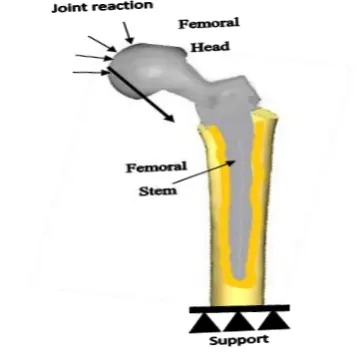
Total hip replacement is performing due to hip deterioration [39, 40]. Hip replacement divided into two major mechanical structures, the femoral head which concerned more with the tribological aspect is the drive of the design, and the femoral stem, which supports the body load on the femur and distributed within inner space of femoral cavity. Figure 3 shows the model used in this study. The first step is applying topology optimization to design the stem for minimizing bone stress induced by the stem bone interaction according to the objective function in (4). Topology optimization design is done using the following design strategy-
A. Conformal lattice structure (CLS)
In this method, topology optimization is performed using SIMP method. Density ρ is lower- penalization (i.e. ρ1~1.5) to allow the existence of gray areas. Gray area is no desired aspect of traditional topology optimization caused it gives the undetermined status of the design; so, it will be difficult to determine whether there is or there is not material. However, in CLS method, ray areas are translated to truss shape by replacing the element edges with truss members. After identifying the truss locations, another optimization is performed to find out individually, the best truss cross-section in the overall design. The problem is simulated using tetrahedral, first-order mesh using OptiStruct solver. (Fig.3). The material in use is Titanium alloy (Ti-6Al-7Nb).
B. SIMP topology optimization
[image:4.595.312.491.149.330.2]Topology optimization will be performed directly for the density function which is penalized to power 3. The p-norm function is used as shown in (4). The volume fraction is set to be 40% of the original volume. This is to reduce the weight of the implant.
Fig. 3. Femoral implant simulation
V. ELECTROCHEMICAL POLISHING SIMULATION
. .
U
C I n
(9) The coefficient of proportionality C can be calculated fromm
C
N
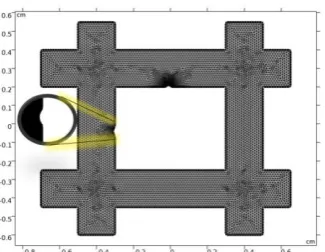
(10)Here, m is atomic mass of the targeted material. is Faraday’s constant, ρ is the targeted material density, and N is valence number of the targeted material. The simulation was done for the simple 2D case in order to evaluate the effectiveness of electrochemical polishing by adding layers of materials. The additive process is being anticipated to decrease the severity of sharps inclusions which is done by 3d printing process. The domain is shown in Fig. 4. Two holes were cut in the domain, circular shape with two depths, 0.15mm and 0.3 mm. is being calculated as 1.69x10⁻¹⁰ m3/A.s.. The test domain is chosen to be as shown in fig. 4 because it is addressing the possibility of polishing the highly anticipated complex design which is. CLS design.
VI. RESULTS
The numerical example as the following. Femoral loading is 600 newtons. CLS- topology optimization is performed in two stages, the first trail is to identify the gray area elements, then followed by the second trail which is optimizing truss links cross-section. Fig 5. Showed the objective history of the optimization processes (First Stage of CLS). Fig. 5 also is the final design objective history of CLS. The p-norm method is also performed to achieve an optimal design. Table 1 shows the stress in the bone for the designed methodologies. Simulation of electrochemical processing is shown in Fig.6.
VII. CONCLUSION
Table 1 showed the prevailing of p-norm optimization comparing to CLS design. SIMP design showed better results regarding inducing stress shielding. Stress shielding is being anticipated for the higher stress of the bone that was imposed by the implant. However, the tribological aspects are not been addressed in the optimization process, but the results showed the tendency of averaging stress method (p-norm, functions) to produce good results, due to function convexity. Chemical polishing by plating is promising post processing for 3D printed implants. Fatigue life is sensitive for surface Finnish, and because there is no possibility of repairing the implant inside the body (as the natural bone does to itself). Fig. 6 showed that the additive layer smoothens the edges of the surface deficit.
ACKNOWLEDGMENT
[image:5.595.348.511.49.175.2]The authors would like to Thank Miss T. Sherstobitova, for her aid in the calculations of electrochemical proportionality coefficient of titanium alloy.
[image:5.595.305.565.201.731.2]Fig. 4. A casestudy of electropolishing model using ALE.
Fig.6 Electropolishing simulation.
TABLEI
BONE STRESS FOR THE DESIGN METHODOLOGIES
Model Maximum octahedral stress in the bone (N/mm3)
Non-optimized case 7.103e2
CLS optimized case 1e3
p-norm optimized case 1.533e2
REFERENCES
[1] M. Subasi, C. Kesemenli, A. Kapukaya, and S. Necmioglu, “Treatment of intertrochanteric fractures by external fixation,”
Acta orthopaedica belgica, vol. 67, no. 5, pp. 468-474, 2001. [2] M. Miloro, G. Ghali, P. Larsen, and P. Waite, Peterson's
principles of oral and maxillofacial surgery: PMPH-USA, 2004.
[3] J. Mu Jung, and C. Sang Kim, “Analysis of stress distribution around total hip stems custom-designed for the standardized Asian femur configuration,” Biotechnology & Biotechnological Equipment, vol. 28, no. 3, pp. 525-532, 2014.
[4] B. van Rietbergen, and R. Huiskes, “Load transfer and stress shielding of the hydroxyapatite-ABG hip: a study of stem length and proximal fixation,” The Journal of arthroplasty, vol. 16, no. 8, pp. 55-63, 2001.
[5] A. Ait Moussa, J. Fischer, R. Yadav, and M. Khandaker, “Minimizing Stress Shielding and Cement Damage in Cemented Femoral Component of a Hip Prosthesis through Computational Design Optimization,” Advances in orthopedics,
vol. 2017, 2017.
[6] M. Reimeringer, N. Nuño, C. Desmarais-Trépanier, M. Lavigne, and P. Vendittoli, “The influence of uncemented femoral stem length and design on its primary stability: a finite element analysis,” Computer methods in biomechanics and biomedical engineering, vol. 16, no. 11, pp. 1221-1231, 2013.
[7] Y. Shishani, and R. Gobezie, "Does a short stemmed humeral implant really make a difference?."
[8] D. R. Sumner, and J. O. Galante, “Determinants of stress shielding: design versus materials versus interface,” Clinical orthopaedics and related research, vol. 274, pp. 202-212, 1992.
[9] F. Schmidutz, M. Woiczinski, M. Kistler, C. Schröder, V. Jansson, and A. Fottner, “Influence of different sizes of composite femora on the biomechanical behavior of cementless hip prosthesis,” Clinical Biomechanics, vol. 41, pp. 60-65, 2017.
[10] J. Snyman, Practical mathematical optimization: an introduction to basic optimization theory and classical and new gradient-based algorithms: Springer Science & Business Media, 2005.
[11] G. Rozvany, “Topology optimization in structural mechanics,”
Structural and Multidisciplinary Optimization, vol. 21, no. 2, pp. 89-89, 2001.
[12] H. L. Cox, The Design of Structures of Least Weight: International Series of Monographs in Aeronautics and Astronautics: Solid and Structural Mechanics: Elsevier, 2014. [13] J. C. Maxwell, The Scientific Papers of James Clerk Maxwell:
University Press, 1890.
[14] A. G. M. Michell, “LVIII. The limits of economy of material in frame-structures,” The London, Edinburgh, and Dublin Philosophical Magazine and Journal of Science, vol. 8, no. 47, pp. 589-597, 1904.
[15] G. Hegemier, and W. Prager, “On michell trusses,”
International Journal of Mechanical Sciences, vol. 11, no. 2, pp. 209-215, 1969.
[16] D. C. Drucker, and R. Shield, Design for Minimum Weight, BROWN UNIV PROVIDENCE RI, 1956.
[17] A. Chan, The design of Michell optimum structures, College of Aeronautics Cranfield, 1960.
[18] D. L. Bartel, Optimum design of spatial structures, IOWA UNIV IOWA CITY DEPT OF MECHANICS AND HYDRAULICS, 1969.
[19] D. Charrett, and G. Rozvany, “Extensions of the Prager-Shield theory of optimal plastic design,” International Journal of Non-Linear Mechanics, vol. 7, no. 1, pp. 51-64, 1972.
[20] G. Rozvany, and W. Prager, “Optimal design of partially discretized grillages,” Journal of the Mechanics and Physics of Solids, vol. 24, no. 2-3, pp. 125-136, 1976.
[21] M. Rossow, and J. Taylor, “A finite element method for the optimal design of variable thickness sheets,” Aiaa Journal, vol. 11, no. 11, pp. 1566-1569, 1973.
[22] K.-T. Cheng, and N. Olhoff, “An investigation concerning optimal design of solid elastic plates,” International Journal of Solids and Structures, vol. 17, no. 3, pp. 305-323, 1981. [23] M. P. Bendsøe, and N. Kikuchi, “Generating optimal topologies
in structural design using a homogenization method,” Computer methods in applied mechanics and engineering, vol. 71, no. 2, pp. 197-224, 1988.
[24] M. P. Bendsøe, “Optimal shape design as a material distribution problem,” Structural and multidisciplinary optimization, vol. 1, no. 4, pp. 193-202, 1989.
[25] T. Albrektsson, G. Zarb, P. Worthington, and A. Eriksson, “The long-term efficacy of currently used dental implants: a review and proposed criteria of success,” Int J Oral Maxillofac Implants, vol. 1, no. 1, pp. 11-25, 1986.
[26] C. E. Misch, M. L. Perel, H.-L. Wang, G. Sammartino, P. Galindo-Moreno, P. Trisi, M. Steigmann, A. Rebaudi, A. Palti, and M. A. Pikos, “Implant success, survival, and failure: the International Congress of Oral Implantologists (ICOI) pisa consensus conference,” Implant dentistry, vol. 17, no. 1, pp. 5-15, 2008.
mandible using bar-retained overdentures,” International Journal of Oral & Maxillofacial Implants, vol. 10, no. 2, 1995. [28] T. Karachalios, C. Tsatsaronis, G. Efraimis, P. Papadelis, G.
Lyritis, and G. Diakoumopoulos, “The long-term clinical relevance of calcar atrophy caused by stress shielding in total hip arthroplasty: A 10-year, prospective, randomized study1 1No benefits or funds were received in support of this study,”
The Journal of arthroplasty, vol. 19, no. 4, pp. 469-475, 2004. [29] S. Cowin, and D. Hegedus, “Bone remodeling I: theory of
adaptive elasticity,” Journal of Elasticity, vol. 6, no. 3, pp. 313-326, 1976.
[30] L. Blankevoort, J. Kuiper, R. Huiskes, and H. Grootenboer, “Articular contact in a three-dimensional model of the knee,”
Journal of biomechanics, vol. 24, no. 11, pp. 1019-1031, 1991. [31] R. Huiskes, H. Weinans, and B. Van Rietbergen, “The
relationship between stress shielding and bone resorption around total hip stems and the effects of flexible materials,”
Clinical orthopaedics and related research, pp. 124-134, 1992. [32] M. G. Joshi, S. G. Advani, F. Miller, and M. H. Santare, “Analysis of a femoral hip prosthesis designed to reduce stress shielding,” Journal of biomechanics, vol. 33, no. 12, pp. 1655-1662, 2000.
[33] D. Carter, T. Orr, and D. Fyhrie, “Relationships between loading history and femoral cancellous bone architecture,”
Journal of Biomechanics, vol. 22, no. 3, pp. 231-244, 1989. [34] B. Van Rietbergen, R. Huiskes, H. Weinans, D. Sumner, T.
Turner, and J. Galante, “The mechanism of bone remodeling and resorption around press-fitted THA stems,” Journal of biomechanics, vol. 26, no. 4-5, pp. 369-382, 1993.
[35] P. Duysinx, and M. P. Bendsøe, “Topology optimization of continuum structures with local stress constraints,”
International journal for numerical methods in engineering,
vol. 43, no. 8, pp. 1453-1478, 1998.
[36] G. W. Jang, J. H. Jeong, Y. Y. Kim, D. Sheen, C. Park, and M. N. Kim, “Checkerboard‐free topology optimization using non‐conforming finite elements,” International Journal for Numerical Methods in Engineering, vol. 57, no. 12, pp. 1717-1735, 2003.
[37] K. Saxe, Beginning functional analysis: Springer Science & Business Media, 2013.
[38] M. A. Al-Ali, M. A. Al-Ali, A. Takezawa, and M. Kitamura, “Topology Optimization and Fatigue Analysis of Temporomandibular Joint Prosthesis,” World Journal of Mechanics, vol. 7, no. 12, pp. 323, 2017.
[39] J. F. Crowe, V. Mani, and C. S. Ranawat, “Total hip replacement in congenital dislocation and dysplasia of the hip,”
JBJS, vol. 61, no. 1, pp. 15-23, 1979.
[40] J. Wedge, and M. Wasylenko, “The natural history of congenital disease of the hip,” Bone & Joint Journal, vol. 61, no. 3, pp. 334-338, 1979.
[41] D. O. Meredith, L. Eschbach, M. A. Wood, M. O. Riehle, A. S. Curtis, and R. G. Richards, “Human fibroblast reactions to standard and electropolished titanium and Ti–6Al–7Nb, and electropolished stainless steel,” Journal of Biomedical Materials Research Part A, vol. 75, no. 3, pp. 541-555, 2005. [42] D. Padhi, J. Yahalom, S. Gandikota, and G. Dixit,
“Planarization of copper thin films by electropolishing in phosphoric acid for ULSI applications,” Journal of the Electrochemical Society, vol. 150, no. 1, pp. G10-G14, 2003. [43] C. Hirt, A. A. Amsden, and J. Cook, “An arbitrary
Lagrangian-Eulerian computing method for all flow speeds,” Journal of computational physics, vol. 14, no. 3, pp. 227-253, 1974. [44] D. J. Benson, “An efficient, accurate, simple ALE method for