Polymers for Advanced Technologies Volume 5, pp. 554-560
Energetic Polymers as Binders
in
Composite Propellants and Explosives
M.
Eamon Colclough’, Hesmant Desai’,
Ross
W. Mi
Malcolm
J.
Stewart2 and Peter Golding3
I DRA, Fort Halstead, Sevenoaks 7”14 7BP, UK D R A Farnborough, Farnborough GU14 6TD, UK AWE, Aldermaston RG7 4PR, U K
ABSTRACT
The principles behind the use of polymeric binders in composite propellants and explosives are described with emphasis on the properties which they should possess in order to satisfy the requirements for inclusion in a composition. The desirability of using energetic polymers as binders in terms of both performance and safety, and the problems associated with their preparation and properties, are discussed. The contributions of chemical synthesis within D R A to overcome these problems will be shown. Preparation of energetic polymers both by polymer modification and by polymerization of an ener- getic monomer is described. W e have developed three energetic polymers: poly-3-nitratomethyl-3-methyl- oxetane (polyNIMMO), polyglycidyl nitrate (polyG- LYN) and nitrated hydroxy-terminated polybutadiene (NHTPB). Two of these ( p o l y N l M M 0 and polyGLYN) have shown excellent properties in propellant and explo- sive formulations and proved that low-vulnerability, high-performance compositions are possible. The proper- ties of the products from our work are compared with those of other groups and a glimpse of the future in this area is given to show the potential for new energetic polymers.
KEYWORDS: Energetic binders, Propellants and explosives, Poly 3-nitratomethyl-3-methyloxetane,
Polyglycidyl nitrate, Nitrated hydroxy-terminated Dolvbutadiene
INTRODUCTION
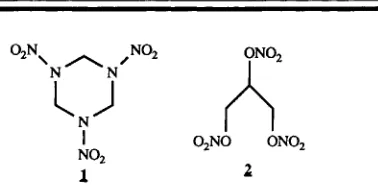
Many highly energetic materials which are desirable for use as ingredients in propellant and explosive formulations are high-melting crystalline solids, e.g. 1,3,5-trinitro-1,3,5-triazinane (RDX, 1) or liquids,
[image:1.612.348.537.297.390.2]tar’, Norman C. Paul’,
FIGURE 1. Structure of common explosives RDX and
n itrog I yce ri ne.
e.g. nitroglycerine, (NG, 2), at normal temperatures Fig. 1).
The performance of propellant and explosive systems is dependent upon the physical shape, sur- face area and mechanical integrity of the finished formulation and so a processing aid or binder is often used with such materials [l]. Over recent years there has been increasing emphasis within the ener- getic materials community on reducing the response of munitions to stimuli such as fire, impact, shock waves, etc. without any degradation in performance. This policy of using insensitive munitions [2] has resulted in a move away from traditional nitrocellulose-based propellants and melt case (TNT- based) explosives, which tend to be brittle materials, to composite type formulations consisting of energe- tic solids bound together by polymeric binders.
The most commonly used polymer binder in propellants and explosives in hydroxy-terminated polybutadiene (HTPB) which has a low viscosity, allowing a high solids loading, and has well estab- lished isocyanate cure chemistry. The polymer binder acts by wetting the solid filler to provide a void-free matrix which gives enhanced mechanical and safety properties and also allows the formulation to be cast into large and irregular cases. HTPB is, however, non-energetic and thus the performance of
CCC 1042-7147/94/090554-07
0
British Crown Copyright 1993Energetic Polymers as Binders I 555
x
x
I
1
/*\A/*\
I
X 3A-A-A = Polymerbackbone X = N Q . ONQ, N3
FIGURE 2. General structure of an energetic polymer.
the composition is limited unless there is a high solids loading. At very high solids loadings there can be processing problems, which can limit the range of possible manufacturing methods, as well as causing problems with vulnerability. Reduction of the solids loading would reduce the vulnerability to stimuli since the solid is the sensitive component. Therefore to reduce vulnerability without lowering perfor- mance, energy can be added to the binder, enabling a lower solids loading, or, alternatively, maintaining the solids loading whilst using an energetic binder should lead to increased performance. These are the concepts behind the use of energetic binders and have led to much research work on both the synthe- sis and formulation of many different types of ener- getic polymers.
The term energetic polymer implies that energe- tic moieties such as nitro (NO,), nitrate (NO,) or azide (N,) are present (3); Fig. 2. There are two synthesis routes employed to make such materials, viz. polymerization of an energetic monomer and modification of an existing polymer to introduce energy. Polymerization of energetic monomers requires careful control of reaction conditions since initiators may not be compatible with the energetic groups and consequently is seen as a high- technology and high-risk approach. However, the use of this method could allow the properties of the material to be tailored to the application. Polymer modification is a low-technology, low-risk approach but can produce one possible material and set of properties and suffers from the usual complications of modifying a macromolecule.
Both of these approaches have been used by ourselves and other workers, and prior to describing our work in this field a short overview of the energetic polymers produced by other workers is given.
ENERGETIC POLYMERS
Early work on energetic polymers has been reviewed by Urbanski [3] and will not be expanded upon here. More recent work has seen the development of energetic polymers into viable ingredients for pro- pellants and explosives.
Energetic Polymers by Polymerization of Energetic Monomers
Polyoxetanes. Since early work was carried out by Manser [4] on polymerization and copolymerization of 3-nitratomethyl-3-methyl oxetane (NIMMO) and
3,3-bis-azidomethyloxetane (BAMO), much work has been published on the synthesis (e.g. [5-91) and analysis (e.g. [lo-111) of these materials. NIMMO
s
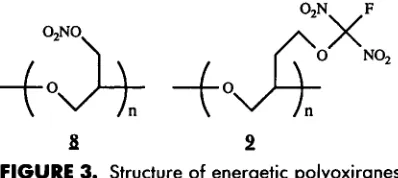
2FIGURE 3. Structure of energetic polyoxiranes.
was synthesized by acetyl nitrate nitration of 3- hydroxymethyl-3-methyl oxetane (HIMMO) [4], eq. (1) and BAMO by azidation of bis-chloromethyl- oxetane using sodium azide [4], eq. (2):
OH CH+2OON& +CH,COOH ----(I)
1 I
6 1
’/Polymerization is carried out using a boron trifluor- ide etherate/l,4-butanediol initiator system to give liquid curable elastomer with low glass transition temperature
Tg
(NIMMO) and a solid, high-melting polymer (BAMO). Owing to the requirement for energetic elastomers, the high-energy BAMO has been evaluated as a copolymer with NIMMO [4, 111 whereas NIMMO has suitable properties to be used as a homopolymer. PolyBAMO is a high-melting solid but a 50/50 copolymer with tetrahydrofuran (THF) has been reported by Manser [12] to produce a flowing liquid polymer. Manser has also described the synthesis of many different oxetanes with NOz, NF,, N(NOJ, cubyl and carboranyl groups, but the difficult syntheses involved have so far precluded their evaluation in large-scale formulations.We have undertaken a major programme of work on polyoxetanes and polyNIMMO in particular, which is discussed below.
Polyoxirunes. The preparation and polymerization of energetic oxiranes has proved to be more difficult than that of oxetanes, with two products being reported. Polyglycidylnitrate (polyGLYN, 8; Fig. 3) was studied [13] but problems were experienced with monomer purity, oligomer contamination and low molecular weights. We have worked on synthe- sis and evaluation of polyGLYN and this is discussed below.
The other energetic polyoxirane which has been studied is poly-2-fluoro-2,2-dinitroethylglycidyl ether (FNGE, 9, [14]). The synthesis and polymeriza- tion could be carried out, but oligomer contamina- tion and poor molecular weight reproducibility caused the mechanical properties of the cured binder to be poor.
Polyformuls. These compounds have been pre- pared by the reaction of dihydric alcohols with formaldehyde to give hydroxyl-terminated polymers (eq. (3)):
n HO-R-OH + n C H 2 0 HO R--OCH,O H + n H 2 0 ----(3)
[image:2.612.335.534.73.162.2] [image:2.612.61.287.73.153.2]556 I Colclough et al.
NO2
Y
IHO
-
CH2-
C - C q-
OH OCN- CH,-
CH,-
C-
CH,--CH,-
NCOI I
NO2 NO2
[image:3.612.326.547.377.436.2]11 I
FIGURE 4. Typical monomers for preparation of energetic polyurethanes.
The work on polyformals from nitrodiols and fluoro- diols has been reported by Adolph and coworkers [15, 161 and many different chain lengths in the starting diol have been examined, giving polymers of molecular weights up to 10,000 [16], but mainly of the order of 2000-4000 including cyclic species. The molecular weights were strongly affected by the reaction temperature, type and amount of solvent used, and by the nature of the acid catalyst. Of the energetic materials synthesized, most are high- melting solids [16] but the fluorinated materials are low Tg elastomers. The energetic polyformals are deemed not suitable for use as energetic binders on their own but may find use as copolymers with suitable low Tg elastomeric monomers.
Energetic Polyurethanes. The synthesis of energetic polyurethanes from short-chain energetic diols, e.g. 10, and energetic isocyanates, e.g. 11, is probably the simplest way to make an energetic polymer (Fig. 4). The products tended to be hard solids rather than the desired liquid prepolymers. Their application as energetic binders has not therefore been productive although the principle of using an energetic isocya- nate to crosslink energetic polymers of other classes described in this paper is feasible.
Energetic Ac ylate-based Binders. For many years the possibility of preparing energetic acrylates and methacrylates has been known, and the synthesis and polymerization of nitroethylacrylate and methac- rylate was reported in 1950 by Morans and Zelinski [17] who described the acrylate polymer as soft and methacrylate as hard. More recently, Scott and Koch [18] have described the synthesis of poly(2,2- dinitropropyl acrylate) and its application as a binder for high-energy melt cast explosives.
Energetic Polymers by Modification of Existing Elastomers
Glycidyl h i d e Polymer (GAP). Glycidyl azide polymer (GAP, 12) is one of the most widely studied energetic polymers and its preparation (eq. (4)) and properties have been recently reviewed [19].
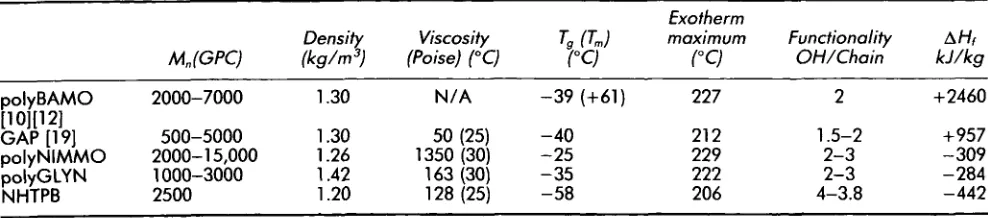
This material is a liquid prepolymer with a Tg of -40°C which has been extensively studied particu- larly with reference to its use as a rocket propellant binder [19]. It is currently the most readily available energetic binder due to its relatively straightforward and low-cost synthesis, and shows excellent binder properties in its pure form. Some properties of GAP are shown in Table 1.
Nitrated polybutadienes. The potential to nitrate HTPB was recognized many years ago and early studies concentrated on a nitromercuration- demercuration route [20] (eq. (5)):
HgCl
i O H HBc'2/"q * HO
NO2
OH .--- (5)
t
BaSe
NO2
Problems of solubility and stability were encoun- tered which have been overcome by elimination of side reactions and control of conditions [21, 221 to give interesting products. We have studied the modification of HTPB by a different route, described below.
Nitrated Polystyrenes. Reproducible synthesis of polynitrostyrene has been a troublesome area since nitrostyrenes cannot be polymerized and nitration of the aromatic rings of polystyrene is not a clean reaction [23]. There is no doubt that polynitrostyrene would be useful in copolymers despite the recent report [24] that it is less soluble and thermally stable than polystyrene.
TABLE 1. Comparison of the Physical Properties of Some Energetic Polymers
Exotherm
Density viscosity T ! ( T J maximum Functionality A H {
M"(GPC) (kg/m3) (Poise) ("C) ("C) ("C) O H / C h a i n kJ/kg
pol y BAMO 2000-7000 1.30 N / A -39 (+61) 227 2 +2460
GAP [101[121 [19] 500-5000 1.30 50 (25) -40 21 2 1.5-2 +957
p o l y N l M M 0 2000-1 5,000 1.26 1350 (30) -25 229 2-3 - 309
polyGLYN 1000-3000 1.42 163 (30) -35 222 2-3 -284
[image:3.612.61.555.662.771.2]Energetic Polymers as Binders / 557
l3
FIGURE 5. Structure of poolyvinyl nitrate.
Polyvinyl Nitrate ( P W ) . Much information on PVN (13), which is perhaps the simplest energetic polymer, has been reported by Urbanski [3] (Fig. 5). Unfortunately its poor thermal stability coupled with a phase transition occurring at 40°C has meant that it has not seen service since nitrocellulose, which it was designed to replace, has superior properties.
ENERGETIC POLYMERS I N
DRA
The objective of our work was to synthesize a range of hydroxyl-functionalized, energetically substituted elastomeric polymers suitable for isocyanate cross- linking. As a precursor to this work we had exten- sively studied the chemistry of dinitrogen pentoxide (N205) which we found to be a powerful versatile nitrating agent which operated in acid-free con- ditions [25]. Using N205, a hydroxyl group can be easily converted to a nitrate ester and an epoxide group to dinitrate ester by reaction with N205 in dichloromethane solution (eqs (6) and (7)):
This chemistry has led to products from polymer modification and polymerization of energetic monomers which have excellent properties for use as energetic binders and are prepared by scaleable processes.
Pol y NIMMO
Monomer Synthesis. The synthesis of NIMMO monomer relies upon the selective nitration of hy- droxyl in the presence of oxetane. This is easily carried out using N205 in dichloromethane solution by careful control of reaction conditions [26] eq. (8):
4 5
The use of N205 avoids dealing with acetyl nitrate, which is potentially explosive, and does not give ring-opened products. Deliberate ring-opening of NIMMO to give metriol trinitrate 14 can be achieved by reacting with 2 moles of N205 [25] as shown in eq.
(9) :
In order to aid scale-up of the monomer, NIMMO is now routinely made in a flow nitration system giving excellent yields and purity of product in dichloro- methane solution which can be directly polymerized 1271.
Polymerization of NZMMO. NIMMO is polymer- ized by a cationic initiator (BF, etherate/butane-1,4- diol) to give a pale yellow liquid elastomer. The mechanism of this polymerization is the subject of much discussion and the detailed studies which we have carried out are beyond the scope of this paper but will be published elsewhere. A simple view of the mechanism is shown in Scheme 1.
Therefore a protonic species is generated in the pre-reaction phase and this then reacts with NIMMO monomer to give the secondary oxonium ion as the true initiator. Rapid reaction with further monomer produces another secondary oxonium as the propa- gation step. When carried out in bulk, contamination by cyclic species, probably caused by a backbiting and transfer reactions, is seen. To overcome this, a polymerization system was used whereby the monomer was introduced slowly over a period of time. This has been successful after much work on achieving optimum conditions which will be the subject of a more detailed publication. The polymer- ization is dependent on many factors such as reac- tion temperature, initiator system, reaction time and monomer addition rate and these have effects on the molecular weight, polydispersity, viscosity, hydroxyl-functionality and presence of cyclic spe- cies.
Properties of PolyNZMMO. The product is a pale yellow viscous liquid which is curable using isocya- nates. The physical properties are shown in Table 1. Molecular weights in the range 2000-15,000 (polyTHF equivalents by gel permeation chroma- tography GPC) have been synthesized but the standard product for evaluation is of molecular weight 5500. The isocyanate cure has been estab- lished for both di- and trifunctional materials and high-quality extensible rubbers are produced. The Tg of the prepolymer is -25°C by differential scanning calorimetry (DSC) and this is virtually unchanged when measured by DMTA on the cured material. The thermal stability has been shown to be reasonable with an onset of decomposition occurring at 170°C (by DSC), and details on the thermal stability have been published by Bunyan and coworkers [28, 291. This product is currently undergoing volume pro- duction studies and has been evaluated as a propel- lant and explosive binder. The energy of the polymer has been shown to contribute to that of the overall formulation and reduced vulnerability has been demonstrated [30].
PolyGLYN
558 I Colclough ef al.
/n
u
SCHEME 1 Preparation of polyNIMM0.
H
I
HOROH
-
HoRo70H
0,NO'+HBF4
-
R-
+ HBF4ON02 OzNO
H I
-
Polymerisation
ON02 OZNO
SCHEME 2 Active monomer polymerization of glycidyl nitrate.
HO
f
CH,-CH=CH-CH,t
OHI
Epoxidation CH,COOOH/CH,CI,
/O\
HO
f
CH,-CH=CH-CH, CH,-
CH-
CH-
CH,ON02
I
CH,
-
CH-
CH-
CH,I
O N 4
HO CH2-CH=CH-CH,
1z
f
Energetic Polymers as Binders / 559
As with the synthesis of NIMMO, the reaction conditions have to be carefully controlled since reac- tion with two moles of N20, can give nitroglycerine, 2, eq. (11):
For the purposes of safety and ease of processing glycidyl nitrate is now prepared routinely by using a flow reactor [27] which produces a high yield of pure monomer in dichloromethane which is ready for polymerization. Therefore the explosive glycidyl nitrate does not need to be isolated.
Polymerization of GLMV. Initial studies of the poly- merization indicated clearly that the conditions used for preparation of polyNIMMO did not apply to polyGLYN. It was observed that the slow addition rates and relative amounts of initiator to monomer were typical of an activated monomer polymeriza- tion, first postulated by Penczek et al. [31] and is shown in Scheme 2.
The synthesis of polyGLYN by this route is a major achievement since the product is a true world lead- der in energetic polymers. We have carried out an exhaustive study on the processes involved in the synthesis of polyGLYN and the variation in proper- ties with reaction conditions. This work will be published in detail in due course. Volume produc- tion of polyGLYN is not as advanced as for poly- NIMMO but evaluation of the properties has been carried out.
Properties of PolyGLMr. PolyGLYN is a pale yellow liquid polymer which can be crosslinked with isocyanates to yield rubber materials. The physical properties are shown in Table 1.
The polymer is high in energy and density and its
Tg of -35°C is good although it may require some plasticization to reach current UK service require- ments. The cure chemistry is well established and the rubbery binders produced have great potential in propellant and explosive formulations since it has been shown [30] that high energy and reduced vulnerability formulations can be produced.
Nitrated HTPB (NHTPB)
Nitrated HTPB has been synthesized by a polymer modification route which relies upon the reaction of N,O, with expoxide groups (eq. (7)) to form dinitrate esters. The synthetic route in the early stages involved epoxidation of HTPB in manner similar to that reported by Zuchowska [32] using in situ perace- tic acid as the epodixation reagent. Reaction of the epoxide groups with N205 in dichloromethane gives
a polymer with a percentage of double bonds con- verted to dinitrate ester groups dependent upon the epoxide content of the intermediate polymer. The properties of the polymer depend upon the percent- age of double bonds converted and for a good compromise between energetic and physical proper- ties, this is 10% (Scheme 3).
The values of x and y are controlled by reaction conditions and, provided that care is taken, the products are soluble and do not have the problems associated with those from nitromercuration/ demercuration. Much work has been carried out on the synthesis of NHTPB which is being published in detail elsewhere. The properties of NHTPB are good for use as a b i d e r and are shown in Table 1. NHTPB is of sufficiently low viscosity for handling in a laboratory or processing environment and can be cured with aliphatic or aromatic isocyanates. The Tg
is slightly higher than HTPB but the product has the advantage of being miscible with energetic plasti- cizers, which HTPB is not.
Variation in the degree of nitration can give more or less energy, higher or lower viscosity and higher or lower Tg. The thermal stability on small-scale testing was acceptable, but large-scale formulation work has not been carried out so far due to the superior properties of polyNIMMO and polyGLYN.
CONCLUSIONS
The energetic polymers on which we have concen- trated have been shown to have excellent properties for use as propellant and explosive binders and have successfully demonstrated the concept that an ener- getic binder can give an increased performance at a given filler loading and can give equivalent perfor- mance with a lower filler loading and consequently reduced vulnerability. In particular, polyNIMMO and polyGLYN have attracted significant interest within the UK and abroad and are being produced on an increasingly large scale. The methods which we have developed in the laboratories to these previously known materials have led to large-scale processes for their production. Our materials com- pare favorably with energetic polymers produced elsewhere and for certain applications are expected to become the binder of choice.
560 / Colclough et al.
energy and better mechanical properties would further lower the amount of fillers needed in formula- tions thus making them much less likely to react to external stimuli. Ultimately a polymer with sufficient energy to be used without a solid oxidizer could revolutionize the performance and safety of propel- lants and explosives.
REFERENCES
1. R. G. Stacer and D. M. Husband, Propellants,
Explosives and Pyrotechnics, 16, 167 (1991).
2. B. H. Bonner, Propellants, Explosives and Pyrotechnics,
16, 194 (1991).
3. T. Urbanski, Chemistry and Technology of Explosives,
Vol. 4, Pergamon Press, Oxford, p. 404 (1984). 4. G. E. Manser, US Patent 4,393,199 (1983); US Patent
4,483,978 (1984).
5. M. A. H. Talukder and G. A. Lindsay, J. Polym. Sci. Part A Polym. Chem., 28, 2393 (1990).
6. H. Cheradarne, J.-P. Andreolety and E. Rousset, Die Makromol. Chem. Macromol. Chem. Phys., 192, 901 (1991).
7. H. Cheradarne and E. Gojon, Die Makromol. Chem. Macromol. Chem. Phys., 192, 919 0991).
8. B. Xu, C. P. Lillya and J. W. C. Chien,
1.
Polym. Sci. Part A Polym. Chem., 30, 1899 (1992).9. B. Xu, Y. G. Lin and J. W. C. Chien, J. A p p l . Polym. Sci., 46, 1603 (1992).
10. T. Miyazaki and N. Kubota, Propellants, Explosives and Pyrotechnics, 17, 5 (1992).
11. Y. Oyumi, Propellants, Explosives and Pyrotechnics 17, 226 (1992).
12. G. Manser, i n Proceedings of the 21st Annual Conference
of ICT on Technology of Polymer Compounds and Energetic Materials, Karlsruhe, Germany, Vol. 50, p. 1 (1990).
13. M. S. Cohen, i n Advanced Propellant Chemistry, R. T. Holzmann, ed., Advances i n Chemistry Series, American Chemical Society, Washington, p 93 (1966).
14. R. S. Miller, P. A. Miller, T. A. Hall and R. Reed Jr, US
Naval Res. Rev., 33, 21 (1981).
15. H. G. Adolph, J. M. Goldwasser and W. M. Koppes, J. Polym. Sci. Part A Polym. Chem., 25, 805 (1987). 16. H. G. Adolph, L. A. Nock, J. M. Goldswasser and R. E.
Farncomb,
1.
Polym. Sci. Part A Polym. Chem., 29, 719 (1991).17. N. S. Morans and R. P. Zelinski, J. A m . Chem. SOC., 72,
2125 (1950).
18. B. A. Scott and L. E. Koch, US Patent 5,092,944 (1992). 19. A. N. Nazare, S. N. Asthana and H. Singh, J. Energetic
Muter. 10, 43 (1992).
20. J. W. C. Chien, T. Kohara, C. P. Lillya, T. Sarubbi, B.-H. Su and R. S. Miller, J. Polym. Sci. Part A Polym. Chem., 18, 2723 (1980).
21. F. Lugadet, A. Deffieux, C. Servens and M. Fontanille,
Europ. Polym. J., 25, 63 (1989).
22. F. Lugadet, A. Deffieux and M. Fontanille, Europ. Polym. J., 26, 1035 (1990).
23. T. Urbanski, Chemistry and Technology of Explosives,
Vol. 1, Pergamon Press, Oxford, p. 418 (1983). 24. M. Coskun, E. Ozdemir, A. Cansiz and G. Akovali,
Turkish J. Chem., 15, 185 (1991).
25. R. W. Millar, M. E. Colclough, P. Golding, P. J. Honey, N. C. Paul, A. J. Sanderson and M. J. Stewart, Phil. Trans. R. SOC. London A, 339, 305 (1992).
26. P. Golding, R. W. Millar and N. C. Paul, UK Patent 2,239,018 (1992).
27. P. Golding, R. W. Millar and N. C. Paul, UK Patent 2,240,779 (1992).
28. P. F. Bunyan, A. V. Cunliffe and A. Davis, Proceedings
of the 26th International Pyrotechnics Seminar,
Jonkoping, Sweden, p. 131 (1991).
29. P. F. Bunyan, Proceedings of the Joint International Symposium on Energetic Materials Technology, New Orleans, USA, p. 75 (1992).
30. D. F. Debenham, W. B. H. Leeming and E. J. Marshall,
Proceedings of the Joint lnternational Symposium on Energetic Materials Technology, San Diego USA, p. 1 (1991).
31. S. Penczek, P. Kubisa, K. Matyjaszsewski and R. Szymanski, Pure A p p l . Chem., 140 (1984).