Clonal Plasticity: A Method for Decentralized Adaptation in
Multi-Agent Systems
Vivek Nallur, Nicolás Cardozo, Siobhán Clarke
Future Cities, DSG, Trinity College Dublin College Green, Dublin, Ireland
{vivek.nallur
|cardozon
|siobhan.clarke}@scss.tcd.ie
ABSTRACT
This paper introduces a new plant-inspired mechanism for decentralized adaptation, calledclonal plasticity, which does not make use of the MAPE loop. The mechanism acts on ev-ery individual in a population and does not require central-ized control. The paper presents a case-study demonstrating its utility and feasibility in adaptation. The paper concludes with some thoughts about the costs and limitations of this mechanism, and possible future strands of research in this direction.
CCS Concepts
•Computing methodologies→Self-organization;
Keywords
decentralized self-adaptation; plasticity;
1.
INTRODUCTION
Technologically, society is moving towards an ever-increasing number of connected devices, which are highly sophisticated in terms of computing power. Concepts likeSmart Cities en-visage a world, where systems from multiple domains, cur-rently silo-ed in their particular function, interact in an in-tegrated manner to provide citizens with efficient and sus-tainable infrastructural support in transportation, energy, water, etc [23, 7]. Other concepts likeInternet of Things envisage a hyper-connected world, where devices, hitherto considered ‘dumb’, would be able to connect to other devices and make intelligent decisions, even in the face of changing human needs [26, 29]. All of these concepts assume that the underlying technological systems and infrastructure are able to adapt to environmental change and preserve their func-tion [3]. Thus, self-adaptive systems are a foundafunc-tional ne-cessity to the realization of such techno-fused societies. Self-Adaptive systems are those that are able to preserve at least one of the so-called * properties (protection, self-healing, self-configuring, self-optimizing, etc.). This has
tra-Permission to make digital or hard copies of all or part of this work for personal or classroom use is granted without fee provided that copies are not made or distributed for profit or commercial advantage and that copies bear this notice and the full citation on the first page. Copyrights for components of this work owned by others than the author(s) must be honored. Abstracting with credit is permitted. To copy otherwise, or republish, to post on servers or to redistribute to lists, requires prior specific permission and/or a fee. Request permissions from [email protected].
SEAMS’16, May 16-17 2016, Austin, TX, USA
c
2016 Copyright held by the owner/author(s). Publication rights licensed to ACM. ISBN 978-1-4503-4187-5/16/05. . . $15.00
DOI:http://dx.doi.org/10.1145/2897053.2897067
ditionally been done using the MAPE-K loop [17]. However, this is difficult to scale for highly distributed systems, since by the time themonitoring, analysis, planningandexecution steps are performed, the original problematic environment could have already changed. Also, a centralized MAPE-K loop based self-adaptation makes little sense in a Multi-Agent System (MAS) where each agent is not only poten-tially autonomous, but also has potenpoten-tially different goals. MASs are typically used in situations where distributed, au-tonomous decision-making is a natural fit. These situations include modeling city traffic [8], socio-technical systems [22], smart-grids [14, 20], smart-parking systems [24], cooperative control [25], etc. Most multi-agent system based adapta-tion relies on the distributed and autonomous nature of the constituent agents [11], but there is little literature on how to configure the agents themselves. Applications such as collision avoidance [6], grid management [16] use collabo-rative learning, and hierarchically deferring to a controller agent, to achieve the application’s objectives. The most pop-ular technique of self-configuration in multi-agent systems is reinforcement-learning [4]. However, in competitive situ-ations where collaboration is not possible, these techniques are not readily applicable. In this context, Prof. David Garlan presented a talk at SEAMS’15 entitled “The MAPE-loop considered harmful”, where it was speculated that a MAPE-less adaptation technique could potentially be use-ful in multiple scenarios. Coker et al. [9] also posited that large-scale software adaptation could be enriched by tech-niques from other domains, such as stochastic search. We wish to position our paper in this line of thought, and present a plant-inspired adaptation technique called clonal plastic-ity. Many plants exhibit adaptive behavior through the use of phenotypic plasticity, where the immediate environ-ment influences the height of the stem, width of the leaves, size of the roots, etc. Another phenomenon that occurs in plants is clonal reproduction, where all the individual plants in a given location are genetically identical copies of a single ancestor, without any sexual reproduction. We combine these two features to create a strategy calledclonal plasticity. In the following sections, we first define what we mean by clonal plasticity for a software (Section 2), show through a case-study (Section 3), its utility in decentralized adaptation. Finally, we reflect from a software engineering perspective (Section 4) on the costs and limitations of using such an adaptation strategy, before concluding the paper.
2.
CLONAL PLASTICITY
sequential reiteration of a basic structural unit or module consisting of the leaf with its associated auxiliary bud and a segment of stem that connects it to other units” [13]. Ba-sically, the individuals that are formed after reproduction are genetically identical to the original parent. This form of reproduction (clonal reproduction) has long been known to botanists as a very successful survival strategy. For instance, one aspen tree has been known to cover 43 hectares of land in Fish Lake County, Utah, with around 47000 clones, with an average age of 100 years [10]. It is important to note that though these clones are genetically (and sometimes physi-cally) connected, they function as independent organisms. Also, in spite of an identical genome, they do not necessar-ily look or behave identically. This variation in structure and/or behavior is due to a phenomenon calledphenotypic plasticity. Plasticity, in this context, is the ability of an or-ganism to vary its structure (height of stem, width of leaves, etc.) or behaviour (connect to its clonal sibling or discon-nect) according to environmental influences.
Phenotypic Plasticity is shown by the genotype of an or-ganism when its expression is able to be altered by environ-mental influences [2]. Plasticity, by this definition, does not include variation in an organism due to genetic factors.
We combine these two phenomenon, exhibited in plants, to propose a self-adaptation mechanism calledclonal plas-ticity. The fundamental difference betweenclonal plastic-ity and other evolutionary mechanisms, such asgenetic al-gorithms(GA), is the absence of a selection function, that identifies fit and unfit individuals. Clearly the absence of a selection function, from an adaptation perspective, im-plies that a system consisting of many individually adapting clones would adapt slower than a system implementing a GA. However, in some uncertain environments, it is better to approach a good solution in graduated steps, than in a fast convergence. Another feature of clonal plasticity is that all of its adaptations are reversible. This may not be the case with a genetic algorithm. Depending on the sequence of steps taken, a GA might not be able to revisit a certain solution, since unfit individuals containing a portion of the solution may have been previously completely removed from a population. In the general case, it is not possible for any adaptive mechanism to guarantee that the adaptation step will definitely lead to a better situation than the current one. However, a good adaptive mechanism must recognize that sometimes environments change fast, and therefore changes made to a system must be reversible.
2.1
Pre-requisites
A pre-requisite for clonal plasticity is plasticity in the genome. That is, depending on environmental feedback, the genome must be able to express behavioral changes. Note, this does not mean that the genome itself is changed, but merely that the organism responds behaviorally to changes in the environment. This is in contrast with other mech-anisms that have been studied under the umbrella of evo-lutionary computing. Whether by schemes of mutation or crossover, evolutionary computation makes changes in the underlying genome of the organism, whereas with clonal plasticity, the genome remains unchanged.
From a software system’s perspective, this feature of clonal plasticity means that functional goals of a plastic system will continue to be met in the same manner, as the original
sys-tem. For certain domains (e.g., critical systems [5]), the guarantee of functional correctness is an important consid-eration.
2.2
The Process of Plastic Reproduction
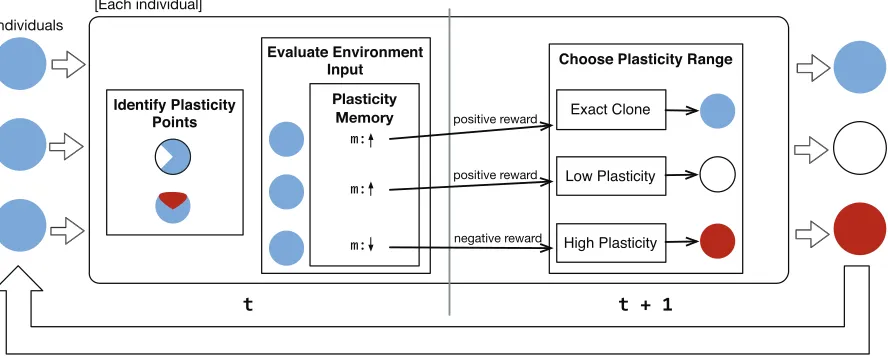
In clonal plasticity, the principal method of reproduction is clonal, which means that child organisms are substan-tially similar to their parent organism. The differentiation between a parent and a child occurs due to environmental influence, and the degree of plasticity exhibited by the or-ganism. The process of plastic reproduction, depicted in Figure 1, is given by the following steps:
1. Identify Plasticity Points: At a given moment in time,t, of the system’s lifetime, each individual in the system (depicted a circle in Figure 1) identifies all its parts that can take multiple representations, values, or behaviour.
2. Evaluate Environmental Input: Simultaneously, the fitness of each individual is self-evaluated in the following way: for each plastic point, environmental feedback is evaluated to check whether it impedes or favors that point. Feedback from the environment may come from different sensors or neighboring individuals or chemotaxis, or the individual’s own reproduction memory (min Figure 1).
3. Plasticity Memory: All individuals that have repro-duced before, keep a record of the previous Plasticity Range chosen during the last reproduction cycle (vari-ablemin Figure 1). This allows an individual to repeat a good adaptation strategy, if it previously had a pos-itive reward, or alternatively abandon a poor adapta-tion strategy.
4. Choose Plasticity Range: During the following time-step (t+1), each individual chooses a plastic response, based on the evaluated environmental input. The avail-able responses may be one of: (1) Exact Clone, (2) Low Plasticity, and (3) High Plasticity.
5. Clone and Modify Plastic Points: During the same time-step, each individual makes a clone of itself. The individual’s plasticity points may be adapted accord-ing to the chosen strategy. The entire process starts again with a new time-step,t, on all clones.
Choosing the Plasticity Range:.
The process of modifying the plastic points considers both positive and negative feedback. For a given time instant t, the adaptation decision depends on two factors:
1. Feedback from environment at time t, whether it is positive or negative.
2. Memory of the modification action, taken at timet-1.
Evaluate Environment Input
Plasticity Memory [Each individual]
Identify Plasticity Points
Choose Plasticity Range
Exact Clone
Low Plasticity
High Plasticity
positive reward
positive reward
negative reward
[image:3.612.86.530.60.239.2]
individuals
Figure 1: Clonal plasticity process
Exact Clone.
In this case, the individual simply makes a copy of itself, with no change at all.
Low Plasticity.
Modification with Low Plasticity implies that the individ-ual chooses the same plasticity point, as chosen during the previous cloning process, and moves in the same direction as before.
High Plasticity.
Modification with High Plasticity implies that the indi-vidual chooses a different plasticity point, than was chosen during the previous cloning process, and moves in a random direction.
Presence of Competition from Other Agents.
Depending on the particular system, plasticity can also ac-commodate competition from other agents. If the feedback from the environment is negative, and the memory of the previous action is also negative, then that agent is deemed to be too weak to clone itself. Rather, it is ‘taken over’ by any random neighbouring agent that is stronger due to a positive feedback from its environment.
2.3
Differences from a GA
Clonal Plasticity is still an instance of an evolutionary process(since it is inspired from plants). However, there are some important differences between Clonal Plasticity and well-known evolutionary techniques, like a Genetic Algo-rithm. These can be summarized as follows:
1. No Selection: Plasticity acts on every individual and the degree of plastic change exhibited is solely depen-dent on the individual’s fitness in its local environment. This raises the possibility of an individual beingfit in one part of the environment, and beingunfitin another part of the environment. The hyper-local environment for fitness and the absence of a selection function com-pletely decentralizes the change process.
2. No change to genome: Phenotypic plasticity occurs
due to environmental conditions (this may be neigh-bouring individuals or physical/temporal environment), but there is no change in the genotype —that is, only parametrizable changes are allowed. This implies that the boundary of change is well-defined.
3. Slow change: Unlike conventional genetic or evolution-ary algorithms, the new ‘child’ is a faithful copy of the parent, and hence, the amount of change that can be exhibited from generation to generation is very little.
4. No objective function: The absence of an objective function means that for a long-lived system, as the en-vironment changes, plasticity will cope with the changes as well. Also, the system designer does not have to in-ject an artificial stopping condition, since the system, in the aggregate, remains largely stable in the absence of change.
By its very nature, clonal plasticity is well-suited to sys-tems where there are a large number of distributed, func-tional units, each requiring adaptation that is local to its particular environment. It is also suited to multi-agent sys-tems, where each agent could potentially adapt on its own terms. To evaluate the effectiveness of plasticity, we use a case study that showcases adaptation in the face of environ-mental change (Section 3).
3.
PLASTIC ADAPTATION CASE STUDY
where individuals adapt immediately after they have sensed a change in their surrounding execution environment.
The initial setting for our case study is that of the regu-lar GoL,i.e., a two dimensional grid of cells, each cell be-ing in one of two possible states, alive or dead. The game progresses by changing the state of each cell with respect to the state of their immediate neighbors. Our version of GoL is decentralized, detaching cells from a central grid ar-rangement. Rather, as shown in Figure 2a, each cell is a free floating individual that finds its neighbors according to their proximity (given by cells’ position). Cells use a 1-radius neighborhood to evaluate game progress (e.g., demarcated by the blue square centered at the live cell in the figures). Each individual cell in the game can react to two changes in their surrounding execution environment, leading to differ-ent adaptations in its behavior. (1) The first environmdiffer-ent change, causes cells to use larger neighborhoods to update their state as the game progresses. This is shown in Fig-ure 2b for a neighborhood of radius 2 (demarcated by the red square center around the alive cell). (2) The second environment change, causes cells to transcend into a three--dimensional space. This is shown in Figure 2c, where all cells are adapted to live in a three-dimensional space.
(a) Decentralized GoL
(b) Large neighbor-hoods adaptation
[image:4.612.57.291.307.402.2](c) 3D adaptation
Figure 2: Game of Life set-up and adaptations
3.1
Implementing Decentralized Adaptations
The two aforementioned adaptation scenarios for GoL are implemented using the adaptation mechanisms proposed in Context-oriented Programming (COP) [15], to adhere to a plastic reproduction mechanism. In particular, we use the Context Traits [12] language for our implementation. Con-text Traits enables the behavioral adaptation of a software system in response to input from its surrounding execution environment. COP is chosen as an implementation mecha-nism since it satisfies the five steps of the plastic reproduc-tion process introduced in Secreproduc-tion 2.2.
1. Our adaptation scenarios affect the interaction between cells. Therefore, the Plasticity Points for all cell individ-uals in GoL are identified precisely as those points where cells interact with each other (i.e.,thecountAliveNeighbors (),livenessConditions(), andstep()functions). In Con-text Traits such adaptations are defined as stand-alone behavior units, defined as shown below for the large neigh-borhood adaptation as an example. The two outermost loops in this adaptation search for cells in a 2-radius neighborhood, while the inner loop, goes over all cells discovered in the environment. If there are alive cells in the neighborhood, then these are counted.
2. Program entities (i.e., object instances) sense their en-vironment and evaluate whether their Plasticity Points
L a r g e N e i g h b o r h o o d C e l l = Trait({ c o u n t A l i v e N e i g h b o r s : function() {
var count = 0;
for( dx = -2; dx <= 2; dx ++) {
for( dy = -2; dy <= 2; dy ++) {
i f( dx == 0 && dy == 0) {}
e l s e {
for( i =0; i < c e l l s . l e n g t h ; i ++) {
i f(t h i s. x + dx == cells [ i ]. x &&
t h i s. y + dy == cells [ i ]. y && cells [ i ]. state ) {
count ++; }
} } } }
return count ; }
}) ;
(i.e., behavior) requires adaptation. If this is the case, then adaptations are enacted immediately. In our ex-ample, the need for adaptation is signaled to an object instance via a context object. Contexts associate ob-ject instances with their behavior adaptations, for exam-ple, the large neighbourhood adaptation requires a new LargeNeighborhoodi,j context is created, associating the context to acelli,jinstance, and the behavioral adapta-tion defined previously, as follows
var L a r g e N e i g h b o r h o o di,j = new cop.Context({ name : ’ L a r g e N e i g h b o r h o o d ’i,j
}) ;
L a r g e N e i g h b o r h o o di,j.adapt( celli,j, L a r g e N e i g h b o r h o o d C e l l ) ;
3. In our implementation, individuals do not keep an active record of their last adaptation taken. Rather, each indi-vidual is aware of all its adaptations at all time. However, these previous actions do not influence individuals’ behav-ior, and Environmental Input is gathered from external sensors and self.
4. When adapting an object instance, in our COP model, we always choose a low plasticity strategy. That is, adap-tations are always assumed to provide the best possible behavior, and hence provide a positive effect, for the ob-ject instance with respect to its surrounding environment.
5. Adaptations have an instantaneous effect on the object instances they modify,i.e.,immediately after the context signals the adaptation, by calling theactivate()construct on the context (e.g., LargeNeighborhood.activate()), the object instance associated with such context will imme-diately use the behavior adaptation associated with the context.
3.2
Environment Dynamics and
Experimen-tal Set-up
To show the feasibility of the plasticity adaptation mecha-nism for decentralized environments, we run a GoL consist-ing ofn2 cells (i.e., individuals).1 At any moment in time, any of the individuals can engage in any of the adaptations, if it is so required in the surrounding environment.
Our GoL implementation has three Plasticity Points, the countAliveNeighbors(),livenessConditions(), andstep() func-tions. The first two functions are behavioural adaptations in the LargeNeighborhood context, while the first and last functions are behavioural adaptations in the3Dcontext.
[image:5.612.316.554.51.318.2]Figure 3 shows the possible adaptation scenarios for our GoL implementation. Starting from the top, the game pro-gresses as stipulated by the original rules, where each cell uses a neighborhood of radius 1 (e.g.,blue square centered on the alive cells in Figure 3) to verify the conditions to progress to the next step. From this stage the environment can influence change in two ways, the rules change to include larger neighborhoods (moving to the game on the lefthand side of Figure 3), or the rules change to work on a three-dimensional space (moving to the right-hand side of Fig-ure 3). Note here that, no matter which of the adaptations is taken, this is not a uniform change for all individuals, but only those cells that sensed the change in the surrounding en-vironment adapt. For example, in Figure 3, in the first case only the leftmost live cell adapted to take into account large neighborhoods in its game rules, while, in the second case, five cells adapted to a three-dimensional space. Cells that have adapted, have two choices for a new adaptation, they can either revert the adaptation taken, or they can incorpo-rate the other adaptation, in response to their environment. If the environment is sensed to revert the adaptation, then the game will revert to its original state. In the case of cells that adapted to large neighborhoods, if they now adapt two three-dimensional spaces, then the game will behave as in the bottom of Figure 3. In the case of cells that adapted to a three-dimensional space, if they now adapt to large neigh-borhoods, then they will also behave as in the bottom of Figure 3i.e.,a three-dimensional space with neighborhoods of radius 2. From such state, either of the adaptations can be reverted, going back to the adaptation signaled by the environment. For example, if the large neighbourhoods is reverted, the behavior will be that of the three-dimensional space.
We executed GoL in two different settings to ensure its usability, and the feasibility of our approach. The first set-ting consisted of controlled adaptations of the game. That is, we implemented two fixed scenarios in which contexts will be activated and deactivated deliberately to verify that the game behaved correctly for each adaptation scenario as well as a the combination of both. In this setting, at every step the game progressed according to its rules (i.e., regu-lar GoL rules and the adapted ones), and when reverting all cells to the original setting, the game continued work-ing normally. The second settwork-ing consisted on an “infinite” run of the game, in which every two seconds each cell would sense the environment and adapt according to the sensed scenario. The cells that sense the adaptation scenario are
1Our implementation of GoL and the simulation experi-ments are available for download at https://bitbucket.org/ viveknallur/seams2016.git.
LargeNeighborhood
LargeNeighborhood retract 3D
regular GoL
3D
3D regular GoL
retract LargeNeighborhood
Figure 3: Adaptation scenarios for GoL
chosen randomly, but they all adapt to the same scenario, i.e.,either large neighborhoods, or three-dimensional space. After this adaptation step, all cells take a step according to the rules currently applying to them, and then the environ-ment is sensed again.
We see that using the process of clonal reproduction along with plasticity in behaviour allows independent cells to adapt to changes in the rules of GoL. Implementing these kinds of adaptations for an individual cell simplifies the adaptation reasoning, since we do not have to account for the entire system as a whole. Performing a MAPE-K based adapta-tion for such a system, where the environment can signal change of neighborhood size on one part of the system, or three-dimensional space at another part of the system would have been very difficult. The analysis and planning would have had to deal with multiple conflicting signals from the monitoring aspect of the adaptation framework.
3.3
Clonal Plasticity Beyond GoL
While GoL serves as an example to show the feasibility of using clonal plasticity for the adaptation of software systems in a decentralized fashion, this application also showcases the applicability of this approach to larger and more complex scenarios.
or required knowledge about other agents. Furthermore, as there is no coordination or synchronization required between agents, the scale of the system will not affect the adaptation time for the individual agents.
4.
SOFTWARE ENGINEERING
PERSPEC-TIVE
The benefit of plasticity is the ability to produce better phenotype-environment matches across more environments, than would be possible by producing a single phenotype in all environments [18]. However, there are some costs to be incurred, as with all adaptive mechanisms, and some limi-tations that accrue to a plastic mechanism.
4.1
Costs
1. Maintenance Costs: Although fitness for purpose is usually considered at design-time, creating a contin-ual sensory mechanism for receiving feedback from the environment, induces maintenance costs.
2. Production Costs: In memory-constrained environments, the binary footprint of a particular piece of software could play an important role. In such deployment sce-narios, creating a regulatory mechanism to sense feed-back and then adjust parameters incurs a cost in terms the of size of the deployed code.
3. Information Acquisition Costs: The process of sens-ing the environment uses up CPU cycles and memory, which may/may not be significant, depending on the domain.
4. Development Costs: From a human perspective, adding a plasticity mechanism, while less cumbersome than other adaptation mechanisms, is still a developmental addition. Any developmental addition also has knock-on effects knock-on testing and validatiknock-on steps in the soft-ware development life-cycle.
4.2
Limitations
1. Information Reliability Limit: Depending on the gran-ularity of the sensory/feedback mechanism, the precise environmental cue for plastic adaptation may not be available. This is dependent more on the domain, and less on the ability of the software. However, the adap-tation performed by the plastic response might not be correct at all times. This could lead to see-saw-ing of the plastic response, which may be counter-intuitive to the system-maintainer.
2. Lag-time Limit: A system can only adapt as quickly as it can detect a relevant change in its environment. De-pending on the implementation of the feedback mech-anism and frequency of cloning, plasticity’s adaptive response may not be in sync with the environment.
It must be noted, that all of these costs and limitations are not exclusive to Clonal Plasticity, but rather are valid for any adaptation mechanism, including those that use the MAPE-K loop.
5.
RELATED WORK
There has been a plethora of work on decentralized adap-tation [27, 28] and the use of natural metaphors [21, 19] for such goals. Our work falls squarely within this field of using nature-inspired mechanisms. Other work such as Morphogenetic engineering also draws its inspiration from the self-organized-yet-architected natural systems, however their emphasis is on the architectural properties enabled through self-organization and self-assembly processes. These can also accommodate adaptation to environmental changes, but the focus is on the complex structure that is autonomously created and sustained. In this paper, we examine a more immediate goal of adaptation, that of responding quickly to changes in the environment. Philosophically, this paper is closest to the notion of functional blueprints [1]. Beal [1] recognizes that “ stress-tolerant system can exploit its tol-erance to navigate dynamically through the space of viable designs”. Clonal Plasticity exploits this very tolerance to differentiated-but-good-enough functionality to adapt to the changing environment.
6.
FUTURE WORK AND CONCLUSION
We propose clonal plasticity as an alternative to exist-ing adaptation mechanisms. In our experiment, we demon-strated the feasibility and performance of the approach. Nonethe-less, to establish the efficacy of clonal plasticity, it needs to be implemented and evaluated in multiple settings, and in multiple domains. We expect that certain domains would be a more natural fit, than others, especially those that re-quire self-configuration of parameters. In the longer term, we would like to establish a taxonomy of problems which allows to systematically pick, whether to use clonal plas-ticity or some other self-adaptive mechanism. In doing so, we hope to enlarge the self-adaptation toolkit available to system designers.
In this paper, we have introduced a new mechanism for adaptation inspired by plants, which is completely decen-tralized and does not require an objective function. This allows a system that is clonally plastic to evolve at runtime, without the need for a human to oversee its performance over the long-term. We have shown its usability and feasi-bility for adaptation to environmental changes. We further discussed potential costs and limitations of implementing clonal plasticity. From a software engineering perspective, clonal plasticity represents a new decentralized pattern of adaptation, where we have explored both, advantages and potential pitfalls of using this pattern.
7.
ACKNOWLEDGMENTS
This work was partially supported by the EU FET-Project Diversify FP7-ICT-2011-9. We thank the external reviewers for their comments to earlier versions of the paper.
8.
REFERENCES
[1] J. Beal. Functional blueprints: an approach to modularity in grown systems.Swarm Intelligence, 5(3):257–281, 2011.
[2] A. Bradshaw. Evolutionary significance of phenotypic plasticity in plants.Genetics, 13:115–155, 1965. [3] M. Brenna, M. Falvo, F. Foiadelli, L. Martirano,
energy systems for the smart-cities of the future. In Energy Conference and Exhibition (ENERGYCON), 2012 IEEE International, pages 755–762, Sept 2012. [4] L. Busoniu, R. Babuska, and B. De Schutter. A
comprehensive survey of multiagent reinforcement learning.Systems, Man, and Cybernetics, Part C: Applications and Reviews, IEEE Transactions on, 38(2):156–172, March 2008.
[5] R. Capilla, M. Hinchey, and F. J. D´ıaz. Collaborative context features for critical systems. InProceedings of the Ninth International Workshop on Variability Modelling of Software-intensive Systems, VaMoS ’15, pages 43:43–43:50, New York, NY, USA, 2015. ACM. [6] Y. Chaaban, J. Hahner, and C. Muller-Schloer.
Towards fault-tolerant robust self-organizing multi-agent systems in intersections without traffic lights. InComputation World: Future Computing, Service Computation, Cognitive, Adaptive, Content,Patterns, pages 467–475, Nov 2009. [7] H. Chourabi, T. Nam, S. Walker, J. Gil-Garcia,
S. Mellouli, K. Nahon, T. Pardo, and H. J. Scholl. Understanding smart cities: An integrative framework. InSystem Science (HICSS), pages 2289–2297, Jan 2012.
[8] R. Claes, T. Holvoet, and D. Weyns. A decentralized approach for anticipatory vehicle routing using delegate multiagent systems.Intelligent
Transportation Systems, IEEE Transactions on, 12(2):364–373, June 2011.
[9] Z. Coker, D. Garlan, and C. Le Goues. SASS: self-adaptation using stochastic search. In10th International Symposium on Software Engineering for Adaptive and Self-Managing Systems, SEAMS 2015, pages 168–174, 2015.
[10] R. E. Cook. Clonal plant populations: A knowledge of clonal structure can affect the interpolation of data in a broad range of ecological and evolutionary studies. American Scientist, 71(3):244–253, May-June 1983. [11] S. Ghosn, P. Ranganathan, S. Salem, J. Tang,
D. Loegering, and K. Nygard. Agent-oriented designs for a self healing smart grid. InSmart Grid
Communications (SmartGridComm), 2010 First IEEE International Conference on, pages 461–466, Oct 2010. [12] S. Gonz´alez, K. Mens, M. Colacioiu, and W. Cazzola.
Context traits: Dynamic behaviour adaptation through run-time trait recomposition. In12th Intl Conf on Aspect-oriented Software Development, AOSD’13, pages 209–220. ACM, 2013.
[13] J. L. Harper. Plant demography and ecological theory. Oikos, 35(2):244–253, 1980.
[14] C. Harris, R. Doolan, I. Dusparic, A. Marinescu, V. Cahill, and S. Clarke. A distributed agent based mechanism for shaping of aggregate demand on the smart grid. InEnergy Conference (ENERGYCON), pages 737–742, 2014.
[15] R. Hirschfeld, P. Costanza, and O. Nierstrasz. Context-oriented programming.Journal of Object technology, 7(3):125–151, March 2008.
[16] J. Kantert, S. Edenhofer, S. Tomforde, J. Hahner, and C. Muller-Schloer. Robust self-monitoring in trusted desktop grids for self-configuration at runtime. In Self-Adaptive and Self-Organizing Systems Workshops
(SASOW), 2014 IEEE Eighth International Conference on, pages 178–185, Sept 2014.
[17] J. Kephart and D. Chess. The vision of autonomic computing.Computer, 36(1):41–50, Jan 2003. [18] R. Levins.Evolution in Changing Environments:
Some Theoretical Explorations. Monographs in Population Biology. Princeton University Press, 1968. [19] K. N. Lodding. The hitchhiker’s guide to biomorphic
software.Queue, 2(4):66–75, June 2004.
[20] A. Marinescu, I. Dusparic, C. Harris, V. Cahill, and S. Clarke. A dynamic forecasting method for small scale residential electrical demand. InNeural Networks (IJCNN), pages 3767–3774, July 2014.
[21] R. Nagpal. Programmable self-assembly using
biologically-inspired multiagent control. InProceedings of the First International Joint Conference on
Autonomous Agents and Multiagent Systems: Part 1, AAMAS ’02, pages 418–425, New York, NY, USA, 2002. ACM.
[22] V. Nallur, J. Monteil, T. Sammons, M. Bouroche, and S. Clarke. Increasing information in socio-technical mas considered contentious. In3rd Self-Adaptive and Self-Organizing Systems Workshops (SASOW), pages 25–30, Sept 2015.
[23] M. Naphade, G. Banavar, C. Harrison, J. Paraszczak, and R. Morris. Smarter cities and their innovation challenges.Computer, 44(6):32–39, June 2011. [24] C. Persson, G. Picard, and F. Ramparany. A
multi-agent organization for the governance of machine-to-machine systems. InWeb Intelligence and Intelligent Agent Technology (WI-IAT), volume 2, pages 421–424, Aug 2011.
[25] P. Shi and Q. Shen. Cooperative control of multi-agent systems with unknown state-dependent controlling effects.Automation Science and Engineering, IEEE Transactions on, 12(3):827–834, July 2015.
[26] P. Vlacheas, R. Giaffreda, V. Stavroulaki, D. Kelaidonis, V. Foteinos, G. Poulios, P. Demestichas, A. Somov, A. Biswas, and K. Moessner. Enabling smart cities through a cognitive management framework for the internet of things.Communications Magazine, IEEE,
51(6):102–111, June 2013.
[27] D. Weyns, S. Malek, and J. Andersson. On decentralized self-adaptation: Lessons from the trenches and challenges for the future. InProceedings of the 2010 ICSE Workshop on Software Engineering for Adaptive and Self-Managing Systems, SEAMS ’10, pages 84–93, New York, NY, USA, 2010. ACM. [28] D. Weyns, B. Schmerl, V. Grassi, S. Malek,
R. Mirandola, C. Prehofer, J. Wuttke, J. Andersson, H. Giese, and K. M. G¨oschka.Software Engineering for Self-Adaptive Systems II: International Seminar, Dagstuhl Castle, Germany, October 24-29, 2010 Revised Selected and Invited Papers, chapter On Patterns for Decentralized Control in Self-Adaptive Systems, pages 76–107. Springer Berlin Heidelberg, Berlin, Heidelberg, 2013.