3836
Pretraining Methods for Dialog Context Representation Learning
Shikib Mehri∗, Evgeniia Razumovskaia∗, Tiancheng Zhao and Maxine Eskenazi Language Technologies Institute, Carnegie Mellon University
{amehri,erazumov,tianchez,max+}@cs.cmu.edu
Abstract
This paper examines various unsupervised pretraining objectives for learning dialog con-text representations. Two novel methods of pretraining dialog context encoders are pro-posed, and a total of four methods are exam-ined. Each pretraining objective is fine-tuned and evaluated on a set of downstream dialog tasks using the MultiWoz dataset and strong performance improvement is observed. Fur-ther evaluation shows that our pretraining ob-jectives result in not only better performance, but also better convergence, models that are less data hungry and have better domain generalizability.
1 Introduction
Learning meaningful representations of multi-turn dialog contexts is the cornerstone of dialog sys-tems. In order to generate an appropriate response, a system must be able to aggregate information over multiple turns, such as estimating a belief state over user goals (Williams et al., 2013) and resolving anaphora co–references (Mitkov,2014). In the past, significant effort has gone into de-veloping better neural dialog architectures to im-prove context modeling given the same in-domain training data (Dhingra et al., 2017; Zhou et al.,
2016). Recent advances in pretraining on mas-sive amounts of text data have led to state-of-the-art results on a range of natural language pro-cessing (NLP) tasks (Peters et al.,2018;Radford et al.,2018;Devlin et al.,2018) including natural language inference, question answering and text classification. These promising results suggest a new direction for improving context modeling by creating general purpose natural language repre-sentations that are useful for many different down-stream tasks.
∗
* Equal contribution.
Yet pretraining methods are still in their infancy. We do not yet fully understand their properties. For example, many pretraining methods are vari-ants of language modeling (Howard and Ruder,
2018;Radford et al., 2018; Devlin et al., 2018), e.g. predicting the previous word, next word or the masked word, given the sentence context. This approach treats natural language as a simple stream of word tokens. It relies on a com-plex model to discover high-level dependencies, through the use of massive corpora and expen-sive computation. Recently the BERT model ( De-vlin et al., 2018) achieved state-of-the-art per-formance on several NLP benchmarks. It intro-duces a sentence-pair level pretraining objective, i.e. predicting whether two sentences should come after one another. This is a step towards having pretraining objectives that explicitly consider and leverage discourse-level relationships. However, it is still unclear whether language modeling is the most effective method of pretrained language rep-resentation, especially for tasks that need to ex-ploit multi-turn dependencies, e.g. dialog context modeling. Thornbury and Slade(2006) underline several discourse-level features which distinguish dialog from other types of text. Dialog must be coherent across utterance and a sequence of turns should achieve a communicative purpose. Fur-ther, dialog is interactive in nature, with feedback and back-channelling between speakers, and turn-taking. These unique features of dialog suggest that modelling dialog contexts requires pretraining methods specifically designed for dialog.
we pretrain a hierarchical dialog encoder (Serban et al.,2016) with four different unsupervised pre-training objectives. Two of the objectives, next-utterance generation (Vinyals and Le, 2015) and retrieval (Lowe et al., 2016), have been explored in previous work. The other two pretraining ob-jectives, masked-utterance retrieval and inconsis-tency identification, are novel. The pretrained dialog encoder is then evaluated on several down-stream tasks that probe the quality of the learned context representation by following the typical pretrain & fine-tune procedure.
Pretraining and downstream evaluation use the MultiWoz dialog dataset (Budzianowski et al.,
2018), which contains over 10,000 dialogs span-ning 6 different domains. The downstream tasks include utterance generation (NUG), next-utterance retrieval (NUR), dialog act prediction (DAP), and belief state prediction (BSP). The pre-training objectives are assessed under four differ-ent hypotheses: (1) that pretraining will improve downstream tasks with fine-tuning on the entire available data, (2) that pretraining will result in better convergence, (3) that pretraining will per-form strongly with limited data and (4) that pre-training facilitates domain generalizability. The results here show that pretraining achieves sig-nificant performance gains with respect to these hypotheses. Furthermore, the novel objectives achieve performance that is on-par with or bet-ter than the pre-existing methods. The contribu-tions of this paper are: (1) a study of four differ-ent pretraining objectives for dialog context rep-resentation, including two novel objectives. (2) a comprehensive analysis of the effects of pretrain-ing on dialog context representations, assessed on four different downstream tasks.
2 Related Work
This work is closely related to research in auxi-liary multi-task learning and transfer learning with pretraining for NLP systems.
Training with Auxiliary Tasks
Incorporating a useful auxiliary loss function to complement the primary objective has been shown to improve the performance of deep neural net-work models, including, but not limited to, error detection (Rei and Yannakoudakis, 2017), cross-lingual speech tagging (Plank et al., 2016), do-main independent sentiment classification (Yu and
Jiang, 2016), latent variable inference for dialog generation (Zhao et al., 2017) and opinion ex-traction (Ding et al., 2017). Some auxiliary loss functions are designed to improve performance on a specific task. For instance, Yu and Jiang
(2016) pretrained a model for sentiment classifica-tion with the auxiliary task of identifying whether a negative or positive word occurred in the sen-tence. In some cases, auxiliary loss is created to encourage a model’s general representational power. Trinh et al.(2018) found that a model can capture far longer dependencies when pretrained with a suitable auxiliary task. This paper falls in line with the second goal by creating learning ob-jectives that improve a representation to capture general-purpose information.
Transfer Learning with Pretraining
The second line of related research concerns the creation of transferable language representation via pretraining. The basic procedure is typically to first pretrain a powerful neural encoder on mas-sive text data with unsupervised objectives. The second step is to fine-tune this pretrained model on a specific downstream task using a much smaller in-domain dataset (Howard and Ruder, 2018). Recently, several papers that use this approach have achieved significant results. ELMo (Peters et al., 2018) trained a two-way language model with Bidirectional Long Short-Term Memory Net-works (biLSTM) (Huang et al., 2015) to pre-dict both the next and previous word. OpenAI’s GPT created a unidirectional language model using transformer networks (Radford et al.,2018) and BERT was trained with two simultaneous ob-jectives: the masked language model and next sen-tence prediction (Devlin et al., 2018). Each of the models has demonstrated state-of-the-art re-sults on the GLUE benchmark (Wang et al.,2018). The GPT model has also been adapted to improve the performance of end-to-end dialog models. In the 2nd ConvAI challenge (Dinan et al.,2019), the best models on both human and automated eval-uations were generative transformers (Wolf et al.,
2019), which were initialized with the weights of the GPT model and fine-tuned on in-domain di-alog data. These models, which leveraged large-scale pretraining, outperformed the systems which only used in-domain data.
predic-tion loss in BERT (Devlin et al., 2018) is a step in this direction. While these pretraining meth-ods excel at modelling sequential text, they do not explicitly consider the unique discourse-level fea-tures of dialog. We therefore take the first steps in the study of pretraining objectives that extract bet-ter discourse-level representations of dialog con-texts.
3 Pretraining Objectives
This section discusses the unsupervised pretrain-ing objectives, includpretrain-ing two novel approaches aimed at capturing better representations of di-alog context. When considering a specific pre-training method, both the prepre-training objective and the model architecture must facilitate the learn-ing ofstrongandgeneralrepresentations. We de-fine a strong representation as one that captures the discourse-level information within the entire dialog history as well as utterance-level informa-tion in the utterances that constitute that history. By our definition, a representation is sufficiently
generalwhen it allows the model to perform bet-ter on a variety of downstream tasks. The next section describes the pretraining objectives within the context of the strength and generality of the learned representations.
For clarity of discussion, the following notation is used: an arbitraryT-turn dialog segment is rep-resented by a list of utterances c = [u1, ...uT],
whereui is an utterance. Further, we denote the
set of all observed dialog responses in the data by
R={r1, ...rM}.
The pretraining objectives, discussed below, are next-utterance retrieval (NUR), next-utterance generation (NUG), masked-utterance retrieval (MUR), and inconsistency identification (InI).
3.1 Next-Utterance Retrieval
NUR has been extensively explored both as an in-dependent task (Lowe et al.,2015,2016) and as an auxiliary loss in a multi-tasking setup (Wolf et al.,
2019). Given a dialog context, the aim of NUR is to select the correct next utterance from a set of k candidate responses. NUR can be thought of as being analogous to language modelling, ex-cept that the utterances, rather than the words, are the indivisible atomic units. Language modelling pretraining has produced strong representations of language (Radford et al.,2018;Peters et al.,2018), thereby motivating the choice of NUR as a
pre-training objective.
For this task we use a hierarchical encoder to produce a representation of the dialog context by first running each utterance independently through a Bidirectional Long-short Term Memory Net-work (biLSTM) and then using the resulting ut-terance representations to produce a representa-tion of the entire dialog context. We use a sin-gle biLSTM to encode candidate responses. Given
[u1, ...uT−1], the task of NUR is to select the
cor-rect next utterance uT from R. Note that for
large dialog corpora, R is usually very large and it is more computationally feasible to sample a subset of R and as such we retrieve K negative samples for each training example, according to some distribution pn(r), e.g. uniform
distribu-tion (Mikolov et al.,2013). Concretely, we min-imize the cross entropy loss of the next utterance by:
ˆ
ui=fu(ui) i∈[1, T −1] (1) [h1, ...hT−1] =fc(ˆu1, ...uˆT−1) (2)
rgt=fr(uT) (3) rj =fr(rj) rj ∼pn(r) (4)
αgt=hT−1Trgt (5)
αj =hT−1Trj (6)
where fu, fc and fr are three distinct biLSTM
models that are to be trained. The final loss func-tion is:
L=−logp(uT|u1, ...uT−1) (7)
=−log exp(αgt)
exp(αgt) +PKj=1exp(αj)
!
3.2 Next-Utterance Generation
NUG is the task of generating the next utterance conditioned on the past dialog context. Sequence-to-sequence models (Sutskever et al.,2014; Bah-danau et al.,2015) have been used for pretraining (Dai and Le,2015;McCann et al.,2017), and have been shown to learn representations that are useful for downstream tasks (Adi et al.,2016;Belinkov et al.,2017).
the previous utterances. However, it differs in that it factors the conditional distribution to word-level in an auto-regressive manner. Specifically, let the word tokens inuT be[w1, ...wN]. The dialog
con-text is encoded as in Eq8 with an utterance and a context biLSTM. Then the loss function to be minimized is shown in Eq9:
L=−logp(uT|u1, ...uT−1) (8)
=−
N
X
k
logp(wk|w<k,hT−1) (9)
3.3 Masked-Utterance Retrieval
MUR is similar to NUR: the input contains a di-alog context and a set ofK candidate responses. The objective is to select the correct response. The difference between the two is twofold. First, one of the utterances in the dialog context has been re-placed by a randomly chosen utterance. Secondly, rather than use the final context representation to select the response that should immediately fol-low, the goal here is to use the representation of the replacement utterance to retrieve the correct utterance. The replacement index t is randomly sampled from the dialog segment:
t∼Uniform[1, T] (10)
Thenutis randomly replaced by a replacement
ut-terance q that is sampled from the negative dis-tributionpn(r) defined in NUR. Finally, the goal
is to minimize the negative log-likelihood of the originalutgiven the context hidden state at
time-stampt, i.e.−logp(ugt|u1, ...q, ...uT), whereugt
is the original utterance at indext.
ˆ
ui=fu(ui) i∈[1, T] (11) [h1, ...hT] =fc(ˆu1, ...uˆT) (12)
rgt=fr(ugt) (13) rj =fr(rj) rj ∼pn(r) (14)
αgt=htTrgt (15)
αj =htTrj (16)
The final loss function is:
L=−logp(ut|u1, ...q, ...uT) (17)
=−log exp(αgt)
exp(αgt) +PKj=1exp(αj)
!
MUR is analogous to the MLM objective of De-vlin et al. (2018), which forces model to keep a distributional contextual representation of each in-put token. By masking entire utterances, instead of input tokens, MUR learns to produce strong repre-sentations of each utterance.
3.4 Inconsistency Identification
InI is the task of finding inconsistent utterances within a dialog history. Given a dialog context with one utterance replaced randomly, just like MUR, InI finds the inconsistent utterance. The replacement procedure is the same as the one de-scribed for MUR, where a uniform random indext
is selected in the dialog context andutis replaced
by a negative sampleq.
While MUR strives to create a model that finds the original utterance, given the replacement index
t, InI aims to train a model that can identify the replacement position t. Specifically, this is done via:
ˆ
ui =fu(ui) i∈[1, T] (18) [h1, ...hT] =fc(uˆ1, ...ˆuT) (19)
αi =hTThi i∈[1, T] (20)
Finally, the loss function is to minimize the cross entropy of the replaced index:
L=−logp(t|u1, ...q, ...uT) (21)
=−log exp(αt) PT
j=1exp(αi)
!
This pretraining objective aims to explicitly model the coherence of the dialog, which encour-ages both local representations of each individual utterance and a global representation of the dialog context. We believe that this will improve the gen-erality of the pretrained representations.
4 Downstream Tasks
4.1 Belief State Prediction
Given a dialog context, the task is to predict a 1784-dimensional belief state vector. Belief state prediction (BSP) is a multi-class classification task, highly dependant on strong dialog context representations. The belief state vector represents the values of 27 entities, all of which can be in-ferred from the dialog context. To obtain the 1784-dimensional label, the entity values are encoded as a one-hot encoded vector and concatenated. The entities are shown in Appendix??. Performance is measured using the F-1 score for entities with non-empty values. This approach is analogous to the one used in the evaluation of Dialog State Track-ing Challenge 2 (Henderson et al.,2014).
This task measures the ability of a system to maintain a complete and accurate state repre-sentation of the dialog context. With a 1784-dimensional output, the hidden representation for this task must be sufficiently general. Therefore, any pretrained representations that lack generality will struggle on belief state prediction.
4.2 Dialog Act Prediction
Dialog act prediction (DAP), much like belief state prediction, is a multi-label task aimed at producing a 32-dimensional dialog act vector for the system utterances. The set of dialog acts for a system ut-terance describes the actions that may be taken by the system. This might include: informing the user about an attraction, requesting information about a hotel query, or informing them about specific trains. There are often multiple actions taken in a single utterance, and thus this is a multi-label task. To evaluate performance on dialog act prediction, we use the F-1 score.
4.3 Next-Utterance Generation
NUG is the task of producing the next utterance conditioned on the dialog history. We evaluate the ability of our models to generate system utterances using BLEU-4 (Papineni et al.,2002). This task requires both a strong global context representa-tion to initialize the decoder’s hidden state and strong local utterance representations.
4.4 Next-Utterance Retrieval
Given a dialog context, NUR selects the correct next utterance from a set ofkcandidate responses. Though this task was not originally part of the MultiWoz dataset, we construct the necessary data
for this task by randomly sampling negative ex-amples. This task is underlined by Lowe et al.
(2016)’s suggestion that using NUR for evaluation is extremely indicative of performance and is one of the best forms of evaluation. Hits@1 (H@1) is used to evaluate our retrieval models. The latter is equivalent to accuracy.
Although some of these pretraining models had a response encoder, which would have been useful to transfer to this task, to ensure a fair comparison of all of the methods, we only transfer the weights of the context encoder.
5 Experiments and Results
This section presents the experiments and results aimed at capturing the capabilities and proper-ties of the above pretraining objectives by evalu-ating on a variety of downstream tasks. All unsu-pervised pretraining objectives are trained on the full MultiWoz dataset (Budzianowski et al.,2018). Data usage for downstream fine-tuning differs, de-pending on the property being measured.
5.1 Experimental Setup
Each model was trained for 15 epochs, with the validation performance computed at each epoch. The model achieving the highest validation set performance was used for the results on the test data. The hyperparameters and experimental set-tings are shown in the Appendix??. The source code will be open-sourced when this paper is re-leased.
In the experiments, the performance on each downstream task was measured for each pretrain-ing objective. Combinations where the pretrainpretrain-ing objective is the same as the downstream task were excluded.
The pretraining and finetuning is carried out on the same dataset. This evaluates the pretraining objectives as a means of extractingadditional in-formationfrom the same data, in contrast to eval-uating their ability to benefit from additional data. Though pretraining on external data may prove to be effective, identifying a suitable pretraining dataset is challenging and this approach more di-rectly evaluates the pretraining objectives.
5.2 Performance on Full Data
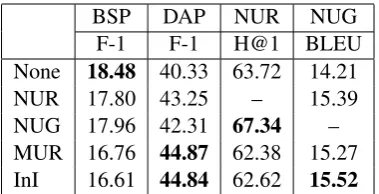
down-BSP DAP NUR NUG F-1 F-1 H@1 BLEU None 18.48 40.33 63.72 14.21 NUR 17.80 43.25 – 15.39 NUG 17.96 42.31 67.34 – MUR 16.76 44.87 62.38 15.27 InI 16.61 44.84 62.62 15.52
Table 1: Results of evaluating the chosenpretraining objectives, preceded by the baseline, on the four down-stream tasks. This evaluation used all of the training data for the downstream tasks as described in Section 5.2.
stream task, using the entire set of MultiWoz data. The first row of Table1shows the performance of randomly initialized models for each downstream task. To evaluate the full capabilities of the pre-training objectives above, the pretrained models were used to initialize the models for the down-stream tasks.
Results are shown on Table1. This experimen-tal setup speaks to the strength and the general-ity of the pretrained representations. Using un-supervised pretraining, the models produce dia-log representations that are strong enough to im-prove downstream tasks. The learned represen-tations demonstrate generality because the multi-ple downstream tasks benefit from the same pre-training. Rather than learning representations that are useful for just the pretraining objective, or for a single downstream task, the learned representa-tions are general and beneficial for multiple tasks. For the DAP and NUG downstream tasks, the pretrained models consistently outperformed the baseline. InI has the highest BLEU score for NUG. This may be a consequence of the impor-tance of both global context representations and local utterance representations in sequence gen-eration models. Both InI and MUR score much higher than the baseline and the other methods for DAP, which may be due to the fact that these two approaches are trained to learn a representation of each utterance rather than just an overall context representation. NUR has significant gains when pretraining with NUG, possibly because the infor-mation that must be captured to generate the next utterance is similar to the information needed to retrieve the next utterance. Unlike the other down-stream tasks, BSP did not benefit from pretraining. A potential justification of this result is that due to the difficulty of the task, the model needs to resort
to word-level pattern matching. The generality of the pretrained representations precludes this.
5.3 Convergence Analysis
This experimental setup measures the impact of pretraining on the convergence of the downstream training. Sufficiently general pretraining objec-tives should learn to extract useful representations of the dialog context. Thus when fine-tuning on a given downstream task, the model should be able to use the representations it has already learned rather than having to learn to extract relevant fea-tures from scratch. The performance on all down-stream tasks with the different pretraining objec-tives is evaluated at every epoch. The results are presented on Figure1.
These figures show faster convergence across all downstream tasks with significant improve-ment over a random initialization baseline. The re-sults show that performance on the initial epochs is considerably better with pretraining than with-out. In most cases, performance evens out during training, thus attaining results that are comparable to the pretraining methods on the full dataset. It is important to note that performance of the models after just a single epoch of training is significantly higher on all downstream tasks when the encoder has been pretrained. This underlines the useful-ness of the features learned in pretraining.
The convergence of BSP shown in Figure 1
is very interesting. Though the baseline ulti-mately outperforms all other methods, the pre-trained models attain their highest performance in the early epochs. This suggests that the represen-tations learned in pretraining are indeed useful for this task despite the fact that they do not show im-provement over the baseline.
5.4 Performance on Limited Data
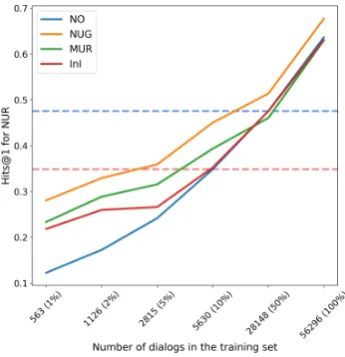
Sufficiently strong and general pretrained repre-sentations, should continue to succeed in down-stream evaluation even when fine-tuned on signifi-cantly less data. The performance on downstream tasks is evaluated with various amounts of fine-tuning data (1%, 2%, 5%, 10% and 50%).
Figure 1: The performance of (from left to right) BSP, DAP, NUR, NUG across epochs with different pretraining objectives. For the BLEU-4 score in NUG, the results are noisy due to the metric being the BLEU score, however the general trend is still apparent.
Figure 2: NUR Hits@1 at different training set sizes. The blue horizontal line is the baseline performance with 50% of the data. The red horizontal line is the baseline performance with 10% of the data.
of the fine-tuning data, this model outperforms the baseline that used 50% of the data.
Table2shows all of the results with 1% of the fine-tuning data, while Table 3 shows the results with 10% of the fine-tuning data. More results may be found in the Appendix??.
BSP DAP NUR NUG F-1 F-1 H@1 BLEU None 4.65 16.07 12.28 6.82 NUR 6.44 14.48 – 11.29
NUG 7.63 17.41 28.08 – MUR 5.89 17.19 23.37 10.47 InI 6.18 12.20 21.84 11.10
Table 2: Performance using 1% of the data; the rows correspond to the pretraining objectives and the columns correspond to the downstream tasks.
The results shown here strongly highlight the effectiveness of pretraining. With a small fraction
BSP DAP NUR NUG F-1 F-1 H@1 BLEU None 5.73 18.44 34.88 9.19 NUR 7.30 20.84 – 14.04
[image:7.595.324.507.236.336.2]NUG 9.62 22.11 45.05 – MUR 7.08 22.24 39.38 11.63 InI 7.30 20.73 35.26 13.23
Table 3: Results with 10% of the data; the rows cor-respond to the pretraining objectives and the columns correspond to the downstream tasks.
of the data, unsupervised pretraining shows com-petitive performance on downstream tasks.
When the amount of data is very limited, the best results were obtained by models pretrained with NUG. This may be indicative of the general-ity of NUG pretraining. Since the generation task is difficult, it is likely that the pretrained model learns to capture the most general context repre-sentation that it can. This makes the represen-tations especially suitable for low resource con-ditions since NUG pretrained representations are general enough to adapt to different tasks given even very small amounts of data,
5.5 Domain Generalizability
Sufficiently general pretrained representations should facilitate domain generalizability on the downstream tasks, just as pretraining should en-courage the downstream models to use domain ag-nostic representations and identify domain agnos-tic relationships in the data.
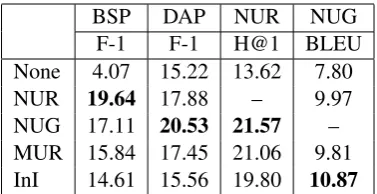
[image:7.595.93.266.239.418.2] [image:7.595.87.275.582.682.2]specif-BSP DAP NUR NUG F-1 F-1 H@1 BLEU None 4.07 15.22 13.62 7.80 NUR 19.64 17.88 – 9.97 NUG 17.11 20.53 21.57 – MUR 15.84 17.45 21.06 9.81 InI 14.61 15.56 19.80 10.87
Table 4: Results of evaluating pretrained objectives on their capacity to generalize to the restaurant do-main using only 50 in-dodo-main samples and 2000 out-of-domain samples during training. The evaluation is carried out only on the in-domain test samples.
ically, for each downstream task there are1000 la-beled out-of-domain examples (2% of the dataset) and only 50 labeled in-domain examples (0.1% of the dataset). The performance of the down-stream models is computed only on the in-domain test samples, thereby evaluating the ability of our models to learn the downstream task on the limited in-domain data. The results on Table4show that pretraining produces more general representations and facilitates domain generalizability.
6 Discussion
The results with different experimental setups demonstrate the effectiveness of the pretraining objectives. Pretraining improves performance, leads to faster convergence, works well in low-data scenarios and facilitates domain generaliz-ability. We now consider the respective strengths of the different pretraining objectives.
NUR and NUG are complementary tasks.
Over all of the results, we can see that pretrain-ing with either NUG or NUR, gives strong re-sults when fine-tuning on the other one. This pro-perty, which has also been observed byWolf et al.
(2019), is a consequence of the similarity of the two tasks. Both for retrieval and generation, con-text encoding must contain all of the information that is necessary to produce the next utterance.
NUG learns representations that are very general. We see that NUG, especially in low data experiments, effectively transfers to many down-stream tasks. This speaks to the generality of its representations. To auto-regressively generate the next utterance, the context encoder in NUG must capture a strong and expressive representation of the dialog context. This representation is all that the decoder uses to generate its response at word level so it must contain all of the relevant
infor-<3 ≥3&<7 ≥7
None 11.02 14.17 15.30 NUR 13.95 15.08 15.88 MUR 12.21 15.36 16.10 InI 11.52 15.40 16.63
Table 5: Results on the downstream task of NUG, with different dialog context lengths (< 3 utterances, 3-7 utterances, and>7utterances.
mation. Despite the similarity of NUG and NUR, generation is a more difficult task, due to the po-tential output space of the model. As such, the representations learned by NUG are more general and expressive. The representative capabilities of the encoder in a generation model are also demon-strated by the work ofAdi et al.(2016).
InI and MUR learn strong local representa-tions of each utterance. The two novel pretrain-ing objectives, InI and MUR, consistently show strong improvement for the downstream NUG task. Both of these objectives learn local repre-sentations of each utterance in the dialog context since both of their respective loss functions use the representation of each utterance instead of just the final hidden state. In an effort to better understand the properties of the different objectives, Table5
shows performance on the NUG task for different dialog context lengths.
Generating a response to a longer dialog context requires a strong local representation of each in-dividual utterance. A model that does not capture strong representations of each utterance will likely perform poorly on longer contexts. For example, for a dialog in which the user requests a restau-rant recommendation, in order to generate the sys-tem utterance that recommends a restaurant, the model must consider all of the past utterances in order to effectively generate the recommendation. If the local representations of each utterance are not strong, it would be difficult to generate the sys-tem output.
The results in Table 5 demonstrate that both InI and MUR strongly outperform other methods on long contexts, suggesting that these methods are effective for capturing strong representations of each utterance. Both MUR and InI perform poorly on shorter contexts. This further demon-strates that fine-tuned NUG models learn to rely on strong utterance representations, and therefore struggle when there are few utterances.
[image:8.595.330.505.61.132.2]finetuning. The pretraining objectives demon-strate large improvements over directly training for the downstream task. No additional data is used for pretraining, which suggests that the pro-posed objective allow the model to extract stronger and more general context representations from the same data. The reduced data experiments show that pretraining on a larger corpora (i.e., the full data), results in strong performance on smaller task-specific datasets (i.e., the reduced data). As such, it is likely that pretraining on larger exter-nal data will result in further performance gains, however, it is challenging to identify a sufficient corpus.
7 Conclusion and Future Work
This paper proposes several methods of unsuper-vised pretraining for learning strong andgeneral
dialog context representations, and demonstrates their effectiveness in improving performance on downstream tasks with limited fine-tuning data as well as out-of-domain data. It proposes two novel pretraining objectives: masked-utterance retrieval
andinconsistency identificationwhich better cap-ture both the utterance-level and context-level in-formation. Evaluation of the learned represen-tations on four downstream dialog tasks shows strong performance improvement over randomly initialized baselines.
In this paper, unsupervised pretraining has been shown to learn effective representations of dialog context, making this an important research direc-tion for future dialog systems. These results open three future research directions. First, the models proposed here should be pretrained on larger exter-nal dialog datasets. Second, it would be interesting to test the representations learned using unsuper-vised pretraining on less-related downstream tasks such as sentiment analysis. Finally, the addition of word-level pretraining methods to improve the di-alog context representations should be explored.
References
Yossi Adi, Einat Kermany, Yonatan Belinkov, Ofer Lavi, and Yoav Goldberg. 2016. Fine-grained anal-ysis of sentence embeddings using auxiliary predic-tion tasks.arXiv preprint arXiv:1608.04207.
Dzmitry Bahdanau, Kyunghyun Cho, and Yoshua Bengio. 2015. Neural machine translation by jointly learning to align and translate. CoRR, abs/1409.0473.
Yonatan Belinkov, Nadir Durrani, Fahim Dalvi, Hassan Sajjad, and James Glass. 2017. What do neural ma-chine translation models learn about morphology? In Proceedings of the 55th Annual Meeting of the Association for Computational Linguistics (Volume 1: Long Papers), volume 1, pages 861–872.
Paweł Budzianowski, Tsung-Hsien Wen, Bo-Hsiang Tseng, I˜nigo Casanueva, Stefan Ultes, Osman Ra-madan, and Milica Gasic. 2018. Multiwoz-a large-scale multi-domain wizard-of-oz dataset for task-oriented dialogue modelling. InProceedings of the 2018 Conference on Empirical Methods in Natural Language Processing, pages 5016–5026.
Andrew M Dai and Quoc V Le. 2015. Semi-supervised sequence learning. InAdvances in neural informa-tion processing systems, pages 3079–3087.
Jacob Devlin, Ming-Wei Chang, Kenton Lee, and Kristina Toutanova. 2018. Bert: Pre-training of deep bidirectional transformers for language understand-ing.arXiv preprint arXiv:1810.04805.
Bhuwan Dhingra, Hanxiao Liu, Zhilin Yang, William Cohen, and Ruslan Salakhutdinov. 2017. Gated-attention readers for text comprehension. In Pro-ceedings of the 55th Annual Meeting of the Associa-tion for ComputaAssocia-tional Linguistics (Volume 1: Long Papers), volume 1, pages 1832–1846.
Emily Dinan, Varvara Logacheva, Valentin Malykh, Alexander Miller, Kurt Shuster, Jack Urbanek, Douwe Kiela, Arthur Szlam, Iulian Serban, Ryan Lowe, et al. 2019. The second conversational intelligence challenge (convai2). arXiv preprint arXiv:1902.00098.
Ying Ding, Jianfei Yu, and Jing Jiang. 2017. Recur-rent neural networks with auxiliary labels for cross-domain opinion target extraction. In Thirty-First AAAI Conference on Artificial Intelligence.
Matthew Henderson, Blaise Thomson, and Jason D Williams. 2014. The second dialog state tracking challenge. InProceedings of the 15th Annual Meet-ing of the Special Interest Group on Discourse and Dialogue (SIGDIAL), pages 263–272.
Jeremy Howard and Sebastian Ruder. 2018. Universal language model fine-tuning for text classification. In
Proceedings of the 56th Annual Meeting of the As-sociation for Computational Linguistics (Volume 1: Long Papers), volume 1, pages 328–339.
Zhiheng Huang, Wei Xu, and Kai Yu. 2015. Bidirec-tional lstm-crf models for sequence tagging. arXiv preprint arXiv:1508.01991.
Ryan Lowe, Iulian V Serban, Mike Noseworthy, Lau-rent Charlin, and Joelle Pineau. 2016. On the evalu-ation of dialogue systems with next utterance classi-fication.
Bryan McCann, James Bradbury, Caiming Xiong, and Richard Socher. 2017. Learned in translation: Con-textualized word vectors. InAdvances in Neural In-formation Processing Systems, pages 6294–6305.
Tomas Mikolov, Ilya Sutskever, Kai Chen, Greg S Cor-rado, and Jeff Dean. 2013. Distributed representa-tions of words and phrases and their compositional-ity. InAdvances in neural information processing systems, pages 3111–3119.
Ruslan Mitkov. 2014. Anaphora resolution. Rout-ledge.
Kishore Papineni, Salim Roukos, Todd Ward, and Wei-Jing Zhu. 2002. Bleu: a method for automatic eval-uation of machine translation. In Proceedings of the 40th annual meeting on association for compu-tational linguistics, pages 311–318. Association for Computational Linguistics.
Matthew Peters, Mark Neumann, Mohit Iyyer, Matt Gardner, Christopher Clark, Kenton Lee, and Luke Zettlemoyer. 2018. Deep contextualized word repre-sentations. InProceedings of the 2018 Conference of the North American Chapter of the Association for Computational Linguistics: Human Language Technologies, Volume 1 (Long Papers), volume 1, pages 2227–2237.
Barbara Plank, Anders Søgaard, and Yoav Goldberg. 2016. Multilingual part-of-speech tagging with bidirectional long short-term memory models and auxiliary loss. In Proceedings of the 54th Annual Meeting of the Association for Computational Lin-guistics (Volume 2: Short Papers), volume 2, pages 412–418.
Alec Radford, Karthik Narasimhan, Tim Salimans, and Ilya Sutskever. 2018. Improving language under-standing by generative pre-training. URL https://s3-us-west-2. amazonaws. com/openai-assets/research-covers/languageunsupervised/language under-standing paper. pdf.
Marek Rei and Helen Yannakoudakis. 2017. Auxiliary objectives for neural error detection models. In Pro-ceedings of the 12th Workshop on Innovative Use of NLP for Building Educational Applications, pages 33–43.
Iulian Vlad Serban, Alessandro Sordoni, Yoshua Ben-gio, Aaron C Courville, and Joelle Pineau. 2016. Building end-to-end dialogue systems using gener-ative hierarchical neural network models. InAAAI, volume 16, pages 3776–3784.
Ilya Sutskever, Oriol Vinyals, and Quoc V Le. 2014. Sequence to sequence learning with neural net-works. InAdvances in neural information process-ing systems, pages 3104–3112.
Scott Thornbury and Diana Slade. 2006. Conversation: From description to pedagogy. Cambridge Univer-sity Press.
Trieu Trinh, Andrew Dai, Thang Luong, and Quoc Le. 2018. Learning longer-term dependencies in rnns with auxiliary losses. In International Conference on Machine Learning, pages 4972–4981.
Oriol Vinyals and Quoc Le. 2015. A neural conversa-tional model. arXiv preprint arXiv:1506.05869.
Alex Wang, Amapreet Singh, Julian Michael, Felix Hill, Omer Levy, and Samuel R Bowman. 2018. Glue: A multi-task benchmark and analysis platform for natural language understanding. arXiv preprint arXiv:1804.07461.
Jason Williams, Antoine Raux, Deepak Ramachan-dran, and Alan Black. 2013. The dialog state track-ing challenge. InProceedings of the SIGDIAL 2013 Conference, pages 404–413.
Thomas Wolf, Victor Sanh, Julien Chaumond, and Clement Delangue. 2019. Transfertransfo: A transfer learning approach for neural network based conversational agents. arXiv preprint arXiv:1901.08149.
Jianfei Yu and Jing Jiang. 2016. Learning sentence em-beddings with auxiliary tasks for cross-domain sen-timent classification. In Proceedings of the 2016 Conference on Empirical Methods in Natural Lan-guage Processing, pages 236–246.
Tiancheng Zhao, Ran Zhao, and Maxine Eskenazi. 2017. Learning discourse-level diversity for neural dialog models using conditional variational autoen-coders. In Proceedings of the 55th Annual Meet-ing of the Association for Computational LMeet-inguistics (Volume 1: Long Papers), volume 1, pages 654–664.