Proceedings of the 55th Annual Meeting of the Association for Computational Linguistics (Short Papers), pages 491–497 Vancouver, Canada, July 30 - August 4, 2017. c2017 Association for Computational Linguistics
Proceedings of the 55th Annual Meeting of the Association for Computational Linguistics (Short Papers), pages 491–497 Vancouver, Canada, July 30 - August 4, 2017. c2017 Association for Computational Linguistics
Parser Adaptation for Social Media by Integrating Normalization
Rob van der Goot University of Groningen
Gertjan van Noord University of Groningen
Abstract
This work explores normalization for parser adaptation. Traditionally, normal-ization is used as separate pre-processing step. We show that integrating the nor-malization model into the parsing algo-rithm is beneficial. This way, multiple nor-malization candidates can be leveraged, which improves parsing performance on social media. We test this hypothesis by modifying the Berkeley parser; out-of-the-box it achieves an F1 score of 66.52. Our integrated approach reaches a signif-icant improvement with an F1 score of 67.36, while using the best normalization sequence results in an F1 score of only 66.94.
1 Introduction
The non-canonical language use on social media introduces many difficulties for existing NLP models. For some NLP tasks, there has already been an effort to annotate enough data to train models, e.g. named entity recognition (Baldwin et al., 2015), sentiment analysis (Nakov et al.,
2016) and paraphrase detection (Xu et al.,2015). For parsing social media texts, such a resource is not available yet, although there are some small treebanks that can be used for development/testing purposes (Foster et al., 2011; Kong et al., 2014;
Kaljahi et al., 2015; Daiber and van der Goot,
2016). To the best of our knowledge, the only treebank big enough to train a supervised parser for user generated content is the English Web Treebank (Petrov and McDonald, 2012). This treebank consists of constituency trees from five different web domains, not including the domain of social media.
0 1 2 3
this (0.5) ths (0.3) thus (0.2)
as (0.5) is (0.4) s (0.1)
nice (0.7) nive (0.2) rice (0.1)
Figure 1: A possible output of the normalization model for the sentence ‘ths s nice’.
The magnitude of domain adaptation prob-lems for the social media domain becomes clear when training the Berkeley parser on newswire text, and comparing its in-domain performance with performance on the Twitter domain. The Berkeley parser achieves an F1 score above 90 on newswire text (Petrov and Klein, 2007). An empirical experiment that we carried out on a Twitter treebank shows that the F1 score drops below 70 for this domain.
Annotating a new training treebank for this do-main would not only be an expensive solution, the ever-changing nature of social media makes this approach less effective over time. We propose an approach in which we integrate normalization into the parsing model. The normalization model pro-vides the parser with different normalization can-didates for each word in the input sentence. Exist-ing algorithms can then be used to find the optimal parse tree over this lattice (Bar-Hillel et al.,1961). A possible normalization lattice for the sentence ‘this is nice’ is shown in Figure1. In this example output, the probability of ‘as’ is higher than the probability of ‘is’, whereas the most fluent word sequence would be ‘this is nice’. The parser can disambiguate this word graph because it has ac-cess to the syntactic context: ‘is’ is usually tagged as VBZ, while ‘as’ is mostly tagged as IN. This ex-ample shows the main motivation for using an in-tegrated approach; the extra information from the normalization can be useful for parsing.
2 Related Work
SANCL 2012 hosted a shared task on parsing the English Web Treebank (EWT) (Petrov and Mc-Donald, 2012). A wide variety of different ap-proaches were used: ensemble parsers, product grammars, self/up-training, word clustering, genre classification and normalization. The teams that used normalization often used simple rule-based systems, and the actual effect of normalization on the final parser performance was not tested. Fos-ter(2010) experiment with rule-based normaliza-tion on forum data in isolanormaliza-tion and report a perfor-mance gain of 2% in F1 score.
A theoretical exploration of the effect of nor-malization on forum data is done byKaljahi et al.
(2015). They released the Foreebank, a treebank consisting of forum texts, annotated with normal-ization and constituency trees. They show that parsing manually normalized sentences results in a 2% increase of F1 score.Baldwin and Li(2015) evaluate the effect of different normalization ac-tions on dependency parsing performance for the social media domain. They conclude that a vari-ety of different normalization actions is useful for parsing.
A more practical exploration of the effect of normalization for the social media domain is done by Zhang et al. (2013). They test the effect of automatic normalization on dependency parsing by using automatically derived parse trees of the normalized sentences as reference. Other work that uses automatic normalization is Daiber and van der Goot(2016), which compare the effect of lexical normalization with machine translation on a manually annotated dependency treebank. All previous work uses only the best normalization se-quence; errors in this pre-processing step are di-rectly propagated to the parser.
For POS tagging, however, a joint approach is proposed byLi and Liu (2015). They use the n-best output of different normalization systems to generate a Viterbi encoding, based on all possible pairs of normalization candidates and their possi-ble POS tags. Using this joint approach, they im-prove on both POS tagging and normalization.
3 Method
We first describe how an existing normalization model is modified for this specific use. Then we discuss how we integrate this normalization into the parsing model.
3.1 Normalization
We use an existing normalization model (van der Goot,2016). This model generates candidates us-ing the Aspell spell checker1 and a word embed-dings model trained on Twitter data (Godin et al.,
2015). Features from this generation are comple-mented with n-gram probability features of canon-ical text (Brants and Franz, 2006) and the Twit-ter domain. A random forest classifier (Breiman,
2001) is exploited for the ranking of the generated candidates.
Van der Goot(2016) focused on finding the cor-rect normalization candidate for erroneous tokens, gold error detection was assumed. Therefore, the model was trained only on the words that were normalized in the training data. Since we do not know in advance which words should be normal-ized, we can not use this model. Instead, we train the model on all words in the training data, includ-ing words that do not need normalization. Accord-ingly, we add the original token as a normalization candidate and add a binary feature to indicate this. These adaptations enable the model to learn which words should be normalized.
We compare the traditional approach of only us-ing the best normalization sequence with an inte-grated approach, in which the parsing model has access to multiple normalization candidates for each word. Within the integrated approach, we compare normalizing only the words unknown to the parser against normalizing all words. We fer to these approaches as ‘UNK’ and ‘ALL’, re-spectively. Figure1shows a possible output when using ALL. When using UNK, the word ‘nice’ would not have any normalization candidates.
3.2 Parsing
We adapt the state-of-the-art PCFG Berkeley Parser (Petrov and Klein, 2007) to fit our needs. The main strength of this PCFG-LA parser is that it automatically learns to split constituents into finer categories during training, and thus learns a more refined grammar than a raw treebank gram-mar. It maintains efficiency by using a coarse-to-fine parsing setup. Unknown words are clustered by prefixes, suffixes, the presence of special char-acters or capitals and their position in the sentence. Parsing word lattices is not a new problem. The parsing as intersection algorithm (Bar-Hillel et al.,1961) laid the theoretical background for
ficiently deriving the best parse tree of a word lat-tice given a context-free grammar. Previous work on parsing a word lattice in a PCFG-LA setup in-cludes Constant et al. (2013), and Goldberg and Elhadad(2011) for the Berkeley Parser. However, these models do not support probabilities, which are naturally provided by the normalization in our setup. Another problem is the handling of word ambiguities, which is crucial in our model.
Our adaptations to the Berkeley Parser resem-ble the adaptations done byGoldberg and Elhadad
(2011). In addition, we allow multiple words on the same position. For every POS tag in every position we only keep the highest scoring word. This suffices, since there is no syntactic ambiguity possible with only unary rules from POS tags to words, and therefore it is impossible for the lower scoring words to end up in the final parse tree.
To incorporate the probability from the normal-ization model (Pnorm) into the chart, we combine
it with the probability from the POS tag assigned by the built-in tagger of the Berkeley parser (Ppos)
using the weighted harmonic mean (Rijsbergen,
1979):
Pchart= (1 +β2)∗
Pnorm∗Ppos (β2∗P
norm) +Ppos (1)
Here,β is the relative weight we give to the nor-malization andPchartis the probability used in the
parsing chart. We use this formula because it al-lows us to have a weighted average, in which we reward the model if both probabilities are more balanced.
4 Data
The normalization model we use is supervised, i.e. it needs annotated training data from the target do-main. This is readily available for Twitter; we use 2,000 manually normalized Tweets from Li and Liu(2014) as training data.
We use the treebank from Foster et al. (2011) as develop and test data for our parser. It com-prises 269 trees for developing and 250 trees for testing, all annotated using the annotation guide-lines for the Penn Treebank (Bies et al., 1995) with some small adaptations for the Twitter do-main (usernames, hashtags and urls are annotated as an NNP under an NP). For training, we use the English Web Treebank (EWT) concatenated with the standard training sections (2-21) of the Wall Street Journal (WSJ) part of the Penn tree-bank (Marcus et al.,1993).
Corpus Sents Words/ Unk% sent
WSJ (2-21) 39,832 23.9 4.4
EWT 16,520 15.3 3.7
[image:3.595.305.525.62.146.2]Foster et al.(2011)* 269 11.1 9.3 Li and Liu(2014) 2,577 15.7 14.1
Table 1: Some basic statistics for our training and development corpora. % of unknown words (Unk) calculated against the Aspell dictionary ignoring capitalization.*Only the development part.
Some basic statistics of our training and devel-opment data can be found in Table1. Perhaps sur-prisingly, the percentage of unknown words in the EWT is lower than in the WSJ. This can be ex-plained by the fact that the WSJ texts contains lots of jargon and named entities which are not present in the Aspell dictionary. The difference in per-centage of unknown words between the normal-ization training data and the development treebank data might be an obstacle at first sight, but this can be overcome by tuning the weight (β) when combining the normalization and parse probabili-ties (Equation1). Nevertheless, the effect of nor-malization will be smaller when there is less noise in the data.
5 Results
The parser is evaluated using the F1 score as im-plemented by EVALB2. All results in this section are averaged over 10 runs, using different seeds for the normalization model, unless mentioned other-wise.
The performance of our model depends on two parameters: the number of normalization candi-dates per word α and the weight given to the normalization β. We tuned these parameters on the development data using α ∈ [1-10] andβ ∈ [0.125,0.25,0.5,1,2,4,8,16] to find the optimal
values. The best performance is achieved using α = 6andβ = 2. From this optimal setting, we
will compare the effects of these variables for both the UNK and the ALL normalization strategies.
Figure 2 shows the effect of using different numbers of candidates and our baseline: the vanilla Berkeley parser. Using only the single best normalization sequence (α = 1) we can obtain
an improvement of1.7%when normalizing all
to-kens. If we only normalize the unknown tokens
Figure 2: F1 scores on the development data when using multiple candidates while normalizing ALL words or only the UNKnown words (beta = 2),
compared to a VANilla Berkeley parser.
the performance is slightly worse, but it still out-performs the baseline.
If we use more normalization candidates, per-formance increases; it converges around α = 6.
At this optimal setting, the baseline is outper-formed by2.2%. However, if more than only the
first candidate is used, it is not beneficial to nor-malize all words anymore. This is probably an effect of creating too much distance between the original sentence and the normalization. The F1 score converges for higher number of candidates, because lower ranked candidates have very low normalization probabilities and are thus unlikely to affect the final parse.
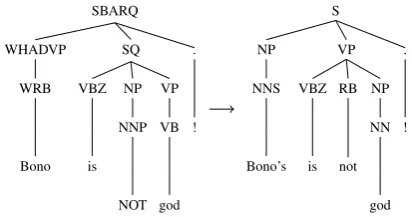
The normalization model seldomly finds a cor-rect candidate beyondα >2, atα = 2the recall for unknown words is 89.4% on the LexNorm cor-pus (Han and Baldwin, 2011), whereas the accu-racy atα = 6is 91.7%. Perhaps surprisingly, the parser performance still improves when increasing α. Manual evaluation reveals that these improve-ments are obtained by using incorrect normaliza-tion candidates. Because these normalizanormaliza-tion can-didates share some syntactic properties with the original word, they can still help in deriving a better syntactic parse. Figure 3 shows an exam-ple of this phenomenon; “Bono” is normalized to Bono’s, and is therefore tagged as an NNS, even though this tag is still not correct, the head gets tagged correctly as NP. Combined with the nor-malization of “NOT”, this results in a much better parse tree.
Table 2 shows the results using different
SBARQ
.
! SQ
VP
VB
god NP
NNP
NOT VBZ
is WHADVP
WRB
Bono
S
.
! VP
NP
NN
god RB
not VBZ
is NP
NNS
[image:4.595.311.517.66.175.2]Bono’s
Figure 3: An example parse from the development corpus; left is the output of the vanilla Berkeley parser, right is the output with the integrated nor-malization.
weights. We compare the non-integrated approach (α = 1) with the optimal number of candidates
(α = 6). The best results are achieved when β is 2, meaning that the normalization should get a higher weight than the POS tagger. The integrated model scores higher with almost all weights, the difference between ALL and UNK is similar as in Figure2.
For the test data, we use the parameter settings that performed best on the development treebank (UNK,α = 6, β = 2), and the best performing seed for the normalization model. The results on the test data are compared to the traditional ap-proach of only using the best normalization se-quence, the vanilla Berkeley parser, and the Stan-ford PCFG parser (Petrov and Klein,2007) in Ta-ble3. The integrated approach significantly out-performs the Berkeley parser as well as the tradi-tional approach. It becomes apparent that the test part of the treebank is more difficult than the de-velopment part. Although the increase is smaller,
Cands(α) 1 6
Weight(β) UNK ALL UNK ALL 0.125 70.79 71.12 70.88 69.45 0.25 70.79 71.12 70.99 62.97 0.5 70.86 71.18 71.21 70.51 1.0 71.19 71.52 71.78 71.08
2.0 71.77 72.10 72.21 71.46
[image:4.595.313.520.578.712.2]4.0 71.73 72.01 72.02 71.43 8.0 71.12 71.33 71.69 71.26 16.0 70.29 70.32 70.50 70.09
Parser dev test Stanford parser 66.05 61.95 Berkeley parser 70.85 66.52 Best norm. seq. 72.04 66.94 Integrated norm. 72.77 67.36*
[image:5.595.100.263.62.158.2]Gold POS tags 74.98 71.80
Table 3: F1 scores of our proposed models and previous work on the test set, trained on the EWT and WSJ.*Statistical significant against
Berkeley-parser atP < 0.01 and atP < 0.05 against the
best normalization sequence using a paired t-test.
normalization still improves parser performance. On the development set, 46% of the errors which can be accounted to mistakes made by the POS tagger are solved, whereas on the test set, we only solve 16% of this theoretical upper bound.
6 Discussion
The addition of multiple words on one position in the chart will probably lead to less pruning in the Berkeley parser, because more constituents in the tree will have a relatively high probability. To test if performance improvements are simply an effect of less pruning, we perform two additional experiments. Firstly, we use the vanilla Berke-ley parser with lower pruning thresholds3 on the Twitter development treebank. This results in a decrease in F1 score from 70.85 to 70.64, showing that our normalization model has a different effect. Secondly, we run our proposed parsing model on the standard development part of the more canon-ical WSJ data (section 24). The vanilla Berkeley parser achieves an F1 score of 89.15, whereas our best performing model scores 89.12 due to over-normalization. This shows that our model does not improve performance across all domains.
To test the effect of the normalization on the search space, we simply count the number of sur-viving constituents in the chart in the middle and final parse level. Results can be found in Ta-ble4. There is a slight increase in the number of constituents when using normalization. A simi-lar effect can be found for the parsing time; aver-aged over 10 runs, the vanilla Berkeley parser took 24.3 seconds on the development set, whereas our
3Tested by running the parser with--accurate. We
also tried to tune the thresholds even further manually, but this had similar effects.
Parse level Berkeley Integrated Norm.
3 756 765
6 3,086 3,115
Table 4: The average number of constituents in the chart per sentence for the middle parsing level (3) and the final level (6) on our development set.
model took 24.5 seconds on the same machine.
7 Conclusion
We have shown that we can significantly improve the parsing of out-of domain data by using nor-malization. If we use normalization as a sple pre-processing step, we observe a small im-provement in performance, while higher improve-ments can be achieved by using an integrated ap-proach. Improvements in parsing performance are not only an effect of using correct normalization candidates, but are also due to wrong normaliza-tion candidates which share syntactic properties with the original word. Additionally, we show that when using only the best normalization sequence, it is better to normalize all words instead of only the unknown words. However, when using an in-tegrated approach it is better to only consider un-known words for normalization.
Potential directions for future work include: allowing multiword replacements, normalization driven by the parsing model, and using lexical-ized parsing so that the normalization candidates are used for more decisions in the parsing process than just assigning POS tags. To further improve the F1-score for the parsing of Tweets, comple-mentary methods can be used: reranking, uptrain-ing or ensembluptrain-ing parsers and grammars are some obvious next steps.
The source code of our experiments has been made publicly available4.
Acknowledgements
We would like to thank our colleagues, especially Barbara Plank and Antonio Toral , and the anony-mous reviewers for their valuable feedback. Fur-thermore we would like to thank Jennifer Foster for sharing the Twitter treebank. This work is part of the Parsing Algorithms for Uncertain Input project, funded by the Nuance Foundation.
4https://bitbucket.org/robvanderg/
[image:5.595.309.505.63.105.2]References
Timothy Baldwin, Marie-Catherine de Marneffe, Bo Han, Young-Bum Kim, Alan Ritter, and
Wei Xu. 2015. Shared tasks of the 2015
workshop on noisy user-generated text: Twitter lexical normalization and named entity recogni-tion. In Proceedings of the Workshop on Noisy User-generated Text. Association for Computa-tional Linguistics, Beijing, China, pages 126–135. http://www.aclweb.org/anthology/W15-4319.
Tyler Baldwin and Yunyao Li. 2015. An in-depth analysis of the effect of text normalization in so-cial media. In Proceedings of the 2015 Confer-ence of the North American Chapter of the As-sociation for Computational Linguistics: Human Language Technologies. Association for Computa-tional Linguistics, Denver, Colorado, pages 420– 429. http://www.aclweb.org/anthology/N15-1045. Yehoshua Bar-Hillel, Micha Perles, and Eliahu Shamir.
1961. On formal properties of simple phrase struc-ture grammars. Sprachtypologie und Universalien-forschung14:143–172.
Ann Bies, Mark Ferguson, Karen Katz, Robert Mac-Intyre, Victoria Tredinnick, Grace Kim, Mary Ann Marcinkiewicz, and Britta Schasberger. 1995. Bracketing guidelines for Treebank II style Penn Treebank project. Technical report, University of Pennsylvania.
Thorsten Brants and Alex Franz. 2006. Web 1T 5-gram version 1. Technical report, Google.
Leo Breiman. 2001. Random forests. Machine learn-ing45(1):5–32.
Matthieu Constant, Joseph Le Roux, and Anthony Si-gogne. 2013. Combining compound recognition and pcfg-la parsing with word lattices and conditional random fields. ACM Transactions on Speech and Language Processing (TSLP)10(3):8.
Joachim Daiber and Rob van der Goot. 2016. The denoised web treebank: Evaluating dependency parsing under noisy input conditions. In Pro-ceedings of the Tenth International Conference on Language Resources and Evaluation (LREC 2016). European Language Resources Associa-tion (ELRA), Paris, France. http://www.lrec-conf.org/proceedings/lrec2016/pdf/86 Paper.pdf.
Jennifer Foster. 2010. “cba to check the spelling”: Investigating parser performance on discussion fo-rum posts. In Human Language Technologies: The 2010 Annual Conference of the North Ameri-can Chapter of the Association for Computational Linguistics. Association for Computational Lin-guistics, Los Angeles, California, pages 381–384. http://www.aclweb.org/anthology/N10-1060.
Jennifer Foster, ¨Ozlem C¸etinoglu, Joachim Wagner, Joseph Le Roux, Stephen Hogan, Joakim Nivre, Deirdre Hogan, and Josef Van Genabith. 2011.
#hardtoparse: POS Tagging and parsing the Twit-terverse. InAAAI 2011 Workshop On Analyzing Mi-crotext. United States, pages 20–25.
Fr´ederic Godin, Baptist Vandersmissen, Wesley De Neve, and Rik Van de Walle. 2015. Multimedia Lab@ACL WNUT NER shared task: Named entity recognition for Twitter microposts using distributed word representations. In Proceedings of the Work-shop on Noisy User-generated Text. Association for Computational Linguistics, Beijing, China, pages 146–153. http://www.aclweb.org/anthology/W15-4322.
Yoav Goldberg and Michael Elhadad. 2011. Joint hebrew segmentation and parsing using a pcfgla lattice parser. In Proceedings of the 49th Annual Meeting of the Association for Com-putational Linguistics: Human Language Tech-nologies. Association for Computational Linguis-tics, Portland, Oregon, USA, pages 704–709. http://www.aclweb.org/anthology/P11-2124. Bo Han and Timothy Baldwin. 2011.Lexical
normali-sation of short text messages: Makn sens a #twitter. In Proceedings of the 49th Annual Meeting of the Association for Computational Linguistics: Human Language Technologies. Association for Computa-tional Linguistics, Portland, Oregon, USA, pages 368–378. http://www.aclweb.org/anthology/P11-1038.
Rasoul Kaljahi, Jennifer Foster, Johann Roturier, Corentin Ribeyre, Teresa Lynn, and Joseph Le Roux. 2015. Foreebank: Syntactic analysis of customer support forums. In Proceedings of the 2015 Con-ference on Empirical Methods in Natural Lan-guage Processing. Association for Computational Linguistics, Lisbon, Portugal, pages 1341–1347. http://aclweb.org/anthology/D15-1157.
Lingpeng Kong, Nathan Schneider, Swabha
Swayamdipta, Archna Bhatia, Chris Dyer, and Noah A. Smith. 2014. A dependency parser for Tweets. In Proceedings of the 2014 Confer-ence on Empirical Methods in Natural Language Processing (EMNLP). Association for Computa-tional Linguistics, Doha, Qatar, pages 1001–1012. http://www.aclweb.org/anthology/D14-1108. Chen Li and Yang Liu. 2014. Improving text
normal-ization via unsupervised model and discriminative reranking. InProceedings of the ACL 2014 Student Research Workshop. Association for Computational Linguistics, Baltimore, Maryland, USA, pages 86– 93.http://www.aclweb.org/anthology/P14-3012. Chen Li and Yang Liu. 2015. Joint POS tagging and
text normalization for informal text. InProceedings of the Twenty-Fourth International Joint Conference on Artificial Intelligence, IJCAI 2015, Buenos Aires, Argentina, July 25-31, 2015. pages 1263–1269. http://ijcai.org/Proceedings/15/Papers/182.pdf. Mitchell P Marcus, Mary Ann Marcinkiewicz, and
corpus of English: The Penn Treebank. Computa-tional linguistics19(2):313–330.
Preslav Nakov, Alan Ritter, Sara Rosenthal, Fabrizio Sebastiani, and Veselin Stoyanov. 2016. Semeval-2016 task 4: Sentiment analysis in Twitter. In Pro-ceedings of the 10th International Workshop on Se-mantic Evaluation (SemEval-2016). Association for Computational Linguistics, San Diego, California, pages 1–18. http://www.aclweb.org/anthology/S16-1001.
Slav Petrov and Dan Klein. 2007. Improved infer-ence for unlexicalized parsing. In Human Lan-guage Technologies 2007: The Conference of the North American Chapter of the Association for Computational Linguistics; Proceedings of the Main Conference. Association for Computational Lin-guistics, Rochester, New York, pages 404–411. http://aclweb.org/anthology/N07-1051.
Slav Petrov and Ryan McDonald. 2012. Overview of the 2012 shared task on parsing the web. InNotes of the First Workshop on Syntactic Analysis of Non-Canonical Language (SANCL). volume 59.
CJ Rijsbergen. 1979. Information Retrieval, volume 2. University of Glasgow.
Rob van der Goot. 2016. Normalizing
so-cial media texts by combining word embed-dings and edit distances in a random for-est regressor. In Normalisation and Anal-ysis of Social Media Texts (NormSoMe). http://www.let.rug.nl/rob/doc/normsome2016.pdf.
Wei Xu, Chris Callison-Burch, and Bill Dolan. 2015. Semeval-2015 task 1: Paraphrase and semantic similarity in twitter (pit). In Proceedings of the 9th International Workshop on Semantic Evalua-tion (SemEval 2015). Association for Computa-tional Linguistics, Denver, Colorado, pages 1–11. http://www.aclweb.org/anthology/S15-2001.
Congle Zhang, Tyler Baldwin, Howard Ho, Benny
Kimelfeld, and Yunyao Li. 2013. Adaptive